Introduction
Childhood-onset schizophrenia (COS), defined by an onset of psychosis before the age of 13 years, is a rare and devastating form of the disorder clinically and neurobiologically resembling adult schizophrenia – but with a chronic, non-episodic course and poorer outcome (Nicolson & Rapoport, Reference Nicolson and Rapoport1999). Our prospective study on COS has been in progress at the National Institutes of Health since 1990.
There are many known structural brain abnormalities in schizophrenia, including increased ventricular size, reduced gray matter (GM) volume in frontal and temporal regions, reduced brain size (Wright et al. Reference Wright, Rabe-Hesketh, Woodruff, David, Murray and Bullmore2000; Honea et al. Reference Honea, Crow, Passingham and Mackay2005), abnormal hippocampal shape (Csernansky et al. Reference Csernansky, Joshi, Wang, Haller, Gado, Miller, Grenander and Miller1998; McClure et al. Reference McClure, Styner, Maltbie, Lieberman, Gouttard, Gerig, Shi and Zhu2013; Zierhut et al. Reference Zierhut, Grassmann, Kaufmann, Steiner, Bogerts and Schiltz2013) and decreased bilateral hippocampal volumes (Nelson et al. Reference Nelson, Saykin, Flashman and Riordan1998; Velakoulis et al. Reference Velakoulis, Pantelis, McGorry, Dudgeon, Brewer, Cook, Desmond, Bridle, Tierney, Murrie, Singh and Copolov1999, Reference Velakoulis, Wood, Wong, McGorry, Yung, Phillips, Smith, Brewer, Proffitt, Desmond and Pantelis2006; Wright et al. Reference Wright, Rabe-Hesketh, Woodruff, David, Murray and Bullmore2000; Honea et al. Reference Honea, Crow, Passingham and Mackay2005; Goldman et al. Reference Goldman, Pezawas, Mattay, Fischl, Verchinski, Zoltick, Weinberger and Meyer-Lindenberg2008; Walter et al. Reference Walter, Studerus, Smieskova, Kuster, Aston, Lang, Radue, Riecher-Rossler and Borgwardt2012). In our unique population of severely and chronically ill COS patients, we have reported increased ventricular volume and decreased GM volume (Sporn et al. Reference Sporn, Greenstein, Gogtay, Jeffries, Lenane, Gochman, Clasen, Blumenthal, Giedd and Rapoport2003; Gogtay et al. Reference Gogtay, Sporn, Clasen, Nugent, Greenstein, Nicolson, Giedd, Lenane, Gochman, Evans and Rapoport2004), as well as decreased hippocampal volume and shape abnormalities (Giedd et al. Reference Giedd, Jeffries, Blumenthal, Castellanos, Vaituzis, Fernandez, Hamburger, Liu, Nelson, Bedwell, Tran, Lenane, Nicolson and Rapoport1999; Gogtay et al. Reference Gogtay, Nugent, Herman, Ordonez, Greenstein, Hayashi, Clasen, Toga, Giedd, Rapoport and Thompson2006; Nugent et al. Reference Nugent, Herman, Ordonez, Greenstein, Hayashi, Lenane, Clasen, Jung, Toga, Giedd, Rapoport, Thompson and Gogtay2007; Mattai et al. Reference Mattai, Hosanagar, Weisinger, Greenstein, Stidd, Clasen, Lalonde, Rapoport and Gogtay2011; Johnson et al. Reference Johnson, Wang, Alpert, Greenstein, Clasen, Lalonde, Miller, Rapoport and Gogtay2013). However, the relationship between brain development and clinical outcome has been relatively unexplored.
Lappin et al. (Reference Lappin, Morgan, Chalavi, Morgan, Reinders, Fearon, Heslin, Zanelli, Jones, Murray and Dazzan2014) examined the relationship between brain volume changes and psychosis in adult first-episode psychosis (FEP) participants (n = 42; n = 20 with schizophrenia and n = 22 with other psychosis) compared with healthy controls (n = 32) at baseline and 6-year follow-up. Used as a marker of plasticity and present in 29% of the Lappin study psychosis participants, bilateral hippocampal increase (BHI) was associated with reduced clinical severity and superior clinical, functional and cognitive outcome. No schizophrenia patients showed BHI, but diagnosis did not explain the association between BHI and clinical outcome. While less GM volume loss was associated with better employment and global function, GM change was not related to illness course or symptom severity at follow-up (Lappin et al. Reference Lappin, Morgan, Chalavi, Morgan, Reinders, Fearon, Heslin, Zanelli, Jones, Murray and Dazzan2014).
In our COS population, we found that rate of GM reduction was related to baseline severity of clinical symptoms [measured by the Scale for the Assessment of Positive Symptoms (SAPS), Scale for the Assessment of Negative Symptoms (SANS) and the Brief Psychiatric Rating Scale for Children], and similar to Lappin et al. our group found that GM change was not related to clinical symptoms at follow-up (Sporn et al. Reference Sporn, Greenstein, Gogtay, Jeffries, Lenane, Gochman, Clasen, Blumenthal, Giedd and Rapoport2003). During a period of 2–6 years, a higher rate of GM loss was associated with better clinical improvement in COS (Sporn et al. Reference Sporn, Greenstein, Gogtay, Jeffries, Lenane, Gochman, Clasen, Blumenthal, Giedd and Rapoport2003) while less GM loss was associated with better global function in adult FEP (Reference Lappin, Morgan, Chalavi, Morgan, Reinders, Fearon, Heslin, Zanelli, Jones, Murray and DazzanLappin et al. Reference Lappin, Morgan, Chalavi, Morgan, Reinders, Fearon, Heslin, Zanelli, Jones, Murray and Dazzan2014). The difference in findings between our group and Lappin's could be explained by progressive change apparent earlier in the course of illness, with a plateau in adolescence (Sporn et al. Reference Sporn, Greenstein, Gogtay, Jeffries, Lenane, Gochman, Clasen, Blumenthal, Giedd and Rapoport2003). Other longitudinal studies have similarly observed the inverse relationship between clinical improvement and GM volume loss (Delisi et al. Reference DeLisi, Sakuma, Ge and Kushner1998; Gur et al. Reference Gur, Cowell, Turetsky, Gallacher, Cannon, Bilker and Gur1998).
Mattai et al. (2011) looked at the longitudinal development of hippocampal volume during adolescence in our COS probands, their healthy siblings and normal volunteers. There were fixed volume deficits of 6–7% bilaterally, higher than the 4–5% deficit seen in adult schizophrenia, and siblings had no deficits relative to healthy comparisons (Nelson et al. Reference Nelson, Saykin, Flashman and Riordan1998; Velakoulis et al. Reference Velakoulis, Wood, Wong, McGorry, Yung, Phillips, Smith, Brewer, Proffitt, Desmond and Pantelis2006; Mattai et al. Reference Mattai, Hosanagar, Weisinger, Greenstein, Stidd, Clasen, Lalonde, Rapoport and Gogtay2011). The results suggest that volume loss is disease-dependent, which is consistent with the current literature (Goldman et al. Reference Goldman, Pezawas, Mattay, Fischl, Verchinski, Zoltick, Weinberger and Meyer-Lindenberg2008; de Castro-Manglano et al. Reference de Castro-Manglano, Mechelli, Soutullo, Landecho, Gimenez-Amaya, Ortuno and McGuire2011; Mattai et al. Reference Mattai, Hosanagar, Weisinger, Greenstein, Stidd, Clasen, Lalonde, Rapoport and Gogtay2011; Walter et al. Reference Walter, Studerus, Smieskova, Kuster, Aston, Lang, Radue, Riecher-Rossler and Borgwardt2012). Mattai et al. (2011) did not examine hippocampal change in relation to clinical status.
We sought to examine hippocampal volume changes in relation to clinical outcome at follow-up, although we could not look at cognitive outcome because of lack of sufficient data. Our hypotheses were: (i) better global function at follow-up will be related to less hippocampal volume decrease; (ii) fewer positive symptoms at follow-up will be related to less hippocampal volume decrease; and (iii) less severe negative symptoms at follow-up will be related to less hippocampal volume decrease.
Method
Subjects
The National Institute of Mental Health (NIMH) COS study has been ongoing since 1990, with national recruitment of patients meeting Diagnostic and Statistical Manual of Mental Disorders (DSM)-IIIR/IV criteria for schizophrenia with the onset of psychosis before the age of 13 years. The COS sample is severely ill, as each patient is typically admitted after trying several antipsychotics with limited results. Diagnosis was determined on the basis of review of medical and academic records, interview with the parents and child, administration of the Schedule for Affective Disorders and Schizophrenia for School-Age Children (Ambrosini et al. Reference Ambrosini, Metz, Prabucki and Lee1989; Kaufman et al. Reference Kaufman, Birmaher, Brent, Rao, Flynn, Moreci, Williamson and Ryan1997), and in-patient observation with a medication-washout period and drug-free observation in most cases. Exclusionary criteria included medical or neurological illness, substance abuse, or an intelligence quotient (IQ) <70 prior to the onset of psychotic symptoms. Further details are described in previously published material (McKenna et al. Reference McKenna, Gordon, Lenane, Kaysen, Fahey and Rapoport1994) (see online Supplementary Appendix S1).
All patients and their full siblings were followed prospectively with anatomical brain magnetic resonance image (MRI) scans and corresponding clinical ratings at 2-year intervals. For this within-subjects study, only COS patients with three or more successive scans between the ages of 10 and 30 years and clinical ratings at the time of last scan between the ages of 10 and 30 years were examined (n = 27; 114 scans). All subjects were receiving antipsychotic medication, including clozapine (n = 17; with n = 9 on more than one study drug), olanzapine (n = 8; with n = 4 on more than one study drug), quetiapine (n = 1) and thiothixene (n = 1). Additional medications that complemented primary antipsychotic included risperidone, divalproex, sertraline, haloperidol, clomipramine, lorazepam, clonazepam, phenobarbital and lithium.
Of the 27 participants, follow-up medication was available for all but one. All participants were taking antipsychotic medications over the follow-up period. Of the participants, 20 were prescribed one antipsychotic, and six participants were prescribed two antipsychotics. Of the participants, 17 were prescribed clozapine, four were prescribed olanzapine, and four were prescribed risperidone. Additional antipsychotics included quetiapine (3), ziprasidone (1) and aripriprazole (1) (because some participants were taking more than one antipsychotic, the numbers do not add up to 26).
MRI acquisition and image analysis
T1-weighted images with contiguous 1.5-mm slices in the axial plane and 2.0-mm slices in the coronal plane were obtained with a three-dimensional spoiled gradient recalled echo in the steady state on a 1.5-T General Electric Signa scanner (USA). Imaging parameters included: echo time of 5 ms, repetition time of 24 ms, flip angle of 45°, acquisition matrix of 256 × 192, number of excitations = 1, and 24 cm field of view. Head placement was standardized (Castellanos et al. Reference Castellanos, Giedd, Marsh, Hamburger, Vaituzis, Dickstein, Sarfatti, Vauss, Snell, Lange, Kaysen, Krain, Ritchie, Rajapakse and Rapoport1996).
The image files in DICOM (Digital Imaging and Communications in Medicine) format were transferred to a Linux workstation for analysis. Subcortical volumes were measured automatically with the FreeSurfer image analysis suite, which is documented and available online (http://surfer.nmr.mgh.harvard.edu/). Individual scans were inspected for significant artifacts or motion disturbances (n = 1 proband was excluded from analysis). The automated procedures for subcortical volumetric measurements of different brain structures have been standardized previously (Fischl et al. Reference Fischl, Liu and Dale2001, Reference Fischl, Salat, Busa, Albert, Dieterich, Haselgrove, van der Kouwe, Killiany, Kennedy, Klaveness, Montillo, Makris, Rosen and Dale2002, Reference Fischl, Salat, van der Kouwe, Makris, Segonne, Quinn and Dale2004; Segonne, Reference Segonne, Dale, Busa, Glessner, Salat, Hahn and Fischl2004, Reference Segonne, Pacheco and Fischl2007). In our study, total hippocampal volume was calculated as a sum of left and right hippocampal volumes for each study participant. Further details are described in a previously published paper (Mattai et al. Reference Mattai, Hosanagar, Weisinger, Greenstein, Stidd, Clasen, Lalonde, Rapoport and Gogtay2011) (see online Supplementary Appendix S2).
Assessment of clinical outcome
Clinical outcome measures at time of last scan were analysed. Global function was assessed using the Children's Global Assessment Scale (CGAS) score (Shaffer et al. Reference Shaffer, Gould, Brasic, Ambrosini, Fisher, Bird and Aluwahlia1983). Positive symptom severity was measured using the SAPS (Andreasen & Olsen, Reference Andreasen and Olsen1982; Andreasen, Reference Andreasen1984). Negative symptom severity was measured using the SANS (Andreasen & Olsen, Reference Andreasen and Olsen1982; Andreasen, Reference Andreasen1983). Over the course of the study, we scored inter-rater reliability with intraclass correlation coefficients (ICCs) for clinical ratings from concomitant raters. ICCs for different groups of child psychiatrists and clinical social workers at five different points of the study ranged from moderate (0.60–0.70) to high (>0.80). Because of the study's time span, there is the possibility for differences among groups of raters; however, we ensured that several raters bridged groups to attenuate possible biases related to study year.
Statistical analysis
Statistical analyses were performed using the R Environment for Statistical Computing (R Development Core Team, 2012). We quantified hippocampal change in three ways: (1) ordinary least squares (OLS) linear regression per person (fit slope of total hippocampal volume for all available scan points); (2) slope of hippocampal volume change given by
 $$\displaystyle{{{\rm Volume}_{{\rm LastScan}} - {\rm Volume}_{{\rm FirstScan}}} \over {{\rm Age}_{{\rm LastScan}} - {\rm Age}_{{\rm FirstScan}}}}\semicolon $$
and (3) percentage change of hippocampal volume change given by
 $$\displaystyle{{{\rm Volume}_{{\rm LastScan}} - {\rm Volume}_{{\rm FirstScan}}} \over {{\rm Volume}_{{\rm FirstScan}}}}.$$
We explored linear relationships between total hippocampal volume change and clinical outcome using the general linear model.
Both the difference score and OLS estimates of individual change have been shown to be unbiased and intuitive measures of individual change (Willett, Reference Willett1989). While there are longstanding concerns about the reliability of the difference score, reliability can be adequate when there is not uniform change, and individual change estimates can be precise in spite of poor reliability (Rogosa & Willett, Reference Rogosa and Willett1983). Non-independence of residuals and serially correlated residuals over time are potential threats to the utility of the estimate for OLS slope per person. However, if the interval between time points is ample (such as a 2-year interval in this study), it is reasonable to assume uncorrelated within-person errors. Also, individual slope estimates remain unbiased in the presence of serially correlated residuals over time (Willett, Reference Willett1989; Singer & Willett, Reference Singer and Willett2003).
We explored sex, time between scans, baseline hippocampal volume, final hippocampal volume and final total intracranial volume as possible confounds in our analysis. None of these changed the interpretation of the models. Socio-economic status and years ill at last scan were also considered as covariates, but neither accounted for a significant amount of variance in outcome when included in models with brain change measures. Hippocampal trajectories for the left and right hippocampus were similar, so we report results using the total hippocampus (the sum of left and right hippocampal volumes). Data for the left and right hippocampus are reported in online Supplementary Tables S1–S4. OLS-fit slope and difference over time approaches yielded comparable results, so we have reported OLS-fit slope and percentage change results for simplicity.
Results
Demographic measures
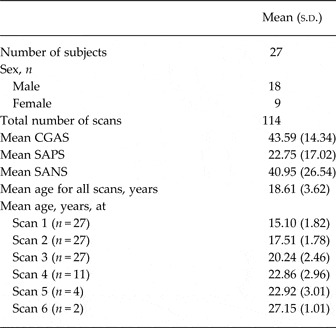
Demographic characteristics are reported in Table 1. Briefly, the mean age for all 114 scans was 18.61 years (s.d. = 3.62) and 66.7% of participants were male (Table 1).
Demographics for childhood-onset schizophrenia probands

s.d., Standard deviation; CGAS, Children's Global Assessment Scale; SAPS; Scale for the Assessment of Positive Symptoms; SANS, Scale for the Assessment of Negative Symptoms.
Structural brain measures
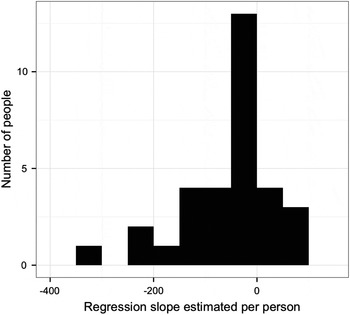
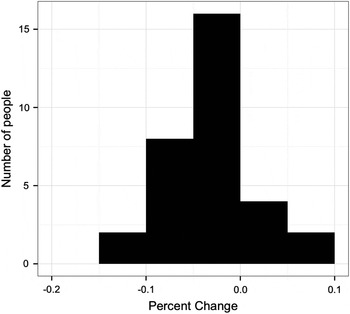
Change in hippocampal volume as measured by OLS-fit slope and percentage change are shown in Figs 1 and 2. Overall change in volume over time was minimal with a qualitative trend of volume loss (mean OLS-fit slope: −50.95, s.d. = 87.43; mean percentage change: –0.03, s.d. = 0.05) (Figs 1 and 2).
Change in total hippocampal volume in childhood-onset schizophrenia probands (n = 27) from baseline to follow-up as measured by ordinary least squares-fit slope per person (change in volume over change in age). Slope values above 0 indicate an increase of hippocampal volume over time, while slope values below 0 indicate a decrease of hippocampal volume over time.

Change in total hippocampal volumes in childhood-onset schizophrenia probands (n = 27) from baseline to follow-up as measured by percentage hippocampal change (change in volume over original volume). Percentage change values above 0 indicate an increase of hippocampal volume over time, while percentage change values below 0 indicate a decrease of hippocampal volume over time.

Relationship between hippocampal change and clinical outcome
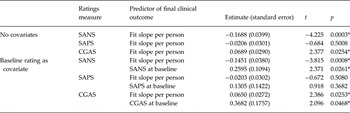
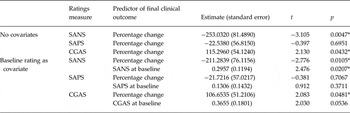
Negative symptoms (SANS score) were associated with less hippocampal volume decrease (fit slope: p = 0.0003; percentage change: p = 0.005), such that less volume decrease was associated with fewer negative symptoms at follow-up (Tables 2 and 3). Positive symptoms (SAPS) were not significantly related to hippocampal change (fit slope: p = 0.501; percentage change: p = 0.695) (Tables 2 and 3). Higher global functioning (CGAS) was associated with hippocampal change (fit slope: p = 0.025; percentage change: p = 0.043), with better outcomes associated with less volume loss (Tables 2 and 3). Sex, time between scans, baseline hippocampal volume, final hippocampal volume, and final total intracranial volume had no impact on the interpretation of the models and were not predictors of final clinical outcome.
Predictors of final global function and symptom severity: hippocampal volume change (in this case, OLS-fit slope per person) and clinical ratings at baseline a

OLS, Ordinary least squares; SANS, Scale for the Assessment of Negative Symptoms; SAPS; Scale for the Assessment of Positive Symptoms; CGAS, Children's Global Assessment Scale.
a Results are shown for unadjusted slope values, fit slope adjusted for baseline ratings, and baseline clinical ratings adjusted for fit slope.
* Significant (p < 0.05).
Predictors of final global function and symptom severity: hippocampal volume change (in this case, percentage change) and clinical ratings at baseline a

SANS, Scale for the Assessment of Negative Symptoms; SAPS; Scale for the Assessment of Positive Symptoms; CGAS, Children's Global Assessment Scale.
a Results are shown for unadjusted values of percentage change, percentage change adjusted for baseline ratings, and baseline clinical ratings adjusted for percentage volume change.
* Significant (p < 0.05).
Discussion
In our population of COS probands, less hippocampal volume decrease was associated with better clinical outcome, specifically better SANS scores indicating less severe negative symptoms and CGAS scores indicating better global functioning. We hypothesize a possible plastic or compensatory role of the hippocampal pathway in these cases. We present a partial replication of Lappin et al. (Reference Lappin, Morgan, Chalavi, Morgan, Reinders, Fearon, Heslin, Zanelli, Jones, Murray and Dazzan2014) with respect to hippocampal volume change and clinical outcome in schizophrenia. Our study differed from Lappin's in important facets, particularly highlighted in our population of young, chronically ill schizophrenia patients as opposed to FEP adult patients, the majority of whom suffered from acute illness.
Hippocampal volume reduction occurs during normal adolescence (Giedd et al. Reference Giedd, Jeffries, Blumenthal, Castellanos, Vaituzis, Fernandez, Hamburger, Liu, Nelson, Bedwell, Tran, Lenane, Nicolson and Rapoport1999; Gogtay et al. Reference Gogtay, Nugent, Herman, Ordonez, Greenstein, Hayashi, Clasen, Toga, Giedd, Rapoport and Thompson2006). In the case of COS, we suggest a relationship between hippocampal volume reduction and negative symptoms as well as global functioning. To supplement our study, we cross-sectionally analysed hippocampal volume and clinical outcome at baseline and final time points. Neither baseline nor final global function and clinical severity were associated with baseline or final hippocampal volume. We also found no relationship between hippocampal volume change and baseline clinical outcome. We suggest that the longitudinal trajectory of the hippocampus relates to final clinical outcome and specifically to negative symptoms.
The hippocampus is a highly plastic region that can be indicative of disease state. In our pediatric cohort, we have a wide variety of clinical outcomes (Sporn et al. Reference Sporn, Vermani, Greenstein, Bobb, Spencer, Clasen, Tossell, Stayer, Gochman, Lenane, Rapoport and Gogtay2007). For hippocampal shape in COS, positive symptom severity has been associated with inward deformations in the anterior hippocampus, and better overall functioning has been associated with outward hippocampal deformation (Johnson et al. Reference Johnson, Wang, Alpert, Greenstein, Clasen, Lalonde, Miller, Rapoport and Gogtay2013). Bilateral hippocampal reductions in psychotic adults are associated with poor clinical outcome (de Castro-Manglano et al. Reference de Castro-Manglano, Mechelli, Soutullo, Landecho, Gimenez-Amaya, Ortuno and McGuire2011), greater duration of illness (Velakoulis et al. Reference Velakoulis, Pantelis, McGorry, Dudgeon, Brewer, Cook, Desmond, Bridle, Tierney, Murrie, Singh and Copolov1999; Chakos et al. Reference Chakos, Schobel, Gu, Gerig, Bradford, Charles and Lieberman2005; Brambilla et al. Reference Brambilla, Perlini, Rajagopalan, Saharan, Rambaldelli, Bellani, Dusi, Cerini, Pozzi Mucelli, Tansella and Thompson2013), lower health status, lower levels of education, and higher levels of positive and negative symptoms (Brambilla et al. Reference Brambilla, Perlini, Rajagopalan, Saharan, Rambaldelli, Bellani, Dusi, Cerini, Pozzi Mucelli, Tansella and Thompson2013). Mechanisms of hippocampal change are unclear, whether they are environmental, due to medication or related to disease (Nelson et al. Reference Nelson, Saykin, Flashman and Riordan1998).
Our results add to the body of literature suggesting that clinical severity and outcome can reflect poor hippocampal plasticity in schizophrenia, so hippocampal pathways can be considered for potential treatment interventions. Theories to consider include the cortisol and dopamine hypotheses. The cortisol hypothesis proposes that stress is associated with reduced hippocampal neurogenesis, changes in hippocampal neuronal function, and decreased hippocampal volume (Mondelli et al. Reference Mondelli, Pariante, Navari, Aas, D'Albenzio, Di Forti, Handley, Hepgul, Marques, Taylor, Papadopoulos, Aitchison, Murray and Dazzan2010; Grace, Reference Grace2012; Collip et al. Reference Collip, Habets, Marcelis, Gronenschild, Lataster, Lardinois, Nicolson and Myin-Germeys2013). The dopamine hypothesis suggests that current D2 antagonist interventions target the connective pathway further downstream the connective pathway from the hippocampus at the nucleus accumbens, mostly addressing positive symptoms (Lodge & Grace, Reference Lodge and Grace2011; Grace, Reference Grace2012). Future work can focus on therapeutic developments that selectively target the hippocampus further upstream the dopamine pathway. Such interventions might help restore appropriate hippocampal regulation in the disease state.
We acknowledge the limitations of our study. Looking only at global function, negative symptoms and positive symptoms in relation to hippocampal volume change, we replicated a small proportion of the Lappin group's study (Lappin et al. Reference Lappin, Morgan, Chalavi, Morgan, Reinders, Fearon, Heslin, Zanelli, Jones, Murray and Dazzan2014) in our sample. We found our subtle volume changes to be almost negligible with very flat slopes in the trajectory of hippocampal volumes. We would prefer to have had a larger sample size that met criteria for analysis because we cannot account for the immense heterogeneity of disease progression in schizophrenia. We speculate that initiation of clozapine for this mostly treatment-refractory patient group may have resulted in a greater improvement in negative symptoms across time and thus stronger relationship for this measure. A further limitation is the unknown specificity of this finding. It has been suggested in cross-sectional studies that larger hippocampal volume represents a plastic compensatory response in attention-deficit/hyperactivity disorder (Plessen et al. Reference Plessen, Bansal, Zhu, Whiteman, Amat, Quackenbush, Martin, Durkin, Blair, Royal, Hugdahl and Peterson2006).
In addition, we cannot accurately determine drug effects, as all patients were receiving medication. The literature is contradictory, with studies indicating that antipsychotic medications can help maintain hippocampal volumes (Lieberman et al. Reference Lieberman, Chakos, Wu, Alvir, Hoffman, Robinson and Bilder2001; Chakos et al. Reference Chakos, Schobel, Gu, Gerig, Bradford, Charles and Lieberman2005; Walter et al. Reference Walter, Studerus, Smieskova, Kuster, Aston, Lang, Radue, Riecher-Rossler and Borgwardt2012), exacerbate deflation of hippocampal volume (Brambilla et al. Reference Brambilla, Perlini, Rajagopalan, Saharan, Rambaldelli, Bellani, Dusi, Cerini, Pozzi Mucelli, Tansella and Thompson2013; Zipursky et al. Reference Zipursky, Reilly and Murray2013), or that drug effects do not explain volume differences (Velakoulis et al. Reference Velakoulis, Pantelis, McGorry, Dudgeon, Brewer, Cook, Desmond, Bridle, Tierney, Murrie, Singh and Copolov1999; Mattai et al. Reference Mattai, Hosanagar, Weisinger, Greenstein, Stidd, Clasen, Lalonde, Rapoport and Gogtay2011; Lappin et al. Reference Lappin, Morgan, Chalavi, Morgan, Reinders, Fearon, Heslin, Zanelli, Jones, Murray and Dazzan2014). Some studies also suggested that type of antipsychotic medication could determine effects on hippocampal volumes (Lieberman et al. Reference Lieberman, Chakos, Wu, Alvir, Hoffman, Robinson and Bilder2001; Zipursky et al. Reference Zipursky, Reilly and Murray2013), while other studies have not found significant volume differences between types of antipsychotics (Velakoulis et al. Reference Velakoulis, Wood, Wong, McGorry, Yung, Phillips, Smith, Brewer, Proffitt, Desmond and Pantelis2006; McClure et al. Reference McClure, Styner, Maltbie, Lieberman, Gouttard, Gerig, Shi and Zhu2013). Our study is unique in that a large percentage (70%) of our group was maintained on clozapine, for which there is no long-term hippocampal data available in the literature.
Ongoing studies are examining hippocampal development in COS probands using 7-T MRI to isolate subnuclei within the hippocampus that may change in relation to clinical outcome.
Supplementary material
For supplementary material accompanying this paper visit http://dx.doi.org/10.1017/S0033291715000677
Acknowledgements
We would like to thank the participants in the study and to acknowledge the contributions of our clinical team in the NIMH.
Declaration of Interest
This research was supported by the Intramural Research Program of the NIMH (protocol 03-M-0035, NCT00049738). The authors report no financial relationships with commercial interests.