A growing literature on “everyday nationalism” (EN) promises to add value to the social constructivist study of nationalism and ethno-nationalism by foregrounding practices and interpretivist methodologies. “Making Identity Count” (MIC) makes a similar promise in International Relations (IR): it sets out to generate the field’s first constructivist national identity database.Footnote 1 This database is being assembled inductively from everyday texts, such as newspapers, novels, and movies. So, rather than relying on surveys or following a codebook filled with pre-given ideas about Chinese or French identity, analysts allow identity categories to emerge directly before they move to reconstruct what it means to be China or France. Analysists also count the number of times a category appears in the text in order to establish relative salience. This, then, opens the door for quantifying the findings, thus contributing to quantitatively oriented scholarship on national identity in IR and beyond.
We make two propositions in this paper: (1) EN and MIC are complementary and (2) a theoretical and methodological cross-fertilization between these two approaches could help advance the study of nations, nationalism, and national identity. We begin by outlining EN and then introduce MIC. There, we offer a novel reading of Antonio Gramsci as a constructivist interested in the everyday experiences of nation and national identity, followed by an illustration of the project’s methodology drawn from our current research on postwar Britain. By bringing forth the masses and their practices, our Gramsci-inspired project follows the scholarship on EN not only ontologically and conceptually, but also in terms of substantive interest in variegated relations and processes through which nations become themselves. We end with a discussion of what these two approaches can borrow from each other.
A brief reflection on the semantic field that encompasses the words “nationalism” and “national identity” is necessary at the outset. Our starting point is that nations and its cognates are associated with modernity (Malešević Reference Malešević2013). As these processes are highly context-dependent, scholars often add adjectives to their categories. The term nationalism thus often includes qualifiers—diachronic (e.g., postcolonial), geographic (e.g., Balkan), or typological (e.g., civic) (Todorova Reference Todorova2015). Another axiom is that these categories refer to social and relational phenomena—“negotiated practice”—as opposed to ontological “things.” This is evident in the now standard claim that national identity requires difference to be, which is also to say that national identification practices depend on the construction of various Others.Footnote 2
Gramsci the Constructivist
Constructivist scholarship on nationalism began as a study of state-directed nation making—that is, of the role of political elites and political institutions in constructing nations and national identities, which is an approach best captured by the concept of political construction (Smith Reference Smith2015). From W.E.B. Du Bois and Benoy Kumar Sarkar to Ernest Gellner and many others, this work has taught us that there are always competing versions of the nation at work, each of which offers different combinations of aesthetic, intellectual, ideological, historical, geographical, religious, social, and political elements.Footnote 3 Today’s constructivists are just as likely to focuses on mass agency, however—that is, it explores not only how the masses respond to elite manipulation and cues but also how the masses elaborate, (re)produce, or challenge national identity categories and nations themselves.
EN is an outstanding example of the latter approach (for recent overviews, see Knott 2016; Ichijo Reference Ichijo, Stone, Dennis, Rizova, Smith and Hou2016). Arising in the 1990s with new Bourdieusian readings of nationhood, as well as with Michael Billig’s influential work on “banal nationalism,” EN came to distinguish itself by focusing on the routine, taken-for-granted habits and symbols of social life that lie beyond the authority, attention, or culture of politicians, government mandarins, and other establishment figures (Brubaker 1992; Bilig Reference Billig1995). J. Paul Goode and David Stroup’s (Reference Goode and Stroup2015) programmatic statement on EN explains why this focus remains valuable:
-
1) it allows constructivists to steer clear of the twin pitfalls of essentialism and reification and stay true to their intersubjectivist ontology;
-
2) it enables new accounts of “how the vast majority of people conceive of, and interact with, ethnic or national identities”;
-
3) it links the above to “large-scale social and political processes, such as the sources of authoritarian legitimacy or the ethnicization of economic development”;
-
4) it provides new insight into “the repertoires available to elites” and also “why citizens respond to certain varieties of ethnic cues rather than others (religious, educational)”;
-
5) it facilitates novel cross-case comparisons since it helps us observe gaps and overlaps in ethnic vs nonethnic, market vs nonmarket or domestic vs transnational practices (to use but three binaries circulating in the literature on nationhood and ethnicity); and
-
6) it enables new accounts of how identities change.
Much of present-day EN scholarship is rooted in practice theory and the concepts of “habitus” and “doxa” with which Pierre Bourdieu sought to capture the fact that in many if not most contexts people tend to carry their social lives unconsciously and unreflexively—that is, according to embodied practices, routines, and habits (Skey Reference Skey2011, 15; cf. Billig Reference Billig1995, 6). The same insights originally inspired our conceptualization of national identity (Hopf Reference Hopf2002, Reference Hopf2010). However, one of the main theoretical inspirations for our MIC project is Gramsci and his writings on social order and change through hegemony and its challengers (Allan, Vucetic, and Hopf Reference Allan, Vucetic and Hopf2018; Hopf Reference Hopf2013). We now think that our neo-Gramscian framework could be profitably used in EN as well.Footnote 4 For one, the Italian philosopher is invaluable in theorizing the relationship between elite national identity projects and mass conceptions of what it means to be a member of a particular national community. Additionally, he developed a theory of hegemony that combines elite ideology with mass common sense, which is enormously useful for EN given that both of these levels of national identity cultivation, production, and reproduction are necessary to understand how national identities are propagated from above and (re)constituted from below.
To begin with, Gramsci’s understanding of social reality is consistent with constructivism’s intersubjectivist ontology.Footnote 5 In elaborating historical materialism, he indeed rejects race, skin color, the state of nature, and the idea that “man is the country he lives in.” Instead, he argues that “man…changes continuously, with the changing of social relations.” Identities are necessarily relational: “Man is aristocratic insofar as man is a serf” (Gramsci Reference Gramsci and Buttigieg2007, 186 [Notebook 6, section 35]). Footnote 6 It is this “historically defined consciousness that indicates what is natural and what is not” (Gramsci Reference Gramsci and Buttigieg2007, 321 [Notebook 8, section 151; also see Gramsci Reference Gramsci and Buttigieg2007, 365 [Notebook 8, Section 215]). Mass common sense, where the practices and ideas of day-to-day nationalism reside, is socially constructed in history and place.
Of course, Gramsci’s focus of attention when writing his notebooks in prison was not primarily on nationalism. He wrote a fair amount about the existence of full-blown “national-popular cultures” in places like France and the absence of such a culture in Italy. In the latter, Gramsci observed, “the people-nation was missing” (1996, 81 [Notebook 3, Section 82]). We could say the lack of a national identity in Italy was one of Gramsci’s more frequent points of comparison of Italy with other European countries, such as France, Germany, and Britain. In Italy, “national sentiment is of recent vintage;” it is only in “a formative phase, for literature has never been a national phenomenon, but a cosmopolitan one” (Gramsci Reference Gramsci and Buttigieg2007, 15 [Notebook 6, Section 16], 87 [Notebook 6, Section 104]). Gramsci pointed out the necessity of having a national language if one is to have a national identity. Yet, national language cannot just be decreed by the state. It “can be formed only to the extent that the social life of the nation gives rise to numerous and stable contacts among various segments of the nation […] through writing, trade, and commerce” (Gramsci Reference Gramsci and Buttigieg1996, 45 [Notebook 3, Section 46]). Gramsci understands national identity the same as any contemporary social constructivist would: it is a product of daily discursive practices, that which is spoken and performed into being.
While not concentrating on the nationalist component of an elite ideological hegemony, Gramsci did write about hegemony as if it must include an encompassing national identity if it is to be based on consent, and not purely coercion. Hegemony is more secure and stable the more deeply the discourse of national identity being propagated by the elite resonates with the masses, still more if it becomes taken for granted in the common sense of the broad population.Footnote 7 Mass common sense, “the most widespread conception of life and morals,” is the “folklore of philosophy” (Gramsci Reference Gramsci, Buttigieg, Buttigieg and Callari1992, 173 [Notebook 1, Section 65]). Gramsci, while contemplating the failure of socialism to come to Italy—in particular the failure of the Italian socialists to successfully recruit the poor and oppressed southern Italian peasantry—observed that common sense “must be conceived as something very serious and be taken seriously” if one wishes one’s ideology to be taken up by more than a narrow stratum of fellow intellectuals (1992, 189 [Notebook 1, Section 89], 360, 369 [Notebook 8, section 213 and section 220]). Gramsci asks rhetorically whether elite ideology, if it is to succeed in mobilizing the masses, “can be in opposition to the spontaneous sentiments of the masses,” to their "traditional popular conception of the world.” He answers: “It cannot be in opposition.” One must remember that “reality will not conform to an abstract scheme” (Gramsci Reference Gramsci and Buttigieg1996, 50–52 [Notebook 3, Section 48]). Instead, the national identity projects advanced by elites must resonate with mass commonsensical understandings of their own identities, national and otherwise. This is a mission that is never completed. Beyond ethnonational differences that separate “Italians” from one another, there are the other salient differences of class, region, and language. Moreover, common sense is about more than national identity. The latter might not even be part of many communities of common sense in a country.
In order to find out what common senses exist in any society, Gramsci recommended comprehensive study of mass popular texts, something we pursue in our project. As we suggest next, he also provided sound methodological advice on how to best design such a study.
Finding National Identity
Upon arriving in prison, Gramsci did not immediately begin to write his notebooks. Instead, he identified topics for the notebooks he expected to write. He also developed a bibliography of materials he would ask others, mostly his sister, to send to him in prison. One of those topics he provisionally titled: “Serialized fiction and popular taste in literature” (Gramsci Reference Gramsci, Buttigieg, Buttigieg and Callari1992, 9 [introduction]). In letters from prison, in this case to Malvina Sanna, he defended reading “trashy” popular literature, pointing out it could suggest answers to the following critical questions: “Why is this always the most read and most published literature? What needs does it satisfy? What aspirations does it respond to? What sentiments and views are represented in these awful books that have such broad appeal?” (Gramsci Reference Gramsci, Buttigieg, Buttigieg and Callari1992, 15–16 [introduction], 129 [Notebook 1, Section 43]).
We think that Gramsci’s interest in how the nation and how being a member of a nation is represented in “these awful books” is in line with Billig and other scholars of “banal nationalism,” who argue that national identity is mostly produced through banal practices of everyday culture (Bilig Reference Billig1995; Edensor Reference Edensor2002; Skey Reference Skey2011) rather than through major sociopolitical upheavals or high-profile mediated spectacles. Footnote 8 Gramsci argues this as well, hence his advice on how and why to sample “the most popular literature” (1992, 129 [Notebook 1, Section 43])Footnote 9. Guerin Meschino, an age-old satirical, can serve as “an encyclopedia to gather information on the mental coarseness and cultural indifference of the vast stratum of people who still feed on it” (Gramsci Reference Gramsci and Buttigieg2007, 148 [Notebook 6, Section 207]). Similarly, “popular serial novels” produce “an implicit national sentiment.” For example, Jules Verne’s fantasies produced for the French readers “an anti-English sentiment, linked to the loss of colonies and the lingering pain of naval defeats” (Gramsci Reference Gramsci and Buttigieg1996, 77 [Notebook 3, Section 78]).Footnote 10 Henrik Ibsen’s A Doll’s House, too, is very well-liked because it “represents sentiments and inclinations that find resonance in the popular psyche” (Gramsci Reference Gramsci and Buttigieg1996, 78 [Notebook 3, Section 78]).
Gramsci suggested sampling “the commercial part of national-popular literature” widely, as “it is extremely valuable from point of view of the history of culture… of the philosophy of the age, that is, of the mass of sentiments and conceptions of the world prevalent among the “silent” multitude” (1996, 312–313 [Notebook 5, Section 54]). He likewise argued for attention to the press, in general, and reviews of every kind—“scientific, literary, philological, popular…. even parish bulletins” (Gramsci Reference Gramsci and Buttigieg1996, 62 [Notebook 3, Section 63]).Footnote 11 He also calls for reconstructing a “living historical model” of public opinion through stuff of “libraries, schools, associations and clubs of various kinds, even architecture, the layout of streets, and their names” (Gramsci Reference Gramsci and Buttigieg1996, 52–53 [Notebook 3, Section 49]). The same goes for May Day festivals: “there must be a more or less reliable record of the subjects they treat” (Gramsci Reference Gramsci, Buttigieg, Buttigieg and Callari1992, 64 [Notebook 1, Section 63]).Footnote 12 One should also survey theater and cinema, for they “have a speed and field of action enormously greater than the book,” comparable to newspapers and journals (Gramsci Reference Gramsci, Buttigieg, Buttigieg and Callari1992, 232 [Notebook 1, Section 153]).
In addition to calling for analytical attention to newspapers and movies, Gramscirecommended ethnographic efforts to “obtain knowledge of popular sentiment” through “active and conscious co-participation, through “compassionality”” (1992, 59–60 [Notebook 2, Section 25]). Like most EN scholars, we understand textual analysis as an inferior kind of ethnography (Fox and Miller-Idriss Reference Fox and Miller-Idriss2008, 556). Yet, we also think that at least some manifestations of everyday nationalism and national identity can be accessed and reconstructed via the interpretation of text, not least because “proper” ethnography can only be limited to the present and the immediate past. Our core methodological wager is straightforward: if at least some habits of nationhood are discursive, then it stands to reason that one could recover them through some form of discourse analysis of a sample of texts that widely circulate in modern states (Allan Reference Allan, Hopf and Allan2016).Footnote 13 This harmonizes with one of the main goals in EN research: to recover the routine, unreflective (“unnoticed”) ways through which nations become a presence in people’s everyday lives.
MIC data comes in the form of inductively coded archives and accompanying “national identity reports” generated by human coders working with agreed-upon discourse analytic parameters. Although the project welcomes adoption of its methodology for any country, at this stage the focus is on the national identities of ten great powers for every tenth year from 1950 to the present—China, India, France, Brazil, Japan, Germany, and Italy, the UK, the USA, and the USSR/Russia over the course of seven calendar years in total. A more recently established stream called “MIC in Asia” analyzes the discourses of national identity in all ASEAN members, in addition to South Korea, Taiwan, and Hong Kong.Footnote 14 The project’s ultimate aim is to produce national identity data for dozens of countries from 1810 through the present.
Each report is based on a standardized sample of texts drawn from an assortment of everyday experiences and institutional centers, namely from (1) political leadership speeches, (2) newspapers, (3) high school history textbooks, (4) novels, and (5) movies. The main rationale for accessing and analyzing such different forms and media of communication was to capture common everyday ideas, at both elite and mass levels, about what it means to be a nation or its member in a given year. As the project goes backward in time, radio broadcasts, street operas, and mass poetry readings become sources of mass texts as well. By the same token, as MIC research expands into contemporary Asia, income level requires moving beyond movies and novels to more affordable cultural consumables, such as TV shows, pirated DVDs, and downloaded movie videos. Social media sources likewise become necessary for generating reports drawn from more recent years.
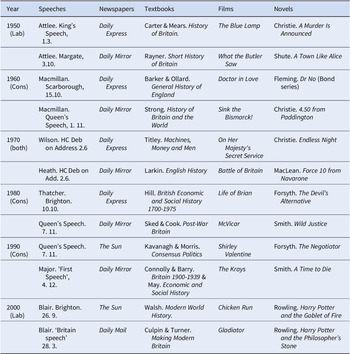
Table 1 summarizes the sources used for the British national identity reports (1950–2000). They are grouped in five columns, whereby with the category “newspapers” is further divided into two subcategories. Newspapers’ editorials, op-eds, and columns (“opinion” for short), together with leadership speeches and history textbooks, are thus used as sources of elite political discourse, while letters to the editor are meant to help gauge mass discourse, together with novels and movies. For each year under study, an effort was made to select historical documents that can be credibly described as bestselling, must-read, highest-circulating, or most-watched.
Textual Sources of British National Identity, 1950–2000.

Notes: Coding and analysis from January 2015 to December 2017 by Vucetic and his coauthors: David Orr (for the year 1980), Kristen M. Olver (for 1990), and Alyssa Maraj Grahame (for 2000). General research assistance was provided by Melanie Mitchell, Kalathmika Natarajan, and Kazim Rizvi. For further details on source selection and for full bibliography, see Vucetic (forthcoming), and the MIC project website https://www.makingidentitycount.org/.
Due to space, we cannot discuss the selection of texts in each of these genres, so we will showcase two newspapers and novels.Footnote 15 For the first, we followed the rankings based on the Press Council and Audit Bureau of Circulations circulation figures or the closest equivalent. Accordingly, we selected Daily Express and Daily Mirror from 1950 through 1980, The Sun and Daily Mirror for 1990 and The Sun and Daily Mail in 2000. We further sampled the editions published on the 15th day of each month, including, when appropriate, Sunday equivalents of the selected newspaper (Sunday Mirror, Sunday Express, Mail on Sunday but not News of the World). With this selection, we achieved some variance in ownership structures and ideological orientations of newspapers known as “popular” or “mass-market” throughout the entire period under study.Footnote 16
Identifying “bestselling novels” was more challenging. To select two top-selling items on the consumer market of books bought by private individuals for their own use or as gifts in each year, we first consulted scholarly histories of the book and UK fiction industry. Based on this knowledge, we adopted multiple strategies. For 1950 and 1960, we consulted annual round-ups of the bestseller market by W.H. Smith’s Trade News, The Observer, The Bookseller, Evening Standard, Evening News, Time & Tide, The Sunday Telegraph, and The Daily Express and picked the two British-authored novels closest to the top of each list. For 1970 and 1980, the reliability of bestseller lists improved thanks to introduction of surveys, automated data collection (after 1980), and other ranking instruments. Especially helpful were secondary assessments of said lists published in The Listener—a weekly BBC magazine published until 1991—and in The Guardian (especially its end-of-year reviews penned from 1970 onward by Alex Hamilton). For 1990 and 2000, we followed the rankings generated by computerized data capture via Electronic Point-of-Sale equipment, disseminated by companies like Nielsen BookScan. As Table 1 shows, several authors appear in multiple years: Fleming, Christie, Smith, Forsyth, and Rowling.
The paperback revolution changed our selection criteria since it rendered paperback the dominant format for bestsellers. First, the paperback revolution changed the meaning of high circulation: in the late 1940s, a top hardback novel would achieve sales of 100,000 over several years, whereas in the 1990s a bestselling paperback would have 500,000 copies sold in weeks. Second, this means that some our “bestselling novels of the year” after 1960 were in fact paperback editions of a hardback released one to three years before the year of the study. In 1960, we thus selected Ian Fleming’s Dr. No, released in March 1958, over Fleming’s For Your Eyes Only, released in April 1960. In principle, either one would have been acceptable as UK readers en masse were enjoying multiple of Fleming’s Bond novels. However, Dr. No, the sixth book in the espionage adventure series, topped that year’s bestseller with more than 150,000 copies sold due to the paperback release in February and, to a lesser extent, text and comic-strip serializations that year in Daily Express. For Your Eyes Only, in contrast, was released in hardback and sold less than 22,000 copies. The same rationale applied to 4.50 from Paddington, a novel first published by Agatha Christie in November 1957, which reappeared in paperback three years later with Fontana Books.Footnote 17
As a strategy for creating an archive of texts containing information on British identity in 1950–2000, this approach has two limitations. First, England—and more specifically London—are taken to be the dominant sites of the discursive production of Britishness. Admittedly, this reproduces a shortcoming in Billig’s own work on the “British” society (Skey Reference Skey2009, 335; Billig Reference Billig1995, 201, 314). Sampling newspaper items appearing in, for example, Manchester Evening News or Liverpool Echo or in Scottish history textbooks would have provided a more complete picture of what it means to be Britain or British through time. Same for a less print-centric archive, not least because radio and, from 1970 onward, television shows were at least as popular as movies.
These sampling choices were driven by both principle and pragmatism. As Tom Edensor has shown in his contribution to the EN literature, the nation is often hierarchical not simply in the sense that some places are more likely to be centers of the discursive production—Gramsci would call them the centers of “moral and intellectual leadership.” Nations are also hierarchical in the sense that some regions are constructed as more national or authentic than others (Edensor Reference Edensor2002). Larger samples also cost more. Adding BBC’s To the Manor Born would have greatly diversified our mass sample for the year 1980; however, it would be prohibitive in terms of coding hours, especially considering the multimodal nature of discursive meanings contained therein.
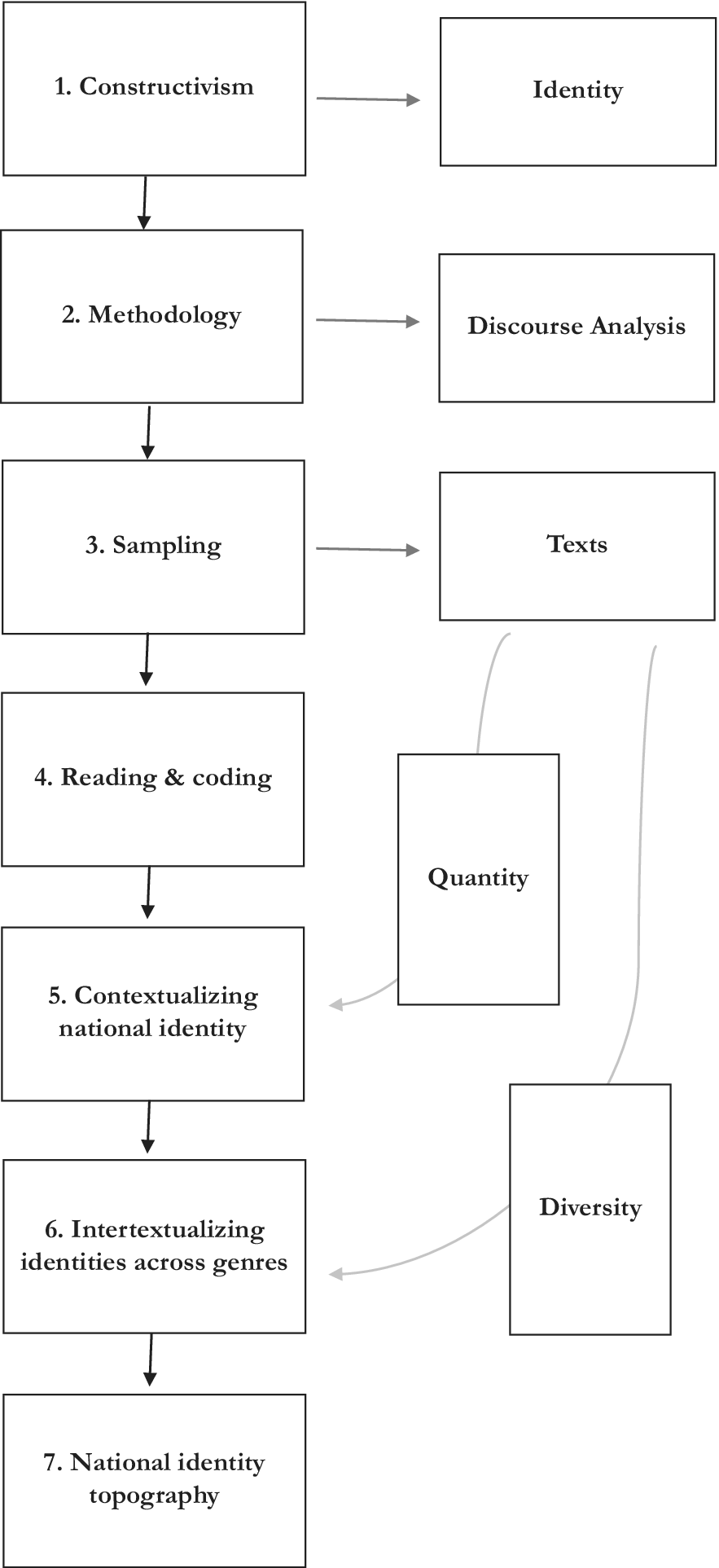
Figure 1 visualizes the generation of national identity report as a step-by-step process (grey boxes, numbered, with notes on key definitions, assumptions, and aims in white boxes). The sampling strategy, shown as Step 3, is moving progressively from the project’s constructivist “first principles” and discourse analytic methodology in Steps 1 and 2. The sampling strategy simultaneously enables an inductivist analysis of British identity—Steps 4–7. Here, the research team began by putting aside any prefabricated ideas about what it meant to be Britain or British—as also England and English, Ireland and Irish, and so on. Three basic inductive coding rules were used to code identity categories appearing in the actual texts: valence; aspirational/aversive, namely, if the identity is one that the Self aspires to or is trying to avoid; and significant Other, which refers to any broadly national categories to which the Self compares itself in time and space.
Making Identity Count, From Theory to Findings.

A distinct advantage of this method is that it forces coders to capture local particulars and contingent meanings that might otherwise be lost when analysis accepts either platitudes (“The British are militaristic”) or, indeed, statements drawn public opinion research (“Young Britons rank Spain as top vacation destination”). The method likewise requires coders to differentiate mere themes (“leisure is good”) from actual national identity categories (“the English like good leisure”), while also paying special attention to any relevant deployment of deixis, including pronouns, possessive adjectives, locatives, and any references to the broader structures of belonging (e.g., “In this society…,” “We have always been traders,” “Our empire was essentially liberal”). To illustrate this procedure, consider our coding of “No Trumpets,” an editorial piece:
Where are the drums? Where are the trumpets? They do not sound for today’s preliminary session of the Commonwealth economic conference.
The sad truth is that nothing of importance is likely to come out of this conference. It may be that Empire lands like New Zealand, already worried about its tariff preferences, will learn that the British Government means to reduce those preferences still more.
The Government is more concerned with getting into the same trading system as Dr. Adenauer than with developing the Empire trading system.
Who supposes that Dr. Adenauer would give a fig for Europe if he had an Empire?
(Daily Express, September 15, 1960).In this text the coder observed four discrete identity categories: imperial, Germany, Europe, and trading. He coded imperial as positive, with a note about the Empire/Commonwealth interchange in which New Zealand appears to be subsumed under the British Self. Germany and Europe were both significant Others. The former, epitomized in the figure of its chancellor, was negatively evaluated because its ambition (regional domination) and inferiority (no empire). The latter was merely neutral. Finally, though Britain was a trading nation, its aspiration was not free trade so much as “the Empire trading system.”Footnote 18
Subjecting every text in the Britain 1960 corpus to the same coding procedure, the same coder then ran a tally of raw identity counts and their prevailing valence, first within texts and genres, and then across all five genres.Footnote 19 In Figure 1, these two steps are represented as “contextualization” (Step 5) and “intertextualization” (Step 6).
Once all texts for 1960 were analyzed in this way, the coder prepared summary tables, from which he proceeded to Step 7: finding the prevailing British identity discourses in 1960. The goal here is to recover the fluid discursive “topography” or “terrain” of British identity in 1960 rather some fundamental aspect of Britishness in this or any other period. Consistent with constructivist teachings, this approach allows researchers to analyze national identity in a decidedly non-essentialist fashion. When taken forward and backward in time, this approach can and does lead to a reconstruction of Britishness that captures not only the most layered elements of identity, but also its main complementarities and contrasts (cf. Skey Reference Skey2011).
Step 7 is the most theoretical in the sense that the coder clustered different identities categories into prevailing (hegemonic, dominant) and alternative (counter-hegemonic, subaltern) discourses according to the elite/mass divide, significant Others, and political, economic, social, and cultural dimensions. Going back to the above example, while some discourses agreed that Britain was trading and imperial, others insisted that it was trading but post-imperial and a champion of decolonization everywhere, not just in so-called the British world. From this finding, one can then draw hypotheses about how the prevailing sense of Britishness circa 1960 shaped British foreign policy at the time when US Secretary of State Dean Acheson publicly chided Britain for losing an Empire but not finding a role.
Therein lies one of the main contributions of MIC to IR. If we accept that the ideas and practices of “who we are” are always prior to “policy,” then knowledge of national identity discourses can help us address a number of important research questions in this field: Which countries are likely to be deemed threats and which are likely to be labeled as friends or allies? Which international organizations, regimes, and norms are useful or valid and which are neither? Which political, social, and economic worldviews are shared across time and space? Which tend to be more idiosyncratic? What we wish to suggest below is that some of these questions might be of relevance to EN. Also, we identify what these two approaches can borrow from each other, both in terms of analytic frames and methodology.
Cross-Fertilizations
The main motivation behind MIC is a desire to advance constructivist IR and practice theory approaches to world politics. Scholars working in this tradition have already shown that national identity discourses, as part of domestic common sense, shape foreign policy decision making and, therefore, international interaction (e.g., Vucetic Reference Vucetic2017, Reference Vucetic and James2018). They do so because they contain heuristic categories and concepts that structure policy dispositions. Constructivists have proposed two causal mechanisms. First, decision-makers are citizens, which makes them more likely to deploy common sense identity in constructing their own beliefs about international politics. Second, widely shared domestic identities constrain and enable policy-makers by making some policies more natural or easier to justify in public than others. This mechanism is known as “discursive fit”: policy-makers will find it easier to marshal domestic support for foreign policy when that policy is taken for granted or otherwise acceptable in identity terms for both elites and masses (Cortell and Davis Reference Cortell and Davis1996; Checkel Reference Checkel1999; Risse and Ropp Reference Risse, Ropp, Risse, Ropp and Sikkink1999; Vucetic Reference Vucetic2011). Crucially, this has also been found to hold true even in authoritarian regimes because no leader, not even a Stalin-like figure, could consistently adopt policies that do not appeal to their “selectorates” and publics (Hopf Reference Hopf2002).
MIC data will likely spur additional studies in this vein, not just of specific foreign policy decisions but also of the co-evolution of national identities and foreign policies—how postwar Britain and France negotiated their “global” foreign policies at home and abroad, for example. While research in this tradition typically revolves around one or two states, our project shows that this can be scaled up to the level of the system of states, thus addressing more theoretical debates in IR. One example is the rise of China and the future of international orders in Asia and the world. A thin ideological hegemony at the international level would be one that appeals to elites. A more enduring and comprehensive, or thick hegemony, would be one that is accepted as commonsensical by masses as well. If MIC analysis shows that “Western democracy” is what makes sense to both elites and masses across different countries, then we can conclude that China’s bid for hegemony is unlikely to be successful (Allan, Vucetic, and Hopf Reference Allan, Vucetic and Hopf2018). Along the same lines, but looking at the literature on “pop culture and world politics,” MIC research could be used to determine which pop culture aspects of global daily life are in fact global (e.g., Nexon and Neumann Reference Nexon and Neumann2006; Grayson, Davies, and Philpott Reference Grayson, Davies and Philpott2009; Furman and Musgrave Reference Daniel and Musgrave2017).
Our wager from the outset has been that MIC research has a potential to contribute to, and cross-fertilize with, research programs in fields other than IR (Vucetic Reference Vucetic, Hopf and Allan2016a). EN is a good candidate for this but within limits given that MIC remains more narrowly focused on the biggest of “big nationalisms”—the nationalism of states as opposed to smaller groups or territories (Todorova Reference Todorova2015, 687).Footnote 20 This is to say that while MIC researchers can provide some insights about how particular national common sense intersects with social identities (race or gender, for example) or with the lived experiences of actors at individual and organizational scales (those in history classrooms, for example), their primary goal is always to generate knowledge for studying large-scale social and political processes involving national imagination and articulation.Footnote 21
That said, MIC could potentially make both theoretical and methodological contributions to EN. One is the introduction of the aforementioned neo-Gramscian framework for analyzing the production of everyday nationalism. If Gramsci is correct, the greater the elite-mass agreement on boundaries between nationals and nonnationals, the more stable the idea of the world as a world of nations with fixed boundaries and hierarchies of belonging. Disagreement, in turn, would imply that such boundary-making is either elite or mass-driven, and so that the hegemony of nationhood is far more unstable and context-dependent than many think. Related, and following the work of Stuart Hall, it could also be that identity metamorphosis is only possible if material and symbolic resources are concentrated (Hall Reference Hall, Hall and duGay1996). But if national identity discourses are indeed rooted in what Gramsci calls “fragmentary, incoherent and inconsequential” practices of everyday life—and those most unselfconscious, taken-for-granted habits in particular—, then any attempted change, however concentrated and intentional, will be slow and uncertain (Hopf, Reference Hopf2017). All of these competing hypotheses are of relevance to EN.
MIC analyses, too, can be of interest to EN scholars working on the relationship between elite constructions of national identity and ordinary people’s understandings of it. Suppose one is interested in the “vertical” consistency of ideologically nationalist interpretations of British politics and society or in how people in Britain draw on the symbolic repertoires of Britishness, Englishness, Scottishness and other identities to create and express the terms of their relationships with other people with or against whom they identify. The most comprehensive way to examine these questions would be to follow what David McCrone and Frank Bechhofer have done and combine social attitudes survey research with ethnographies and in-depth interviews in multiple locales, notably including Berwick-on-Tweed and nearby sites on either side of the Scottish-English border (McCrone and Bechhofer, 2005, 33-42). However, this sophisticated multi-level and multi-methodology undertaking reaches back only to the 1990s or even to 2001, if one follows the surveys alone.
What the current installment of MIC offers is data and analysis from 1950 onward. Though based only on discourse analysis, MIC’s “British national identity reports” still provide valuable information on the changing meanings of key categories of national identification. An equivalent series of reports on Scottish national identity would enable comparisons within the UK. Together they would allow the researcher to make better sense of identity change over time. This would enable analyses not only of the New Labour-era constitutional reforms, which has been of particular interest to scholars such as Bechhofer and McCrone, but also of decolonization, wars, recessions, generational turnovers, and other transformations in postwar British history.Footnote 22 Given that scholars since at least Gellner have focused on the connections between nationalism and change, the potential usefulness of said data and analysis is evident.
MIC data on the content and contestation of national identities over time and space is likely to be valuable for mapping out the most salient identity categories available to elites and/or masses, their prevailing valences, and, therefore, the conditions under which some national identity claims are likely to resonate with citizens while others do not. In this way, MIC might come to support Bart Bonikowski’s call for a more reflexive use of survey research, as in his study of similarities and differences in the cultural repertoires of French and German nationhood (Bonikowski Reference Bonikowski, Skey and Antonsich2017). Such maps can then be mobilized to examine their cultural taproots of policy choices and political preferences, whether toward other states, as in IR, or toward immigration and economic protectionism, as in Bonikowski’s work in the EN tradition. What is more, given that MIC analysts abstract their findings into nominal categories that can be counted, our project can also be of some interest to researchers who rely on survey research—the 1995, 2003, and 2013 ISSP National Identity modules or the World Values Survey, for example—but who wish to develop and deploy new typologies of nationhood rather than stick with hackneyed binaries—à la ethnic versus civic.
Going in the opposite direction, EN has already influenced MIC by heightening our theoretical attentiveness to the public/private and conscious/subconscious aspects of mass common sense. The results of Goode’s research on Russian patriotism in 2014–2015 show nontrivial inconsistencies in how the boundaries of nationhood are negotiated when one controls for “publicity,” that is, when Russians talk about Russia in interviews, versus focus groups (Goode Reference Goode, Skey and Antonsich2017). In future research we intend to pursue a similar research strategy to determine the degree to which privately held views about the nation differ from those expressed in texts. A finding that this difference is consistently large across contexts would be valuable for theoretical reasons, starting with our interest in the neo-Gramscian theories of hegemony. It would be valuable for methodological reasons as well, since “talking to people about the nation”—as in the aforementioned studies by McCrone and Bechhofer (2005) and Goode (2017)—would provide an opportunity for a validity check on MIC analyses, at least those conducted in more contemporary time. As Michael Skey (Reference Skey2011) argued in his study of contemporary Englishness and Britishness, interviews can be exceptionally helpful in accessing those commonsensical understandings of territoriality, temporality, and political organization via deixis and other forms of everyday talk (e.g., Fox and Miller-Idris Reference Fox and Miller-Idriss2008, 540; Billig 1996, 61).
As they endeavor to expand their data base backward in time, MIC researchers will borrow EN insights on the importance of making one’s data sources less print-centric. A good starting point in this regard is Edensor’s (Reference Edensor2002) conceptualization of the nation as a “matrix” that encompasses everything from material and visual environments to cultural performances to eating habits (e.g., Fox and Miller-Idris Reference Fox and Miller-Idriss2008; Sumartojo Reference Sumartojo2013; Skey and Antonsich Reference Skey and Antonisch2017). However, if we accept that any study of the meanings conveyed by coins, stamps, restaurants, airports, railways, public squares, parks, museums, cemeteries, and similar material structures requires textual sources, then MIC’s inductive approach is in principle well suited for this type of analysis as well. Indeed, the main challenge here is not to identity the “proper” matrix. Rather, it is to analyze aspects of it in a way that stays true to the interpretivist “first principles” and thus captures the fluid and historically constituted character of nations and their identities.
Conclusion
We have identified a few conceptual and methodological complementarities between EN and our Gramsci-inspired project on national identity. Said complementarities point several areas of potential cross-fertilization. We have argued that MIC brings to the EN scholarship a new method for uncovering national identity discourses from everyday texts that facilitates comparative research, cross-country as well as diachronic. We also think that MIC’s interpretivist findings can be used for better design of surveys and other more positivist instruments for recovering identity. On the other side, what EN brings to MIC are new theoretical and methodological tools for identifying the unnoticed aspects of mass common sense as well as for moving away from discourse and print-centrism. Studies in the former tradition have indeed demonstrated that it is both possible and useful to unearth national identity discourses—contemporary as well as historical—from material, spatial, and performative dimensions of nationhood. This literature holds significant promise for MIC future research. While cross-fertilization calls tend to minimize nuances, limitations, and challenges, we think that the issues profiled here represent the beginning of a larger and more sustained dialogue between EN and MIC, and the ways in which it could open up new research avenues.
Acknowledgments
We remain grateful to all those who have made MIC possible. Earlier versions of the present article benefitted from the comments and critiques received in 2019 from the anonymous reviewers, Paul Goode, Viacheslav Morozov, and from the attendees of the Asia Research Institute seminar series at the National University of Singapore and of the CEEISA-ISA Joint International Conference in Belgrade. All errors remain ours alone.
Financial Support
This work was supported by the Social Sciences and Humanities Research Council of Canada under Grant number 231013 and by the Asia Research Institute, National University of Singapore, “Identities” Research Cluster.
Disclosure
Authors have nothing to disclose.