Introduction
Country background
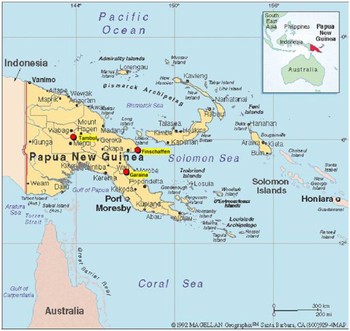
Papua New Guinea (PNG) is located in the South Pacific region from longitude 141°E to 156°E and latitude 1°S to 11°S, sharing a land border only with Indonesia to the East (Figure 1). It has a total land area of about 470 000 km2 constituting the mainland and more than 700 Islands including atolls. It is mostly mountainous with coastal lowlands and rolling foothills. The Owen Stanley Ranges, which has a peak elevation of 4 793 m at Mt. Wilhelm runs through the middle of the mainland of PNG from west to east. Up to 60 percent of the land mass is covered by pristine natural forest providing natural habitat to a wide range of flora and fauna (Kambuou, Reference Kambuou1996; MoA&L, 2004). It also has numerous rivers and over 5 000 lakes with an extensive system of marshes located on the north and south parts of the country.
Political map of Papua New Guinea and location of three sample sites (source: http://www.infoplease.com/atlas/country/papuanewguinea.html#axzz0zSNfxZKM 25 March 2010)

About 87 percent of the total population depend on subsistence agriculture for their livelihood. The main livestock species are pigs, poultry, cattle, goats, sheep and rabbits. Although PNG harbours large numbers of introduced exotic pigs of European origin, indigenous pigs are by far the most important to the farmers considering their social and cultural roles. They are raised by several hundred ethnic groups (Reilly, Reference Reilly2008) residing in various agro-ecological zones. Historically and culturally, pigs have been associated with PNG people much earlier than any other livestock species. However, the genetic structure and diversity of this invaluable resource remains unknown.
Introduction of pigs to PNG
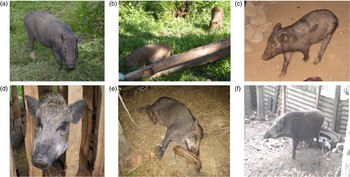
Archaeological and linguistic evidences have suggested the first introduction of pigs to PNG between 10 000 and 2 500 years ago (Hide, Reference Hide2003). However, the origin, taxonomy and diversity of the indigenous pigs of PNG are not well understood. Recent DNA evidence suggests that the indigenous pigs of PNG belong to the species Sus scrofa and were introduced by humans to the main island of PNG (Allen et al., Reference Allen, Matisoo-Smith and Horsburgh2001; Larson et al., Reference Larson, Dobney, Albarella, Fang, Matisoo-Smith, Robins, Lowden, Finlayson, Brand, Willerslev, Rowley-Conwy, Andersson and Cooper2005; Lum et al., Reference Lum, Mcintryre, Greger, Huffman and Vilar2006; Larson et al., Reference Larson, Cucchi, Fujita, Matisoo-Smith, Robins, Anderson, Rolett, Spriggs, Dolman, Kim, Thuy, Randi, Doherty, Due, Bollt, Djubiantono, Griffin, Intoh, Keane, Kirch, Li, Morwood, Pedrina, Piper, Rabett, Shooter, Van den Bergh, West, Wickler, Yuan, Cooper and Dobney2007). Larson et al. (Reference Larson, Cucchi, Fujita, Matisoo-Smith, Robins, Anderson, Rolett, Spriggs, Dolman, Kim, Thuy, Randi, Doherty, Due, Bollt, Djubiantono, Griffin, Intoh, Keane, Kirch, Li, Morwood, Pedrina, Piper, Rabett, Shooter, Van den Bergh, West, Wickler, Yuan, Cooper and Dobney2007) suggest that Austronesian-speaking people (Kirch, Reference Kirch1997), whose putative homeland was present-day Taiwan introduced pigs into the region some 3 500 years ago, although pigs involved were not of Taiwanese origin. They argued further that the so-called wild pigs of PNG are probably feral pigs derived from the initial introductions from Southeast Asia. This argument is supported by observations in some parts of the country where hunters capture young piglets alive and take them home to be raised (Figure 2c).
Indigenous pigs of Papua New Guinea. (a, b) Typical indigenous pigs seen in Nawaeb district; (c) captured wild pig being raised in confinement; (d) indigenous sow in a sty at Kabwum village in Finschhafen district; (e) a nursing indigenous sow in Finschhafen village, Finschhafen district. Piglets have ochre, chocolate and cream coloured stripes lengthwise over their bodies suggesting gene flow from wild pigs; (f) nursing indigenous sow in Tambul village, Tambul district.

Socio-cultural importance of pigs
In the largely traditional and subsistence rural communities of PNG, in particular in the fertile and densely populated highlands, pigs have strong socio-cultural significance. Pigs are culturally the most important animals used extensively in many forms of exchange, alms-giving, feasting, compensation and as symbols of social status and rank. Pigs are used for bride prize payments, as gifts to establish or maintain social relations and as payments to resolve social disputes or strengthen relationships between individuals, families, clans and tribes. Pigs are also slaughtered during initiation rites, funerals for the dead and during elaborate ceremonies or gatherings where feasting is involved. Lemonnier (Reference Lemonnier2002) surmises that the use of pigs in these ways symbolizes the transformation of strength and maleness embodied in the pig into a substitute or token of life suitable for compensation and exchange. In many parts of PNG, the number of pigs owned and their body size and conditioning is used to judge the social rank of a person. Furthermore, the pig husbandry system followed reflects gender relationships whereby women in some communities look after the pig but do not own them, although pigs cannot be disposed off without their consent (Dwyer, Reference Dwyer2006).
Traditional methods of pig breeding and feeding in PNG often portray cultural differences among various ethnic communities. In the central highlands and some lowland areas, boars are often castrated and sows mated with wild boars; young piglets are captured from the wild and either eaten or cared for by women who sometimes carry them in string bags or walk them on tether to food gardens till they reach maturity. In some coastal and eastern highland areas, however, wild pigs are less common. Availability of feed resources varies among various communities. For instance, surplus sweet potato tubers and vines are commonly used for feeding pigs in the Eastern Highlands province. Pigs are allowed to root in fallow food gardens and this is seen as a way of cultivating the land in some places. In coastal and island regions, however, coconuts, taro and sago are often used to feed pigs. All these differences in feeds and feeding system suggest that the indigenous pigs are adapted to dealing with various types of feeds.
Pig population
The pig population of PNG is not known with certainty. The frequently quoted figure is 1.8 million, estimated in 2003 (FAOSTAT, 2010). Quartermain (Reference Quartermain2002) estimated that at least one million of this population could be genetically isolated indigenous populations maintained by rural communities, with the rest being increasingly influenced by introduced and cross-bred pigs that are mainly raised by market-oriented pig farmers. Gibson and Rozelle (cited by Hide, Reference Hide2003) estimated the village (indigenous) pig numbers at 1.7 million in 1998 based on a sample of 830 rural households from different parts of PNG. The number of indigenous pigs per household in the four regions of Papua, Highlands, Momase and New Guinea Islands was 1.9, 3.3, 1.7 and 1.3, respectively.
The current pig population of PNG consists of indigenous, exotic and cross-bred pigs. Only one indigenous type is reported in FAO's Domestic Animal Diversity Information System (FAO, 2010). This is because indigenous pigs are regarded as non-descriptive type without any geographical pattern of morphological variation (Figures 1 and 2). However, it does not imply lack of variation among indigenous pigs. For instance, Near East sheep that are all of “generic type” phenotypically and not easy to tell apart, display much more genetic variation than readily distinguishable European breeds (Peter et al., Reference Peter, Bruford, Perez, Dalamitra, Hewitt and Erhardt2007). In addition to this, the preliminary analyses of microsatellite data also suggest the presence of at least four distinct populations of indigenous pigs in PNG (Nidup et al., Reference Nidup, Ayalew, Danbaro, Gongora and Moran2010). Therefore, indigenous pigs of PNG may be shown to have a high level of genetic variation in productive ability regardless of the fact that there is no obvious partitioning into breeds.
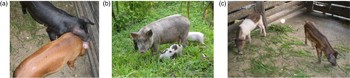
Exotic pigs (Figure 3a) are mostly European breeds, such as Large White, Landrace, Berkshire, Tamworth, Saddleback and Large Black. These breeds are mostly used for intensive commercial production and cross-breeding with the indigenous pigs (Figure 3b, c).
(a) Introduced exotic pigs of Large Black and Duroc origins; (b) Cross-bred sow with her highly heterogeneous looking piglets; (c) progenies of wild pig and improved or exotic sows. Large ear and belted-white phenotype suggest exotic pig origin while stripes indicate wild pig origin.

Cross-breeding between exotic and indigenous pigs was a policy of the Australian colonial government soon after Second World War in an effort to restock and improve pig populations which were devastated by the war in many parts of PNG (Malynicz et al., Reference Malynicz1973a, Reference Malyniczb; Hide Reference Hide2003). Unabated loose disseminations of these European breeds and their cross-breds now constitute a threat to the continued survival of indigenous pigs.
Importance of genetic diversity
Present and potential future animal production is underpinned by the genetic diversity in the existing breeding populations. Even though it is not clear whether or not the indigenous pigs of PNG belong to the same breed, it is conceivable that, through natural and artificial selection, the different populations found in various parts of the country, including those in geographically isolated valleys, plateaus and islands, may have accumulated various specific genetic adaptations to different environmental challenges leading to population differentiation. Indigenous pigs are vital for supporting household economies, livelihoods and cultures of a significant proportion of the human population. However, they have received very little attention from the policy-makers because they are regarded as “low producers” without considering important traits such as adaptability to poor feed quality, resistance to several diseases and adaptation to wide range of environments. It should be noted that indigenous pig genetic resources will continue to be useful for food security and rural development of current and future generations. To meet the needs of the present as well as future generations, it is necessary to document and characterize the indigenous pigs for conservation, promotion and sustainable utilization.
Objective of the study
This study was conducted in the larger framework of an analysis of genetic diversity in South Asian pigs (Nidup et al., unpublished data). It has the specific objectives of providing a preliminary phenotypic description of indigenous pigs and prevailing husbandry practices in major pig-growing regions of PNG as a prelude to the genetic analyses.
Materials and methods
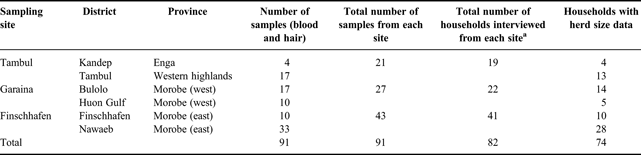
Three divergent sampling sites (Table 1; Figure 1) from major pig-raising areas of the country were selected for the study. The first site (Tambul) covered a wide area in the highlands region of the country from Kandep district in Enga province to Tambul district in the Western Highlands. The second site (Garaina) consisted of agriculturally fertile valleys in Bulolo and Huon Gulf districts in the west of Morobe province. The isolated villages in Finschhafen and Nawaeb districts on the east side of Morobe province were the third sampling areas (Finschhafen). Purposeful sampling was employed to identify major pig raising villages far from urban centres, which are considered less likely to have been influenced or contaminated by the expanding distribution of cross-bred pigs. Hair and blood samples of 91 pigs (Table 1) from three sampling sites were collected for microsatellite and mitochondrial DNA studies. At least 82 households from six districts of three provinces were interviewed on a semi-structured questionnaire (Table 1).
Number of households interviewed and samples collected from six districts of PNG.
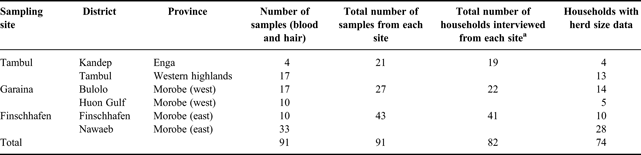
aSome households without herd size data were also interviewed.
Each of the respondents was asked to identify their indigenous pigs by breed type. The questionnaires covered origins and sources of pigs, reasons for keeping them, current herd sizes, husbandry practices as well as their perceptions of pig population trends. Linear body measurements, which were taken with standard measuring tape coated with plastic film graduated to the next half-centimetre, were recorded from adult pigs. The external body forms and appearances of pigs were also documented. Although every possible attempt was made to ensure that only households with indigenous pigs were included in the study, some of the households later revealed that one or more of their pigs were of mixed (cross-bred × indigenous) or of unknown genetic background. Data were collected between November 2009 and March 2010. Simple descriptive statistics were used to analyse these data.
Results and discussion
Local names and purpose of raising pigs
Three quarters of the respondents (n = 82, Table 1) mentioned local names of pigs, which appear to be local linguistic terms given to pigs in general (e.g. Buc, Ambi, Pi, Kong, and Kareh) and have some similarities between sampling sites. The names relate more to linguistic differences between sites rather than genetic distinctiveness of the pigs. Although indigenous and cross-bred pigs were clearly distinguishable, the term “breed” was neither clearly understood nor used. The pedigree observation on 91 “indigenous pigs” revealed that 19 percent have a known parent that is considered a cross-bred with either known exotic cross or an indigenous type from a distant source within the country. At site level, this figure is 14 percent for both Tambul and Finschhafen but as high as 30 percent for Garaina. This merely indicates the extent of spread of various levels of exotic cross-bred pigs but not necessarily commercialization tendencies.
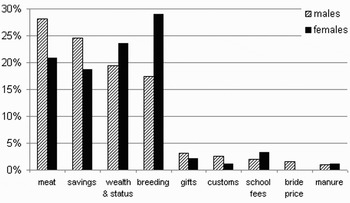
The main reasons of keeping pigs (Figure 4) are meat production (25 percent) followed by breeding (23 percent), wealth creation (22 percent) and savings (22 percent), with slight differences between those for males and females and between sites. Male pigs are preferred for meat, savings and bride prices, as are females for breeding and status symbol. The other reasons include needs to honour social obligations (gifts, deity), pay school fees and secure manure for farmyards.
Frequency of reported reasons for raising indigenous pigs (n = 91).

Sources of pigs
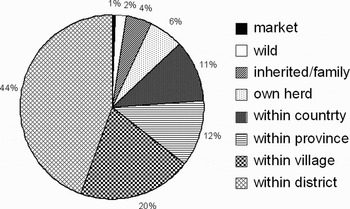
Over three quarters of the pigs originated from within the study district, 12 percent from outside the district in the same province and another 11 percent from a neighbouring province within the country, indicating a large-scale gene flow from one part of the country to another (Figure 5). Farmers also mentioned multiple sources of boars used in their herds. Only 12 percent reported using boars from their own herd, 39 percent used boars in their village, while 20 percent depended on communal boars. Half of the respondents did not have any control of mating as they rely on communal mating, or any available boar for mating. A few wild pigs (2 percent) also contributed as breeding boars.
Frequency of reported sources of sample indigenous pigs at study sites (n = 91).

Herd size and composition
The herd size differed between sampling areas ranging from 3.24 head in Tambul to 9.21 in Garaina (Table 2) with an average of 6.23 heads per household. Individual herd sizes ranged from 1 to 138. Breeding sows and boars constitute 14 and 8 percent, respectively, with the number of boars varying from zero to five.
Herd size and percentage of different categories of pigs in three sampling sites.

Eighty percent were identified by their owners as having known indigenous dam and boar parentage, whereas 20 percent had a mixed parentage of known and unknown genotype. One of the farmers maintained a breeding boar of feral origin. Two other boars with known feral parentage were also observed giving a total frequency of 4 percent for pigs regarded by owners as half-feral or wild.
Population trend
Farmers had mixed views on the population trend of the indigenous pigs. From the 64 responses, just over a third indicated that the population of indigenous pigs in their area is increasing while the rest indicated decreasing (31 percent), stable (30 percent) or unknown (5 percent) trends. Some of the reasons stated for a decreasing trend of indigenous pigs are decreased interest of farmers who have switched to other alternative livelihoods (41 percent), unavailability of breeding stock (29 percent), competition from exotic and cross-bred pigs (8 percent) and competition from pigs of neighbouring areas (8 percent).
Important traits
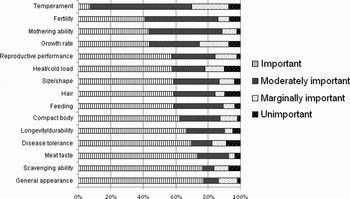
When pig owners were asked to indicate the importance of a selected set of common desirable production and adaptation traits as unimportant, marginally important, moderately important and important, at least half of the respondents identified the following traits as important in descending order of ranking; scavenging ability, meat taste, general appearance, compact body, feeding habits, coat hair cover and tolerance to heat or heat load, most of which relate to adaptation attributes (Figure 6). Traits that were least frequently identified as important were mothering ability, reproductive performance, general appearance and longevity/durability.
Rankings of importance of selected traits of indigenous pigs by their owners (n = 82) in three sampling sites.

External features
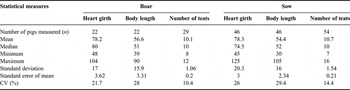
Overall breeding males measured 78.2 cm on heart girth and 56.6 cm on body length; the respective averages for sows were 78.3 and 54.4 cm (Table 3). But some of these values are those of growing boars and sows and hence cannot be taken as typical values of the adult populations. Females have from 7 to 16 teats when compared with males with 8 to 12 teats (Table 3).
Body measurements (cm) of breeding males and females.

Only preliminary descriptions of phenotype of the whole sample herd of 54 growing sows and 29 young boars sampled for genetic diversity study (Nidup et al., Reference Nidup, Ayalew, Danbaro, Gongora and Moran2010) are presented here:
The snout is often short (37 percent), cylindrical (34 percent) or elongated, thin and long (26 percent), but rarely (2 percent) concave. The head profile is mostly (79 percent) straight and convex profiles appear only in 6 percent of the cases. Slightly concave foreheads are also observed in low (15 percent) frequencies. Ear sizes can be small (27 percent), medium (57 percent) or large (16 percent), with mostly (88 percent) prick orientation. Few droopy (2 percent) and semi-lopping (10 percent) forms are also observed on both indigenous and admixture genotypes. Ear orientations are dominated by those that point upwards (65 percent) and backwards (24 percent), but some (11 percent) have forward pointing ears. Bristles are mostly (69 percent) found on the dorsal backline, and also form parallel lines on the backline (15 percent) or found scattered throughout the body (16 percent). The hair coat is normally straight (53 percent) and dense (18 percent); about 16 percent of pigs of both sexes have sparse hair throughout the body. Both smooth and wrinkled forms of skin are evenly observed on both sexes.
Tails on the indigenous pigs are normally straight (93 percent) but can also be curly or twisted (7 percent). None of the pigs identified as admixtures were observed with curly or twisted tails. Most pigs had normal udder, while 5 percent of pigs had asymmetrical udder. Most (83 percent) of the pigs were identified by their owners as having a placid and friendly temperament, with the rest 17 percent showing various levels of aggressiveness both in indigenous and admixture pigs.
Pig housing
No patterns were apparent in the type of housing provided, with semi-intensive sties and pens observed only in 41 percent of the sample households (Figure 2c–f). One in ten farmers keep their pigs tethered all the time around the homestead and gardens, and another 21 percent combine tethering and day-time scavenging. About one in ten pig farmers do not provide any shelter at all, and another 17 percent provide only night sheds, indicating that the rearing practices are predominantly of very low input. Generally, farmers reside in village settlements with at least several households residing close together, with the food gardens not far away. It is therefore expected that pigs are often tethered or kept in pen enclosures around the homestead.
Feeding and watering
Only 10 percent of the pig farmers mentioned the use of commercial feeds, which were fed to their pigs at least once a week. The majority of farmers use a variety of local feeds (52 percent), let the animals freely scavenge (9 percent) or a combination (29 percent) of these two. Supplementary feeds are provided twice a day in some cases. Water supply to pigs was never mentioned as a constraint to pig production, but when water is made available, it is mostly (71 percent) supplied once everyday.
Relevant policy and legislation
PNG needs a national strategy for the identification, sustainable use and conservation of its pig genetic resources. Such a strategy is needed to provide direction and guidance to maintain and develop the vital livelihood support and socio-cultural services of PNG indigenous pigs in much of the country. It can provide a common platform for interaction and collaboration between various stakeholders such as livestock owners and farmers, policy-makers, scientists, private sector, civil society organizations and donors. In planning the effective use of this genetic resource, it is necessary to take account of limited human and financial resources available within the country. It is therefore important to engage all stakeholders in drawing up a national strategy to ensure comprehensive understanding of the potential of these pig genetic resources towards their optimal utilization for the benefit of present generations without unduly compromising options for future generations.
A critical constraint towards the development of a national strategy is the incomplete (or lack of) baseline information on the identity, diversity, distribution, utilization and current status of the indigenous pig genetic resources of the country. It is a general concern that in the face of uncontrolled continued spread of exotic and cross-bred pig genotypes through commercialization in hitherto unaffected natural habitats of PNG indigenous pig populations, no indigenous pig genetic evaluation or improvement activities are underway or firmly planned. This is compounded by the inadequate technical and logistic capacity in the design and operationalization of appropriate programmes for the management of pig genetic resources.
PNG has legislation governing quarantine and sanitary aspects of management of animal genetic resources, implemented by the National Agricultural Quarantine and Inspection Authority. This legislation prevents indiscriminate import of animal genetic materials and imposes strict quarantine protocols in the movement of both indigenous and exotic genetic resources into and out of the country. A standard (generic) germplasm transfer form is also available to regulate the import and export of live animals or biological samples from them. However, no action is being taken to at least sensitize the general public on the negative long-term effects of uncontrolled distribution of unknown grades of cross-bred pigs emanating from commercial piggeries for mating in the villages. The unintended and undesirable consequences of indiscriminate mating of these crosses with indigenous pig populations need to be discussed at various research and development forums in the country and acted upon.
Existing sanitary and quarantine legislation concerning food production standards does not affect the actual use, development and conservation of animal genetic resources. There is not a single operational conservation farm or herd of indigenous pigs in the country, although the National Agricultural Research Institute (NARI) plans to establish such herds at Labu in the lowlands and/or Tambul in the highlands.
Needs for research and development
A primary consideration for research and development of PNG indigenous pigs is a need to have a national inventory of the indigenous pig genetic resources and their production environment through a baseline survey. This study should also cover estimation of pig population size, their structure and dynamics. Along with comprehensive phenotypic characterization, the genetic differentiation of PNG indigenous pig populations needs to be explored through molecular genetic studies. The apparently age-long practice of castrating boars in village herds to allow sows to mate with wild pigs may have genetic significance. Sampling of wild (feral) pigs in PNG may be needed to provide molecular genetic data that could be integrated with available morphological and biogeographical information to help elucidate the origin, taxonomic affinities and level of differentiation among the different populations of indigenous pigs of PNG. This could help to identify evolutionarily significant units (Moritz, Reference Moritz1994) and the planning of management plans for indigenous pigs in PNG.
As established through nation-wide stakeholder consultation by NARI, the public livestock research system should focus on addressing: (1) inadequate feeds and nutrition for both subsistent and commercial production operations; (2) high mortality of piglets and (3) low reproductive rates (NARI 2006a, b). Action is also needed to address the limited preparedness to manage likely major outbreaks of contagious diseases such as swine flu and swine cholera. The public veterinary services do not have the capacity to handle this. Although a limited number of large commercial piggeries continue to struggle with rising cost of feed made from imported ingredients, the formal pork market supplies imported cuts at competitive prices. On the other hand, emerging smallholder market-oriented pig growers, required to comply with safety standards to enter the market chain, are constrained by limited capacity as well as high cost of public inspection protocols. These policy related issues need to be closely investigated with the view of encouraging participation of smallholder farmers in the fast growing domestic pig meat market and providing immediate incentives for sustainable use of indigenous pigs in the country.
Conclusion and recommendations
The largely indigenous but loosely interbreeding population of pigs of PNG has considerable economic, genetic and cultural significance to the people of PNG. This population has remained under continuous genetic introgression from introduced local and cross-bred pigs from commercial piggeries as well as from public extension services that unsuccessfully promoted cross-breeding with exotic pigs to increase subsistent pig production at village level. To date even in isolated rural villages up to a third of pigs maintained by subsistent pig farmers are considered to be admixtures of indigenous and introduced genotypes. A third of surveyed pig farmers believe that the population of indigenous pigs is decreasing, while another third thinks it is on the increase.
Local names of PNG indigenous pigs do not suggest breed identities, and animals show variable body form and appearance across major pig growing areas of the country. Village pig herds range in size from 1 to 138, with an overall average of 6.23. Breeding boar numbers vary from zero to five, but only 12 percent reported to be using their own boar, whereas the rest mentioned use of boars in their village (39 percent), rely on known communal boars (20 percent), or opt to leave the sows to freely mate. Very little, if any, external inputs are used in raising pigs, and much of feed comes from scavenging, garden fodder and kitchen waste.
The genetic differentiation of this population is yet to be explored. It is therefore recommended that a nation-wide baseline survey of indigenous pig populations be conducted to identify and document genetically distinct indigenous pig populations in the country to provide the basis for a national management plan. It is also recommended that comprehensive molecular genetic studies be undertaken to elucidate the genetic attributes and differentiation of this probably unique genetic resource.
Acknowledgements
We would like to thank Irene Hoffman, FAO, Rome, for making this collaborative project on Genetic Diversity of Indigenous Pigs of Papua New Guinea possible between the University of Sydney, National Agricultural Research Institute of PNG and The PNG University of Technology. We thank several staff of NARI at Labu and Tambul for their assistance in field data collection. We would also like to express our gratitude to all the participant farmers for their permission to collect data from their pigs and for sharing their views with us.