Introduction
Flexible laryngoscopy is a commonly performed procedure in otolaryngology. It is regarded as the ‘gold standard’ for evaluating the larynx and hypopharynx. The procedure is used in the diagnosis, pre-operative planning and functional evaluation of swallowing and voice disorders.Reference Holsinger, Kies, Weinstock, Lewin, Hajibashi and Nolen1
Although flexible laryngoscopy is not considered painful, many patients describe it as uncomfortable. A number of different medications have been reviewed for their ability to reduce discomfort during flexible laryngoscopy. These include nasal decongestants, topical cocaine, local anaesthetics, lubricants and saline irrigation.Reference Leder, Ross, Briskin and Sasaki2–Reference Singh, Brockbank and Todd5 Indeed, at our institution, co-phenylcaine spray (5 per cent lignocaine plus 0.5 per cent phenylephrine) is routinely used (costing £11.48 per application6). The value of these therapies prior to endoscopy is debatable, and, aside from the financial implications, their use can in some cases even increase procedure-related discomfort.Reference Johnson, Belafsky and Postma7
In order to negate the costs and possible side effects of these medications, we assessed an alternative method of pain relief, through the use of visual distraction. This has successfully been used in other procedures, including aural microsuction, with promising results.Reference Choudhury, Amer, Daniels and Wareing8 To that end, we undertook an audit of clinical practice at the University Hospital Southampton NHS Foundation Trust, examining the use of visual distraction and local anaesthetic in patients undergoing flexible laryngoscopy.
Materials and methods
Ethical considerations
This study, conducted as an audit of surgical practice, was registered with the University Hospital Southampton NHS Foundation Trust research and development department. All treatments used within the audit formed part of routine clinical practice.
Study design
Patients were fully informed about the nature of the audit prior to enrolment. The study included patients undergoing flexible laryngoscopy as part of routine practice within the emergency otolaryngology clinic at the University Hospital Southampton NHS Foundation Trust (during January 2014). Any patient who had previously undergone flexible laryngoscopy was excluded.
All patients underwent flexible laryngoscopy performed by one of two senior ENT core trainees (with prior experience of conducting the procedure). All procedures were undertaken in the same room, with standardised equipment, and a standardised process of examination and explanation.
Pre- and post-procedural discomfort assessments were undertaken using a visual analogue scale (VAS; Figure 1); the difference in scores was calculated to provide a procedure-specific discomfort score.
Pre- and post-procedural discomfort assessments, using a visual analogue scale.

Patients were asked whether they would like to receive co-phenylcaine anaesthetic spray and/or simultaneously view the procedure on a television screen (visual distraction). Thus, each patient fell into one of four groups: (1) topical anaesthetic spray (co-phenylcaine spray with 5 minute interlude), without visual distraction; (2) topical anaesthetic spray (co-phenylcaine spray with 5 minute interlude), with visual distraction (simultaneously viewing their procedure on a television screen); (3) no topical anaesthetic spray, without visual distraction; and (4) no topical anaesthetic spray, with visual distraction.
Statistical analysis
A power calculation was undertaken, using the results from a similar study examining visual distraction during aural microsuction. This revealed that the inclusion of 24 patients would provide an adequately powered study (over 80 per cent).Reference Choudhury, Amer, Daniels and Wareing8 The first six patients enrolled into each of the four groups described above were included in the data analysis; this ensured a degree of data standardisation, with equally sized groups. Data were collated and analysed using Microsoft Excel® spreadsheet software (2009), with statistical analysis performed in SPSS software, version 20 (IBM, Washington, DC, USA), using independent t-tests (statistical significance achieved at p < 0.05).
Results
In total, 24 adult patients were included in the study. All patients were assessed for laryngeal or pharyngeal pathology, including possible foreign bodies, tonsillitis and hoarseness, and underwent pre-operative vocal fold checks prior to thyroid surgery. The average patient age was 47 years, and there was an even sex ratio within the groups.
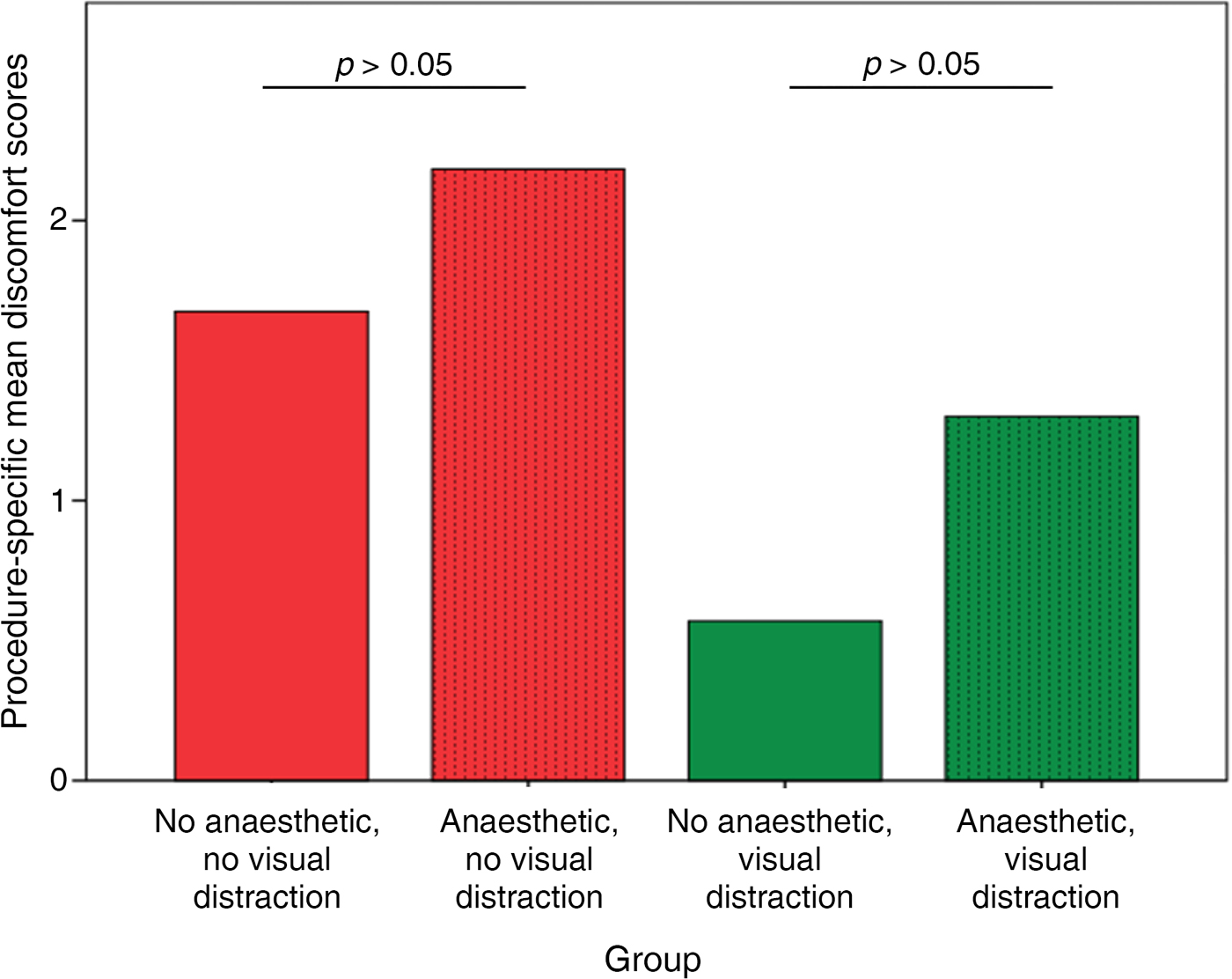
Procedure-specific discomfort scores were low in all groups, with a mean of 1.4 out of 10 (range, 0–3.2). There were no statistically significant differences in: operator scores, nostril used, procedural difficulty, or normal or abnormal examination findings (p > 0.05).
Figure 2 reveals that the use of topical anaesthetic spray was not associated with significantly reduced discomfort scores. The highest discomfort score was seen in those who received the anaesthetic spray, but without visual distraction. The lowest score was found in those who had no anaesthetic, but received visual distraction.
Procedure-specific mean discomfort scores within the four groups. The use of topical anaesthetic spray was not associated with significantly reduced discomfort scores.

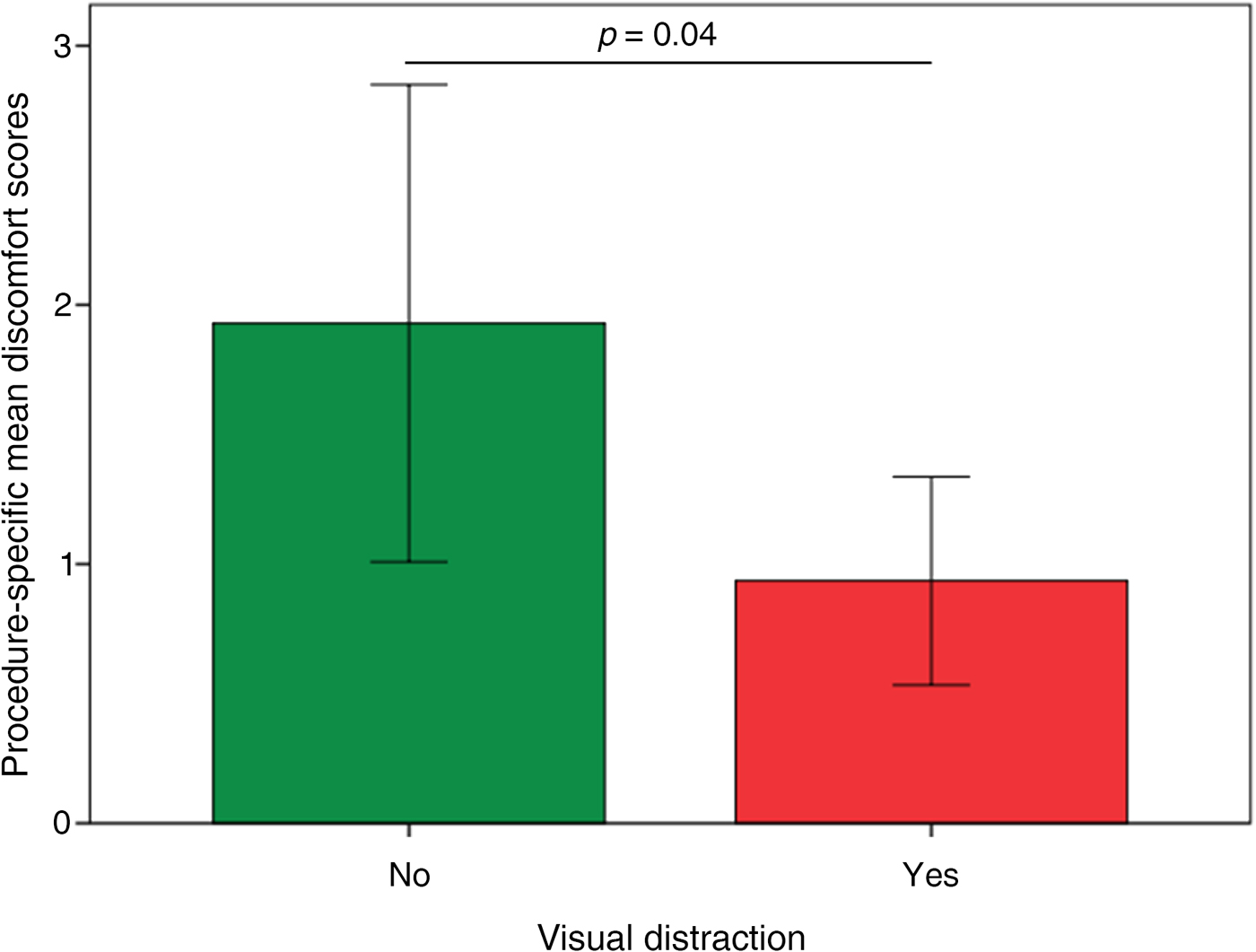
Figure 3 reveals that discomfort scores were significantly reduced when using visual distraction, with or without the use of topical anaesthesia (p = 0.04). Procedure-specific mean discomfort scores were: 0.94 in the visual distraction groups and 1.93 in the no visual distraction groups. When asked post-procedure, 67 per cent of all patients would opt to view the procedure in the future, rising to 83 per cent in those who were exposed to visual distraction.
Procedure-specific mean discomfort scores for the visual distraction versus no visual distraction groups, regardless of topical anaesthetic application. Visual distraction significantly reduced procedure-specific mean discomfort scores, irrespective of topical anaesthetic use. Error bars represent 95 per cent confidence intervals.

Discussion
This study aimed to assess the effect of visual distraction on patient-reported discomfort during flexible laryngoscopy. Visual distraction was shown to reduce overall discomfort and improve patient experience. Indeed, it was superior to the use of a topical anaesthetic spray. Viewing the procedure can also be of value when educating patients. Visual distraction should be considered as a simple and cost-effective alternative to local anaesthetic, or be used in routine practice for the additional benefit of improved patient education.
A number of previous studies have examined visual distraction as a means of pain relief; most commonly, patients view their examination simultaneously, on the same monitor used by the clinician. In previous studies, there was a statistically significant decrease in discomfort, measured using VAS scores, for procedures including colonoscopy, lithotripsy and aural microsuction.Reference Choudhury, Amer, Daniels and Wareing8–Reference Marsdin, Noble, Reynard and Turney10 As the facilities to undertake this form of visual distraction are readily available, it provides a cost-effective alternative to analgesia, which in this study was superior to a topical anaesthetic spray.
• Flexible laryngoscopy is a commonly performed procedure in otolaryngology
• Although not painful, the procedure can be uncomfortable; thus, local anaesthetic spray use is common
• In this study, topical anaesthetic spray use was not associated with significantly reduced discomfort scores
• Visual distraction significantly reduced procedure-specific mean discomfort scores, irrespective of topical anaesthesia use
• Visual distraction is a simple and cost-effective alternative to local anaesthetic for flexible laryngoscopy
The value of topical anaesthetic spray for flexible laryngoscopy has been questioned previously. A randomised clinical trial undertaken by Leder et al. found no improved tolerance of the procedure (performed by experienced individuals) when topical anaesthetic was used, compared with placebo.Reference Leder, Ross, Briskin and Sasaki2 However, a study by Johnson et al. did find improved patient tolerability scores in topical anaesthetic groups as compared to placebo.Reference Johnson, Belafsky and Postma7 These results match anecdotal evidence, with some clinicians offering topical anaesthetics, whilst others do not.
The current study is unique, as it is the first to examine an alternative form of pain relief, visual distraction, to improve flexible laryngoscopy tolerability. Viewing of the procedure is likely to be undertaken by many otolaryngologists currently. The findings highlight an alternative to a costly and sometimes unpleasant topical anaesthetic.
Study limitations
This study was limited by its small size and low number of operators. In addition, because this study was undertaken as an audit of clinical practice, patients choose which group they are assigned to, and the results are analysed based on these choices. This is likely to have biased the results. However, we feel that this study has highlighted the potential effectiveness of visual distraction as a form of pain relief during flexible laryngoscopy. These results can be used to provide patients with an informed choice in the future, and provide a low-cost alternative to local anaesthetic sprays.
Competing interests
None declared.