Various modifications of the Fontan procedure have been developed to manage patients with a single ventricle. At this stage of palliation, blood is primarily pulled through the pulmonary circulation by the active force of ventricular relaxation with little impetus for antegrade flow. Accordingly, pulmonary and systemic blood flow may be adversely affected by a relatively small increase in pulmonary vascular resistance. Studies have historically reported worse outcome following Fontan palliation in patients with higher pulmonary arterial pressures.Reference Choussat, Fontan, Besse, Anderson and Shinebourne1–Reference Day, Etheridge and Veasy3 A poor outcome may also be associated with decreased proximal pulmonary artery size and late changes of intimal thickening and medial thinning in intra-acinar pulmonary arteries.Reference Ridderbos, Wolff and Timmer4,Reference Ridderbos, Bonenkamp and Meyer5 Pulmonary vasodilators improve the functional capacity of some patients with pulmonary arterial hypertension and normal ventricular anatomy. Some have proposed that pulmonary vasodilators might likewise improve the outcome of some patients with a Fontan procedure.Reference Beghetti6,Reference Gewillig, Brown, van der Bruaene and Rychik7 However, pulmonary vasodilators have often failed to improve unequivocal endpoints of efficacy in this setting.Reference Rhodes, Ubeda-Tikkanen and Claire8–Reference Goldberg, Zak and Goldstein20 Previous studies have potentially failed to focus on a subset of patients with relatively high pulmonary vascular resistance and a potentially greater probability of responding favourably to targeted therapy. The results of heart catheterisation and acute vasodilator testing in a subset of patients were reviewed to determine whether some patients acutely respond more favourably to sildenafil and might be candidates for precision care with a phosphodiesterase V inhibitor long term.
Materials and methods
The Institutional Review Board of the University of Utah (75 South 2000 East, Salt Lake City, UT, United States 84112) provided permission for a retrospective review of the medical records of patients in this study. Heart catheterisation and acute vasodilator testing with intravenous sildenafil were performed in 11 patients following Fontan palliation. The indications for haemodynamic measurements were the primary cardiologists’ concerns for heart failure, oedema, or liver disease. Measurements of mean pulmonary arterial pressure, mean atrial or mean pulmonary arterial wedge pressure, and systemic arterial pressure were performed while patients were managed with general anaesthesia and assisted ventilation. The transpulmonary gradient was determined by the difference between mean pulmonary arterial pressure and mean atrial or mean pulmonary arterial wedge pressure. Indexed pulmonary blood flow, indexed systemic blood flow, indexed pulmonary vascular resistance, and indexed systemic vascular resistance were calculated using estimates of oxygen consumption and the Fick principle. However, calculations of flow and resistance should be interpreted cautiously because the Fick principle is limited in the setting of surgical fenestrations, collateral blood flow through systemic arteries to pulmonary arteries, collateral blood flow through systemic veins to pulmonary veins or the atrium, and flow from the coronary sinus to the atrium.
The phases of vasodilator testing varied for individual patients. One patient was evaluated with sildenafil after initial baseline measurements with 30% oxygen. Seven patients were evaluated with sildenafil after initial baseline measurements with 21–25% oxygen and subsequent measurements with 100% oxygen. Two patients were evaluated with sildenafil after initial baseline measurements with 21–22% oxygen, measurements with 100% oxygen, and subsequent measurements with 21–22% oxygen. One patient was evaluated with sildenafil after initial baseline measurements with 25% oxygen, measurements with 100% oxygen, measurements with 100% oxygen and 20 parts per million nitric oxide, and subsequent measurements with 25% oxygen. The haemodynamic measurements for this study were performed before and after treatment with intravenous sildenafil with the fraction of inspired oxygen held constant. Sildenafil was given in incremental doses over a period of 10–15 minutes until a total dose of 0.20 mg/kg was given or a 10% decrease in mean systemic arterial pressure was observed.
Results (mean ± standard deviation) were compared by paired t-tests to identify statistically significant changes (p < 0.05) in response to sildenafil and unpaired t-tests to identify significant differences (p < 0.05) between patient subgroups.
Results
Vasodilator testing
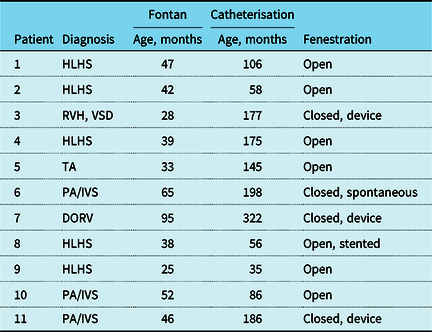
Demographic information for individual patients is listed in Table 1. Five female and six male patients were evaluated at a median age of 145 months (range of 35 to 322 months). Fontan procedures were performed at a median age of 42 months (range 25 to 95 months). Fontan palliation was performed using a lateral tunnel with a fenestration in 1 patient and an extracardiac conduit with a fenestration in 10 patients. A fenestration was patent at the time of heart catheterisation in seven patients. The fenestration was transiently occluded in patient 1 during haemodynamic measurements. None of the patients had angiographic evidence of large enough collateral vessels to warrant occlusion with vascular coils or plugs.
Demographic information

DORV = double-outlet right ventricle; HLHS =hypoplastic left heart syndrome; PA/IVS = pulmonary atresia with an intact ventricular septum; RVH = right ventricular hypoplasia; VSD = ventricular septal defect; TA = tricuspid valve atresia.
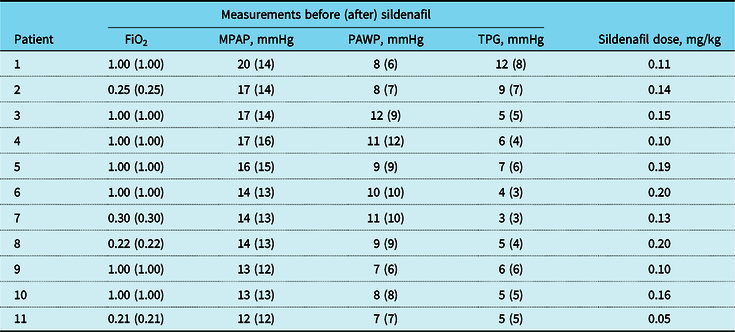
Patients were treated with a mean and median sildenafil dose of 0.14 mg/kg (range 0.05–0.20 mg/kg). The pulmonary haemodynamic measurements and doses of sildenafil for individual patients are shown in Table 2. Patient 1 and patient 10 were being treated with sildenafil before heart catheterisation. Sildenafil was held at least 10 hours prior to their haemodynamic evaluations. The median mean pulmonary arterial pressure was 14 mmHg (range of 12 to 20 mmHg). The median transpulmonary gradient was 5 mmHg (range of 3 to 12 mmHg). Except for patients 3 and 9, patients with a mean pulmonary arterial pressure greater than 14 mmHg had a transpulmonary gradient greater than 5 mmHg and patients with a mean pulmonary arterial pressure less than or equal to 14 mmHg had a transpulmonary gradient less than or equal to 5 mmHg.
Individual pulmonary haemodynamic measurements

FiO2 = fraction of inspired oxygen; MPAP = mean pulmonary arterial pressure; PAWP = mean pulmonary arterial wedge or mean atrial pressure; TPG = transpulmonary gradient.
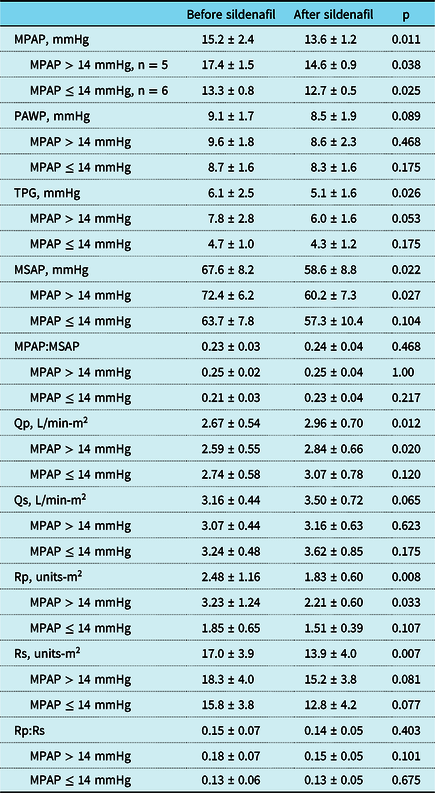
Table 3 summarises the collective changes in haemodynamic measurements and calculations for all patients, patients with a mean pulmonary arterial pressure greater than 14 mmHg, and patients with a mean pulmonary arterial pressure less than or equal to 14 mmHg. Collectively, sildenafil treatment was associated with acute changes in mean pulmonary arterial pressure, transpulmonary gradient, mean systemic arterial pressure, indexed pulmonary blood flow, indexed pulmonary vascular index, and indexed systemic vascular index.
Collective haemodynamic measurements and calculations

Haemodynamic measurements and calculations are expressed and mean ± standard deviation.
MPAP = mean pulmonary arterial pressure; MSAP = mean systemic arterial pressure; PAWP = mean pulmonary arterial wedge or mean atrial pressure; Qp = indexed pulmonary blood flow; Qs = indexed systemic blood flow; Rp =indexed pulmonary vascular index; Rs=indexed pulmonary vascular index; TPG = transpulmonary gradient
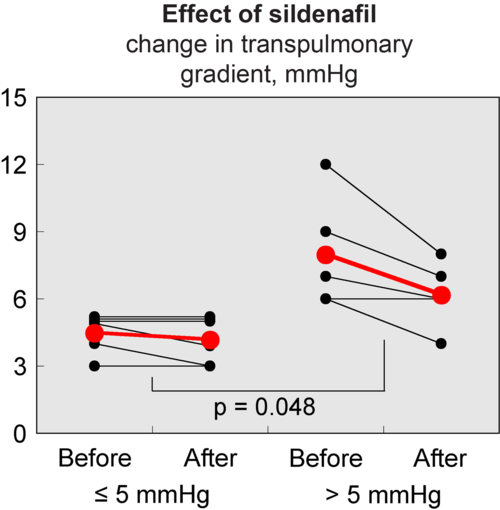
Figure 1 shows that the change in mean pulmonary arterial pressure with sildenafil was greater for patients with a mean pulmonary arterial pressure greater than 14 mmHg versus patients with a mean pulmonary arterial pressure less than or equal to 14 mmHg. Figure 2 shows that the change in transpulmonary gradient with sildenafil was greater for patients with a transpulmonary gradient greater than 5 mmHg versus patients with a transpulmonary gradient less than or equal to 5 mmHg. The only patient with a transpulmonary gradient greater than 5 mmHg who did not experience a decrease in transpulmonary gradient had a mean pulmonary arterial pressure of 13 mmHg. Changes in pulmonary arterial wedge pressure, indexed pulmonary blood flow, indexed systemic blood flow, indexed pulmonary vascular resistance, and indexed systemic vascular index were not significantly different for patients with a mean pulmonary arterial pressure greater than 14 mmHg versus patients with a mean pulmonary arterial pressure less than or equal to 14 mmHg.
Effect of sildenafil on mean pulmonary arterial pressure. Median mean pulmonary arterial pressure was 14 mmHg. The mean dose of intravenous sildenafil was 0.14 mg/kg (range 0.10–0.19 mg/kg) for patients with a mean pulmonary arterial pressure greater than 14 mmHg and 0.14 mg/kg (range 0.05–0.20 mg/kg) for patients with a mean pulmonary arterial pressure less than or equal to 14 mmHg. Sildenafil was associated with a greater change in mean pulmonary arterial pressure in patients with a mean pulmonary arterial pressure greater than 14 mmHg. Black: individual measurements of pressure, red: mean values of pressure.

Effect of sildenafil on transpulmonary gradient. Median transpulmonary gradient was 5 mmHg. The mean dose of intravenous sildenafil was 0.13 mg/kg (range 0.10–0.19 mg/kg) for patients with a transpulmonary gradient greater than 5 mmHg and 0.15 mg/kg (range 0.05–0.20 mg/kg) for patients with a transpulmonary gradient less than or equal to 5 mmHg. Sildenafil was associated with a greater change in transpulmonary gradient in patients with a transpulmonary gradient greater than 5 mmHg. Black: individual measurements of pressure, red: mean values of pressure.

Long-term outcome
Patients 3 and 7 were not treated with a phosphodiesterase V inhibitor long term following heart catheterisation. Care providers started or continued all other patients on sildenafil or tadalafil after heart catheterisation independent of their acute vasodilatory response. However, patient 10 was only treated with sildenafil for 5 months after heart catheterisation. Patient 1 had a mean pulmonary arterial pressure of 20 mmHg and a transpulmonary gradient of 12 mmHg and underwent heart transplantation 9 months after heart catheterisation despite long-term treatment with oral sildenafil. His care providers did not treat him with additional pulmonary vasodilators before transplantation. Patient 6 had a mean pulmonary arterial pressure of 14 mmHg and a transpulmonary gradient of 4 mmHg and underwent heart transplantation 5 months after heart catheterisation due to long-standing protein-losing enteropathy despite long-term treatment with oral sildenafil. All remaining patients are alive without heart transplantation 12–107 months following heart catheterisation.
Follow-up haemodynamic evaluations have been performed in two patients after long-term treatment with oral sildenafil. Patient 2 had a similar acute response to nitric oxide and sildenafil. He was initially treated with amlodipine due to an initial lack of insurance coverage for sildenafil. Problems with generalised oedema did not improve while being treated with amlodipine. However, his oedema improved and he experienced a decrease in mean pulmonary arterial pressure from 17 mmHg to 14 mmHg and a decrease in transpulmonary gradient from 11 mmHg to 9 mmHg after 7 months of treatment with oral sildenafil. His mean pulmonary arterial pressure further decreased to 13 mmHg and his transpulmonary gradient further decreased to 5 mmHg after 2 years of treatment with a combination of oral sildenafil and oral ambrisentan. Patient 9 experienced an increase in mean pulmonary arterial pressure from 13 mmHg to 17 mmHg, as well as 4 mmHg increase in pulmonary arterial wedge pressure, with no change in transpulmonary gradient after 57 months of treatment with oral sildenafil.
Discussion
Sildenafil acutely decreased mean pulmonary arterial pressure and transpulmonary gradient in this cohort of patients following Fontan palliation. However, the changes primarily occurred in patients with mean pulmonary arterial pressures and transpulmonary gradients that exceeded median values of 14 mmHg and 5 mmHg, respectively.
An elevated mean pulmonary arterial pressure is a time-proven predictor of outcome with Fontan palliation.Reference Choussat, Fontan, Besse, Anderson and Shinebourne1–Reference Day, Etheridge and Veasy3 Small increases in pulmonary vascular resistance may impede blood flow in patients without a subpulmonary ventricle. Intuitively, pulmonary vasodilators should improve pulmonary blood flow, improve exercise tolerance, and contribute to an improved long-term outcome following Fontan palliation. However, the active process of ventricular relaxation is also a major determinant of pulmonary and systemic blood flow. Patients with diastolic ventricular dysfunction may fail to pull blood through the lung well, even if their pulmonary vascular resistance is normal. Collateral arterial and venous connections may also influence pulmonary blood flow and the risk of complications in Fontan patients. Accordingly, pulmonary vasodilators may not be beneficial for all patients. This study shows that sildenafil primarily improves direct measurements of mean pulmonary arterial pressure in patients with a relatively high mean pulmonary arterial pressure. Sildenafil was also associated with an increase in the estimate of pulmonary blood flow using the Fick principle. This study does not provide unequivocal evidence that the acute effects of sildenafil on mean pulmonary arterial pressure and pulmonary blood flow will be sustained with long-term treatment.
Goldberg and associates have reported that sildenafil and udenafil fail to improve oxygen consumption at peak exercise; however, both agents may increase oxygen consumption at the anerobic threshold in some patients.Reference Goldberg, French and McBride11,Reference Goldberg, Zak and Goldstein20 Arguably, this may improve the functional capacity of patients during submaximal exercise. However, the magnitude of improvement in oxygen consumption at the anaerobic threshold that will make patients feel or function noticeably better is unknown. The magnitude of improvement in oxygen consumption at the anerobic threshold that will prevent complications of Fontan palliation is also unknown. If Goldberg and associates had compared patients based upon their mean pulmonary arterial pressures, we might know whether treatment significantly improved oxygen consumption at peak exercise in a subset of patients, as well. Additional studies are needed to determine whether pulmonary vasodilators are beneficial for all Fontan patients or whether therapy should be targeted for precision care in patients with higher mean pulmonary arterial pressures and higher transpulmonary gradients.
This study has two major limitations. First, only a small number of patients were studied. The analysis identified significant effects of sildenafil on mean pulmonary arterial pressure and transpulmonary gradient. Smaller effects in haemodynamic calculations could have been overlooked (type II error), especially for comparisons between patients in different subgroups based upon mean pulmonary arterial pressure or transpulmonary gradient. Second, there is a paucity of information concerning the long-term effect of sildenafil in these patients. However, the available long-term observations suggest that treatment with a phosphodiesterase V inhibitor alone may not prevent the need for heart transplantation due to a high pulmonary arterial pressure; may not prevent the need for heart transplantation due to protein losing enteropathy without a corresponding high pulmonary arterial pressure; and may not prevent a progressive decrease in diastolic ventricular function. Additional limitations of this study were related to methods employed during heart catheterisation. The results were evaluated retrospectively and a standard evaluation of vasodilator testing with supplemental oxygen was not used. However, the amount of supplement oxygen was held constant during each evaluation with sildenafil. Haemodynamic measurements with assisted ventilation during anaesthesia in a supine position may not correspond well with pressures during activities of daily living. Furthermore, the Fick principle is an imperfect method for calculating blood flow following Fontan palliation. MRI may be used to more accurately measure pulmonary blood flow. However, our institution is currently unable to perform MRI during heart catheterisation. For these reasons, direct pressure measurements were the focus of this study.
In conclusion, sildenafil acutely decreased mean pulmonary arterial pressure and transpulmonary gradient following Fontan palliation. However, improvement primarily occurred in patients with relatively high values of mean pulmonary arterial pressure and transpulmonary gradient. It is possible that the subset of patients with relatively high pressures who have a favourable acute response to intravenous sildenafil will also have a favourable long-term response to treatment with a phosphodiesterase V inhibitor.
If so, acute vasodilator testing may help to identify the most appropriate patients for pulmonary vasodilators. We have an opportunity in patients with Fontan palliation to focus future studies on precision care, treating the right patient with the right agent, to determine whether a subset of patients will experience meaningful and unequivocal improvement from pulmonary vasodilators.
Acknowledgements
None.
Financial support
This research received no specific grant from any funding agency, commercial or not-for-profit sectors.
Conflicts of interest
Ronald Day has no conflict of interest.
Ethical standards
The Institutional Review Board of the University of Utah approved this study (IRB_00033414) and waived the need for informed consent.