Significant outcomes
∙ The oxidative status in earthquake survivors with PTSD has not been explored before.
∙ Our study suggests that the total oxidant and antioxidant status may not influence earthquake survivors with PTSD.
Limitations
∙ Small sample size of the study.
∙ All the participants had survived the earthquake.
Introduction
Earthquakes are one of the most destructive and life-threatening natural disasters, because of the high mortality associated with it. Despite the fact that earthquakes are devastating natural disasters that are experienced more often, less attention is drawn to risk factors and post-earthquake mental health responses. Furthermore, earthquakes can cause serious physical injuries, the death of a loved one, and significant economic loss (Reference Basoglu, Kilic, Salcioglu and Livanou1). On the 23rd of October 2011 and on the 9th of November 2011, in the Van region located in eastern Turkey, two earthquakes measuring 7.2 and 5.7, respectively, on the Richter scale occurred. According to the Disasters and Emergency Situations Directorate (AFAD) of Turkey, 644 people were killed, 252 people were rescued from the rubble, and 1.966 people were injured in the two earthquakes (2).
People exhibit a variety of emotional responses to natural disasters. Many responses may be normal, but some can lead to mental disorders, such as post-traumatic stress disorder (PTSD). PTSD is a common and chronic mental disorder that anyone who has been exposed to a violent trauma has the potential to develop (Reference Bunting, Ferry, Murphy, O’neill and Bolton3). PTSD patients have memories of the traumatic event that they relive again and again (i.e. flashbacks, nightmares, preoccupation with thoughts or images of the event). They avoid people and places associated with the trauma and are hyper-aroused (irritability, difficulty sleeping, trouble concentrating, hyper-vigilant). Some previous studies have reported that the prevalence of PTSD among earthquake survivors range from 3% to 87%. It varies based on cultures and socio-demographic characteristics (Reference Basoglu, Salcioglu and Livanou4).
There is mounting evidence indicating that oxidative stress is involved in the induction and development of many different forms of psychiatric disorders (Reference NG, Berk, Dean and Bush5). During physical and physiological stress, the underlying mechanisms involved are the activation of the hypothalamic–pituitary–adrenal axis and sympatho–adrenal–medullary systems, causing the release of corticosterone along with the release of catecholamines. Furthermore, the elevation in the catecholamine levels produces free radicals, which may provoke oxidative stress (Reference Huang, Webb and Evans6). It has been declared that free oxygen radicals are increased in psychiatric disorders such as schizophrenia (Reference Herken, UZ, Ozyurt, Sogut, Virit and Akyol7–Reference Yanik, Vural and Kocyigit9), bipolar disorder (Reference Frey, Andreazza and Kunz10,Reference Selek, Savas, Gergerlioglu, Bulbul, UZ and Yumru11), anxiety disorders (Reference Hovatta, Juhila and Donner12,Reference Bouayed, Rammal and Soulimani13), obsessive compulsive disorder (Reference Selek, Herken and Bulut14), and substance use (Reference NG, Berk, Dean and Bush5). Although it is known that PTSD develops in response to a stressful event or situation, the results of the previous studies about PTSD seem to be unsatisfactory (Reference Tezcan, Atmaca, Kuloglu and Ustundag15,Reference Attari, Naderi Attari and Rezayat16). In those studies, the markers of oxidative stress were reported to be irrelevant to PTSD. The activities of antioxidant enzymes [glutathione peroxidase (GSH-Px); superoxide dismutase (SOD); and catalase (CAT)] and malondialdehyde (MDA) levels, a product of lipid peroxidation, were measured in PTSD patients and did not show any difference when compared with the control groups (Reference Tezcan, Atmaca, Kuloglu and Ustundag15). The other study showed that the patients with PTSD had higher lipid peroxidation rates and lower antioxidant capacity compared with normal individuals (Reference Attari, Naderi Attari and Rezayat16).
There is limited information about the effect of earthquakes on oxidative stress (Reference Terawaki, Terada, Ogura, Era and Hosoya17). The alteration of the neuroendocrine systems has been shown to be involved in the pathology of PTSD. Song et al. investigated serum cortisol, growth hormone (GH), and prolactin levels in 34 earthquake survivors with PTSD. Thirty earthquake survivors with subclinical PTSD and 34 normal controls after 3 months of an earthquake in Northern China were enrolled to the study. They found that earthquake survivors (PTSD and subclinical PTSD) diagnosed with PTSD had significantly higher serum GH levels, and earthquake survivors without PTSD had significantly higher serum cortisol levels (Reference Song, Zhou and Wang18). To our knowledge, there is no report available on the serum total oxidant and antioxidant status in earthquake survivors with PTSD. The measurement of the total antioxidant capacity (TAC) and the total oxidant status (TOS) were useful tests for the prediction of oxidative status (Reference Erel19). In the present study, we evaluated the oxidative status of serum using a more recently developed measurement method by Erel in earthquake survivors with PTSD (Reference Erel19).
Material and methods
Participants and study design
This study was conducted in the Department of Psychiatry at the Yuzuncu Yil University (Van, Turkey) between June 2012 and February 2013.
In this study, 45 patients with chronic PTSD (15 males, 30 females) and 40 non-PTSD individuals (14 males, 26 females) were enrolled. The patients were included in the study ∼6 months to one year after the two earthquakes. Patients with PTSD did not receive any treatment before the study. None of them were receiving antioxidant vitamin supplements including vitamin E or C.
The control group consisted of 40 healthy earthquake survivors (without a history of psychiatric disease). The participants in the control group were asymptomatic with an unremarkable medical history and a normal physical examination. None of the control individuals were receiving antioxidant vitamin supplements including vitamin E or C.
Exclusion criteria
The exclusion criteria were as follows: pregnancy, severe systemic diseases, drug and alcohol dependence, comorbid axis I or II conditions, epilepsy, or a severe neurological disorder.
Clinical measurements
The PTSD diagnoses of the participants were made according to the DSM-IV criteria via structured clinical interviews, and a semi-structured form prepared by the authors was used to collect the demographical and clinical variables of all participants. Patients were assessed for PTSD by a psychiatrist with the Clinician-Administered PTSD Scale (CAPS) and the Clinical Global Impression (CGI) scale.
The CAPS Scale is a 30-item structured interview that corresponds with the DSM-IV criteria for PTSD, developed by Blake et al. (Reference Blake, Weathers and Nagy20). CAPS can be used to assess symptoms over the period of a week, over a period of a month, or for a lifetime diagnosis of PTSD. The inter-rater reliability for CAPS is high, ranging from 0.92 to 1.00 for ‘frequency’ ratings and 0.93 to 0.98 for ‘intensity’ ratings; the global severity correlation is 0.89. The validity and reliability studies of the Turkish version of CAPS were performed (Reference Aker, Özeren, Basoglu, Kaptanoglu, Erol and Buran21).
The CGI is a three-item observer-rated scale commonly used to measure the course of the illness and the treatment responses for mental disorders (Reference Guy22). It measures illness severity (CGI-S), global improvement or change (CGI-C), and therapeutic responses; however, the first two scales are more frequently used than the therapeutic response section in both clinical and research settings (Reference Kadouri, Corruble and Falissard23).
The study was conducted according to the revised version of the Helsinki Declaration and was approved by the local ethics committee. Written informed consents were obtained from all the participants after they had received a complete description of the study protocol. The participants were not paid for their participation.
Blood samples
Blood samples were collected at 8:00 and 11:00 a.m. after an overnight fasting period. Blood samples were collected in empty tubes and were immediately stored at 4°C. The serum samples were then separated from the cells by centrifugation at 3000 rpm for 10 min. The remaining serum portions were stored in plastic tubes at −80°C and used for the analysis of oxidative status parameters.
Measurement of serum TOS
Serum TOS levels were determined spectrophotometrically (Genesys 10 UV Scanning UV/VIS Spectrophotometer, high-intensity xenon lamp and dual-beam optical geometry to deliver data quality) at 530 nm using kits (Reference Erel24). The oxidants presented in the sample oxidised the ferrous ion-o-dianisidine complex, yielding ferric ion. The oxidation reaction was enhanced by the presence of excess glycerol in the reaction medium. The ferric ion and the xylenol orange generated a coloured complex, which was measured spectrophotometrically. The results were expressed as micromolar hydrogen peroxide equivalents per liter (µmol H2O2 equivalent/l).
Measurement of the serum total antioxidant status
The serum TAC levels were measured spectrophotometrically (Genesys 10 UV Scanning UV/VIS Spectrophotometer) at 660 nm using kits (Reference Erel25). This method was based on the hydroxyl radical, which is the most potent radical, produced via the Fenton reaction. In the classical Fenton reaction, the hydroxyl radical is produced by mixing ferrous ion solution and hydrogen peroxide. The results were given as mmol Trolox Eq/l.
Calculation of the oxidative stress index (OSI)
The per cent ratio of the TOS levels to the TAC levels was accepted as the OSI (Reference Aslan, Nazligul and Horoz26). OSI (arbitrary unit)=TOS (μmol H2O2 Eq/l)/TAC (mmol Trolox Eq/l).
Statistical analysis
The results were expressed as mean±standard deviation. The comparisons of the parameters of earthquake survivors with PTSD and without PTSD were performed using Student’s test. The categorical variables were presented as counts and percentages. The results were considered to be statistically significant when the p-value was <0.05. For correlation evaluations, the Pearson correlation test (two-tailed) was used. The data were analysed using SPSS® for Windows (version 16.0).
Results
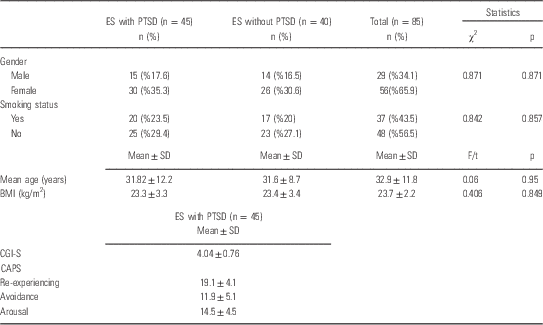
Forty-five (52.9%) of 85 earthquake survivors had chronic PTSD, and 40 (47.1%) did not have PTSD. The clinical and demographic data of the study population are shown in Table 1. There were no statistically significant differences between the two groups regarding age, gender, or body mass index (BMI; p>0.05), (Table 1).
Gender distribution, smoking status, age, and BMI of the participants
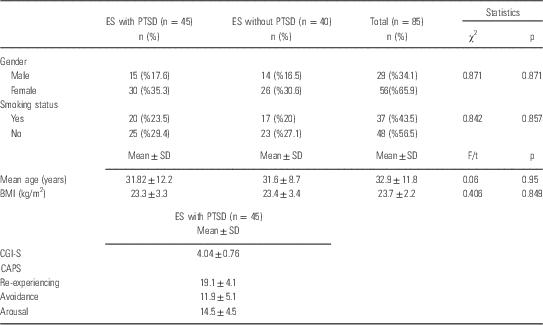
BMI, body mass index; CAPS, Clinician-Administered PTSD Scale, CGI-S, Clinical global impression-severity of illness; non-PTSD-ES, earthquake survivors who did not develop post-traumatic stress disorder; PTSD-ES, earthquake survivors who have developed post-traumatic stress disorder.
The mean of the CGI-Scores for the earthquake survivors with PTSD was 4.04±0.76. The mean scores of the CAPS scale for the earthquake survivors with PTSD were as follows: for re-experiencing 19.1±4.1, for avoidance 11.9±5.1, and for arousal 14.5±4.5 (Table 1).
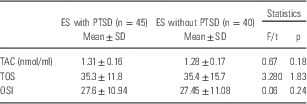
There were no statistically significant differences in the total antioxidant status, TOS, or OSI between the earthquake survivors with and without PTSD (all, p>0.05; Table 2).
TAC, TOS, and OSI levels of participants
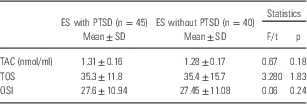
non-PTSD-ES, earthquake survivors who did not develop post-traumatic stress disorder; OSI, oxidative stress index; PTSD-ES, earthquake survivors who have developed post-traumatic stress disorder; SD, standard deviation; TAC, total antioxidant capacity; TOS, total oxidant status.
There were no correlations between the CAPS scores and oxidant and antioxidant stress markers (all, p>0.05). We did not find any correlation between TAS, TOS, OSI, and CGI scores.
Discussion
There is limited information about oxidative stress and earthquake survivors in the world (Reference Terawaki, Terada, Ogura, Era and Hosoya17). More recently, a study reported the elevation of oxidative stress after the great East Japan earthquake; however, to the best our knowledge, this is the first study in which the antioxidant capacity of earthquake survivors with PTSD was determined using the measurement of TAC along with the measurement of TOS levels and the calculation of OSI.
We investigated serum total oxidant and antioxidant status in earthquake survivors with chronic PTSD caused by earthquakes. In the present study, we observed no statistically significant differences in the serum TOS, antioxidant status, or OSI in earthquake survivors with chronic PTSD when compared with the participants who did not have PTSD. There were no correlations between the CAPS scores and the oxidant and antioxidant stress markers.
Oxidative stress has been defined as a disturbance of the equilibrium between the pro-oxidant and endogenous antioxidant systems in favour of pro-oxidation. It has been demonstrated that lipid peroxidation, DNA oxidation, and protein oxidation are directly involved in the oxidative injury of cellular macromolecules in tissues. PTSD patients have sleep problems and sleep disturbances such as insomnia, which is one of the most important factors contributing to oxidative stress (Reference Gulec, Ozkol and Selvi27). It has been reported that oxidative stress in PTSD could result from insomnia (Reference Richards, Nwose and Bwititi28).
Human studies suggest that oxidative stress levels can change, depending on age and habits such as cigarette smoking and alcohol use (Reference Yu29). To eliminate these potential confounding factors, we matched the patients with healthy controls for age, gender, cigarette smoking, and BMI. Thus, this method removed primary possible limitations related to the design of the present study. The most important part of our study is excluding other axis I and II disorders that may be confounding factors in the results of oxidative stress parameters. Major depressive disorder is generally accompanied with PTSD, and oxidative stress mechanisms have been implicated (Reference Bilici, EFE, Koroglu, Uydu, Bekaroglu and Deger30).
The reports in the literature about oxidative stress levels in patients with PTSD are controversial (Reference Attari, Naderi Attari and Rezayat16,Reference Saito, Aoki, Fujiwara, Goto, Tomiyama and Iwasa31,Reference Borovac Stefanovic, Kalinic and Mimica32). Attari et al.,(Reference Attari, Naderi Attari and Rezayat16) reported increased MDA levels in patients with PTSD compared with healthy controls. Saito et al., investigated the urinary 8-OHdG in 73 elderly residents in emergency temporary housing. In the elderly female residents, they reported that the urinary 8-OHdG levels tended to decrease with time after the disasters (Reference Saito, Aoki, Fujiwara, Goto, Tomiyama and Iwasa31). Conversely, Borovac Stefanovic et al., (Reference Borovac Stefanovic, Kalinic and Mimica32) did not find an association between serum MDA levels and PTSD. Ceprnja et al., examined oxidative damage markers in PTSD patients. They observed a statistically significant difference in the protein carbonyl concentrations. They found that concentrations were significantly lower in the PTSD group than in the control group (Reference Ceprnja, Derek and Unic33). They could not detect a significant difference in oxidative damage markers between PTSD patients and healthy individuals. Tezcan et al., did not find any association between serum antioxidant enzyme activities and PTSD. However, they have indicated that there is a positive correlation between the GSH-Px and SOD enzyme activities and the symptom severity in PTSD patients. In addition, they did not find any significant association between symptom severity and MDA in PTSD patients. Our findings are in agreement with previous studies (Reference Tezcan, Atmaca, Kuloglu and Ustundag15,Reference Borovac Stefanovic, Kalinic and Mimica32,Reference Ceprnja, Derek and Unic33).
In the present study, we used an automated method, which has several major advantages in comparison with the other currently available methods, to measure TAC in our study population. It is fast, easy, stable, reliable, sensitive, and fully automated. It also has a high linearity, and the results are highly reproducible and do not interact with commonly occurring serum components such as bilirubin, serum lipids, and anticoagulants. Accurate measurements of TAC can be obtained in as little as 10 min, making this assay imminently suitable for the clinical biochemistry laboratory (Reference Wayner, Burton, Ingold, Barclay and Locke34). We aimed to evaluate total oxidant and antioxidant parameters via TAC, TOS, and OSI instead of larger amounts of antioxidants and oxidants.
As mentioned previously, physical and physiological stress that causes the release of corticosterone along with the release of catecholamines increases free radicals and oxidative stress. Cortisol shows a diurnal secretion; thus, when the blood sampling time was changed, the results were different. Therefore, these results are also conceivable for oxidative stress measurements.
This study has some limitations. First, the small sample size of the study may show possible differences between groups if they are present in reality. Second, when interpreting the results, it should be kept in mind that they are limited to the survivors of earthquake trauma and cannot be generalised to all PTSD patients. These results may have been different if the participants had never experienced an earthquake.
In conclusion, our study suggests that the total oxidant and antioxidant status may not affect earthquake survivors with PTSD. This is the first study to evaluate the oxidative status in earthquake survivors with chronic PTSD. Further studies are necessary to confirm these findings.
Acknowledgements
P.G.O. wrote the whole version of the manuscript and performed clinical assessment of the patients, I.K. and C.U carried out the labaratory assesments, M.B. and A.A. performed the statistical analysis and interpretation of data, Y.B and M.C.K designed the study methods, and O.O. helped in writing the final version of the manuscript to be published.
Financial Support
None.
Conflict of Interest
None.
Ethical Standards
The authors assert that all procedures contributing to this work comply with the ethical standards of the relevant national and institutional committees on human experimentation and with the Helsinki Declaration of 1975, as revised in 2008, and approved by the local ethics committee.