

Introduction
All indigenous cattle in Tanzania belong either to the humped and short-horned Zebu (TSZ), the small humped and long-horned Sanga or to the stabilized cross-breds of the Small East African Shorthorn Zebu (SEAZ) and the Sanga (Gwakisa, Barendse and Teale, Reference Gwakisa, Barendse and Teale1996). The value of these breeds is mainly for the provision of draft power, manure, revenue, meat and hides (URT, 2006). The TSZ cattle belong to the SEAZ, which constitutes the majority of cattle in eastern and some parts of south-central Africa, including Madagascar (Mwacharo et al., Reference Mwacharo, Okeyo, Kamande and Rege2006). The TSZ is the dominant breed type in Tanzania and is widely distributed throughout the Tanzanian mainland. There is broad phenotypic and genetic diversity between and within strains of this breed type (Msechu, Reference Msechu2001).
The Ankole breed is a Sanga type while the Tarime and Fipa strains are stabilized cross-breds of Sanga with the SEAZ (Rege and Tawah, Reference Rege and Tawah1999). Large and distinct populations of the Ankole and Fipa cattle are found only in Western and Southwestern Tanzania (Alderson and Bodo, Reference Alderson and Bodo1992). Fipa cattle are the most useful indigenous animals in the socio-economic activities of the Fipa and Nyamwanga communities of Southwestern Tanzania and Northeastern Zambia, respectively.
The general phenotypic and probably genetic variations among the indigenous cattle breeds have resulted from an adaptive response to the natural environment, level of management and, to some extent, the effect of breeding practices (Mwacharo et al., Reference Mwacharo, Okeyo, Kamande and Rege2006). The assessment of phenotypic and genetic diversity of the population is, therefore, of interest not only as a first step in the organization and conservation of genetic resources but also for the design of genetic improvement programmes of any cattle breed. Phenotypic characteristics, including productive and adaptive traits, are important in identifying breed/strain attributes that are relevant to the immediate farming community's needs and utility.
Morphological characteristics are useful attributes in the characterization of a breed as they are easily assessed and understood by the relevant communities. Morphological descriptions have been used to classify animal populations according to their levels of phylogenetic distinctiveness (Gatesy and Arctander, Reference Gatesy and Arctander2000), thus allowing the differentiation between breeds and strains. Moreover, morphological description can be used to evaluate breeding goals (Zechner et al., Reference Zechner, Zohman, Solkner, Bodo, Habe and Marti2001) or to determine such goals retrospectively, especially in traditional systems where breeding practices are not documented (Rege, Reference Rege2001). Variability in body measurements across locations, sex, age and breeds can be exploited in predicting live body weight (BW) and hence the economic value of cattle, camel, sheep or goats (Semakula et al., Reference Semakula, Mutetikka, Kugonza and Mpairwe2010). Linear body measurements and productive attributes can also be used to assess the type and function of beef and dairy cattle, sheep and goats and the animals’ potential value as breeding stock (Alderson, Reference Alderson1999).
Unlike several other TSZ strains and the Ankole breed whose qualitative traits have been documented, albeit mainly on the basis of limited qualitative features and the owning tribe or geographical location where they are predominant, there is scanty documented information on the Fipa cattle population with regard to its phenotypic characteristics. For appropriate decision-making on any strain management and utilization, a much more broad and meaningful documentation based on phenotypic and genetic characterization is required. The present study was, therefore, undertaken to document morphometric and physical characteristics of the Fipa cattle so as to facilitate their field identification, classification and development of a sustainable strain improvement programme.
Materials and methods
Study area
The study was carried out in three administrative districts (Sumbawanga rural, Sumbawanga urban and Nkasi) of Rukwa region located in the southwest Highlands of Tanzania (Figure 1). These districts have the highest Fipa cattle population in Tanzania (Mwakilembe et al., 2007). The Fipa cattle are the main source of beef for local consumption and export. The other local beef cattle breeds that are kept in Rukwa region include Tarime and Ankole. The geographical location, climate, vegetation, agro-ecological zones (AEZs), landscape, soil types and common farming systems of the study area have been described by Mwambene et al. (Reference Mwambene, Katule and Chenyambuga2012).
A map of Tanzania showing the study villages where Fipa cattle were measured.

Research design and sampling frame
The study employed a cross-sectional design whereby all the information was collected once in the same period. To obtain the desired data, sampling of wards in the study districts was purposive, targeting wards with large numbers of Fipa cattle. The selected wards included Kaengesa and Sandulula in Sumbawanga rural, Ntendo and Matanga in Sumbawanga urban, and Mashete and Mkwamba in Nkasi district. However, selection of study villages within wards was random as described by Mwambene et al. (Reference Mwambene, Katule and Chenyambuga2012).
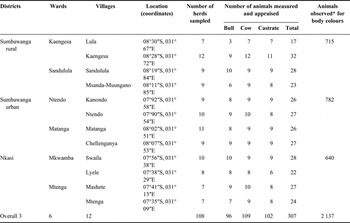
Two villages were randomly chosen per ward, making a total of 12 study villages. In each village, at least seven Fipa cattle herds were purposively selected, targeting farmers who have had herds with more than 10 Fipa cattle for the last 10 years, making a total of study herds for the entire study area to be 108. At least one mature (>4 years) bull, cow and castrate per herd were then randomly selected for detailed qualitative and quantitative traits appraisal and measurement, respectively. Overall, body measurements and qualitative trait descriptions were recorded on a total of 307 Fipa cattle comprising 96 bulls, 109 cows and 102 castrates. However, body colour patterns were studied on a total of 2 137 animals from all 108 herds across the study area (Table 1).
Sampling frame of the household herds and individual animals for morphometric measurements and observations.

Note: *Number of animals whose body colours were described and recorded.
Quantitative data collection procedure
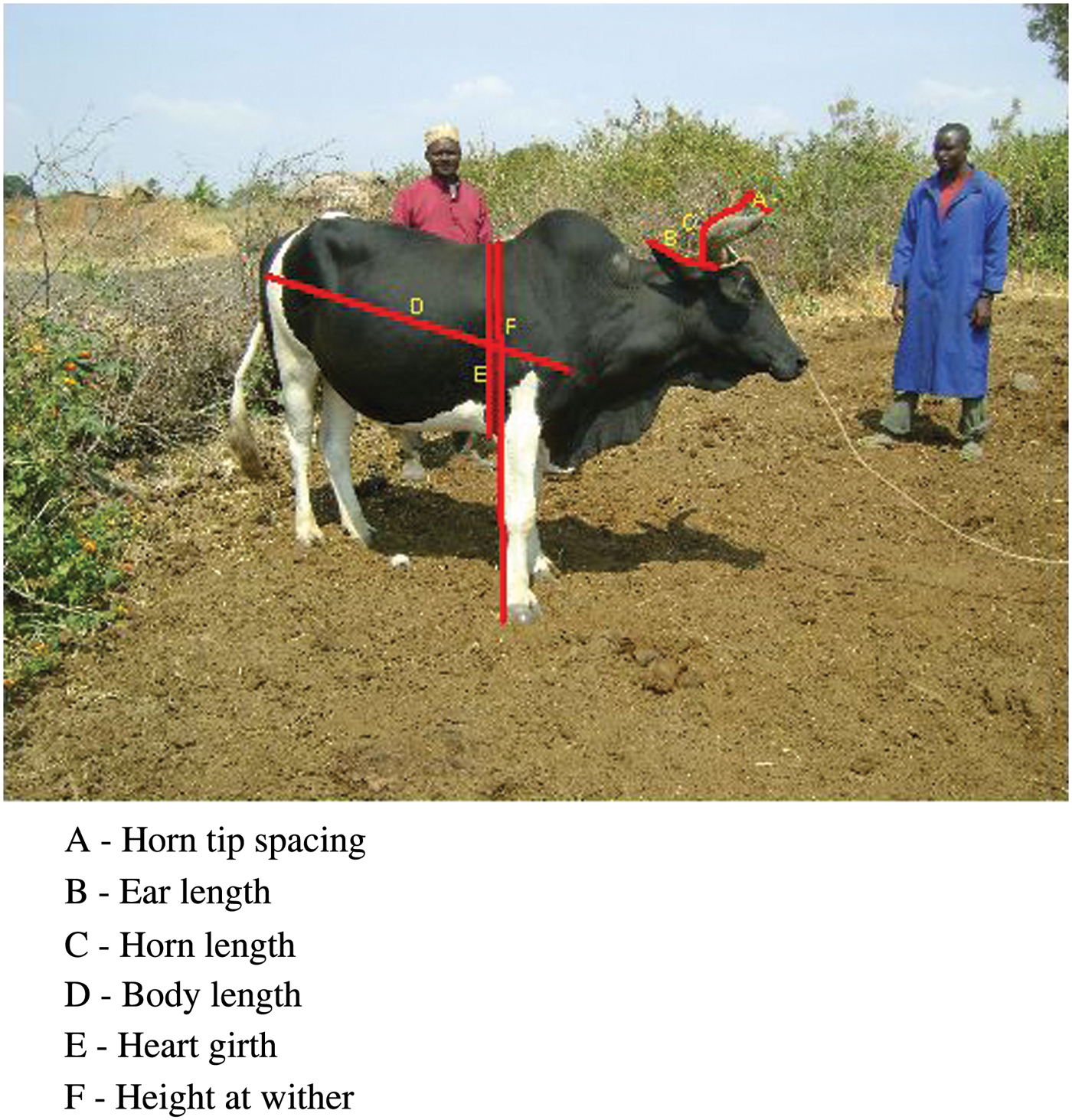
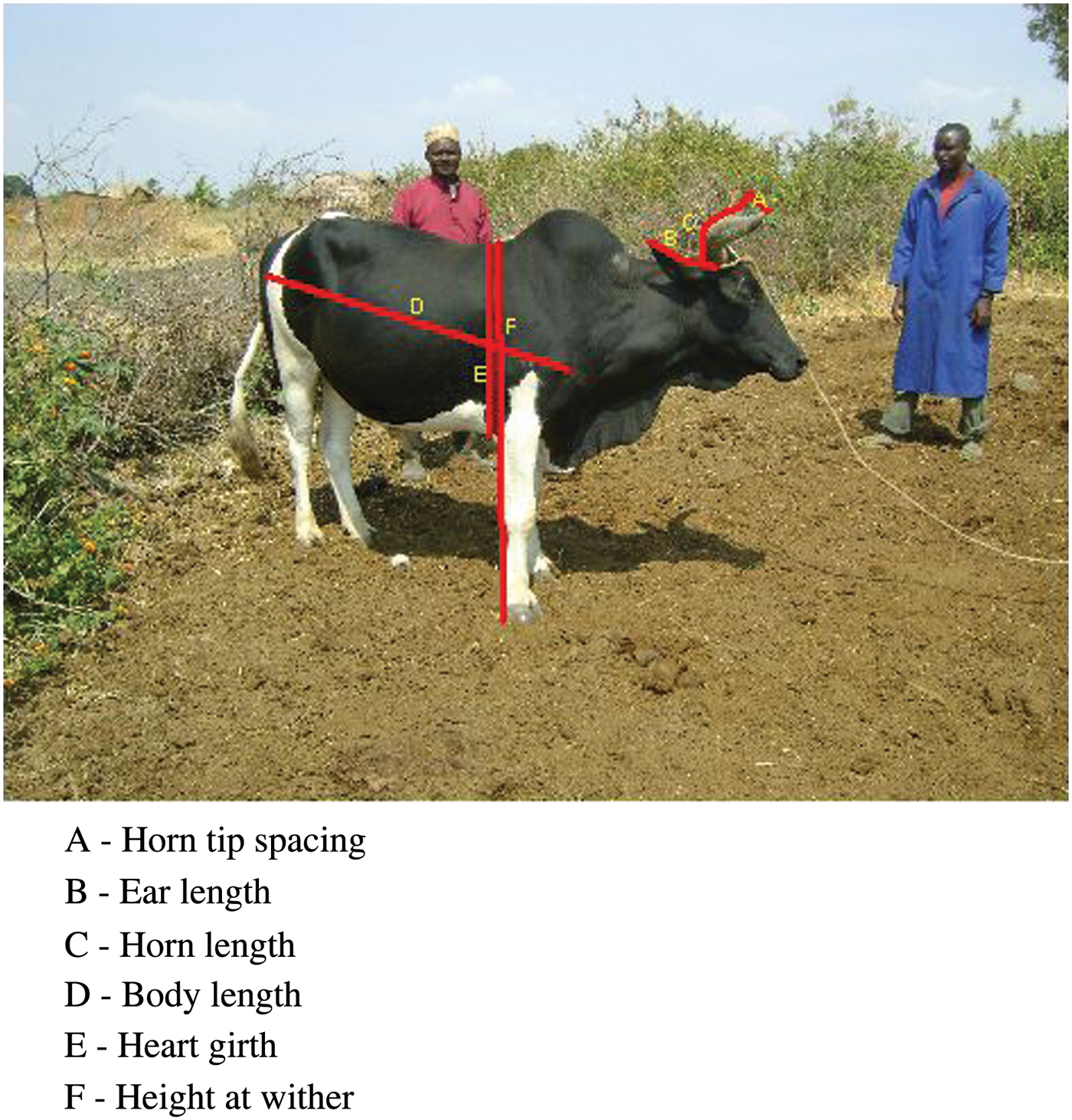
The various body measurements were taken on randomly selected mature male, female and castrate animals once, as described by Mason (Reference Mason1996). Measurements were taken on 14 traits as described by Francis et al. (Reference Francis, Sibanda, Hermansen and Kristensen2002) and Adeyinka and Mohammed (Reference Adeyinka and Mohammed2006). BWs and heart girths (HG) were estimated and measured, respectively, using a weigh band calibrated both in kilograms and centimetres, on different sides of the band. The bands (Rondo(R)) used have been calibrated from some East African indigenous beef cattle breeds (Shirima et al., Reference Shirima, Kashoma, Kazwala and Kambarage2005). Before the actual estimation of BWs of the 307 animals was established, the correctness of the calibration was validated by comparing the actual weights and estimated weights of 30 mature bulls, cows and castrates. The BW was estimated and HG measured as the perimeter of the body immediately behind the shoulder blades in a vertical plane, perpendicular to the long-axis of the body. A tailor's measuring tape was used to measure tail length (TL), as the distance from the base of the tail to the end of tail switch; tail base (TB), as the circumference of the TB; horn length (HL), as the straight distance between the base and tip of horn; horn circumference (HC), as the thickness of the horn base (HB); HB spacing, as the distance between the HBs; and horn-tip (HT) spacing, as the distance between the HTs. A mason's measuring tape was used to determine the body length (BL), as the distance from the shoulder point to the pin bone; height at withers (HW), as the distance from the hoof base to the withers; rump width (RW) as the widest point of hip bone; and rump length (RL), as the length of the hip bone. All measurements were taken by one person to minimize between-individual variations and were repeated three times with the animal being moved to a “normal” position, i.e. standing on a flat surface with the forelegs together and the head held up for each measurement (Figure 2).
Some measurements performed on Fipa bulls, cows and castrates.
Measurements were taken early in the morning before the animals were sent out to graze in order to avoid upward biases of certain variables following feeding. Visibly pregnant females were excluded from the study. Each animal was identified by location (herd, village, ward and district) and sex (entire male, female or castrate). The ages of the animals were estimated based on dentition according to the method of Schmidt and Yeates (Reference Schmidt and Yeates1985). Only mature animals, i.e. those with more than three permanent pairs of incisor teeth were randomly selected for measurements.
Qualitative data collection procedure
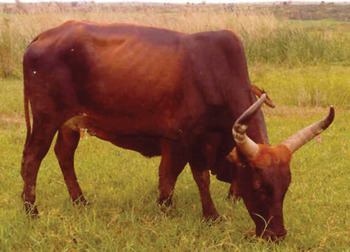
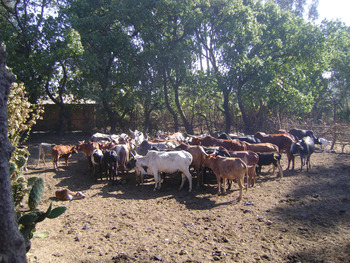
Coat colour was scored using a standard colour descriptor manual (SADC/ILRI Animal Genetic Resources Survey Colour Chart; SADC, 2001). Seven coat colour patterns were identified (Uniform, Pied, Spotted, Shaded, Striped/Brindle, Roan and Dun) (Figure 3). Body part profiles were also observed and described among the sampled animals (Figure 4).
A Fipa cow with preferred reddish colour pattern.

A herd of Fipa cattle showing animals with small, cervico-thoracic positioned humps and majority with lyre-shaped horns. See calves being housed with adult animals.

Data analysis
All quantitative data were analysed using the General Linear Models Procedure of the Statistical Analysis Systems, Ver. 9.1.3 (SAS, 2004), with the MANOVA option for calculating partial correlation coefficients among the various body measurement variables. Location (district) and sex were used as fixed effects and villages within location as nested effects. The statistical model used for the body measurements took the following form:
 $$Y_{ijkl} = \mu + L_{i+} S_j + \left({L \times S} \right)_{ij}+L_i \left({V_k } \right)+E_{ijkl}\comma \;$$
where Y ijkl is the measurement on the lth animal of the jth sex from the ith district and kth village for estimated BW and linear body measurements; μ is the general mean common to all animals considered in the study; L i is the effect of the ith district (i = Sumbawanga urban, Sumbawanga rural or Nkasi); S j is the effect of the jth sex (j = male, female or castrate); (LS)ij is the interaction between the ith location (district) and the jth sex; L i(V k) is the effect of kth village within the ith location (district); and E ijkl is the random effects peculiar to each animal.
Stepwise regression procedure of SAS (2004) was used to generate and test various prediction equations for estimating live BWs using various linear body measurements. The analyses were carried out within and between sexes for each district individuals as well as for the entire study area. The coefficients of determination (R 2) from the regression equations were used to determine the suitability of the linear body measurements as predictors of animal live BW. The data on body part colour and profile patterns were analysed using the FREQ procedure of SAS (SAS, 2004). Tests of significance of associations (χ 2 test) between qualitative variables and districts were undertaken in order to assess whether the occurrences of these patterns were random or specific to certain districts.
Results
Body morphometric characteristics
Table 2 shows the analysis of variance (ANOVA) summary for various body measurements of Fipa cattle. Body measurements were significantly (P ≤ 0.05) influenced by location, sex and location × sex interaction. However, the interaction of sex and location had no significant (P > 0.05) influence on HT, TL, TB, RL, RW, EW (ear width) and EL (ear length).
Summary of ANOVAs for body measurements of Fipa cattle.

Note: ***Very highly significant (P < 0.001); **highly significant (P < 0.01); *significant (P ≤ 0.05); nsnon-significant (P > 0.05).
Df, degree of freedom; BW, body weight; BL, body length; HG, heart girth; EL, ear length; EW, ear width; HL, horn length; HC, horn-base thickness; HB, horn-base spacing; HT, horn tip spacing; HW, height at withers; RL, rump length; RW, rump width; TL, tail length; TB, tail base thickness.
Effect of location (districts) and sex on BW and linear body measurements
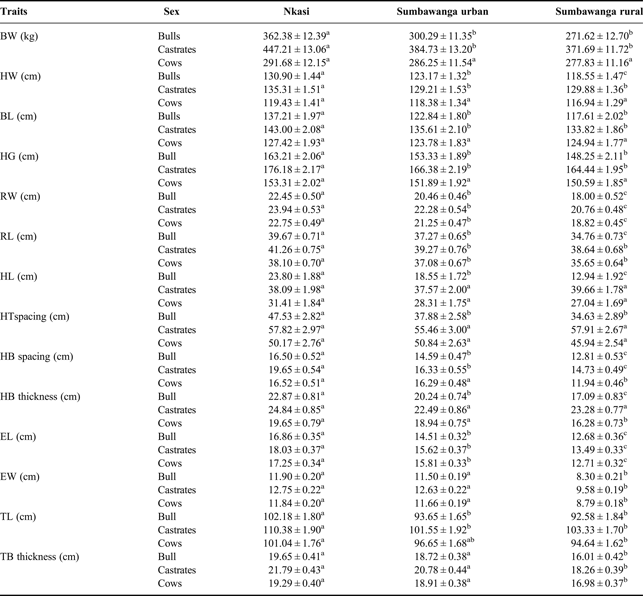
The least-square means for the body measurements taken on the Fipa cattle are summarized in Table 3. Generally, the body measurements (BW, HW, BL, HG, RW and RL) and TL, EL and HC measurements of the castrates and intact bulls from Nkasi district were significantly (P < 0.05) greater than those of the Sumbawanga rural and urban district, except for EW, TB, HB, HL and HT. On the other hand, the linear body measurements of the cows from Nkasi district were not significantly (P > 0.05) greater than those of the other districts, except for RL body measurement and HB, EL, EW, TL and TB measurements. The RW of the cows; RL of bulls; HL, EL, EW, TB and HB of bulls, cows and castrates; and HC of the bulls and cows from Sumbawanga urban district were significantly (P < 0.05) greater than those of the Sumbawanga rural district. Generally, castrates, bulls and cows from Sumbawanga rural and urban districts were smaller in body size than their counterparts from Nkasi district.
Least square means (±SE) for BWs and linear body measurements of Fipa cattle, summarized by districts and sex.
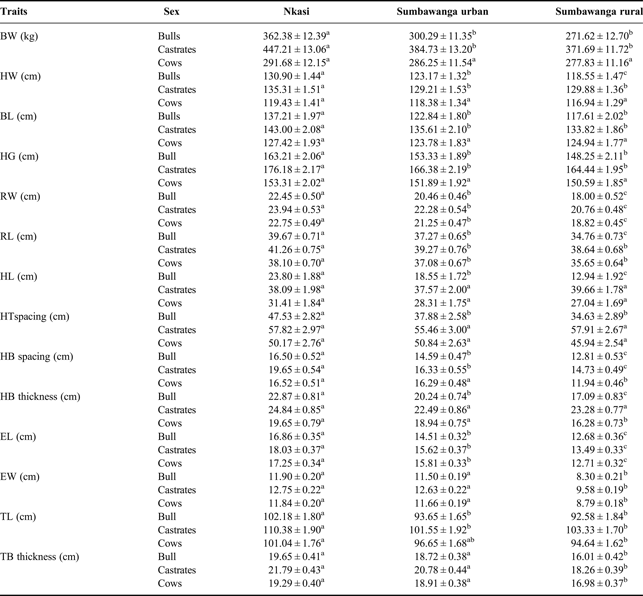
a,b,cLeast-square means with different superscripts within a row are significantly different at P ≤ 0.05.
Effect of location (districts) on BW and linear body measurements
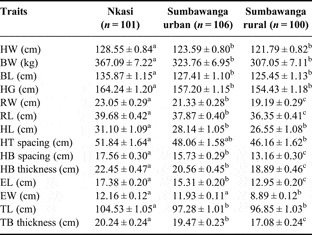
The least-square means for the body measurements of Fipa cattle studied in the three districts are presented in Table 4. The body measurements for the Fipa cattle from Nkasi district were significantly (P < 0.05) larger than those of the Sumbawanga rural and urban districts, except for EW and HT, implying that the animals of Nkasi district were much bigger than those of the other districts. The body measurements of the Fipa cattle from Sumbawanga urban district were not significantly (P < 0.05) different from those of Sumbawanga rural district, except for RW, RL, HB, EW, EL and TB.
Comparison of least-square means (±SE) for body measurements of Fipa cattle summarized by districts.

Note: n = number of animals measured; least-square means with different superscripts within a row are significantly different at P ≤ 0.05.
Effect of sex on BW and linear body measurements
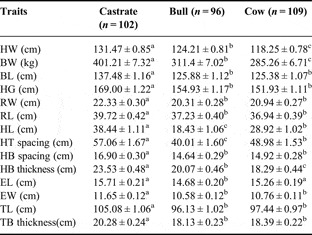
The effect of sex on the body measurements of Fipa cattle are presented in Table 5. Generally, the body measurements for the castrate animals were significantly (P ≤ 0.05) greater than those of the intact bulls and cows, except for EL, meaning that castrate animals were larger than bulls and cows. However, the majority of the body measurements of the intact bulls were not significantly (P > 0.05) different from those of the cows except for BW, HT, HL, HB and EL.
Comparison of least-square means (±SE) for body measurements of Fipa cows, bulls and castrates.

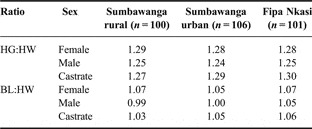
Table 6 gives the ratios between selected linear measurements for the Fipa cattle. In general, the HG:HW or BL:HW ratios were almost consistent across the study districts, showing the proportionate relationships of the selected body measurements of the animals across the study districts.
Ratios of selected linear measurements for adult Fipa cattle observed in the study.

Note: n = number of animals measured.
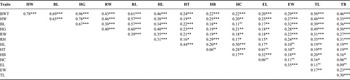
The phenotypic partial correlations among the various traits of Fipa cattle are given in Table 7. The correlation coefficients were all positive and the majority were highly significant (P ≤ 0.001), except for EW vs HL, EL vs HT, HB vs HT, EW vs HT, EL vs HC, EW vs HC, TB vs HC, TL vs EL and TB vs EL.
Partial correlation coefficients and significance levels among various body measurements of Fipa cattle.

Note: *Significant at P < 0.05; **highly significant at P < 0.01; ***very highly significant at P < 0.001; nsnot significant at P > 0.05.
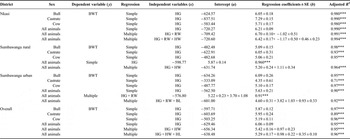
Linear regression of HG on BW was conducted within each sex and for all categories of Fipa cattle in each district and across all the districts. Generally, the BW of castrates from Nkasi district was predicted more accurately than their counterparts in Sumbawanga urban district. The BW of bulls and cows was predicted more accurately than castrates almost in all the three districts. Based on the coefficient of determination (R 2) and regression coefficients, the HG of animals from Nkasi district predicted BWs of animals more accurately than the other linear traits. The relationships among live BW and HG and other linear measurements were further studied using a stepwise multiple regression analysis by adding one trait at a time, to the HG of all animals in each district. The essence was to determine how other linear traits influence the precision of live BW predictions compared with using HG alone (Vargas et al., Reference Vargas, Elzo, Chase and Olson2000). However, the multiple regression analysis improved coefficients of determination (R 2) thus indicating that addition of one or more other measurements to HG resulted in significant improvement in accuracy of prediction (Table 8).
Linear regression parameter estimates for prediction of BWs using HGs in mature Fipa cattle presented by districts, sexes and across the study area.

Note: ***Very highly significant at P < 0.001.
Physical characteristics
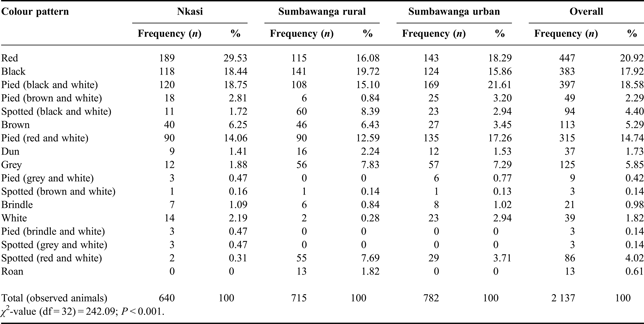
Table 9 presents the occurrence of various body colour patterns of the Fipa cattle. Overall, the predominant colour patterns were red (20.92 percent), pied black and white (18.58 percent), black (17.92 percent) and pied red and white (14.74 percent) (Figure 1). The predominant body colours and colour patterns were different for each study district.
Occurrence of body coat colour patterns in Fipa cattle summarized by districts.
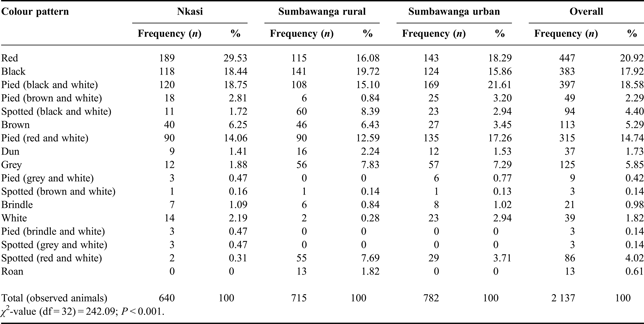
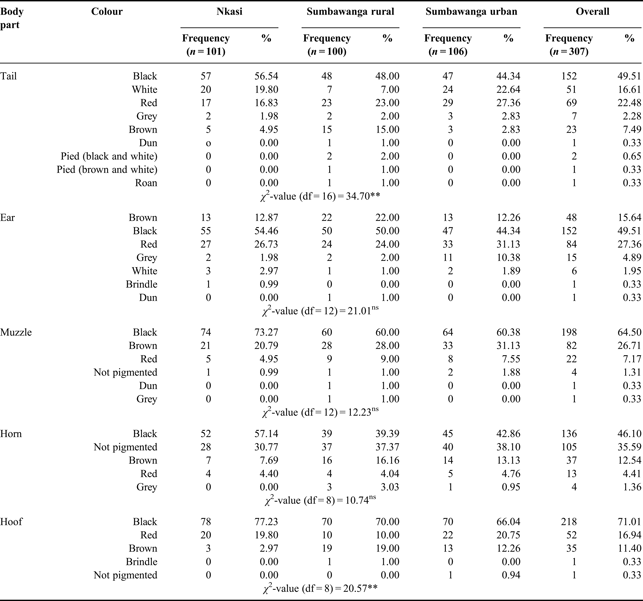
Table 10 gives the occurrence of different colour patterns on various body parts of the Fipa cattle. Overall, the predominant colour patterns were black (49.5 percent), red (27.4 percent) and brown (15.6 percent) for ear tips; black (64.5 percent) and brown (26.7 percent) for muzzles; black (49.5 percent), grey (22.5 percent) and white (16.6 percent) for tail switches; black (46.1 percent) and brown (48.1 percent) for horns and black (71.0 percent) and red (16.9 percent) for hooves. The occurrences of predominant colour patterns of ears, muzzles and horns were almost similar across the study districts, while they were not similar for hoofs and tail switches.
Frequency of occurrence of various colours on different body parts of Fipa cattle summarized by districts.
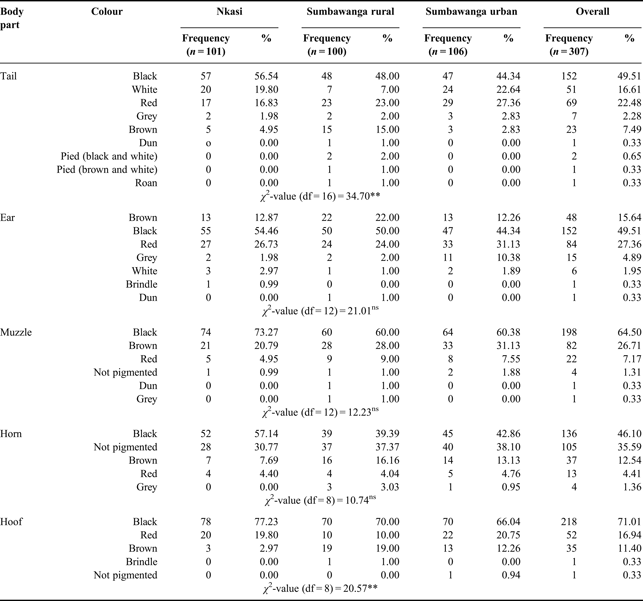
Note: **Highly significant at P < 0.01; nsnot significant at P > 0.05.
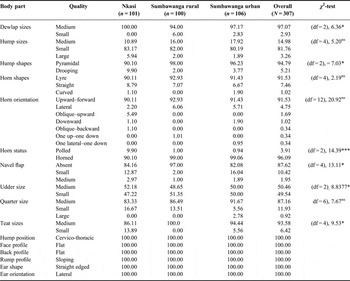
The sizes, shapes and profiles of different body parts of the Fipa cattle are given in Table 11. Most (87.6 percent) of the animals had no navel flap, whereas the profiles for rump, face and back were sloping for the rump and flat for the face and back in all the animals. The hump size was small in most (81.8 percent) of the animals, except bulls. Most (94.8 percent) of the animals had pyramid-shaped humps that were at the cervico-thoracic position. Most (91.5 percent) of the animals had upward–forward oriented and lyre-shaped horns. They had small- to medium-sized udder and the teats and quarters were medium sized. They had laterally oriented ears and medium-sized dewlaps. There were significant (P < 0.05) differences of the proportions of sizes, shapes and status of the body parts between the study districts, except the hump sizes and position, horn shapes and orientation, quarter sizes, ear orientation, face, back, rump and ear profiles.
Frequency (%) of occurrence of size, shape and profile of various body parts of Fipa summarized by districts.

Note: n = number of animals observed; *significant at P < 0.05; **highly significant at P < 0.01; ***very highly significant at P < 0.001; nsnot significant at P > 0.05.
Discussion
Body measurements
The body measurements of the mature Fipa cattle in the Rukwa region clearly differed between the three districts. The BW and linear body measurements for the Nkasi Fipa cattle were significantly greater than those of the Sumbawanga urban and rural districts, except for EW and HT spacing. The differences in body measurements of the Fipa cattle found in the three districts indicate that the Fipa cattle population is subdivided into subpopulations perhaps due to differences in availability of feed resources and breeding practices used, breeding barrier caused by physical distance between districts or inherent genetic differences (Mwambene et al. Reference Mwambene, Katule and Chenyambuga2012). The smaller stature of the Sumbawanga Fipa cattle might, therefore, be an adaptive mechanism to poor availability of feed due to shortage of grazing land caused by high human population pressure and expansion of cropping activities. Furthermore, differential natural selection for adaptation to cope with the harsher environment, where a smaller-framed animal would be better suited, might have also affected the growth rate of the Sumbawanga rural and urban Fipa cattle than those of Nkasi district because of differences in availability of feed resources. Similarly, the Fipa community being small-scale mixed farmers who rely mostly on animal draft power from cattle might have preferred short and compact animals as it is believed that such types of animals are better at pulling ploughs for longer hours than taller animals (Mwacharo et al., Reference Mwacharo, Okeyo, Kamande and Rege2006). Thus, their breeding goals might have for a long time been oriented towards achieving such a short and compact animal. On the other hand, the shortage of breeding bulls of high vigour caused by indiscriminate castration coupled with random/uncontrolled mating practices particularly in Sumbawanga rural and urban district (Mwambene, et al. Reference Mwambene, Katule and Chenyambuga2012) could have affected the body size of the resultant animals.
The values of the linear body measurements, such as HW (121–128 cm) of the Fipa cattle, are slightly larger than those of the Tarime (107–116 cm) (Chenyambuga et al., Reference Chenyambuga, Ngowi, Gwakisa and Mbaga2008), Iringa red (107–116 cm) and Tanzanian Maasai zebu (111–120 cm) (Sungael, Reference Sungael2005). The three subgroups studied are shorter at the withers than Ngaudere (132–136 cm) (Rege, Reference Rege and Tawah1999). The observed differences in HW might be due to genetic or breed differences.
The BL (125–137 cm) and HG (154–169 cm) estimates for the Fipa cattle obtained in this study compare well with those of the Tanzanian Maasai zebu (129 and 160 cm) and Kamba zebu (130 and 159 cm) (Mwacharo et al., Reference Mwacharo, Okeyo, Kamande and Rege2006) and Iringa red (116 and 158 cm) (Sungael, Reference Sungael2005). However, they are slightly larger than those of Malawi zebu (95.3 and 154.9 cm) (Butterworth and McNitt, Reference Butterworth and McNitt1984) and Tarime zebu (90 and 150 cm) (Chenyambuga et al., Reference Chenyambuga, Ngowi, Gwakisa and Mbaga2008). The values for BL and HG observed in this study are lower compared with those of Ankole (150 and 190 cm) (Petersen et al., Reference Petersen, Ndumu, Kiwuwa, Kyomo, Semambo, Rowlands, Nagd and Nakimbugwe2003). Differences in BL are normally contributed by genotype of the strain and kind of management which the cattle receive, and age of the animals (Hall, Reference Hall1991). The HG values observed in the present study are also slightly lower than those of Butana (174–184 cm) and Kenana (167–180 cm) (Osman, Reference Osman1985), but similar to that of Boran cattle (152–171 cm (Kimenye, Reference Kimenye1985). This difference in HG is attributed to the differences in body size and degree of fatness (body condition), and are largely influenced by both genetic potential and environment.
The ratio of HG to HW of mature Fipa cattle (1.24–1.30) is comparable to those of Kamba (1.30–1.37) and Maasai (1.31–1.33) (Mwacharo et al., Reference Mwacharo, Okeyo, Kamande and Rege2006). The ratio of BL to HW of Fipa cattle (0.99–1.07) is comparable to that of the Kamba zebu (1.05–1.15), but inconsistent with that reported for Maasai cattle in Kenya (Mwacharo et al., Reference Mwacharo, Okeyo, Kamande and Rege2006). This indicates that the Fipa cattle are compact animals with a characteristically beef-type conformation. They are slightly longer in BL and shorter in HW. Hall (Reference Hall1991) reported that this type of body structure has evolved as a result of it being more effective in dissipating heat than a squat body. This reason can also be associated with the Fipa cattle as majority (oxen, entire bulls or sometimes cows) are used for draft activities thus necessitating heat dissipation.
The average RW for all sex classes of the Fipa cattle are lower than those reported by Joshi, McLaughln and Philips (Reference Joshi, McLaughln and Philips1957) for the other TSZ, Ankole and Boran. The observations on RW suggest that the Fipa cattle strain is among the Tanzanian indigenous cattle with medium body size.
The phenotypic partial correlation coefficients between the morphometric measurements were positive and the majority highly significant. BW was highly and positively correlated with HG (0.96), HW (0.78), BL (0.69) and RL (0.61); hence, the latter traits can reliably be used as a proxy (either singly or in combination with other linear traits) for estimating BW for this strain. These findings are almost similar to those reported by Alsiddig et al. (Reference Alsiddig, Babiker, Galal and Mohammed2010) for Baggara cattle and Mwacharo et al. (Reference Mwacharo, Okeyo, Kamande and Rege2006) for Maasai cattle in Kenya. However, the coefficients were higher than those reported by Okeyo et al. (Reference Okeyo, Mosi, Ahuya, Rege and Okomo1996) for the Kenyan Kavirondo zebu. The regression equation of BW on HG had R 2 of 0.99 for the Nkasi Fipa cattle subgroup which gave more confidence in the use of this parameter to predict BW of this cattle subgroup. The regression coefficient relating BW and HG was larger for the Fipa cattle from Nkasi district than those of the other two districts, more so for castrates than for intact bulls and females. This indicates that as HGs of Nkasi Fipa cattle increase, their BW increased at a higher rate than their counterparts in the other districts. This might be associated with high correlation of HG and BW for Nkasi animals than that of the other districts, implying better availability of feed levels in the district as both HGs and BWs are highly influenced by the environment particularly feed. Generally, from the observed correlation and regression coefficients and high R 2 values (>90), HG would be the best estimator for live BW. However, the accuracy of estimation was further improved when the HG was combined with other traits in multiple regression analysis.
Marked differences between castrates, males and females in linear body measurements have also been reported by many scholars (Mwacharo et al., Reference Mwacharo, Okeyo, Kamande and Rege2006; Kugonza et al., Reference Kugonza, Nabasirye, Mpairwe, Hanotte and Okeyo2011). In the present study, sexual dimorphism was evident in the Fipa cattle, with castrates and entire males having significantly greater linear measurements than the females for most of the traits studied. However, there were insignificant differences between bulls and cows with respect to the BL, RW, RL, HB, EW, TL and TB thickness. The sex-related differences are most probably the result of the usual between-sex differential hormonal effects on growth. On the other hand, the superiority of castrates for all body measurements might be associated with imposed accretion of subcutaneous fats, which in turn affect live weight and other body measurements (Berg and Butterfield, Reference Berg and Butterfield1976). Castration, especially at early age, also increases growth and changes body structure. It stimulates growth of the lumbar vertebrae, hind limb bones, patella and hindquarter bones but inhibits growth of the ribs, scapula, carpus, forelimb bone and forequarter bone. At the same time steers as compared with bulls show a shift in bone weight distribution towards the hindquarter, pistol and long bones.
The mean BWs of the Fipa cattle were slightly higher than those reported for Tarime cattle (Chenyambuga et al., Reference Chenyambuga, Ngowi, Gwakisa and Mbaga2008), Iringa red (Sungael, Reference Sungael2005) and SEAZ (Mwacharo and Rege, Reference Mwacharo and Rege2002), but were almost similar to those of Ethiopian Boran, Karamajong, Abyssinia and Maasai zebu (Payne and Hodges, Reference Payne and Hodges1997), and other several tropical cattle (Butterworth, Reference Butterworth1985). However, the BWs were lower than those of Kenyan Boran, Kenana and Butana (Osman, Reference Osman1985). The BWs of the Fipa bulls and castrates observed in the present study suggest that under good feeding management and purposive selection for birth weights and growth rates, they should be a good beef resource that can compete well with the Boran.
Physical characteristics
The Fipa cattle had variable body colour patterns with some community colour preference across the study area. The predominant colours were red, pied (black and white), black and pied (red and white). Other colours such as brown, grey, spotted (black or red and white), pied (brown and white), dun, white, roan and brindle were found in small proportions in the herds of cattle. The majority of farmers preferred Fipa cattle with black or red or mixture of either red or black and white. The white was reported to be not preferred by many farmers due to being associated with high tick infestations. Non-preference for white was reported to also have an effect on the price of selling such animals. This finding is similar to that reported for Tarime (Chenyambuga et al., Reference Chenyambuga, Ngowi, Gwakisa and Mbaga2008) and Baggara cattle (Alsiddig et al., Reference Alsiddig, Babiker, Galal and Mohammed2010).
Most of the animals had black, red and brown ear tips; black and brown muzzles; black, red and white tail switches; black and brown horns and black and red hooves. The observation of animals with multicolour has also been reported by Zulu (Reference Zulu2008) for Angoni and Barotse cattle in Zambia and Msanga, Mbaga and Msechu (Reference Msanga, Mbaga and Msechu2001) for many TSZ strains.
Most of the Fipa cattle had no navel flap. They had sloping rump, cervico-thoracic positioned humps, small-sized humps in females and castrates but medium in bulls and pyramid-shaped humps in most animals. The animals had flat faces and backs, and majority were naturally horned. The horns of mature animals were moderately long in castrates and cows, but short in bulls. The horns were upward–forward oriented and lyre-shaped with long (below the hock joint) tails. The udders were small- to medium-sized and the teats and quarters were medium-sized. The animals had laterally oriented ears and medium-sized dewlaps. These observations are consistent with those observed for Baggara (Alsiddig et al., Reference Alsiddig, Babiker, Galal and Mohammed2010) and Tarime cattle (Chenyambuga et al., Reference Chenyambuga, Ngowi, Gwakisa and Mbaga2008).
Conclusion and recommendations
Based on the findings obtained from the present study, it is concluded that:
1. Fipa cattle have medium body size and multiple coat colours (mainly red, pied black and white, black and pied red and white). Their body sizes are bigger than those of common TSZ but similar to or bigger than the Tanzanian Maasai cattle.
2. Fipa cattle live BWs and linear body measurements are significantly influenced by location and sex of the animals.
3. Although a number of traits measured could be used to predict BW accurately, HG would be the best estimator of BW in Fipa cattle either singly or in a combined regression analysis with other linear traits.
4. The evident wide within and between subpopulation variations in body measurements and qualitative traits observed in this study clearly indicate large phenotypic diversity which exists in the Fipa cattle population.
Therefore, under good management practices such as feeding, selective breeding and disease control, the Fipa cattle promise to be a good local beef breed in Tanzania. Thus development of conservation and improvement strategies for the strain is essential through mobilization of Fipa communities, non-governmental organizations, policy-makers and research institutions.
Acknowledgements
This publication is an output of the Fipa cattle research project funded by the Agricultural Sector Development Programme (ASDP) in Tanzania. We sincerely thank all the field officers and extension staff who assisted us in the survey work. We are also grateful to all the Fipa cattle farmers who willingly provided unrestricted access to their farms and animals.
Ethical clearance statement
Research protocols followed the guidelines stated in the Guide for the Care and Use of Agricultural Animals in Research and Teaching (FASS, 2010).
Statement of interest
The authors strongly declare that there are no conflicts of interest.