Introduction
Cognitive impairments of different kinds are common among older adults and can result from many conditions, occasionally or persistent. To evaluate cognitive function in persons in the phase of mild cognitive impairment (MCI), neuropsychological tests are often used. Nonetheless, for patients with subjective cognitive impairment (SCI), such objective measures mostly fail to show evident impairment since the difficulties, by definition, should be merely self-experienced. Yet, limitations in identifying subtle decline on neuropsychological tests do not exclude the self-experienced decline in these individuals. It is argued that the earliest signs of cognitive decline are best perceived by the individual, rather than by someone else (Frank et al., Reference Frank, Lenderking, Howard and Cantillon2011; Caselli et al., Reference Caselli2014). Subjectively, memory complaint is as well a core criterion for MCI (Petersen, Reference Petersen2004; Albert et al., Reference Albert2011), but the memory complaint here is usually also corroborated by an informant (Petersen, Reference Petersen2004).
SCI can occur in apparently healthy adults and is characterized by subjective changes in memory and cognition, but with an absence of an objective evidence of abnormal cognitive status (Stewart, Reference Stewart2012). MCI has commonly been used to describe the intermediate stage between normal cognitive changes of aging and early dementia based upon Petersen (Reference Petersen2004), although a considerable proportion of people with MCI do not develop dementia (Wallin et al., Reference Wallin2016). The MCI criteria involve objectively measured cognitive decline that does not fulfill the criteria for dementia. In the original MCI criteria, an essentially intact ability to perform everyday activities was required (Petersen, Reference Petersen2004), but research has shown that people with MCI commonly have difficulties in complex everyday activities (Jekel et al., Reference Jekel2015), and more recent criteria acknowledge that such problems could occur already in MCI (Albert et al., Reference Albert2011). The prevalence of self-reported memory complaints, SCI and MCI in the general population, aged 65 years and older living in the community, is approximately 40% (Garcia-Ptacek et al., Reference Garcia-Ptacek2014) and 16–20%, respectively (Roberts and Knopman, Reference Roberts and Knopman2013). Both SCI and MCI are potential early markers for further cognitive decline and subsequent dementia (Wallin et al., Reference Wallin2016), a yearly progression from MCI to dementia of 5% in community settings and 10% in specialist settings has been reported (Mitchell, Reference Mitchell2009). SCI has been suggested as a phase prior to MCI, but it can occur as long as up to 15 years before decline to MCI or dementia (Reisberg et al., Reference Reisberg2008). It is, though, important to state that not all persons with SCI or those with MCI develop dementia, and some even reverse to normal cognition (Roberts and Knopman, Reference Roberts and Knopman2013). However, since persons with SCI risk further cognitive decline, i.e. developing MCI and eventually dementia, attention should be paid to this group (Eckerström et al., Reference Eckerström2013) and to expand the clinical characterization of prodromal dementia (Wallin et al., Reference Wallin2016) and subjective cognitive decline (Jessen et al., Reference Jessen2014).
Few assessment tools have been developed for people with SCI targeting subjective memory and cognitive functioning (Eckerström et al., Reference Eckerström2013). In addition, both everyday functioning and social functioning have been overlooked in persons with cognitive impairment without dementia (Frank et al., Reference Frank, Lenderking, Howard and Cantillon2011; Eckerström et al., Reference Eckerström2013). One issue connected to both these areas, is the use of technology. The self-perceived ability to use everyday technologies (ETs) such as cell phones, remote controls, and automatic telephone services has repeatedly shown to be sensitive to separate groups in different phases/levels of cognitive functioning by using the Everyday Technology Use Questionnaire (ETUQ) (Nygård et al., Reference Nygård, Pantzar, Uppgard and Kottorp2012; Fallahpour et al., Reference Fallahpour, Kottorp, Nygård and Larsson Lund2014) and the short version of the ETUQ, S-ETUQ (Kottorp & Nygård, Reference Kottorp and Nygård2011). Furthermore, the ETUQ and the S-ETUQ has also demonstrated to be sensitive to cognitive decline regarding the individual relevance of ET (Nygård et al., Reference Nygård, Pantzar, Uppgard and Kottorp2012; Ryd et al., Reference Ryd, Nygård, Malinowsky, Öhman and Kottorp2015), as well as in the number of ETs reported as actually used by the person (Hedman et al., Reference Hedman, Nygård, Almkvist and Kottorp2015). The ETUQ and the S-ETUQ have shown acceptable psychometric properties and is validated for use across populations: older adults with MCI, dementia and without cognitive impairment (Kottorp & Nygård, Reference Kottorp and Nygård2011; Nygård et al., Reference Nygård, Pantzar, Uppgard and Kottorp2012), and people with acquired brain injury (Fallahpour et al., Reference Fallahpour, Kottorp, Nygård and Larsson Lund2014)). To define and use valid subjective reports on cognitive decline is vital to be able to identify very early signs of dementia development (Jessen et al., Reference Jessen2014). Early detection can be important in order to initiate early interventions – and also for future effective treatments to preserve function (Jessen et al., Reference Jessen2014).
This study aims to investigate and compare self-perceived ability in ET use and ETs reported as actually used on a group level in a sample of older adults with SCI, MCI, and older adults with no known cognitive impairment, i.e. controls, within the Gothenburg MCI Study.
Methods
Selection of participants
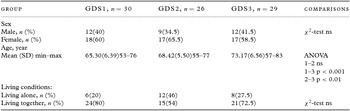
The participants with SCI and MCI in this study are participants in the Gothenburg MCI Study (Wallin et al., Reference Wallin2016). Participants with SCI and MCI were recruited through the Memory Clinic at the Sahlgrenska University Hospital (Gothenburg) by a physician. The selection was made among those included in the follow up in the Gothenburg MCI Study during the time for the project. Older adults without known cognitive impairment, i.e. controls were recruited via information meetings on dementia, senior citizen organizations, and spouses and acquaintances of patients and controls in the study. The specific criteria for all participants for inclusion in the present study were (i) age 50 years or older, (ii) living in ordinary housing in the community and needing to use some ETs in everyday life, and (iii) being able to participate in an S-ETUQ interview in Swedish. For participants with cognitive impairment, some additional inclusion criteria were added (iv) a self- or informant reported cognitive decline, and (v) a duration of cognitive decline of at least six months. Persons with other diseases that could cause cognitive impairment such as brain tumors, stroke, or psychiatric diseases were not included. In total 85 participants were divided into three sub-groups: controls, SCI, and MCI took part in the study; see Table 1. As seen in Table 1, there are differences in age between the groups. Due to small sub-groups, it was not possible to match the groups according to age. The differences were, however, accounted for in the analyses. Before initiation, approval from the regional ethical committee at the Gothenburg University number L091-99/T479-11 was obtained.
Demographic characteristics of the participants

Instruments
In order to stage the level of cognitive decline of the participants in the Gothenburg MCI Study, the Global Deterioration Scale (GDS) was used. The GDS describes seven clinically distinguishable global stages, from normality to severe dementia: GDS level 1 represents no cognitive decline, GDS level 2 represents very mild cognitive decline (no objective evidence of memory deficit on clinical interview or deficits in employment or social situations) (here SCI), GDS level 3 represents mild cognitive decline (here MCI), and GDS levels 4–7 represent different stages of dementia (Auer and Reisberg, Reference Auer and Reisberg1997). A physician and/or a registered nurse conducted the assessments and the GDS staging was performed by a registered nurse in collaboration with a physician or a psychologist. Subjective cognitive complaints were determined through clinical interviews.
The GDS scores were based on four instruments: MMSE (Folstein et al., Reference Folstein, Folstein and McHugh1975); Clinical Dementia Rating (CDR, Morris, Reference Morris1997) a global measure of functioning. The information for CDR was gathered from both the participant and a proxy informant.; Stepwise Comparative Status Analysis (STEP, Wallin et al., Reference Wallin1996) for basic cognitive symptoms, cognitive variables (memory disturbance; disorientation; reduced abstract thinking; visuospatial disturbance; poverty of language; sensory aphasia; visual agnosia; apraxia), and Investigation of Flexibility (I-FLEX, Wallin et al., Reference Wallin2016), which is a short version of the Executive Interview, EXIT (Royal et al., Reference Royal, Mahurin and Gray1992) for frontal lobe symptoms (items number–letter task; word fluency; anomalous sentence repetition; interference task; Luria hand sequences; counting task). For inclusion, subjective and objective (verified by a proxy informant) evidence for progressive cognitive impairment for more than six months was required. Furthermore, objective cognitive symptoms according to STEP, I-Flex, MMSE, and/or CDR were required. For GDS 2, the person was not to have any symptoms on STEP, no more than one box checked on CDR, not more than two symptoms on I-flex or a score below 27 on MMSE. For GDS 3 one or several symptoms on STEP, I-Flex, MMSE, or CDR were required. Persons with more than two symptoms on STEP and/or a score below 25 on MMSE were not included, as they were considered to fulfill criteria for dementia.
The S-ETUQ was used to measure the participants’ overall self-perceived ability in using ETs, relevant to the person, such as cell phones, automatic ticket machines, radios and coffee machines (Kottorp and Nygård, Reference Kottorp and Nygård2011). The S-ETUQ, developed from the ETUQ (Rosenberg et al., Reference Rosenberg, Nygård and Kottorp2009), comprises 33 ETs, including less, as well as more, challenging items. It has been demonstrated that the person measures of perceived difficulty in ET use generated from the S-ETUQ are statistically similar to person measures generated from the full version of the ETUQ (Rosenberg et al., Reference Rosenberg, Nygård and Kottorp2009; Kottorp and Nygård, Reference Kottorp and Nygård2011). The measures of the person's perceived difficulty using ET generated from the S-ETUQ can also be expressed as the person's perceived ability to use ET. Throughout this paper, the term, primarily used, will be perceived ability to use ET.
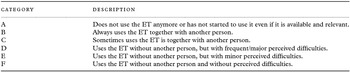
A six-step category scale A–F (Table 2) was used to register the self-perceived ability of use for each of the items relevant to the person (Kottorp and Nygård, Reference Kottorp and Nygård2011). The number of ETs actually used was obtained by counting all items registered as step-categories B–F for each participant (Hedman et al., Reference Hedman, Nygård, Almkvist and Kottorp2015).
Description of the six-step rank-category scale used in S-ETUQ

Note: A perceived relevant item is defined as available to the person, having earlier been used by the person, is currently used by the person, and/or is intended to be used by the person. Finally, an item reported as actually used is defined as an item reported as relevant and actually used by the person during the past 12 months.
Data-gathering procedures
The standardized S-ETUQ interviews were performed by three experienced occupational therapists. Before data collection, all data collectors participated in a one-day training regarding how to follow the standardized procedure of administering and scoring the ETUQ/S-ETUQ (Nygård, Reference Nygård2012). The data collection was performed in the office of the occupational therapist and the sessions lasted approximately 30–45 minutes. All participants gave their oral and written consent for participation in the study. Data were collected from March 2011 to November 2014.
Data analysis
The S-ETUQ gives the number of ETs actually used by each participant out of possible 33 ETs. The number of the ETs actually used was compared group-wise across the three groups with an analysis of variance, ANOVA, using Statistical Package for Social Sciences, SPSS Version 23 (2015).
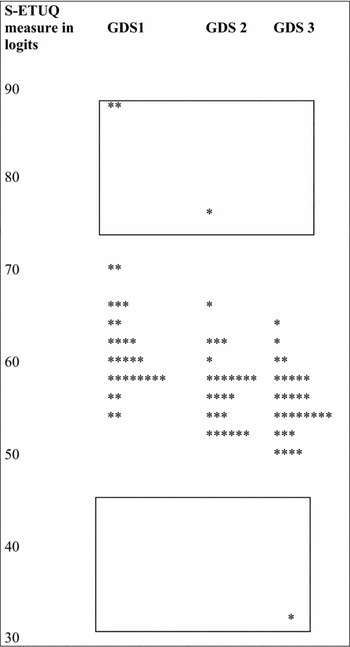
Data from the S-ETUQ-interviews with the 85 participants were analyzed with a Rasch rating scale model (Bond and Fox, Reference Bond and Fox2007) using the Winsteps computer program, Version 3.91.0 (Linacre, Reference Linacre2016). In the analyses, the ordinal S-ETUQ raw data are converted into interval measures using a logarithmic transformation of the odds probabilities of each response. The analysis provides estimations of the person's ability to use ET presented as a measure expressed in logits. Individual measures are generated based on the score profile across the ET in the S-ETUQ that each person perceives as relevant; i.e. the number of ETs may differ between the participants. The individual measures are presented along a calibrated continuum ranging from less to more ability. A higher individual measure is equivalent with higher ability to use ET. In these analyses, four remarkably high or low individual measures were detected (Figure 1). These measures might be described as outliers in this sample, but compared to earlier data collected with the S-ETUQ the measures are within the normal distribution range (95%) of self-perceived ability to use ET. Furthermore, no systematic explanations to these outlier measures were found. However, since an ANCOVA analysis requires normally distributed data, we decided not to include these outliers in those analyses. The following analyses were performed using the SPSS (2015). To describe and compare the participants’ ability to use ET across groups, the individual measures were then evaluated using ANCOVA. The effect of the independent variables, Age, Group, and Gender on the dependent variable and ability to use ET, were initially tested in a series of univariate analyses with an inclusion criteria of p < 0.05 in order to be included in a multivariate model. In the event of a significant main effect in the final model, post hoc test Least Significant Difference (LSD) with a level of significance set at p < 0.05 was used to more in-depth investigate the differences between specific groups.
Comparison of S-ETUQ person ability measures between the three groups. n = 85. Each * represents one person. The four persons in the boxes are outliers and are not included in the analyses.

Results
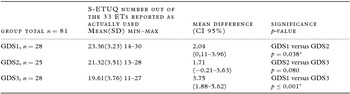
In all three groups, it was shown that a majority of the 33 ETs in the S-ETUQ were reported as actually used by many of the participants (Table 3). However, a range in number of actually used ETs was demonstrated in individuals in all groups. The number of ETs reported as actually used were highest in the control group followed by the SCI and MCI groups. The results of the ANOVA analysis of ETs reported as actually used showed a significant main effect for group (F (8.01), p < 0.001). In comparisons with post-hoc test LSD, the controls-SCI group and the controls-MCI group differed significantly regarding ETs reported as actually used (Table 3), but not the SCI–MCI groups. When inspecting differences between the three groups regarding ETs actually used, there was a higher frequency of use of ETs connected to use in public spaces and/or social functioning, e.g. internet banking, cell phone/text message, and automatic ticket machine among the controls and the persons with SCI than the persons with MCI.
Presentation and comparison of group wise number of ETs reported as actually used

*p < 0.05.
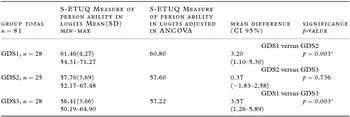
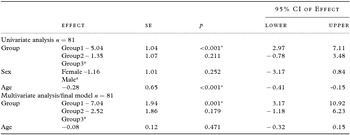
Similarly, the individual measures of ability in ET use presented group-wise in Table 4 and in Figure 1. The control group has a higher ability in ET use than the SCI and MCI groups. Yet, there are overlaps in range between the three groups. The results of the ANCOVA model showed a significant main effect for group (F (6.19), p = 0.003). In comparisons with post-hoc test LSD, the controls-SCI group and the controls-MCI group differed significantly in ability to use ETs (Table 4), but not in the SCI–MCI groups. The differences remained significant even when the effect of age was taken into account. The univariate and multivariate regression models are presented in Table 5.
Rasch-generated person ability measures of perceived ability to use ET and mean person ability measures adjusted in ANCOVA

*p < 0.05.
Results of the ANCOVA procedures; variables that might influence on the individual ability measure were controlled for with an inclusion criterion of p < 0.05

aThis parameter is set to zero because it is redundant.
*p < 0.05.
Discussion
In this study, the ability in ET use and the number out of 33 ETs in the S-ETUQ actually used by the participants were compared between controls, persons with SCI, and persons with MCI. In the findings, it was shown that the controls perceived a significantly higher ability in ET use compared to those with SCI or MCI. However, no significant differences between the SCI and MCI groups were found. Interestingly, the significantly lower ability in the SCI group compared to the controls suggests that a lower ability to use ET is experienced already in very minor cognitive decline. Self-reported measures to detect subjective cognitive decline in older adults are often based on assessments of different domains of cognitive functioning, e.g. memory and/or executive function (Rabin et al., Reference Rabin2015), while the perception of everyday functioning is rarely used for such purposes (Frank et al., Reference Frank, Lenderking, Howard and Cantillon2011), one reason being that assessments of everyday functioning often fail to capture such subtle deficits. Hence, development and refinement of assessments identifying and measuring aspects of everyday functioning in early stages of cognitive decline are necessary (Frank et al., Reference Frank, Lenderking, Howard and Cantillon2011; Jessen et al., Reference Jessen2014). The findings from this study indicate that self-reported ET use through the S-ETUQ, which is an aspect of everyday functioning, demonstrates sensitivity to detect differences between controls and SCI. Evaluation of self-perceived ability in ET use through the S-ETUQ has also earlier been shown to separate groups with different levels of cognitive impairment, e.g. dementia versus MCI and MCI versus controls (Kottorp and Nygård, Reference Kottorp and Nygård2011; Ryd et al., Reference Ryd, Nygård, Malinowsky, Öhman and Kottorp2015). Interestingly, in this study, the S-ETUQ additionally demonstrates sensitivity to capture significant differences between older adults without known cognitive impairment i.e. controls and persons with SCI. Similarly, the number of ETs reported as actually used also significantly separated the controls from the SCI group as well as the MCI group. This may illustrate that already a slight decrease in cognitive functioning might influence the number of ETs actually used. Interestingly, both the ability to use ET and the number of ETs reported as actually used did not differ significantly between those with SCI and those with MCI. Further studies using the full version of the ETUQ with 90+ items in larger samples are needed to gain more detailed knowledge of ET use in persons with SCI, in comparison with older adults and those with MCI. Moreover, earlier research has shown that ability to use ET and activity involvement correlates over time for people with MCI; lower ability in ET use was more strongly related with lower activity involvement over a period of five years (Hedman et al., Reference Hedman, Nygård, Malinowsky, Almkvist and Kottorp2016). As SCI could reflect a longitudinal decline and the first signs of Alzheimer's disease (AD), it would be of importance to follow a sample with SCI over time to capture the trajectory of decline (Jessen et al., Reference Jessen2014). Assessments of the ability to use ET might be one way to capture these early signs, which in future treatment with only minor cognitive decline could preserve function (Jessen et al., Reference Jessen2014). Additionally, early identification of difficulties in ET use can be important since there are possibilities that people with SCI and MCI then can maintain the ability to manage the use of specific important ETs by, for example, new strategies in using them. However, more studies are needed.
Assessments evaluating subtle decline in cognitive functioning have been recommended to include aspects of social functioning (Frank et al., Reference Frank, Lenderking, Howard and Cantillon2011; Eckerström et al., Reference Eckerström2013). The S-ETUQ does not specifically assess social functioning, but, among the items in the S-ETUQ, almost half are ETs connected to use in public spaces and social functioning (e.g. cash card, automatic ticket vending machines, cell phone). The differences between the three groups regarding the ETs actually used with a higher use of ETs connected to use in public spaces and/or social functioning among the controls and the persons with SCI than the persons with MCI indicate that the-ETUQ might be one method to capture the appearance of limitations in social functioning, at least the parts including use of technology. To capture such changes, the importance of repeated assessments of ET use with a particular focus on ETs connected to use in public spaces and/or social functioning is underscored.
Although the S-ETUQ seems to be able to capture difficulties in ET use already in SCI, it is important to note that the S-ETUQ is not a cognitive test but a tool that gives us a measure of how well the person can interact with the ET around him/her. One of the advantages with the S-ETUQ is that it is based on a Rasch model. The individual measures of ability to use ET are generated based upon response patterns rather than on the sum of raw scores, as in many traditional assessments. Moreover, the individual measure is generated regardless of which ETs the participants find relevant, i.e. it is possible to make comparisons on both individual and group levels even if each person finds different ETs in the S-ETUQ as relevant. Finally, the evaluation of cognitive level based on the GDS might not be sensitive enough to separate the GDS2 and GDS3 groups. Therefore, there might be overlaps between the groups which could have had an impact on the results. In future studies, a more thorough evaluation of cognitive level may be needed. Also, it could be argued that the people with MCI might have poorer insight than people with SCI resulting in better performance in self-assessments and that this could be the reason for not finding any differences between the groups. It is known that persons with MCI could overestimate rather than underestimate their performance (Fragkiadaki et al., Reference Fragkiadaki, Kontaxopoulou, Beratis, Andronas, Economou and Yannis2016). On the other hand, it also described how people with MCI generally are aware of their difficulties and can provide valid descriptions (Rosenberg and Lyketsos, Reference Rosenberg and Lyketsos2008).
In conclusion, this study shows that a significantly lower number of ETs were reported as actually used and a lower ability in ET use were self-perceived in the SCI and MCI groups compared to the controls. This indicates that both these aspects of ET use are affected already in very early cognitive decline and may impact everyday functioning in home as well as in society. Self-reported ET use based upon interviews with the S-ETUQ may be a sensitive marker to detect functional changes already in SCI.
Conflict of interest
None.
Description of authors’ roles
C. Malinowsky carried out the statistical analysis and wrote the paper. A. Kottorp was responsible for the statistical design of the study and wrote the paper. A. Wallin formulated the research question, designed the study and assisted in writing the paper. A. Nordlund formulated the research question and made a critical review of the manuscript. L. Rosenberg supervised data collectors and assisted in writing the paper. L. Nygård formulated the research question, designed the study, supervised data collectors and wrote the paper. E. Björklund, A. Pernevik, and I. Melin collected the data.
Acknowledgments
The authors wish to thank the participants who shared their experiences of technology use. The research was funded by the Swedish Research Council for Health, Working Life and Welfare (FORTE), the Swedish Research Council (VR), and Sahlgrenska University Hospital.