Introduction
The ash leaf-cone roller, Caloptilia fraxinella (Ely) (Lepidoptera: Gracillariidae) is an invasive, cosmetic pest of horticultural ash trees, (Fraxinus Linnaeus; Oleaceae) in several municipalities in the Western Prairie provinces. Infestations have occurred in Edmonton, Alberta, Canada since 1999 (Pohl et al. Reference Pohl, Saunders, Barr, Wartenbe and Fownes2004), Saskatoon, Saskatchewan, Canada since 1998 (personal observations) and have been reported in Calgary, Alberta, Canada (J. Lemmen, University of Alberta, Edmonton, Alberta, Canada, personal communication) and Regina Saskatchewan, Canada (personal observations). Caloptilia fraxinella mines leaflets of green (Fraxinus pennsylvanica Marshall), black (Fraxinus nigra Marshall), and white (Fraxinus americana Linnaeus) ash and collection records prior to 1998 place the native range of C. fraxinella in southern Ontario, Canada (specimens deposited in the Great Lakes Forestry Centre, Canadian Forestry Service, Sault Ste. Marie, Ontario, Canada [Kathryn Nystrom, curator]) and Québec, Canada (specimens deposited in the Laurentian Forestry Research Collection, Canadian Forest Service, Natural Resources Canada, Sainte-Foy, Québec, Québec, Canada [Georges Pelletier, curator]), and into the eastern United States of America (Forbes Reference Forbes1923). Black ash occurs as far west as southeastern Manitoba, Canada and green ash is native as far west as southeastern Alberta, Canada (Farrar Reference Farrar1998). Since the appearance of C. fraxinella in the urban forests of Western Prairie cities its main hosts are green and black ash.
Caloptilia fraxinella overwinter as adults and exhibit a prolonged reproductive diapause over fall and winter after eclosion from cone-rolled leaflets in the summer (Evenden et al. Reference Evenden, Armitage and Lau2007). Adults mate in early spring and eggs are laid preferentially in the lower canopy as soon as host ash trees flush new leaflets in late May (Evenden Reference Evenden2009). Eggs hatch within several days and larvae develop through five instars (Pohl et al. Reference Pohl, Saunders, Barr, Wartenbe and Fownes2004; Evenden Reference Evenden2009). First and second instars serpentine mine the mesophyll layer of leaflets. Second and third instars create blotch mines on the outer edges of leaflets. Fourth instars disperse on silken lines to new leaflets that they roll into characteristic pyramidal cones. Development to the fifth instar followed by pupation occurs within leaflet cones and adults eclose in mid-July (Evenden Reference Evenden2009). Caloptilia fraxinella does not significantly damage its host tree (Pohl et al. Reference Pohl, Saunders, Barr, Wartenbe and Fownes2004), but a severely infested ash may have every leaflet rolled, which reduces the cosmetic value of the tree. Insecticide sprays are undesirable in an urban setting and are unlikely to be effective on internally feeding larvae but natural biological control is possible from the parasitoid complex. In this study, we identify the parasitoid complex of C. fraxinella in its expanded range and assess the parasitism rate and other parasitoid characteristics to determine the potential for biological control of this invasive leafminer.
Parasitoids previously documented to attack C. fraxinella in its expanded range include an unidentified Apanteles Förster species (Hymenoptera: Braconidae), Pteromalus phycidis (Ashmead) (Hymenoptera: Pteromalidae), Zagrammosoma americanum Girault (Hymenoptera: Eulophidae), and Elachertus argissa (Walker) (Hymenoptera: Eulophidae) (Pohl et al. Reference Pohl, Saunders, Barr, Wartenbe and Fownes2004). The unidentified Apanteles microgastrine parasitoid was the dominant parasitoid reared from C. fraxinella in the initial seasons after its appearance in Edmonton (Pohl et al. Reference Pohl, Saunders, Barr, Wartenbe and Fownes2004) and in Saskatoon (personal observation). Other Apanteles parasitise early instars (first-third) of internally feeding Lepidoptera larvae such as Plutella xylostella (Linnaeus) (Lepidoptera: Plutellidae) (Cardona and Oatman Reference Cardona and Oatman1975) and Phthorimae operculella (Zeller) (Lepidoptera: Gelechiidae) (Salazar and Rivera Reference Salazar and Rivera1995). Little is known about the life history of the Apanteles species associated with C. fraxinella and in the current study it is identified to species as Apanteles polychrosidis Vierek (Hymenoptera: Braconidae).
Apanteles polychrosidis is a generalist parasitoid reported mainly from hosts in the family Tortricidae (Lepidoptera) with leaf-rolling life strategies on various angiosperms (Seaman et al. Reference Seaman, Nyrop and Dennehy1990; Biddinger et al. Reference Biddinger, Felland and Hull1994; Li et al. Reference Li, Fitzpatrick, Troubridge, Sharkey, Barron and O'Hara1999; LaGasa et al. Reference LaGasa, Murray, Hitchcox and Pauley-Crawley2000; Cossentine et al. Reference Cossentine, Jensen, Deglow, Bennett, Goulet and Huber2004, Reference Cossentine, Deglow, Jensen and Goulet2005) or defoliators of conifers (Huber et al. Reference Huber, Eveleigh, Pollock and McCarthy1996). Apanteles polychrosidis parasitises first and second instar obliquebanded leafroller, Choristoneura rosaceana (Harris) (Lepidoptera: Tortricidae), and emerges from third and fourth instar hosts before pupation (Cossentine et al. Reference Cossentine, Jensen, Deglow, Bennett, Goulet and Huber2004). Many solitary Apanteles species alternate hosts within a season and overwinter either as a prepupae or as a larva within an overwintering host (Shaw and Huddleston Reference Shaw and Huddleston1991). In British Columbia, Canada, A. polychrosidis parasitises both generations of the obliquebanded leafroller and overwinters within larvae of the second generation (Cossentine et al. Reference Cossentine, Jensen, Deglow, Bennett, Goulet and Huber2004). Apanteles polychrosidis has never previously been documented from a nontortricid or from leaf-mining larvae.
The objectives of this study were the following: (1) to identify the parasitoid community of C. fraxinella in its expanded range in Western Canada; (2) describe the life histories of these parasitoids in association with C. fraxinella in the ash urban forest; and (3) determine the phenology and distribution of host use, adult eclosion patterns, and reproductive biology of A. polychrosidis, the dominant parasitoid in this system. Rearings of field collected C. fraxinella infesting green ash and traps positioned in the ash canopy were used to identify and determine the phenology of species within the parasitoid complex. The life history of A. polychrosidis after eclosion from C. fraxinella was followed with laboratory observations of its mating, courtship, and oviposition behaviour into an alternate host, the obliquebanded leafroller.
Materials and methods
Parasitoid complex
To determine the parasitoid complex of C. fraxinella in its expanded range, rolled leaflets with emergence windows made by C. fraxinella (to avoid collection of A. polychrosidis individuals) were collected haphazardly from three to five green ash trees at five to seven sites in Edmonton, Alberta, Canada (53°34′N, 113°31′W) in June 2009, 2010, 2011 (range 200–2000 rolled leaflets/tree) except in 2010 when leaflets without emergence windows (which signified A. polychrosidis parasitism) were collected. Collection sites were parks with green ash dominant or boulevards with green ash planted as infill trees among a taller canopy of American elm, Ulmus americana Linnaeus (Ulmaceae), and older green ash. Leaflet rolls were kept in individual 30 mL transparent plastic cups covered with clear plastic lids (SOLO cup company, Lake Forest, Illinois, United States of America) (10 067 in 2009, 23 863 in 2010, and 17 159 in 2011) and groups of 100 cups were placed in transparent plastic bags with a damp paper towel to maintain humidity. Bags were held under summer conditions in a walk in growth chamber at 24 °C with a 16L:8D (light:dark hours) cycle. Eclosed parasitoids were collected and stored in 95% ethanol prior to identification. Twenty putative braconid parasitoids, four from each of five sites, were collected in 2008 and identified by Daryl Williams at the Northern Forestry Centre, Canadian Forest Service (Edmonton, Alberta, Canada) to Apanteles. The Apanteles specimens were further identified to species as A. polychrosidis by José Fernandez and Henri Goulet of Agriculture and Agri-Food Canada (AAFC) and the National Reference Collection (NRC) in Ottawa, Canada. Other Hymenoptera parasitoid specimens were identified by Gary Gibson (Pteromalidae), John Huber (Chalcidae), and Andrew Bennet (Ichneumonidae) also of AAFC and NRC. Parasitoid specimens and adult samples of their host are vouchered in the Canadian National Collection of Insects and Arachnids, and Nematodes, Ottawa, Canada (CNC).
Percentage parasitism caused by each identified parasitoid species in 2009 to 2011 was calculated as the number of parasitoids that eclosed from C. fraxinella pupae divided by the total number of pupae collected per year. In 2010, A. polychrosidis parasitism was similarly scored from emergence from leaflet rolls (23 863) collected from three trees at each of five sites in Edmonton. In 2008 and 2009, the percentage of parasitism by A. polychrosidis was determined through in situ counts in the field from six green ash trees at each of nine sites. To estimate percent parasitism, 100 leaflet rolls per tree were haphazardly selected throughout the canopy and scored as un-parasitised (with a C. fraxinella cocoon) or parasitised (with an A. polychrosidis cocoon).
Phenology of host use
Larval dissections
Several hundred eggs and first, second, and third instar C. fraxinella were field collected (27, 28 May 2008 and 3, 5 June 2008) from two trees at each of eight sites to determine levels of endoparasitism at the egg, serpentine, and blotch-mine stages. Leaflets with eggs and larvae were placed on Whatman no. 1 filter paper (GE Healthcare, Mississauga, Ontario, Canada) moistened with distilled water in a sealed Petri dish and kept in a growth chamber at 24 °C with a 16L:8D cycle until emergence of fourth instars from blotch mines. A total of 363 recovered fourth instars were dissected under a compound microscope at 60× to assess the presence of endoparasitic larvae within C. fraxinella collected at the different life stages in the field (egg = 22, first instar = 155, second instar = 39, third instar = 147).
Host and parasitoid phenology
Development of the host, C. fraxinella, was sampled twice-weekly on three green ash trees at each of five sites in Edmonton, Alberta, Canada from 13 May to 15 July 2008 to encompass the entire development period of C. fraxinella. The terminal 30 cm of four branches per tree were sampled from each of four positions: (1) upper 1/3 from the north side of the canopy, (2) lower 1/3 from the north side of the canopy, (3) upper 1/3 from the South canopy, and (4) lower 1/3 from the south canopy. Branches were individually bagged, and frozen overnight (−20 °C) before assessment of the developmental stage of C. fraxinella. Concurrent counts of adult parasitoids in the sampled ash trees were obtained from four yellow sticky cards (10 × 15.5 cm; Contech, Delta, British Columbia, Canada) similarly positioned in the canopy of each tree. Numbers of each identified parasitoid species captured on the four yellow cards in each tree at each developmental stage of the host were enumerated until host larvae were in the fourth and fifth instar inside leaflet rolls. Data loggers (HOBO UA-002-64, Onset Computer Corporation, Cape Cod, Massachusetts, United States of America) tracked temperature (°C) and light intensity (l×) at the same four positions within the canopy of one tree at each site. All statistical analyses were conducted with generalised linear mixed effect models (GLMM) in R (R Development Core Team 2011) using the Poisson family of errors with a log link recommended for count data (Crawley Reference Crawley2007). One GLMM was used to determine the within-tree preference for oviposition by C. fraxinella. Caloptilia fraxinella counts of nonmotile stages (egg through third instar) were specified as the dependent variable, location within the canopy was the independent fixed variable and tree nested within site specified as random factor with leaflets without C. fraxinella removed from the analysis. Generalised mixed effect models were also used to assess variation of the number of each parasitoid species with sample date and location within the tree. Number of each parasitoid was specified as the dependent variable in each model and sample date and location within the tree were independent fixed variables with individual trees nested within site and specified as a random factor. Two models were constructed for female parasitoids in which sex could be determined (one each for A. polychrosidis and Diadegma Förster (Hymenoptera: Ichneumonidae)) and three for combined males and females in which parasitoid sex could not be determined (Sympiesis species 1, Sympiesis species 2 and 3 combined, and P. phycidis). If models were significant, a post hoc Tukey's honestly significant difference (HSD) test (package available in the MASS library from the Comprehensive R Archive Network [CRAN]) was used to identify differences in parasitoid abundance among sample dates and location within trees. Sample date was a categorical factor. Temperature and light intensity within the canopy were analysed individually as dependent variables in two GLMMs with location within the canopy as the independent fixed variable, and site and date specified as random factors. Post hoc Tukey's HSD tests were used to identify significant differences in temperature and light intensity among the four locations within the canopy.
Phenology of parasitoid emergence
Emergence sleeves, made from white nylon organza (30 cm diameter × 70 cm length, mesh size 330 × 330 μm), were placed over branches with visible leaflet rolls in the mid-canopy of green ash trees and were sealed at both ends with flagging tape. Five trees at each of five sites were sampled every two days from 4 to 12 July 2008 with one sleeve per tree. At each sample date, bags with branches were removed and one new branch in each tree was bagged. Branch samples were frozen at (−20 °C) overnight and parasitoids captured in the bags were enumerated, identified, and separated by sex when possible. To determine if lack of an emergence window, normally created on leaflet rolls by fifth instar C. fraxinella (Pohl et al. Reference Pohl, Saunders, Barr, Wartenbe and Fownes2004), is a reliable diagnostic feature of A. polychrosidis parasitism, all collected leaflet rolls that harboured A. polychrosidis (103) were scored for the presence or absence of an emergence window and analysed with a binomial exact test (R Development Core Team 2011). To determine if there was a temporal difference in eclosion between the sexes of each parasitoid species recovered, two generalised linear mixed effects models were used with error terms specified as the Poisson family with a log link (R Development Core Team 2011). The number of A. polychrosidis, or Diadegma species, was specified as the dependent variable with sex and sample date as independent variables and tree nested within site was designated as a random variable. An additional experiment was conducted in 2009 to further assess the emergence phenology of male and female A. polychrosidis. Leaflet rolls that contained A. polychrosidis cocoons were collected from five trees at each of seven sites in Edmonton, Alberta, Canada, on 2 July 2009, placed in clear plastic emergence containers in groups of 50 leaflets and held indoors under natural light next to a window. Emergence containers were checked every two days from 3 to 31 July 2009 and the number and sex of emerged wasps were recorded. The number of A. polychrosidis was the dependent variable and sex and sample date were independent fixed variables with site designated as a random variable in a GLMM with the Poisson family of errors and log link specified (R Development Core Team 2011).
Courtship and mating behaviour of A. polychrosidis
Mating behaviour of A. polychrosidis was observed using individuals from the emergence phenology experiment in 2009 (above). Wasps were separated by sex as they eclosed and were kept under natural light conditions next to a window in the laboratory in clear plastic containers and fed sterile 10% honey water ad libitum. Twenty-five females (one to four days old) were subsequently placed individually into clear glass vials. To determine if males would multiply mate, five males were introduced in succession to each of five virgin females and allowed five minutes to mate and perform courtship behaviours. Prior mating observations showed that mating occurs quickly once males and females are paired.
Acceptance of another host by A. polychrosidis reared from C. fraxinella
To test the hypothesis that A. polychrosidis reared from C. fraxinella can oviposit in another known host, C. rosaceana (Cossentine et al. Reference Cossentine, Jensen, Deglow, Bennett, Goulet and Huber2004, Reference Cossentine, Deglow, Jensen and Goulet2005), several hundred male and female A. polychrosidis were held together in dome-shaped cages (60 × 60 × 60 cm; BugDorm, Megaview Science, Taichung, Taiwan) under natural light conditions in the laboratory and fed sterile 10% honey water ad libitum for a minimum of two days to ensure they were mated before use in the bioassay. First-third instar C. rosaceana were obtained from a laboratory colony held at 25 °C 16L:8D and fed a modified pinto-bean based diet (Shorey and Hale Reference Shorey and Hale1965). Larvae were introduced individually in 30 mL cups that contained the artificial diet on which they were reared to 10 male and five female A. polychrosidis within clear, plastic 500 mL containers. Choristoneura rosaceana larvae were exposed to the wasps for four hours between 1200 and 1600 and then were returned to rearing conditions. Choristoneura rosaceana larvae exposed to A. polychrosidis were checked for parasitoid emergence daily.
Results
Parasitoid complex
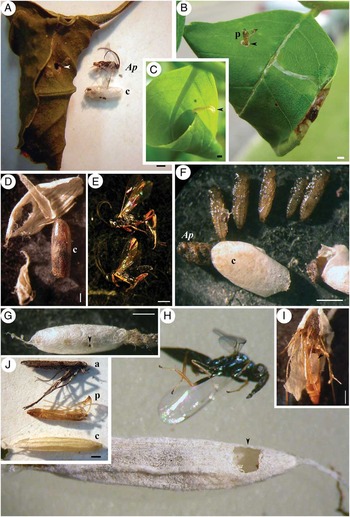
All braconid parasitoid specimens reared from C. fraxinella in this study were the same species previously found to parasitise C. fraxinella in Edmonton (Pohl et al. Reference Pohl, Saunders, Barr, Wartenbe and Fownes2004). This species was identified here as A. polychrosidis Veirek (Hymenoptera: Braconidae) and was the most common parasitoid of C. fraxinella in this study (Table 1). Leaflet rolls are created (Fig. 1C) by fourth instar C. fraxinella before endoparasitoids emerge. Apanteles polychrosidis emerge from and kill fifth instar C. fraxinella before hosts can construct the characteristic emergence window in the rolled leaflet (Pohl et al. Reference Pohl, Saunders, Barr, Wartenbe and Fownes2004); thus, absence of the moth emergence window is diagnostic for A. polychrosidis parasitism (Z 1,103 = 8.52, P < 0.0001). Solitary, endoparasitic A. polychrosidis larvae emerge from C. fraxinella within the leaflet roll created by its host and spin a hammock-like cocoon (Fig. 1A) in which pupation occurs. After eclosion, the adult wasp chews an exit hole (Fig. 1A) in the side of the cone-rolled leaflet that is morphologically different from the emergence window created by C. fraxinella larvae (Fig. 1B). Diadegma sp. (near D. fenestrale (Holmgren)) (Hymenoptera: Ichneumonidae) is a larval endoparasitoid that spins its cocoon within the cocoon of C. fraxinella (Fig. 1D) and was the second most common adult (Fig. 1E) parasitoid reared (Table 1). Three ectoparasitic Sympiesis species (Hymenoptera: Eulophidae) emerged from C. fraxinella pupae. Two of the Sympiesis species (Sympiesis species 1 and 2) did not match specimens in the CNC and were not identified below the level of genus but species 2 keyed out closely to Sympiesis near Sympiesis viridula (Thompson). The third species was Sympiesis sericeicornis (Nees). Sympiesis species 2 (near S. viridula) and Sympiesis species 1 (Fig. 1H) were also recorded in the present study as facultative hyperparasitoids of A. polychrosidis pupae. A total of one–five Sympiesis use one A. polychrosidis host (Fig. 1F). Larvae fed externally on C. fraxinella or A. polychrosidis and chewed a hole through the cocoon to access the host pupa inside (Fig. 1G). None of the Sympiesis species spun cocoons; instead they all pupated as naked pupae (Fig. 1F) within the abdominal cavity of C. fraxinella (Fig. 1I) or A. polychrosidis pupae (Fig. 1F). Pteromalus phycidis (Ashmead) (Hymenoptera: Pteromalidae) was the least common parasitoid reared from C. fraxinella (Fig. 1J) in this study (Table 1).
Percent parasitism of Caloptilia fraxinella by identified members of the parasitoid complex.

*Indicates that percentages of A. polychrosidis were calculated from leaflet rolls sampled in situ. Apanteles polychrosidis was not sampled in 2011 and the remainder of the parasitoid complex was not sampled in 2008. Other percentages were calculated as the total number of each parasitoid species emerged from field collected C. fraxinella pupae divided by the total number of C. fraxinella pupae collected in that year and reared in the laboratory.
(A) Emergence hole (arrow) of Apanteles polychrosidis (Ap) in parasitised cone-rolled leaflet of Caloptilia fraxinella. Apanteles polychrosidis cocoon (c). (B) Cone-rolled leaflet with C. fraxinella emergence window (arrowhead) and pupal exuvium (p). Note the serpentine mine on the leaflet surface. (C) Fourth instar C. fraxinella (arrowhead) on a partially rolled green ash leaflet. (D) Diadegma cocoon (c) with remains of C. fraxinella cocoon. (E) Female (top) and male (bottom) Diadegma. (F) Five Sympiesis species 1 (top), a facultative hyperparasitoid, emerged from one A. polychrosidis pupa (Ap). Cocoon (c). (G) Entrance hole (arrowhead) of a larval Sympiesis species 1 in the cocoon of A. polychrosidis. (H) Emergence hole (arrowhead) from C. fraxinella cocoon and emerged adult Sympiesis species 1. (I) Larval Sympiesis species 1 (arrowhead) in abdominal cavity of C. fraxinella pupa. (J) Adult (a), pupal exuvium (p), and cocoon (c) of C. fraxinella. All scale bars represent 1 mm.

Phenology of host use
Larval dissections
No parasitoids were recovered from C. fraxinella collected as eggs or first and second instars. Four parasitoid larvae were recovered from C. fraxinella collected as third instar larvae (overall parasitism rate = 0.01%). These parasitoids could have been either A. polychrosidis or Diadegma based on their endoparasitic habit.
Host and parasitoid phenology
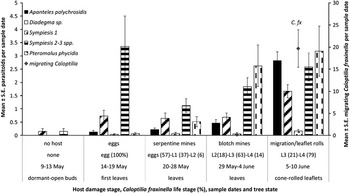
Capture of A. polychrosidis females on yellow sticky cards positioned in the ash tree canopy varied throughout the developmental period of its host (χ24 = 160.68, P < 0.001) with none caught before hosts were present (Fig. 2). Significantly, more A. polychrosidis females were captured during the migration of fourth instar C. fraxinella than at the egg (z 1 = 7.32, P < 0.001) serpentine miner stage (z 1 = 8.83, P < 0.001) and blotch miner stage (z 1 = 6.99, P < 0.001; Fig. 2). The number of female A. polychrosidis did not vary by location within the tree (χ23 = 2.24, P = 0.524). The number of female Diadegma captured also varied during host development (χ24 = 41.95, P < 0.001) and Diadegma females were most commonly found during fourth instar larval migration than at any other stage of host development (Fig. 2). The number of female Diadegma did not vary by location within the tree (χ23 = 2.37, P = 0.499). The number of Sympiesis species 1 captured on yellow sticky traps remained low and constant throughout the larval development of C. fraxinella (χ24 = 3.17, P = 0.530; Fig. 2) and did not vary within the tree canopy (χ 23 = 3.81, P = 0.283). Capture of the other Sympiesis species (Sympiesis species 2 and S. sericeicornis) varied with host development (χ24 = 58.71, P < 0.001) and peaked during the serpentine and blotch-mine host stages (Fig. 2). The location of Sympiesis varied within the canopy of the tree (χ23 = 13.79, P = 0.0032) with fewer trapped low in the canopy on the south side than at either high (z 1 = 3.44, P = 0.0033) or low (z 1 = 2.82, P = 0.025) positions on the north side. Numbers of P. phycidis captured on yellow sticky cards varied with host developmental stage (χ 24 = 147.06, P < 0.001). More P. phycidis adults were captured at the fourth instar dispersal stage than the blotch-mine (z 1 = 2.62, P = 0.044) and serpentine-mine stages of the host (z 1 = 10.42, P < 0.001), and more at the blotch than serpentine-mine stage (z 1 = 7.98, P < 0.001). More P. phycidis were captured in traps located high on the south side of the tree compared with low on the north side (z 1 = 2.67, P = 0.038).
Mean (±SE) numbers of parasitoids per sample date (left axis) caught in green ash trees matched with the damage caused and life stages present of their host Caloptilia fraxinella by sample date and tree phenology in 2008 at Edmonton, Alberta, Canada. L1 is first instar C. fraxinella, L2 is second instar, L3 is third instar, and L4 is fourth instar and percentages at each stage are indicated in brackets. Mean number of migrating Caloptilia fraxinella larvae per sample date are represented by diamonds and scaled to the right axis.

There was a significant effect of position within the canopy on the number of early stage C. fraxinella (χ23 = 41.37, P < 0.001). There were more C. fraxinella in the lower canopy than the upper with significantly more C. fraxinella in the low south than high south (z 1 = 5.10, P < 0.001) and low north canopy than high north canopy (z 1 = 3.82, P < 0.001). There was no difference between north and south in either the lower (z 1 = 0.07, P = 0.999) or upper (z 1 = 1.42, P = 0.487) canopy.
Temperature varied within the canopy (χ 23 = 144.02, P < 0.001) with no difference between the high southern and northern canopies (z 1 = 1.76, P = 0.294) or at low and high positions on the south side of trees (z 1 = 2.37, P = 0.0834). The low southern canopy was cooler than the high northern canopy (z 1 = 3.99, P < 0.001). The low northern canopy was cooler than the high northern canopy (z 1 = 11.19, P < 0.001), and both the low southern (z 1 = 6.36, P < 0.001) and high southern (z 1 = 9.43, P < 0.001) canopies. The low northern canopy was the coolest at 21.197 ± 0.065 °C and the high northern canopy the warmest at 21.81 ± 0.064 °C. Light intensity was significantly different in all four positions within the canopy (χ23 = 216440, P < 0.001) and most intense in the low southern canopy (216.90 ± 2.93 lux) and least intense in the low northern canopy (133.96 ± 1.16 lux).
Phenology of parasitoid emergence
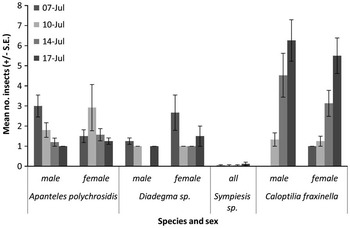
In sleeve cage experiments conducted in 2008, male A. polychrosidis emerged before females (Fig. 3). There was a significant sex:date interaction (χ21 = 18.51, P < 0.001) that showed males eclosed earlier than females under natural conditions in the field (Fig. 3). The number of Diadegma retrieved in sleeve cages was lower than A. polychrosidis and there was no difference in the number of males and females recovered over time (sex:date interaction, χ21 = 2.29, P = 0.13). Sympiesis were pooled and not separated by sex and capture numbers were low over the entire sample period.
Mean (±SE) number and sex of insects emerged from Caloptilia fraxinella in rolled leaflets assessed with sleeve cage traps per sample date in 2008 at Edmonton, Alberta, Canada.

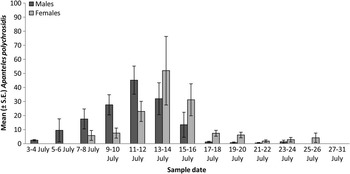
Apanteles polychrosidis that emerged from rolled leaflets (n = 3175) in the laboratory displayed a significant female-biased sex ratio (χ21 = 10.79, P = 0.001). There was a significant interaction between the sex of A. polychrosidis and the sample date that described adult eclosion (χ21 = 7.40, P = 0.0065). As was observed in the field (Fig. 3), males emerged first, dominated the first 10 days of eclosion, peaked at 11–12 July 2009 and dropped to zero by 23–24 July 2009 (Fig. 4). Females began to eclose 8–9 July 2009, dominated samples by 13–14 July 2009 and continued to eclose in low numbers until 26 July 2009 (Fig. 4).
Mean number per site (±SE) of Apanteles polychrosidis emerged from Caloptilia fraxinella by sex and emergence date in rolled leaflets held under laboratory conditions in 2009.

Courtship and mating behaviour of A. polychrosidis
Courtship behaviour preceded all mating encounters observed (n = 7). Males faced females and fluttered their wings, hopped toward the female and pulsed their antennae downward, followed by contact of the antennal tips with the female. After antennal contact, males would mount the abdomen of receptive females from behind. Courtship behaviour was followed with copulation that lasted,  $$$\bar{x}$$$
= 49.25 ± 8.73 (SE, n = 7, range 36–80) seconds. Of the five males observed, one did not mate, two mated once, one twice, and one three times.
Acceptance of another host by A. polychrosidis reared from C. fraxinella
One generation of A. polychrosidis was successfully reared on C. rosaceana. Ovipositing female A. polychrosidis use their antennal tips to drum C. rosaceana larvae and frass, which appears to initiate a sequence of ovipositor stabs that ends with ovipositor insertion into the host larva.
Discussion
A complex of parasitoids uses C. fraxinella in its extended range as a host. Apanteles polychrosidis remains the most common parasitoid of C. fraxinella (Pohl et al. Reference Pohl, Saunders, Barr, Wartenbe and Fownes2004) 12 years after the initial introduction of its host to Edmonton. In 2001–2003, the parasitoid complex on C. fraxinella consisted of A. polychrosidis and a few isolated accounts of P. phycidis (Ashmead) (Hymenoptera: Pteromalidae), Z. americanum Girault (Hymenoptera: Eulophidae), and E. argissa (Walker) (Hymenoptera: Eulophidae) (Pohl et al. Reference Pohl, Saunders, Barr, Wartenbe and Fownes2004); thus, the parasitoid complex (2008–2011) has increased in complexity. Parasitism of C. fraxinella by Z. americanum and E. argissa (Pohl et al. Reference Pohl, Saunders, Barr, Wartenbe and Fownes2004) are not supported in the current study but P. phycidis remains associated with C. fraxinella in low numbers. The current complex includes in order of frequency recovered: A. polychrosidis, a Diadegma sp., three species of Sympiesis, and P. phycidis. Diadegma and the Sympiesis species have not previously been recorded as parasitoids of C. fraxinella.
The rate of A. polychrosidis parasitism initially declined after the introduction of C. fraxinella from 23% in 2001, 7% in 2002, and 2% in 2003 (Pohl et al. Reference Pohl, Saunders, Barr, Wartenbe and Fownes2004). In contrast, the parasitism rate by A. polychrosidis in the current study increased from 36.5% in 2008 to nearly 57% in 2009 followed by a decrease to 10% in 2010. The low parasitism rate in 2010 may reflect unfavourable weather conditions that impact the parasitoid population either directly (Fink and Völkl Reference Fink and Völkl1995) or indirectly through interference with host–parasitoid synchrony (Godfray Reference Godfray1994; Van Nouhuys and Lei Reference Van Nouhuys and Lei2004). The high parasitism rates in 2008–2009 suggest that A. polychrosidis has the potential to naturally suppress populations of C. fraxinella. The rate of parasitism by the other parasitoids in the complex remains consistently <1%.
A similar complex of parasitoids uses Caloptilia azaleela (Brants) and Caloptilia leucothoes Kumata (Lepidoptera: Gracillariidae) leaf miners on Rhododendron Linnaeus (Ericaceae) in which Apanteles near Apanteles xanthostigma (Hymenoptera: Braconidae) is the dominant parasitoid of Caloptilia azalella (Sugiura Reference Sugiura2011). The primary parasitoids in the Rhododendron–Caloptilia system are also facultatively parasitised by two idiobiont hyperparasitoids, Acrolyta Förster (Hymenoptera: Ichneumonidae) and Sympiesis dolicogaster Ashmead (Hymenoptera: Eulophidae) that parasitise fifth instar and pupae of C. azaleella. Sympiesis sericeicornis, recorded in this study, is also a primary parasitoid on other leaf-miner larvae in the family Gracillariidae (Doǧanlar and Beirne Reference Doǧanlar and Beirne1980; Hagley Reference Hagley1985; Casas Reference Casas1989; Girardoz et al. Reference Girardoz, Kenis and Quicke2006). It also hyper-parasitises the primary parasitoid of the spotted tentiform leafminer, Phyllonorycter blancardella (Fabricius) (Lepidoptera: Gracillaridae) an Apanteles (Hagley Reference Hagley1985). Pteromalus phycidis is also a hyper-parasitoid of other Apanteles (Elliott et al. Reference Elliott, Simmons and Haynes1986) but was not recorded as a hyperparasite in the current study.
Caloptilia fraxinella prefers to oviposit in the lower canopy (Evenden Reference Evenden2009) but there is no evidence from the current study that this behaviour is dictated by light intensity. Most within-tree flight activity by females occurs after dusk and before dawn (personal observations), and therefore light intensity may not play a role in ovipositional preference. Light intensity did not affect ovipositional preferences of another night-flying gracillariid (Connor Reference Connor2006). The distribution of early instar hosts or variable light intensity and temperature within the canopy did not affect the distribution of A. polychrosidis or Diadegma. However, most A. polychrosidis and Diadegma were found at the larval migration stage. Decreased light intensity reduces host location efficiency in another braconid parasitoid, Cotesia glomerata (Linnaeus) (Hymenoptera: Braconidae), while flight activity in Diadegma insulare (Cresson) (Hymenoptera: Ichneumonidae) increases with light intensity (Idris and Grafius Reference Idris and Grafius1998). Temperature may have no effect on parasitoid foraging (Fink and Völkl Reference Fink and Völkl1995) and even though temperature within the canopy of green ash was significantly different, the differences were <1 °C. Sympiesis species 2 and S. sericeicornis were captured in traps on the north side of trees and may prefer lower light intensity and temperature. Sympiesis sericeicornis does not fly when wind speed exceeds 2 m/second (Casas Reference Casas1989) so wind speed, which we did not measure, may also affect the distribution of these eulophids. Pteromalus phycidis may prefer to forage in the higher light intensities and temperature of the upper southern canopy even though the density of C. fraxinella hosts was lowest in the upper canopy because light intensity influences other pteromalid species (Smith and Rutz Reference Smith and Rutz1991).
Apanteles polychrosidis is the dominant parasitoid of C. fraxinella in its expanded range in western North America. There was no evidence of A. polychrosidis parasitism of C. fraxinella eggs in dissections or sticky traps. Other Apanteles species parasitise their hosts at early and mid-instars (Shaw and Huddleston Reference Shaw and Huddleston1991) and few are known to be egg parasitoids. Apanteles polychrosidis and Diadegma are the only two endoparasitoids that parasitise C. fraxinella. Thus, the four endoparasitoid larvae found in dissections are likely one of these species. Cotesia vestalis has three distinct larval instars: first instar caudate-mandibulate, second instar with posterior anal vesicles and vermiform third instar (Yu et al. Reference Yu, Shi, Huang and Chen2008) as do most Apanteles species (Shaw and Huddleston Reference Shaw and Huddleston1991) and dissections in the current study revealed three distinct larval instars.
Parasitism rates determined from dissected larvae were almost negligible and the majority of adult A. polychrosidis and Diadegma were trapped during the transition from leaf mining to leaf rolling when C. fraxinella is vulnerable. Similar numbers of female Diadegma and A. polychrosidis are trapped while C. fraxinella migrate to new leaflets but A. polychrosidis has a much higher rate of parasitism. Diadegma and A. polychrosidis are both endoparasitoids and A. polychrosidis may out-compete Diadegma larvae within the host in multiparasitism events either by direct conflict between species (Salt Reference Salt1961), or by greater resistance to host defense by A . polychrosidis larvae (Godfray Reference Godfray1994). Campoplegine and microgastrine first instars both have large mandibles to fight (Strand Reference Strand2000). Also, A. polychrosidis superparasitises obliquebanded leafroller with up to 26 eggs per host but only one larva survives four days after oviposition (Cossentine et al. Reference Cossentine, Deglow, Jensen and Goulet2005) so intraspecific larvicide must occur in this species and interspecific larvicide could also occur.
Apanteles polychrosidis is a generalist parasitoid previously recorded from Lepidoptera larvae in the family Tortricidae. Apanteles polychrosidis parasitises the leaf-rolling species C. rosaceana on apple (Cossentine et al. Reference Cossentine, Jensen, Deglow, Bennett, Goulet and Huber2004) and raspberry (Schuh and Mote Reference Schuh and Mote1948; Li et al. Reference Li, Fitzpatrick, Troubridge, Sharkey, Barron and O'Hara1999), and other tortricid leafrollers; Archips rosanus (Linnaeus), Spilonota ocellana (Denis and Schiffermüller) (LaGasa et al. Reference LaGasa, Murray, Hitchcox and Pauley-Crawley2000), Platynota idaeusalis (Walker) (Biddinger et al. Reference Biddinger, Felland and Hull1994), and Endopiza viteana Clemens (Seaman et al. Reference Seaman, Nyrop and Dennehy1990) in North America. It also successfully parasitises another leafroller, Pandemis limitata (Robinson) (Lepidoptera: Tortricidae), when larvae are exposed without the leaf roll in laboratory experiments (Cossentine et al. Reference Cossentine, Deglow, Jensen and Goulet2005). It uses several other Choristoneura species in North America that do not exhibit a leaf-rolling habit such as the spruce budworm, Choristoneura fumifera and the jack pine budworm, Choristoneura pinus (Huber et al. Reference Huber, Eveleigh, Pollock and McCarthy1996). None of these other recorded hosts of A. polychrosidis are leaf miners and it is unlikely that this parasitoid would switch its host-search tactics to use the concealed larvae in leaf mines. In the current study, most adult A. polychrosidis were recovered from sticky traps during the migration of C. fraxinella from leaf-mining to leaf-rolling habits, which suggests that oviposition occurs within exposed larvae. Use of exposed C. fraxinella does not require A. polychrosidis to change its host-search tactics to accommodate oviposition in concealed leaf-miner larvae.
The protandrous emergence of A. polychrosidis and the tendency of male wasps to remain near their eclosion sites on ash trees (T.J. Wist, unpublished) suggest that males wait at eclosion sites for females to emerge. Indeed, A. polychrosidis mate soon after female eclosion in the laboratory and several other Apanteles species mate within the first hour of female emergence (Tagawa and Kitano Reference Tagawa and Kitano1981; Arakaki and Ganaha Reference Arakaki and Ganaha1986). A courtship ritual occurs before A. polychrosidis mate that may be influenced by pheromonal and visual stimulation of males (Weseloh Reference Weseloh1977; Askari and Coppel Reference Askari and Coppel1978). Not all Apanteles species exhibit protrandry as synchronous emergence of the sexes occurs in A. flavipes but males still wait at female emergence sites for mating opportunities (Arakaki and Ganaha Reference Arakaki and Ganaha1986). Mating quickly after emergence suggests that A. polychrosidis females are monandrous (Ridley Reference Ridley1989), while males are capable of multiply mating, like many other microgastrine males (Matthews Reference Matthews1974). The mean copulation time of A. polychrosidis recorded in the current study is 49 seconds, which exceeds the 20 seconds required for efficient sperm transfer, needed by A. melanoscelus (Ratzeburg) (Weseloh Reference Weseloh1977) and is longer than the mean mating time of 15 seconds by A. flavipes (Arakaki and Ganaha Reference Arakaki and Ganaha1986). Multiple mating in quick succession by some A. polychrosidis males and a skewed female sex ratio suggests that early emerging males that mate multiply gain a reproductive advantage over later emerged males as most female braconid wasps mate only once (Matthews Reference Matthews1974).
Most microgastrine braconids overwinter as endoparasitoids within larval hosts or as cocooned prepupae (Shaw and Huddleston Reference Shaw and Huddleston1991). Apanteles polychrosidis must use another host than C. fraxinella to overwinter because C. fraxinella overwinter as adults (Pohl et al. Reference Pohl, Saunders, Barr, Wartenbe and Fownes2004). In Pennsylvania, United States of America, A. polychrosidis overwinters in P. idaeusalis larvae (Biddinger et al. Reference Biddinger, Felland and Hull1994) and in British Columbia, Canada A. polychrosidis emerge from late instar, overwintered C. rosaceana larvae (Cossentine et al. Reference Cossentine, Jensen, Deglow, Bennett, Goulet and Huber2004). Choristoneura rosaceana may be an overwinter host for A. polychrosidis as it occurs in Edmonton (Anonymous 2013), and its larvae are readily parasitised by A. polychrosidis in the laboratory.
Since the introduction of C. fraxinella to western Canada, the parasitoid complex has changed. Apanteles polychrosidis still dominates the parasitoid complex of C. fraxinella and is the most likely candidate to exact biological control in the expanded range of its host. Host distribution, light, and temperature do not affect the distribution of parasitoids within the tree canopy. The majority of parasitism by A. polychrosidis occurs while C. fraxinella are exposed as fourth instar larvae during migration to new leaflets; thus, this parasitoid did not adopt a new host location strategy to use a concealed host. Protandrous emergence, followed by mating when females emerge and successful parasitism of an alternate larval host suggest that A. polychrosidis overwinters within larval hosts (Shaw and Huddleston Reference Shaw and Huddleston1991) before it parasitises C. fraxinella each spring. With its high parasitism rate, A. polychrosidis may be a significant natural biological control to suppress C. fraxinella populations in the expanded range of this leaf miner.
Acknowledgements
The authors thank Daryl Williams (Northern Forestry Centre, Canadian Forest Service, Edmonton, Alberta, Canada) for confirmation that the Apanteles specimens obtained in the current study were consistent with Apanteles described in Pohl et al. (Reference Pohl, Saunders, Barr, Wartenbe and Fownes2004). They are especially indebted to José Fernandez and Henri Goulet (AAFC Ottawa, Canada) for the species identification of A. polychrosidis. They thank other AAFC staff for identification of other parasitoids; John Huber for Sympiesis species, Gary Gibson for P. phycidis, and Andrew Bennet for Diadegma. They thank Emily Dombowskie, Elizabeth Hodges, Ilona Houston, Jessica Kwon, Joelle Lemmen-Lechelt, Andrew Perri, and Jocelyn Walker for assistance with fieldwork. The authors are indebted to the National Science and Engineering Research Council (NSERC), Alberta Innovates, and the Alberta Government for scholarships to TJW that funded this research and the Alberta Crop Industry Development Fund (ACIDF) and Landscape Alberta Nursery Trades Association (LANTA) for their generous grants (MLE).