Introduction
Panic disorder (PD) is amenable to both pharmacotherapy and cognitive behavior therapy (CBT) (Craske & Zucker, Reference Craske and Zucker2001; Bakker et al. Reference Bakker, van Balkom and Stein2005). Although drug therapy and CBT are effective treatments for PD, not all patients respond fully to monotherapy and several studies have shown that combining these treatments improves outcome. A recent systematic review of randomized trials of combined antidepressant and psychotherapy treatment for PD concluded that combined treatment was superior to monotherapy during acute and continuation treatment (Furukawa et al. 2006). Despite the apparent benefits of an integrated approach, barriers to treatment accessibility often prevent such an approach from being used. Although antidepressants are easily obtained from primary care physicians, access to trained CBT therapists can be limited and the cost of CBT may be too high for many individuals. These barriers can prevent patients from receiving optimal treatment for their PD (National Institutes of Health, 1991).
Various approaches have been developed to improve access to CBT. For example, some approaches reduce therapist–patient contact by delegating some therapy tasks to computer-aided CBT (Marks et al. Reference Marks, Kenwright, McDonough, Whittaker and Mataix-Cols2004). Others use self-help material that incorporate standard CBT techniques designed to reduce panic attacks, anticipatory anxiety and phobic avoidance (Gould & Clum, Reference Gould and Clum1995). Research on self-administered CBT (SCBT) is limited but available data suggest that this may be a successful and low-cost method of delivering CBT to PD patients (Gould et al. Reference Gould, Clum and Shapiro1993; Gould & Clum, Reference Gould and Clum1995; Carlbring et al. Reference Carlbring, Ekselius and Andersson2003), with some studies reporting equivalence of self- to therapist-directed CBT (Lidren et al. Reference Lidren, Watkins, Gould, Clum, Asterino and Tulloch1994; Park et al. Reference Park, Mataix-Cols, Marks, Ngamthipwatthana, Marks, Araya and Al Kubaisy2001; Carlbring et al. Reference Carlbring, Nillsson-Ihrfelt, Waara, Kollenstam, Burman, Kaldo, Soderberg, Ekselius and Anderson2005; Kiropoulos et al. Reference Kiropoulos, Klein, Austin, Gilson, Pier, Mitchell and Ciechomski2008). SCBT may be included in the treatment armamentarium of primary care physicians, who treat the majority of PD patients, and can be introduced as an initial intervention in the treatment process or as a compliment to pharmacotherapy. However, before SCBT is widely prescribed, large controlled clinical trials are needed to demonstrate its clinical value when used alone or in combination with medication. This randomized controlled study evaluated the efficacy of acute and extension treatment of PD with SCBT and the serotonin-reuptake inhibitor sertraline, alone or in combination.
Method
Subjects
Out-patients were recruited from 15 academic health centers through media advertisements and self- or practitioner referrals. The ethics committee at each hospital approved the study and patients provided written informed consent. Patients were eligible for the study if they met DSM-IV criteria for PD with or without agoraphobia (AG) based on both a psychiatric interview and a Structured Clinical Interview for DSM-IV (SCID; First et al. Reference First, Spitzer, Gibbon and Williams1997). To minimize placebo response and select patients with at least moderately severe PD, participants had to have a minimum of six full panic attacks in the 4-week period prior to the screen visit, and two full panic attacks a week in the 2-week lead-in period before the baseline visit. Co-morbid depression, generalized anxiety disorder, social phobia, somatization disorder and specific phobia were allowed as long as these conditions were secondary to and not clinically more prominent than the PD±AG. To prevent the inclusion of severely depressed patients, subjects were eligible if their score on the 21-item Hamilton Depression Rating Scale was ⩽17 (Hamilton, Reference Hamilton1960).
Patients were excluded if they had other Axis I psychiatric disorders; electroconvulsive therapy in the past 6 months; a history of psychosurgery; significant medical conditions; abnormal laboratory findings; a hypersensitivity to serotonergic agents; a history of non-response to sertraline; lactose intolerance; significant suicide risk; and use of any psychotropics within 14 days of the baseline visit (6 weeks for fluoxetine) or treatment with CBT in the past 12 months. Oxazepam was allowed during the study if needed, with a maximum daily dose of 15 mg and a weekly total dose of 60 mg. Women who were pregnant, lactating or not using reliable contraception were excluded.
Study design
The study used a factorial randomized design with Drug (sertraline or placebo drug) and Self-Help (SCBT or no SCBT) as factors. Factorial trials are an efficient way to evaluate two or more interventions and allow for the evaluation of separate effects of each intervention and possible additive effects of combined treatments (McAlister et al. Reference McAlister, Straus, Sackett and Altman2003). Patients were randomly allocated to one of four groups by a computer-generated randomization code: placebo drug alone (PBO), placebo drug plus SCBT (PBO/SCBT), sertraline alone (SERT), or sertraline plus SCBT (SERT/SCBT). Placebo and sertraline were provided as matching capsules and administered double-blind. Investigators at each site were provided with a sealed envelope that contained the identification of the study drug being administered to the patient. In a medical emergency, the investigator was authorized to break the code for that subject only. Outcome assessments were made by investigators who were blind to allocation of the drug and who were not told whether the patient was assigned to SCBT. Patients were instructed not to divulge their SCBT assignment to the investigators.
Procedures
After completing the screening evaluations, patients entered a 14-day lead-in period in which they prospectively recorded their panic attacks and, if necessary, underwent a wash-out from a disallowed medication. If, at the end of the lead-in period, the frequency of panic attacks had fallen to below the entrance criteria, the lead-in period was extended by an additional 2 weeks. If panic attack frequency remained below the entrance criteria, the patient was excluded. Patients meeting entry criteria at both screening and baseline visits were randomized. Safety and efficacy were measured at baseline and at weeks 1, 2, 3, 4, 6, 8, 10 and 12, and toxicology screening was repeated at weeks 6 and 12. Patients who completed the acute treatment were eligible to enter 12 weeks of extension treatment if they showed an adequate response (i.e. Clinical Global Impression of Improvement score of 1, 2 or 3) and good tolerance to the study treatments. Outcome was assessed at weeks 16, 20 and 24. Treatment was discontinued at week 24 and patients were followed monthly for an additional 6-month period to assess relapse. The results of the discontinuation phase will be published separately.
Treatments
Sertraline and placebo were provided within the context of clinical management sessions as described by Fawcett et al. (Reference Fawcett, Epstein, Fiester, Elkin and Autry1987) . Study drugs were initiated at 25 mg/day and increased to 50 mg/day after 1 week. In the presence of dose-limiting side-effects, patients were maintained at 25 mg/day for an additional week. If side-effects persisted and the dose could not be increased, the patient was withdrawn from the study. The dose was maintained at 50 mg/day until week 4. Thereafter, the dose was increased by 50 mg every 2 weeks or more until maximum improvement on the Clinical Global Impression scale (Guy, Reference Guy1976) was obtained. The targeted maximal dose for acute treatment was 200 mg/day. During extension treatment, patients were maintained at the dose achieved by week 12. However, if side-effects occurred at any time, the dose was decreased to the next lower level. Compliance with study medication was monitored by pill count. A returned capsule count for trial medication was recorded at each visit to monitor compliance.
SCBT consisted of 12 audiotapes and a workbook that contained monitoring forms for homework. The tapes and workbook were developed for this study by psychologists with expertise in CBT (D.K. and Z.S.). Each tape described the principles of treatment and provided detailed instructions and homework. Treatment components included extensive psycho-education about anxiety and the cognitive model of PD, breathing retraining and relaxation skills, cognitive restructuring that addressed misappraisal of panic symptoms, interoceptive and situational exposure, and relapse prevention. Tapes were distributed weekly during acute treatment by a research coordinator and a standard format was adopted for instructions to be given to patients. Compliance was assessed at each visit by asking patients how much time they spent listening to the tape, whether they attempted the suggested homework and whether they recorded their homework in the workbook. Patients who entered the 12-week extension phase were given the CBT package to use at their own discretion and no particular instructions were given.
Assessments
Multiple outcome measures were selected as key measures in PD research (Shear & Maser, Reference Shear and Maser1994): for core PD symptoms, a panic diary was used to assess frequency of panic attacks and frequency of anticipatory anxiety, and the avoidance-alone subscale of the Mobility Inventory for Agoraphobia (MI-AAL; Chambless et al. Reference Chambless, Caputo, Jasin, Gracely and Williams1985) was used to assess agoraphobic avoidance. The study investigator recorded the frequency of panic attacks and anticipatory anxiety after reviewing the patient's daily diary with the patient. Dysfunctional cognitions were assessed with the Body Sensations Questionnaire (BSQ), which measures fear of arousal-related bodily sensations (Chambless et al. Reference Chambless, Caputo, Bright and Gallagher1984), and the Agoraphobic Cognitions Questionnaire (ACQ), which measures panic-related cognitions (Chambless et al. Reference Chambless, Caputo, Bright and Gallagher1984). Disability due to PD was assessed with the Sheehan Disability Scale (SDS), which measures impairment in the areas of work, social life, and family life (Sheehan et al. Reference Sheehan, Harnett-Sheehan and Raj1996). Finally, the Clinical Global Impression (CGI; Guy, Reference Guy1976) was used to provide an overall evaluation of symptom severity (CGI-S) and improvement (CGI-I). The study was powered to detect moderate effect sizes for the quantitative outcomes.
Data analyses
Continuous outcomes were analyzed using linear mixed-effects regression models, implemented in SAS version 9.1 (SAS Institute Inc., USA), with time (in weeks since baseline) coded as a continuous variable. To account for correlation among the repeated measures over time, the intercept and time were specified as random effects and an unstructured covariance matrix was specified for the random effects parameters. The mixed model methodology, as opposed to conventional repeated-measures ANOVA, allows all available observations on each patient to be used without having to use an imputation procedure such as last-observation carried forward. The mixed models were estimated by means of Restricted Maximum Likelihood (REML), and degrees of freedom were computed using the Kenward–Roger approach (Littell et al. Reference Littell, Milliken, Stroup, Wolfinger and Schabenberber2006). Categorical outcomes were analyzed using generalized linear models with the log link function and Poisson variance function specified for count variables, and the logit link function and binomial variance function specified for dichotomous variables. The generalized estimating equations (GEE) approach was used to account for correlation among repeated measures over time using an AR(1) working correlation structure and robust (sandwich) covariance estimators for the regression coefficients. Predictors included in each model were: drug (sertraline, placebo); SCBT (SCBT, no SCBT); interaction between drug and SCBT; time; two-way interactions between time and drug, and time and SCBT; time-squared (t 2) to allow for possible quadratic trends over time; two-way interactions between t 2 and drug, and t 2 and SCBT; and three-way interactions between time, drug and SCBT, in addition to t 2, drug and SCBT. In this longitudinal randomized trial, our interest was focused on the trends over time among the groups and the main coefficients of interest in the analyses were therefore the two-way and three-way interactions with time. Likelihood-ratio tests were used to compare the models including quadratic effects of time, with the reduced models involving linear effects of time only: if the likelihood-ratio tests were significant, the results are presented for the quadratic trend models; otherwise, the results are presented for the linear trend models. To maintain the family-wise error rate associated with testing multiple outcomes, we used the Bonferroni adjustment (Proschan & Waclawiw, 2000); that is, we required the p value for any effect in our regression models to be ⩽0.05 divided by the number of related scales representing each construct (i.e. 0.05/3=0.016 for the three core PD symptoms, 0.05/2=0.025 for dysfunctional thoughts, 0.05/3=0.016 for patient-rated disability and 0.05/2=0.025 for clinical global impression). If the main or interaction effects with time were significant at the Bonferroni-adjusted significance levels, we then constructed tests of hypotheses comparing the trends among the four arms using single and multiple degree of freedom contrasts. We first tested whether there was a significant linear (or quadratic) trend in each treatment group; we then constructed simultaneous tests concerning the equality of the regression slopes among the four arms. Finally, we compared the least squares means among the arms at week 12, using the Tukey–Kramer adjustment for multiple comparisons.
We fitted similar models to the data from patients advancing to the extension treatment, this time comparing least square mean differences among the treatment groups at weeks 16, 20 and 24 using the Tukey–Kramer adjustment for multiple comparisons.
Results
Subject characteristics
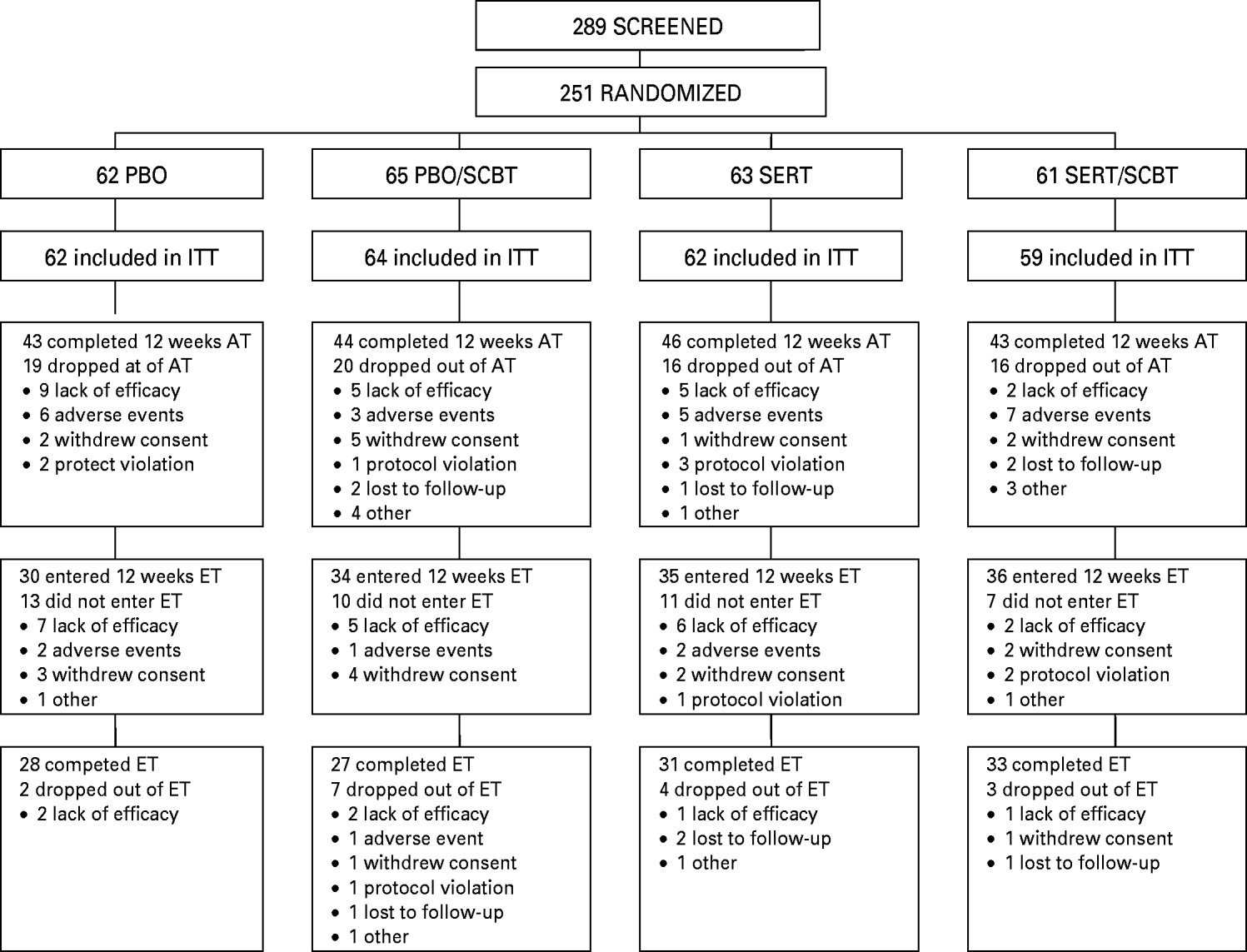
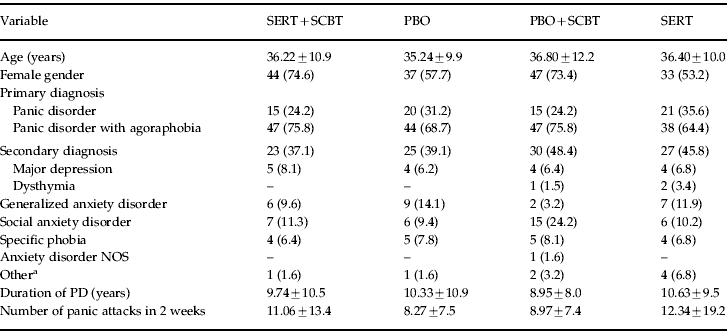
A total of 289 participants were screened or went through the formal screening lead-in period. Of these, 251 met study criteria at baseline and were randomized to one of the four treatment groups (see Fig. 1). Four participants had no post-baseline assessments and were excluded from the intent-to-treat (ITT) analyses. Table 1 presents the demographic and baseline characteristics of the ITT sample. Differences among the treatment groups were not statistically significant.
Flow of participants during the trial. ITT, intent-to-treat; AT, acute treatment; ET, extension treatment.

Demographic and clinical characteristics at baseline for the ITT population

ITT, intent-to-treat; SERT, sertraline; SCBT, self-administered cognitive behavior therapy; PBO, placebo; NOS, not otherwise specified; PD, panic disorder.
Values are given as n (%) or mean±standard deviation.
a Other secondary diagnosis included hypochondriasis, learning disability, eating disorder and avoidant personality disorder.
Attrition
Seventy-one patients (28.7%) discontinued acute treatment prematurely. Of the 176 patients who completed 12-week acute treatment, 135 advanced to 12-week extension treatment. Of these, 16 (11.8%) discontinued treatment prematurely. Attrition was similar across treatment groups. The reasons for discontinuing acute and extension treatment are described in Fig. 1.
Study drug, concomitant anxiolytic use, and safety
The dose (mean±s.d.) of the study drug was 138.3±59.5 mg/day for PBO, 126.9±62.1 mg/day for PBO/SCBT, 116.1±59.6 mg/day for SERT and 95.8±57.6 mg/day for SERT/SCBT. Oxazepam was used at least once by 55.9% of participants (n=138) and the mean weekly dose ranged from 24.8±30.9 mg to 33.7±18.0 mg. The groups did not differ in use or dose of oxazapam. The mean dose of the study drug was similar for patients who advanced to extension treatment. There were no clinically relevant changes in vital signs or weight during the trial. The majority of patients reported at least one adverse event during acute or extension treatment, with 28.9% (n=72) reporting a severe adverse event. The frequency of adverse events overall and severe adverse events were similar across treatment groups. There were no serious adverse events as defined by US Food and Drug Administration regulations (Ott & Yingling, Reference Ott and Yingling2006).
Compliance with SCBT
Compliance with the SCBT program during acute treatment was good. The percentage of participants who listened to at least 80% of the tapes was 81.2% for PBO/SCBT and 91.5% for SERT/SCBT. In both treatment groups, 64% of patients completed at least 80% of the assigned homework.
Efficacy evaluation
Core panic disorder symptoms
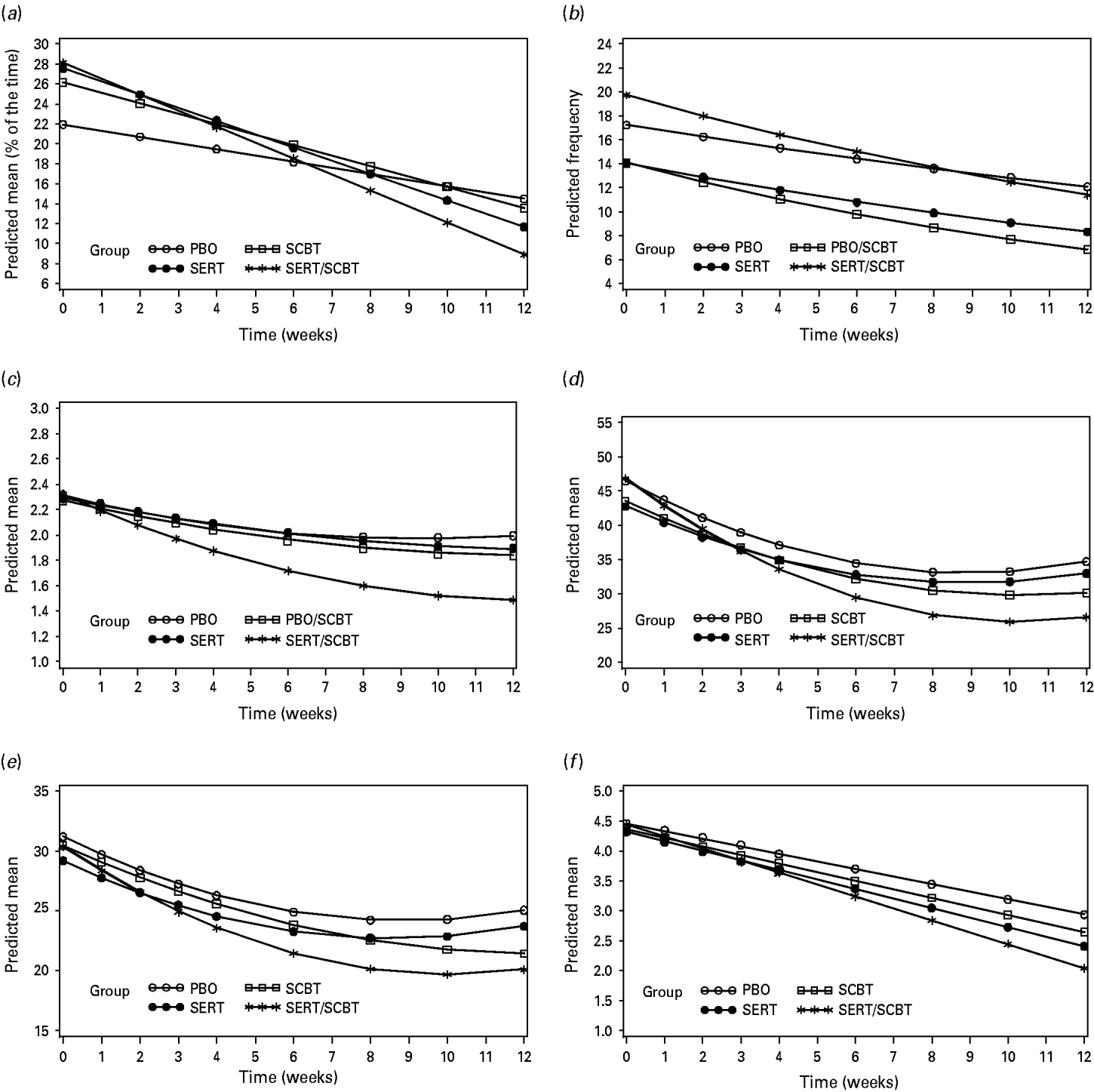
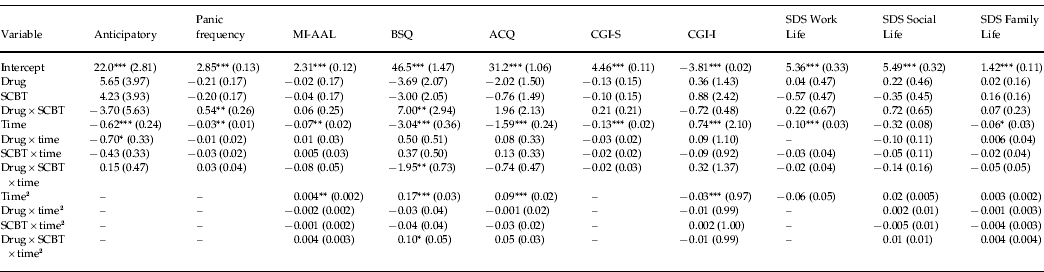
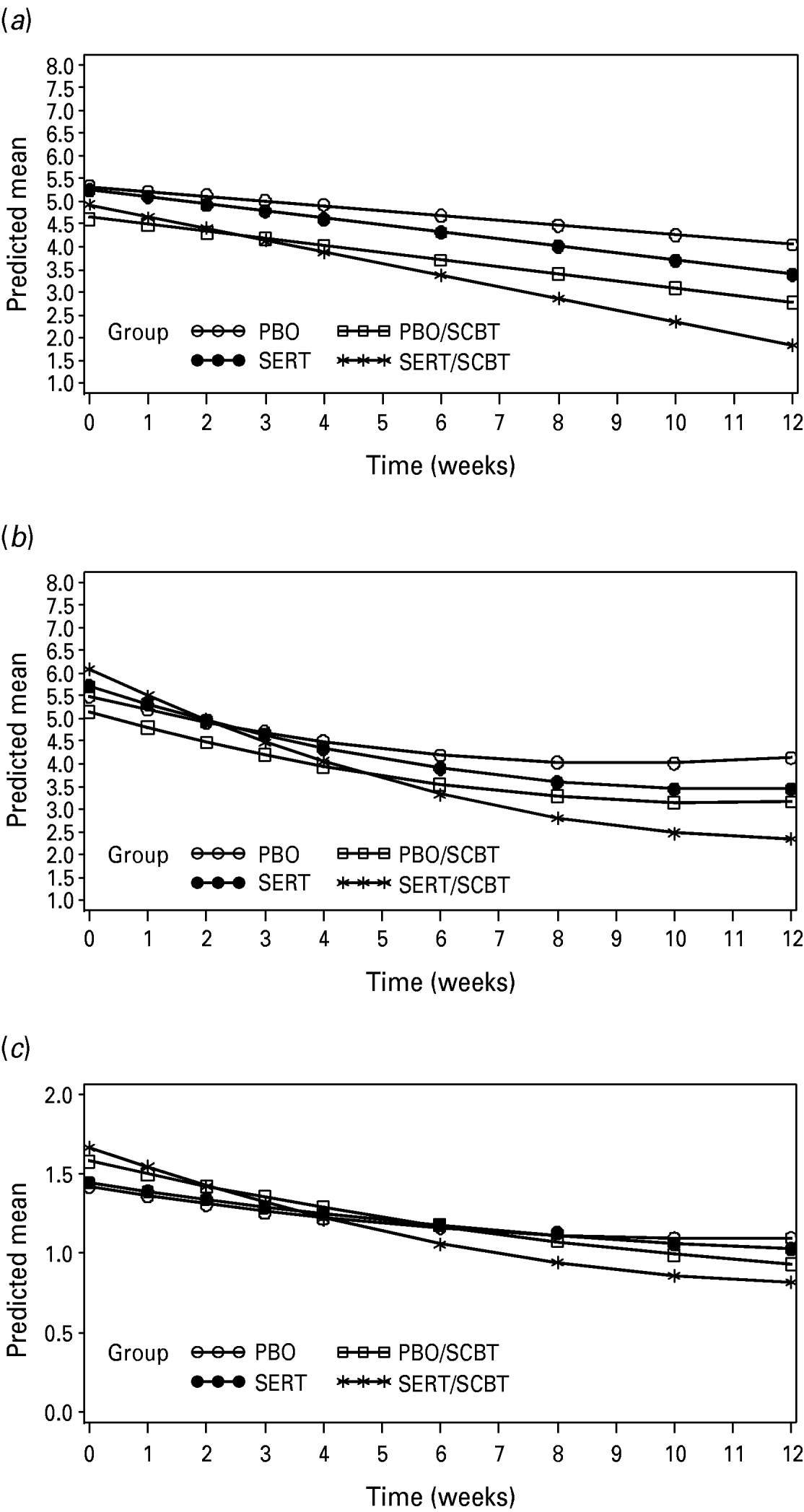
The results of the mixed model analyses for frequency of anticipatory anxiety, frequency of panic attacks and agoraphobic avoidance (MI-AAL) are summarized in Table 2. For anticipatory anxiety, the p value for the drug×time effect was 0.0353, which was non-significant after adjustment for multiplicity, indicating no statistically significant main effect of the drug treatment; the SCBT×time effect was also non-significant (p=0.1980), as was the test for additive interaction of the two treatments over time (p=0.7506). The predicted linear trends in the four treatment groups are displayed in Fig. 2 a. There were significant rates of decline in the mean frequency of anticipatory anxiety over time in all four groups, with estimated weekly reductions of 1.6, 1.3, 1.1 and 0.6% in the SERT/SCBT, SERT, PBO/SCBT and PBO groups respectively. At week 12, the predicted mean frequency of anxiety was 8.9, 11.7, 13.6 and 14.5% in the SERT/SCBT, SERT, PBO/SCBT and PBO groups respectively, but none of the pairwise comparisons were significantly different; moreover, among patients entering the continuation phase, none of the pairwise comparisons at weeks 16, 20 and 24 were significant.
Predicted mean scores from weeks 0 to 12 for core panic symptoms, dysfunctional cognitions and clinical global impression: (a) frequency of anticipatory anxiety; (b) frequency of panic attacks; (c) Mobility Inventory for Agoraphobia Alone (MI-ALL); (d) Body Sensations Questionnaire (BSQ); (e) Agoraphobic Cognitions Questionnaire (ACQ); (f) Clinical Global Impression – Severity (CGI-S).

Results of mixed model analyses

SCBT, Self-administered cognitive behavior therapy; MI-AAL, Mobility Inventory for Agoraphobia Alone; BSQ, Body Sensations Questionnaire; ACQ, Agoraphobic Cognitions Questionnaire; CGI-S, Clinical Global Impression-Severity; CGI-I, Clinical Global Impression-Improvement; SDS, Sheehan Disability Scale.
* p<0.05, ** p<0.01, *** p<0.001.
For panic attack frequency, the drug×time and SCBT×time effects were non-significant (p=0.5289 and 0.1234 respectively), and the test for the additive interaction of the two treatments over time was also non-significant (p=0.4550). Thus, there were no statistically significant effects on panic attack frequency over time associated with any of the treatments. The predicted trends for the four groups are displayed in Fig. 2 b. There were significant reductions in the risk of panic attacks over time in all four groups with estimated weekly relative risk reductions of 4.3, 5.9, 4.5 and 2.9% in the SERT/SCBT, SERT, PBO/SCBT and PBO groups respectively. At week 12, the predicted mean frequency of panic attacks was 11.4, 8.3, 6.8 and 12.1 times per week in the SERT/SCBT, SERT, PBO/SCBT and PBO groups respectively, but none of the pairwise differences were statistically significant. The absence of effects persisted into the extension phase, with no significant differences observed in the frequency of panic attacks at weeks 16, 20 or 24.
For the MI-AAL there were no significant linear or quadratic drug by time or SCBT by time effects, and the tests for additive interaction effects over time were also not significant. The predicted quadratic trends for the four groups are displayed in Fig. 2 c. There were significant quadratic rates of decline in all four groups. The mean scores at week 12 were 1.5, 1.9, 1.8 and 2.0 in the SERT/SCBT, SERT, PBO/SCBT and PBO groups respectively, with the Tukey–Kramer adjusted pairwise comparison between SERT/SCBT and PBO significant [adjusted (adj) p=0.0155]. For patients entering the continuation phase, the mean scores at week 24 were significantly lower in SERT/SCBT than in PBO (adj p=0.0331) and significantly lower in SERT/SCBT than in PBO/SCBT (adj p=0.0455).
Dysfunctional thoughts
The results of the mixed model analysis for scores on the BSQ and ACQ are summarized in Table 2. There were no significant linear or quadratic drug by time or SCBT by time effects for the BSQ; however, the p values for the additive interaction effects of the two treatments were 0.0078 and 0.0478 for the linear and quadratic time effects respectively; thus, after adjustment for multiplicity, there was a statistically significant interaction effect of SERT and SCBT over time. The predicted quadratic trends for the four groups are displayed in Fig. 2 d. The results show significant quadratic rates of decline in all four groups; pairwise comparisons of the quadratic trends among the four groups using multiple degree of freedom contrasts in the mixed-effects model revealed that the quadratic trend in the SERT/SCBT group was significantly different from the quadratic trends in the PBO (p=0.0003), PBO/SCBT (p=0.0027) and SERT groups (p<0.0001), even after adjustment for multiplicity. Neither SERT nor PBO/SCBT was significantly different from PBO, and SERT was not significantly different from PBO/SCBT. The mean scores at week 12 were 26.6, 33.0, 30.1 and 34.7 in the SERT/SCBT, SERT, PBO/SCBT and PBO groups respectively and Tukey–Kramer-adjusted pairwise comparisons at week 12 revealed a significant difference between SERT/SCBT and SERT (adj p=0.0180) and between SERT/SCBT and PBO (adj p=0.0014). Among patients advancing to extension treatment, the mean scores on the BSQ were significantly lower in SERT/SCBT than in PBO at weeks 16, 20 and 24 (adj p=0.0014, 0.0014, and 0.0063 respectively), and significantly lower in SERT/SCBT than in SERT at weeks 16 and 20 (adj p=0.0104 and 0.0124 respectively).
There were no significant linear or quadratic drug by time or SCBT by time effects for the ACQ, and the tests for additive interaction of the two treatments were also non-significant. The predicted quadratic trends for the four groups are displayed in Fig. 2 e. There were significant quadratic rates of decline in the mean ACQ scores in all four groups. At week 12, the predicted mean scores on the ACQ were 20.1, 23.7, 21.4 and 25.1 in the SERT/SCBT, SERT, PBO/SCBT and PBO groups respectively, with the difference between SERT/SCBT and PBO statistically significant (adj p=0.0058). Among patients advancing to extension treatment, the mean scores on the ACQ remained significantly lower in SERT/SCBT than PBO at weeks 16, 20 and 24 (adj p=0.0049, 0.0038 and 0.0089 respectively).
CGI
The results of the mixed model analyses for the CGI-S scale are summarized in Table 2. There were no significant drug×time or SCBT×time effects, and the additive interaction effect for the two treatments was also not significant. The predicted linear trends in the four groups are displayed in Fig. 2 f. There were significant rates of decline in mean CGI-S scores in all four groups, with estimated weekly rates of decline of 0.19, 0.15, 0.14 and 0.12 in the SERT/SCBT, SERT, PBO/SCBT and PBO groups respectively. The mean CGI-S scores at week 12 were 2.0, 2.4, 2.6 and 2.9 in the SERT/SCBT, SERT, PBO/SCBT and PBO groups respectively, with a statistically significant difference between SERT/SCBT and PBO (adj p=0.0048). Among patients advancing to extension treatment, the mean scores on the GCI-S scale remained significantly lower in SERT/SCBT than in PBO at weeks 20 and 24 (adj p=0.0465 and 0.0298 respectively).
The results of the logistic regression analysis of the CGI-I scale (categorized as ‘much improved’ or ‘very much improved’ versus other) are summarized in Table 2. There were no significant linear or quadratic drug×time or SCBT×time effects, and the tests for additive interaction were also non-significant. There was a significant increase in the odds of improvement over time in all four groups. The predicted probabilities of improvement at week 12 were 87.3% for SERT/SCBT, 70.8% for SERT, 66.7% for PBO/SCBT, and 64.1% for PBO; the difference between SERT/SCBT and PBO was significant (p=0.0086). Among patients advancing to extension treatment, the difference between SERT/SCBT and PBO remained significant at weeks 20 (p=0.0019) and 24 (p<0.0001); additionally, the difference between SERT/SCBT and PBO/SCBT was significant at weeks 20 (p=0.0015) and 24 (p=0.0003).
Patient-rated disability
The results of the mixed model analyses for the SDS subscales are summarized in Table 2. The predicted linear trends in the four groups are displayed in Fig. 3. For the subscale relating to work, the linear trend model revealed no significant drug×time or SCBT×time effects, and the test of additive interaction of drug and SCBT over time was also not significant. The predicted means at week 12 were 1.8, 3.4, 2.8 and 4.0 in the SERT/SCBT, SERT, PBO/SCBT and PBO groups respectively, with significant differences between SERT/SCBT and PBO (adj p=0.0005) and between SERT/SCBT and SERT (adj p=0.0287). Among patients advancing to extension treatment, the mean scores in the SERT/SCBT group remained significantly lower than PBO at weeks 16, 20 and 24 (adj p=0.0003, 0.0007, 0.0123 respectively).
Predicted mean scores from weeks 0 to 12 for the Sheehan Disability Scales (SDS) in the areas of (a) work, (b) social life and (c) family life.

For the SDS subscale relating to social life, the mixed model revealed no significant linear or quadratic drug×time, SCBT×time, or drug×SCBT×time effects. The predicted means at week 12 were 2.3, 3.4, 3.2 and 4.1 in the SERT/SCBT, SERT, PBO/SCBT and PBO groups respectively; the difference between SERT/SCBT and PBO was statistically significant (adj p=0.0017). Among patients advancing to extension treatment, this difference remained significant at weeks 16, 20 and 24 (adj p=0.0002, 0.0002 and 0.0039 respectively); moreover, scores were significantly lower in SERT than in PBO at weeks 16 and 20 (adj p=0.0295 and 0.0272 respectively).
For the SDS subscale relating to family life, the mixed model analyses revealed that there were no significant drug×time, SCBT×time or drug×SCBT×time interactions. The predicted means at week 12 were 0.82, 1.03, 0.93 and 1.10 in the SERT/SCBT, SERT, PBO/SCBT and PBO groups respectively, but these were not significantly different. For patients entering the continuation phase, the mean scores on the SDS subscale relating to family life were significantly lower in SERT/SCBT versus PBO at week 20 (adj p=0.0452) and in SERT/SCBT versus PBO/SCBT at week 24 (adj p=0.0375).
Discussion
This is the first multisite placebo-controlled trial of the efficacy of a self-help intervention and pharmacotherapy in patients with PD. Primary analyses of longitudinal data revealed a significant difference in the trend over time for the BSQ but not for any other measure; specifically, sertraline plus SCBT produced the greatest decline in fear of bodily sensations compared to placebo and the active treatments. Secondary analyses revealed that the combination of sertraline and SCBT was the only active treatment that could be differentiated from placebo at weeks 12 and 24. With the exception of frequency of panic attacks and anticipatory anxiety, combined treatment was superior to placebo in reducing scores on the MI-AAL, BSQ, ACQ, CGI-S, CGI-I and SDS subscales. One explanation why combination treatment was not better than placebo in reducing panic attacks and anticipatory anxiety is that these core symptoms of PD can fluctuate widely from week to week and their episodic nature makes them subject to substantial variability that can attenuate treatment differences (Pollack et al. Reference Pollack, Otto, Worthington, Manfro and Wolkow1998). The study also failed to demonstrate that co-administration of sertraline and SCBT improved outcome relative to the other active treatments. Although sertraline/SCBT fared better than sertraline monotherapy in reducing week-12 scores on the BSQ and SDS-work subscale, and better than placebo/SCBT in reducing week-24 scores on the MI-AAL and SDS-family subscale, no other differences emerged.
An unexpected finding in this study was that sertraline alone did not fare better than placebo in improving symptoms of PD. This contrasts with three large randomized trials that demonstrated an advantage of sertraline over placebo drug in the acute treatment of PD (Londborg et al. Reference Londborg, Wolkow, Smith, DuBoff, England, Ferguson, Rosenthal and Weise1998; Pohl et al. Reference Pohl, Wolkow and Clary1998; Pollack et al. Reference Pollack, Otto, Worthington, Manfro and Wolkow1998). Because negative results are not often reported by industry sponsors, we have no access to unpublished data and cannot compare our findings with other negative trials. Nevertheless, our study closely resembles positive outcome trials in terms of sample size, patient demographics and clinical characteristics such as duration of PD and presence of agoraphobia. Our study also resembles these trials with respect to duration and dosage of sertraline treatment and attrition rates. The only discernable difference between this study and other trials is that our study patients were more ill. They had more frequent panic attacks at baseline and more co-morbid Axis I disorders. Co-morbidity can make PD difficult to treat and reduces the efficacy of selective serotonin reuptake inhibitors (SSRIs) (Pollack et al. Reference Pollack, Rappaport, Clary, Mardelian and Wolkow2000). It is therefore possible that the failure to detect a sertraline–placebo difference in the present study may be attributed to the presence of a more severe disorder.
In contrast to the favorable outcome with the combined treatment of sertraline and SCBT, placebo plus SCBT showed no advantage over placebo alone. Several studies have reported that self-directed CBT with varying degrees of therapist contact is more effective than a control condition in alleviating core symptoms of PD (Gould et al. Reference Gould, Clum and Shapiro1993; Lidren et al. Reference Lidren, Watkins, Gould, Clum, Asterino and Tulloch1994; Febrarro et al. Reference Febbraro, Clum, Roodman and Wright1999; Carlbring et al. 2001;Febbraro, Reference Febbraro2005). However, not all studies have found that self-directed CBT is effective (Holden et al. Reference Holden, O'Brien, Barlow, Stetson and Infantino1983; Hecker et al. Reference Hecker, Losee, Fritzler and Fink1996). A limitation across positive outcome trials is that a high proportion of patients were on stable doses of anti-panic medication. As a result, we cannot rule out the possibility that the addition of a self-help intervention augmented response to pharmacotherapy. The generalizability of these self-help studies is also limited by the fact that the sample sizes were small and most participants were mildly ill. Our study, based on a larger number of patients, suggests that SCBT without any therapist assistance may not be an effective intervention for patients with moderate to severe PD, who may require therapist-directed CBT or adjunctive pharmacotherapy. One important caveat of this study is that we did not include an SCBT alone treatment cell. SCBT plus placebo drug is not equivalent to SCBT alone and patients may have different expectations about being treated with or without medication, which could affect outcome. Studies involving therapist-delivered CBT have reported that placebo drug enhances the effects of CBT during acute treatment (Furukawa et al. 2007). Thus, it is possible that SCBT alone would have fared worse than it did in the present trial. Although we realize that the addition of an SCBT only group would have been preferable, it was beyond the limited resources of this study.
To summarize, this multicenter trial suggests that sertraline combined with SCBT may be an effective treatment for PD. The current data could not confirm the efficacy of sertraline monotherapy or self-directed CBT without concomitant medication or therapist assistance in the treatment of PD. Future studies of self-help interventions should be carried out in primary care settings where the majority of PD patients initially present.
Study registration
This study was approved by Health Canada and carried out entirely in Canada. The study was completed prior to the requirement for registration with ClinicalTrials.gov or any other registry.
Acknowledgments
This work was supported by the Canadian Institutes of Health Research (POP-15247) and Pfizer Canada. We thank Dr V. Hadrava of Pfizer Canada for his generous support during the study. Data management was provided by Dr N. B. Segal of SciMed, Consulting, Scarborough, Ontario. The participating sites were: Clarke Institute of Psychiatry, University of Toronto, Toronto (Dr J. Bradwejn); Royal Ottawa Hospital, University of Ottawa, Ottawa (Dr D. Bakish); Centre Universitaire de Sante de Sherbrooke (CUSE), University of Sherbrooke, Sherbrooke (Dr J.-P. Boulanger); PsycHealth Centre, Winnipeg (Dr M. Enns); Victoria Hospital, London (Dr R. Kraus); Hotel-Dieu de Levis, Levis (Dr C. Lajeunesse); Kelowna General Hospital, Kelowna (Dr P. Latimer); University of Western Ontario Hospital Campus, London (Dr E. McCrank); Centre Hospitalier Pierre Janet, Hull (Dr R. Payeur); Centre Hospitalier Universitaire de Laval, Universite de Laval, Quebec (Dr J. Plamondon); Western Canada Behavior Center, Calgary (Dr R. Reesal); Vancouver Hospital, Vancouver (Dr O. Robinow); University of Alberta Hospital, Edmonton (Dr P. Silverstone); and Chedoke McMaster Hospitals, Hamilton (Dr M. Van Ameringen).
Declaration of Interest
Dr J. Bradwejn acted during and subsequent to the completion of this study as a Principal Investigator for clinical trials sponsored by Wyeth, Novartis, Johnson and Johnson, and SmithKline Beecham. He also acted as a consultant for Servier and as a speaker for SmithKline Beecham and Servier.