Introduction
Hematopoietic stem cell transplantations (HSCTs) are efficacious in treating hematological malignancies and select autoimmune diseases as a first line of therapy and when all other treatments have been exhausted (Copelan, Reference Copelan2006). In HSCT, the patient's (autologous) or a donor's (allogeneic) stem cells are harvested followed by the administration of high doses of chemotherapy and/or radiotherapy (conditioning therapy) and reinfusion of collected stem cells (Copelan, Reference Copelan2006). After a period of neutropenia (low blood counts), engraftment fosters hematopoietic stability and allows the patient's return to health (Elredge et al., Reference Elredge, Nail and Maziarz2006). Historically, an extensive inpatient stay for peri-transplant and post-transplant has been standard practice due to treatment toxicities and high risk for infectious complications (Solomon et al., Reference Solomon, Matthew and Barreras2010). The availability of outpatient HSCT, in which the patient receives the preparative regimen, transplant, and subsequent medical care a few times weekly in an outpatient facility, allows patients to achieve comparable, if not superior, care and outcomes in exchange for financial savings, reduced risk of hospital induced infections, and fewer disruptions to daily functioning (McDiarmid et al., Reference McDiarmid, Hutton and Atkins2010; Graff et al., Reference Graff, Singavi and Schmidt2015; Gratwohl et al., Reference Gratwohl, Pasquini and Aljurf2015). Several studies have also demonstrated that at-home HSCT programs, in which patients receive the transplant in an outpatient facility and then subsequent treatment in the home setting, are equally safe and feasible (Svahn et al., Reference Svahn, Remberger and Myrback2002; Fernandez-Aviles et al., Reference Fernandez-Aviles, Carreras and Urbano-Ispizua2006). One study found lower incidences of infection, shorter durations of fever, increased savings in medical costs, and fewer readmission rates among 50 patients receiving home care in comparison to 50 patients in an in-hospital control group (Fernandez-Aviles et al., Reference Fernandez-Aviles, Carreras and Urbano-Ispizua2006). As the cost savings and feasibility of a homebound setting are mediated by the involvement of caregivers (Applebaum et al., Reference Applebaum, Bevans and Son2016), it is critical to thoroughly explore the challenges and potential benefits experienced by caregivers in this treatment setting.
Cancer caregivers, estimated at roughly four million individuals in the United States (Romito et al., Reference Romito, Goldzweig and Cormio2013) are instrumental in supporting a patient's recovery by fulfilling tasks that cannot solely be managed by a patient's medical team (Rivera, Reference Rivera2009; Given et al., Reference Given, Given and Sherwood2012) and often while concurrently maintaining many responsibilities (Rabow et al., Reference Rabow, Hauser and Adams2004). Providing care for patients undergoing outpatient HSCT can be particularly demanding as caregivers are tasked with assuming their role for a much longer and intensive period of time (i.e., 24 hours a day, seven days a week for at least 100 days post-transplant). They are tasked with monitoring common transplant-related sequela (i.e., nausea, diarrhea, infection) and providing updates on the patient's compliance with prescribed medication, diet, and activity regimens (Solomon et al., Reference Solomon, Matthew and Barreras2010). Caregivers are also entrusted with responding to complex emotional needs of patients, likely due to a higher uncertainty of patient prognosis, the possibility of relapse and the lethality of the illness and treatment (Elredge et al., Reference Elredge, Nail and Maziarz2006) while attending to their own physical and emotional needs that often go unaddressed (Beattie and Lebel, Reference Beattie and Lebel2011; Jim et al., Reference Jim, Quinn and Barata2014).
The demanding nature of caregiving, combined with limited physical and psychological resources, puts caregivers at risk for burden, as is well substantiated by the caregiving literature (Given et al., Reference Given, Kozachik, Collins, Maas, Buckwalter, Hardy, Tripp-Reimer and Titler2001; Stenberg et al., Reference Stenberg, Ruland and Miaskowski2010; Van Ryn et al., Reference Van Ryn, Sanders and Kahn2011; Applebaum and Breitbart, Reference Applebaum and Breitbart2013). In a scoping review of caregiver burden in autologous and allogeneic HSCT, researchers corroborated the existing literature that suggests HSCT caregivers are equally susceptible to role strain and unmet needs (Applebaum et al., Reference Applebaum, Bevans and Son2016) and face significant areas of burden such as social isolation, financial demands, and difficulties maintaining employment (Simoneau et al., Reference Simoneau, Mikulich-Gilbertson and Natvig2013). With a shift toward the implementation of home-based HSCT in which total care is provided in the home setting following conditioning, caregivers will assume an even larger role in patient care and earlier in the course of treatment. As such, these caregivers will likely have greater unmet needs, resulting in a significant and negative impact on caregiver functioning.
Providing support for caregivers is a core function of transplant programs that aim to treat patients in non-traditional inpatient hospital settings, such as the outpatient clinic or home environment (Beattie and Lebel, Reference Beattie and Lebel2011). The purpose of the present study was to comprehensively examine the unique experience of caregivers in the outpatient and homebound settings with the long-term goal of developing appropriate and targeted supportive care services. Attention was given to understanding the facilitators and challenges of providing care in a homebound setting for the purposes of addressing unmet needs, a key contributor to caregiver burden (Armoogum et al., Reference Armoogum, Richardson and Armes2013).
Method
Participants
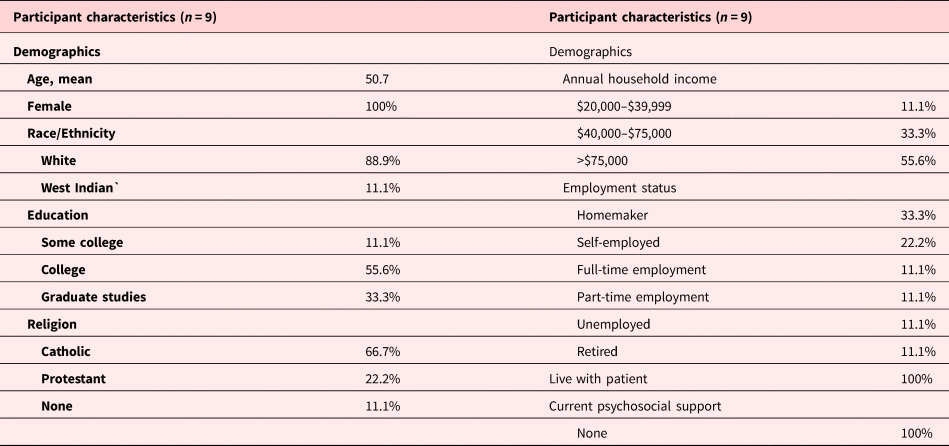
Twelve caregiver-patient dyads were recruited for a pilot study examining the feasibility of post-HSCT care delivered in a homebound setting to patients 18–80 years old with diagnoses of plasma cell dyscrasia, a treatment plan of autologous HSCT, caregiver support available 24 hours a day for seven days a week, and residence in a pre-approved homebound setting (Landau et al., Reference Landau, Shah and Reeds2018) (Table 1).
Demographic characteristics

Procedure
Patients received stem cell reinfusion in the hospital setting and returned to their homebound residents with their caregivers for protocol-specific care once medically cleared (Landau et al., Reference Landau, Shah and Reeds2018). Caregivers fulfilled basic care requirements, including strict food preparation and oversight of medication administration. Upon enrollment, the advanced practice practitioner (APP) delivered tablets to caregivers to record video diary sessions at four distinct time points: between days 1–5, 6–9, 10–14 of recovery and one to three days following discharge to the original home. Video diary prompts developed by study team members were provided to caregivers upon enrollment. Caregivers participated in a semi-structured focused interview with either the study's qualitative analyst or team member (clinical psychologist or doctoral candidate) by phone within four weeks post-discharge. Both sets of prompts are provided in Supplementary Appendix A. Upon discharge, videos obtained from tablets were uploaded to a research folder housed in MSK's secure shared drive as were transcriptions of digital recordings of video diaries and interviews prepared by a professional transcription service.
Data collection was performed until the point of data saturation (n = 12), or until responses to questions were no longer novel (Braun and Clarke, Reference Braun and Clarke2006). Transcripts of 12 interviews and 30 video diaries were obtained as participants completed these tasks. Transcripts of the interviews and video diaries were coded as they were prepared by the professional transcription service. In the process of data analysis, it became apparent that one dyad was prematurely discharged from the study due to transplant-related complications, while another incorrectly completed study tasks, thereby rendering their data unusable.
Analyses
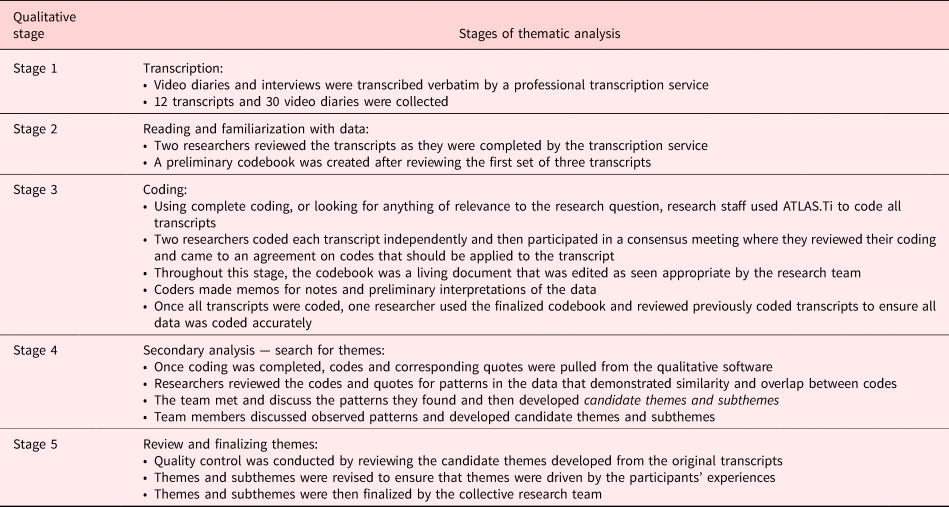
Thematic analysis informed by the perspective of Braun and Clarke (Reference Braun and Clarke2006) was used to identify recurrent thematic patterns of salient concepts in the narratives based on the frequency of code usage across participants. Themes were considered salient with a minimum frequency of 15 and distribution among half of caregivers who completed qualitative measures (n = 12). Initial codes were created to analyze words, themes, and concepts while memoing facilitated notation of emerging ideas around the data (Birks et al., Reference Birks, Chapman and Francis2008). Analyses are summarized in Table 2.
Stages of data analysis

Adapted from Braun and Clark.
Data availability
The data that support the findings of this study are available from the corresponding author upon reasonable request.
Results
Archival demographic information was available for 9 of the 12 enrolled caregivers, who were predominantly White, female, spouses between the ages of 41–50, with variability in current employment (i.e., homemaker, self-employed).
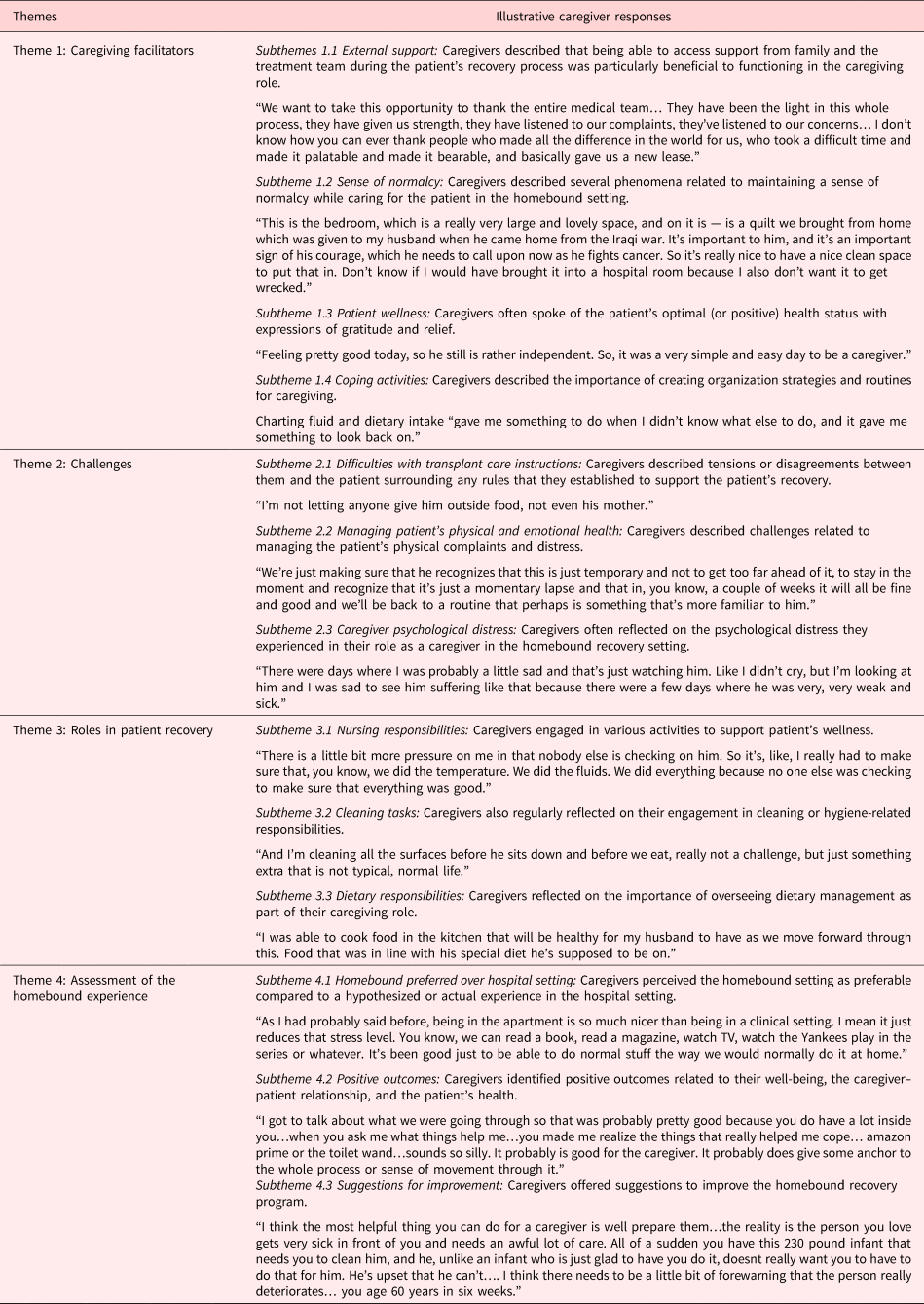
Four core themes emerged from the data analyses: caregiving facilitators, challenges in caregiving, roles in patient recovery, and assessment of the homebound experience (Table 3).
Illustrative caregiver responses

Caregiving facilitators
Caregivers described a range of facilitators of their role, including access to support from family and the medical team, a sense of normalcy, patient wellness, and coping strategies.
External support
Caregivers felt highly supported by the medical team, despite not being housed directly in the hospital, and by family members through the use of technology (i.e., phone) despite lacking in-person contact due to health maintenance efforts.
One caregiver shared her experience of being able to connect with family members using multiple platforms: “Our children … were able to come and visit … we've had friends send packages and cards, and that's nice to be able to have that connection with everybody else, too … nobody that's come to visit has seen him in a clinic or hospital type setting, it's been more relaxed.”
Family members were instrumental in helping manage outstanding and diverse role responsibilities.
Sense of normalcy
Caregivers agreed that the home environment helped maintain a sense of normalcy. Having increased control over when and for how long one could leave the recovery setting was notable, as was the opportunity to personalize the recovery setting with items brought from home.
One caregiver noted, “we're not sitting in a room cooped up, just waiting … We can watch a movie, we can take a walk, we can do our work. We just have things to occupy our time … more life as usual than not … it's making this process not so huge and overbearing.”
Patient wellness
Caregivers expressed gratitude and relief when the patient had an optimal health status. Caregivers highlighted the patient's capacity to engage in routine activities and function independently and regarded their role as “easier” when not having to respond to the patient's declining health or medical emergencies.
Coping activities
Caregivers suggested that organization strategies, including cleaning rituals, organizing medications, ensuring appropriate medication administration, and measuring liquid intake, were psychologically beneficial. Medication organization was regarded as particularly helpful in facilitating a sense of readiness to independently manage this task post-discharge.
Logging patient progress helped facilitate greater perspective on the patient's health trajectory as one caregiver stated, “keeping a log of my daily experiences helps in tracking the progress being made, which are many, and the fallbacks that we're experiencing, which have proven to be short lived as they have predicted. So it helps me to keep both of those things in perspective, the good things and the not so good.”
The ability to engage in physical exercise and relaxing activities while homebound benefitted both patient and caregiver wellness and helped relieve a sense of confinement, as one caregiver detailed, “it was nice to get out, have some fresh air and exercise … and I think that was good for her too to get … her body moving instead of just laying around … it was good for both of us.” Participation in relaxing self-care activities, including watching television, reading, and napping, was endorsed at a much lower frequency in comparison to other activities.
Challenges in caregiving
Participants indicated that difficulties with ensuring adherence to supportive recovery rules, managing the patient's physical and emotional health, and coping with distress were challenges faced in caregiving.
Difficulties with transplant care instructions
Caregivers described disagreements between themselves and the patient surrounding rules established to support the patient's recovery, including recommended exercise routines and dietary restrictions. Caregivers struggled to strike a balance between allowing patients to preserve a sense of independence and adhering to the caregiver's supportive recovery rules. Caregivers also encountered issues with visitors’ (i.e., medical team members) compliance with caregiver established rules for health maintenance efforts. One caregiver stated,
“I was so annoyed with that lady who didn't put on the mask … it was the fact that the nurses and the medical staff need to realize that the caregiver needs respect because it's hard enough getting the patient…to listen to you.”
Managing the patient's physical and emotional health
Managing the patient's physical and psychological functioning was regarded as challenging. Many endorsed feeling anxious and uncertain of how to cope with patient symptoms, including fever, gastrointestinal bleed, and exhaustion. Caregivers struggled with the patient's and their own perception of side effects as setbacks to recovery. A patient's declining health was considered by many caregivers as the most difficult period of transplant. One described, “he has constant diarrhea, and he needs everything done for him right now. It's hard for him. It's hard to see him this way.” Caregivers detailed being consumed by tasks such as cleaning the patient following bowel issues and having a patient's disrupted sleep impact their own. Caregivers attempted to cope by focusing on sanitation, the dyad's return to their previous routines and life post-transplant and redirecting the patient's attention to enjoyable activities or assumption of household tasks. One described, “if he got sick or complained about the food. I made a few more beds than I would have … changed the linens more often. I bought a Swiffer and Swiffed.”
Caregiver psychological distress
Caregivers voiced concerns regarding role restraints, patient wellness, and performing caregiving responsibilities without the medical team. Caregivers were burdened by having to manage family issues from afar, such as caring for an elderly parent. Maintaining regular communication with those family members through technological means, as was feasibly achieved in the home setting, helped ease this burden. Caregivers also struggled to perform caregiver-specific tasks, such as cleaning and managing food preparation. Most reported feeling apprehensive at least once during the post-transplant recovery period, and most often in the first week, about performing medical tasks or responding to an emergency due to fear of worsening the patient's current state. One caregiver commented, “it is a little nerve wracking to be the person who … put the one wrong thing in his body that could make him sick.” Symptoms such as nausea and vomiting triggered caregivers’ concern regarding the patient's prognosis. Caregivers were also challenged with a homebound-specific issue of the dearth of constant physical presence of the medical team. One caregiver explained, “It's one thing to be able to push a button and have a nurse come. It's another thing to be in a place and you're not … able to have someone there at a moment's notice.” Still, many were comforted by their availability through alternative means (i.e., telehealth). Coping mechanisms included the use of humor, prayer (although at a low frequency), and maintaining a positive mindset.
Roles in patient recovery
Caregivers completed a range of tasks, including medical and nursing responsibilities, hygienic practices, and dietary management.
Nursing responsibilities
Performing nursing-related responsibilities had the highest code frequency among role-based activities. Caregivers engaged in tasks such as regularly taking and charting the patient's temperature, recording liquid intake, organizing medications, and ensuring appropriate administration. Almost all described feeling apprehensive while performing nursing tasks but noted increased comfort once they observed and practiced these duties.
Cleaning tasks
Many caregivers established rules for using masks and gloves to maintain the patient's health, sterilizing equipment and having the patient shower at appropriate times. Most caregivers admitted to cleaning much more diligently.
Dietary responsibilities
Caregivers described their experiences following strict regulations for food preparation, including adherence to a low microbial diet with specific instructions spanning temperature at which to cook food and consumption of leftovers. Some caregivers struggled to identify how certain foods were prepared by venues, achieve a consistent temperature throughout the food (as measured by thermometer), and manage the patient's urge to eat foods that fell outside of dietary restrictions.
Assessment of the homebound experience
Caregivers compared the recovery experience in the home to the hospital setting, described positive outcomes gained from their experiences, and suggested improvements for future homebound HSCT programs.
The homebound setting was preferred over the hospital
The homebound recovery program was preferred over a hypothesized or actual hospital stay by all participants. One caregiver captured the perceived difference between a hospital and home setting, “I find the hospital obviously more depressing, more stressful. You're surrounded by sick people and sad eyes looking over those masks and it's just psychologically much better out of the hospital.” Caregivers characterized the hospital as “sterile” and the homebound environment as increasingly comfortable, private and conducive to optimal psychological functioning. The homebound setting allowed for greater control over when and how care was provided (i.e., APP visits to the home), rather than deferring to the hospital's timeline. A sense of comfort was emphasized in connection to having a space decorated with cherished personal items and the opportunity to complete tasks without having to leave the patient's side.
One caregiver conveyed her experience in saying, “Having a very humane space to take care of someone you love when they're sick makes a huge difference. It makes a difference for him because he can see himself as something other than just being sick…He can see his own things. He can see beauty. He has the ability to go outside.”
Furthermore, caregivers working remotely were able to maintain employment responsibilities through the availability of an internet connection and a comfortable, designated work space. Of note, caregivers indicated that the homebound setting's close proximity to the hospital in case of an emergency was optimal.
Positive outcomes
Caregivers endorsed positive outcomes that included a strengthening of the caregiver-patient relationship. One explained, “He was able to relinquish some of the control of his own care and that he trusted me to do it. And I think that as a couple, that's a huge thing.” Completion of video diaries for the study helped some caregivers gain a greater perspective on parts of the caregiving experience. Moreover, the perception that caregivers were successful in their roles helped strengthen a sense of confidence in being able to achieve other life goals.
Suggestions for improvement
Caregivers suggested that further education and practice of role-specific medical tasks would have been valuable. Multiple caregivers requested more extensive education about role expectations and at an earlier point in the caregiving trajectory. Caregivers posited the idea of first performing tasks with the medical team's assistance to feel more comfortable performing it independently. Moreover, caregivers suggested that periodic offers of psychosocial support throughout the recovery period would have been helpful, though some acknowledged that communicating with a therapist at various points during the recovery period would have been challenging given caregiving responsibilities. Others proposed being informed about what items to bring to the homebound setting from the original home setting, how to obtain coverage if needed, improvements in scheduling appointments, and offered ideas of comfortable furniture for the home setting.
Discussion
This study sought to characterize the experiences of caregivers undertaking a comprehensive and exhaustive role in a trial piloting the use of homebound HSCT. The homebound recovery program offers benefits not easily replicated in an inpatient setting. In the homebound program, patients received routine, high-quality medical care in a sanitary setting without sacrificing privacy, greater risk of infection, control over daily routines and regimented oversight of activities, all of which pose psychological and physical impediments to recovery. Importantly, the home setting offered a sense of normalcy for caregivers, which encompassed the perception of comfort, the freedom to move between the recovery setting and the outside world, and the opportunity to complete role-specific tasks with more oversight and while in close proximity to the patient. Unmet needs were identified as increasing preparedness in handling nursing tasks and managing caregiver and patient distress.
Feelings of apprehension and guilt over the perceived worsening of the patient's medical state call for an increased sense of preparedness for caregivers, which has been linked to lower levels of distress and higher levels of hope and reward (Henriksson and Arestedt, Reference Henriksson and Arestedt2013). Caregivers explicitly requested both education and practice in completing medical tasks that might be required of them over the course of patient recovery, which is particularly important given that medical staff were not always physically present.
Our results underscore the burden of managing caregiver and patient psychological wellness. Shifts in patients’ mood and distress were linked to post-transplant psychological sequela in caregivers. Difficulty coping with the physical deterioration of the patient's health and doubt in the caregiver's ability to successfully provide emotional and physical care were apparent. Furthermore, engagement in relaxing activities was endorsed at a low frequency, suggesting that caregivers were not engaging in these behaviors as often as needed. It is crucial to support the caregivers’ emotional needs as patient needs are often prioritized over those of their caregiver counterparts (Williams, Reference Williams2007) and more likely in this demanding recovery setting.
Limitations
Limitations of this study impact the generalizability and utility of our findings. While data saturation was reached with 12 participants, a larger sample may have generated more nuanced phenomena. Demographic information was not collected for all participants, and those for whom demographic information exist were predominantly female, white, college educated, spouses of patients and not maintaining full-time employment. Recruiting a diverse sample that more accurately represents the heterogeneous cancer caregiver population would allow for greater generalization of results. Furthermore, it would be beneficial to replicate this study with participants who are housed in their actual home environment and/or with less restrictive geographic criteria to compare findings. Finally, while steps were taken to ensure interrater reliability of coding, inconsistencies in data collection, including variability in interviewing styles, may have influenced the content of qualitative data and availability of particular themes.
Clinical implications
These findings highlight unmet needs related to preparation and training of caregivers and the provision of psychosocial support. Several caregivers described the first days post-transplant as the most taxing, suggesting the importance of providing sufficient support during this time. Assessing caregivers’ readiness upon enrollment in the transplant program using empirically supported instruments (i.e., Preparedness for Caregiving Scale (PCS; Archbold et al., Reference Archbold, Stewart and Greenlick1990)) will identify those at higher risk for negative outcomes. Interviews and/or checklists concerning the transplant process can also be used to acquire a nuanced understanding of what information or training is lacking.
Homebound HSCT caregivers will benefit from training that utilizes a successive approximation model with continued follow up to promote skills generalization and sustained learning. Ideally, caregivers will emerge with the capacity to provide care at an increasingly independent level and without immediate support of hospital staff. Supplemental training modules that are available upon request and through accessible forums (i.e., Internet) to address caregivers’ changing needs over the post-transplant trajectory would be of value. Ultimately, intervention techniques and implementation strategies should depend on program goals and incorporate optimizing outcomes for caregivers (Sorensen et al., Reference Sorensen, Pinquart and Habil2002). Several educational programs have already demonstrated efficacy in reducing caregiver burden and increasing self-efficacy (Hendrix et al., Reference Hendrix, Landerman and Abernethy2011, Reference Hendrix, Bailey and Steinhauser2016; Porter et al., Reference Porter, Keefe and Garst2011; Belgacem et al., Reference Belgacem, Auclair and Fedor2013). While these programs are correlated with lessened burden, one must consider that participation in these trainings in addition to overseeing caregiving, professional and personal responsibilities, may temporarily increase burden. Attention to this tension will help produce training programs that are tailored to efficiently and effectively meet the needs of homebound HSCT caregivers.
Caregivers will undoubtedly need additional psychosocial support in this recovery structure. Support programs that have shown to reduce caregiver distress through improving the caregiver's self-care, communication with physicians and the patient, cognitive reframing (Given et al., Reference Given, Given and Sikorskii2006) and problem solving (Bevans et al., Reference Bevans, Castro and Prince2010) may be incorporated. Enhancing caregivers’ problem-solving skills would benefit those doubting their capacity to successfully accomplishing care tasks (Sorensen et al., Reference Sorensen, Pinquart and Habil2002). Strengthening these skills may also help caregivers navigate disagreements with others involved in patient care, an identified source of stress found here.
Initial steps to developing a targeted psychosocial support program include assessing for the feasibility of therapies based on the delivery of service. For instance, telehealth modalities may be more appropriate given significant barriers to participating in in-person or home-based therapies. Studies have shown internet-based services, several of which offer peer-to-peer and/or professional support with interactive components, remote human support, and/or online exercises (Guay et al., Reference Guay, Auger and Demers2017; Applebaum et al., Reference Applebaum, Buda and Schofield2018) to be feasible, acceptable, and efficacious in reducing caregiver distress. Participants here voiced their receptivity of communicating with providers and family through technological forums, which the acceptability of this modality. Importantly, due to the ever-changing nature of caregiver distress over the course of the HSCT trajectory (Sabo et al., Reference Sabo, McLeod and Couban2013), considerations should also be made to ensure that the delivery of psychotherapeutic interventions is available continuously across the post-transplant period, as was executed by Laudenslager et al. (Reference Laudenslager, Simoneau and Kilbourn2015).
Future directions
Future studies of larger samples of caregivers will allow for the investigation of mediating and/or moderating factors of caregiving burden, such as relationship satisfaction, age, and previous caregiving experience. Furthermore, to establish an increasingly rigorous research methodology, themes generated from the current study may be used to develop a quantitative measure assessing facilitators and barriers to serving as a caregiver in a homebound HSCT program.
Supplementary material
The supplementary material for this article can be found at https://doi.org/10.1017/S1478951520000954.
Funding
This research was supported by funding from the National Institutes of Health (T32CA009461, PI: Jaime Ostroff, PhD; P30CA008748, PI: Craig Thompson, MD).
Conflict of interest
The authors have no conflicts of interest to disclose.