1. Introduction
The number of publications in international journals plays a critical role in employment and promotion at Korean universities, and this gives a great incentive to graduate science and engineering students to write in English (Cho, Reference Cho2009). However, writing research articles in English is a great burden to students in Korea as EFL learners (Cho, Reference Cho2009; Shin, Reference Shin2010). Furthermore, non-native English speaking (NNES) scholars are also known still to suffer from language-related problems such as grammar and vocabulary (Hanauer & Englander, Reference Hanauer and Englander2011; Uzuner, Reference Uzuner2008).
In order to increase students’ lexicogrammatical knowledge, data-driven learning or DDL (Johns, Reference Johns1991, Reference Johns1994) has been employed in previous research (Boulton, Reference Boulton2009, Reference Boulton2010; Chan & Liou, Reference Chan and Liou2005; Cobb, Reference Cobb1997; Sun & Wang, Reference Sun and Wang2003; Estling Vannestål & Lindquist, Reference Estling Vannestål and Lindquist2007), with some studies (Anthony, Reference Anthony2006; Charles, Reference Charles2007; L. Flowerdew, Reference Flowerdew2001; Lee & Swales, Reference Lee and Swales2006; Thurston & Candlin, Reference Thurston and Candlin1998; Tribble, Reference Tribble2002) also suggesting the possibility of using corpora for improving English for academic purposes. Since these studies mainly focus on the potential of corpora in classroom settings, further research is necessary to examine what should be provided to support students’ independent corpus use for academic writing, taking account of various individual and contextual factors.
In this study, two different corpora were introduced to ten graduate engineering students: a general corpus equipped with advanced search functions, and a specialized corpus of academic papers related to the participants’ fields. The main purpose of this study is to examine the evaluations of the respective corpora as reference sources from the perspectives of NNES graduate engineering students in an EFL setting. To this end, primary data were collected via weekly interviews and final surveys and were analyzed according to a grounded theory approach (Corbin & Strauss, Reference Corbin and Strauss2008). Based on the findings, the study identifies what is needed to facilitate appropriate corpus consultation for academic writing and makes suggestions for future corpus use.
2. Corpora as reference sources for L2 writing
There has been some research on corpus use for L2 writing. While C. Yoon (Reference Yoon2011) divides it into two groups according to the roles of the corpora used, i.e., research tools and reference tools, there are further differences among studies on corpora as reference tools. One stream mainly deals with corpus consultation for error correction in writing (Chambers & O’Sullivan, Reference Chambers and O’Sullivan2004; Gaskell & Cobb, Reference Gaskell and Cobb2004; O’Sullivan & Chambers, Reference O’Sullivan and Chambers2006; Todd, Reference Todd2001). In these studies, students consulted corpora to correct errors in their writing which had been underlined or highlighted by their language teachers. To differentiate this method from DDL, Gaskell and Cobb (Reference Gaskell and Cobb2004) call it ‘feedback-driven learning’. To examine its effectiveness, some of these studies focus on specific language items such as students’ grammatical errors (Gaskell & Cobb, Reference Gaskell and Cobb2004) or lexical errors (Todd, Reference Todd2001). On the other hand, in two other studies (Chambers & O’Sullivan, Reference Chambers and O’Sullivan2004; O’Sullivan & Chambers, Reference O’Sullivan and Chambers2006), various errors were marked in students’ French writing, and error corrections by corpus consultation were classified and compared, including grammatical errors, lexical errors, and capitalization errors. These studies show that, even though students can correct all types of errors, corpus consultation is particularly helpful in lessening the interference of their first language. However, one student in the first study (Chambers & O’Sullivan, Reference Chambers and O’Sullivan2004) said that “the errors need to be highlighted first. I don’t believe I could significantly improve an unmarked piece” (op. cit.: 169). It is thus questionable whether students can benefit from corpus consultation when they use corpora without the intervention of their instructors.
In another stream of research (Kennedy & Miceli, Reference Kennedy and Miceli2001, Reference Kennedy and Miceli2010; Park, Reference Park2012; H. Yoon, Reference Yoon2008; H. Yoon & Hirvela, Reference Yoon and Hirvela2004), students do autonomously use corpora as reference sources for writing without any feedback from their instructors. Kennedy and Miceli (Reference Kennedy and Miceli2001) examined their students’ behaviors according to four steps in corpus consultation, including formulating the question, devising a search strategy, observing the examples found and selecting relevant ones, and drawing conclusions. Based on their findings, they drew up a list of guidelines for each step, and these served as a basis for improving their future ‘corpus apprenticeship’. In a follow-up study, Kennedy and Miceli (Reference Kennedy and Miceli2010) provided longer and more refined training where they introduced two corpus use strategies, i.e., pattern-hunting and pattern-defining. They found that the participants developed their own consultation styles and had to master a variety of functions for each reference. With cutting-edge technologies such as screen recordings and digital query logs (Park & Kinginger, Reference Park and Kinginger2010), Park (Reference Park2012) analyzed individual learner-corpus interactions (LCI) from the Vygotskian microgenetic perspective. Rather than using well-known corpora, Park chose Google’s custom search function and identified three steps in corpus consultation: needs analysis, querying, and evaluation of the search results and decision making. Among all the interactions, 47% brought about inappropriate or no changes in students’ writing, which Park attributed particularly to difficulties with the third step.
While the aforementioned studies were conducted with only a few students, H. Yoon and Hirvela (Reference Yoon and Hirvela2004) investigated intermediate and advanced students’ opinions of corpus use via questionnaires and interviews. The students’ evaluation was that using corpora was helpful in increasing their general and academic writing skills as well as boosting their confidence, even though it was time-consuming. The intermediate students showed more favorable attitudes toward corpus use; however, as they were given more activities and more time for corpus training, it would be a hasty conclusion to say that corpus use is more helpful to intermediate than advanced students. H. Yoon (Reference Yoon2008) also conducted a longitudinal case study on changes in the perceptions of six graduate students with different majors and found that they took more responsibility for their own writing by consulting the corpus provided, thereby becoming independent writers. She also illustrated a variety of factors to be considered, including academic disciplines, prior writing experience, English proficiency, and familiarity with the corpus. In both studies, the students consulted only the Collins COBUILD Corpus, and thus these studies are limited to the use of a general corpus for academic writing.
One of the common features in most of these studies is that they were generally conducted in classroom settings where students consulted corpora under their instructors’ guidance, performing their in-class writing tasks within a certain time limit. Therefore, they do not offer a concrete illustration of students’ experience of using corpora on their own. What is more, in these writing classrooms, students’ majors were often so diverse (Charles Reference Charles2011) that disciplinary or contextual factors were not properly taken into account, which can impact on corpus users’ perceptions and behaviors as in Hafner and Candlin’s (Reference Hafner and Candlin2007) study on corpus use by law students. In addition, most of the previous studies mainly drew upon only one type of corpus, often a general corpus. As some suggestions have been made for using a specialized corpus for academic purposes (Anthony, Reference Anthony2006; Cargill & Adams, Reference Cargill and Adams2005; Charles, Reference Charles2007; L. Flowerdew, Reference Flowerdew2001; Lee & Swales, Reference Lee and Swales2006; Thurston & Candlin, Reference Thurston and Candlin1998; Tribble, Reference Tribble2002), it is imperative to explore the effectiveness of specialized corpora combined with general ones particularly in academic settings. Finally, as computer and internet technologies have developed so quickly, students can now access advanced corpora anytime and anywhere. Therefore, to reflect these recent trends, it is also necessary to conduct research on the current use of diverse corpora in more natural settings.
To address these research issues, a case study was designed and conducted on the autonomous use of general and specialized corpora for academic writing by NNES graduate students with the same major, i.e., computer engineering. The research questions that guided this study are as follows:
1. What are the benefits and drawbacks of a general corpus as a reference source for academic English writing?
2. What are the benefits and drawbacks of a specialized corpus as a reference source for academic English writing?
3. How do the participants evaluate corpora as reference sources for academic English writing?
3. Methodology
3.1. Setting and procedure
The present study was conducted in a computer engineering lab at a Korean university. The researcher carried out this study, serving as an English writing instructor for the lab.
At the first meeting, the researcher provided a corpus workshop, explaining how to consult the Corpus of Contemporary American English (COCA) and a specialized corpus with the freeware concordancer AntConc, using several activities.Footnote 1 Over 22 weeks, the students submitted what they wrote in English to the researcher, who had an interview and a one-to-one feedback session with individual students every week. During these sessions, the researcher provided not only direct feedback but also data-driven feedback (Chang, Reference Chang2013) by consulting the corpora together with the participants to find correct or better expressions and to develop their corpus consultation skills. After each session was over, the participants consulted the corpora on their own to keep feedback logs based on the feedback provided, which were collected one week later. In this study, search logs in which the participants recorded their own searches were used to complement primary data. The researcher and the participants communicated in their first language, Korean. During the research period, the participants wrote journal articles, conference papers, revision summaries, abstracts for Korean conference papers, project proposals, emails, and weekly report summaries in English. The research was terminated 22 weeks later, as no new findings were noted.
While COCA was chosen as the general corpus, a specialized corpus, named Michelangelo, was compiled manually. Its first version contained 178 papers compiled from lists of bibliographical references provided by those students with publication experience. After student D5 (see Table 1) complained that Michelangelo did not include papers relevant to his study, he was requested to submit an additional list of references, and a second version was released a month later with 23 papers added. Michelangelo mainly consists of journal articles and conference papers in the participants’ fields, and thus features the academic written English language of computer science and engineering. This corpus contains both NES and NNES writers’ publications in line with the view that students need to be exposed to academic English as a lingua franca (J. Flowerdew, Reference Flowerdew2008; Mauranen, Reference Mauranen2003; Wood, Reference Wood2001). At the time of the research, COCA comprised 400 million words, and Michelangelo 1,352,033 words without tagging or parsing.
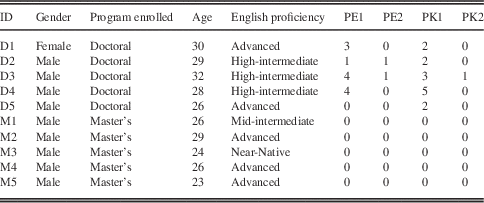
Overview of the participants’ information
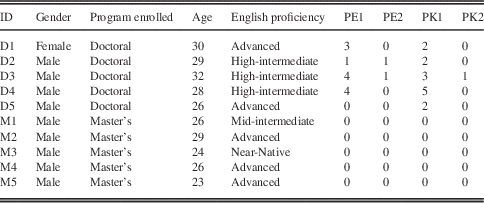
English proficiency=English proficiency measured by TEPS scores; PE1/PE2=the number of publications in international journals as primary/secondary authors; PK1/PK2=the number of publications in Korean journals as primary/secondary authors.
3.2. Participants
The participants who volunteered for the study, five master’s and five doctoral students, were all Koreans who had learned English as a foreign language. As shown in Table 1, for participant identification, each student was assigned a code ranging from D1 to M5, where the letters indicate the degree conferred upon graduation, and the numbers indicate the order of entrance to the lab. Except for M2 and M4, the other students had no experience of studying abroad. M2 and M4 had stayed in English-speaking countries for eight and ten months, respectively.
The students were asked to submit their recent English test scores as an indicator of their level of proficiency in English. M3 submitted the score of 106 in an internet-based TOEFL test, which is equivalent to Level 1 according to the TEPS grading system used by all other participants. Their scores ranged from Level 3+ to Level 1, i.e., from mid-intermediate to near-native level, though it should be noted that TEPS does not test speaking or writing skills. The doctoral students had all published articles in both Korean and international journals except for D5, who had published two articles only in Korean journals. The master’s students had not published articles in either language. Prior to the start of the study, none of the participants had heard about a corpus. With the exception of M5, all participants had used Google and/or Google Scholar as a language reference for English writing, though D3 was the only one who had used its advanced search functions such as quotation marks and wild cards.
While ten participants can be considered rather many for a single case study, it is possible to include more than one case in a case study for comprehensive research (Duff, Reference Duff2008). Given that a case can be an individual, an institution, or even a country (Chapelle & Duff, Reference Chapelle and Duff2003), it is more appropriate to consider that the case in this study refers to an engineering lab consisting of ten individual members to uncover “the multiple realities” (Stake, Reference Stake1995: 12), i.e., disparate views and patterns of corpus use for academic English writing.
3.3. Data collection and analysis
For this research project, a variety of data were collected including the recordings of weekly interviews and feedback sessions, first and second surveys, search logs and feedback logs, and the students’ written productions, along with the researcher’s fieldnotes, memos, and email correspondence with the students. This paper mainly draws upon the transcripts of the weekly interviews and the students’ written responses to the second survey as primary data. Before each feedback session, the researcher had a semi-structured interview with individual students who had submitted their writing. The researcher asked them to describe what they had looked up in the corpora and other language references, how they felt about them, and what difficulties they had experienced in using the corpora (see Appendix 1 for a complete list of interview questions). Each interview lasted for approximately three to thirty minutes depending on the length of the participants’ answers and the researcher’s follow-up questions.
An initial survey was conducted at the beginning of the project in order to obtain demographic information and details of academic needs; a second questionnaire was distributed at the end in order to collect the participants’ final evaluations. In the second survey, the students wrote down for what purposes they had used the corpora and in what ways they had been helpful or not. They also freely left several comments and suggestions for better corpus use (see Appendix 2 for the second survey questions).
Along with the written productions, the students also submitted their search logs and feedback logs. Since neither screen recordings (Park, Reference Park2012; Park & Kinginger, Reference Park and Kinginger2010) nor computer-generated logs (Gaskell & Cobb, Reference Gaskell and Cobb2004; Pérez-Paredes, Sánchez-Tornel & Alcarez Calero, Reference Pérez-Paredes, Sánchez-Tornel and Alcaraz Calero2012; Park, Reference Park2012; Park & Kinginger, Reference Park and Kinginger2010) were allowed in this lab for security reasons, manual logs were the only means to obtain valuable data showing the processes involved in the participants’ corpus consultation. The participants recorded their own searches in a search log and filled in a feedback log based on the feedback sessions (Chang, Reference Chang2013). During the weekly interviews, the participants’ writing and search logs were compared and utilized as a prompt to explain how searches were done.
The data collected were analyzed qualitatively using grounded theory techniques (Corbin & Strauss, Reference Corbin and Strauss2008). The data analysis went through three stages including open coding, axial coding, and selective coding (Corbin & Strauss, Reference Corbin and Strauss2008; Daengbuppha, Hemmington & Wilkes, Reference Daengbuppha, Hemmington and Wilkes2006) with the aid of MAXQDA (Version 10). The participants’ written productions and search logs as well as the researcher’s fieldnotes and memos were compared with the primary data for triangulation (Lincoln & Guba, Reference Lincoln and Guba1985; Stake, Reference Stake1995). The analysis and interpretation of the data was examined by the participants themselves as well as the researcher’s colleagues to ensure the trustworthiness of the research (Lincoln & Guba, Reference Lincoln and Guba1985).
4. Findings
This section presents the main benefits and drawbacks of using COCA as a general corpus and Michelangelo as a specialized corpus, as well as of corpus use in general.
4.1. Benefits of using COCA as a general corpus
∙ The general corpus is helpful in finding collocations, synonyms and exact expressions.
COCA is a highly interactive corpus that supports part-of-speech and genre-based searches, thereby enabling its users to find exactly what they want. D3 and others (D1, D4, D5, M2, M3 and M4) appreciated this benefit.
I feel more comfortable with COCA than Google Scholar. I used COCA and it was more accurate. I could specify parts of speech. In the case of Google, I had to examine its results after I did a search, but COCA just showed relevant results. (D3-Interview-0325)
In particular, D1, D4 and D5 mentioned that they had benefited from COCA in finding synonyms which enriched their otherwise ‘monotonous’ writing. This was possible because it is not only grammatically but also semantically tagged.
My difficulty was writing boring paragraphs, using the same expressions over and over again. Since COCA provides different expressions with similar meaning, it helps me a lot in overcoming this difficulty. (D5-Survey-0622)
∙ The general corpus is a credible reference.
D3 and D4 reported that the general corpus was a credible writing reference, but their reasons were different. While D4’s opinion derived from COCA’s genre-specific frequency information, D3 highly valued its inclusion of more native-speaker English writing.
A thesaurus dictionary shows more synonyms than COCA, but it only lists words without further information. It doesn’t give frequency information, and I can’t determine which one to choose because I don’t have a native speaker’s intuition. But COCA shows frequency information and examples. (D4-Interview-0430)
Google Scholar is beginning to lose my trust. I thought its results were correct, but I realized there are also people like me on Google Scholar who made mistakes in their publications. We cannot guarantee everything on Google Scholar is correct because I also made mistakes and my papers are available online. If I had not gotten any satisfying results with COCA, I would have searched Google. But there was nothing that drove me to search Google. (D3-Interview-0603)
∙ The general corpus shows the English language of various genres.
D2 and D5 mentioned that one of the strong points of COCA was that it included different English genres. However, they did not greatly appreciate this benefit, at least for their writing.
I can search English used in various fields, but it seems hard to search for English in the field that I need. (D2-Survey-0622)
4.2. Drawbacks of using COCA as a general corpus
∙ The general corpus does not show the English language of the participants’ fields
COCA includes a number of academic journals and magazines related to engineering such as Mechanical Engineering and IBM Journal of Research & Development. Nevertheless, all of the participants, except for M1 and M2, mentioned that it did not include enough texts related to their academic fields.
I couldn’t get search results with COCA. It showed only some of my searches like the words that are used a lot, such as “cpu.” It showed only those simple words. (M3-Interview-0211)
Furthermore, as not only EFL but also graduate students, they wondered about whether or not they could use in their writing what they found through COCA.
Although some phrases I’ve found with COCA look okay in terms of grammar or expressions, I’m not so sure I can use them in my field. (D5-Survey-0622)
∙ The general corpus is not easy to use.
Except for M3 and M5, none of the participants felt that COCA was easy to use. Although they admitted that its highly sophisticated search functions enabled them to obtain the very expressions they wanted, they complained that it had taken some time for them to familiarize themselves with those functions. However, M2 suggested that this problem could be overcome easily once he had consulted it a lot.
I sometimes forget how to use COCA, but that’s because I haven’t used it a lot. If I use it a lot, it won’t be a problem. (M2-Survey-0622)
4.3. Benefits of using Michelangelo as a specialized corpus
∙ The specialized corpus shows the English language the users want to acquire.
Except for M1, who did not use any corpora at all during the research period for personal reasons, the other participants highly valued this benefit. Coxhead and Nation (Reference Coxhead and Nation2001) classified English vocabulary into four categories: high frequency words, academic vocabulary, technical vocabulary, and low frequency words. According to the participants, Michelangelo was beneficial across all categories.
In fact, the word that I type in is not the focus. I usually look for how that word is used in my field and how frequently it is used, so dictionaries are not helpful… What is difficult is mainly those terms like “FTL” or “garbage collection,” which we do not use every day. Michelangelo shows how uncommon words such as those are used in my field, and that is its biggest advantage. (D2-Interview-0506)
I feel the usage of a word is very different depending on the context. Although a word is frequently used, if it is not used in my field, I feel that I don’t need to use it. That’s why I looked up words in Michelangelo. (M3-Interview-0401)
∙ The specialized corpus has a ‘summary effect’.
A summary effect is an in vivo code (Corbin & Strauss, Reference Corbin and Strauss2008: 65), which is borrowed from D2’s description. D2 and others (D3, D4 and M3) commented that it helped them focus on target expressions.
I consulted Google Scholar by using double quotation marks. Unlike Michelangelo’s line-by-line search results, its search results were mixed together with journal information. And hundreds of pages came up for my search word in Google. I think Michelangelo has a summary effect. (D2-Interview-0429)
In particular, as the specialized corpus shows target expressions aligned and highlighted in the center, D2 added that the specialized corpus was fast (see Section 4.6).
4.4. Drawbacks of using Michelangelo as a specialized corpus
∙ The specialized corpus does not have any drawbacks.
In the final survey, D2 and M2, who said in the interviews that the specialized corpus was fast, left the comment that they did not find any drawbacks to the specialized corpus.
∙ The specialized corpus needs another computer program.
D5 felt discomfort in using the concordancer for Michelangelo.
I tend to consult Michelangelo least often. I only use it for the feedback log.
(Why?)
It’s bothersome to implement another program. Other references can be opened in one browser. (D5-Interview-0408)
In fact, D5’s discomfort was not caused by the specialized corpus per se; rather, it was related to the use of an offline concordance program for an offline corpus. Some participants (D3, M3 and M4) also stated that they were dissatisfied with the lack of advanced search functions in Michelangelo, which stemmed from their comparison of the search possibilities on an untagged corpus and on COCA. In this regard, D3 made the suggestion of compiling a COCA-like specialized corpus.
I think it’s urgent to compile a COCA-like corpus of research papers specialized in each research field. For example, in the case of the CS field, it would be appropriate to compile a COCA-like corpus of CS articles published in ACM or IEEE journals. (D3-Survey-0622)
∙ The specialized corpus does not show enough results.
Half of the participants (D1, D4, D5, M3 and M5) indicated that Michelangelo needed more papers to be a helpful reference source in terms of both quantity and quality. They pointed out that Michelangelo sometimes failed to show target expressions because of a lack of relevant papers.
Because I didn’t contribute a lot to the compilation of the corpus, I sometimes found no results for the target expressions I wanted. (D5-Survey-0622)
In fact, this drawback was due in part to the initial false assumption that all of the lab students belonged to the same research field. It was later realized that the students were largely divided into two research fields, mobile systems and storage systems, and that Michelangelo included more papers related to the latter, which was D2’s research field.
When Michelangelo was compiled, I gave you really a lot of references. I gave you the references I had collected, so it was helpful to me, I guess. Other students did not give you enough references, so it was not as helpful to them as it was to me. (D2-Interview-0318)
∙ The specialized corpus is a less credible reference.
D3 and M5 considered Michelangelo to be a less credible reference, but for different reasons. While the lack of search results led M5 to lose his trust in Michelangelo,Footnote 2 D3, who judged COCA to be credible, suggested that Michelangelo should contain more NES texts to improve its credibility.
I thought “search time” was only used in Korea, so I searched for it in Michelangelo, and there were a lot of results. But many of them came from one paper. If that paper had been written by foreigners, then the results would have been credible, but it was written by Chinese people, so I felt something was strange because the expression was mainly used in that paper. So I searched COCA, and it showed some results, so I came to know that that expression is usable.
(You mean only credible papers should be included in the corpus?)
If possible, it should mainly consist of native English speakers’ papers. (D3-Interview-0506)
∙ The specialized corpus can induce its users to commit plagiarism.
D2 and D4 indicated the possibility that they could unintentionally copy others’ expressions by consulting Michelangelo. Unlike COCA, Michelangelo consisted of academic papers directly related to the participants’ research areas. As a result, plagiarism might occur by encouraging the borrowing of phrases or entire sentences rather than finding phraseological patterns.
When I looked up target words in Michelangelo, I sometimes found sentences I could refer to. I could get expressions similar to what I intended to use. It could be plagiarism but was useful. (D4-Survey-0622)
In fact, at the beginning of the research, D4 avoided using corpora because he feared that he might commit plagiarism.
If I start to consult a corpus, I can get clearer sentences, but, if I were to use them, they would look similar to the originals, and then they would be copies. (D4-Interview-0205)
His initial fear of using corpora seems to stem from his previous writing habit of copying expressions from other papers, i.e., using related papers as reference sources for his writing (J. Flowerdew & Li, Reference Flowerdew and Li2007).
Especially when I wrote difficult sentences, I searched for similar papers to mine to find sentences similar to what I had in mind and used them in my paper. For example, if a sentence occurred in my mind, but was difficult for me to express or for other people to understand, and if those sentences I wanted to write were clearly expressed in other papers, I just used them but came to follow the logic of the original papers. (D4-Interview-0205)
The participants’ tendency to borrow expressions originated from their awareness that they should follow the writing conventions of their discipline. Because of this obligation, combined with their lack of confidence in English, they hesitated to create their own sentences.
The creativity of expressions is somewhat lacking in this field. As I started to use the corpus, I came to use formulaic expressions more often. This is not copying, but I tend to use the same expressions as the originals because of the feeling of security. (D2-Interview-0513)
4.5. Overall benefits of corpus use
∙ Corpora help with English writing.
Some participants (D2, D4 and M3) explicitly said that they had gained confidence in what they had written and had produced better writing with the aid of corpora. D3, D4 and M3 mentioned that corpora were better than Google in that the web showed too many search results in an apparently random order.
4.6. Overall drawbacks of corpus use
∙ Corpora are mere language reference sources.
M3 and M4 indicated that corpora were not helpful in constructing sentence structures.
When I have to write something in English, it’s difficult to construct sentence structures. You know, there are several expressions with the same meaning. It takes lots of time to think about how to express my ideas.
(Didn’t the corpora help you with that?)
It’s not that helpful in the structural aspect. (M4-Interview-0401)
As regards his writing difficulties in constructing English sentences, M3 hoped that he could access context-aware corpora in the future which display possible sentences for given words.
I’m dreaming that a future corpus recognizes contexts in writing. For example, if I just type in “program,” then it shows “program variation.” Rather than prepositions or verbs for each word, it shows what words can be included in a sentence that I’m going to write. After all, what I want to do is to construct a sentence, but I don’t have much writing experience, so what I’m doing now is just listing words. Combining words is not easy, so it might be good if a corpus suggests possible sentence structures someday. (M3-Interview-0528)
∙ Corpora are time-consuming to use.
In line with previous studies (Chambers, Reference Chambers2005; Chambers & O’Sullivan, Reference Chambers and O’Sullivan2004; Charles, Reference Charles2011; Kennedy & Miceli, Reference Kennedy and Miceli2001; Liu & Jiang, Reference Liu and Jiang2009; H. Yoon & Hirvela, Reference Yoon and Hirvela2004), the participants also complained that consulting corpora was time-consuming, but again their reasons were different. It took M5 some time because he had to read English. On the other hand, D2 spent time consulting Michelangelo frequently. Along with M2, he said that the corpus was fast.
This is really time-consuming. It really takes lots of time.
(Is it worth using it?)
Yes. Fast. Probably that’s because I searched for very easy parts, but it helped me a lot. I’m usually confused about those easy parts. I usually search for those confusing parts, and that’s why it’s effective. (D2-Interview-0312)
These disparate attitudes can be explained by the differences between M5 and D2. M5 was a first-year graduate student serving as a teaching assistant and not engaged in any research project, while D2 was a doctoral student with publication experience. During the research period, D2 wrote a conference paper as well as weekly reports on his experiments, and what he needed was to check some confusing expressions which he already knew, while M5 mainly wrote weekly reports describing what he did as a teaching assistant.
∙ Corpora require a certain level of English proficiency.
The participants’ independent corpus use revealed that it required considerable English proficiency, including not only reading skills but also grammatical knowledge, to perform relevant searches and interpret them appropriately. For example, M5 explained his search process as follows:
I looked up that verb-preposition combination “compare to” but couldn’t get results. So I came to know that the correct expression is “compare with.” I guess that is why it doesn’t appear in COCA. (M5-Interview-0225)
It is evident that M5 could not find any search results for compare to because the verb compare requires an object. However, he simply concluded that compare with was the correct expression without further searches.
Another similar problem was detected in D4’s use of Michelangelo. Without sufficient knowledge of article usage, D4 merely judged which articles to choose based on their frequencies in the corpus.
What was confusing was the article of the noun “temperature,” and I found both “a” and “the” in Michelangelo. So I judged which one was appropriate by comparing their frequencies. Because there were more definite articles, I chose “the.” (D4-Interview-0319)
Participants D2, D4, D5, M4 and M5 failed to use corpora for some errors as they were unaware they represented problems. They added that they would have consulted corpora if they had known that they were wrong.
5. Discussion and concluding remarks
This study has examined the usefulness of general and specialized corpora as reference sources for academic English writing through a case study. Based on its findings, several suggestions can be made for EAP students’ active and appropriate corpus use. First of all, this study shows that the main requirement for independent corpus use is to make sure that learners have access to a corpus that meets their needs. Although the general corpus received positive evaluations, the participants highly valued the specialized corpus for its direct relevance to their academic fields. Their attitudes can be attributed to their tendency to adhere strictly to the writing conventions of their discipline as NNES graduate engineering students. Furthermore, given that D1 and D5 lost interest in Michelangelo because it did not contain papers directly related to their research area, a more thorough and detailed needs analysis should precede the compilation of a specialized corpus. As suggested by Charles (Reference Charles2012), one of the most effective ways to ensure a more efficient use of corpora would be to encourage students to compile their own specialized corpora. Additionally, in support of the new norms of academic English (cf. J. Flowerdew, Reference Flowerdew2008; Mauranen, Reference Mauranen2003), Michelangelo included a number of papers written by NNES researchers, which some participants felt harmed the credibility of the corpus.
The findings also point to the need for a certain degree of language proficiency for effective corpus consultation. During independent corpus use, some participants did not even attempt to look up their errors in a corpus because they believed that they were correct, or they lacked necessary grammatical knowledge for appropriate corpus search and interpretation. Although Park (Reference Park2012) considered that learner-corpus interactions can lead to microgenetic development, the problem is that unnoticed errors are unlikely to initiate the interaction at all. The need for language proficiency might appear to contradict Boulton’s (Reference Boulton2009, Reference Boulton2010) research, which suggested that students with low proficiency could benefit from DDL without prior training. However, while Boulton’s paper-based classroom materials were adjusted to the students’ level in advance by the teacher, the participants in this study had to handle raw corpus data, taking charge of the entire process of corpus consultation. These contextual and material differences may account for the difficulties in independent corpus use without the intervention of an instructor.
As regards the grey area of unnoticed errors and inappropriate corpus searches, a combination of two methods can be recommended to compensate for students’ limited language proficiency. The first, as mentioned in earlier studies (Chambers & O’Sullivan, Reference Chambers and O’Sullivan2004; Gaskell & Cobb, Reference Gaskell and Cobb2004; Liu & Jiang, Reference Liu and Jiang2009; O’Sullivan & Chambers, Reference O’Sullivan and Chambers2006; Todd, Reference Todd2001), is the underlining of errors by human proofreaders to invite students’ corpus consultation. The alternative is to enhance students’ corpus consultation skills through a “corpus apprenticeship” (Kennedy & Miceli, Reference Kennedy and Miceli2001, Reference Kennedy and Miceli2010), and these skills should be distinguished from mere familiarity with new tools. For example, Charles (Reference Charles2011) divided corpus competence into developmental stages of corpus awareness, corpus literacy, and corpus proficiency; and corpus consultation is known to require and foster mental and cognitive abilities (O’Sullivan, Reference O’Sullivan2007).
Previous studies (Chambers, Reference Chambers2005; Gaskell & Cobb, Reference Gaskell and Cobb2004; Kennedy & Miceli, Reference Kennedy and Miceli2001, Reference Kennedy and Miceli2010) have emphasized the need for more extensive training for successful corpus use. Despite the initial workshop and continuous corpus-driven feedback, most of the participants in this study were still not familiar with the advanced search functions of COCA, even though they considered them to be beneficial. Therefore, a variety of more student-centered activities, including group discussions for better corpus consultation strategies, may increase students’ corpus competence. For example, D4 offered a constructive suggestion as follows:
It would be a good idea to ask more questions to students. You can ask, for example, “For this language problem, which one is better between COCA and Michelangelo?” or “If you decide to consult COCA, how would you consult it?” Then even for a while, students would think about it and, if they have different solutions, they can have a discussion. Or it would be helpful to show parts of other students’ writings and ask how to consult corpora. (D4-Survey-0622)
Finally, the findings suggest that, if corpus users write academic papers, they should be provided with explicit guidelines to reassure them about plagiarism. Unlike COCA, Michelangelo consisted of research articles compiled from the participants’ lists of bibliographical references. As a result, despite being “a valuable resource for finding alternative ways of saying things, or novel variations of specific lexico-grammatical patterns” (Lee & Swales, Reference Lee and Swales2006: 68), some of the participants expressed concern about the possibility of unintentional plagiarism or “patchwriting” (Howard, Reference Howard1995; Pecorari, Reference Pecorari2003) in corpus use. However, this is not exclusive to corpus use: undergraduate students can copy phrases from textbooks (Currie, Reference Currie1998), and graduate students borrow expressions from journal articles (J. Flowerdew & Li, Reference Flowerdew and Li2007). Therefore, rather than abandoning corpora altogether, EAP instructors should offer clear instructions and follow-up guidance on plagiarism as part of corpus training for NNES graduate students.
Although the web can be considered a corpus (Geluso, Reference Geluso2011; Park, Reference Park2012; Sha, Reference Sha2010; Shei, Reference Shei2008a, Reference Shei2008b; Wu, Franken & Witten, Reference Wu, Franken and Witten2009), this study introduced principled corpora and presented their own advantages such as the accuracy and credibility of search results, the summary effect, and an appropriate number of examples. It is true that, unlike corpora, Google does not require long-term training for technical knowledge (Geluso, Reference Geluso2011); nor does it suffer from a paucity of search results (Sha, Reference Sha2010; Shei, Reference Shei2008a, Reference Shei2008b; Wu et al., Reference Wu, Franken and Witten2009). Pérez-Paredes et al. (Reference Pérez-Paredes, Sánchez-Tornel and Alcaraz Calero2012) found that those who used both the BNC and the web performed better and that the students did not properly exploit corpus search functions despite their prior experience and guidelines. Nevertheless, the present study shows that there are still some benefits which only corpora can provide, complementing Google and other language references.
Since this study is limited to one engineering lab, its findings may not be generalizable to a larger population or other disciplines. Furthermore, since it dealt with perceptions of corpora by the participants as a group, it does not show in detail how individual factors, such as to what extent they consulted each corpus, interacted with their opinions. Further research is thus necessary to consider how individual learner factors operate in corpus use. For future research, it would be also interesting to investigate how corpus competence can be developed to improve L2 proficiency or to compensate for the lack of language skills in L2 writing. It would be worthwhile as well to redefine the role of corpora vis-à-vis Google in language learning and teaching.
Acknowledgements
This article is based on my doctoral dissertation. I wish to thank my advisor, Dr. Sun-Young Oh, and committee members, Drs. Oryang Kwon, Jin-Wan Kim, Byungmin Lee, and Jin-Hwa Lee. I also wish to thank the editors and two anonymous reviewers for their valuable comments. Finally, my gratitude extends to the participants and their lab professor.
Appendix 1: Interview questions
1. What was difficult when you wrote in English?
2. What references did you consult when you wrote in English? What did you look up in them?
3. Did you consult COCA/Michelangelo? What did you search in it?
4. How was COCA/Michelangelo?
5. Did you experience any difficulty in consulting COCA/Michelangelo?
6. Was there any change in your attitude as well as your writing by consulting COCA/Michelangelo?
Appendix 2: Questions in the second survey
1. For what purposes have you consulted the following references? (e.g. COCA, Michelangelo, Google/Google Scholar, dictionaries, and others)
2. If you do not use COCA/Michelangelo, please tell me why.
3. In what ways is COCA/Michelangelo helpful for your writing? What difficulties does COCA/Michelangelo help resolve?
4. In what ways do you feel discomfort with COCA/Michelangelo in your writing? What problems have you encountered in consulting COCA/Michelangelo?
5. Please write any comments or suggestions.