Introduction
A number of statutory drivers for mental health service provision in Northern Ireland have been published in recent years (Bamford Review of Mental Health and Learning Disability, 2007; Department of Health, Social Services and Public Safety, 2013). These statutory drivers emphasised early intervention, health promotion, improving access to services, a shift in those services to community care, personalisation of care thereby empowering individuals, and the provision of accessible information. Such transformative demands have created targets for new innovative and accessible service delivery mediums (Department of Health, Social Services and Public Safety, 2012).
Traditional therapies for a variety of reasons are inaccessible or unappealing to certain individuals. In Northern Ireland, an evaluation of an urban psychological therapy service revealed that young males from a low socioeconomic background were significantly underrepresented in a profile of treatment-seeking adults (Maybin & Dyer, Reference Maybin and Dyer2011). This finding has been repeated in multiple cross-cultural studies (Griner & Smith, Reference Griner and Smith2006). Cost alone is prohibitive, yet Singleton et al. (Reference Singleton, Bumpstead, O’Brien, Lee and Meltzer2003) highlighted that, crucially, people in socioeconomically deprived areas are also more likely to experience mental health problems. Low intensity cognitive behaviour therapy (LI-CBT) has sought to address cost, with other problems such as stigma and accessibility in psychological service delivery (Bennett-Levy et al. Reference Bennett-Levy, Richards and Farrand2010), intentions, which parallel the Northern Irish statutory drivers.
Stress control (SC)
Equitable and effective allocation of resources, together with the extension of access to mental health services for people traditionally ‘hard-to-reach’ has been innovatively addressed by a LI-CBT initiative, SC (White, Reference White2008). SC is a psycho-educational course, facilitating mass communication and it provides a forum for the dissemination of psychological knowledge and materials (e.g. pamphlets and mp3s). SC was developed as part of a wider ‘menu’ of supported, or multi-strand psychological interventions (White, Reference White2008), but it may be delivered in isolation as an unsupported lower intensity intervention as well, in a purely didactic fashion rather than psychotherapeutically (White, Reference White1998).
SC is a standardised programme that consists of six psycho-educational sessions, which each last two and a half hours, including a 30 minute break. The sessions are delivered weekly by mental health professionals who have received additional course specific accredited training. SC is didactic and not a psychotherapeutic intervention per se, so the demands on highly-skilled therapists are not as intense compared with traditional one-to-one psychotherapeutic interventions. To enable uptake and reduce stigma the sessions are delivered in a community setting. The focus of SC is common mental health problems and so content addresses stress, depression, anxiety, panic and sleep difficulties from the cognitive behaviour therapy (CBT) perspective. Participants are simply offered the opportunity to attend free of charge, to pay attention to presentations and to take materials home containing exercises and preparation for following sessions.
Reports on the effectiveness of SC have been published with samples in a variety of countries. SC was reported to have a small and statistically significant effect size in a Scottish sample that endured at follow-up over a 2-year period for generalised anxiety disorder (White, Reference White1998). In a Belgian adaptation of SC, Van Daele et al. (Reference Van Daele, Van Audenhove, Vansteenwegen, Hermans and Van Den Bergh2013) reported clinically significant and reliable change for almost 30% of participants in an intervention group that was not replicated in a control group. Kellet et al. (Reference Kellett, Clarke and Matthews2007) also reported clinically significant outcomes for SC comparable to individual CBT and individual psychodynamic-interpersonal psychotherapy on a range of psychometrics in an English sample. As such, SC may be considered a standardised LI-CBT approach with previously proven clinical and cost effectiveness.
Accessibility
SC’s flexibility aims to maximise the potential effect of discrete insights within CBT, with clients who are traditionally reticent to access psychological services. White (Reference White2010) describes a ‘carousel’, where groups are provided free and they are regularly run outside of business hours. They are thus flexible enough for people with competing pressures to attend. As the groups are not as interactive as psychotherapy, the didactic model facilitates clients dropping in or out, to any session at any time, in any place, and to return on other occasions that idiosyncratically suit them.
The new forms of this type of proactive community outreach have been urged to target demographic profiles at risk, specifically males, youth and the socioeconomically deprived (Department of Health, Social Services and Public Safety, 2012). Operationalising gender and age into discrete variables has been readily achieved and now socioeconomic status has also been robustly quantified with an official scaled measure of spatial deprivation based on postcodes in Northern Ireland, the multiple deprivation measure (MDM; Northern Ireland Statistics & Research Agency, 2010).
Self-help empowerment
SC aims to empower individuals with the existing psychological knowledge base, so that they may become their own therapists (White, Reference White2010). The novel approach begins with marketing, which attempts to normalise the esoteric language of mental health. The dynamic differs from the traditional presence of an individual patient and therapist, yet it still seeks to acquaint people with their maladapted patterns of behaving and thinking akin to individual CBT interventions (Young et al. Reference Young, Rygh, Weinberger and Beck2007), to do so more cost effectively, and to coincide with the aims of current statutory drivers that highlighted prompt personalisation of care, thereby empowering individuals.
The aims of this study were threefold. The first aim was to gauge whether outcome measures of depression, anxiety and stress indicated change in these domains after attending SC. In addition to routine statistical significance testing, the aim was to report clinical significance testing on SC. The second aim was to assess whether demographics traditionally ‘hard-to-reach’ – males, younger adults and those from deprived areas – accessed SC. The third aim was to elucidate what prompted their access and the experiences of attendees at SC.
Methods
Design
A mixed methods design with a concurrent embedded strategy was employed (Creswell, Reference Creswell2013). The data were analysed as part of routine clinical evaluation procedures first. Afterwards, the data were treated as a secondary data source for the purpose of this report by the researcher who completed the analysis. Thus, the data were collected simultaneously and analysed in one phase (i.e. pre- and post-intervention together), resulting in the concurrent aspect of the strategy. The embedded element of the strategy resulted from the primary quantitative methods guiding the study and the secondary qualitative methods supporting that quantitative aspect. The strengths of both quantitative and qualitative approaches through a mixed methods design were utilised; the quantitative approach operationalised the variables of concern in the research questions and facilitated statistical modelling, the qualitative approach ensured that the complexity inherent in those experiences of attendees was not lost in the output.
Quantitative methods were used to address the first and second research questions. A repeated-measures design with two data collection points (i.e. pre- and post-intervention) employed dependent t-tests on three sub-scales of the Depression Anxiety Stress Scales – 21 (Lovibond & Lovibond, Reference Lovibond and Lovibond1995) and descriptive statistics were produced on the demographic data. In an extension to the analysis, calculations of clinical significance were also completed in order to gauge how many attendees exhibited reliable improvement following the intervention (Jacobson & Truax, Reference Jacobson and Truax1991).
A qualitative approach addressed the third research question. Summative content analysis (Hsieh & Shannon, Reference Hsieh and Shannon2005) was employed to analyse both Initial and Evaluation Questionnaires returned by attendees of SC. The results of the qualitative analysis were intended to test the validity of the quantitative findings, however, the summative content analysis analysed feedback to gauge how attendees at SC experienced the group as well.
Attendees
Overall, attendance facilitated inferential statistical analysis; 170 people attended, that is, completed one of the Initial, or Evaluation Questionnaires at the first or last sessions. However, the ‘carousel’ model resulted in incomplete responses within the data. In total, SC consisted of six sessions, and the course was run six times. The course was run three times between October and December 2013 and three times between February and March 2014. Across the six occasions on which the course was run, 93 people completed it, that is, 93 attendees returned both an Initial and Evaluation Questionnaire alongside DASS-21s. Almost 90% who completed the courses attended >4 sessions.
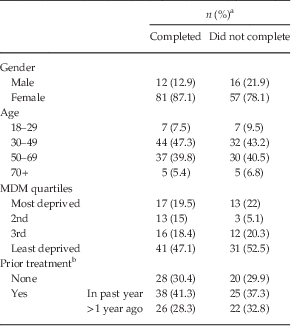
To profile attendees of SC, a number of descriptive statistics were produced. A MDM variable for each attendee was also calculated according to their postcode, which could be compared to an ordinal ranked list of 890 geographic areas, which weights and aggregates multiple specific indices of deprivation (Northern Ireland Statistics & Research Agency, 2010). Attendees’ MDM values were expressed as quartiles for interpretation and are provided in Table 1, alongside self-reported experiences of prior mental health treatment.
Socio-demographics and previous treatment experiences (n=170)

MDM, multiple deprivation measure.
a Valid data collected (i.e. excluding missing values).
b Medical, psychotherapeutic or combined.
Materials
The Initial Questionnaire gathered demographic information and information related to the source of attendees’ recruitment, while the Evaluation Questionnaire gathered feedback on SC. These questionnaires were tailored instruments. The Initial Questionnaire required categorical responses to be provided in checkboxes, although ‘Other’ options to each question generated qualitative data. The Evaluation Questionnaire posed open-ended questions on attendees’ experiences of the intervention.
A pre- and post-DASS-21 was also completed by attendees, which has three self-report sub-scales (depression, anxiety and stress), with seven items each. The psychometric properties of the DASS-21 are well established. Reliability using Cronbach’s α has been reported for each sub-scale at 0.94, 0.87 and 0.91 (Antony et al. Reference Antony, Bieling, Cox, Enns and Swinson1998). Adequate construct validity has also been reported alongside the three sub-scales’ evidenced convergent and discriminant validity compared to other popular measures of the same dimensions (Henry & Crawford, Reference Henry and Crawford2005).
Procedure
Marketing is a key aspect of SC, so that the esoteric language of mental health is normalised. By extending the reach of psychological knowledge in this way, stigma in cohorts of people who do not ordinarily attend psychological services is targeted. As such, recruitment was pursued through a variety of mediums; SC was advertised in local papers surrounding the sites at which SC was facilitated, posters were posted in local GP services, flyers were distributed at these GP services too along with local statutory and charitable mental health service providers. The weekly SC course was provided free of charge six times at various venues, three times at the end of 2013 and three times at the beginning of 2014. Every session was co-facilitated by either a clinical psychologist, assistant psychologist or CBT therapist. In total, three facilitators delivered the courses, who all attended accredited SC training in advance and adhered to the didactic nature of SC.
Initial Questionnaires were completed by attendees alongside the DASS-21 at the beginning of the first session. Subsequently, Evaluation Questionnaires were completed alongside the DASS-21 again at the end of the last session.
The raw data were collated and transcribed for analysis in two separate quantitative and qualitative databases. Together, these databases contained all of the routine evaluation data collected on SC, which was anonymised.
For the summative content analysis (Hsieh & Shannon, Reference Hsieh and Shannon2005) initial descriptive codes were available, structured according to the categories of answers on the Initial and Evaluation Questionnaires. Using these descriptive codes a manifest content analysis was conducted; the frequencies of particular words and content (which was analysed and classified according to the codes) in the text were generated. This stage of analysis was quantitative, involving transformation of the qualitative data.
The frequencies and codes generated through manifest content analysis were subsequently reviewed. The review extended the summative content analysis beyond counts and frequencies to include a latent content analysis. The researcher engaged at this stage in interpretation of the text and identified broader categories than those simply based on the structure of the questionnaires. The initial coding categories were linked and manifested in broader categories. The researcher subsequently merged those broad categories as well. The broad categories were refined to elucidate underlying meanings in an iterative and inductive process, which generated higher-order themes. The researcher completed this process by comparing the individually coded segments of text in the higher-order themes, searching specifically for divergent cases too and thus clarifying distinctions.
Results
Efficacy
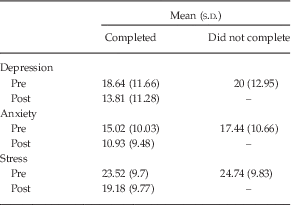
Separate dependent t-tests indicated that attendees demonstrated significantly lower scores on all three DASS-21 sub-scales post-intervention; depression, t(83)=5.51, p<0.001, r=0.52; anxiety, t(85)=5.21, p<0.001, r=0.49; stress, t(87)=4.97, p<0.001, r=0.47.
The severity of symptoms, pre and post, reported by attendees who completed SC can be seen in Table 2, alongside the severity of symptoms reported by those who attended SC but who did not complete it. In an extension to the analysis, calculations of clinical significance were also completed. While consensus in this approach has yet to be achieved, Jacobson & Truax (Reference Jacobson and Truax1991) advocated for a process of classifying responses according to the relative likelihood that they were drawn either from a normal or dysfunctional population. Thus, a cut-off point based on information from DASS-21 normative data compared with DASS-21 data at each first session of SC was calculated. The cut-off point represented a point beyond which individual scores for each DASS-21 sub-scale represented a statistically significant chance of being drawn from a dysfunctional population at the first session. The attendees who met this criteria had their DASS-21 scores at the last session separately analysed and frequencies were calculated for those that subsequently fell below the cut-off point. These frequencies represented a rigorous measure of clinical significance to examine the efficacy of SC. Using Jacobson & Truax’s (Reference Jacobson and Truax1991) robust measure of clinically significant change, it was also revealed that 38.71% (n=36) of attendees who completed SC exhibited clinically significant improvement on one or more sub-scale following the intervention.
Depression Anxiety Stress Scales scores (n=170)

Profiles
Male attendance at SC was modest, 16.5% (n=28) of the total 170 attendees. However, ‘word of mouth’ appeared to account for a disproportionate source of recruitment; responding to ‘How you heard about the course?’, ‘word of mouth’ was the most popular single response (20.6%, n=35), while amongst only males this figure rose (32.1%, n=9). Encouragingly, 100% of attendees who responded to whether they would ‘recommend a friend’ indicated that they would. Patterns in male attendance were indicative; 10 males attended the three SC classes in 2013, compared with 18 males in 2014.
Young adults’ attendance at SC was also modest, 8.2% (n=14) of total attendees were aged 18–29. Similar to males, ‘word of mouth’ appeared to account for a disproportionate source of recruitment, 28.6% (n=4). Figures for separate SC classes amongst 18–29 year olds were also instructive; two evening groups accounted for 64.3% (n=9) of 18–29 year olds who attended SC. Assuming there was nothing inherent to the geographic location of classes, it would appear that younger adults were not attracted to morning classes.
On the basis of residential postcodes, each attendee was allocated a value between 1 and 890 according to their Super Output Area (i.e. a small geographic area designated to facilitate statistical analysis) and its place on the league table of the MDM (Northern Ireland Statistics & Research Agency, 2010). The Super Output Area values revealed that the majority of attendees at SC were from higher socioeconomic backgrounds; 42.4% (n=72) of attendees lived in geographic areas which were within the least deprived MDM quartile. However, substantial differences were observed in the central tendency figures; the mode attendance figure was within the lowest quartile, or the most deprived areas. One notable departure from the pattern of higher socioeconomic attendees was observed at a unique SC geographic location, which accounted for the mode figure.
Feedback
Two primary themes flowed from the Initial Questionnaires database, ‘Direct Marketing’ and ‘Interagency Work’. ‘Direct Marketing’ emerged as a theme because of the frequency with which attendees noted adverts (total 45 individually coded segments of text) as having prompted attendance. The ‘Interagency Work’ theme that emerged in this analysis evidenced the benefits of informal connections that had been utilised when promoting SC. A total of 24 attendees highlighted different organisations that had not been provided as options on a checklist to indicate the source of their recruitment.
The four primary themes that flowed from the Evaluation Questionnaires database were related to outcomes. There was an almost palpable satisfaction with SC that manifested in unprompted, expressed ‘Expressed Gratitude’ (total 94 individually coded segments of text). The three remaining themes that emerged were ‘Increased Understanding’, ‘Communication’ and ‘Practical tips’.
The inherent outcome for attendees was summed up by an ‘Increased Understanding’ following SC. Recurrent mention of the four CBT modes was made (total 15 individually coded segments of text) and feedback also elucidated a broadened awareness of the aetiological factors of distress:
“Understanding why I felt like I did”
The ‘Increased Understanding’ that was facilitated by the course included a code ‘Respect’. The notion of respect was one which was highlighted as an important aspect; responses to what was ‘most helpful’ included:
“The course is delivered in a way that respects my ability to apply the techniques myself.”
And
“I felt relaxed and could take on board everything in my own time and way.”
The respect that the course accorded to these individuals was tacit acknowledgement of their capacity for self-directed change. The expression of this function of the course through feedback reflects the importance of it in motivating attendees, which likely contributed to the positive quantitative results.
In according respect to attendees and related to the third theme of ‘Communication’, the facilitators efficient, motivational and welcoming delivery was repeatedly commended upon in feedback, for example:
“Clear, concise, excellent presentation”
And others who responded to the ‘most helpful’ question said:
“the relaxed way in which the course was delivered”
The provision of materials also stood out as helpful. A total of 20 attendees highlighted one form or another of written materials and CD/mp3.
The provision of materials was an aspect of the course that was appreciated; however, it was just one aspect of the course that received positive feedback for a focussed utilitarian approach. Amongst the codes subordinate to the theme of ‘Practical tips’ were a list of the individual content and strategies or techniques for various scenarios related to stress (total 31 individually coded segments of text). From the theoretical perspective underlying CBT, it is logical that these would have been instrumental in affecting change in peoples’ lives, which prompted the feedback that manifested in the theme of ‘Expressed Gratitude’.
Discussion
The quantitative analysis indicated that SC was an effective low intensity intervention, and its delivery compared favourably with published data (White, Reference White1998; Kellet et al. Reference Kellett, Clarke and Matthews2007; Van Daele et al. Reference Van Daele, Van Audenhove, Vansteenwegen, Hermans and Van Den Bergh2013). The statistically significant positive results were supported by rigorous clinical significance testing. These findings illustrated the high incidence of mental health difficulties in attendees and also indicated that SC had a substantial impact on a large cohort of those who experienced mental health difficulties and completed the intervention. It is highly encouraging that a low cost, low intensity therapeutic class could affect clinical improvement in such a group (i.e. 38.71%, n=36, clinically significant change). The result also compares favourably to published data on the effectiveness of the first year of England’s Increasing Access to Psychological Therapies – a modern national initiative that aimed to make evidence-based psychological therapies for depression and anxiety disorder more widely available. Here, Gyani et al. (Reference Gyani, Shafran, Layard and Clark2013) reported 40.3% with reliable recovery, although they used different methods and different measures. Therefore, the results reported here demonstrate that SC attracted people in need of mental healthcare input and affected quantifiable change within those people’s lives, while satisfying the statutory demands for delivery in an accessible community context.
The results demonstrated that success with targeting males, younger adults and those at risk of deprivation was modest. Male attendance overall reflected the statutory drivers’ emphasis upon male tendencies not to access mental healthcare services (Department of Health, Social Services and Public Safety, 2012). Recruitment source figures emphasised that males displayed a tendency to be recruited via ‘word of mouth’. As such, after the 2013 classes were completed, the 2014 classes exhibited increased male attendance. Nurturing this pattern with proactive marketing in the social sphere of males will be necessary in future.
The 18–29 age group displayed low attendance figures in comparison to other age cohorts. Young adult attendance patterns at specific groups and responses to the source of their recruitment were once again instructive. Assuming there was nothing inherently skewing attendance figures at individual geographic locations, then 18–29 year olds appeared less favourably disposed to morning groups. Recruitment source figures emphasised that the 18–29 age cohort also displayed a tendency to be recruited via ‘word of mouth’, remarkably similar to males. This recurrent finding may have important implications for service development in this new psychological service provision sphere.
The pattern of modest attendance figures at SC by those in the most deprived areas was outstandingly reversed by a lone group. However, this pattern offers opportunity for the targeting of individuals hailing from such deprived areas and future recruitment for SC may take advantage of this to more fully satisfy those statutory drivers.
Qualitative feedback
Advertising undertaken appeared to have been effective and generated significant interest, while the capitalisation upon interagency contacts by SC promoters nurtured an inherent desire within the wider community for help-seeking via SC. It was notable that both themes that emerged from the Initial Questionnaires were related to the subject of recruitment and that the quantitative analysis indicated that ‘word of mouth’ was the most common recruitment source, but also disproportionately so for the target profiles. Encouragingly for prospective target profile attendance figures, the incidence of interagency work indicated that the means for recruiting those target individuals was pre-existing within SC promotional efforts, although these efforts could benefit from re-direction towards organisations specifically tailored for those profiles of concern.
The theme of ‘Expressed Gratitude’ on behalf of attendees for SC clearly reinforced the utility and efficacy of the course, which corroborated the quantitative results. The three remaining themes traced the intricacies of the processes that manifested in the outcomes observed. ‘Increased Understanding’ coalesced out of expressions within the data of increased awareness about mental health on behalf of attendees. However, the recognition that those individuals were capable agents of change in their own lives appeared to also have a motivating impact upon them as this was expressed through the ‘Respect’ code. Importantly, this effect coincided with the aims of current statutory drivers which included personalisation of care, thereby empowering individuals.
The variety of materials and the skills of the instructors was clearly the means, which facilitated attendees’ blossoming understanding and manifested in the ‘Communication’ theme. However, the utilitarian nature of the course appeared to also have been crucial. ‘Practical tips’ summed up the applicability of the course content to attendees lives and the frequency with which these were remarked upon highlighted the importance of such an approach.
Implications and mixed methods interpretation
The qualitative data converged closely with the quantitative data in two areas. The first area of convergence concerned the efficacy of SC. The qualitative data elucidated those factors that enabled change in attendees’ presentations. The qualitative data also highlighted how this change capitalised upon the principles of some aspirational statutory drivers and SC appeared to be an effective operationalised delivery system for these.
The second area in which the two analytic approaches converged concerned the impact of promotional work, most notably for males and younger adults. As was noted in the quantitative results, ‘word of mouth’ was the most popular source of recruitment, exceedingly so for males and younger adults. The indications from the converged quantitative and qualitative analyses were thus encouraging, because although males and younger adults in quantitative analysis were underrepresented, they also appeared prone to the pre-existing promotional techniques in situ, highlighted in the qualitative analysis to include interagency work. Similarly, marketing has been cited by White (Reference White2008, Reference White2010) to encourage uptake, crucially, with the iterative provision of SC. These factors combined with feedback which indicated that 100% of attendees would recommend SC suggested that continued provision could increase the effect of ‘word of mouth’ on increasing access, most particularly for males and younger adults.
Limitations
Attendees at SC were not selected randomly and so caution in interpretation of the results is necessary. The programme was evaluated by those who had completed the course, which may have been a biased cohort. In addition, when the quantitative and qualitative databases were converged and discrepancies were identified these had to be resolved. When resolving these issues the primacy of the quantitative data may have adversely affected interpretations of the researcher. Although not working on SC directly, the primary researcher worked in the associated service responsible for delivering SC which might have influenced the assumptions made in coding and analysis.
Conclusions
The feedback retained on SC, when subjected to in depth analysis, bolsters prospective success. SC was effective and feedback was overwhelmingly positive on the course. There remains no pressing need to address course content or its delivery. The qualitative analysis also delineated themes that reinforced that SC accords with statutory drivers for the provision of information around mental healthcare, and the personalisation of care thereby empowering individuals.
Marketing and inter-agency work that has been completed heretofore has proven successful and so a more targeted approach is rational. Inter-agency cooperation with organisations associated with cohorts considered ‘hard-to-reach’ and outside the sphere of healthcare provision should be undertaken. The Department of Health, Social Services and Public Safety (2012) highlighted these organisations as sports organisations, educational institutions, criminal justice and unemployment service providers, as well as further cooperation with carers/support groups and industrial organisations aligned with employees at high risk of stress. Age may have been affected by times of delivery of the courses; SC should therefore continue to be provided in the evenings. Socioeconomic deprivation was affected by location of delivery of the courses; SC should therefore be expanded in those most deprived areas on the MDM league table. In addition to this type of policy, the results here indicate that promoting ‘word of mouth’ for future iterations of SC will be crucial. To bolster the two themes of ‘Direct Marketing’ and ‘Interagency Work’ which indicated success here; marketing on social media will be specifically undertaken in future and educational sessions with staff of agencies who have previously referred is planned to focus on highlighting the results reported above (especially the magnitudes of SC’s efficacy, the importance of encouraging attendance in those ‘hard-to-reach’ and the potential for combining these factors).
Focussing promotional work, which effectively capitalised upon a desire in the community for this type of intervention, on male, young adults and in geographic areas of social deprivation promises to attract those stubbornly ‘hard-to-reach’ in future iterations of SC. Future research should focus on the effectiveness of strategies to target those cohorts ‘hard-to-reach’.
Acknowledgement
The authors would like to express gratitude to Rosie Donnelly (CBT Therapist at re:think/re:act), Alan Johnston (Monkstown Village Initiatives) and Rachel McIlveen (Assistant Psychologist), but most especially to the attendees at SC whose engagement and participation made this project possible.
Financial Support
The work of the Psychological Therapies Service is supported by government funding provided by the Northern Health & Social Care Trust.
Conflicts of Interest
The authors certify that they have no affiliations with, nor involvement in any organisation or entity with any financial, or non-financial interest in the subject matter or materials discussed in this manuscript.
Ethical Standards
The authors assert that all procedures contributing to this work comply with the ethical standards of the relevant national and institutional committee on human experimentation with the Helsinki Declaration of 1975, as revised in 2008. The authors assert that ethical approval for publication of this audit has been provided by their local REC.