

The Allais paradox, first presented over lunch by Maurice Allais to Jimmie Savage during a symposium in Paris in 1952, is among the best-known decision problems in contemporary behavioural and social science. It goes like this:
Which of the following two gambles do you prefer?
a) A 100% chance at 100 million francs
b) An 89% chance at 100 million francs
A 1% chance at nothing
A 10% chance at 500 million francsFootnote 1
Most people choose (a), which does not maximize the expected pay-off, but which may be explained as resulting from risk-aversion. Now, consider the next choice:
Which of the following two gambles do you prefer?
c) An 89% chance at nothing
An 11% chance at 100 million francs
d) A 90% chance at nothing
A 10% chance at 500 million francsFootnote 2
Here, most people choose (d), which maximizes expected pay-off and is the riskier gamble of the two. This implies that individuals maximize and non-maximize expected monetary pay-off, and are both risk-seeking and risk-averse. As a result, these outcomes were considered to be a serious problem for decision theory, developed by Savage and others as one overarching theory that explains all human decision making.
Even though referred to by many, the history of the Allais paradox is surprisingly little-examined. One important reason, I venture, is that the history of the Allais paradox directly connects to deeper and implicit epistemological disputes which defy the usual categorizations of contemporary history of the behavioural and social sciences. Building on, among other things, yet unexplored archival sources, the present article documents the history of the Allais paradox, and attempts to unveil the underlying epistemological arguments.
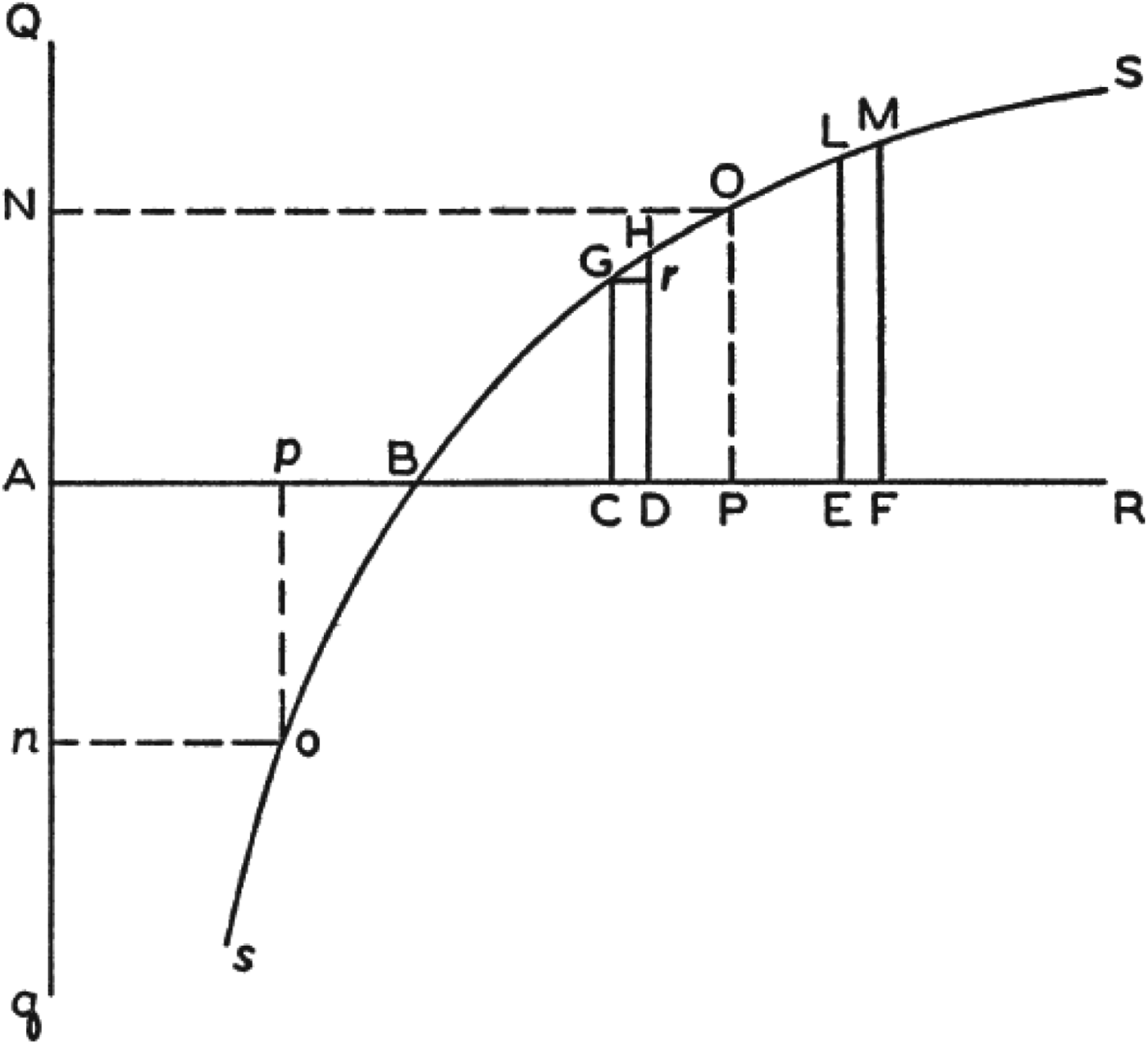
Decision theory, or the theory of risk, or rational choice theory, goes back to the second half of the seventeenth century when mathematicians and other scholars started to investigate how to calculate mathematically the optimal decision in uncertain situations. The mathematics that came out of these and similar questions was probability theory and rational choice theory.Footnote 3 A major problem confronting probability theory was what became known as the St Petersburg paradox, invented by Nicholas Bernoulli in 1713. Nicholas Bernoulli demonstrated that gambles could be constructed for which probability theory computed a maximum willingness to pay that was clearly at odds with intuition.Footnote 4 The most famous solution to the St Petersburg paradox was offered by his cousin Daniel Bernoulli in 1738.Footnote 5 Daniel Bernoulli argued that individuals base their choice between two or more (uncertain) outcomes not on the monetary or objective value of the outcomes, but on their individual, subjective valuation of these outcomes. Bernoulli labelled this individual valuation ‘moral value’ and supposed that it decreases with increasing monetary outcome, as in the curve in Figure 1.Footnote 6
Daniel Bernoulli, ‘Exposition of a new theory on the measurement of risk’ (1738), Econometrica (1954) 22, pp. 23–26, 26. Monetary value is on the x axis, moral value on the y axis.

Up until the early twentieth century, the literature on mathematical theories of decision making under uncertainty consisted predominantly of attempts to solve this and similar paradoxes.Footnote 7
Between the 1920s and the 1950s a number of ideas were introduced that thoroughly reshaped the way decision theorists thought about decision making under uncertainty.Footnote 8 Authors such as Bruno de Finetti and Frank Ramsey introduced the idea that probability theory could be applied not only to objective uncertainties out there in the world, such as the probability that a coin falls heads and the probability that the sun rises tomorrow, but also to subjective probabilities; that is, uncertainties inside the individual of the sort ‘how uncertain am I that it will rain tomorrow?’ or ‘how certain am I that this second-hand car will last at least two years?’Footnote 9 In a related development, authors such as John Maynard Keynes and Rudolf Carnap extended the theory of logic to include uncertain propositions; that is, propositions with a degree of probability that is less than one.Footnote 10 The subjectivist probability theory commenced by de Finetti and Ramsey, and the logical probability approach of Keynes, Carnap and others, made statistics a part of decision theory. Thus Abraham Wald's influential Statistical Decision Functions (1950) stated on the first page that a ‘statistical decision problem arises when we are faced with a set of alternative decisions, one of which must be made, and the degree of preference for the various possible decisions depends on the unknown distribution F(x) of X’.Footnote 11
However, the uncertainty employed was always an uncertainty external to human beings, even if individuals might assess and respond to this uncertainty in different ways. In 1944, John von Neumann and Oskar Morgenstern's Theory of Games and Economic Behavior added a new chapter to the history of decision theory by constructing a theory that explains human decision making in relation to the uncertainty stemming from other individuals' strategic behaviour.Footnote 12
In Von Neumann, Morgenstern, and the Creation of Game Theory (2010), Robert Leonard provides an encompassing and definitive account of the background, construction and subsequent influence of von Neumann and Morgenstern's Theory of Games. One of the many themes in Leonard's book is von Neumann's use of David Hilbert's approach of founding the mathematical investigation of a scientific field on a set of independent and consistent axioms that produce the laws of the field. In the Theory of Games von Neumann, together with Morgenstern, effectively created a ‘Hilbertian mathematics of social reality’.Footnote 13
Glossed over by many commentators, and even often only implicit in Leonard's historical account, is the careful and subtle nature of the behavioural axioms on which game theory was based by von Neumann and Morgenstern.Footnote 14 Von Neumann and Morgenstern constructed game theory on the basis of ‘a characterization of “rational behavior” … a complete set of rules of behavior in all conceivable situations'. By ‘rational behavior’ von Neumann and Morgenstern meant ‘the endeavor of the individual to obtain a maximum of utility, or, in the case of the entrepreneur, a maximum of profit’.Footnote 15
But the key term here is ‘characterization’. Synonyms that were used included ‘exact description’, ‘rationalization’ and ‘generalization’. This method of ‘characterization’ was distinguished from the descriptive method: ‘The aim of this book lies not in the direction of empirical research.’ Instead, von Neumann and Morgenstern started from a few, what they considered well-known, characteristics of rational behaviour, and tried to frame these characteristics into one consistent mathematical framework. The axioms summarized rational behaviour into a few characteristics which left out large amounts of empirical content, but not all: ‘We shall attempt to utilize only some commonplace experience concerning human behavior which lends itself to mathematical treatment and which is of economic importance.’Footnote 16 As a consequence, it did not matter so much for the characterization of rational behaviour whether individuals actually do behave rationally. What von Neumann and Morgenstern wanted to characterize was the ‘the endeavor of the individual’ to behave rationally, irrespective of whether the individual actually achieves this goal of rationality.
A further exposition of this epistemology can be found in von Neumann's ‘The mathematician’.Footnote 17 Mathematics was more than the summing up of intuitions, experiences and observations, von Neumann argued. Mathematics was a ‘science which interprets experiences on a higher than purely descriptive level’. As a result, von Neumann argued, there is ‘a quite peculiar duplicity in the nature of mathematics’.Footnote 18 Mathematics was always grounded in experience and empirical observation, but once the experiences and empirical observations had been summarized into a few postulates, mathematics set off onto its own creative life of proof and derivation. But this creative and aesthetic mathematical life of proof and derivation was unrelated to empirical reality. Any derivation and proof had always to be related to the empirical world. The derivations did not have to be exact descriptions or predictions of the empirical world, but always had to be agreed upon as useful summaries, characterizations or rationalizations of the empirical world.
The ‘quite peculiar duplicity’ of von Neumann and Morgenstern's mathematical approach also had another important implication. Because the axioms were as much subject to the logic of mathematical reasoning as they were grounded in empirical reality, they were, when agreed upon, also rules for rational behaviour in a social world comprising uncertainty and other individuals seeking to behave rationally in their own interests. As much as von Neumann and Morgenstern wanted to provide ‘a characterization of “rational behavior”’ they also wanted to provide ‘a complete set of rules of behavior in all conceivable situations’. Thus in the Theory of Games von Neumann and Morgenstern aimed to characterize rational decision behaviour, while at the same time aiming to provide rules for how to make decisions rationally.
The remainder of this article is organized as follows. The next section shows how Friedman and Savage tried to incorporate the behavioural axioms of the theory of games in existing economics theories, the following section sets out how Baumol and Samuelson strongly disagreed. The fourth section explores the further escalation of this discussion in the Savage–Allais dispute of 1952–1953. The final section shows how and when the Allais paradox became the iconic decision paradox of contemporary behavioural and social science.
The interpretation of the von Neumann–Morgenstern axioms in economics
While von Neumann was working with Morgenstern on the Theory of Games at Princeton in 1941, he hired a bright new research assistant from the University of Michigan, Leonard Jimmie Savage. At Michigan, Savage had written his PhD thesis in mathematical statistics, entitled ‘The application of vectorial methods to the study of distance spaces’, under the supervision of Summer Myers. But he also credited the influence of University of Chicago economists Milton Friedman and Allen Wallis on his scientific education.Footnote 19 Friedman had started his academic career at the University of Chicago under Henry Schultz in the early 1930s. Wallis also studied economics at Chicago in the 1930s, and became close friends with Friedman. From 1942 to 1946, Wallis was director of the Statistical Research Group created by the United States Office of Scientific Research and Development at Columbia University. Together with Harold Hotelling, an economist from Columbia University and a collaborator of Schultz in the 1930s, Wallis employed Friedman and other Chicagoans at the Statistical Research Group at Columbia University during the war.Footnote 20 It was also Wallis who hired Savage for the Statistical Research Group, which resulted in, among other things, the collaboration between Friedman and Savage. Wallis and Savage in particular would remain close friends for the rest of Savage's life. In June 1947 Savage joined the Department of Mathematics at the University of Chicago, where he would remain until 1964, the year he took up a named professorship at Yale University.
Friedman and Savage felt that their respective approaches to the use of mathematics and statistics in economics (Friedman) and to the mathematical foundations of statistics (Savage) were compatible. The ‘classic article’ of Friedman and Savage, ‘The utility analysis of choice involving risk’ (1948), like von Neumann and Morgenstern's Theory of Games, aimed to ‘rationalize’ a part of human behaviour in the economy, namely individuals' responses towards risk.Footnote 21 Thus the very first sentence of the article stated, ‘The purpose of this paper is to suggest that an important class of reactions of individuals to risk can be rationalized by a rather simple extension of orthodox utility analysis.’Footnote 22 At the same time the interpretation changed in a subtle way. Von Neumann and Morgenstern were interested in characterizing the interaction of rational individuals in an uncertain world – in building a new social theory, in other words. Friedman and Savage, by contrast, emphasized the interpretation of the axioms as characterizing the decision behaviour of one individual. The article by Friedman and Savage marks the transition of the von Neumann and Morgenstern axioms from the foundation for social theory to the foundation for decision theory.
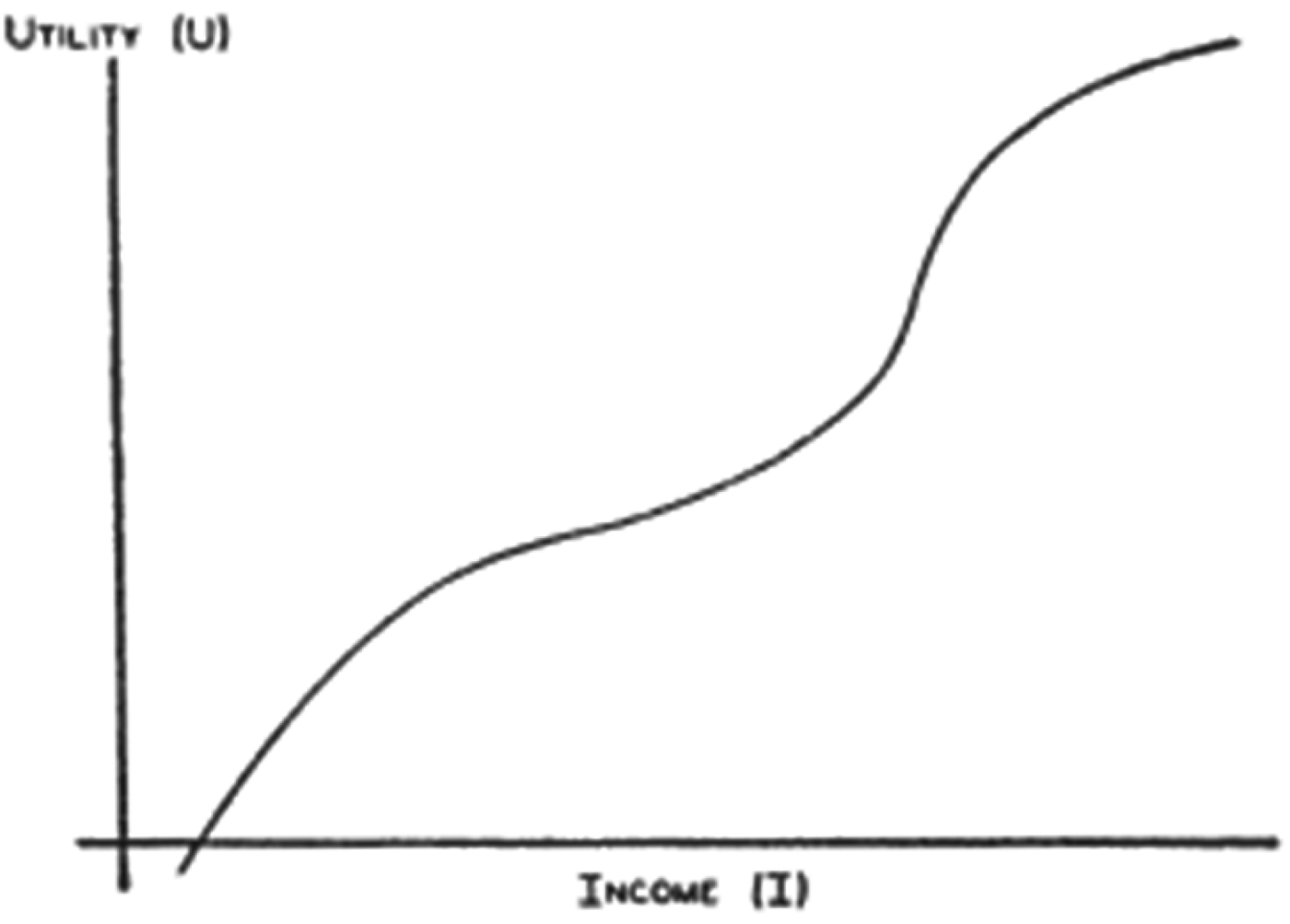
Specifically, Friedman and Savage wanted to rationalize the observation that individuals in the economy both gamble and buy insurance, and hence seem both risk-seeking and risk-averse at the same time. To solve this apparent contradictory behaviour, Friedman and Savage suggested a rationalization in the form of a ‘wiggly utility curve’ (Figure 2). Assuming that individuals on some parts of the wealth–utility curve are risk-seeking and have a preference for gambling while being risk-averse and thus buying insurance on other parts of the curve, they argued, provided a rationalization of the contradictory behaviour. What is important here is not so much the exact rationalization that Friedman and Savage constructed, but the epistemological position they took. Friedman and Savage emphasized that no new or separate empirical investigation was needed, as the behaviour to be rationalized was clearly observable to everyone: ‘This choice among different degrees of risk so prominent in insurance and gambling, is clearly present and important in a much broader range of economic choices’, they argued, and ‘[t]his paper attempts to provide a crude empirical test by bringing together a few broad observations about the behavior of individuals in choosing among alternative risk … and investigating whether these observations are consistent with the hypothesis revived by von Neumann and Morgenstern’. In addition, the second section of the article, in which Friedman and Savage described the simultaneous risk-seeking and risk-averse behaviour, was entitled ‘Observable behavior to be rationalized’.Footnote 23
Milton Friedman and Leonard Jimmie Savage, ‘The utility analysis of choice involving risk’, Journal of Political Economy (1948) 56, pp. 279–304, 297: the wiggly utility curve.
Where for the psychologist in his or her laboratory, or for the astronomer behind his or her telescope, the most important question is whether the theory proposed is verified by the observations, and whether the observations are not artefacts resulting from imperfect experiments or telescopes, to Friedman and Savage the key question was how best to rationalize a number of indisputable facts of human economic behaviour. In this process some well-known rationalizations of economic theory were rejected: ‘Diminishing marginal utility plus maximization of expected utility would … imply that individuals would always have to be paid to induce them to bear risk. But this implication is clearly contradicted by actual behavior.’Footnote 24 Using the ordinal–cardinal language introduced by English economists John Hicks and Roger Allen's ‘A reconsideration of the theory of value’ (1934), Friedman and Savage argued that the indifference curve analysis of Francis Ysidro Edgeworth, Vilfredo Pareto and Irving Fisher of the early twentieth century could ‘be used to rationalize riskless choices’, while the new ‘numerical properties’ of utility functions developed by von Neumann and Morgenstern's Theory of Games could be employed ‘to rationalize choices involving risk’.Footnote 25
Thus the method of Friedman and Savage's ‘utility analysis’ was indeed partially in line with von Neumann's view of mathematics as expressed in von Neumann and Morgenstern's Theory of Games and von Neumann's ‘The mathematician’. Von Neumann and Morgenstern's axioms aimed to capture the rational economic behaviour that individuals endeavour to achieve, irrespective of whether they actually do so, while Friedman and Savage focused only on actual economic behaviour, which was understood as being rational. At the same time, however, Friedman and Savage left open the possibility of observed behaviour deviating from the theory – albeit less explicitly than had von Neumann and Morgenstern. This partial move away from von Neumann and Morgenstern was the result of Friedman and Savage's wish to justify their approach in the language and standards of their time. They repeatedly talked about verifying and testing their theory, and labelled their theory a hypothesis that made predictions about actual behaviour, in which the predictions constituted a test of the hypothesis. Yet testing and verifying the theory simply meant investigating whether the proposed rationalization corresponded to observable behaviour, in which behaviour observed in the lottery booth was as good a test as more extensive empirical investigations.
The descriptive counterarguments of Baumol and Samuelson
A number of up-and-coming economists disagreed with the axiomatic approach to economic behaviour offered by von Neumann and Morgenstern and Friedman and Savage. Paul Samuelson from the Massachusetts Institute of Technology, Princeton University economist William Baumol, and engineer–economist Maurice Allais (1911–2010) from the Ecole nationale supérieure des mines in Paris were particularly outspoken. This debate was understood by its participants, and by historians, to be about the measurability of utility, in which a von Neumann–Morgenstern–Friedman–Savage camp was accused of proposing a cardinal measure of preference in the form of utility/money which, for different reasons, was impossible to construct.Footnote 26 But underneath, the question was what the behavioural axioms – and economic theory in general – aimed to provide: characterizations or descriptions that could be refuted directly by empirical observations. Baumol, Allais and Samuelson took the latter position, although by and large they did not seem to be aware of the fact that it was this different epistemological point of view that lay behind their disagreements with Friedman and Savage.
In a letter dated 5 May 1950, Baumol explained to Samuelson how he took the von Neumann–Morgenstern utility index to be a description of the ‘introspective utility’ that individuals attach to different (bundles of) goods. In addition, Baumol offered a few counterexamples that he intended to use in a brief paper on the subject. Inspired by Baumol, Samuelson also sat down to put into a brief note his arguments against the von Neumann–Morgenstern approach. Samuelson's main objection was that the axioms were not a good description of human decision behaviour. He bluntly stated, ‘I know of no empirical predictions that this theory has suggested which have turned out to be (1) valid and (2) novel or inexplicable without this special theory.’ To drive home his objections, Samuelson argued, ‘If only the data knew what men know, planets might move in perfect circles.’Footnote 27
In a long letter to Samuelson, Savage argued in reference to Samuelson's article that the axioms were of course not intended as exact descriptions:
you point out that the utility theory, as I shall for simplicity call it in this letter, is not consistent with every conceivable sort of behavior. This is, of course, true, and to the credit of the theory insofar as it shows that the theory is not simply tautological … [Von Neumann's] interest, like Milton's and mine, is the theory stems from the belief that it is a skillfully chosen zero approximation to reality. As a matter of fact, if you and I have anything to argue about, it is the question of whether this particular approximation has been skillfully chosen.Footnote 28
The ‘skillfully chosen zero approximation to reality’ was a reflection of Savage's attempt to articulate the epistemological position he had adopted from von Neumann. In addition, Savage maintained that the behavioural axioms of von Neumann and Morgenstern were nothing more than a set of assumptions underpinning Daniel Bernoulli's famous function of decreasing ‘moral value’ with respect to monetary value.Footnote 29
In the summer of 1950, Baumol submitted his own comment on the von Neumann–Morgenstern–Friedman–Savage approach to the University of Chicago's Journal of Political Economy, where editor Earl Hamilton sent it to four reviewers. One of the reviewers was Milton Friedman, who repeated his disagreement with Baumol, but who also asked Hamilton, in view of the preceding discussions, to let Baumol know he was the reviewer. According to Baumol, it was ‘not at all difficult to construct examples in which the Neumann–Morgenstern [numerical utility] index leads to results conflicting with plausible preferences’.Footnote 30 That is, Baumol claimed it was easy to construct examples that were at odds with the intuition of the axioms.
Baumol essentially produced the same kind of counterexample that would later be made famous by Allais, Daniel Ellsberg, Daniel Kahneman, Amos Tversky and others.Footnote 31 One counterexample ran as follows: call the numerical utility derived from choice options ‘utils’, to avoid all unfortunate connotations and discussions related to equating numerical utility with money.Footnote 32 Now, which of the two options will you prefer?
a: a 5/6 chance of winning a 600 utils prize with a consolation prize of 60 if you lose
b: a 1/6 chance of winning the 600 utils prize with a consolation prize of 420.Footnote 33
The von Neumann–Morgenstern and Friedman–Savage approach would argue for a, as the respective expected utilities (or perhaps one should say expected utils) of a and b are 510 and 450. However, Baumol argued, it was introspectively clear that many individuals would prefer b to a as a result of risk-aversion. Hence the theory was flawed. Friedman and Savage defended themselves with the argument that the axioms' not being introspectively obvious only spoke in favour of them. Science always advances by what initially seem rather implausible propositions, they argued; one could even say that the more implausible the hypothesis, the likelier it is to be true.Footnote 34 Again, this is very close to von Neumann and Morgenstern's epistemology.
After their two collaborative publications in 1948 and 1952, Friedman and Savage went their separate ways. Friedman further developed his epistemological views of economics in ‘The methodology of positive economics’ (1953), which was heavily discussed by economists, philosophers and historians during the rest of the twentieth century.Footnote 35 Savage, on the other hand, went back to his initial métier, the mathematical foundations of statistics, and to the interpretation of the behavioural axioms as envisaged by von Neumann.
The Allais–Savage dispute
Just at the time when the unsolved dispute between Friedman–Savage and Baumol–Samuelson subsided somewhat, French engineer–economist Maurice Allais contacted Baumol. Baumol and Allais had been in irregular contact since the late 1940s, but never on this issue. The reason Allais contacted Baumol was the latter's Journal of Political Economy article:
I am pleased to send you a study on risk which, in view of your article in the Journal of Political Economy, I think will interest you. Unfortunately, I have not taken account of your paper, my paper having been edited before receiving the corresponding Journal of Political Economy issue. I would of course be most delighted to receive your observations and suggestions.Footnote 36
Moreover, Allais referred to discussions he had been having with Friedman regarding von Neumann and Morgenstern's Theory of Games, Daniel Bernoulli's ‘Exposition of a new theory on the measurement of risk’ and Friedman and Savage's ‘The utility analysis of choice involving risk’.Footnote 37 In a reply, Baumol drily noted, ‘It is interesting incidentally that while you were having this discussion with Friedman we were carrying on a similar debate by mail.’Footnote 38 The two men quickly found each other in their disagreement with von Neumann and Morgenstern's Theory of Games and Friedman and Savage's paper of 1948, but while to Allais this was only the beginning of a long and intense effort to refute von Neumann, Morgenstern, Friedman and Savage, Baumol had already begun to lose interest in the whole matter.Footnote 39
While Allais liked to portray himself as the iconic founding father of a French school of rational choice theorists that opposed a corresponding American school, Sophie Jallais and Pierre-Charles Pradier show Allais's research to have arisen from a broader development in French economic-engineering research.Footnote 40 Two groups may be distinguished in France of the late 1940s and early 1950s, they argue, that extensively discussed expected utility theory. Based on research by Pierre Massé in the early 1940s, Allais and other engineer–economists attending Allais's seminar at the Ecole nationale supérieure des mines de Paris – including Marcel Boiteux, Gérard Debreu, Edmond Malinvaud and Jacques Lesourne – opposed the use of expected utility theory in any way and actively designed counterexamples and countertheories to show it to be invalid. By contrast, mathematicians from the Institut de statistique de l'Université de Paris – including Georges Darmois, Georges Guilbaud, Georges Morlat, Jean Ville and Germain Kreweras – agreed on a prescriptive use of expected utility theory as providing decision rules for trained, rational decision-makers (that is to say, managers) in the public sector.
At the same time, no one went further and in greater detail into designing counterexamples and countertheories than did Allais. Allais's attempts to prove wrong the ‘American school’ of utility theory famously erupted during the Colloque international sur le risque, held in Paris from 12 to 17 May 1952. For this symposium Allais persuaded Samuelson to restate his views of the matter, in a paper Baumol subsequently referred to as also describing his own position.Footnote 41 Other participants in the symposium included Kenneth Arrow, Bruno de Finetti, Milton Friedman, Ragnar Frisch, William Jaffé, Jacob Marschak, Jimmie Savage, Leonard Shackle and, of course, Allais himself.Footnote 42
In contrast to von Neumann, Morgenstern, Friedman and Savage, Allais situated the Theory of Games in the mathematical probability tradition of the seventeenth century, the St Petersburg paradox and its solution by Daniel Bernoulli of the eighteenth century, and the Weber–Fechner psychophysics of the late nineteenth century.Footnote 43 Allais recalled how Daniel Bernoulli had proposed to describe the human psychology of choosing between outcomes of different probability not in terms of expected monetary value, but in terms of expected moral value. Allais argued that this expected moral value was a form of ‘cardinal’ utility, in the sense that it suggested that subjective valuation of (monetary) outcomes could be measured numerically.Footnote 44 Allais subsequently equated this Bernoullian cardinal utility with the Weber–Fechner equation of psychophysics, thus linking it to psychology.
In experimental psychology and psychophysics as they arose in late nineteenth-century Germany, the Weber–Fechner equation referred to the experimentally observed decreasing sensation with which individuals perceive an increasing value of a stimulus, thus producing a curve similar to the Bernoulli curve depicted in Figure 1. Linking the two, the lower sensation of, say, adding one kilogram on top of twenty-five, rather than five, kilograms already being carried is psychologically the same situation as the lower sensation/utility resulting from adding an extra euro to twenty-five euros as opposed to adding an extra euro to five euros. Psychophysics played a major role in the early years of English neoclassical economic theory, when, for instance, Stanley Jevons and Edgeworth employed psychophysics to base economics on individual perception, valuation and hence demand of goods, rather than on the supply of goods.Footnote 45 Also, for Allais the Bernoulli money–moral value curve was one example within the broader Weber–Fechner theory of the relationship between objective stimulus and subjective perception. Moreover, Allais understood Bernoulli–Weber–Fechner explicitly as a descriptive claim or hypothesis about the functioning of the human mind.
However, Allais argued that the Bernoulli–Weber–Fechner hypothesis of ‘psychological value’ did not go far enough, and offered his own extension of the theory by introducing the idea that the individual values a stimulus (including monetary gains) with respect to his or her own ‘psychological mean’. In other words, Allais argued that the Bernoulli–Weber–Fechner hypothesis was correct, but that it had to be defined not with respect to the mathematically or economically determined origin, but with respect to the individual's own psychological origin, or mean. This psychological mean, then, varied among individuals. For instance, in the choice between a certain gain of five euros and a four-in-ten chance at ten euros, the (implicit) mathematical or economic origin is zero euros. The psychological mean, by contrast, asks how these two outcomes relate to the psychological situation the individual is currently in regarding the monetary stimuli. That psychological situation is different for a billionaire and a waitress, possibly leading the two to make different choices.Footnote 46
In addition, Allais understood the discussions of rational behaviour in terms of a distinction between reason-based philosophy on the one hand and empirically grounded science on the other. Allais distinguished clearly and rigorously, but largely implicitly, between reason as a basis of knowledge in the domain of philosophy, and systematic and controlled observation as the basis for knowledge in the domain of empirical science. This made the scientific investigation of the Bernoulli–Weber–Fechner hypothesis a difficult enterprise. ‘Psychological value’ referred to the value attached to an outcome inside the individual human mind. The only way to reach it was through introspection by the individual.
Based on this distinction between reason and experimental observation, Allais understood there to be two ways of defining rational behaviour. The first one was that of rational behaviour as the abstract criterion of consistency, non-contradiction and the other components of philosophical reason. Although Allais did not say so explicitly, it is safe to suppose that such a definition of rational behaviour could also only be refuted through reasoning/introspection. To emphasize Allais's position, remember that von Neumann, Morgenstern and Savage would have disagreed with this interpretation, and would have argued that even these abstract criteria had to derive somehow from experience and observation. Allais, however, argued that the only way a rational definition could be changed was when one individual convinced another individual that his or her reason-derived definition was flawed.
The second definition of rational behaviour, Allais argued, was ‘experimentally, by observing the conduct of persons who, one has reason in other respects to believe, act rationally’;Footnote 47 that is, by experimentally observing the introspective conclusions a rational individual reaches in actual or hypothetical choice situations. This empirical definition depended crucially on the assumption that the individual used in the experiment indeed acted rationally. For if the individual did not behave rationally, it would obviously be impossible to infer descriptions and theories of rational behaviour from observing the individual. Also this second empirical definition conflicted with von Neumann and Morgenstern's Theory of Games and with the manuscript of what would become Savage's The Foundations of Statistics. To von Neumann and Morgenstern and Savage, it was perfectly fine if the individual behaviour deviated from the rational norm, as long as the individual intended to behave rationally. Under Allais's second definition, however, the individual used in the experiment had to be assumed to behave rationally. And importantly, Allais believed that also von Neumann and Morgenstern, Friedman and Savage, and the manuscript of Savage's Foundations held this view. Allais hence believed that experimental evidence that showed individuals to not behave rationally would refute their ‘American school’ of rational decision theory.
In late 1951, Allais and Savage started a correspondence on decision theory in which Allais continuously challenged Savage on his approach, and in which Savage reluctantly but seriously and sometimes extensively took account of Allais's arguments, although in the end he only adjusted his theory in a minor way.Footnote 48 From the first letter onwards, Allais explicitly understood as the object of investigation of Savage's book manuscript the ‘psychological attitude’ or ‘psychological value’ of the individual towards different choice options, and considered Savage's axioms to be an empirical description of this human psychology. At the same time, Savage's position, as expressed in his letters, seemed somehow different, which quickly frustrated Allais:
I admit not to understand your position all that well … Naturally, we may define rational man as a man who obeys your postulates, but this definition of rationality appears to me considerably cut off from the concept of rationality as it is obtained by scientific logic … It is necessary to acknowledge the observations I sent you in my last two letters.Footnote 49
During the 1952 symposium in Paris, Allais presented Savage with a number of decision problems set up with the same purpose as Baumol's earlier counterexample: to show that the von Neumann–Morgenstern–Savage theory was descriptively invalid. The problem that would become the key example of the Allais paradox, already cited in the introduction, ran as follows:
1. Which of the following two gambles do you prefer?
a) A 100% chance at 100 million francs
b) An 89% chance at 100 million francs
A 1% chance at nothing
A 10% chance at 500 million francs
2. Which of the following two gambles do you prefer?
c) An 89% chance at nothing.
An 11% chance at 100 million francs
d) A 90% chance at nothing
A 10% chance at 500 million francs
Savage, like many human beings, chose option (a) in the first question and (d) in the second question, which contradicted the axioms as laid out by Savage in his own forthcoming book. Thus Savage had to choose between two unappealing options. Either he had to admit that his axioms were invalid, or he had to decide that he, Savage, the mathematician and the expert on his own theory and its postulates, had behaved irrationally.
The important detail in the Allais–Savage history is that Savage gave this outcome some thought.Footnote 50 Had he, like Allais, taken the position that the empirical evidence directly and necessarily verified or refuted the theory, he could have decided immediately that the theory was false. But Savage, like his mentor von Neumann, believed that although individuals intend to behave rationally as defined by his postulates, they may fail to do so. At the same time a violation of the axioms could also mean that the axioms were invalid characterizations of rational behaviour. Thus Savage needed some time to reflect on whether Allais's set of questions and his own answers to them had convinced him that his postulates were not a good characterization of rational behaviour, or that he had behaved irrationally. When Savage came back to Allais he declared that he believed that he had been irrational and that he considered the seven postulates to still be good characterizations of rational behaviour.
Allais, on the other hand, interpreted his lunch questionnaire discussion with Savage as the first observation in an empirical investigation into the validity of the von Neumann–Morgenstern–Savage theory as a description of the psychological valuation of monetary outcomes. According to Allais, Savage's responses showed that a linear, monotonic description of individual valuation of expected monetary outcomes, as postulated in Savage's The Foundations of Statistics and in von Neumann and Morgenstern's Theory of Games, was invalid. Allais clearly saw Savage's answers as a first wedge in the postulates. To capitalize on this result, Allais wrote Savage (who was still in Paris) a letter two days after the symposium in which he further developed his attempts to disprove Savage, by offering a question to which, he argued, Savage could not answer in a fashion that was in accordance with his own theory or with Bernoulli's theory of decreasing marginal utility. Allais came straight to the point. It is worthwhile quoting Allais at length here:
I suppose a lottery consisting of 1000 tickets and one unique prize of 200 million francs.
In a first situation, individual X possesses 999 tickets and agrees to buy the 1000th ticket for price S0 …
In the second situation, he possesses only 998 tickets and he is offered only to buy one ticket, the last ticket out of his reach in any situation.
Let S1 be the sum he is willing to pay for the 999th ticket in the second situation.
…
A number of people whom I have posed this question, and who are commonly regarded as rational, have given me without exception a value of S0 that is superior to that of S1.
Do you consider such a situation irrational?
…
I intend to conduct a questionnaire regarding this question on two groups of people: To students from the Ecole des Mines in Paris who, on average, may probably be considered to be rational; and to members of a seminar series [groupe de conference, the seminar already referred to] which I am chairing and who might equally be considered rational.
In any case, before organizing this questionnaire, I would like to have your opinion through a reply to this letter if possible, on these different questions, in such a way that I can take them into account.Footnote 51
Within a day, Savage responded that he saw no reason why a rational but prudent person could not be risk-averse and thus value increasing amounts of expected monetary outcomes with decreasing margin. A week later, however, Allais replied that he was ‘not convinced by your answers’.Footnote 52 The reason, Allais argued, was that the same result would obtain if the exercise was done with fifty, two hundred, three hundred, four hundred, or a thousand francs instead of 200 million. This implied that at each possible interval one would have to draw a curve of decreasing utility of expected monetary outcome, while the curve as a whole would have to be increasing up to 200 million francs. Thus, Allais implied, the Bernoulli and von Neumann–Morgenstern–Savage idea of a constantly increasing valuation of expected monetary outcomes was invalidated. Clearly, Allais felt that he had cornered Savage into a paradox of his and von Neumann and Morgenstern's axioms.
Subsequently, Allais sent Savage, as promised, a ‘Sondage sur le risque’.Footnote 53 This questionnaire – published in French as ‘Questionnaire destiné a tester la validité de la formulation de l’école Américaine pour les hommes rationnels’ (Questionnaire intended to test the validity of the definition of rational men by the American school) – consisted of ten sets of questions regarding the risk attitude of the respondent.Footnote 54 The third set, for instance, posed the two questions which would later become the famous Allais paradox and eight other similar questions. Set four presented four questions along the lines of the question that Allais posed to Savage in his letter of 19 May 1952 just quoted. Along more or less similar designs in the other sets, the tenth set asked twenty-one questions of the sort ‘Do you play poker, and if so, which fraction of your monthly income do you spend on poker?’, ‘Do you practice sports of high, or very high risk?’, and ‘When you lose at a game of chance, up to which fraction p of your monthly income are you indifferent regarding your total loss during the game?’ In addition, Allais asked Savage ‘to send me an indication of which are your different values for possible gains of 100 to 1 billion francs’.Footnote 55
Savage, meanwhile, was busy and apparently not very eager to comply with the extensive request by Allais, which is not surprising after what Savage must have also realized was a paradoxical outcome of his postulates. From June to November 1952, however, Allais continued to insist in a number of letters, indicating among other things that he intended to use Savage's response in ‘a general study on Risk and in two articles for Econometrica’.Footnote 56 In addition, in his letters Allais copied a few times his earlier questionnaire and accompanying valuation question, should Savage have lost the earlier copy.
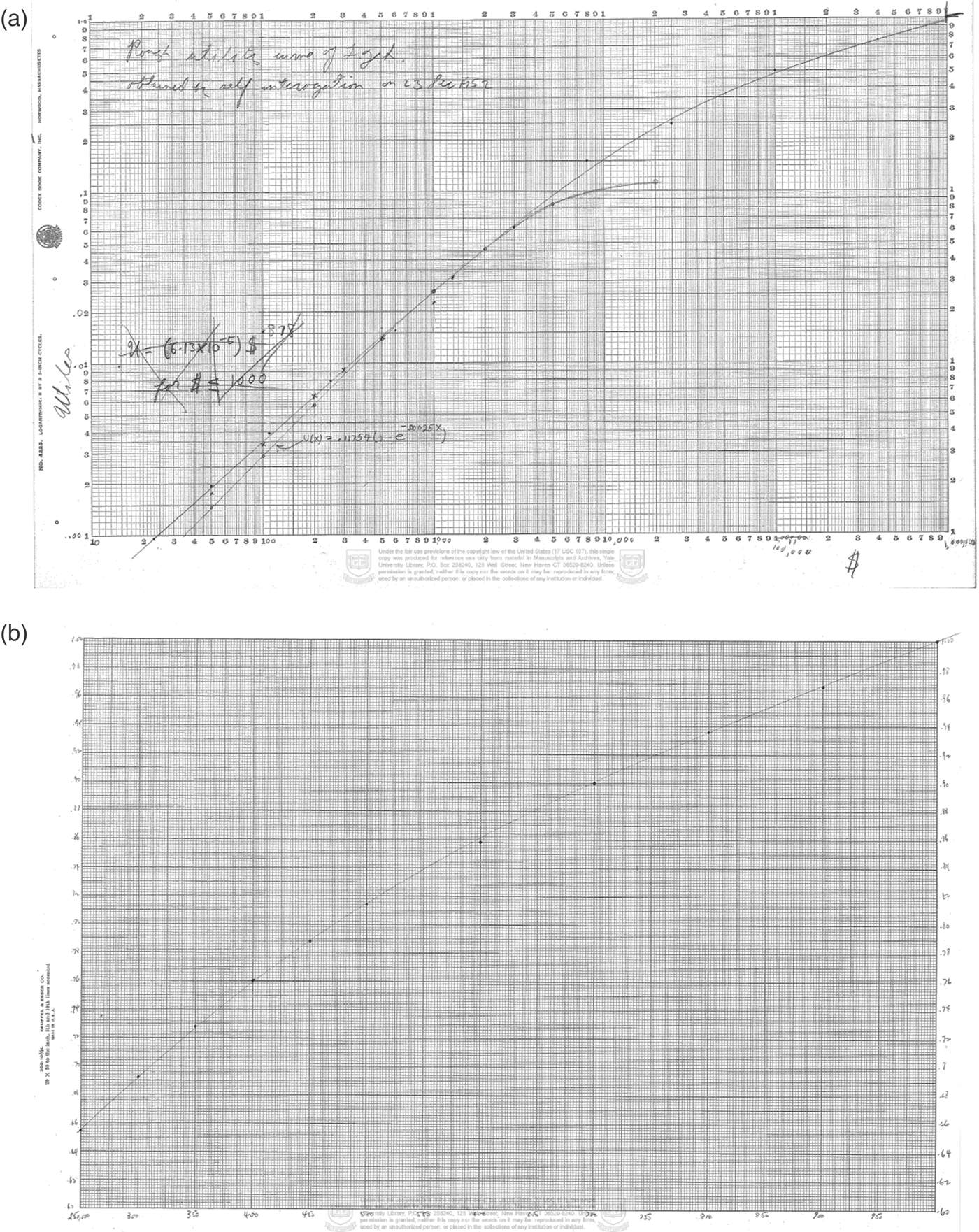
In March 1953 Savage finally responded, and quite extensively. In his answer to the list of questions of Allais and in the separate request to sketch his own utility curve, Savage proceeded by first assuming zero income or wealth to have zero utility, and one million dollars to have one unit of utility. Subsequently, he estimated ‘by self interrogation’ for a few different incomes between zero and one million dollars how much money he would want to receive to forego a gamble between an even chance of obtaining a certain income or nothing at all.Footnote 57 He then estimated his utility curve in the area of zero to one million dollars to be
 $$ U(x) = 0.035578(1 - e^{ - 0.001x} ) ^{58} $$
Footnote 58Having established an estimation of his own income-utility curve, Savage then ‘gave your [Allais's] questionnaire to a computer with instructions to answer those questions on it, the answers of which are implicit … in the exponential formula’. The reason for letting the computer determine the answers was that ‘my long experience with the questionnaire is such that I can't fill it out spontaneously any more’. But of course, letting a computer provide the answers based on a predetermined equation also ensured that no irrational answers would come out. After the computer had done its work, Savage examined the answers given by the computer ‘to see whether any of the mechanically-given answers seemed hopelessly inappropriate to my own tastes’.Footnote 59 Savage was pleased to report,
I believe I can honestly say, for what little it may be worth, that while my spontaneous answers to many of the questions would have been different I am not grossly dissatisfied with the answers chosen for me by the curve, especially after reflection, though the curve does make me out to be somewhat bolder than I really am.Footnote 60
Other ‘Americans’ whom Allais asked to fill out the questionnaire did not serve Allais's goal. Friedman, for instance, patiently filled out the whole questionnaire while at the same time pointing to the many practical shortcomings that made the questionnaire in his view scientifically meaningless.
Savage's extensive response was completely in line with the von Neumann–Morgenstern–Savage theory, and, for that matter, with the Bernoulli curve that Allais liked to elaborate upon. And although Savage did not mention it, his response to Allais flatly denied Allais's suggested invalidation of the well-formed income–utility curve. Thus it is no surprise that Savage's letter was the last in the correspondence between Allais and Savage. In late 1953 Savage was asked by the editor of Mathematical Reviews, John Weyhausen, to review Allais's 1953 Econometrica article. Clearly not very inspired, Savage noted that the utility theory adhered to by ‘what the author calls the American School … is in fact shared by many others and is not confined to America’.Footnote 61 Subsequently, Savage summarized Allais's position and concluded that he knew of no one who agreed with Allais. After this episode, Allais, not unlike Baumol two years earlier, shifted his attention to other issues.
However, Savage did incorporate Allais's critique by introducing in his nearly completed manuscript a distinction between a normative and an empirical ‘interpretation’ of the theory.Footnote 62 The normative interpretation comprised the von Neumann–Morgenstern–Savage approach of characterizing rational behaviour irrespective of whether individuals actually do behave rationally all the time, and in addition derived from this characterization rules for behaving rationally. The empirical interpretation, on the other hand, investigated under which circumstances individuals behave rationally, and under which circumstances they do not. This new normative–empirical distinction of Savage's The Foundations of Statistics did not basically change the von Neumann–Morgenstern–Savage approach, but recognized that scientists, and in particular psychologists, should also empirically investigate how individuals actually do behave. Moreover, it took Savage away from the position taken in Friedman and Savage's 1948 book and 1952 Journal of Political Economy article, and back more closely to von Neumann and Morgenstern's Theory of Games.
More explicitly and forcefully than did Baumol and Samuelson, Allais understood the von Neumann–Morgenstern–Savage axioms to be descriptive claims of human behaviour. But apart from the epistemological interpretation of the axioms, one cannot but agree that Allais had pointed to a weak spot in the von Neumann–Morgenstern–Savage theory, and that Savage simply refused to acknowledge this. Savage's distinction between a normative and an empirical interpretation of the axioms is hence best read as an attempt to save the axioms, while at the same time accommodating the questionnaire results by relegating them to a different, empirical, domain. Indeed, one equally has to appreciate this clever move by Savage. It temporarily silenced Allais and contributed to the impact of Savage's book.
The evolution of the Allais paradox from the 1950s to the 1990s
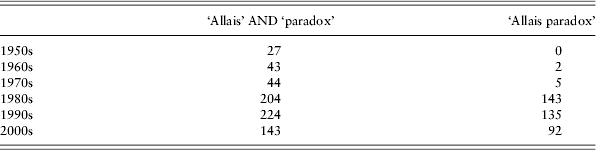
From the 1950s to the 1970s, Allais's criticism of expected utility theory was known among specialists, just like those of Ellsberg, Baumol, George Shackle and others.Footnote 63 Yet Allais's criticism had not become the iconic Allais paradox that every behavioural scientist and many a social scientist is familiar with today. The status of the Allais paradox began to rise only in the 1980s, as illustrated in Table 1.
JSTOR search for ‘Allais’ AND ‘paradox’ and for ‘Allais paradox’ in all categories. Note: JSTOR is case-insensitive, as well as dash-insensitive. The general drawback of an increasing total output of scientific publications over the years, however, still applies, as does the absence of books, and the limited representation of non-English academic output
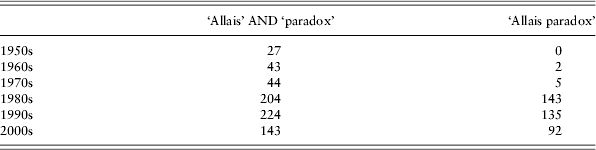
The relative sudden rise to fame of the Allais paradox in the 1980s may be explained by four developments. First of all, although Allais had published one paper in English on his criticism of the ‘American school’ of expected utility theory, most of his allegations had been published in French. But in 1979, Allais, together with Ole Hagen from the Oslo Institute of Business Administration, published a seven-hundred-page restatement of his position in English entitled Expected Utility Hypotheses and the Allais Paradox. It included an English translation of ‘Fondements d'une théorie positive des choix’; contributions by Bruno de Finetti, Oskar Morgenstern and others under the heading ‘The neo-Bernoullian position versus the 1952 Allais theory’; and a number of ‘Contemporary views on the neo-Bernoullian theory and the Allais paradox’, by leading authors in the field such as Peter Fishburn and Richard Cyert. This forcefully catalysed the alleged empirical counterevidence to expected utility theory that Allais had produced in the early 1950s as the principal paradox of expected utility theory.
Second, while the majority of economists until the 1960s maintained the view that the assumptions of human behaviour on which economics was founded were generalized characterizations, this began to change in the 1970s and 1980s. Gradually, economics became a behavioural science, in the sense that the assumptions of human behaviour came to be understood as descriptive claims that could be refuted or validated directly by empirical evidence.Footnote 64 As a result, Allais's counterexamples could retrospectively be understood as the first empirical counterevidence of these descriptive claims by economists regarding human behaviour – exactly as Allais had intended them.
Also in 1979, but independently of Allais and Hagen's edited volume, the counterexamples that Allais had produced in the early 1950s were employed by two psychologists as the basis for their empirical refutation of expected utility theory from the 1970s to the 2000s. In ‘Prospect theory’, Kahneman and Tversky repeatedly emphasized that their counterexamples were mere reproductions of Allais's examples of twenty-five years earlier, albeit with more moderate gains than the extreme gains of Allais's examples. Kahneman and Tversky's article became one of the most cited articles in Econometrica, and among others provided the basis for behavioural economics, which arose as a highly visible new subdiscipline in economics from the early 1990s onwards.Footnote 65 All this research emphasized the Allais paradox as the iconic and historically first counterexample to expected utility theory.
Then, fourth, in 1988 Allais won the Nobel memorial Prize in economics. Officially, Allais received the prize for ‘for his pioneering contributions to the theory of markets and efficient utilization of resources’ and not for the paradox that bore his name.Footnote 66 However, to the French engineer–economists expected utility theory and its counterexamples had always been part of an engineering approach towards the economy. Obviously, his Nobel memorial Prize in economics further increased the status of Allais's paradox.
Conclusion
The Allais paradox is an icon of decision-making research in the behavioural and social sciences. To understand the Allais paradox against the history of probability theory, rational choice theory and statistics, it is necessary to first consider the careful epistemology of the new Theory of Games, as developed by von Neumann and Morgenstern. The epistemology of the Theory of Games is best understood as an epistemology of generalized characterizations. While Savage diverted somewhat from this position in his papers with Friedman in an attempt to reconcile the Theory of Games with twentieth-century economics, he came back to the careful epistemology of von Neumann in his The Foundations of Statistics.
Allais, on the other hand, understood the axioms of the Theory of Games and The Foundations of Statistics on the basis of an epistemology of directly refutable descriptions. As a result, Savage's irrational responses to Allais's shrewd questions implied to the latter that the axioms were not accurate, objective descriptions. To the former, however, it merely was a reason to reflect once again on whether the axioms were indeed true to the nature of rational human decision making under uncertainty.
The two epistemologies continued to define discussions in economics on rational choice theory throughout the rest of the twentieth century. Allais, and later Kahneman and Tversky and the behavioural economic research that arose from their work, forcefully argued for an interpretation of rational choice theory and its axioms as exact descriptions. Many other economists, by contrast, continued to favour an epistemology of generalized characterizations – albeit often implicitly. The first regard the Allais paradox as an icon of everything that is wrong in post-war economics, the second consider it an icon of those who fail to see how economics is different from psychology and other behavioural sciences.
APPENDIX
(a) and (b). Savage's initial sketches of his own utility curve (above), and the final version (below) as sent to Allais. Savage sketched his own utility curve for $0 to $1,000,000, through ‘self interrogation on 23 dec[ember] 1952’ in response to Allais's questionnaire on risk. Dollars (‘$’) are on the horizontal axis, ‘utiles’ on the vertical axis. The estimated utility function on the graph sketch is U(x)=0.11754(1 – e −0.0025x), which is different from the utility function eventually mentioned in Savage's letter to Allais, U(x)=0.035578(1 – e −0.001x).Footnote 67