


Introduction
Current animal research regulations are regarded as essential instruments for mediating the ethical disagreements inherent in biomedical practice (Grimm et al. Reference Grimm, Olsson and Sandøe2019). Despite their broad acceptance within the scientific community, these legal provisions remain the subject of debate (Grimm et al. Reference Grimm, Olsson and Sandøe2019). Beyond frequently highlighting their limitations, the literature has formulated several proposals to enhance their clarity and maximise their effectiveness (Tannenbaum & Bennett Reference Tannenbaum and Bennett2015; Laber et al. Reference Laber, Newcomer and Bronstad2016; Louis-Maerten et al. Reference Louis-Maerten, Rodriguez Perez, Cajiga, Persson and Elger2024a). This paper specifically focuses on the ethical assessment of biomedical research involving animals, as regulated by Directive 2010/63/EU.
Within this broad discussion, considerable attention is paid to Replacement, Reduction and Refinement (the 3Rs) and harm-benefit analysis (HBA), recognised as fundamental preconditions for legitimising animal use for scientific purposes (Grimm et al. Reference Grimm, Olsson and Sandøe2019). Their centrality is unsurprising, given that their relevance is explicitly stated in the law. Indeed, by mandating the implementation of both frameworks, Directive 2010/63/EU establishes a connection between them (European Parliament and Council 2010). However, this has led to the perception that these frameworks are so deeply intertwined that drawing a line between seems challenging (Jörgensen et al. Reference Jörgensen, Lindsjo, Weber and Röcklinsberg2021).
Although connected, there should be a boundary between these normative requirements. The 3Rs and HBA are different constructs, endowed with distinct characteristics and roles within the regulatory process (Tannenbaum & Bennett Reference Tannenbaum and Bennett2015; Brønstad et al. Reference Brønstad, Newcomer and Laber2016). While theoretically clear, this distinction can be quite blurred in practice (Griffin et al. Reference Griffin, MacArthur Clark, Zurlo and Ritskes-Hoitinga2014; Sena & Currie Reference Sena and Currie2019). Given their significance for moral decision-making, investigating the ethical dimensions embedded in these frameworks can help demarcate them and accurately portray their intertwinement within the assessment of project proposals. Indeed, it can be hypothesised that, consistent with their differences, these paradigms are based on only partially overlapping moral tenets.
Drawing on this hypothesis, this paper aims to examine whether the 3Rs and HBA are grounded in the same moral factors and to descriptively analyse the normative functions attributed to them in recent literature and in Directive 2010/63/EU. Scrutinising the moral pillars underpinning these frameworks is crucial for highlighting their similarities and differences, thereby gaining a better understanding of how the biomedical research evaluation process works. It is also plausible that this inquiry will provide insights into which parameters may be deemed relevant to authorising in vivo study protocols. Consequently, this paper also attempts to identify a set of operational and normative criteria that ethics committees may find meaningful when assessing a research project’s likelihood of reaching its objectives.
As implementing the 3Rs and HBA is a legally binding part of a project evaluation, this investigation can be situated within a perspective of ethics within legal limits or regulations, according to which the principle of legality prevails over moral theories and public concerns, thereby ensuring compliance with constitutive state regulations (Grimm Reference Grimm, Dumitras, Jitea and Aerts2015a). Accordingly, animal research should be approved only in accordance with the guidelines set out in Directive 2010/63/EU (Eggel & Grimm Reference Eggel, Grimm, Vinnari and Vinnari2019). As such, the ethical considerations formulated in this paper are to be interpreted in light of this framework. Thus, they might help advance the implementation of the 3Rs and HBA in Member States’ evaluation procedures, consistent with the requirements of Directive 2010/63/EU.
Given this theoretical context and the outlined objectives, the research question underpinning this investigation can be phrased as follows: Which moral factors underlie the 3Rs and HBA in biomedical research emerging from the analysis of recent literature and Directive 2010/63/EU, and how can these concepts be compared in light of these elements?
Materials and methods
Study strategy
To address the research question, the strategies for operationalising the 3Rs and HBA – along with their limitations – were examined, as they represent a valuable starting point for identifying the moral issues researchers routinely confront. Based on this examination, the moral factors underlying the 3Rs and HBA were analysed and compared to provide a descriptive account of the normative, legal and ethical functions attributed to them in the literature. Finally, a set of normative, operational criteria potentially relevant to decision-making processes was developed.
To achieve these aims, a four-step strategy was followed. First, a bibliographic search identified relevant sources describing the normative and operational accounts of the 3Rs and HBA within the literature and Directive 2010/63/EU (see Systematic literature research and review). Second, a review of these sources identified recurring arguments and themes relate to the moral factors and their strategic operationalisation (see Literature review and clustering). Third, research findings were examined and compared to descriptively account for the 3Rs and HBA concepts, their current application and their normative functions (see The moral factors underlying the 3Rs and HBA). Fourth, further scrutiny of the data obtained led to identify the aforementioned set of criteria (see A descriptive set of normative and operational criteria).
Systematic literature research and review
This investigation began with a systematic survey of the literature on the 3Rs and HBA in animal research, focusing on articles, essays and book chapters that examined this topic from a theoretical standpoint. Although most sources are philosophical in nature, interest in the pragmatic aspects of implementing such frameworks led to the review of some scientifically and technically oriented sources. This offered insights into researchers’ conceptions of animal welfare and concerns regarding experimental validity, as well as the pragmatic solutions they adopt to address ethical dilemmas.
Database selection
Since material concerning animal experimentation, the 3Rs and HBA is extensively indexed in the Google Scholar, PubMed, Ingenta Connect and Scopus databases, searches of these archives could comprehensively identify relevant sources for this investigation. This process also turned up several philosophical and scientific books, the content of which complemented and enriched the analysis. The following sub-section details the search strategy.
Search terms, streams, and screening
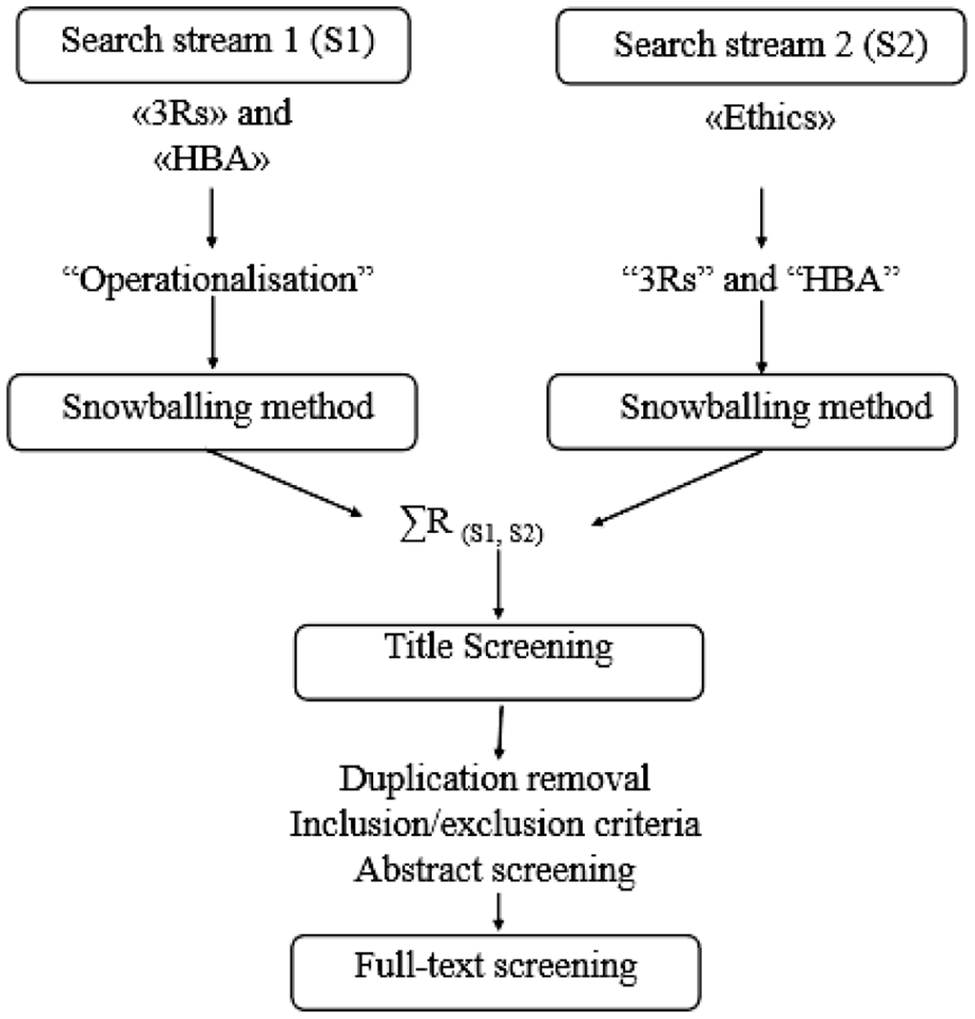
To identify relevant sources in the aforementioned databases, two separate searches were conducted using key terms expected to appear in the sources or their titles. These sources were then reviewed to identify those most relevant to the research question. Figures 1, 2, 3 and 4 detail the search process.
Overall literature search and screening process for identifying sources on the operationalisation of the Three Rs (Replacement, Reduction, and Refinement) and Harm-Benefit Analysis, and on ethical considerations in relation to these frameworks.

Figure 1. Long description
The flowchart presents the overall literature search and screening process. It begins with two parallel search streams. Search Stream 1 (S1) focuses on the operationalisation of the Three Rs (Replacement, Reduction, and Refinement) and Harm-Benefit Analysis (HBA), followed by the snowballing method. Search Stream 2 (S2) focuses on animal research ethics. It is then narrowed in relation to the Three Rs and Harm-Benefit Analysis, followed by the snowballing method. The results of the two search streams are then combined into a single set of records indicated as ΣR (S1,S2). The combined records undergo title screening, followed by duplicate removal, the application of inclusion and exclusion criteria, abstract screening, and full-text screening.
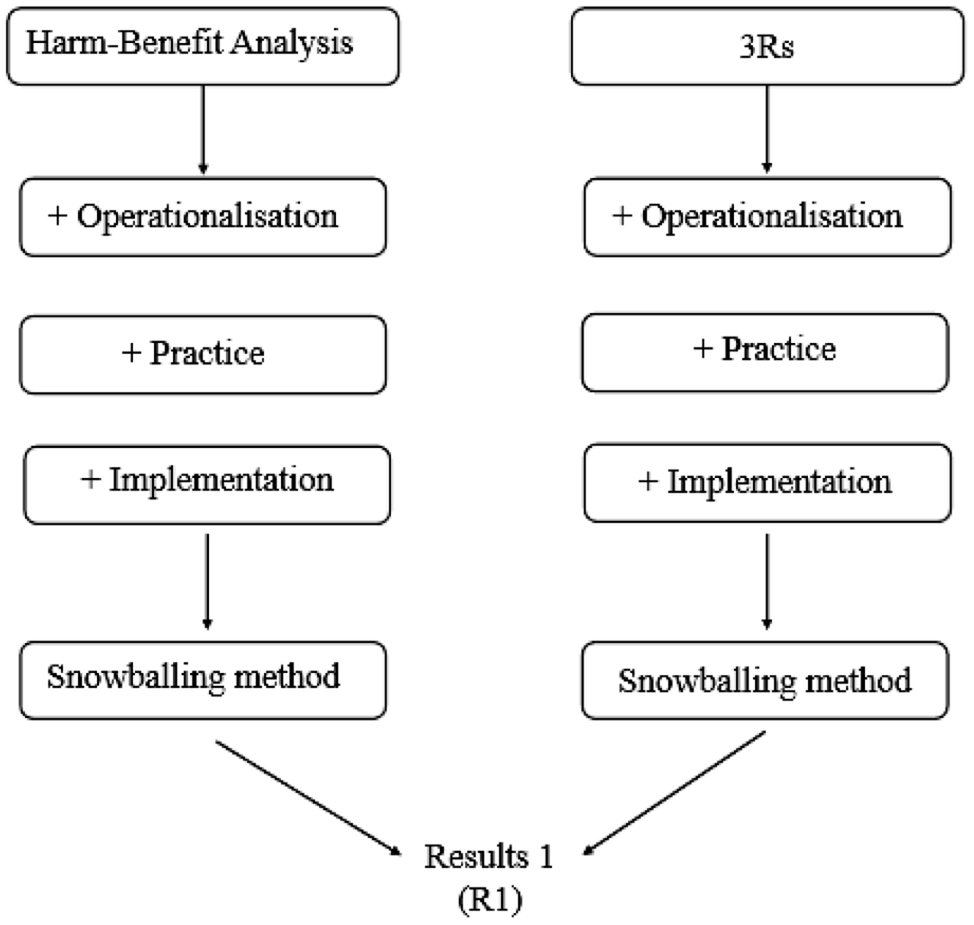
Search stream 1 (S1): literature search focused on the operationalisation of the Three Rs (Replacement, Reduction and Refined) and Harm-Benefit Analysis.

Figure 2. Long description
The flowchart presents Search Stream 1 (S1), which identifies literature on the operationalisation of the Three Rs (Replacement, Reduction, and Refinement) and Harm-Benefit Analysis (HBA), by combining these keywords with the terms “operationalisation”, “practice”, and “implementation”. The search was then expanded through the use of snowballing techniques.
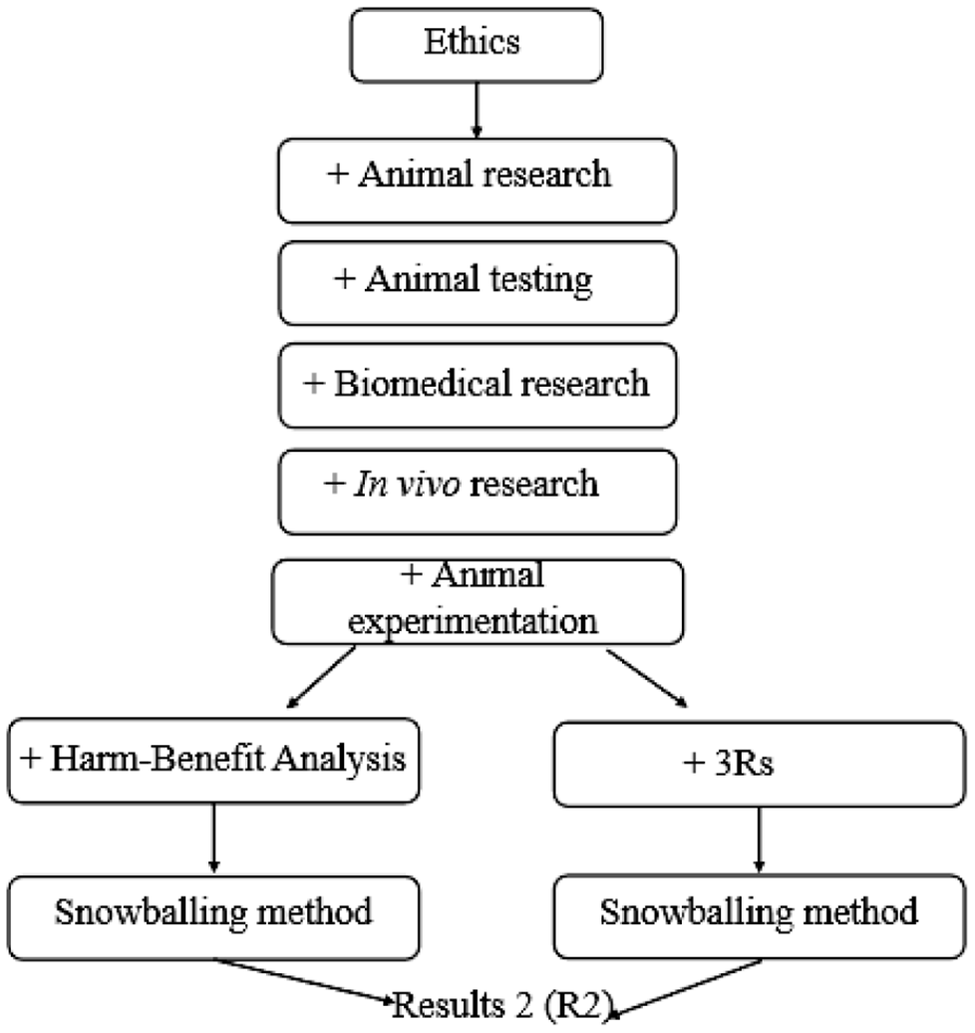
Search stream 2 (S2): literature search focused on the ethical considerations of Three 3Rs (Replacement, Reduction, and Refinement) and Harm-Benefit Analysis in biomedical practice.

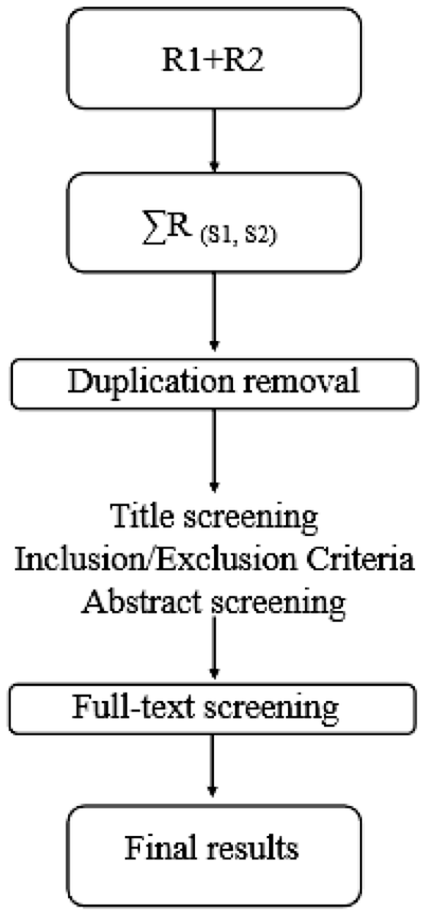
Screening and selection process used to identify the final sources included in the literature review.

The first search concerned the operationalisation of the 3Rs and HBA in the natural sciences. Therefore, the key terms ‘3Rs’ and ‘harm-benefit analysis’ were used in combination with ‘operationalisation’, ‘implementation’ and ‘practice’. The sources were then expanded using supplementary backward and forward snowballing techniques to identify additional relevant publications.
The second search aimed to address ethical considerations in biomedical research practices.
Therefore, the key term, ‘ethics’ was used in combination with ‘animal research’, ‘animal testing’, ‘biomedical research’, ‘in vivo research’ and ‘animal experimentation’. These streams were further combined with the terms ‘harm-benefit analysis’ and ‘3Rs’ to refine the results. The sources were then expanded using the backward and forward snowballing techniques.
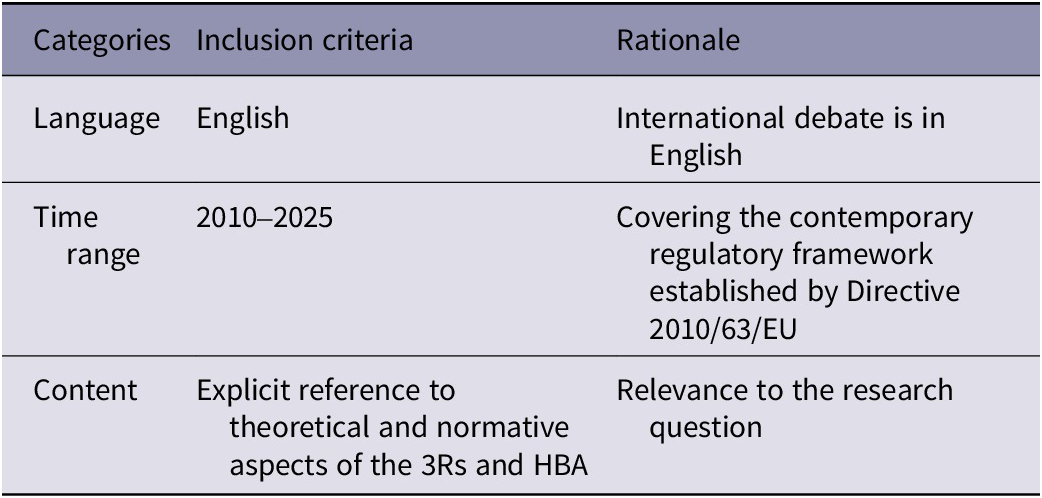
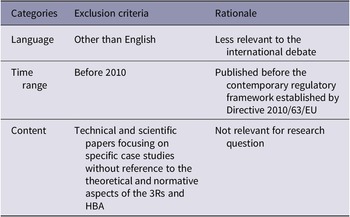
The sources identified by the two searches were merged and then refined by removing duplicates, followed by screening titles, applying the established inclusion (Table 1) and exclusion (Table 2) criteria, and sequentially screening abstracts and full texts.
The inclusion criteria used to select literature, organised by language, publication period and content

Table 1. Long description
The table presents the inclusion criteria applied during the literature selection process. Sources were assessed according to three categories: language, publication period and content. Language: Only sources written in English were included, as English is the main language through which the international debate on the Three Rs and Harm-Benefit Analysis is conducted. Publication period: Sources published between 2010 and 2025 were included. This period was selected because it reflects the current regulatory context shaped by the introduction of Directive 2010/63/EU. Content: Sources were included when they explicitly addressed theoretical and normative aspects of the Three Rs and Harm-Benefit Analysis. This criterion ensured that the selected literature was relevant to the research question.
Exclusion criteria used to screen literature, organised by language, publication period and content

Table 2. Long description
The table presents the exclusion criteria applied during the literature selection process. The same three categories used for the inclusion criteria were applied: language, publication period and content. Language: Sources not written in English were excluded because they were considered less relevant to an international debate primarily conducted in English. Publication period: Sources published before 2010 were excluded because they did not reflect the contemporary regulatory framework introduced with Directive 2010/63/EU. Content: Highly technical or scientific publications focusing on overly specific case studies were excluded when they did not address theoretical or normative aspects of the Three Rs or Harm-Benefit Analysis, as they were considered insufficiently relevant to the research question.
Thematic clustering process
The sources selected were reviewed, with notes taken to facilitate elaboration and analysis. First, the practical strategies for applying the 3Rs and HBA were scrutinised on the assumption that examining the operational dimension of biomedical research (henceforth, ‘Operational Focus’) can provide insights into the moral aspects of this practice. This task was performed through an iterative process combining inductive and deductive approaches.
The deeply practice-oriented nature of the 3Rs required analysing their operationalisation inductively to identify several highly recursive techniques for implementing this normative requirement, namely, the systematic use of established terminology and the attribution of the same strengths and weaknesses to them. Conversely, because Directive 2010/63/EU is regarded as the most important source of guidance for performing HBA, this legislative text was first analysed deductively to identify its application strategies, which in turn led to an examination of the extent to which the reviewed literature reflects these requirements.
The most relevant approaches to implementing the 3Rs and HBA, along with their limitations, were thus identified and grouped into macro-thematical clusters (‘domains’) based on recurring themes identified in the literature. Once derived, the domains were analysed to elaborate on the ethical rationale for introducing the 3Rs and HBA, the model of good scientific practice they are expected to promote, and their current weaknesses, thereby elucidating the moral factors underpinning these frameworks. Subsequently, the domains were analysed using a bottom-up approach and grouped according to the main moral concerns that emerged from their content. This process led to the identification of the moral factors underlying the 3Rs and HBA, namely, the Animal and the Epistemological foci.
Results
Literature search
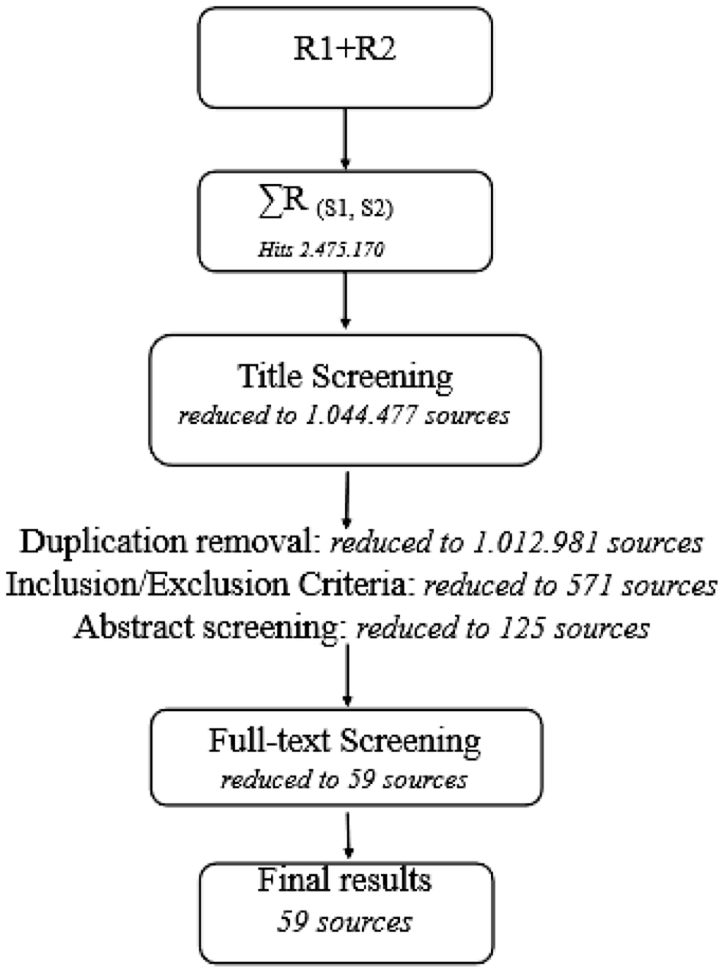
The initial literature searches identified 2,475,170 sources (Figures 2 and 3), an infeasible number to screen. Therefore, this pool was condensed and refined (Figure 4). Figure 5 details the results obtained at each step of this analytical selection process.
Results of the literature search and selection process, showing the number of records remaining at each stage.

Figure 5. Long description
The flowchart presents the numerical results of the literature screening and selection process. The results of the two searches, R1 and R2, are combined. The combined searches produce 2,475,170 records. After duplicate removal, 2,443,674 records remain. Title screening reduces the number to 1,012,981 records. The application of inclusion and exclusion criteria reduces the number to 571 records. Abstract screening reduces the number to 125 records. Full-text screening results in 61 sources, which constitute the final set of sources included in the review.
Literature review and clustering
The results of the literature review and clustering process are reported in Tables 3 and 4. The tables illustrate the identified domains and connect them to the Operational Focus from which they are derived, highlighting their operationalisation and the related operational problems, as reflected in the surveyed literature.
Summary of the operationalisation of the Five Domains of the Three Rs with the number of literature hits, examples of operationalisation strategies, and the main problems associated with their implementation

Table 3. Long description
The table summarises five domains concerning the operationalisation of the Three Rs, reporting literature hits, operational strategies and related problems. Harm minimisation (29): enrichment, low-stress handling, analgesia and microsampling; problems include difficulties assessing suffering and limited training and reporting. Animal use optimisation (19): sample-size calculation and microsampling; problems include calculation errors and limited ethical review. Alternatives to animal research (21): in vitro, in silico and complementary non-animal approaches; problems include scientific, cultural and regulatory barriers. Study design (21): accurate animal-number planning and innovative methods; problems include inaccurate estimates and limited expertise. Ethical considerations (30): balancing scientific benefit, animal welfare and reproducibility; problems include tensions among the Three Rs and unclear implementation guidelines.
Summary of Five Domains related to Harm-Benefit Analysis (HBA) operationalisation, with the number of literature hits, examples of operationalisation and the main problems associated with their implementation

Table 4. Long description
The table summarises five domains concerning the operationalisation of Harm-Benefit Analysis, reporting literature hits, operational strategies and related problems. Harm (15): case-by-case assessment considering welfare, rights and scientific factors; problems include comparing different harms and assessing severity. Benefit (23): assessment of scientific quality, potential outcomes and likelihood of success; problems include benefit overestimation and difficulties in evaluation. Decision-making and justification (19): Bateson Cube, discourse and metric models; problems include weaknesses in ethics committee processes and weighing incommensurable harms and benefits. Study design and outcomes (15): assessment of design factors affecting harm and scientific quality; problems include incomplete project information. Assessment challenges and ethical concerns (18): guidance and standards for ethical research; problems include inconsistent legislation and reliance on subjective judgement.
The moral factors underlying the 3Rs and HBA
By analysing the domains presented in Literature review and clustering, it was possible to adopt a bottom-up approach and further cluster the findings into two foci that represent the main normative anchorage points of the subsequent investigation: the Animal Focus and the Epistemological Focus. On the one hand, the Animal Focus describes the moral concern for animal well-being and the intention to minimise their suffering, pain and distress within laboratory settings (Curzer et al. Reference Curzer, Perry, Wallace and Perry2016). On the other hand, the Epistemological Focus reflects researchers’ desire to maximise the quality and validity of their research to advance science and enhance patient care (Curzer et al. Reference Curzer, Perry, Wallace and Perry2016). Both foci are endowed with moral significance and inextricably linked in the pursuit of sound and ethical scientific practice (Strech & Dirnagl Reference Strech and Dirnagl2019; Brønstad & Sandøe Reference Brønstad and Sandøe2020; Eggel & Würbel Reference Eggel and Würbel2021; Vitale & Ricceri Reference Vitale and Ricceri2022; Grimm et al. Reference Grimm, Biller-Adorno, Buch, Dahlhoff, Davies, Cederroth, Maissen, Lukas, Passini, Tornqvist, Olsson and Sandstrom2023). This aligns them with the moral factors underlying the 3Rs and HBA in the context of biomedical research (Brill et al. Reference Brill, Guerrero-Martin and Metcalf Pate2019; Pollo & Vitale Reference Pollo and Vitale2020; Critser & Locke Reference Critser and Locke2024; Lauwereyns et al. Reference Lauwereyns, Bajramovic, Bert, Camenzind, De Kock, Elezovic, Erden, Gonzalez-Uarquin, Isil Ulman, Hoffman, Kitsara, Kostomitsopoulos, Neuhaus, Petit-Demouliere, Pollo, Riso, Schober, Sotiropoulos, Thomas, Vitale, Wilflingseder and Ahluwalia2024). This perspective evolved from examining the domains of the 3Rs and HBA and inferring their position within the scope of the Animal Focus, the Epistemological Focus, or both.
The results of this analysis are presented below.
Animal focus
This section examines the most recursive domains connected to the Animal Focus, demonstrating that this anchorage point underlies both the 3Rs and HBA.
The ‘Harm minimisation’ domain has permeated the 3Rs since their original formulation, as inferred from the centrality of the notions of ‘humanity’ and ‘inhumanity’ in the conceptual structure of Russell and Burch’s principles: humanity can be regarded as their ultimate aim, to be achieved by reducing, and whenever possible eliminating, inhumanity (Tannenbaum & Bennett Reference Tannenbaum and Bennett2015). These terms are used to refer to either the mental states animals experience or to the procedures and interactions that elicit such states (Tannenbaum & Bennett Reference Tannenbaum and Bennett2015; Louis-Maerten et al. Reference Louis-Maerten, Rodriguez Perez, Cajiga, Persson and Elger2024a).
The concern for animal well-being embedded in the 3Rs can also be inferred from the lively, ongoing debate regarding whether harms should be evaluated at the global or individual level when assessing the moral legitimacy of animal research (Louis-Maerten et al. Reference Louis-Maerten, Rodriguez Perez, Cajiga, Persson and Elger2024a). This debate ties into the discourse on the correct understanding of reduction, closely connected to the ‘Animal optimisation’ domain. The first interpretation, defined relative reduction, mandates downsizing sample sizes to the minimum number of animals required to ensure statistical power (Camenzind & Eggel Reference Camenzind and Eggel2022). Conversely, some scholars consider the second interpretation, termed absolute reduction mandating reducing the overall number of animals employed in biomedical research, the only morally acceptable goal of the second R (Camenzind & Eggel Reference Camenzind and Eggel2022). Although the debate continues, the first interpretation appears to garner greater support, as it is perceived as more consistent with Russell and Burch’s phrasing of the principle (Camenzind & Eggel Reference Camenzind and Eggel2022).
The literature also presents two views on the objectives of replacement: partial and absolute. While the former refers to research involving animals that are exposed to limited or no distress (as briefly anticipated by the ‘Alternatives to animal use’ domain), the latter refers to not using animals at any stage of the research (Locke et al. Reference Locke, Romanchik, Kincaid and Golden2024). Directive 2010/63/EU accepts both approaches, consistent with Russell and Burch’s proposal (Brønstad & Sandøe Reference Brønstad and Sandøe2020; Locke et al. Reference Locke, Romanchik, Kincaid and Golden2024). It explicitly mandates partial replacement by requiring Member States to use non-in vivo research strategies whenever possible; when this is infeasible, it recommends using less-sentient animals (Griffin et al. Reference Griffin, MacArthur Clark, Zurlo and Ritskes-Hoitinga2014; Milford et al. Reference Milford, De Clercq, Louis-Maerten, Geneviève and Elger2025). Notwithstanding its legal recognition, partial replacement is widely criticised for impeding the pursuit of real replacement by misleadingly inviting researchers to perform mere refinement (Lauwereyns et al. Reference Lauwereyns, Bajramovic, Bert, Camenzind, De Kock, Elezovic, Erden, Gonzalez-Uarquin, Isil Ulman, Hoffman, Kitsara, Kostomitsopoulos, Neuhaus, Petit-Demouliere, Pollo, Riso, Schober, Sotiropoulos, Thomas, Vitale, Wilflingseder and Ahluwalia2024; Louis-Maerten et al. Reference Louis-Maerten, Rodriguez Perez, Cajiga, Persson and Elger2024a).
The hierarchy of the 3Rs provides further insights into their intersection with the Animal Focus. Russell and Burch prioritised replacement as the most relevant principle, followed by reduction and then refinement (Olsson et al. Reference Olsson, Franco, Weary and Sandøe2012; Lauwereyns et al. Reference Lauwereyns, Bajramovic, Bert, Camenzind, De Kock, Elezovic, Erden, Gonzalez-Uarquin, Isil Ulman, Hoffman, Kitsara, Kostomitsopoulos, Neuhaus, Petit-Demouliere, Pollo, Riso, Schober, Sotiropoulos, Thomas, Vitale, Wilflingseder and Ahluwalia2024; Milford et al. Reference Milford, De Clercq, Louis-Maerten, Geneviève and Elger2025). However, current scientific practice appears to invert this order (Brønstad & Sandøe Reference Brønstad and Sandøe2020; Milford et al. Reference Milford, De Clercq, Louis-Maerten, Geneviève and Elger2025). Such a paradigm shift is expected to affect the ‘Ethical considerations’ domain and is likely motivated by researchers’ belief that refinement is easier to achieve than replacement (Milford et al. Reference Milford, De Clercq, Louis-Maerten, Geneviève and Elger2025).
Concern for animal well-being – represented by the ‘Harm’ domain – is also a central tenet of HBA, which scrutinises the harms animals are expected to experience during experimental procedures. According to the ‘Assessment challenges and ethical concerns’ domain, to effectively evaluate harms and compare them with research benefits, it is essential to consider not only pain but also all potential stressors included in the study design (Griffin et al. Reference Griffin, MacArthur Clark, Zurlo and Ritskes-Hoitinga2014; Brønstad et al. Reference Brønstad, Newcomer and Laber2016). This approach is consistent with a key assumption of the biomedical research regulatory system: although it is impossible for humans to fully understand animals’ subjective negative experiences and suffering, their discomfort is theoretically manageable at the project level (Kramer & Bovenkerk Reference Kramer and Bovenkerk2024). Researchers address their moral responsibility for animal welfare by developing research protocols, prospective benefits of which outweigh potential harms to animals and by actively limiting the latter (Graham & Prescott Reference Graham and Prescott2015). Nonetheless, consistent with the ‘Decision-making and justification’ domain, this responsibility is also legally mandated by Article 38 of Directive 2010/63/EU, emphasising the ethical dimension of HBA (European Parliament and Council 2010; Lauwereyns et al. Reference Lauwereyns, Bajramovic, Bert, Camenzind, De Kock, Elezovic, Erden, Gonzalez-Uarquin, Isil Ulman, Hoffman, Kitsara, Kostomitsopoulos, Neuhaus, Petit-Demouliere, Pollo, Riso, Schober, Sotiropoulos, Thomas, Vitale, Wilflingseder and Ahluwalia2024).
Epistemological focus
As for the Animal Focus, the links between the Epistemological Focus and the main related domains are highlighted below.
The Epistemological Focus reflects researchers’ desire to ensure high experimental validity in the pursuit of advancing biomedicine, while also adhering to ethical and procedural rules intended to ensure research quality and minimise animal suffering (Madden et al. Reference Madden, Hewitt, Przybylak, Vandebriel, Piersma and Cronin2012). Consistent with the ‘Harm minimisation’ domain and the ‘Ethical considerations’ domain, the literature advises limiting animal use to instances when it is strictly necessary and beneficial for scientific practice, and otherwise heeding the notion that, all things being equal, research that causes less harm to animals is always morally preferable (Curzer et al. Reference Curzer, Perry, Wallace and Perry2016; Brønstad & Sandøe Reference Brønstad and Sandøe2020). However, the clause ‘all things being equal’ introduces an important caveat: the study protocol must always be designed or modified to fully preserve the intended epistemological gain (Curzer et al. Reference Curzer, Perry, Wallace and Perry2016). According to the ‘Harm minimisation’ and ‘Alternatives to animal use’ domains, when any available non-in vivo strategy can produce analogous knowledge, it should be adopted; if not, animal use is morally permissible, provided that harms are minimised (Curzer et al. Reference Curzer, Perry, Wallace and Perry2016; Locke et al. Reference Locke, Romanchik, Kincaid and Golden2024).
This recalls the principles of reduction and replacement (respectively linked to ‘Animal use optimisation’ and ‘Alternatives to animal use’ domains), which similarly intend to prevent unnecessary harm to animals. Although reduction prescribes avoiding the use of surplus animals by carefully calculating the sample size required for the experimental aims and methodologies (Lauwereyns et al. Reference Lauwereyns, Bajramovic, Bert, Camenzind, De Kock, Elezovic, Erden, Gonzalez-Uarquin, Isil Ulman, Hoffman, Kitsara, Kostomitsopoulos, Neuhaus, Petit-Demouliere, Pollo, Riso, Schober, Sotiropoulos, Thomas, Vitale, Wilflingseder and Ahluwalia2024), replacement prescribes employing non-in vivo methods instead of in vivo methods whenever feasible. Such a substitution has a dual ethical merit: not only does it limit animal suffering, but it also indirectly addresses the problems of the reliability of model organisms and the poor translatability of research findings by introducing alternatives (Eggel & Grimm Reference Eggel, Grimm, Springer and Grimm2018; Sena & Currie Reference Sena and Currie2019; Pollo & Vitale Reference Pollo and Vitale2020; Lilley et al. Reference Lilley, Isbrucker, Ragan and Holmes2021; Bailey Reference Bailey2024).
Like the 3Rs, HBA encourages limiting the unnecessary use of animals for scientific purposes: the ‘Decision-making and justification’ and ‘Study design and outcomes’ domains capture its authorisation of animal research only when animals are indispensable and actual benefits can be envisioned (Grimm Reference Grimm2015b; Carbone Reference Carbone2019; Grimm et al. Reference Grimm, Olsson and Sandøe2019; Brønstad & Sandøe Reference Brønstad and Sandøe2020; Linder & Grimm Reference Linder, Grimm, Bruce and Bruce2022). Accordingly, Directive 2010/63/EU requires project proposals to be detailed and for ethics committees to verify that they are scientifically or educationally justified, comply with the law, and have morally acceptable goals (European Parliament and Council 2010). This demands prioritising a clear definition of the experimental benefits to inform the discourse around HBA, which is broadly centred around the ‘Benefit’ domain .
A preference for societal benefits among regulatory authorities and researchers can be inferred from the literature (Nobis Reference Nobis2011; Brønstad et al. Reference Brønstad, Newcomer and Laber2016; Eggel & Grimm Reference Eggel, Grimm, Springer and Grimm2018; Kramer & Bovenkerk Reference Kramer and Bovenkerk2024). However, some scholars argue for the value of pure knowledge, devoid of any necessary practical application, as a research outcome (Griffin et al. Reference Griffin, MacArthur Clark, Zurlo and Ritskes-Hoitinga2014). This latter perspective is grounded in the assumption that ‘morally responsible animal research will produce “knowledge worth having” and that the prospective moral justification of animal research ought to rest on the value of knowledge the experiment will produce’ (Eggel & Grimm Reference Eggel, Grimm, Springer and Grimm2018; Eggel et al. Reference Eggel, Neuhaus and Grimm2019; p 137). This position introduces some operational considerations, requiring that ethics committees assess only whether the knowledge achievable from a project is worth having and not whether it entails societal benefits (Eggel & Grimm Reference Eggel, Grimm, Springer and Grimm2018; Eggel et al. Reference Eggel, Neuhaus and Grimm2019; Kramer & Bovenkerk Reference Kramer and Bovenkerk2024).
Beyond the responsible use of animals in science, per the ‘Study design’ domain, the Epistemological Focus encompasses efforts to maximise research quality and validity. This notion is traditionally embedded in the 3Rs, which were developed to facilitate the convergence of animal research and ethics toward medical and scientific progress (MacArthur Clark Reference MacArthur Clark2018; Louis-Maerten et al. Reference Louis-Maerten, Rodriguez Perez, Cajiga, Persson and Elger2024a). Therefore, the 3Rs emphasise epistemological gain by pushing researchers not only to minimise animal harm but also to obtain as much knowledge as possible from each animal experiment (Curzer et al. Reference Curzer, Perry, Wallace and Perry2016).
Analogously, HBA should promote high-quality science by assessing and, only then, authorising humane, well-designed projects, consistent with ‘Study design and outcomes’ and ‘Assessment challenges and ethical concerns’ domains. As such, an accurate study design is an essential precondition for generating potential benefits and valuable knowledge, thereby giving meaning to the use of animals and precluding irresponsible or poor-quality research (Brønstad et al. Reference Brønstad, Newcomer and Laber2016; Eggel et al. Reference Eggel, Neuhaus and Grimm2019). Moreover, strengthening research validity appears to be the most effective strategy to address uncertainty about benefits in decision-making, as it increases the likelihood of achieving benefits (Brønstad et al. Reference Brønstad, Newcomer and Laber2016; Brill et al. Reference Brill, Guerrero-Martin and Metcalf Pate2019).
Comparing the Animal and the Epistemological Foci
Comparing the Animal and the Epistemological Foci provides critical insights into the normative functions attributed to the 3Rs and HBA in recent literature and helps clarify how they intertwine in the regulatory decision-making process.
This comparison confirms this investigation’s first hypothesis, demonstrating that the two foci only partially overlap within the 3Rs and HBA due to the diverse normative functions attributed to them in biomedical research (Lilley et al. Reference Lilley, Isbrucker, Ragan and Holmes2021; Locke et al. Reference Locke, Romanchik, Kincaid and Golden2024). This conclusion arises from the identification of seven comparative elements throughout the analysis: good science enforcement, ethical assessment of animal research, animal well-being and research quality, role in the assessment process, primary stage of application, underlying ethical frameworks, and experimental results.
This analysis revealed various points of convergence and divergence in the actualisation of the Animal and the Epistemological Foci within the specific scope of the 3Rs and HBA. In light of this, the Animal Focus results in a similar but not identical expression in the two frameworks: the 3Rs and HBA focus on identifying anticipated harms and on strategies to minimise or prevent them, but they rely on different approaches to address these issues (Bass Reference Bass and Garrett2012). The Epistemological Focus is also realised differently in the 3Rs and HBA, with a considerable emphasis on experimental outcomes in the former and a careful assessment of prospective benefits in the latter (Franco et al. Reference Franco, Sandøe and Olsson2018).
The findings of the comparison are detailed in Table 5.
Showing linking of eight normative and operational criteria to comparative elements of the Three Rs (3Rs) and Harm-Benefit Analysis (HBA), with illustrative examples

Table 5. Long description
The table compares the Animal and Epistemological Foci within the Three Rs and Harm-Benefit Analysis (HBA) across five elements. Both Foci support good science enforcement and animal wellbeing and research quality. The 3Rs primarily influence research design and scientific necessity, whereas HBA evaluates animal harms against prospective benefits. Both contribute to ethical assessment, but the 3Rs apply mainly at the study-design stage and HBA during project proposal assessment. Both frameworks share utilitarian and consequentialist elements; however, the 3Rs additionally reflect pathocentric and sentientistic concerns, whereas HBA incorporates the Principle of Proportionality. Finally, only the Epistemological Focus explicitly concerns experimental results: these correspond to experimental outcomes within the 3Rs and to prospective benefits within HBA.
A descriptive set of normative and operational criteria
Based on the preceding analyses, a set of potentially significant normative and operational criteria for assessing project proposals was developed from the reviewed literature, confirming this investigation’s second hypothesis. The criteria were derived from the comparative elements identified during the comparative analysis of the Animal and the Epistemological Foci within the 3Rs and HBA.
The developed set of normative and operational criteria is presented in Table 6.
Normative and operational criteria associated with the Animal and Epistemological Foci in the Three 3Rs (Replacement, Reduction, and Refinement) and Harm-Benefit Analysis: related comparative elements and illustrative examples

Table 6. Long description
The table presents eight normative and operational criteria associated with the Animal and Epistemological Foci in the Three Rs and Harm-Benefit Analysis, linking each criterion to comparative elements identified in Table 5 and providing illustrative examples. The criteria concern animal harm, pain minimisation, animal living conditions, animal use justification, non-in vivo research methods, experimental goals and benefits, scientific necessity, and study design and methods. Examples include assessing sources of animal distress, reducing pain and invasiveness, ensuring appropriate living conditions, preventing unnecessary animal use, promoting non-in vivo methods, clearly defining experimental aims and prospective benefits, justifying the scientific value of animal research, and providing sufficient methodological information for ethical and regulatory review.
Discussion
The 3Rs and HBA are universally recognised as two main pillars of the ethical assessment of animal research and are therefore expected to provide guidance to enhance good research practices. The findings presented in the Results describe how both frameworks can be linked to two moral factors: the Animal and Epistemological Foci. However, profound discrepancies in the expression of these ethical anchorage points across the 3Rs and HBA confirm that the foci only partially overlap within the two frameworks.
Moreover, this analysis identified a set of normative and operational criteria that may be relevant to members of ethics committees, thereby validating the study’s second hypothesis. These criteria emerged from the comparative analysis of the Animal and the Epistemological Foci and provide a practical illustration of how these moral factors may inform project assessment procedures.
When considered collectively, these findings provide several theoretical and practical insights into the roles of the 3Rs and HBA in ethical evaluations of animal research.
Beyond one-sided interpretations
As demonstrated, the 3Rs and HBA entail two different approaches to the ethical design and assessment of animal research, stemming from adherence to different moral principles and normative evaluative criteria; at the same time, they demonstrate that these frameworks share the common goals of minimising animal harm and strengthening research quality. However, this dual aim is not universally recognised in the literature, with several scholars tending to emphasise either their moral or epistemological dimension, implying incompatibility (Landi et al. Reference Landi, Shriver and Mueller2015; Brønstad et al. Reference Brønstad, Newcomer and Laber2016; Strech & Dirnagl Reference Strech and Dirnagl2019; Gutfreund Reference Gutfreund2020). Some cases even portray the 3Rs and HBA as devoid of ethical connotations and merely instrumental to achieving research objectives (Curzer et al. Reference Curzer, Perry, Wallace and Perry2016; Strech & Dirnagl Reference Strech and Dirnagl2019; Gutfreund Reference Gutfreund2020; Louis-Maerten et al. Reference Louis-Maerten, Rodriguez Perez, Cajiga, Persson and Elger2024a). In other cases, they are presented respectively as an ethical operational framework for reducing harms and a morally oriented evaluation framework, both exclusively focused on the issue of animal welfare and lacking practice-oriented frameworks to promote scientific quality (Griffin et al. Reference Griffin, MacArthur Clark, Zurlo and Ritskes-Hoitinga2014; Parker & Browne Reference Parker and Browne2014; Brønstad et al. Reference Brønstad, Newcomer and Laber2016; Sena & Currie Reference Sena and Currie2019).
These single-sided interpretations are unconvincing, as they conflict with the formulations of both frameworks. Russell and Burch’s notion of humanity within the 3Rs should be viewed as an effort to reconcile a humanistic and a scientific attitude towards other species, both of which are built into biomedical research and only apparently contrastive (Kirk Reference Kirk2017). The same applies to HBA, where an analogous intertwinement between ethical sensitivity towards animals and attention to scientific rigour has been observed during this investigation.
Therefore, acknowledging that the 3Rs and HBA are underpinned by both the Animal and Epistemological Foci is an important step towards their correct understanding and implementation (Richter Reference Richter2024).
Clarifying the relationship between the 3Rs and HBA
A proper understanding of the ethical aspects of both frameworks may also clarify their respective procedural roles in animal research, which are too often conflated.
Although these frameworks are theoretically well differentiated in the literature, some scholars describe their operationalisation, presenting the 3Rs as embedded in HBA and HBA as primarily aimed at ensuring the application of the 3Rs (Griffin et al. Reference Griffin, MacArthur Clark, Zurlo and Ritskes-Hoitinga2014; Curzer et al. Reference Curzer, Perry, Wallace and Perry2016; Sena & Currie Reference Sena and Currie2019). It is reasonable to assume that similar statements stem from a misinterpretation of HBA’s ultimate goals. Although Directive 2010/63/EU mandates both the 3Rs and HBA, they should be regarded as two separate principles, given that their requirements are articulated in two distinct places in the document, thereby clarifying that they are interrelated but not coincident (European Parliament and Council 2010).
Such demarcation raises the additional issue of determining the type of relationship between these frameworks. Based on the above considerations, this paper proposes an interpretation of this connection by relating the implementation of these constructs to different primary moments in research planning, as illustrated in Table 5. Although researchers should consider HBA requirements when developing their research projects, the study design phase is prominently characterised by the application of the 3Rs. By contrast, HBA is better performed in the later stage of project proposal evaluation, even if that stage also involves verifying the implementation of the 3Rs. Consistent with these observations, the relationship between the 3Rs and HBA can be described in chronological and functional terms.
Practical implications and limitations
In view of the preceding observations and the analytical findings, two practical implications for regulatory assessments can be articulated.
First, it is essential to clearly distinguish between the notions of experimental outcomes and benefits in ethical evaluations of animal research. While the first term refers to objective results obtained at the end of a study, the second term refers to prospective research findings deemed advantageous to their recipients during the project assessment procedure. Although these may or may not coincide, they cannot be conceptually equated in principle. This distinction should be considered when reviewing animal research project proposals to clearly identify the study’s aims and expected benefits and to make accurate, comprehensive evaluations.
Second, because all the elements of the identified set of normative and operational criteria are imbued with welfarist and gnoseological significance, both the Animal and the Epistemological Foci should be considered during the study design and evaluative phases of project proposals to promote humane and high-quality research practice.
Study limitations
This research also has some limitations that should be acknowledged. First, the findings are extrapolated exclusively from the surveyed literature and therefore reflect the perspectives, conceptualisations, and ongoing debates represented within the selected publications. Second, the identification of the domains and the Foci, the foundations of the analysis, relied on an interpretative clustering process that is inevitably influenced by the authors’ subjectivity. Finally, the presented set of normative and operational criteria does not aim to include all relevant parameters for regulatory assessments, nor to assign them a priority order, but merely to account for key aspects of the moral factors of the Animal and Epistemological Foci that ethics committees are likely to consider.
Animal welfare implications
While the 3Rs and HBA are intended to ensure robust and humane scientific practice, the tendency to conflate or misinterpret their purposes and functions in evaluating animal research may weaken or even impair the regulatory authorisation process. Clarifying the distinction between them by analysing their underlying moral factors helps to disambiguate their actual roles in designing and assessing biomedical research proposals and promotes their correct understanding and application.
The identification of the moral tenets underlying the 3Rs and HBA within the Animal and Epistemological Foci also highlights the need to consider both the animal welfare and gnoseological dimensions of in vivo study protocols during their review. Therefore, these factors may enhance animal well-being by ensuring that only humane and rigorous experiments are approved and performed, thereby preventing the inadvertent waste of animal lives that may result from misinterpreting the 3Rs and HBA.
Finally, the set of normative and operational criteria may offer researchers conceptual insights and practical guidance for designing their studies and completing regulatory applications, thereby facilitating ethical reviews and fostering good scientific practice.
Conclusion
This paper analysed the moral factors underpinning the 3Rs and HBA and descriptively portrayed the normative functions attributed to them in recent literature and in Directive 2010/63/EU.
The findings of this investigation support the conclusion that the moral foundations of the 3Rs and HBA can be clustered around two anchorage points: the Animal and Epistemological Foci. While the former concerns the humane treatment of laboratory animals, the latter concerns the promotion of scientifically rigorous and valuable research. Although these frameworks are often interpreted through either a welfarist or an epistemological lens, the analysis indicates that both dimensions are embedded in both the 3Rs and HBA.
At the same time, the study highlights that the 3Rs and HBA are two separate normative requirements and play distinct roles in the authorisation process for biomedical research. This observation confirms the investigation’s first hypothesis: the Animal and the Epistemological Foci only partially overlap within these frameworks and thus apply differently within them.
Consistent with these observations, the relationship between the 3Rs and HBA can be understood in functional and chronological terms, as the 3Rs and HBA serve distinct functions and are primarily implemented at different phases of research proposal planning.
The analysis also identified a set of normative and operational criteria potentially relevant to ethics committees’ decision-making, thereby confirming the inquiry’s second hypothesis. This list of criteria corroborates the conclusion that the 3Rs and HBA are grounded in both the Animal and Epistemological Foci and should be considered equally when designing and assessing animal research projects.
Data availability
The data supporting the findings of this study are available from the corresponding author upon reasonable request.
Acknowledgements
The present work was performed by Micol Volonteri in partial fulfilment of the requirements for obtaining the PhD degree at Università Vita-Salute San Raffaele , Milano, Italy. Micol Volonteri’s doctoral studies are supported by a PhD scholarship from Università Vita-Salute San Raffaele, Milan, Italy. The authors thank Cambridge Proofreading and Editing for their assistance with the language editing of this paper. Open Access publication was supported through the University of Vienna’s agreement with Cambridge University Press. Micol Volonteri gratefully acknowledges the Messerli Research Institute for hosting her during her research visit to Vienna.
Competing interests
None.


 Open access

