


Introduction
Trichotillomania (TTM) is characterized by repetitive hair pulling, driven by escalating tension before the action and during the attempts to resist it, and causing variable hair loss (Woods et al., 2006a). It is performed in response to several emotions including increasing anxiety, depression, distress or unconscious conflicts with resultant tension relief, pleasure or gratification. Due to TTM and OCD's similar treatments and neurobiological and genetic underpinnings (Bienvenu et al., Reference Bienvenu, Wang, Shygart, Welch, Grados and Fyer2008; Ferrão et al., Reference Ferrão, Miguel and Stein2009; Zuchner et al., Reference Zuchner, Wendland, Ashley-Koch, Collins, Tran-Vet and Quinn2009) the classification of TTM as an obsessive-compulsive spectrum disorder has been favoured (Sadock and Sadock, Reference Sadock and Sadock2007; Stein et al., Reference Stein, Grant, Franklin, Keuthen, Lochner, Singer, Woods, Hercogova and Lotti2010) despite the existing debates (Bohne et al., Reference Bohne, Savage, Deckersbach, Keuthen and Wilhelm2008; Duke et al., Reference Duke, Keely, Geffken and Storch2010; Stein et al., Reference Stein, Grant, Franklin, Keuthen, Lochner, Singer, Woods, Hercogova and Lotti2010). The new Diagnostic and Statistical Manual of Mental Disorders (5th edition, DSM-5; American Psychiatric Association, 2013) made some revisions regarding OCD and related disorders by introducing them in a separate chapter including obsessive-compulsive, body dysmorphic, trichotillomania, hoarding and excoriation disorders.
Post-treatment evaluation studies of behaviour therapy, cognitive behaviour therapy (CBT), group therapy, dialectical behaviour therapy, and acceptance and commitment therapy for TTM have proved them to be successful in reducing its symptoms (Diefenbach et al., Reference Diefenbach, Tolin, Hannan, Maltby and Crocetto2006; Keijsers et al., Reference Keijsers, van Minnen, Hoogduin, Klaassen, Hendriks and Tanis-Jacobs2006; Keuthen et al., Reference Keuthen, Rothbaum, Welch, Taylor, Falkenstein, Heekin, Jordan, Timpano, Meunier, Fama and Jenike2010; Ninan et al., Reference Ninan, Rothbaum, Marsteller, Knight and Eccard2000; Twohig and Woods, Reference Twohig and Woods2004; Walther et al., Reference Walther, Ricketts, Conelea and Woods2010). For example, as van Minnen et al. (Reference van Minnen A, Hoogduin, Keijsers, Hellenbrand and Hendriks2003) explored the efficacy of a six-session behaviour therapy in which 64% of the patients achieved a clinically meaningful symptom boost change, Mouton and Stanley (Reference Mouton and Stanley1996) found improvements in severity of hair pulling in four out of five participants in group behaviour therapy although only two maintained their gains at the 6-month follow-up. Diefenbach et al. (Reference Diefenbach, Tolin, Hannan, Maltby and Crocetto2006) found that despite substantial symptom improvements after group behaviour therapy, TTM severity remained problematic and few met criteria for clinically significant changes during post-treatment, and symptoms relapsed during the 6-month follow-up. Falkenstein et al. (Reference Falkenstein, Mouton-Odum, Mansueto, Golomb and Haaga2016) evaluated comprehensive behavioural (ComB) treatment of TTM in a study. At the post-treatment and 3-month follow-up assessments, 38 and 11% of the participants met criteria for clinical significance, respectively. This uncontrolled study showed that ComB led to reduced TTM symptom severity and impairment and improvement in quality of life. According to Twohig and Woods (Reference Twohig and Woods2004), the combination of acceptance and commitment therapy plus habit reversal (AEBT) is successful in decreasing the number of hairs pulled to near-zero levels for four of the six, with results maintaining for three of the four participants at the 3-month follow-up and reducing the hair pulling level of the two remaining participants by 50%. Fine and colleagues (Reference Fine, Walther, Joseph, Robinson, Ricketts, Bowe and Woods2012) applied a structured AEBT to two adolescents during 11 sessions, resulting in clinically significant gains by showing at least 2 weeks of abstinence from hair pulling, and subjective reports of decreased distress and impairment, although one required a booster session due to relapse. Woods et al. (Reference Woods, Wetterneck and Flessner2006b) conducted a randomized trial comparing a 10-session ACT-enhanced HRT to a wait-list control, in which 66% of the treatment group were considered treatment responders. Keuthen and colleagues (Reference Keuthen, Rothbaum, Welch, Taylor, Falkenstein, Heekin, Jordan, Timpano, Meunier, Fama and Jenike2010) used DBT-enhanced habit reversal in treating 10 females with TTM, resulting in significant improvement in hair pulling severity and emotion regulation, hair pulling impairment, anxiety and depressive symptoms occurring during acute treatment, with the improvements maintaining during the subsequent 3 months. Keuthen and Sprich (Reference Keuthen and Sprich2012) and Welch and Kim (Reference Welch and Kim2012) conducted case studies for adults and adolescents, respectively, in which hair pulling decreased substantially during treatment, but increased slightly during post-treatment and follow-up. Keuthen and colleagues (Reference Keuthen, Rothbaum, Fama, Altenburger, Falkenstein, Sprich and Welch2012) conducted a randomized controlled trial where DBT-enhanced HRT was compared with minimal attention control. Post-treatment, eleven of the 20 (55%) participants in the treatment condition and one participant (5.5%) in the minimal attention control condition were considered ‘much’ or ‘very much’ improved, respectively. The treatment gains were largely maintained at 6-month follow-up. Habit reversal training (HRT) is an empirically supported behavioural approach to increase awareness of the target behaviour and teaches alternative coping skills, maintains motivation, and increases generalization (Bloch et al., Reference Bloch, Landeros-Weisenberger, Dombrowski, Kelmendi, Wegner, Nudel, Pittenberger, Leckman and Coric2007; Diefenbach et al., Reference Diefenbach, Reitman and Williamson2000; Himle et al., Reference Himle, Flessner and Woods2004; Stein et al., Reference Stein, Christenson and Hollander1999). For the self-monitoring component of HRT, clients keep a diary to raise awareness of pulling behaviour. It also teaches them to identify, eliminate, change or avoid situations (a place, an action, emotions or thoughts) triggering episodes of hair pulling. Finally, they develop a competing response such as flicking fingers for a fixed period of time (i.e. 1 minute) or until the urge goes away (Adams et al., Reference Adams, Adams, Miltenberger, O'Donohue and Fisher2008; Bloch et al., Reference Bloch, Landeros-Weisenberger, Dombrowski, Kelmendi, Wegner, Nudel, Pittenberger, Leckman and Coric2007; Flessner et al., Reference Flessner, Penzel and Keuthen2010; Woods, Reference Woods, Woods and Miltenberger2006). HRT is more effective than drug treatment for both children and adults (Bloch et al., Reference Bloch, Landeros-Weisenberger, Dombrowski, Kelmendi, Wegner, Nudel, Pittenberger, Leckman and Coric2007; Flessner et al., Reference Flessner, Penzel and Keuthen2010). Few patients receiving CBT achieve complete abstinence and some fail to maintain treatment gains (Keijsers et al., Reference Keijsers, van Minnen, Hoogduin, Klaassen, Hendriks and Tanis-Jacobs2006; Lerner et al., Reference Lerner, Franklin, Meadows, Hembree and Foa1998). The findings of a study conducted by Lerner et al. (Reference Lerner, Franklin, Meadows, Hembree and Foa1998) indicated that 85% of subjects receiving CBT showed decreases in pulling. However, only 30 to 40% of patients succeed in retaining their treatment gains within 6 to 38 months (Lerner et al., Reference Lerner, Franklin, Meadows, Hembree and Foa1998; Mouton and Stanley, Reference Mouton and Stanley1996). Furthermore, some view HRT as an incomplete intervention as it fails to address private events, e.g. emotions (Diefenbach et al., Reference Diefenbach, Reitman and Williamson2000). Wells (Reference Wells2000) developed metacognitive therapy (MCT), which focuses on modifying thoughts to alter patients’ relationships with their thoughts (Wells, Reference Wells1997, Reference Wells2000, Reference Wells2009; Fisher and Wells, Reference Fisher and Wells2008). Detached mindfulness (DM) experiments (Wells, Reference Wells2005, Reference Wells2009) are MCT techniques aiming to enhance metacognitive awareness, increase flexible control of attention and thoughts, and modify metacognitive beliefs about hair pulling rituals. DM strategies include metacognitive guidance, free-association task, prescriptive mind-wandering, suppression counter-suppression experiment, blank or empty mind, verbal loop, tiger task, and use of metaphors (clouds image, passenger train analogy, recalcitrant child analogy) (Wells, Reference Wells2005, Reference Wells2009).
Although studies have not investigated the effect of MCT on TTM, a number of studies (Fisher and Wells, Reference Fisher and Wells2008; Rees and van Koesveld, Reference Rees and van Koesveld2008; Shareh et al., Reference Shareh, Gharraee, Atef-Vahid and Eftekhar2010) have confirmed the effectiveness of MCT for OCD, leading to the conclusion that MCT would also be effective in TTM treatment. The aim of the present study was to conduct a preliminary investigation to demonstrate the effectiveness of the most efficient metacognitive techniques and the additive effects of HRT on TTM.
Method
Design
This study consisted of a case series and a randomized wait-list controlled trial. First, it employed a case series design to evaluate the effectiveness of metacognitive techniques and HRT on TTM in eight patients, three of whom dropped out of the study. Replication across five patients constitutes a ‘direct replication’ (Barlow and Hersen, Reference Barlow and Hersen1984; Sidman, Reference Sidman1960), establishing the generality of treatment effects across different TTM patients. There was a 3-week baseline period during which patients met the therapist for 15 minutes weekly. In the first patient, a stable trend was observed during 3 weeks and the researcher decided to conduct a 3-week evaluation for the baseline period to carry out the treatment. Patients received eight weekly 45- to 60-minute sessions of treatment. Following treatment, patients were followed up at 1-, 6- and 12-month points. After the baseline, six sessions of metacognitive techniques were used (sessions 1 to 6) followed by two further sessions (7 and 8) of habit reversal. This method of treatment partitioning was used to isolate and observe the effects of the metacognitive intervention, and determine any additive advantages of using more established habit reversal techniques later on.
An experimental study consisting of an experimental group (n = 17; received eight sessions of MCT/HRT) and a waiting list control group (n = 17; waiting for participating in a group therapy) was then performed to confirm the results.
Patients
Case series. All the eight selected patients (from an out-patient psychological office in Tehran from among a group of people all suffering from TTM) met the required criteria of being diagnosed with TTM according to DSM-5, having had TTM for at least 1 year, aged 18 to 50 years, and having an average intelligence (IQ > 89) at least. Patients with psychotic status, a neurological disease or substance abuse problem or other co-morbid psychological and personality disorders were excluded, as well as the patients who had received psychological treatment or pharmacotherapy during the previous year. However, the patients were not excluded if they had generalized anxiety, dysthymia, and major depressive disorder ‒ which are all highly co-morbid with TTM (Christenson et al., Reference Christenson, Mackenzie and Mitchell1994; Winchel et al., Reference Winchel, Jones, Molcho, Parsons, Stanley and Stanley1992a,Reference Winchel, Jones, Stanley, Molcho and Stanleyb).
The first patient was a 19-year-old single man with an IQ of 98, with a 6-year history of TTM with co-morbid dysthymia, no psychological and pharmacological treatment history for this problem, and was referred by a military service organization. He pulled his scalp hair.
The second patient was a 25-year-old single man with an IQ of 100, and an 11-year history of TTM with symptoms including pulling of scalp hair, eyebrows and eyelashes. He had previously received antipsychotic medications and cognitive behaviour therapy for 4 years beginning at the age of 18 due to OCD and severe major depressive disorder (MDD) with psychotic features. He was also suffering from depressive and anxious symptoms with no symptoms and medications for psychotic disorders. He had to wear baseball caps at work.
The third patient was a 48-year-old married woman with a 29-year history of TTM, an IQ of 106, no concurrent co-morbidity, and no history of medications and psychological treatments. Symptoms included pulling of scalp hair.
The fourth patient was a 31-year-old married man with an estimated IQ of 108, an 18-year history of TTM, no concurrent disorders and no history of psychological treatment, but suffered from subclinical generalized anxiety disorder. He pulled eyebrows and hairs on the hands. He was referred by his dermatologist. He was unsatisfactorily treated by a psychiatrist 3 years previously and received naltrexone for about 15 months. At the time of study, he was not on medication and had never received psychological treatments for TTM.
The fifth patient was a 35-year-old married woman with an IQ of 97, a 17-year history of TTM, no concurrent disorders and no history of medications or psychological treatments. She was worried about her compulsive hair pulling, especially her eyebrows.
Experimental study
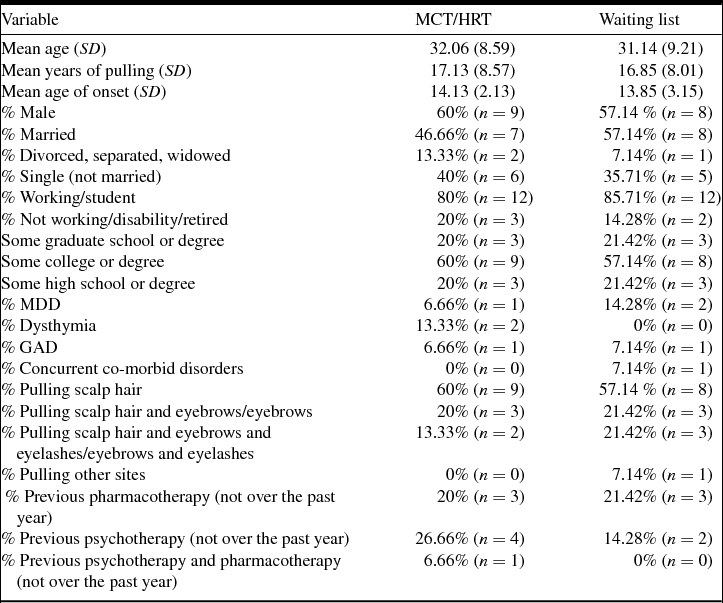
Thirty-four patients meeting all aforementioned research entry criteria were selected; 17 were randomly assigned to MCT/HRT and 17 to the waiting list control group. Participants’ demographic information has been provided in Table 1.
Demographic information by condition

MDD, major depressive disorder; GAD, generalized anxiety disorder.
Outcome measures
Structured Clinical Interview for DSM-IV Axis I Disorders-Patient Edition (SCID-I/P; First et al., Reference First, Spitzer, Gibbon and Williams1996) and Structured Clinical Interview for DSM-IV Axis II Disorders (SCID-II, First et al., Reference First, Gibbon, Spitzer, Williams and Benjamin1997). These are semi-structured interviews with acceptable psychometric properties (Zanarini et al., Reference Zanarini, Skodol, Bender, Dolan, Sanislow and Schaefer2000) for assessing DSM-IV axis I and axis II disorders and were administered to assess co-morbid psychiatric disorders by two clinical psychologists. Inter-rater reliability by Cohen's kappa (Reference Cohen1960) for SCID-I and SCID-II was measured to be .77 and .83 in case series and .74 and .78 in the experimental study, respectively.
Psychiatric Institute Trichotillomania Scale (PITS; Winchel et al., Reference Winchel, Jones, Molcho, Parsons, Stanley and Stanley1992a)
The PITS provides data on TTM onset, course and pulling sites, and utilizes a guided interview format to standardize data collection by different interviewers. In recent examinations of the trichotillomania clinician-rated measures, the PITS inter-rater reliability is generally acceptable and concurrent validity has been demonstrated between item scores and self-reported indices of TTM severity, but the internal consistency of the PITS fell below minimally acceptable levels (Diefenbach et al., Reference Diefenbach, Tolin, Crocetto, Maltby and Hannan2005; Stanley et al., Reference Stanley, Breckenridge, Snyder and Novy1999).
Massachusetts General Hospital Hair Pulling Scale (MGH-HPS; Keuthen et al., Reference Keuthen, O'Sullivan, Ricciardi, Shera, Savage, Borgmann, Jenike and Baer1995)
The MGH-HPS is a seven-question measure most commonly used to self-report measuring of hair-pulling severity. Items are rated on a 4-point scale, with scores ranging from 0 to 28. Higher scores indicate more severe hair pulling. As the strongest psychometric properties of any current TTM measure for adults (Diefenbach et al., Reference Diefenbach, Tolin, Crocetto, Maltby and Hannan2005; Keuthen et al., Reference Keuthen, Flessner, Woods, Franklin, Stein and Cashin2007), the MGH-HPS has demonstrated adequate internal consistency (α = .89, Keuthen et al., Reference Keuthen, O'Sullivan, Ricciardi, Shera, Savage, Borgmann, Jenike and Baer1995; α = 0.80, Diefenbach et al., Reference Diefenbach, Tolin, Hannan, Maltby and Crocetto2006), good test‒retest reliability (r = .97; O'Sullivan et al., Reference O'Sullivan, Keuthen, Hayday, Ricciardi, Buttolph, Jenike and Baer1995), acceptable convergent and divergent validity (Diefenbach et al., Reference Diefenbach, Tolin, Crocetto, Maltby and Hannan2005; O'Sullivan et al., Reference O'Sullivan, Keuthen, Hayday, Ricciardi, Buttolph, Jenike and Baer1995), and has been found to be sensitive to change when correlated with other measures of TTM (O'Sullivan et al., Reference O'Sullivan, Keuthen, Hayday, Ricciardi, Buttolph, Jenike and Baer1995).
Yale‒Brown Obsessive Compulsive Scale-Trichotillomania version (Y-BOCS-TM; Stanley, Swann, Bowers, Davis, and Taylor, Reference Stanley, Swann, Bowers, Davis and Taylor1992)
The Y-BOCS-TM is a 10-question clinician-administered interview for assessing severity of TTM. Rated on a 5-point Likert scale (0 = none, 4 = severe), its total score ranges from 0 to 40 with excellent inter-rater reliability (.91–.93) and only moderate internal consistency and test‒retest reliability (.70 and .76, respectively). Concurrent validity for the Y-BOCS-TM was demonstrated with some self-monitoring and clinical rating measures, but not with other instruments. Moreover, research has supported the use of the instrument as this measure is sensitive to changes during treatment (Stanley et al., Reference Stanley, Prather, Wagner, Davis and Swann1993).
Wechsler Abbreviated Scale of Intelligence (WASI; Wechsler, Reference Wechsler1999)
The WASI is a well normalized brief measure of general intelligence. The two-subtest version (vocabulary and block design) of the WASI was administered to estimates the participants’ IQ. The two-scale WASI has test‒retest reliability correlations of .85 to .88, and the correlation between the two-scale WASI and the WAIS-III is .87 (Groth-Marnat, Reference Groth-Marnat2003; Wechsler, Reference Wechsler1999).
Beck Depression Inventory-Second Edition (BDI-II, Beck et al., Reference Beck, Steer and Brown1996)
The BDI-II is a widely used, 21-item self-reporting inventory, rated on a 4-point scale with a possible total score between 0 and 63, and measuring the severity of depressive symptoms in adults over a 2-week period preceding the assessment. The reliability and validity of the BDI-II have been well established, with a test‒retest reliability coefficient of 0.93 and internal reliability of 0.86. Internal consistency for psychiatric out-patients and college students were 0.92 and 0.93, respectively (Beck et al., Reference Beck, Steer and Brown1996). In a study in Iran, a Cronbach's alpha of 0.91 was reported by Fata et al. (Reference Fata, Birashk, Atef-Vahid and Dabson2005).
Beck Anxiety Inventory (BAI; Beck et al., 1988)
The BAI is a 21-item self-reporting inventory assessing the psychological and cognitive components of anxiety. Ratings are obtained on a 4-point scale with a possible total score between 0 and 63. The BAI has shown good test‒retest reliability after 1 week (0.75; Beck et al., Reference Beck, Epstein, Brown and Steer1988a,Reference Beck, Steer and Garbinb), good internal consistency (0.87; Beck and Steer, Reference Beck and Steer1991) and validity (Nedeljkovic and Kyrios, Reference Nedeljkovic and Kyrios2007). In a study in Iran, a Cronbach's alpha of 0.92 was reported for this inventory (Fata et al., Reference Fata, Birashk, Atef-Vahid and Dabson2005).
Rosenberg Self-Esteem Scale (RSES; Rosenberg, Reference Rosenberg1965)
The RSES is perhaps the most widely used self-report measure of general self-esteem. The scale is a 10-item Likert scale with items answered on a 4-point scale. The total score ranges from 0 to 30. Higher scores indicate higher self-esteem. In investigating internal consistency, a Cronbach's alpha of 0.86 was obtained and in considering concurrent validity, the attachment anxiety subscale and avoidance subscale correlated negatively with the RSES (r = ‒0.23 and r = ‒0.17, respectively; Wongpakaran and Wongpakaran, Reference Wongpakaran and Wongpakaran2012).
Self-monitoring
Self-monitoring is one of the most frequently used methods of behavioural assessment (Groth-Marnat, Reference Groth-Marnat2003). In this study, patients were asked to count hairs. It consisted of an average daily number of hairs pulled during a week (reported over a month at follow-ups).
Global Assessment of Functioning (GAF; Spitzer et al., Reference Spitzer, Gibbon, Williams, Endicott, Sederer and Dickey1996)
The GAF is a scale ranging from 1 (persistent danger of hurting oneself or others) to 100 (superior functioning) used to subjectively rate the social, occupational and psychological functioning of adults. All GAF ratings were done by two clinical psychologists. The intra-class correlation (ICC) values were .75 and .75 in case series and experimental study, respectively
Clinical Global Improvement Scale (CGI; Guy, Reference Guy1976)
The CGI is one of subscales of the Clinical Global Impressions (CGI) Scale (Guy, Reference Guy1976) utilizing a 7-point Likert scale scoring frequently used to measure improvement in clinical trials for many psychological disorders including TTM (Diefenbach et al., Reference Diefenbach, Tolin, Hannan, Maltby and Crocetto2006; Ninan et al., Reference Ninan, Rothbaum, Marsteller, Knight and Eccard2000; Tolin et al., Reference Tolin, Franklin, Diefenbach and Gross2002). Its psychometric properties have been confirmed (Leon et al., Reference Leon, Shear and Klerman1993). CGI ratings (from 1 = very much improved to 7 = very much worse) were used to determine treatment responder status at post-treatment and follow-ups. Ratings were done by patients.
Client Satisfaction Questionnaire (CSQ; Larsen et al., Reference Larsen, Attkisson, Hargreaves and Nguyen1979)
The CSQ is an 8-item self-report questionnaire assessing treatment satisfaction of clients, and has good psychometric properties (Attkisson and Greenfield, Reference Attkisson, Greenfield and Maruish1999; Attkisson and Zwick, Reference Attkisson and Zwick1982; Nguyen et al., Reference Nguyen, Attkisson and Stegner1983). In order to investigate patients’ satisfaction of treatment procedures and outcomes during post-treatment, they were asked to complete the CSQ.
Working Alliance Inventory-Short (WAI-S; Tracey and Kokotovic, Reference Tracey and Kokotovic1989)
The WAI-S is a 12-item instrument scored on a 7-point Likert scale (1 = never and 7 = always). The average working alliance score ranges from 1 to 7 (1‒3, a poor or negative relationship; 4, a neutral position; 5‒7, a good or positive therapeutic relationship). WAI-S measures were obtained in both case series and experimental study after session 2 to minimize the potential confound between alliance scores and symptom improvement over the course of therapy. The WAI-S has strong internal consistency, ranging from .70 to .91 for the subscales and .90 to .95 for the total score (Busseri and Tyler, Reference Busseri and Tyler2003; Dunkle and Fridlander, Reference Dunkle and Friedlander1996; Ligiero and Gelso, Reference Ligiero and Gelso2002; Tracey and Kokotovic, Reference Tracey and Kokotovic1989). A meta-analytic review conducted by Martin et al. (Reference Martin, Garske and Davis2000) estimated that the test‒retest reliability was approximately .73.
Procedure
Case series
In 2013, 21 out of 32 patients referred to an out-patient clinic for treating their hair pulling behaviour met the DSM-5 criteria for TTM. Therefore, all patients were interviewed ‒ according to DSM-5 criteria ‒ by a psychiatrist and later assessed by two clinical psychologists using PITS, SCID-I/P, SCID-II and WASI to confirm the diagnosis and screening for IQ and co-morbid disorders. Patients with a co-morbid diagnosis and below-average intelligence were excluded, leaving eight patients with all the required criteria in the study. Three patients dropped out; one due to the inability to follow the timetable of treatment sessions (30-year-old single man with 14-year history of TTM and co-morbid major depressive disorder), and two patients refused to participate after one or two sessions for unknown reasons (25- and 32-year-old women with 1-year and 18-year history of TTM and no concurrent co-morbidity). After giving written, informed consent, the eligible participants completed a demographic form, BAI and BDI-II and were asked to monitor and report the number of hairs pulled during all baseline, treatment and follow-up sessions. Y-BOCS-TM was completed at pre-baseline, post-treatment and follow-ups. In addition, MGH-HPS, RSES and GAF were implemented at pre-baseline, post-treatment and 12-month follow-up sessions. Furthermore, CGI, CSQ and WAI-S were completed at post-treatment. After the baseline phase, patients received eight sessions of 45- to 60-minute weekly treatment sessions (MCT/HRT). An assistant professor in clinical psychology (the author) conducted the treatment and recorded all therapy sessions on audiotape. This therapist ‒ who had already administered MCT and HRT on trichotillomania, anxiety and mood disorders ‒ administered an innovative treatment protocol including elements of MCT and HRT, developed by him and his colleagues in Tehran Psychiatric Institute. The treatment consisted of various strategies designed to shift patients into thinking in a metacognitive mode and to reverse habits of hair pulling. This involved the use of DM techniques, hair pulling postponement, and HRT. All skills were tailored specifically to address TTM.
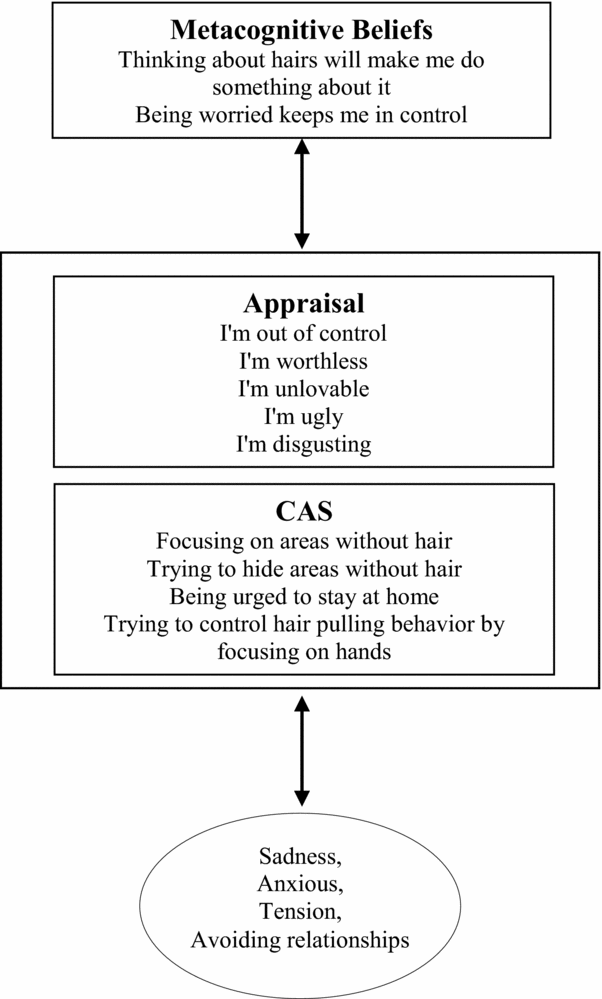
In the first treatment session, an idiosyncratic formulation of the patients’ problems was developed based on the metacognitive model (Fig. 1). The generic metacognitive model was used as the basis for the formulation. Through socialization, patients were instructed that metacognitive beliefs about intrusions and hair pulling rituals and habits would be the main focus of the treatment.
An idiosyncratic trichotillomania case formulation. CAS, cognitive attentional syndrome; the CAS consists of a perseverative thinking style that takes the form of worry or rumination, attentional focusing on threat, and unhelpful coping behaviours that backfire.

DM experiments (Wells, Reference Wells2005, Reference Wells2009) were then executed to enhance metacognitive awareness, increase flexible control of attention and thoughts, and modify metacognitive beliefs about hair pulling rituals. In subsequent treatment sessions patients were asked to postpone hair pulling until a determined time (15 minutes before sleep) and to implement these techniques consistently between therapy sessions. The rationale given to patients for implementing DM and hair pulling postponement was that these techniques are experiments to challenge the beliefs about uncontrollability of responses, to increase flexible choice of responses, and to reduce the activation of the cognitive attentional syndrome.
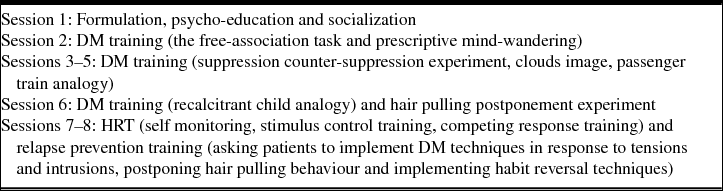
Habit reversal techniques were later taught in sessions 7 and 8. Relapse prevention was done in the last session of treatment first by reviewing main therapeutic strategies used, and second by emphasizing the following of these strategies to cope with similar situations. This programme is therefore a combination of techniques starting with metacognitive techniques followed by specific habit reversal in the seventh and eighth weeks. The session-by-session treatment protocol is given in Table 2.
Treatment outline by session

Experimental study
In 2014, of the 89 patients who were referred to our out-patient clinics for treating their hair pulling behaviour and interviewed by a psychiatrist, 61 met the DSM-5 criteria for TTM. Twenty-two participants were excluded for diagnostic considerations (e.g. co-morbid disorders) after being interviewed by PITS, SCID-I/P and SCID-II, two due to below-average intelligence score, and three for unwillingness to participate in the research project. Of the remaining 34 participants, 17 were randomly assigned to MCT/HRT and 17 to waiting list. Two patients (one man and one woman) from the MCT/HRT dropped out prior to beginning the treatment (one due to scheduling difficulties and the other due to severe gastrointestinal disease leading to hospitalization) and three from the control group (one due to family care responsibilities and the other two for unknown reasons).
Experimental group subjects experienced 8 weeks of MCT/HRT while the waiting list did not receive any treatments.
Three trained therapists, unaware of each other, delivered treatments in three different out-patient clinics. Every therapist had been directly trained by providing opportunities for practice and using procedures such as role-playing, rehearsal, feedback and periodic booster sessions. They were continuously supervised for more than 6 months to ensure accuracy of treatment implementation and to reduce therapeutic drift. In addition, two trained psychologists conducted direct observations randomly twice for every patient by viewing the sessions through a one-way mirror and provided feedback to the therapist after each observed session. At pre- and post-treatment, both groups completed RSES, GAF, BAI, BDI-II, MGH-HPS and Y-BOCS-TM and were asked to monitor and report the number of hairs that they were pulling. CGI, CSQ and WAI-S were also administered in MCT/HRT group at post-treatment. All assessments were done by two independent assessors.
Before taking the informed consent, waiting list participants were told that they should wait a few months to enter into a group therapy.
Overview of data analysis
Case series
Participants with a score ≤ 2 on the CGI were categorized as responders. Participants would also achieve clinically significant change criteria if their MGH-HPS post-treatment score was ≤ 6. Session-by-session scores across baseline, treatment and follow-up on outcome measures were plotted. Percentages of improvements were made for each patient on each measure. The Wilcoxon signed ranks tests were implemented to compare baseline, post-treatment and follow-up scores because assumptions for the use of parametric statistics were violated.
Experimental study
Group comparisons were conducted using one-way analysis of covariance (ANCOVA), condition (MCT/HRT versus waiting list) as the independent variable, pre-treatment scores as the covariate variables, and post-treatment scores as the dependent variables.
Results
Case series
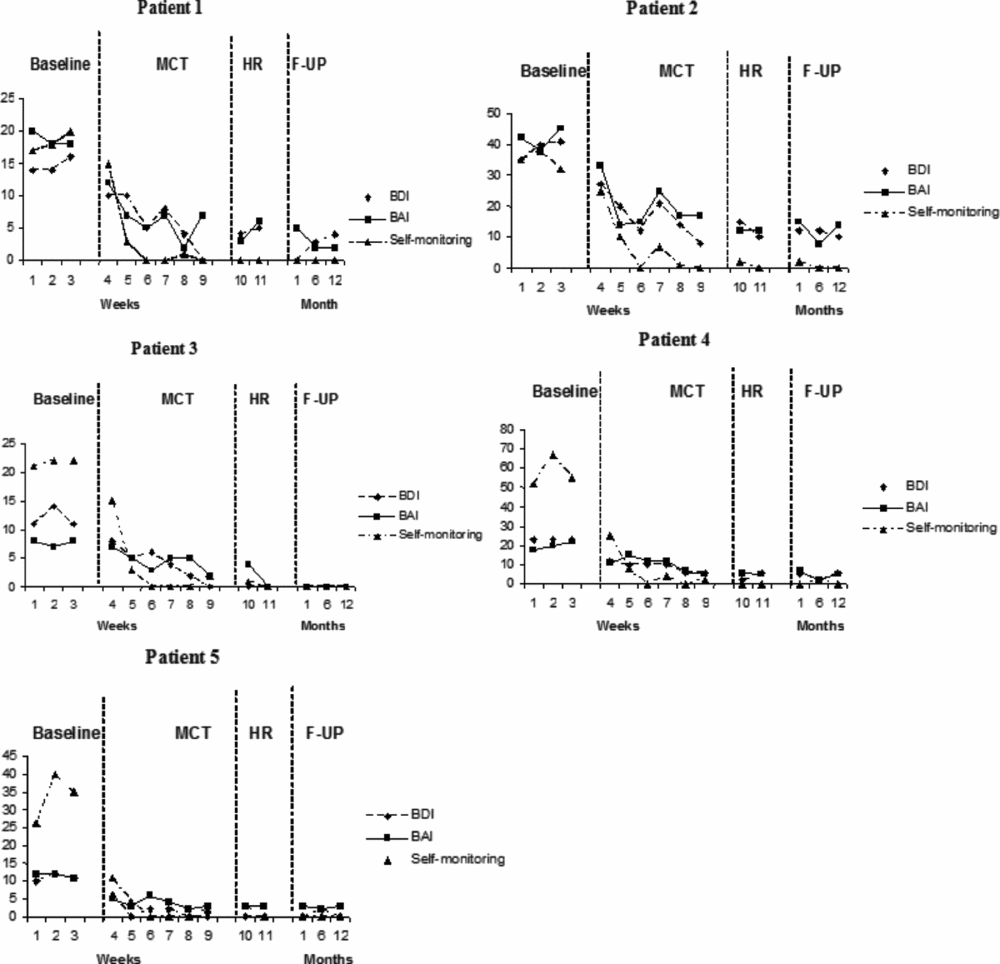
Participants experienced moderately severe TTM symptoms (MGH-HPS: mean = 18.20, SD = 2.58; PITS: mean = 27.11, SD = 3.84) and severe functional impact due to TTM-related thoughts and behaviours (Y-BOCS-TM: mean = 29.80, SD = 8.16). CGI scores indicated that all five participants were responders in post-treatment and each follow-up session. CGI scores for the first to fifth patients are post-treatment CGI: 2, 2, 0, 2,1; CGI scores during 1-month follow-up: 1, 2, 0, 1, 0; CGI scores during 6-month follow-up: 1, 2, 0, 1, 0; and CGI scores during 12-month follow-up: 1, 2, 0, 1, 0. MGH-HPS scores also indicated that three of five participants (60%) achieved clinically significant change criteria in post-treatment and 12-month follow-up. MGH-HPS scores for the first to fifth patients are post-treatment: 6, 10, 5, 9,6; and MGH-HPS scores during 12-month follow-up: 6, 10, 6, 8, 6. Figure 2 shows patients’ scores on the BDI-II, BAI and self-monitoring during the baseline, treatment and follow-up. Wilcoxon signed ranks tests demonstrated no significant differences between baseline 1 and 3 on any of the outcome measures (BDI-II, Z = 1.60, p = .109; BAI, Z = .730, p = .465; self-monitoring, Z = 1.23, p = .216.) This stability of the baselines suggests that any effects occurring during treatment are unlikely to be due to spontaneous recovery from TTM, self-monitoring, sitting in the presence of a therapist to answer questions, and natural variation in scores. These graphs showed that the treatment phase was associated with relatively rapid reductions in depression, anxiety and hair pulling behaviour over the course of treatment and these reductions largely maintained during follow-ups.
Scores on the BDI-II, BAI and self-monitoring for patients 1–5 during baseline, treatment and follow-up. MCT, metacognitive therapy; HR, habit reversal; F-UP, follow-up.

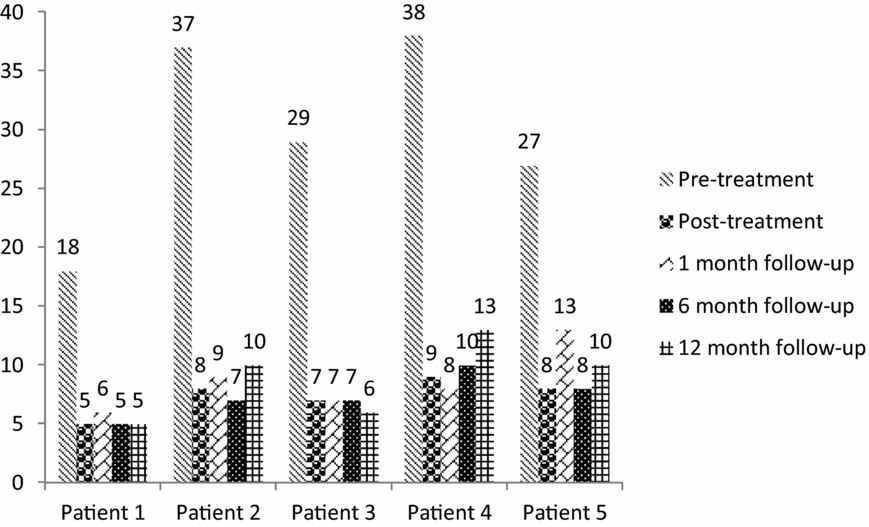
Pre-treatment, post-treatment and follow-up scores on Y-BOCS-TM are shown in Fig. 3. As illustrated in this figure, post-treatment and follow-up scores are substantially lower than pre-treatment scores in all patients. The treatment was therefore effective in treating compulsive hair pulling behaviour.
Scores on the Y-BOCS-TM at pre-treatment, post-treatment and follow-up for each patient

Wilcoxon signed ranks test computed using the pre-baseline/mean baseline scores and the post-treatment scores showed significant improvements from pre- to post-treatment for all measures (Y-BOCS-TM, Z = 2.03, p = .042; BDI-II, Z = 2.02, p = .043; BAI, Z = 2.02, p = .043; self-monitoring, Z = 2.02, p = .043, MGH-HPS, Z = 2.03, p = .042; RSES, Z = 2.04, p = .041; GAF, Z = 2.03, p = .042). Wilcoxon signed ranks test showed that there were no significant differences between post-treatment scores and scores at each follow-up interval on BDI-II, BAI, self-monitoring, MGH-HPS, RSES and GAF (post-treatment and 1-month follow-up: BDI-II, Z = .53, p = .593; BAI, Z = 1.06, p = .285; self-monitoring, Z = 1.00, p = .317; post-treatment and 6-month follow-up: BDI-II, Z = .37, p = .705; BAI, Z = 1.84, p = .066; self-monitoring, Z = 1.00, p = .317; post-treatment and 12-month follow-up: BDI-II, Z = 1.00, p = .317; BAI, Z = .44, p = .655; self-monitoring, Z = .00, p = 1.000; MGH-HPS, Z = 0, p = 1; RSES, Z = 0, p = 1; GAF, Z = .37, p = .70).
Mean percentage improvement was calculated to be 75, 60, 78, 73, 30, 16 and 100% in the Y-BOCS-TM, MGH-HPS, BDI-II, BAI, RSES, GAF and self-monitoring, respectively. Furthermore, all of the patients reported complete satisfaction with the treatment procedures and outcomes (CSQ scores ranged from 26 to 32 with a mean of 29.4).
As shown in Fig. 2, the MCT phase of treatment (sessions 1–6) was associated with rapid and substantial reductions in primary outcome measures and these reductions were maintained in sessions 7 and 8. Metacognitive techniques seem to improve the patients before implementing habit reversal. In other words, habit reversal was added to determine if any further immediate gains could be made beyond the effects associated with MCT. Wilcoxon signed ranks test demonstrated that there were no significant differences between BDI-II, BAI and self-monitoring scores in sessions 6 and 8 (BDI-II, Z = 1.34, p = .180; BAI, Z = 1.60, p = .109; self-monitoring, Z = 1.73, p = .083), indicating that some important effects of the treatment can probably be attributed to metacognitive treatment techniques. However, it should be pointed out that patients may have also improved significantly before HRT for various reasons including their need to be accountable to the therapist soon. As such situations cannot be thoroughly controlled, it would not be advised to generalize conclusions of this research.
It is worth mentioning that in each treated case, most of the improvement occurs after the first three sessions, with the largest improvement occurring after MCT case formulation and socialization. This suggests that it is an important part of the treatment; DM also appears to be important but there is little improvement with adding postponement experiments. The graphs might suggest the possibility of an even shorter treatment.
The mean WAI-S score was 5.80 (SD = 1.12), indicating a good therapeutic relationship.
Group comparisons
Overall, participants reported moderate to severe TTM symptoms (MGH-HPS: mean = 19.24, SD = 2.41; PITS: mean = 26.95, SD = 3.43) and severe functional impacts due to TTM-related thoughts and behaviours (Y-BOCS-TM: mean = 33.20, SD = 6.76). Mean post-treatment CGI and CSQ scores of 1.48 and 28.92, respectively, showed that MCT/HRT participants were responders and satisfied with treatment.
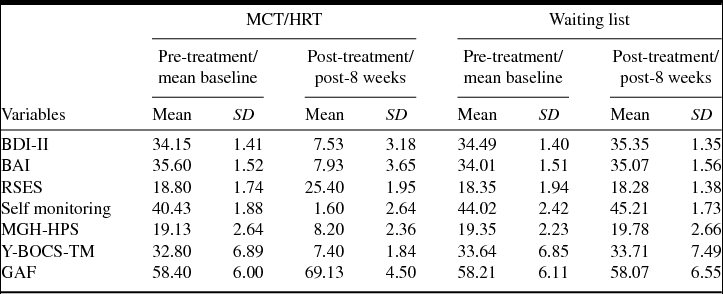
Pre-treatment/mean baseline and post-treatment/post-8-week scores by conditions (MCT/HRT and waiting list) for BDI-II, BAI, RSES, self-monitoring, MGH-HPS, Y-BOCS-TM and GAF are provided in Table 3. ANCOVA was used to determine any differences between changes due to MCT/HRT and waiting for treatment. Results demonstrated that there were significant differences between MCT/HRT and waiting list changes in BDI-II (F = 159.83, p < .001), BAI (F = 124.25, p < .001), RSES (F = 190.28, p < .001), self-monitoring (F = 111.15, p < .001), MGH-HPS (F = 448.18, p < .001), Y-BOCS-TM (F = 398.38, p < .001) and GAF (F = 68.37, p < .001). Therefore, the MCT/HRT treatment is vastly more effective than waiting list group. The mean WAI-S score in MCT/HRT group was 5.54 (SD = 1.23), which indicates a good therapeutic relationship.
Pre-treatment and post-treatment scores by conditions for BDI-II, BAI, RSES, self-monitoring, MGH-HPS, Y-BOCS-TM and GAF

BDI-II, Beck Depression Inventory-Second Edition; BAI, Beck Anxiety Inventory; RSES, Rosenberg Self-Esteem Scale; MGH-HPS, Massachusetts General Hospital Hair Pulling Scale; Y-BOCS-TM, Yale–Brown Obsessive Compulsive Scale-Trichotillomania version; GAF, Global Assessment of Functioning.
Discussion
This research has been conducted to investigate the effectiveness of major metacognitive techniques plus habit reversal in the treatment of TTM. The results of this preliminary case series and randomized wait-list controlled trial proved this treatment programme to be effective in the treatment of TTM.
Based on case series findings at post-treatment and each follow-up, CGI and MGH-HPS scores indicated that all of five participants (100%) were responders and three of them (60%) achieved clinically significant change criteria. Self-monitoring data shows that the treatment is successful in decreasing the number of pulled hairs to zero levels in all patients. The subjects’ depression and anxiety scores decreased from 19.86 and 19.92 in baseline to 4.20 and 5.20 in the post-treatment, respectively. Another finding consisted of of score reduction in hair pulling scales (Y-BOCS-TM and MGH-HPS) and increased self-esteem and global functioning scores. Based on Wilcoxon signed ranks tests, it can be concluded that gains are maintained at relatively long-term follow-ups. These results indicate that MCT plus HRT might be an effective intervention compared with individual behaviour therapy (van Minnen et al., Reference van Minnen A, Hoogduin, Keijsers, Hellenbrand and Hendriks2003), group behaviour therapy (Mouton and Stanley, Reference Mouton and Stanley1996; Diefenbach et al., Reference Diefenbach, Tolin, Hannan, Maltby and Crocetto2006), ComB treatment (Falkenstein et al., Reference Falkenstein, Mouton-Odum, Mansueto, Golomb and Haaga2016), CBT (Ninan et al., Reference Ninan, Rothbaum, Marsteller, Knight and Eccard2000; Lerner et al., Reference Lerner, Franklin, Meadows, Hembree and Foa1998), AEBT (Twohig and Woods, Reference Twohig and Woods2004; Woods et al., Reference Woods, Wetterneck and Flessner2006b; Fine et al., Reference Fine, Walther, Joseph, Robinson, Ricketts, Bowe and Woods2012), and DBT-enhanced habit reversal treatment (Keuthen et al., Reference Keuthen, Rothbaum, Welch, Taylor, Falkenstein, Heekin, Jordan, Timpano, Meunier, Fama and Jenike2010, Reference Keuthen, Rothbaum, Fama, Altenburger, Falkenstein, Sprich and Welch2012; Keuthen and Sprich, Reference Keuthen and Sprich2012; Welch and Kim, Reference Welch and Kim2012), which have been considered as the most effective treatments in TTM. However, the confirmation of such a statement requires further research studies. In addition, MCT plus HRT appears to be time efficient and achieving good treatment outcomes in eight sessions. Although two out of eight participants (25%) dropped out of the case series primarily, the treatment was found to be well accepted by all the five participants committing to the study because they attended all treatment sessions and followed the instructions completely.
The percentages of improvement were over 60 in any patient in outcome measures (except RSES and GAF). Furthermore, since the pre-treatment duration of disorder varied across cases, spontaneous recovery is more likely not to coincide with treatment effects. Although treatment led to the reduction of self-report pulling to zero levels (self-monitoring), the participants’ urge to pull their hair still remained (YBOCS-TM and MGH-HPS > 0). It seems that socialization, DM and habit reversal techniques can help patients fight the urge to pull their hair.
ANCOVA results showed that MCT/HRT treatment is more effective than the waiting list control group. The lack of significant changes from baseline to post-8-week stage in the waiting list group confirms that the improvements from MCT/HRT are not due to history, maturation, and reactivity to extended self-monitoring.
The clinical implication of the present study is that MCT case formulation, socialization and metacognitive techniques plus HRT may currently be a promising intervention for the treatment of TTM. DM techniques mostly focus on developing meta-awareness in the context of suspending conceptual processing and separating self from cognitive events (Wells, Reference Wells2009). Ritual postponement can increase the level of tolerance, ban dysfunctional rituals, and modify maladaptive metacognitive beliefs about the necessity for doing rituals (Wells, Reference Wells2009). HRT is directed at increasing awareness of hair pulling, teaching alternative coping skills and decreasing hair pulling time (Diefenbach et al., Reference Diefenbach, Reitman and Williamson2000; Himle et al., Reference Himle, Flessner and Woods2004; Stein et al., Reference Stein, Christenson and Hollander1999; Yeh et al., Reference Yeh, Taylor, Thordarson and Corcoran2003).
DM and HRT were used to respond to tension and urges for pulling hairs, therefore it could be concluded that the treatment would be effective in decreasing patients’ depression (BDI-II) and anxiety (BAI). Given that MCT/HRT reduces hair pulling and improves visible appearance, a consequent increase in self-esteem and global functioning will not be surprising.
There are some limitations in this study. An ABC design with a follow-up was used in part of this study. While phase A includes baselines, the first phase of treatment (phase B) involves MCT techniques, and phase C involves HRT. However, ABAC is a stronger design that could be utilized to isolate the effects of each treatment (reducing carry-over). In spite of this, such a design would be unlikely to add anything in this case because of the great (and presumably lasting) effect of MCT. Although the baselines clearly show stability, it is a weakness not to have baselines as long as the treatment phase. The study was based on a small sample of patients because a small-n design is appropriate to test the potential utility of a novel approach in treating a disorder. However, the results may not be completely representative of all TTM cases. Therefore, their generalization may be limited. The outcome is based on the results obtained from patients who completed the research project. Unfortunately, six patients (two in the case series and four in the experimental study) did not complete the research. Consequently, it limits the conclusions that can be drawn. Another limitation of this study which is worth being mentioned, is the lack of follow-up data from RCT.
It is interesting that the majority of participants who volunteered in this study were men, whereas in the rest of the TTM literature, female participants were dominant in number, as 95% of patients seeking treatment for TTM are female (Huynh et al., Reference Huynh, Gavino and Magid2013). Based on cultural and religious beliefs in Iran, a scalp with hair is a private part of the body for women and must be covered by a scarf, and only their husbands and physicians (such as dermatologists, not psychologists) are allowed to see women's private parts. Consequently, some women, especially those with severe religious backgrounds, refused to participate in the study.
In addition, the impact of non-specific treatment factors on the outcome could not be assessed due to the lack of a treatment based on placebo. Nevertheless, this is the first study of MCT plus habit reversal technique for TTM. Therefore, continuous evaluations of this new treatment approach are warranted. The control group is the strength of this study. On the positive side, there is a good overlap between interview findings, and self report maintained at several follow-ups. In the case series study, the results showed association of MCT with all of the observed effects with no further short-term gains related to introduction of HRT. Despite these results, the study had been designed to combine metacognitive and habit reversal techniques. Therefore, future studies can clarify if MCT alone can improve TTM and maintain the results. For example, the ABAB design can be conducted to allow researchers to establish a baseline (A), show that hair pulling decreases while delivering MCT (B), that hair pulling increases again when MCT is discontinued (A), and yet show another decrease upon the administration of MCT (B). Alternatively, the multiple baseline design can be conducted. Also, future studies are required to compare MCT with HRT to determine whether they are equally or differentially effective. Furthermore, in the present case series study, most of the improvements occurred after the first three sessions. Therefore, it might suggest the possibility of an even shorter treatment. Future studies may focus on assessing the effectiveness of a shorter treatment by using MCT case formulation, socialization and DM. The scientific value of the results can be increased by implementing HRT before MCT in a crossover design.
Acknowledgement
The author would like to acknowledge Adrian Wells, the founder of metacognitive therapy, for his helpful feedback on a part of manuscript review. Heartfelt thanks are expressed to Fatemeh Layeghian Javan for her perceptive comments on the manuscript, and all study participants, assessors and therapists for their kind cooperation.
Conflict of interests: Hossein Shareh has no conflict of interest with respect to this publication.
Financial support: This research received no specific grant from any funding agency, commercial or not-for-profit sectors.
Ethical standards: The author asserts that all procedures contributing to this work comply with the ethical standards of the relevant national and institutional committees on human experimentation and with the Helsinki Declaration of 1975, and its most recent revision.



Comments
No Comments have been published for this article.