INTRODUCTION
The constant development and widespread prevalence of anthelmintic resistance within populations of parasitic nematodes of the gastrointestinal tract in small ruminants (Jackson and Coop, 2000; Kaplan, 2004) and the increasing concern of consumers for drug residues in animal products, have led to research exploring novel approaches which could be used to reduce the exclusive reliance on chemical anthelmintics for a more sustainable control of these parasites (Waller, 1999). Several outdoor and indoor studies, conducted on naturally or experimentally infected sheep or goats, have shown that the consumption of various bioactive forages, rich in plant secondary metabolites, in particular legume forages, was related with an improvement of the host resilience and/or a modulation of the biology of nematodes, suggesting that these plants might possess anthelmintic properties and represent an alternative to chemotherapy (see recent reviews by Kahn and Diaz Hernandez, 2000; Waller and Thamsborg, 2004; Hoste et al. 2005).
Several results suggest that condensed tannins might be one class, amongst the various secondary metabolites present in forages, with potential anthelmintic properties. Both in vivo and in vitro studies have been performed to examine the effects of different sources of tannins on various biological traits of nematodes. Variations in results were found according to the parasitic stage, in particular depending whether infective third-stage larvae (L3) or adult worms were submitted to a tannin-rich environment (Paolini et al. 2003). Results acquired in goats receiving quebracho, a tannin-rich resource, suggested that these polyphenolic compounds could affect the establishment of the early stages of nematode infection (Paolini et al. 2003). These in vivo results were concordant with in vitro data acquired on several nematode species, showing a decrease in L3 motility after contact with crude extracts or extracted condensed tannins from a range of tanniferous plants (Molan et al. 2000a,b,c, 2003a,b; Paolini, Fouraste and Hoste, 2004). Furthermore, these inhibitory effects on larvae disappeared after adding specific inhibitors of tannins, like polyethylene glycol (PEG), to the extracts. These latter results have thus substantiated the hypothesis of a central role for tannins in the effects on L3. However, the mechanisms of action of these polyphenols on the infective larvae remain obscure.
For trichostrongyle nematodes, the exsheathment of L3 is a crucial step in the life-cycle since it represents the transition from the free-living to the parasitic stages. It has been known for some time that the larval exsheathment occurs in the region of the gastrointestinal tract immediately anterior to the digestive organs inhabited by the adult nematodes (Hertzberg et al. 2002). Information on the kinetics of exsheathment acquired for Haemonchus contortus (Dakkak, Fioramonti and Bueno, 1981) or Ostertagia ostertagi (De Rosa et al. 2005) have shown that for both species, the majority of larvae were exsheathed 60 min after ingestion, and that both processes of larval exsheathment and establishment at the predilection site have to occur within a limited time-frame. Several studies have identified some of the mechanisms involved in the process of exsheathment after ingestion of the infective larvae by the host, both in regard to the inducing signals or to the functional and structural changes provoked in the third-stage larvae (Rogers and Somerville, 1968; Somerville and Rogers, 1987; Gamble, Lichtenfels and Purcell, 1989). In vitro and in vivo studies have indicated that the bicarbonate/carbonic acid balance (Petronijevic, Rogers and Somerville, 1985, Sciacca et al. 2002) and the pH (Hertzberg et al. 2002, Davey and Rogers, 1982) of the luminal content were major factors to stimulate the exsheathment. Recent in vivo results have indicated that the diet composition could also modulate the process by affecting these factors (DeRosa et al. 2005).
The objectives of the current study were (i) to test the hypothesis that the extracts of tanniferous plants might interfere with the very early process of the parasitic life of the gastro-intestinal nematodes, i.e. the exsheathment of the third-stage, infective larvae, before invasion of the host mucosal tissues; (ii) to assess the precise role of tannins in these effects. These questions were addressed (i) by examining in vitro the consequences of incubation with extracts of various tanniferous plants on the artificial exsheathment of nematode third-stage larvae and (ii) by measuring the consequences on the process when applying polyethylene glycol, a specific inhibitor of tannins (Makkar et al. 1995; Jones and Mangan, 1977). Moreover, in order to assess the specificity of the observed effects, comparative data were acquired using 2 parasitic species, the abomasal parasite, Haemonchus contortus, and the intestinal species, Trichostrongylus colubriformis.
MATERIALS AND METHODS
Plant extracts
The plants were collected from the field in the South of France. The plant species were chosen because of their relative content in tannins and their appetency for goats. Hence, extracts of 2 woody trees were obtained, i.e. chestnut tree (Castanea sativa) and pine tree (Pinus sylvestris), as well as extracts of 2 bushes: one heather species (Erica erigena) and one from the legume family (genista: Sarothamnus scoparius). The extracts were obtained firstly from the whole plants for heather and genista; from leaves for pine tree, and from the external tegument of fruits for chestnuts, all parts of plants being consumed by goats in situation of rangeland browsing. In addition, rye grass extracts were included in the assay as a negative control, in order to assess any consequences due to the procedure of extract preparation. The methods of extraction have been described previously (Barrau et al. 2005). Briefly, 10 g of each plant material were reduced to powder, extracted by maceration in 100 ml of 30% ethanol in water at 60 °C for 2 h. The filtrate was then concentrated under low pressure at 40 °C, then frozen and lyophilized for 24 h to obtain dry ground samples which were used in the biological assay. The tannin contents of the 5 extracts were measured according to the method of the European Pharmacopea (2001). The results indicated respectively 24·7% of the DM in chestnut tree; 19·0% in heather; 2·5% in pine tree; 1·5% in genista and 0·3% in rye grass.
Larval artificial exsheathment assay
The third-stage larvae of H. contortus and T. colubriformis were produced in monopecifically infected donor goats. The same batch of 2 to 3-month-old larvae was used in the assays. Firstly, 1500 ensheathed third-stage nematode larvae (L3) were incubated for 3 h with 1 of the 4 plant extracts before being resuspended at a concentration of 600 μg /ml in phosphate buffer solution (PBS; 0·1 M phosphate, 0·05 M NaCl, pH 7·2). The use of PBS aimed at avoiding interference with any non-specific effect due to pH change. After incubation, the larvae were washed and centrifuged, 3 times in PBS, pH 7·2. After this first step of incubation with plant extracts, the larvae were submitted to the artificial process of exsheathment by contact with a solution of sodium hypochloride (2% w/v) and sodium chloride (16·5% w/v) diluted 1 to 300 in PBS, pH 7·2. The kinetics of larval exsheathment according to the experimental treatments were then measured by microscopic observation and identification of exsheathed larvae at a magnification of ×200 by regular examination at 10, 20, 30, 40, 50 and 60 min after contact with the solution for exsheathment. Six replicates were run for each plant to examine the changes in proportion of exsheathed larvae with time. In addition to the 4 tanniferous plants, negative controls (L3 in PBS and L3 in extracts of rye grass at 600 μg/ml) were run in parallel in the assay.
Effects of addition of polyethylene glycol (PEG) to plant extracts on the larval exsheathment process
In order to assess the role of tannins in the observed effects, we examined the influence of a specific inhibitor of tannins (polyethylene glycol: PEG, MW 3350; at a concentration of 2 μg/μg tannins as applied in previous studies in order to bind to tannin molecules) (Molan et al. 2000a, 2003b) on the artificial exsheathment of H. contortus and T. colubriformis larvae. The addition of PEG prevents tannins binding to proteins and comparisons of the results obtained with extracts with or without PEG confirmed the role of tannins in the observed effects. Each plant extract was pre-incubated overnight with PEG. Thereafter, treated plant extracts were used at the concentration of 600 μg/ml to examine the possible effects on larval exsheathment as previously described. Again, negative controls (rye grass+PEG) were included in the assay. Moreover, a comparison was performed between a PBS control and a PBS control+PEG and no difference was observed in the pattern of larval exsheathment, with or without addition of PEG (data not shown).
Statistical analyses of the results
The statistical comparisons of differences in mean of the exsheathment rates, based on the results from the 6 replicates, depending on plant treatments and time. The statistical differences across time were assessed through the general linear model (GLM) procedure using Systat 9 software (SPSS Ltd).
RESULTS
Larval exsheathment in the controls
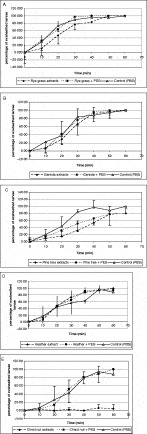
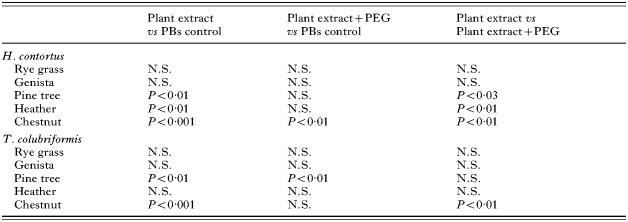
For H. contortus, depending on the assays, the larvae began to exsheath between 30 and 40 min after deposition of the sodium hypochloride solution. At 60 min, more than 80% of the larvae were generally exsheathed (see Fig. 1A–E). For T. colubriformis, a similar pattern in larval exsheathment was observed, but the process began earlier since some larvae were yet exsheathed at 10 min. After 60 min, nearly 100% of the larvae were exsheathed (see Fig. 2A–E). For both nematode species, no significant differences were found in the process between the larvae in PBS and those having been incubated in rye grass extracts (see Figs 1A and 2A and Table 1).

Fig. 1. Effects of 3 h contact of Haemonchus contortus third-stage larvae with extracts of rye grass (A), genista (B), pine tree (C), heather (D) and chestnut tree (E), with or without addition of PEG, on the process of artificial in vitro exsheathment provoked by addition of a 2% solution of hypochloride. No significant differences to control values were observed with rye grass and genista extracts. Significant differences were measured after contact with pine tree (P<0·01), heather (P<0·01) and chestnut extracts (P<0·001). The addition of PEG removed the significant effects for pine tree and heather extracts. For chestnut extracts+PEG, differences to control values remained significant.

Fig. 2. Effects of 3 h contact of Trichostrongylus colubriformis third-stage larvae with extracts of rye grass (A), genista (B), pine tree (C), heather (D) and chestnut tree (E), with or without addition of PEG, on the process of artificial in vitro exsheathment provoked by addition of a 2% solution of hypochloride. No significant differences from control values were observed with rye grass, genista and heather extracts. Significant differences were measured after contact with pine tree (P<0·01) and chestnut extracts (P<0·001). The addition of PEG removed the significant effects for chestnut but not for pine tree extracts.

Effects of the four tanniferous plant extracts on the larval exsheathment
For both parasite species, the incubation of the third-stage larvae with the 4 tanniferous plant extracts led to 3 different situations. The results of the statistical analyses according to the treatments applied are summarized in Table 1.
With the genista extracts, no significant difference was found in the pattern of exsheathment between the control, the larvae treated with the plant extracts and the larvae in contact with extracts plus PEG, this being observed for both H. contortus and T. colubriformis (Figs 1B and 2B).
With pine tree extracts, the process of exsheathment was delayed since, for both parasite species, significant differences (P<0·01) to the control pattern were found (Figs 1C and 2C, Table 1). For example, for H. contortus, only 58% of the larvae were exsheathed after 50 min compared to 79% in the control (Fig. 1C). Similarly, for the T. colubriformis larvae, the contact with pine tree extracts was associated with 55% of exsheathment at 40 min whereas, for the control, 95% of larvae were exsheathed at the same time (Fig. 2C).
With the heather extracts, the process of exsheathment was significantly (P<0·01) delayed after contact for H. contortus (Fig. 1D) but not for T. colubriformis (Fig. 2D).
Lastly, for chestnut-tree, the 3 h contact with the plant extracts led to a nearly total significant inhibition (P<0·001) for both H. contortus and T. colubriformis (Fig. 1E and 2E) since no larvae were exsheathed after 60 min, whereas the percentage for the controls were respectively 100% for H. contortus and 87% for T. colubriformis.
Consequences of the addition of polyethylene glycol to the four plant extracts
A similar result was observed after PEG being added to the rye grass and to the genista extracts (Figs 1 A and B; 2A and B, Table 1), with no significant difference observed when compared to control values.
The addition of PEG to the pine tree (Fig. 1C) and the heather (Fig. 1D) extracts for H. contortus and the chestnut (Fig. 2E) extracts with T. colubriformis removed the inhibitory activity previously measured with the untreated extracts since no significant differences were assessed any more in the pattern of larval exsheatment when compared to the control values (Table 1).
In the case of pine tree extracts acting on T. colubriformis (Fig. 2C), the addition of PEG did not reverse the effect on larvae since significant differences were still assessed (P<0·01) when compared to control and no significant differences were found between results acquired with extracts with or without PEG.
Lastly, in the case of the chestnut tree extracts acting on Haemonchus contortus, the addition of PEG was associated with a significant change (P<0·01) in the exsheathment process when compared to the non-treated extracts (Fig. 1E). However, the exsheathment process remained significantly different from the PBS control values (P<0·01).
DISCUSSION
The first objective of the current study aimed at exploring the hypotheses that interactions of plant extracts with the very early step of parasitic infection, i.e. the exsheathment process, exist and might be one mechanism contributing to some of the anthelmintic effects which have been associated with the consumption of tanniferous plants (see reviews by Kahn and Diaz Hernandez, 2000; Min and Hart, 2002; Waller and Thamsborg, 2004). The second objective was to demonstrate that tannins play a key role in the process. Our results tend to confirm the assumption that the presence of plant secondary compounds in extracts might interfere with the larval exsheathment. The comparison of results acquired with the 5 plant extracts on the 2 nematode models used suggests that a degree in interference with the exsheathment process exists, depending on the extracts. According to this latter criterion, the responses observed with both the abomasal and the intestinal species can be classified into 3 categories. Firstly, no significant effects were found with both rye grass and genista extracts for both nematode species as well as with heather extracts for T. colubriformis. Secondly, a significant delay in the exsheathment process was observed with pine tree extracts on both parasite species and with heather extracts on H. contortus. Last, with chestnut, the process of exsheathment remained totally inhibited after 60 min, for both parasite species. It is worth to underline that chestnut was also the plant species presenting the highest tannin content in extracts. However, previous in vitro studies using units of flavan-3-ols have indicated that besides concentrations in plants, the quality of the condensed tannins present, in particular the ratio prodelphinidin/procyanidin, might also be an important criteria to consider to explain modulations of effects on nematode larvae (Molan et al. 2003a).
The hypothesis that tannins are responsible for most of the observed effects is further supported by the comparison of responses obtained after contact with extracts having either been or not been previously treated with polyethylene glycol. For most cases with the 3 plant extracts (pine tree; heather, chestnut) which provoked changes in the rate of larval exsheathment, the effects were partly (chestnut tree with H. contortus) or totally removed after addition of PEG. The sole exception was the effect of pine tree extracts on T. colubriformis which persisted after PEG addition. Since PEG is generally described as an inhibitor of tannins, by preventing their binding with proteins (Jones and Mangan, 1977; Makkar et al. 1995; Silanikove, Perevolotsky and Provenza, 2001; Molan et al. 2003b), these results tend to confirm the role of these polyphenols in the observed inhibition and/or delay of exsheathment. With other in vitro models used to examine the effects of plants on the parasitic third-stage larvae, like the larval migration assay (Rabel, McGregor and Douch, 1994), it has been shown that condensed tannins, but also some other substances, like sesquiterpene lactones (Molan et al. 2003b; Marley et al. 2003), flavonoids (Barrau et al. 2005), proteinases (Stepek et al. 2004) could alter the biology of nematodes. The difference between a total or a partial restoration towards control values after addition of PEG to extracts might thus be explained by the presence or not of other plant secondary compounds disturbing the exsheathment process. However, considering the extent of restoration observed in the current study after PEG addition, the role of tannins appears substantial.
The third objective of the study was to examine the specificity of the effects observed according to the nematode species. This question was addressed in regard to previous in vivo results having shown differences in activity of the same tannin-rich resource depending on the parasite species and/or the anatomical location (Athanasiadou et al. 2001, Paolini et al. 2003, 2005). When considering the effects of the various total plant extracts compared to the control PBS values, most of the results obtained were similar for the 2 parasitic species. However, with heather extracts, according to the results of the statistical analysis, a significant delay in larval exsheathment was measured for H. contortus but not for T. colubriformis.
In addition, comparative results between the 2 nematodes, based on the data acquired with or without PEG addition, tend to reinforce the hypothesis that some differences in sensitivity to plant extracts exist between the 2 species, in relation with the presence of various biochemical compounds in plants. For both pine tree and chestnut, the extracts induced significant and similar effects on the 2 nematode species when compared to PBS controls, i.e. a delay in exsheatment with pine tree and a total inhibition with chestnut tree. However, for pine tree extracts, the effects on H. contortus, appeared mainly due to tannins since the addition of PEG restored normal values. In contrast, for the intestinal species, the addition of PEG did not abrogate the effects suggesting that other plant metabolites were principally involved. With chestnut extracts, the results of statistical analyses indicate a total restoration towards control values after PEG addition for T. colubriformis, but only a partial one for the abomasal species.
Our results have been obtained in in vitro conditions and they might obviously differ from those present in vivo in the ruminal or the abomasal juices. However, care has been taken to avoid some major biases. Incorporation of rye grass extracts as controls in the assays aimed at measuring the possible role of any contaminants associated with the plant extraction procedure. The concentration of extracts which has been applied (600 μg/ml) corresponded to a calculated range of tannin concentrations from 9 to 150 μg/ml depending on the plant species. These values are similar or lower to those applied in previous in vitro studies examining the effect of tannins on larval migration assay (Molan et al. 2000a,b; 2003b; Paolini et al. 2004). They are also lower than those reported for digesta in the gut of sheep after consumption of tannins (Molan et al. 2000a, 2003b). Therefore, the observed effects seem to be compatible with in vivo conditions. However, these in vitro results still have to be considered as indicative and will need to be confirmed using in vivo studies, in particular by using cannulated animals.
Several hypotheses can be put forward to explain the modulation of larval exsheathment in relation with the tannin contents in plant extracts. It has been established that the exsheathment process results from the action of some enzymes (in particular some proteinases) on the larval sheath proteins (Rogers, 1982, Gamble et al. 1989) On the other hand, it is known that one general property of tannins is to form complexes with proteins, including enzymes, and that these interactions decrease the enzymatic activity and the protein reactivity (Bruneton, 1999). It can therefore be postulated that the delay or inhibition of larval exsheathment observed in the current study could be related either to the fixation of tannins on proteins of the sheath, disturbing the action of enzymes, or to the complexation with the enzymes themselves. Further work on the mechanisms of action are required to improve our understanding of interactions between plant secondary metabolites and the different parasitic stages and species, in order to make our use of tanniferous forages more pertinent in field situations and to select the most appropriate resources depending on the geographical areas and the local epidemiology of parasite infections.
This work received the financial support from the European Union (Contract QLK5-CT 2001-01843=WORMCOPS) and is part of a collaboration between Denmark, the UK, the Netherlands, Sweden, Spain and France. The financial helps of the Programme ECOS Nord-ANUIES between France and Mexico and of the Region Midi-Pyrénées (contract 030121196) are also sincerely acknowledged. Special thanks are due to Pr Goby, from the Perpignan University, for providing heather samples.