Introduction
There are a range of agronomic practices that can be used to provide crops with a competitive advantage over weeds in accessing water, nutrients, and light. For wheat (Triticum aestivum L.), cultivar choice, seeding date, seeding rate, row spacing, row orientation, and fertilizer placement can all be adjusted to ensure wheat crops have greater access to these resources than weeds (Blackshaw Reference Blackshaw2004; Borger et al. Reference Borger, Hashem and Pathan2009; Lemerle et al. Reference Lemerle, Cousens, Gill, Peltzer, Moerkerk, Murphy, Collins and Cullis2004; Lutman et al. Reference Lutman, Moss, Cook and Welham2013). In Australian wheat production systems, the benefits of higher plant densities and narrow row spacings have been proven to increase the competitive advantage of wheat crops over weeds. Enhanced wheat crop competition resulting from these practices has produced substantial reductions (>50%) in the biomass and seed production of major weeds of these systems, rigid ryegrass (Lolium rigidum Gaudin) (Borger et al. Reference Borger, Riethmuller and D’Antuono2016; Lemerle et al. Reference Lemerle, Lockley, Koetz and Diffey2013), wild oat (Avena fatua L.) (Radford et al. Reference Radford, Wilson, Cartledge and Watkins1980), ripgut brome (Bromus diandrus Roth) (Gill et al. Reference Gill, Poole and Holmes1987), and wild radish (Raphanus raphanistrum L.) (Walsh and Minkey Reference Walsh and Minkey2006). Less well established are the potentially large impacts that competitive wheat cultivars (Lemerle et al. Reference Lemerle, Verbeek and Orchard2001), crop row orientation (Borger et al. Reference Borger, Hashem and Pathan2009), and fertilizer placement (Blackshaw Reference Blackshaw2004) can have on weed populations. In addition, there is considerable interest in the effects of enhanced wheat competition resulting from increasing wheat plant populations above common commercially used densities (∼120 plant m−2) (Lemerle et al. Reference Lemerle, Cousens, Gill, Peltzer, Moerkerk, Murphy, Collins and Cullis2004) on the growth and development of weed populations in Australian cropping systems.
A recent and widespread change in crop production practices in Australia is the adoption of tactics that are aimed at capturing and destroying weed seeds during the harvest operation, which is known as harvest weed seed control (HWSC). The efficacy of these HWSC practices can be considerably impacted by the plant architecture and height of seed retention of the targeted weed species. Enhanced wheat crop competition may lead to changes in the growth habit of weeds that potentially increases their susceptibility to HWSC. A recent study found that L. rigidum seed were retained higher in the canopy of wheat crops with higher biomass production (>12,000 kg ha−1) compared with those with lower biomass production (<7,000 kg ha−1) (Walsh et al. Reference Walsh, Broster, Aves and Powles2018). Many annual weeds, including L. rigidum, are shade intolerant (Ehret et al. Reference Ehret, Graß and Wachendorf2015; Morgan and Smith Reference Morgan and Smith1979), and their morphological response is stem elongation in an attempt to intercept more light (Holt Reference Holt1995; Smith Reference Smith1982). This response will potentially result in an increased proportion of seed retained higher in the canopies of more competitive wheat crops. This biological attribute of shade-intolerant weed species may create the opportunity to use crop competition to increase weed seed retention height and, therefore, the efficacy of HWSC. The aims of this study were to examine (1) the effect of enhanced wheat crop competition on the growth and reproductive development of the dominant weeds, L. rigidum, R. raphanistrum, B. diandrus, and A. fatua; and (2) the impact of this competition on the potential efficacy of HWSC systems.
Materials and Methods
A target-neighborhood design pot experiment (Figure 1) was used to assess the influence of increasing wheat (neighbor) plant density on the growth and reproductive development of four (target) weed species. Wheat (‘Magenta’) seed were planted at a depth of 1 cm around the periphery of large plastic pots (25-cm diameter by 23-cm height) filled with potting mix (25% peat moss, 25% sand, and 50% mulched pine bark) over gravel. Wheat was established at six plant densities (0, 60, 120, 200, 300, and 400 plants m−2) using a seeding template to ensure uniform plant spacing and uniform distance (10 cm) from each plant to the center of the pot (Figure 1). The plant densities used were based on the recommended target plant densities for Australian wheat crops (Anderson et al. Reference Anderson, Sharma, Shackley and D’Antuono2004; Lemerle et al. Reference Lemerle, Cousens, Gill, Peltzer, Moerkerk, Murphy, Collins and Cullis2004). Four replicates of each wheat density were planted for each species in the four target-neighbor experiments. Once planted, pots were placed on weed matting in a randomized complete block design in a field on the University of Western Australia, Crawley campus, where they were exposed to fluctuating temperature and light conditions typical of the Western Australian crop production season. To supplement rainfall, pots were watered to near field capacity as required. To allow for the potential replacement of any wheat seed that did not germinate, wheat seed were also planted in a potting mix–filled polystyrene box (45 cm by 30 cm) that was placed on a bench adjacent to the pots. Seed of four weed species, R. raphanistrum, L. rigidum, B. diandrus, and A. fatua, were planted at the same time as the wheat. Raphanus raphanistrum seed were planted to a depth of 1 cm in a potting mix–filled tray (30 cm by 30 cm). This tray was located on a bench in a temperature-controlled (15 to 20 C) laboratory. Lolium rigidum, B. diandrus, and A. fatua seed were placed on agar-filled (0.6% v/v) trays (10 cm by 15 cm) placed in the dark at 15 to 20 C. At 4 d after planting or placement on agar, weed seedlings were transplanted into the center of each pot. At this time, wheat seedlings were also transplanted where wheat had not emerged. Wheat and weed seedlings were successfully transplanted by the careful removal and then placement of seedlings in the pots to avoid root damage, followed by watering to reduce transplant shock. The four target-neighbor experiments were repeated over the 2014 and 2015 growing seasons, with the first four trials established on June 3, 2014, and the repeat trials established on May 8, 2015.
Target-neighbor design templates used to ensure consistent distance (10 cm) between target weeds (squares) and neighboring wheat plants (circles). Lines indicate the inside diameter of pots and the spacing between target weeds and neighboring wheat plants.

When wheat reached the early tillering stage (GS21), each pot trial was fertilized weekly with 2 g of a complete liquid fertilizer (N 19% [NH2 15%, NH4 1.9%, NO3 2.1%], P 8%, K 16%, Mg 1.2%, S 3.8%, Fe 400 mg kg−1, Mn 200 mg kg−1, Zn 200 mg kg−1, Cu 100 mg kg−1, B 100 mg kg−1, Mo 10 mg kg−1).
Data Collection
Before weed and wheat maturity, plastic containers were placed around the base of each pot to collect any weed seed that shed. At wheat maturity, wheat and weed plant material, including grain and seed, were harvested at intervals downward through the crop canopy. The upper canopy plant material was collected by making an initial cut at 40 cm above the soil surface. The plant canopy was then harvested downward at 10-cm increments to the soil surface. Any seed and plant material on the soil surface were collected and included in the 0- to 10-cm-height samples and were therefore a component of biomass and seed production determinations. At each harvest height, wheat and weed plant material were harvested and placed in separate paper bags. The first trial was harvested on October 20, 2014, and the second trial was harvested on October 16, 2015. The harvested plant samples were then oven-dried for 3 d at 70 C before being weighed to determine biomass production. Wheat yield at each height was determined by threshing heads before collecting and weighing the grain. Weed seed yields were determined by collecting and counting the seed collected at each harvest height.
Statistical Analyses and Data Presentation
Two-way ANOVAs in Genstat for Windows v. 18 (VSN International, Hemel Hempstead, UK) were used to examine the effect of year and wheat plant density on plant biomass, seed production, and seed retention data for four weed species, L. rigidum, A. fatua, B. diandrus, and R. raphanistrum. Similarly, two-way ANOVAs were used to examine seasonal and planting density effects on wheat biomass and grain yield. Whenever there was a significant interaction effect (P < 0.05) of year and wheat plant density, one-way ANOVAs were used to examine wheat plant density effects. There was no seasonal influence (P > 0.05) on biomass and seed retention at each canopy height, and data were pooled across seasons for analysis and presentation. Similarly, there were no differences (P > 0.05) in wheat biomass at each canopy height between seasons or between each of the four weed species experiments; therefore, these data were pooled for analysis and presentation.
Growing degree days (GDD) were calculated (Equation 1) to indicate differences in growing season environments:
 $${\rm{GDD}} = \sum {\left( {{{{T_{\min }} + {T_{\max }}}}\over{2}} \right)} $$
where T min and T max are the minimum and maximum daily temperatures, respectively.
To standardize between-season differences, production biomass data of target plants were converted to a percentage of the biomass production of target plants grown without competition. A two-parameter hyperbolic decay curve was used to describe the response of individual plants of target weed species to increasing competition effects of neighboring wheat plant densities (Equation 2) (Goldberg and Fleetwood Reference Goldberg and Fleetwood1987; Goldberg and Werner Reference Goldberg and Werner1983; Weiner Reference Weiner1982):
 $$G = ab/(b + x)$$
where G represents the biomass or seed production of the target weed plant at wheat plant density x, a is the biomass or seed production of the target plant in the absence of competition (x = 0), and b is the slope of the regression. The model was fit by least-squares regression analysis using SigmaPlot software v. 14.0 (Systat, San Jose, CA), with adjusted R2 values used to identify suitability of fit.
To compare differences in growth and reproductive development responses between weed species, the estimated wheat plant densities required for 50% reduction of biomass (BR50) and seed production (SR50) were calculated (Equation 2). One-way ANOVAs were used to compare BR50 and SR50 values of weed species, with means separated by LSD at P = 0.05.
Results and Discussion
Wheat Competition Effects on Weed Growth
Despite marked differences in weed growth between seasons, there were similar weed biomass reductions in response to increasing wheat competition in both the 2014 and 2015 growing seasons. Averaged over wheat plant densities, weed growth of all four weed species was markedly higher (P < 0.05) in 2015 compared with 2014 (Table 1). The differences in plant growth were a result of the earlier planting time and subsequently longer growing season in 2015 (2,500 GDD) when each weed species produced significantly higher (P < 0.05) biomass compared with 2014 (2,151 GDD). Regardless of the weed biomass differences between seasons, the highest wheat density (400 plants m−2) and, therefore crop competition effect, resulted in proportionately similar biomass reductions of 88%, 86%, 92%, and 88% for L. rigidum, A. fatua, B. diandrus, and R. raphanistrum, respectively, when compared with plants grown without competition (Figure 1). Similarly large reductions in L. rigidum biomass have been observed in field trials in which increasing wheat plant density from 50 to 400 plants m−2 reduced L. rigidum biomass by 60% to 80% (Lemerle et al. Reference Lemerle, Cousens, Gill, Peltzer, Moerkerk, Murphy, Collins and Cullis2004). Field studies have also identified substantial biomass reductions in R. raphanistrum (30% to 90%) (Eslami et al. Reference Eslami, Gill, Bellotti and McDonald2006) and A. fatua (70% to 90%) (Radford et al. Reference Radford, Wilson, Cartledge and Watkins1980) when wheat plant densities were increased from 0 to 400 plants m−2. No Australian studies were identified that investigated the influence of increasing wheat densities on B. diandrus biomass production.
Biomass of Lolium rigidum, Avena fatua, Bromus diandrus, and Raphanus raphanistrum when grown as individual target plants with neighboring wheat plants in target-neighbor design pot experiments conducted in the outdoor growth facility at University of Western Australia, Perth, during the 2014 and 2015 winter–spring growing seasons. a

a Means with the within the same column and average values for each weed species with the same letter are not significantly different based on LSD (P > 0.05).
Wheat crop stands are rarely uniformly established at the targeted density (e.g., 120 plants−2) across an entire field, with areas of little or no crop competition due to reduced or no establishment creating opportunities for enhanced weed growth. The potential for increased weed growth due to reduced wheat competition was demonstrated by biomass increases of 69%, 73%, 72%, and 49% for L. rigidum, A. fatua, B. diandrus, and R. raphanistrum, respectively when wheat density was reduced from 120 to 0 plants m−2. As indicated by weed biomass regression curves, the major proportion of these biomass increases occurred at the lowest wheat plant densities (60 to 0 plants m−2) (Figure 2). At wheat plant densities higher than the current commercial target, the impact of wheat competition was comparatively smaller for all four weed species. Increasing the wheat plant density from 120 to 400 plants m−2 resulted in biomass reductions (P < 0.05) for L. rigidum (61%), A. fatua (48%), B. diandrus (72%), and R. raphanistrum (77%) (Figure 1). Enhanced wheat competition, therefore, led to smaller but substantial reductions in the competition effects of these weed species.
Effect of increasing neighboring wheat plant densities on the biomass (as a percentage of plant biomass in the absence of competition) of individual target plants of Lolium rigidum (A), Avena fatua (B), Bromus diandrus (C), and Raphanus raphanistrum (D). Curves were fit with nonlinear regression analyses using a two-parameter hyberbolic model, y = ab/(b + x). Parameter estimates and adjusted R2 values of the curves for each species are included in Table 2.

Avena fatua and B. diandrus were more vulnerable to wheat competition effects than L. rigidum and R. raphanistrum, with similarly large reductions in the growth of these species in response to increasing wheat plant densities. The two-parameter hyperbolic model adequately explained (P < 0.0001) proportional decreases in plant biomass of target weeds in response to increasing competition from neighboring wheat plants (Figure 2). Although wheat competition consistently reduced the plant biomass of each weed species, there were larger and more consistent decreases in plant biomass for A. fatua and B. diandrus than for L. rigidum and R. raphanistrum (Figure 2). To compare weed species tolerance to wheat competition effects, the estimated wheat plant density required to reduce weed plant biomass by 50% (BR50) was determined for each species (Table 2). Raphanus raphanistrum, with the highest BR50 value, was more tolerant (P < 0.05) to wheat competition effects than L. rigidum, A. fatua, and B. diandrus.
Parameter estimates and adjusted R2 values following the two-parameter hyperbolic decay model for biomass and seed production values of Lolium rigidum, Avena fatua, Bromus diandrus, and Raphanus raphanistrum, with estimated wheat plant densities required for 50% reductions in biomass (BR50) and seed production (SR50) of the four weed species.a

a Values in brackets are the standard errors of the mean of four replicates. Means within columns followed by the same letter are not significantly different (P > 0.05).
Wheat Competition Effects on Weed Seed Production
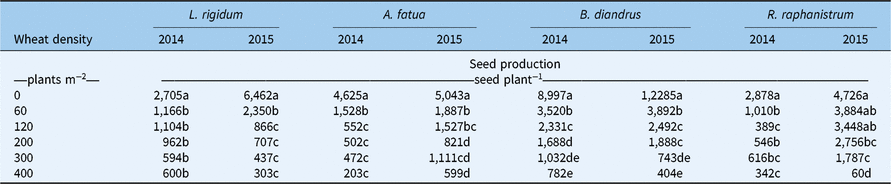
Wheat competition substantially reduced (90% to 95%) seed production and, therefore, the potential seedbank inputs of L. rigidum, A. fatua, B. diandrus, and R. raphanistrum (Figure 2). The highest level of wheat competition (400 plants m−2) reduced (P < 0.05) seed production of L. rigidum, A. fatua, B. diandrus, and R. raphanistrum by 4,109, 4,433, 10,048, and 3,601 seed plant−1, respectively, when compared with the seed production by these plants grown without competition (Table 3). Emphasizing the importance of uniform crop establishment, the greatest proportional reductions in weed seed numbers were observed at the lowest wheat densities. Seed production decreases for L. rigidum (61%), A. fatua (65%), B. diandrus (65%), and R. raphanistrum (36%) were achieved when wheat plant densities were increased from 0 to 60 plants m−2 (Figure 3). When wheat plant density was further increased to the common commercially targeted density (i.e., 120 plants m−2), the overall reduction in seed production was 77%, 50%, 77%, and 78% for L. rigidum, A. fatua, B. diandrus, and R. raphanistrum, respectively. When wheat competition was enhanced by increasing plant densities from 120 to 400 plants m−2, there were proportionately smaller but frequently significant (P < 0.05) reductions in weed seed production for three species, A. fatua (61%), B. diandrus (75%), and R. raphanistrum (90%). Notably, R. raphanistrum seed production was more affected by enhanced crop competition (120 to 400 plants m−2) than by lower wheat plant densities (0 to 120 plants m−2), indicating the higher tolerance of this species to crop competition. Similarly large reductions in seed production have been reported for R. raphanistrum (80% to 90%) and A. fatua (30% to 80%) when wheat plant densities were increased from 0 to 400 plants m−2 and 0 to 250 plants m−2, respectively (Eslami et al. Reference Eslami, Gill, Bellotti and McDonald2006; Radford et al. Reference Radford, Wilson, Cartledge and Watkins1980). Very few Australian studies have investigated the impact on weed seed production of increasing wheat crop competition effects, with no information on seed production responses in L. rigidum and B. diandrus to these increased wheat densities. In a study conducted in Oklahoma, USA, it was observed that increasing the wheat planting rate from 265 to 530 seed m−2 reduced by 25% the seed production of a related Bromus species, cheat (Bromus secalinus L.) (Koscelny et al. Reference Koscelny, Peeper, Solie and Solomon1990).
Influence of increasing neighboring wheat plant density on the seed production of target Lolium rigidum, Avena fatua, Bromus diandrus, and Raphanus raphanistrum plants in target-neighbor design pot experiments conducted in the outdoor growth facility at University of Western Australia, Perth, during the 2014 and 2015 winter–spring growing seasons (April to October). a

a Means with the same letter within the same column are not significantly different based on LSD (P > 0.05).
Effect of increasing neighboring wheat plant densities on the seed production (as a percentage of seed production in the absence of competition) of individual target plants of Lolium rigidum (A), Avena fatua (B), Bromus diandrus (C), and Raphanus raphanistrum (D). Curves were fit with nonlinear regression analyses using a two-parameter hyperbolic model, y = ab/(b + x). Parameter estimates and adjusted R2 values of the curves for each species are included in Table 2.

The seed production of A. fatua and B. diandrus was reduced more consistently and to a greater extent by increasing wheat plant densities than that of L. rigidum and R. raphanistrum (Figure 3). Similar to weed plant biomass responses, weed seed production responses were explained by a two-parameter hyperbolic model (P < 0.0001). Raphanus raphanistrum, with the highest SR50 value, was clearly more tolerant to wheat competition effects than A. fatua and B. diandrus (P < 0.05) (Table 2). The variability of R. raphanistrum seed production, as influenced by seasonal conditions, resulted in the large difference in SR50 values between this species and L. rigidum not being significant (P > 0.05).
Wheat Competition Effects on Wheat Growth and Development
Increasing neighboring wheat densities led to increased wheat biomass production and, therefore, increased crop competition with target weed species. Across the target-neighbor studies in 2014 and 2015, increasing wheat density from 60 to 400 plants m−2 generally resulted in higher wheat biomass levels (P < 0.05) (Table 4). There were, however, inconsistencies in biomass increases with increasing wheat plant densities that likely resulted in nonuniform increases in wheat competition effects. There was a strong seasonal influence on wheat growth, with consistently higher (25% to 39%) biomass levels at each wheat density averaged across the four experiments in 2015 compared with 2014. Interestingly, despite these differences in wheat biomass, there were not equivalent reductions in weed biomass and seed production levels between seasons (Tables 1 and 3) due to crop competition. In contrast, for A. fatua and R. raphanistrum, there were increases (P < 0.05) in plant biomass and seed production in the 2015 growing season.
Influence of wheat plant density on the biomass of wheat grown as neighboring plants to Lolium rigidum, Avena fatua, Bromus diandrus, and Raphanus raphanistrum target plants in target-neighbor design pot experiments conducted in the outdoor growth facility at University of Western Australia, Perth, during the 2014 and 2015 winter–spring growing seasons (April to October). a

a Means with the same letter within the same column are not significantly different based on LSD (P = 0.05).
There was a lack of influence of wheat plant density on grain yield, highlighting the compensatory nature of wheat toward maximizing yield potential. Grain yields remained mostly uniform across plant densities in all target-neighbor pot studies (Table 5) with only a few instances in which increasing wheat plant densities resulted in increased wheat grain yields, for example, L. rigidum in 2014, B. diandrus in 2015, and R. raphanistrum in 2015. Increasing wheat plant densities that resulted in higher biomass levels (Table 4) did not typically result in corresponding increases in grain yield (Table 5). There was, however, a strong seasonal influence on grain yields similar to that observed for wheat biomass, with substantially higher (P < 0.05) grain yields in 2015 than in 2014.
Influence of wheat plant density on the grain yield of wheat grown as neighboring plants to Lolium rigidum, Avena fatua, Bromus diandrus, and Raphanus raphanistrum target plants in target-neighbor design pot experiments conducted in the outdoor growth facility at University of Western Australia, Perth during the 2014 and 2015 winter–spring growing seasons (April to October). a

a Means with the same letter within the same column are not significantly different based on LSD (P > 0.05).
Wheat Competition Effects on Canopy Distribution of Weed Biomass
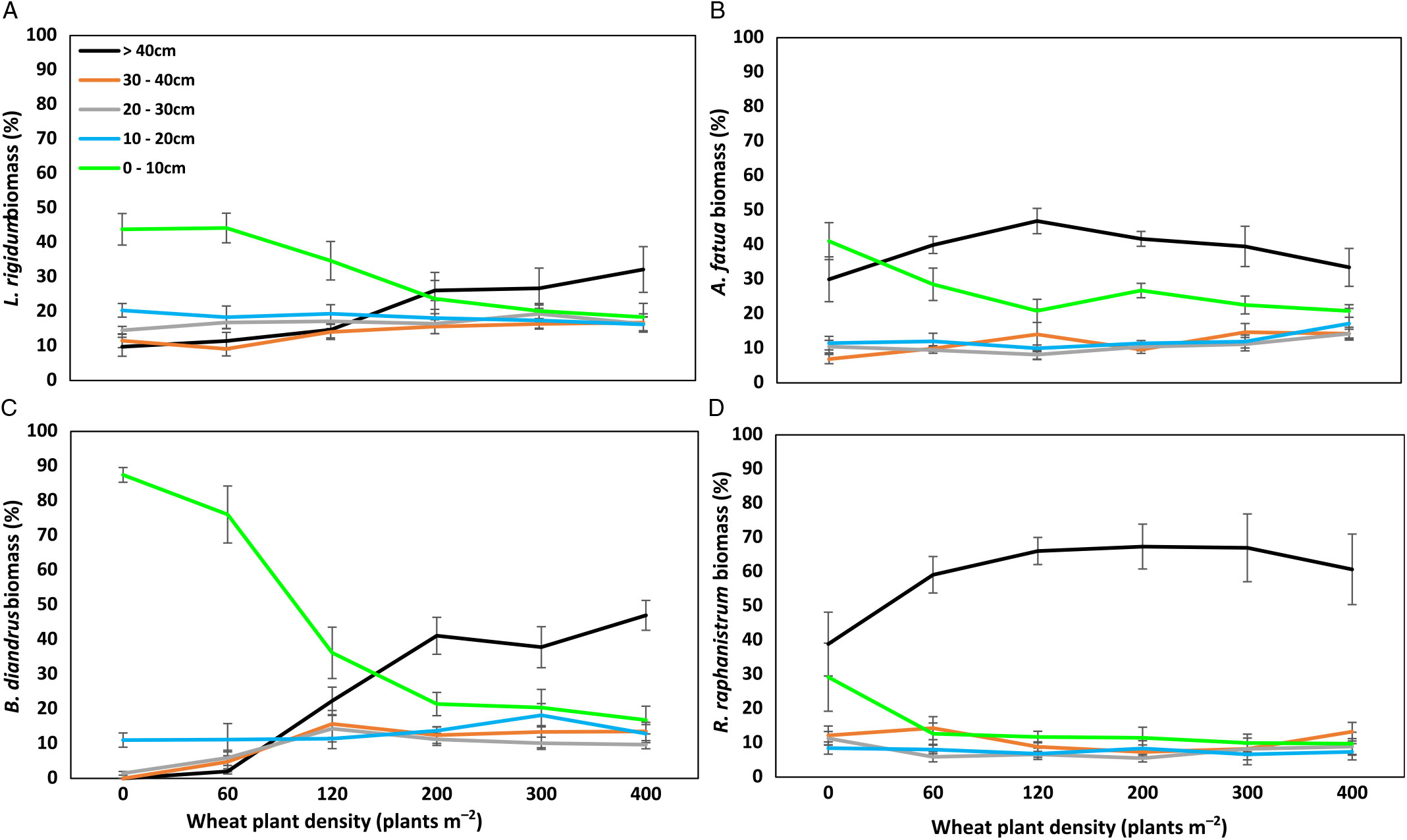
Increasing wheat competition resulted in a more erect growth habit of weed plants. In the absence of competition, individual weed plants displayed a more prostrate growth habit, with low proportions of total plant biomass in the upper canopy (>40cm) (Figure 4). There were large (P < 0.05) differences between the four species in the proportions of biomass production at this height. In the absence of competition, there were lower proportions of total biomass in the upper canopy (>40 cm) for L. rigidum (10%) and B. diandrus (0%) when compared with R. raphanistrum (39%) and A. fatua (30%) (Figure 4). With increasing wheat competition, there were large reductions (P < 0.05) in total plant biomass for all weed species (Table 1; Figure 2); however, these reductions were not consistent through the crop canopy. For all four species, biomass reductions were greater in the lower than upper crop canopy (Figure 4). This resulted in substantial increases (P < 0.05) in the proportion of total biomass above 40 cm. With enhanced wheat competition (400 plant m−2) the proportion of biomass in the upper canopy had increased to 32%, 33%, 47%, and 61% for L. rigidum, A. fatua, B. diandrus, and R. raphanistrum, respectively. The more erect growth habit is a common response by shade-intolerant plant species to low light conditions caused by wheat crop competition (Morgan and Smith Reference Morgan and Smith1979; Zerner et al. Reference Zerner, Gill and Vandeleur2008). As has previously been shown, there are differences between plant species in their response to shading (Bazzaz and Carlson Reference Bazzaz and Carlson1982; Holt Reference Holt1995). For example, without shading, B. diandrus plant growth was prostrate, with no biomass production above 30 cm, but the highest wheat density resulted in >40% of biomass being produced in the upper canopy. In contrast, proportional increases in upper canopy biomass for the other three species were much less (10% to 20%).
Biomass distribution through the wheat canopy at maturity of Lolium rigidum (A), Avena fatua (B), Bromus diandrus (C), and Raphanus raphanistrum (D) plants as influenced by increasing wheat plant densities. Bars represent standard errors of the mean across four replicates and two growing seasons.

Wheat Competition Effects on Canopy Distribution of Weed Seed Retention
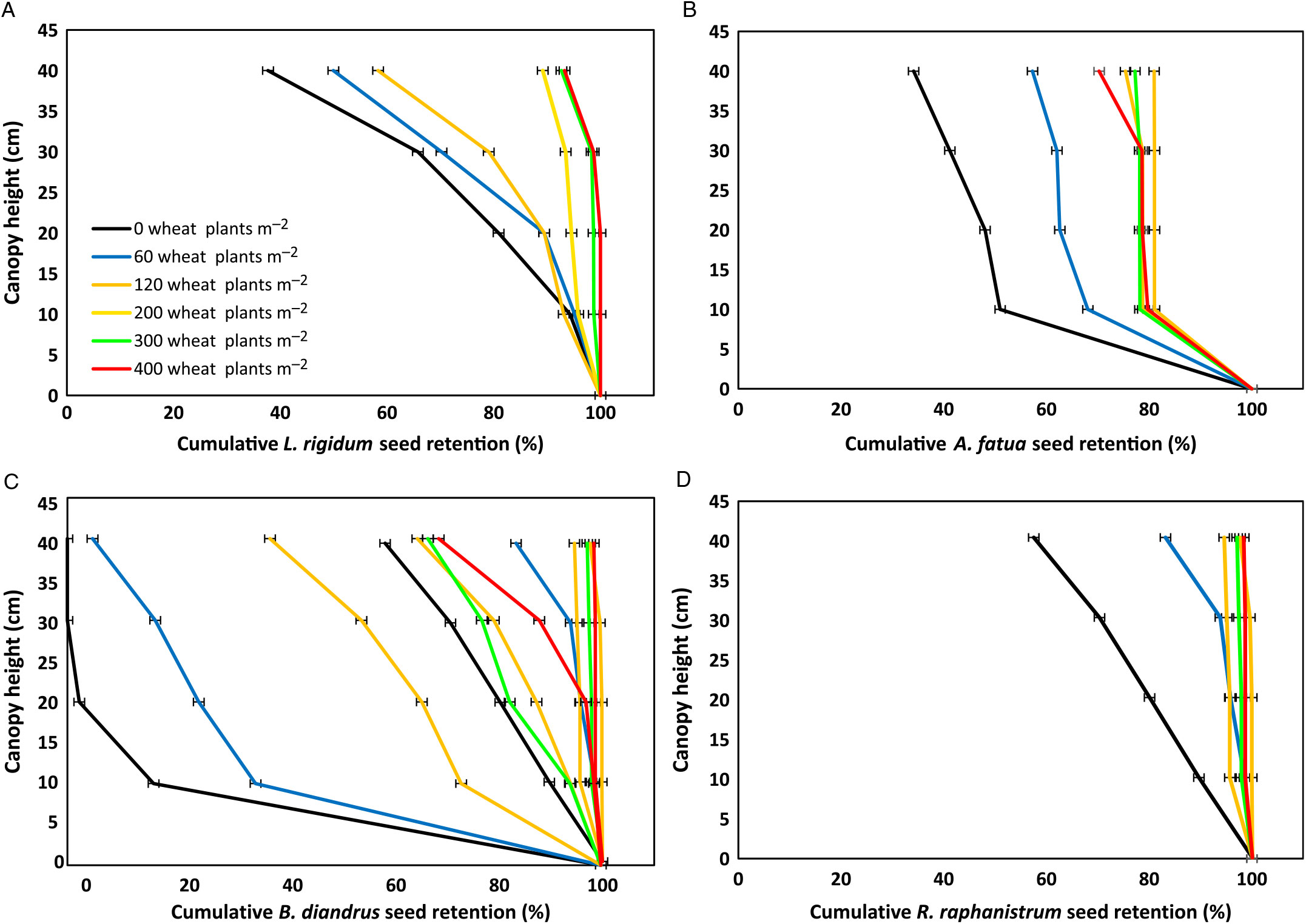
Wheat crop competition increased the seed retention height of L. rigidum, A. fatua, B. diandrus, and R. raphanistrum, increasing the potential efficacy of HWSC on these weed species. The proportion of weed seed production retained above a low wheat harvest height (e.g., 10 to 15 cm) (seed retention) at crop maturity determines the potential efficacy of HWSC systems (Walsh and Powles Reference Walsh and Powles2014). In these studies, increasing densities of neighboring wheat plants and, therefore, increasing crop competition, resulted in increasingly higher weed seed retention levels (Figure 5). In the absence of wheat crop competition (0 plants m−2) seed retention was 94%, 51%, 16%, and 90% for L. rigidum, A. fatua, B. diandrus, and R. raphanistrum, respectively. Increasing wheat density from 0 to 60 plants m−2 produced a large increase (P < 0.05) in seed retention for B. diandrus (19%) and A. fatua (21%), with smaller increases for L. rigidum (4%) and R. raphanistrum (8%). When the wheat density was increased to that commonly used in commercial fields (120 plants m−2), weed seed retention values at 10 cm for L. rigidum, A. fatua, B. diandrus, and R. raphanistrum increased to 93%, 81%, 74%, and 99%. These seed retention values were similar to those previously observed for these species when grown in commercial wheat fields and field trials (Burton et al. Reference Burton, Beckie, Willenborg, Shirtliffe, Schoenau and Johnson2016; Howard et al. Reference Howard, Mortimer, Gould, Putwain, Cousens and Cussens1991; Shirtliffe et al. Reference Shirtliffe, Entz and Van Acker2000; Tidemann et al. Reference Tidemann, Hall, Harker, Beckie, Johnson and Stevenson2017; Walsh et al. Reference Walsh, Broster, Aves and Powles2018; Walsh and Powles Reference Walsh and Powles2014). As the 120 plants m−2 density resulted in near maximum seed retention above 10 cm for L. rigidum and R. raphanistrum, enhanced wheat competition at higher densities had little or no effect on the seed retention for these species. In contrast, increasing wheat plant densities from 120 to 400 plants m−2 increased B. diandrus seed retention above 10 cm to 99% (Figure 5). Compared with the other species, Avena fatua seed retention was less affected by increasing wheat crop competition, with the maximum seed retention of 80% for this species observed at all wheat plant densities above 60 plants m−2. In contrast to the other species tested, seed retention above 10 cm of A. fatua is not related to tiller height but to preharvest seed shedding. With shed seed included in the 0- to 10-cm fraction, the results indicate that increasing crop competition did not influence A. fatua seed shedding.
Cumulative retention of Lolium rigidum (A), Avena fatua (B), Bromus diandrus (C), and Raphanus raphanistrum (D) seed through mature wheat crop canopies as influenced by increasing wheat plant density. Bars represent standard errors of the mean of eight replicates.

The effect of enhanced wheat competition was that higher proportions of seed production were retained in the upper canopy (>40 cm) at crop maturity, thereby increasing the potential efficacy of HWSC systems by reducing the requirement for a low harvest height in large wheat crops. In the absence of competition (0 plants m−2), the proportion of seed production retained above 40 cm was low for L. rigidum (38%), A. fatua (34%), B. diandrus (0%), and R. raphanistrum (58%) (Figure 5). The competition effect of 120 wheat plants m−2 increased seed retention above 40 cm to 58%, 81%, 38%, and 98% for L. rigidum, A. fatua, B. diandrus, and R. raphanistrum, respectively. Enhanced wheat competition effects resulting from wheat density of 400 plant m−2 further increased upper canopy seed retention of L. rigidum (93%) and B. diandrus (70%) but not R. raphanistrum (98%) and A. fatua (70%). At this wheat density, the major proportion of total seed production was retained above 40 cm for all four weed species, L. rigidum (93%), A. fatua (70%), B. diandrus (70%), and R. raphanistrum (98%). A consequence of increasing wheat competition is that the reliability of HWSC is improved by increased proportions of weed seed retained in the upper canopy and, therefore, the opportunity to collect high proportions of seed production even when low harvest heights are not possible.
Wheat Competition Effects on Canopy Distribution of Wheat Biomass
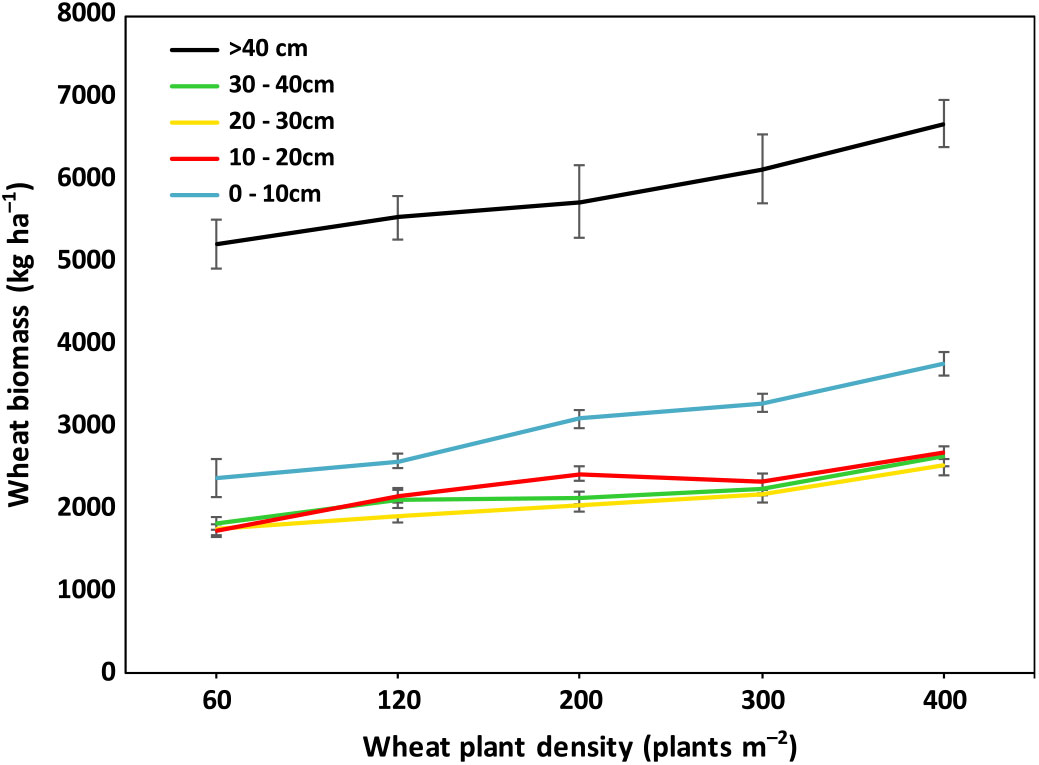
The distribution of wheat plant biomass through the crop canopy remained consistent across all wheat plant densities and weed species experiments. At each planting density, wheat biomass levels at individual canopy heights were similar (P > 0.05) across the four studies, indicating that if there was a weed competition effect, it was similar for all four species. Wheat biomass levels consistently increased at each canopy height with increasing wheat plant densities (Figure 6). These consistent increases in canopy biomass resulted in similar proportions of total biomass at each canopy height. Regardless of plant density and growing season, there was approximately 11%, 9%, 8%, 8%, and 63% of total wheat biomass at the 0- to 10-cm, 10- to 20-cm, 20- to 30-cm, 30- to 40-cm, and >40-cm sections of the crop canopy (Figure 6). The substantially increased amounts of wheat biomass (excluding grain) in the upper canopy at maturity highlights the potential shading effect on targeted weed plants.
Wheat crop biomass (excluding grain) distribution through the canopy at maturity. Bars represent standard errors of the mean across four weed species and two growing seasons.

The effects of wheat crop competition were substantially reduced growth and seed production of L. rigidum, A. fatua, B. diandrus, and R. raphanistrum, thereby restricting the impact of these weeds on crop production. Additionally, this competition effect increased the potential efficacy of HWSC treatments on seedbank inputs of these weed species and, therefore, their future impact on cropping systems. In these studies, increasing wheat plant densities severely restricted the growth and development of L. rigidum, A. fatua, B. diandrus, and R. raphanistrum and, therefore, the negative impacts of weed competition and seedbank inputs. The need to ensure uniform wheat crop establishment was highlighted by the largest proportion of the total reductions in weed biomass and potential weed seedbank inputs occurring at the lowest wheat plant densities (60 to 120 plants m−2). When wheat plant densities were increased above the common commercially used density of 120 plants m−2, the resulting enhanced wheat competition significantly (P < 0.05) reduced weed growth and development. In particular, the effect of enhanced wheat competition was a greater proportion of seed retention in the upper canopy, further increasing the reliability of HWSC treatments. The impact of enhanced wheat competition on targeted weed species is less weed competition, reduced seedbank inputs, and increased susceptibility to HWSC for the dominant weeds of Australian cropping.
Acknowledgments
The author would like to acknowledge the assistance of casual staff and students from University of Western Australia who assisted in the collection and processing of the samples. This work was funded by a Grains Research and Development Grant. No conflicts of interest have been declared.