Introduction
The investigation of disequilibrium is greatly assisted by understanding the prevalence of the condition. While large series reporting diagnoses encountered in neuro-otological clinics have been published from some parts of the world, little data are available on the causes of vertigo in Asian countries. Previous work from Thailand found that the most common diagnoses were benign paroxysmal positional vertigo (BPPV) and Ménière's disease (K Y K Bangpoophamorn and S Sirompotong, unpublished data).Reference Asawavichianginda and Asawavichianginda1–Reference Navacharoen, Navacharoen, Navachareon, Bulyalert and Kangsanarak3 However, the majority of these data was reported prior to widespread awareness of the diagnosis of vestibular migraine. Subsequently, the international literature has indicated that, whenever studied, vestibular migraine and BPPV are the most prevalent causes of vertigo reported.Reference Dieterich and Brandt4, Reference Neuhauser, Leopold, von Brevern, Arnold and Lempert5
The low incidence of reported vestibular migraine in Thailand continues, despite the international trend, as seen in Isaradisaikul and colleagues' recent retrospective chart review which classified 73 per cent of vertigo cases as peripheral, with BPPV and Ménière's disease accounting for the majority of these. Only 0.8 per cent of the remaining cases were thought to have a central cause, and 26 per cent were ‘unclassified’.Reference Isaradisaikul, Navacharoen, Hanprasertpong, Kangsanarak and Panyathong2 While these data suggest that vestibular migraine is not often seen in Thailand, the matter remains unresolved because the review's methodology may not have selected vestibular migraine cases. In Isaradisaikul and colleagues' review, the screening criterion for chart review was a hospital attendance coded with an International Classification of Diseases version 10 code pertaining to vertigo. Unfortunately, vestibular migraine does not yet have its own such code, with basilar migraine being the closest approximation, and there is no reference to this condition having been included in the review's selection criteria.
Thus, to determine whether vestibular migraine is encountered in Thailand, we conducted a prospective study investigating the prevalence of conditions causing vertigo in patients presenting to the neuro-otology clinic of Bangkok's largest public hospital. Diagnosis was determined by a protocol developed in advance of the data collection period and rigorously applied, which was based on internationally recognised diagnostic criteria. It was anticipated that this method would probably provide a more accurate estimation of the causes of vertigo in Thailand, and would resolve the dilemma of an apparent absence of vestibular migraine in this country.
Methods
A prospective audit was conducted on all patients presenting to the neuro-otology out-patient clinic, within the otolaryngology head and neck surgery department of Rajavithi Hospital, Bangkok, between November 2007 and November 2008. This hospital is the largest public tertiary referral hospital in Thailand. The population studied consisted of patients referred to the clinic from typical referral sources in Thailand, such as general practitioners, other hospitals and patients themselves. All inter-hospital referrals of patients with vertigo without an obvious neurological cause, such as cerebrovascular accident, were seen in this clinic. Within the hospital, otolaryngological self-referrals with vertigo were directed to neuro-otology by clinic nursing staff. Cases presenting to the emergency department were screened using the diagnostic protocol and then referred to neuro-otology (via the otolaryngology department) for follow up. The majority of patients were self-referred and had received minimal medical assessment prior to their presentation to the neuro-otology clinic.
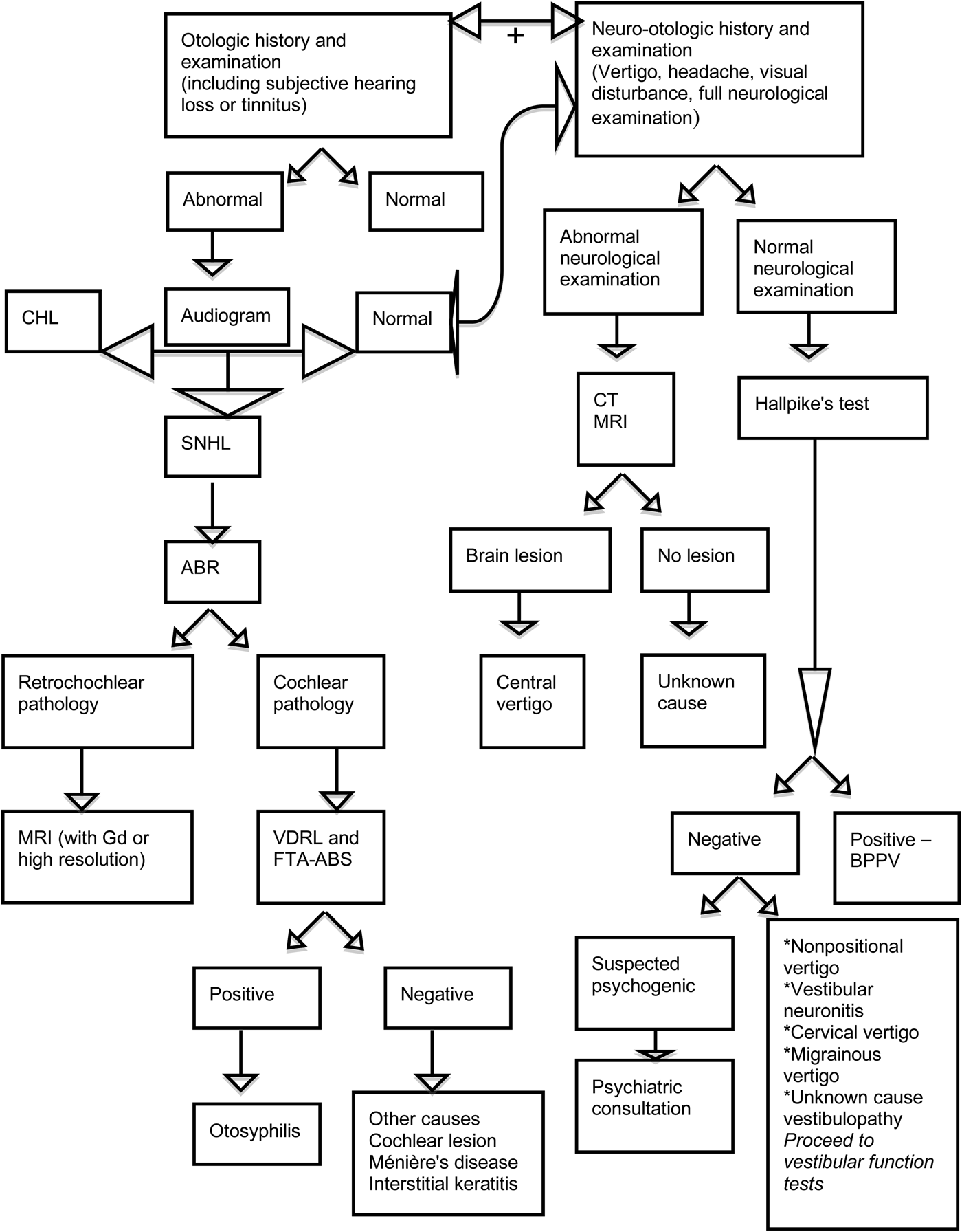
A diagnostic protocol was established prior to the commencement of data collection to ensure that consistent criteria were applied during the diagnostic process (Figure 1). Vertigo was defined as ‘the sensation of motion when no motion is occurring relative to earth's gravity’, as suggested by the Committee on Hearing and Equilibrium of the American Academy of Otolaryngology – Head and Neck Surgery.Reference Monsell6
Diagnostic algorithm utilised in the study. All patients underwent otological history-taking and oto-neurological examination. Depending on findings, audiography, computed tomography (CT), magnetic resonance imaging (MRI), Hallpike testing, syphilis testing (with veneral disease research laboratory (VDRL) and fluorescent treponemal antibody absorption (FTA-ABS) tests) and psychiatric consultation were employed to arrive at a diagnosis. CHL = conductive hearing loss; SNHL = sensorineural hearing loss; ABR = auditory brainstem response testing; BPPV = benign paroxysmal positional vertigo

Some of the more prevalent diagnoses arising from application of the protocol were Ménière's disease, vestibular migraine, BPPV, vestibular migraine in association with BPPV, and ‘unknown’. The study used the criteria for vestibular migraine suggested by Neuhauser et al., i.e.: (1) recurrent vestibular symptoms (i.e. rotatory or positional vertigo, other illusory self- or object-motion, or head motion intolerance); (2) migraine according to the criteria of the International Headache Society; (3) at least one of the following migrainous symptoms during at least two vertiginous attacks: migrainous headache, photophobia, phonophobia, or visual or other auras; and (4) exclusion of other causes by appropriate investigations.Reference Neuhauser, Leopold, von Brevern, Arnold and Lempert5
Accepted international criteria were applied to arrive at each of the other diagnoses, namely, those of the American Academy of Otolaryngology – Head and Neck Surgery for Ménière's disease and BPPV.Reference Neuhauser, Leopold, von Brevern, Arnold and Lempert5, 7
A diagnosis of Ménière's disease was made only when the American Academy of Otolaryngology – Head and Neck Surgery criteria for definite Ménière's disease were met. The end-point of the study was the establishment of a diagnosis, with a minimum follow-up period of six months applied to conditions other than BPPV. A diagnosis of ‘BPPV (history)’ was applied when patients gave a typical history for the condition on at least five occasions, but examination failed to reveal the typical positional nystagmus.Reference von Brevern, Radtke, Lezius, Fledmann, Ziese and Lempert8 The prevalence of each diagnostic category within the clinic population was recorded. Patient demographics (i.e. age, gender, marital status, educational level, income and occupation) were also collected and their associations with each diagnostic criteria explored. Demographic data were classified according to criteria used by the National Statistical Organisation of Thailand, to facilitate comparison between study data and national population data.9
The study was conducted under the auspices of the Human Research Ethics Committee of Rajavithi Hospital, Ministry of Health, Thailand. Patient data were anonymised before being entered into the trial database, in order to ensure that the researchers performing the analyses were blinded to patients' identities.
Comparisons of demographic data across diagnostic categories were made using analysis of variance (ANOVA) for parametric data and ANOVA by ranks for non-parametric data, utilising the Statistical Package for the Social Sciences software program, version 16 (SPSS Inc, Chicago, Illinois, USA). Categorical data were analysed using chi-squared statistics. Some patients met the diagnostic criteria for both BPPV and vestibular migraine. For the purposes of reporting and statistical analysis, such patients were analysed twice, once in each diagnostic category.
Diagnostic protocol
Every patient underwent a thorough otological assessment consisting of targeted history-taking, otological examination, and subsequent investigation(s) and/or psychiatric assessment as dictated by the protocol. Patients with abnormal neurological signs on clinical examination underwent magnetic resonance imaging (MRI) of the brain. Patients with abnormal auditory brainstem response test results suggesting retrocochlear pathology also underwent MRI of the brain. The diagnostic algorithm is summarised in Figure 1.
Any history of hearing loss, aural fullness, tinnitus, phonophobia, hyperacusis or previous ear surgery was determined. Neuro-otological history also included questions to specify the nature of disequilibrium and to distinguish rotational vertigo from imbalance. The duration of vertiginous episodes and their frequency were recorded. Potential triggers were explored, including head position, ambient temperature and bright light. Associated factors such as sleep quality, diet, hormonal supplements and medication history were also assessed. All patients were specifically asked about headaches, including their character, duration, frequency, and association with vertigo and the above-mentioned precipitants. The presence of migrainous aura and in particular visual disturbance, photophobia and distortion of the visual field were determined.
Otological examination included otoscopy and/or microscopic inspection of the ear, together with tuning fork tests. If the latter suggested asymmetrical hearing loss or conductive impairment, formal audiography was undertaken.
A full neurological examination was performed, consisting of examination of cranial nerves, motor and sensory function, deep tendon reflexes, and cerebellar function, together with Dix–Hallpike testing. Cerebellar function was assessed via finger–nose, finger-tapping and heel to knee tests, Romberg's test, and assessment for the presence of dysdiadochokinesis. Neuro-otological testing comprised head thrust, conjugation testing, and assessment for the presence of vertical and lateral gaze. The presence or absence of nystagmus was assessed based on clinical observation.
If a psychiatric condition was suspected, a psychiatry referral was made. All psychiatric diagnoses were made by psychiatrists.
Results
One hundred and sixty-seven patients were assessed during the 12-month prospective audit.
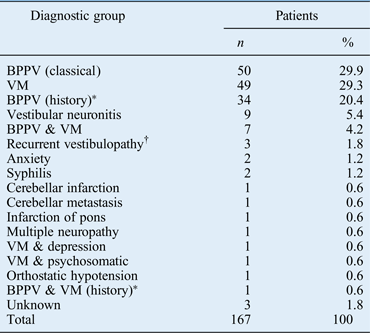
The most prevalent conditions encountered were BPPV and vestibular migraine, which together accounted for almost two-thirds of cases. Patients with a good history for BPPV but no nystagmus constituted 20.4 per cent. Vestibular neuronitis accounted for 5.4 per cent. The remaining cases were largely neurological. No case of Ménière's disease was encountered. Patients diagnosed with both BPPV and vestibular migraine accounted for 4.2 per cent of cases. The prevalence of vestibular vertigo diagnoses is summarised in Table I. Demographic data for the patients with the most prevalent conditions (i.e. BPPV (definite), vestibular migraine and vestibular neuronitis) are presented.
Prevalence of vestibular vertigo diagnoses
*Head position dependent disequilibrium without nystagmus on Hallpike testing. †Objective evidence of peripheral vestibular lesion but no firm diagnosis. BPPV = benign paroxysmal positional vertigo; VM = vestibular migraine
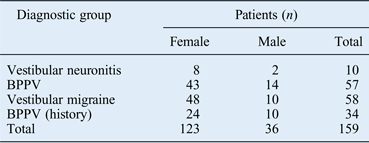
The mean age of participants was 52 years, with age ranging from 16 to 81 years. The age distribution was similar for all diagnostic groups, with the peak incidence being in middle age (i.e. 50–60 years of age). Sixty-nine per cent of patients were female, and the proportion of women did not vary significantly across the diagnostic groups (Table II, χ2 = 2.1, 3 degrees of freedom, p = 0.56). The age distributions were similar for each gender across all of the diagnostic groups; a univariate ANOVA with diagnosis and gender as the fixed factors and age as the dependent factor did not reveal any significant difference for either of the main effects, nor was there an interaction between these variables.
Gender by diagnostic group
BPPV = benign paroxysmal positional vertigo
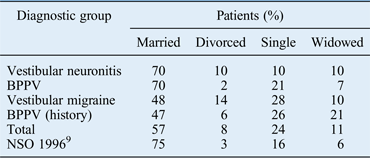
The Thailand national census defines marital status as married, divorced, single or widowed. Data for these categories, for each diagnostic group, are presented in Table III, along with 1996 census data for comparison.9 Marital status did not vary significantly between the diagnostic groups considered (χ2 = 13.7, 9 degrees of freedom, p = 0.11). However, closer examination of Table III indicates that the proportion of married individuals was similar in the vestibular neuronitis and BPPV groups, and also in the vestibular migraine and BPPV (history only) groups. When each pair of similar groups was combined and the resulting two larger groups compared, marital status was found to differ significantly between different diagnostic groups (χ2 = 8.7, 3 degrees of freedom, p = 0.03), with a lower proportion of patients being married in the combined vestibular migraine and BPPV (history only) groups. This finding has not been reported previously, and is likely to be related to specific sociodemographic factors present in Thailand. The proportion of married patients in the combined BPPV and vestibular neuronitis group resembled the overall percentage of married people in Thailand, as per national demographic data.
Marital status by diagnostic group
BPPV = benign paroxysmal positional vertigo; NSO = National Statistical Office, Kingdom of Thailand
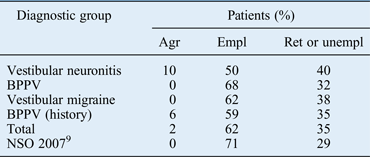
There were similar proportions of people in employment, and either retired or unemployed, amongst all diagnostic groups, as seen in Table IV; these proportions were similar to demographic data on employment status in Bangkok. Some of the patients seen were subsistence farmers, reflecting the demographics of rural Thailand; this suggests that some of the people treated in the clinic lived outside Bangkok.
Employment status and type by diagnostic group
Agr = agricultural work; Emp = employed; Ret or unempl = retired or unemployed; BPPV = benign paroxysmal positional vertigo; NSO = National Statistical Office, Kingdom of Thailand
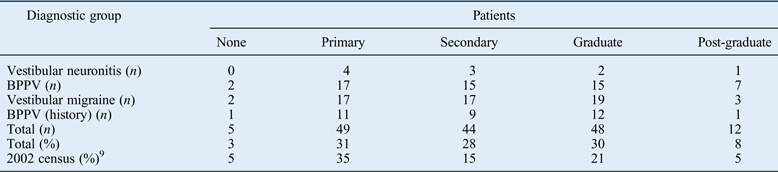
As with employment, the level of educational attainment did not differ significantly between the diagnostic groups (χ2 = 5.1, 12 degrees of freedom, p = 0.956) (Table V). The educational attainment of the total participant group was generally greater than that seen in general census data; however, the latter included all persons aged six years or more, and thus included children who had not finished schooling.
Educational attainment by diagnostic group
BPPV = benign paroxysmal positional vertigo
For those individuals earning money, the range of incomes was similar across the diagnostic groups, with the mean similar to the average family income for mid-Thailand (i.e. 16500 Baht/month). In Thailand, many people do not earn money and are dependent upon family or friends to provide housing and subsistence. Thirty per cent of study participants were in this circumstance, with similar proportions across all diagnostic groups.
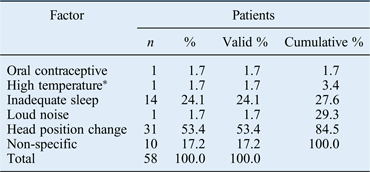
Associations between vestibular migraine and common triggers for migraine and BPPV were assessed. Position change was found to be associated with vestibular migraine in 53 per cent of participants with this condition. Inadequate sleep was reported by 24 per cent of vestibular migraine sufferers. The prevalence of association of various factors with vestibular migraine is presented in Table VI.
Prevalence of association of various factors with vestibular migraine
*Ambient temperature
Discussion
The prevalence of conditions causing disequilibrium in Thailand would appear to be similar to that reported in recent series from elsewhere in the world, with BPPV and vestibular migraine accounting for the majority of cases. Previous Thai studies have reported a much higher incidence of Ménière's disease, and have not recognised the diagnosis of vestibular migraine. The main distinguishing features between the present study and previous Thai studies were its prospective, protocol-driven design, inclusion of the relatively new diagnostic entity of vestibular migraine as a differential diagnosis, application of the 1995 American Academy of Otolaryngology diagnostic criteria for Ménière's disease, and improvements in diagnostic imaging, in particular the use of MRI and CT.7
In previous Thai series from specialised clinics, reported between 1995 and 2010, BPPV was found to be the most common diagnosis, with prevalences ranging from 18.8 to 52.5 per cent, similar to the present study (K Y K Bangpoophamorn and S Sirompotong, unpublished data).Reference Asawavichianginda and Asawavichianginda1–Reference Navacharoen, Navacharoen, Navachareon, Bulyalert and Kangsanarak3 These findings are also similar to recent international reports. In a prospective study in a Toronto hospital multidisciplinary clinic, 28.9 per cent of all diagnoses, and 43 per cent of cases with a vestibular cause of vertigo, were attributed to BPPV.Reference Bath, Walsh, Ranalli, Tyndel, Bance and Mai10 In a German neuro-otology clinic population, BPPV was the cause of vertigo in 31 per cent.Reference Neuhauser, Leopold, von Brevern, Arnold and Lempert5 Kroenke et al. reported a prevalence of 18.8 per cent in a selected US population.Reference Kroenke, Lucas, Rosenberg, Scherokman, Herbes and Wehrle11
The second most common diagnosis was vestibular migraine, which was diagnosed in approximately one-third of the patients. This proportion is higher than the prevalence of 6–9 per cent reported in selected patient groups in other countries.Reference Dieterich and Brandt4, Reference Neuhauser, Leopold, von Brevern, Arnold and Lempert5, Reference Brandt12 As noted above, previous Thai series have not reported vestibular migraine (K Y K Bangpoophamorn and S Sirompotong, unpublished data).Reference Asawavichianginda and Asawavichianginda1–Reference Navacharoen, Navacharoen, Navachareon, Bulyalert and Kangsanarak3 There could be a number of reasons for this. Methodology differences, such as reliance on International Classification of Diseases version 10 codes for case selection, may have contributed, since vestibular migraine was not coded specifically by the International Classification of Diseases 10 system and therefore cases may not have been identified. Environmental and racial characteristics of the Thai population may also be partly responsible. Limited data are available on the sociodemographic characteristics of participants in other studies; however, age and gender characteristics are similar to those reported here, with a female preponderance and a mean age of 43–49.9 years (K Y K Bangpoophamorn and S Sirompotong, unpublished data).Reference Asawavichianginda and Asawavichianginda1–Reference Navacharoen, Navacharoen, Navachareon, Bulyalert and Kangsanarak3, Reference Bath, Walsh, Ranalli, Tyndel, Bance and Mai10, Reference Harris and Alexander13 It is unlikely that referral patterns were of key significance in explaining such a difference in prevalence, as the present study group had a broad referral base and were largely self-referred.
Vestibular migraine is also referred to in the literature as a migraine-related vestibulopathy, migrainous vertigo, migraine-associated dizziness and migraine-associated vertigo.
The association between migraine and vestibular abnormalities has been recognised for some time.Reference Straube and Rauch14, Reference Vukovic, Plavec, Galinovic, Lovrencic-Huzjan, Budisic and Demarin15 Kayan et al. showed that vertigo was more commonly experienced by migraine suffers than by patients with tension headaches.Reference Kayan and Hood16 Kuritzky et al. reported that more than 80 per cent of patients with migraine have vestibular abnormalities.Reference Kuritzky, Toglia and Thomas17 The concurrence of vertigo and migraine is 3.2 per cent, which is higher than the 1 per cent predicted by chance, based on a migraine prevalence of 14 per cent and a vertigo prevalence of 7 per cent.Reference Jensen and Stovner18, Reference Neuhauser, Radtke, von Brevern, Feldmann, Lezius and Lempert19 Furthermore, vestibular vertigo has been found to be associated with other vestibular disorders such as Ménière's disease and BPPV.Reference Neuhauser, Leopold, von Brevern, Arnold and Lempert5, Reference Radtke, Lempert, Gresty, Brookes, Bronstein and Neuhauser20
The International Headache Society classification of headaches includes basilar migraine, a condition which links migraine and vertigo.21 However, as noted by Dieterich and Brandt, only a small proportion of vertigo associated with migraine would be classified as basilar migraine, because of monosymptomatic episodes, or because the vertigo duration is either shorter or longer than the aura duration required in the International Headache Society criteria for basilar migraine.Reference Dieterich and Brandt4 Neuhauser et al. proposed diagnostic criteria for vestibular migraine which have been used by a number of investigators, including our group.Reference Neuhauser, Leopold, von Brevern, Arnold and Lempert5 However, despite the publication of clearly defined diagnostic criteria and protocols, Thai clinicians may still tend to under-diagnose vestibular migraine due to relative inexperience with this clinical entity. Vestibular migraine is a complex diagnosis with diagnostic features that can be similar to those of Ménière's disease. Vestibular migraine and Ménière's disease both present with recurrent vertigo and thus may be difficult to differentiate. Therefore, it is to be expected that increased recognition of vestibular migraine will probably reduce the numbers of patients diagnosed with Ménière's disease.
The prevalence of Ménière's disease varies considerably between international centres. In centres in Europe, the USA, Canada and Japan, Ménière's disease seems to account for approximately 1–7 per cent of patients in clinic populations.Reference Dieterich and Brandt4, Reference Neuhauser, Leopold, von Brevern, Arnold and Lempert5, Reference Bath, Walsh, Ranalli, Tyndel, Bance and Mai10–Reference Brandt12, Reference Radtke, von Brevern, Feldmann, Lezius, Ziese and Lempert22, Reference Shojaku, Watanabe, Fujisaka, Tsubota, Kobayashi and Yasumura23 By way of contrast, in Spain a retrospective study of patients presenting to an ENT clinic revealed a Ménière's disease prevalence of 21.8 per cent; however, the diagnosis of vestibular migraine was not reported, and 17.2 per cent of patients were diagnosed with a controversial diagnosis of cervical pathology.Reference Guilemany, Martinez, Prades, Sanudo, De Espana and Cuchi24 A retrospective review of Ménière's disease diagnosis data in a selected patient population seen in an African otolaryngology department over a 10-year period reported a 0.22 per cent prevalence of Ménière's disease; there was no comment on the epidemiology of other vestibular pathologies.Reference Ibekwe and Ijaduola25 Interestingly, previous Thai series have reported some of the highest prevalences of Ménière's disease in vertiginous populations, ranging from 12.7 to 30.54 per cent (K Y K Bangpoophamorn and S Sirompotong, unpublished data).Reference Asawavichianginda and Asawavichianginda1–Reference Navacharoen, Navacharoen, Navachareon, Bulyalert and Kangsanarak3 It may be concluded that the reported prevalence of Ménière's disease in the general population differs between countries by up to an order of magnitude. In general, Ménière's disease is reported more frequently in retrospective studies, and when vestibular migraine has not been recognised as a potential diagnosis. The previous studies in Thailand fall into both categories. Ménière's disease is reported to have a prevalence of 1–5 per cent, based on prospective study data from European and North American neuro-otology clinics; thus, it seems quite possible that the absence of Ménière's disease among the 167 patients in the present study was a chance occurrence, and that its prevalence in Thailand may well be closer to that reported elsewhere.
It is possible that some cases of mild hearing loss in the present study were missed, as tuning fork tests are ineffective in eliciting bilateral sensorineural hearing loss and not all the participants received a formal audiogram. However, considering that multiple other Ménière's disease diagnostic criteria were considered in the diagnostic algorithm of the study, we believe that cases of definite Ménière's disease were not missed.
It should also be appreciated that the diagnostic criteria for Ménière's disease have become more stringent over time, and this is likely to have reduced the reported incidence in recent studies. In 1995, the American Academy of Otolaryngology – Head and Neck Surgery published more stringent criteria for Ménière's disease diagnosis, replacing their looser 1972 criteria, and this may have influenced the diagnosis and reported prevalence of Ménière's disease worldwide.7, Reference Celestino and Ralli26 For example, Celstino et al. noted that 35 per cent of Ménière's disease cases diagnosed in a well-known Rochester study using the 1972 Academy criteria would not have met the 1995 criteria.Reference Celestino and Ralli26, Reference Wladislavosky-Waserman, Facer, Mokri and Kurland27 Much of the literature published in Thailand pre-dates the introduction of the 1995 Academy criteria, and is likely to have overestimated the prevalence of Ménière's disease as determined by more contemporary diagnostic criteria.
The fourth most common cause of vestibular vertigo in our study was vestibular neuronitis, with a prevalence of 5.4 per cent. Elsewhere, the reported prevalence of vestibular neuronitis has ranged from 1 per cent in Spain, through 3–4.9 per cent in the USA and 3–7.9 per cent in Germany, to 10.5 per cent in Canada.Reference Dieterich and Brandt4, Reference Neuhauser, Leopold, von Brevern, Arnold and Lempert5, Reference Bath, Walsh, Ranalli, Tyndel, Bance and Mai10, Reference Brandt12, Reference Kroenke, Hoffman and Einstadter28 Thus, our results compare well to those in the USA and Germany, but are higher than in Spain and lower than in Canada. Our study's prevalence of vestibular neuronitis was also higher than the 0.18–1.99 per cent reported in previous Thai series (K Y K Bangpoophamorn and S Sirompotong, unpublished data).Reference Asawavichianginda and Asawavichianginda1–Reference Navacharoen, Navacharoen, Navachareon, Bulyalert and Kangsanarak3 Once again, this difference is difficult to explain, but methodological differences and reliance on International Classification of Diseases coding by the other Thai groups may have influenced results.
The present study also examined patients' sociodemographic factors to determine whether these were similar to those reported elsewhere. Patient age was consistent with previous reports (K Y K Bangpoophamorn and S Sirompotong, unpublished data).Reference Asawavichianginda and Asawavichianginda1–Reference Navacharoen, Navacharoen, Navachareon, Bulyalert and Kangsanarak3, Reference Bath, Walsh, Ranalli, Tyndel, Bance and Mai10, Reference Harris and Alexander13, Reference Guilemany, Martinez, Prades, Sanudo, De Espana and Cuchi24 The proportion of female participants in our study, 69 per cent, was consistent with the literature, which reports that vertigo is more frequent in women than men (K Y K Bangpoophamorn and S Sirompotong, unpublished data).Reference Asawavichianginda and Asawavichianginda1–Reference Navacharoen, Navacharoen, Navachareon, Bulyalert and Kangsanarak3, Reference Harris and Alexander13
Our study population had a higher proportion of people educated beyond primary level, compared with the national average (Table V). This differs from previous studies reporting that dizziness and/or vertigo are more likely to occur in people with lower educational attainment.Reference Lempert and Neuhauser29 This may be because our patient population was drawn primarily from Bangkok, where the population is generally better educated than rural dwellers.
Potential triggers for vestibular migraine were explored. Large numbers of patients with vestibular migraine reported inadequate sleep, a known migraine trigger.Reference Neuhauser and Lempert30 We also found a strong association between vestibular migraine and BPPV (history only). This was not an unexpected finding, as vestibular migraine is typically described as a spontaneous or positional vertigo.Reference Lempert and Neuhauser29
• Little is known about vertigo aetiology in Asian countries
• In this Thai study, the commonest conditions were benign paroxysmal positional vertigo and vestibular migraine
• Vestibular migraine prevalence was higher and Ménière's disease prevalence much lower than in previous Thai studies
• The overall prevalence of disequilibrium diagnoses was similar to international reports
• Vestibular migraine was associated with known migraine triggers (i.e. inadequate sleep and head position change)
We did not however find an association between vestibular migraine and other well-known migraine triggers, as has previously been reported.Reference Neuhauser, Leopold, von Brevern, Arnold and Lempert5 Cause–effect analysis was not conducted; thus, the true nature of the relationship between vestibular migraine and the associated features in question was not further investigated.
Conclusion
Our study findings indicate that patients in Thailand experience vestibular migraine, in keeping with reports from other countries. Ménière's disease was not encountered in this study, suggesting that there is a substantially lower prevalence of this condition in Thailand than previously reported. These differences with previous literature we attribute to our prospective study design, adherence to a diagnostic protocol including vestibular migraine as a diagnosis, and acknowledgement that vestibular migraine may be difficult to differentiate from Ménière's disease. The sociodemographic characteristics of Thai patients with vertigo were similar to those reported internationally.
Acknowledgements
The authors acknowledge the contribution of Dr David Szmulewicz, who critically appraised the paper, and Dr Ian Curthoys, who gave general advice.