INTRODUCTION
Introduced species may have adapting strategies allowing them to modify population features to widely disperse into a new habitat. Besides, invasive species show some special characteristics, such as wide environmental tolerance, rapid growth, high reproductive capacity, constant recruitment and commensalism with human activities (e.g. ship ballast water or hull-fouling transport for aquatic species). Once an exotic species has arrived and successfully settled, it may disperse along the coastline by natural means, as floating or drifting, or by human-mediated vectors (Ricciardi & Rasmussen, Reference Ricciardi and Rasmussen1998; Carlton, Reference Carlton2001; Nyberg & Wallentinus, Reference Nyberg and Wallentinus2005). Since the impact of alien species on the ecosystem may produce changes in the richness and genetic variability of native species (Piriz & Casas, Reference Piriz, Casas, Alveal and Antezana2001; Grosholz, Reference Grosholz2002; Casas et al., Reference Casas, Scrosati and Piriz2004), adequate information about their phenology and reproductive patterns is of paramount importance for understanding their population dynamics.
The first specimens of Undaria pinnatifida (Harvey) Suringar in the Nuevo Gulf were found by the end of 1992, attached to structures of the mercantile seaport near Puerto Madryn, suggesting an accidental introduction by shipping (Piriz & Casas, Reference Piriz and Casas1994). Studies conducted on the population in the Nuevo Gulf (Casas & Piriz, Reference Casas and Piriz1996) suggested that the coexistence of mature and immature juvenile sporophytes was presumably related to the narrow range of seawater temperatures besides the absence of a clear seasonal trend in both sporophyll sizes and maturity. In the southern hemisphere the period of appearance of sporophytes is variable, taking place normally in autumn but also during all the year; sporophytes degradation usually occurs during the summer (Hay & Villouta, Reference Hay and Villouta1993; Casas & Piriz, Reference Casas and Piriz1996; Stuart et al., Reference Stuart, Hurd and Brown1999). In the northern hemisphere seawater temperature has been also suggested to be the most important environmental factor affecting the life cycle of U. pinnatifida (Saito, Reference Saito, Tokida and Hirose1975; Stuart et al., Reference Stuart, Hurd and Brown1999). Recruitments in the U. pinnatifida population growing in Nuevo Gulf suggest that mature individuals can also reproduce throughout the year, in contrast to different patterns observed in Japanese populations where U. pinnatifida is native (Akiyama & Kurogi, Reference Akiyama and Kurogi1982).
The introduction of exotic species by anthropogenic causes may produce ecological changes in a short time (Carlton, Reference Carlton1996, Reference Carlton2003; Piriz & Casas, Reference Piriz, Casas, Alveal and Antezana2001). An introduced species could become an established one, which depends on both the environmental and ecological adaptive characteristics of the alga; if such a non-native species spreads from the point of introduction and becomes abundant, it is termed ‘invasive species’ (Kolar & Lodge, Reference Kolar and Lodge2001). In view of the controversial opinions on the opportunistic and competitive features of Undaria (Battershill et al., Reference Battershill, Miller and Cole1998; Curiel et al., Reference Curiel, Bellemo, Marzocchi, Scattolin and Parisi1998; Casas et al., Reference Casas, Scrosati and Piriz2004; Casas, Reference Casas2005) somewhat opposed to some indications about the non-aggressive characteristics of the kelp (Floc'h et al., Reference Floc'h, Pajot and Wallentinus1991, Reference Floc'h, Pajot and Mouret1996; Boudouresque & Verlaque, Reference Boudouresque and Verlaque2002), Undaria should be considered as a successful species once established outside its native region.
In addition to its high dispersal rate, the dense source population of Nuevo Gulf may have caused high propagule availability (Carlton, Reference Carlton, Mooney and Hobbs2000) which resulted in new introduced populations expanding their range along the coasts of Patagonia (Casas, Reference Casas2005; Martín & Cuevas, Reference Martín and Cuevas2006) showing extensive range expansion over a short period (Grosholz, Reference Grosholz2002). Undaria was observed growing on artificial substrata such as floating pontoons, wreckage, fishing nets and wharf piles and also was experimentally confirmed to be able to competitively displace native algal species in Nuevo Gulf (Casas & Piriz, Reference Casas and Piriz1996; Wallentinus, Reference Wallentinus and Gollasch1999; Casas et al., Reference Casas, Scrosati and Piriz2004). Since invasive species are able to modify their spreading and reproductive patterns depending on environmental conditions, our findings may be comparative, becoming relevant information for future introduced populations.
The main goal of the present detailed study of Undaria pinnatifida was to determine both the population dynamics and phenology of the local population outside its native scope. For that reason this study focused on the relationships among morphological characters with seawater temperatures, seasonality of reproductive stages and recruitment patterns.
MATERIALS AND METHODS
Study site
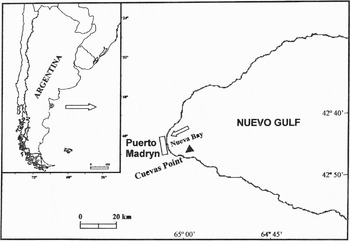
Samples were collected from a densely distributed population growing on a rocky seabed covered by gravel, sand and fragments of valves. It was located 4.5 to 7 m depth with respect to the mean tidal level (MTL), within Nueva Bay on the west of Nuevo Gulf (42º 46′ S, 65º 03′ W) (Figure 1). This area has a low wave exposure and during the study the seawater surface temperature ranged from 8.5°C in winter to 19°C in summer (Casas, Reference Casas2005).
Map showing the location of the 1997–2000 Undaria pinnatifida population study (arrow) near Puerto Madryn city and the site of the 2001–2002 recruitment experiment (arrowhead) at Cuevas Point.

The patterns of distribution of native flora could have been previously altered by the presence of a U. pinnatifida population (Casas et al., Reference Casas, Scrosati and Piriz2004), but at the time of this study the associated flora of this area was mainly composed of Codium vermilara (Olivi) Delle Chiaje, whereas the crustose Corallinaceae Synartrophyton sp., and Ulva lactuca Linné, Dictyota dichotoma (Hudson) Lamouroux, Ceramium virgatum Roth, Anotrichium furcellatum (J. Agardh) Baldock, Lomentaria clavellosa (Turner) Gaillon, Gracilaria gracilis (Stackhouse) Steentoft, Irvine et Farnham and Neosiphonia harveyi (Bailey) Kim, Choi, Guiry & Saunders were also frequently observed. The presence of Cladophora sp. and Ectocarpus siliculosus (Dillwyn) Lyngbye were associated with summer environmental conditions. The listed algae were observed at the same depth where U. pinnatifida was distributed.
Tegula patagonica d'Orbigny (Mollusca), Arbacia dufresnii Blainville (Echinoidea) and Pseudechinus magellanicus Philippi (Echinoidea) were observed as associated fauna, mainly related to the holdfast but in some cases to sporophylls and blades. Individuals of Ribeiroclinus eigenmanni (Jordan) (Teleostei) were occasionally collected as by-catch because of the utilization of U. pinnatifida thalli as refuge.
Population study
Morphological variables were registered bimonthly from October 1997 to February 2000. On each collecting day at least 50 or more sporophytes were obtained by sampling in a variable number of four-sided areas of 0.25 m2 that were randomly placed by SCUBA divers.
Samples were rinsed with seawater in the laboratory to ensure the visualization of small specimens and then the holdfasts were cut away. Sporophyte length (cm) was measured from the proximal end of the stipe to the distal end of the midrib. The drained weight of sporophytes without holdfast was verified to the nearest 0.01 g. When the midrib became a visible structure, the maximum midrib width was measured to the nearest mm. All these variables were not registered in February 1998, 1999 and 2000 because of damaged blades and midribs.
All collected sporophytes were considered for the calculations of density, even the smallest juvenile specimens and the more damaged thalli.
REPRODUCTIVE FEATURES
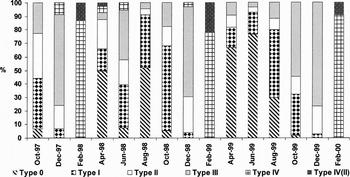
To analyse the reproductive pattern of U. pinnatifida the width of sporophylls was measured to the nearest cm. Subsequently, all the collected sporophytes were classified in types based on the presence or absence of midrib and on the characteristics of the sporophyll, if present:
Type 0: youngest sporophytes in which midribs are not defined.
Type I: young sporophytes with a clearly visible midrib, without sporophyll.
Type II: sporophytes showing little sporophylls, in which the stipe is still visible.
Type III: sporophytes with fully developed sporophylls that entirely surrounds the stipe.
Type IV: senescent sporophytes with damaged blades, with only remains of midrib and sporophylls.
Type IV (II): senescent sporophytes like in Type IV, but with sporophylls like in Type II.
The proportion of each type was calculated from the total number of sporophytes collected on each sampling day.
RECRUITMENT EXPERIMENT
In a location near Cuevas Point, about 7 km south from the previously described study site (Figure 1), a dense population growing on a subtidal rocky reef was selected for testing the recruitment pattern of U. pinnatifida. At this site the kelp grew at 6 m depth (MTL) and was mainly associated to Codium vermilara (Casas et al., Reference Casas, Scrosati and Piriz2004). In the experiment, 0.25 m2 quadrangles (N = 10) were randomly fixed to the sea bottom onto the rock separated at least 1 m from one another. For the sampling of recruited thalli, all quadrangles were kept Undaria-free by monthly removals of sporophytes from May 2001 until the end of the experiment in November 2002. Some collecting dates were missed owing to adverse weather conditions.
In the laboratory, each individual was measured in length (cm) and classified according to its type. The number of sporophytes collected in each quadrangle was registered for calculations of density.
STATISTICAL ANALYSES
Correlations were calculated after testing data normality with the Lilliefors test, when non-normality occurred data were logarithmically transformed. Homoscedasticity was verified with the Levene test. Data analyses were performed with Statistica 6.0 (StatSoft, Tulsa, OK, USA).
RESULTS
Sporophytes phenology
Throughout the study, 3363 sporophytes were collected with a mean value of 224.2 individuals (± SE 39.6, N = 15) sampled on each collecting date. The maximal number of plants collected just on a single date (June 1999) was 436 plants m−2.
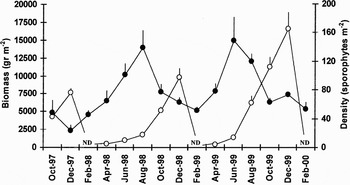
The mean values of density, biomass and length showed seasonal variations. The maximal mean density (149.1 ± 33, N = 56) was associated with newly recruited sporophytes seeming that the number of sporophytes was progressively increasing throughout the winter (Figure 2). A significant correlation between density and seawater temperatures confirmed that the maximal number of sporophytes was registered in winter, when the seawater temperature reached its lowest value (R2 = 0.50, P = 0.003, N = 15). When the relationship between biomass and sporophytes density of each sampling date was explored, no significant regression was found (R2 = 0.07, P = 0.43, N = 11), meaning that the increase of density did not result in a marked increase of biomass, because such a number of plants were small juveniles (Figure 2).
Average biomass (g m−2) (empty circles) and density (number of sporophytes m−2) (filled circles) of Undaria pinnatifida collected on each sampling date (+SE) for population study. ND, no data (see text).

During the study an average biomass of 8392.2 g (±SE 1913, N = 15) was collected and the maximal mean value of biomass (16501 g ± 2359.3, N = 16) was registered in December 1999 (Figure 2). Most of the sporophytes were damaged and detached in summer, resulting in a reduction of the biomass; the large size of sporophytes also favoured their detachment, which diminished the density.
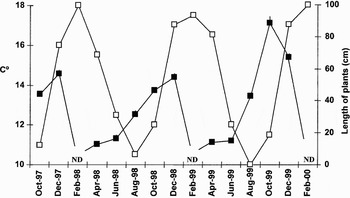
When the length of the sporophytes was analysed, specimens collected in winter and spring were healthier (i.e. entire blades) than those collected in summer. The total length ranged from 0.4 to 150 cm and a significant but negative correlation was found with seawater temperature as the highest values of length were related to lowest values of seawater temperatures (R2 = 0.32, P = 0.028, N = 15). Maximal mean values of length were observed by the spring and at the beginning of the summer (88.5 cm±4.4, N = 53), whereas the minimal values were observed in summer when the sporophytes became damaged and in autumn when the presence of juveniles reduced the length average (12.6 cm±1, N = 239) (Figure 3).
Average length of Undaria pinnatifida sporophytes (+SE) (filled squares) collected for population study and seawater temperatures (empty squares) registered on each sampling date. ND, no data (see text).

The midrib width was another morphological character positively related with the weight since a significant correlation was found with the weight of sporophytes (R2 = 0.92, P = 0.001, N = 11). In our study the widest midribs (30 mm) corresponded to the heaviest thalli (689.51 g) collected in December 1997.
Reproductive pattern
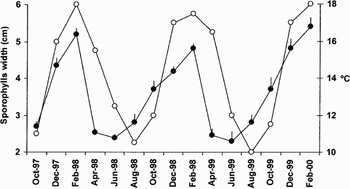
The sporophylls of 1361 (91 ±12.5, N = 15) specimens were measured. The development in size of the sporophylls was clearly seasonal with the smallest sporophylls (0.8 cm width) found at the end of autumn, a season characterized by the presence of juveniles. The largest sporophylls (12 cm width) belonged to those sporophytes collected in summer (February 2000) although they were damaged. A significant correlation between the size of the sporophylls and the seawater temperature was found (R2 = 0.42, P = 0.009, N = 15), indicating that increases in temperature induce larger sporophylls (Figure 4).
Width of Undaria pinnatifida sporophylls (+SE) (filled circles) measured for testing seasonality of this reproductive structure and seawater temperatures (empty circles) registered during the 1997–2000 population study.

In the course of the exploration we found almost all reproductive conditions. The reproductive pattern of U. pinnatifida was not so clearly seasonal. At first sight the presence of Type 0 indicated that recruitment was a very recent event registered from April to October (Figure 5). In June 1998 there was a lowering in the proportion of Type 0 juveniles probably related to the weather alteration of April 1998 when storms, an average of autumn–winter seawater and air temperatures higher than normal and rainfalls over 300 times the normal value were registered (Service of Oceanography and Meteorology—CENPAT, unpublished results).
Reproductive pattern of Undaria pinnatifida observed during the 1997–2000 population study. The proportion of each reproductive Type was calculated from the total of sporophytes sampled on each collecting date.

Young sporophytes with visible midrib belonging to Type I, were also indicative of recent recruitment and were observed from April to December. The specimens belonging to Type II were found during all sampling periods, though always in lower proportions than 35% (Figure 5).
From April to December the presence of mature individuals of Type III was constant but in different proportions. In December at the beginning of summer, a high proportion of this type was registered, ranging from 70 to 80% (Figure 5).
In summer (February 1998, 1999 and 2000) besides senescent sporophytes of Type IV, senescent sporophytes with immature sporophyll that could belong to Type II if they were in good condition were observed. These individuals classified as Type IV (II) confirmed that the summer environmental conditions affected the integrity of individuals independently from their reproductive maturity stages. Also a small percentage of Type IV (II) was observed in April 1998 indicating that sporophytes in process of reproductive maturity (Figure 5) were affected by the particular environmental conditions occurring in that year.
Recruitment
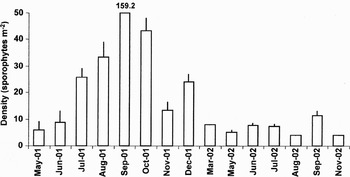
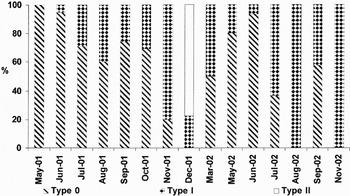
During the experiment performed at Cuevas Point from May 2001 to November 2002, there was a constant presence of juveniles, which were monthly removed. The total number of sporophytes collected throughout the experiment was 575 (38.3±13.2, N = 15) with densities that ranged from 4 to 159 sporophytes m−2 (Figure 6). 61.77% of the sporophytes collected were Type 0 juveniles without midrib and 33.56% Type I with midrib but without sporophyll. Only 4.67% of the sporophytes showed incipient sporophyll Type II and were registered in December 2001 (Figure 7).
Abundance of recruited sporophytes collected in the 2001–2002 experiment performed at Cuevas Point. Average density calculated as number of sporophytes m−2 (+SE).

Proportion of each reproductive type registered through the recruitment experiment performed at Cuevas Point.

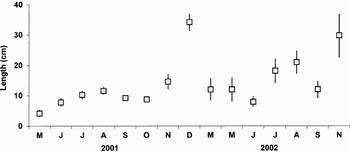
The length of the sporophytes recruited ranged from 0.5 to 52 cm, with an average length from 4.12 cm (±1.14, N = 15) in May 2001 to 31.7 cm (±3, N = 20) in December 2001. The size distribution of the sporophytes showed a predominance of young recruiting sporophytes since 87% were individuals below 20 cm in length (Figure 8).
Average length (±SE) of Undaria pinnatifida sporophytes collected at Cuevas Point where the 2001–2002 recruitment experiment was performed.

DISCUSSION
We focused our interest in the relationships between morphological characters of individuals of this population of U. pinnatifida with the annual variations of seawater temperature in Nuevo Gulf. The population showed a seasonal trend in weight of sporophytes with highest average biomass only in spring, values not only related with the weight of individuals but also with size of sporophylls that were progressively increasing towards the summer. Differently, in New Zealand the highest values of biomass are reported for winter and spring with a decline of these values in summer, which correlates with the variations of superficial seawater temperatures (Hay & Villouta, Reference Hay and Villouta1993). Similarly, in Korea the growth and biomass in a cultivation area are maximal at the end of winter and spring (Oh & Koh, Reference Oh and Koh1996).
The midrib width was a useful parameter, which allowed us to confirm the relationship between this structure and the size of sporophytes. This character was closely related with both rates of zoospore release in Tasmania and individual biomass in New Zealand (Hay & Villouta, Reference Hay and Villouta1993; Schaffelke et al., Reference Schaffelke, Campbell and Hewitt2005).
The number of individuals in Nuevo Gulf increased during the growing season (autumn–winter). In comparison with other introduced populations, the maximal mean density of individuals, found in June 1999, was similar to that found in mainland Australia where density of 150 plants m−2 was reported in a single collection performed in September 1996. In a similar way, 100 plants m−2 were indicated in Tasmania, near 200 plants m−2 in New Zealand as a result of seasonal peak in recruitment and approximately 250 sporophytes m−2 off the French Mediterranean coasts (Boudouresque et al., Reference Boudouresque, Gerbal and Knoepffler-Péguy1985; Sanderson & Barrett, Reference Sanderson and Barrett1989; Hay & Villouta, Reference Hay and Villouta1993; Campbell & Burridge, Reference Campbell and Burridge1998).
Although the largest sporophyte was collected in winter (August 1999) when the lowest values of seawater temperature were registered, the average length of individuals was maximal in spring. This situation shows similarities with those of other introduced populations of U. pinnatifida, as reported for the Mediterranean Sea with sporophytes up to 100 cm in length and in the Venice Lagoon with sporophytes up to 180 cm in length (Boudouresque et al., Reference Boudouresque, Gerbal and Knoepffler-Péguy1985; Curiel et al., Reference Curiel, Bellemo, Marzocchi, Scattolin and Parisi1998). Castric-Fey et al. (Reference Castric-Fey, Beaupoil, Bouchain, Pradier and L'Hardy-Halos1999) reported for Brittany the presence of individuals up to 190 cm in length and on the south coast of England sporophytes up to 100 cm in length were found in 1994 (Fletcher & Manfredi, Reference Fletcher and Manfredi1995).
The differences in size observed on the different coasts where the alga has been found could be also related with environmental conditions other than temperature, such as light and turbidity of the water closely related to depth. Light intensity is also important in determining the vertical distribution (Floc'h et al., Reference Floc'h, Pajot and Wallentinus1991). Other factors such as grazing of blades and sporophylls were not associated to the size of sporophytes because the consumption rates by herbivores are low (Sanderson; Reference Sanderson1990, Teso et al., unpublished results). In California where Undaria has been present since 2000, the native kelp crab Pugettia producta (Randall, 1839) (Crustacea) was reported as a grazer on juvenile Undaria blades (Silva et al., Reference Silva, Woodfield, Cohen, Harris and Goddard2002; Thornber et al., Reference Thornber, Kinlan, Graham and Stachowicz2004).
The degree of exposure may be an important factor related with differences in vertical distribution but not with the size of sporophytes. Areas protected from high wave action are denser than those with high exposure (Sanderson, Reference Sanderson1990; Brown & Lamare, Reference Brown and Lamare1994).
In Nuevo Gulf U. pinnatifida has been found growing from the rocky intertidal up to 22 m in depth, showing tolerance to a wide range of radiation. This broad growing area indicates that if adequate substrates are available, the lower limit is determined by the quality of light. In coasts where the presence of Undaria has been reported, the percentage of light could be dramatically reduced by water turbidity. In these cases, although suitable substrates were available, the maximum depth where sporophytes were found was no more than 5 m (Saito, Reference Saito, Tokida and Hirose1975; Sanderson, Reference Sanderson1990; Brown & Lamare, Reference Brown and Lamare1994).
Seasonality in the size of sporophylls was a good indicator of reproductive maturity. Sporophylls showed a gradual development during the year, since mature sporophytes have been observed from April attaining the maximal number in December. Maximal values in width were registered in February 2000 in spite of the damage produced on the sporophytes by the summer temperatures. Damaged individuals with larger (near 18 cm in diameter) and healthier sporophylls were observed in the drift line on Puerto Madryn city beaches in summer (G. Casas, personal observation) leading us to the conclusion that sporophytes are reproductive from January to December.
Populations of Undaria in the northern hemisphere that grow in the northern limit of dispersal have also a seasonal pattern but a low optimal growth temperature (Skriptsova et al., Reference Skriptsova, Khomenko and Isakov2004). In coastal regions with a narrow temperature range and maximal temperatures in summer from 15 to 19°C, young and mature sporophytes are found together all the year (Hay & Luckens, Reference Hay and Luckens1987; Stuart et al., Reference Stuart, Hurd and Brown1999).
Recent experiences showed that small but undoubtedly mature sporophylls are able to release zoospores (Schaffelke et al., Reference Schaffelke, Campbell and Hewitt2005). In our study the production and viability of zoospores were not statistically tested, but we experimentally confirmed the occurrence of juveniles during all the cycle, indicating that in Nuevo Gulf zoospores are released and could germinate at any time, including the coldest months. This can be inferred from the occurrence of juvenile and mature sporophytes with different frequencies but during almost all the year, indicating that the reproductive pattern is not seasonal. Indeed, after the canopy of mature sporophytes was removed, younger sporophytes were recurrently observed, suggesting that they were resting among large individuals and will develop when freed from the competitive canopy effect. Moreover, dense brownish gametophytes of Undaria were observed settled on the crustose Corallinaceae Synartrophyton sp., on Ascidiaceae and on valves of Aulacomya ater Molina. Nevertheless, further sampling for other potential substrates for gametophytes will be necessary, since the presence of Undaria on a determined group of taxa gives no indication as to whether these organisms are its preferred settlement surface.
Mediterranean populations of U. pinnatifida have an annual life cycle and thus one recruiting season. The same occurs in Japanese populations (Akiyama & Kurogi, Reference Akiyama and Kurogi1982; Boudouresque et al., Reference Boudouresque, Gerbal and Knoepffler-Péguy1985; Curiel et al., Reference Curiel, Bellemo, Marzocchi, Scattolin and Parisi1998). On the contrary, most of the introduced populations have successive recruitment, since both small juvenile and large mature sporophytes are found simultaneously all the year (Hay, Reference Hay1990; Floc'h et al., Reference Floc'h, Pajot and Wallentinus1991; Hay & Villouta, Reference Hay and Villouta1993; Casas & Piriz, Reference Casas and Piriz1996; Casas, Reference Casas2005). This pattern of constant recruitment occurs in Nuevo Gulf and thus shows clear differences with the dynamics of the native Japanese populations (Wallentinus, Reference Wallentinus and Gollasch1999). The relatively small annual range of variation of the seawater temperatures could determine this situation. Consequently, in this paper, it has been demonstrated that this Patagonian population of U. pinnatifida has a constant recruitment, together with high reproductive rates. It is clear that they possess some of the characteristics of introduced species, explaining why they became a highly invasive species or ‘pest species’, with the negative environmental and economic effects they have developed since their introduction in Argentina.
ACKNOWLEDGEMENTS
We are grateful to N. Palleres for collaborating with us in the laboratory work and to the Service of Nautical and Diving (CENPAT–CONICET), especially to H. García for assistance in the field. The valuable suggestions of Dr E. Cáceres helped us to improve the manuscript.