Cerro de Trincheras is a regional center in northern Mexico on the Magdalena River, Sonora (McGuire and Villalpando Reference McGuire, Elisa Villalpando, Fish, Fish and Elisa Villalpando2007, Reference McGuire and Elisa Villalpando2011, Reference McGuire and Elisa Villalpando2015; Villalpando and McGuire Reference Villalpando and McGuire2009). The site has over 900 terraces that supported habitation structures as well as areas for production, rituals, and social gatherings (McGuire and Villalpando Reference McGuire, Elisa Villalpando, Fish, Fish and Elisa Villalpando2007, Reference McGuire and Elisa Villalpando2011). Cerro de Trincheras was occupied approximately AD 1300 to 1450 and was contemporary with similar terraced hill sites in northwest Mexico and the southwestern United States (Fish et al. Reference Fish, Fish and Elisa Villalpando2007). After AD 1450, population declined drastically; groups continued to occupy the area throughout the protohistoric period, but there was a general abandonment of prehispanic cultural patterns. In AD 1694 Spanish captain Juan Mateo Mange (Reference Mange1993; Manje Reference Manje and Karns1954) reported the archaeological site in his expedition diary.
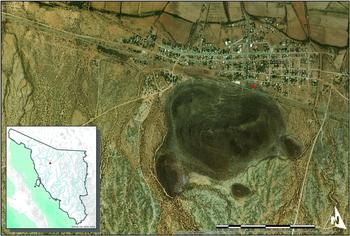
Previous excavations on the hill documented 10 inhumations (McGuire and Villalpando Reference McGuire and Elisa Villalpando2011; Villalpando and McGuire Reference Villalpando and McGuire2009). Recent archaeological research located an urnfield cemetery at the base of the hill in a small mound called La Loma de las Cremaciones (Figure 1; Villalpando et al. Reference Villalpando, Cruz Guzmán and Nava Maldonado2009; Watson et al. Reference Watson, Cerezo-Román, Nava Maldonado, Cruz Guzmán, Elisa Villalpando, Schmidt and Symes2015). Watson and colleagues (Reference Watson, Cerezo-Román, Nava Maldonado, Cruz Guzmán, Elisa Villalpando, Schmidt and Symes2015) explored formation of the cemetery and the importance of its creation for prehispanic inhabitants.
Map of the site.

We build and expand on these early findings to investigate transformations of this cemetery space. Unlike Watson and colleagues (Reference Watson, Cerezo-Román, Nava Maldonado, Cruz Guzmán, Elisa Villalpando, Schmidt and Symes2015), we explore the repurposing and transformation of this cemetery from the prehispanic to historic periods. Rather than adopting a static approach, we evaluate how the space was for centuries an area of social negotiation and integration. Cemetery use changed significantly through time, but the special quality of the space as a place of remembrance persevered as it was transformed. We explore these transformations by evaluating different modes of disposal of the dead through time and the repurposing of space.
Creation of The Cemetery
Both inhumation burial and cremation were practiced at Cerro de Trincheras, although cremation was the prevalent mode of interment (Watson et al. Reference Watson, Cerezo-Román, Nava Maldonado, Cruz Guzmán, Elisa Villalpando, Schmidt and Symes2015). The urnfield sample comprises 141 prehistoric cremations and three historic infant inhumations. Cremation usually included a transformational process and secondary treatment; remains were often placed in urns and interred away from the place of cremation.
Cremation is an act of deliberate transformation, going beyond the burning of flesh (Kuijt et al. Reference Kuijt, Quinn and Cooney2014). There are changes in the perception of the deceased by society. The individual, formerly a living member of the society, is transformed into a new materiality as small, burned bone fragments.
Following burning at a location to the northwest of the hill, remains were gathered and placed inside a vessel with associated burned objects and buried in the cemetery at the northern base of the hill. Cremated bones are easily manageable, allowing for many different treatments—as seen in some modern and past societies (Williams et al. Reference Williams, Cerezo-Román, Wessman, Cerezo-Román, Wessman and Williams2017). Through the actions of collecting remains, transporting them to a new location, and burying them, a “second body” is created for the deceased in their ancestral or transformed state (Williams Reference Williams2004). Remains are more than just fragments; they tell stories and evoke memories. The Trincheras remains may have been used to construct a new social persona for remembrance. Vessels in which remains were placed could have served as a “new body,” but distinct vessel shapes and burial objects maintained individuality and personhood.
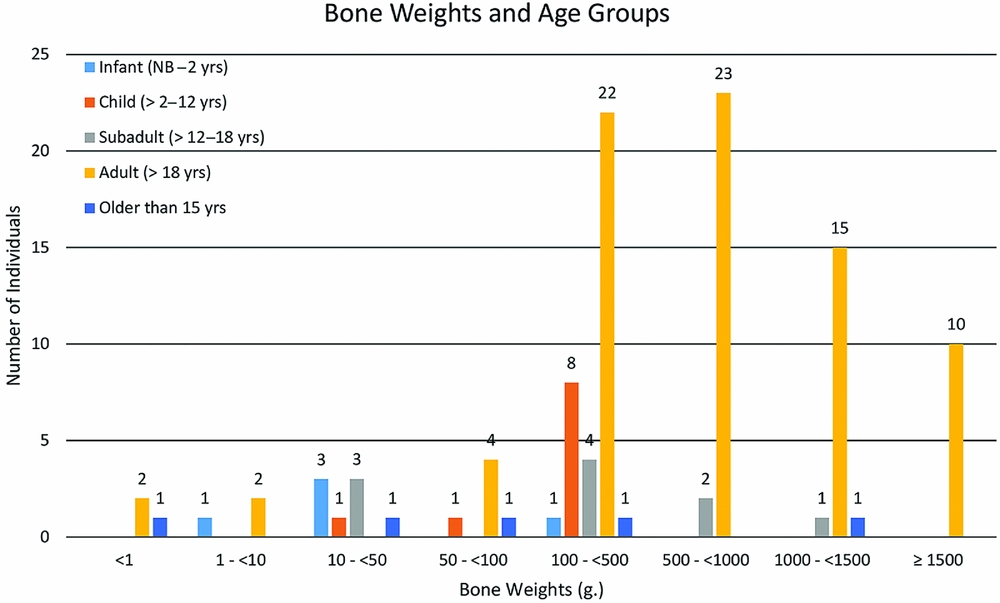
Cremated bones of an adult usually weigh 1.5 kg or more (Cerezo-Román Reference Cerezo-Román2015). At Trincheras, cremation bone weights average 721 g per individual. This value is considerably higher than the mean masses of Preclassic (99.97 g) and Classic period (362.70 g) Hohokam secondary cremation deposits in the Tucson Basin, southern Arizona (Cerezo-Román Reference Cerezo-Román2015), and some other ancient cremations (e.g., McKinley Reference McKinley1993) where remains are fragmentary. The average bone weight of the Trincheras sample is consistent with complete adults and children (Figure 2). Moreover, the inventory of osteological elements also suggests that most deposits contain the remains of nearly complete bodies. This may indicate that individuals were transformed by fire into a different kind of self, but that the individual and individuality were maintained.
Bone weights and age groups.

Cemetery Transformations
Watson and colleagues (Reference Watson, Cerezo-Román, Nava Maldonado, Cruz Guzmán, Elisa Villalpando, Schmidt and Symes2015) proposed that homogeneity in the treatment of remains is associated with ritual, emphasizing collective identity rather than the individuality of the deceased. In contrast, we suggest that a complex sequence of performances, concerned with transforming and then reconstituting the dead into a new materiality, served to mediate remembrance. Through these processes and the passage of time, individuals were transformed into part of an ancestral collective memory.
Memory can be thought of as linked to actions, meanings, and experiences (Kuijt Reference Kuijt2008), suggesting that there are general patterns in developing social memory and commemoration. These include repetition in observance, reenactment of some former circumstances, social sanctions for the ceremony, and formality. Kuijt notes that by reenacting the events, they are legitimized and given authority and meaning. In this way the events are understood, coherent, and meaningful to participants. Memory is also time sensitive and dynamic. Its creation occurs through actions of people that intersect at different social scales. Events and interactions of people involved help to shape long-term, intergenerational meaning and convert them into a form of collective or communal memory (Kuijt Reference Kuijt2008). Memory also changes over time from experiential and personal to abstract and referential. For mourners who knew the deceased, that memory begins as experiential and personal. Through time, however, memory becomes depersonalized and abstract, and the dead merge into an ancestral memory that is anonymous and collective. Kuijt (Reference Kuijt2008) further notes that remembrance, regeneration, and forgetting are complementary in the creation of secondary mortuary deposits.
Urn burials are secondary deposits, and we can see them as symbolic acts that have complex sets of social, political, and personal meanings. Removing bones from pyres and placing them in highly visible locations preserves the memory of the dead. At Trincheras, the cemetery is next to the main settlement, and its location at the northern hill base can be viewed from most points in the settlement. Mourners also were afforded physical views of the cremation fire and subsequent burial. From the settlement, residents likely saw smoke from cremation fires to the northwest and the emplacement of urns in the cemetery to the north. This visibility suggests a personal, active, and direct memory and remembrance.
It also is likely that families of the deceased knew exactly where their family member was buried. Vessels in the urnfield cemetery were placed near each other (Villalpando et al. Reference Villalpando, Cruz Guzmán and Nava Maldonado2009; Watson et al. Reference Watson, Cerezo-Román, Nava Maldonado, Cruz Guzmán, Elisa Villalpando, Schmidt and Symes2015). Occasionally, rocks were placed around the vessels, suggesting that they delimited burial space, although how is not always clear. If viewed from the hillside, differences between each urn would not be as apparent. This suggests that through time the memories of individuals buried in the urnfield became indirect and referential, transformed into a collective ancestry. Individuals could be reimagined as more general ancestors for the entire community.
Vessels were placed close together, increasing community cohesion and shared social membership through time. This certainly was not a rapid process. As new cremations occurred, they engendered memories of previous funerals, over time creating a tradition of how to remember and commemorate the dead. It is uncertain when the last urns were placed in the cemetery, but in historical times the urnfield was no longer used as a cremation burial ground, and use of the space was transformed.
Three infant inhumations were deposited in the urnfield after AD 1450 but their exact chronology is unclear. Nava Maldonado (Reference Nava Maldonado2013) notes that each of these infant burials was found under a small pile of rocks. Associated material included wood fragments and metal screws and nails, and one of the individuals had two shell buttons found on its sternum. Nava Maldonado (Reference Nava Maldonado2013) compares these with Tohono O'odham and lower Pima infant burials from Arizona, Sonora, and Chihuahua, and suggests that the closest match is with O'odham burial customs. For example, at Palo Parado (Arizona), Quitovac (Sonora), El Divisadero (Chihuahua), and El Olote (Chihuahua), small rock piles were placed over burials, similar to those found at the infant inhumations at Cerro de Trincheras (Nava Maldonado Reference Nava Maldonado2013). Other scholars (Brew and Huckell Reference Brew and Huckell1987; Hanlon Reference Hanlon1972) mention the placement of rocks to cover burials as part of O'odham burial customs in Arizona. The relationship between prehispanic occupants and later historic populations in the area is uncertain. Nonetheless, since the urnfield continued to be used for burials, it is likely that the ancient use of the space was remembered by the local population. Wickholm (Reference Wickholm, Fahlander and Oestigaard2008) argues that monuments and specific sites evoke memories of historic events. Certainly, remembrance of ancestors falls within this description. At the urnfield cemetery, no monuments were found, but it is possible that the site still held some remembrance—mainly related to disposal of the dead—to historic populations of the area, and perhaps even related to prehispanic occupants.
There are other possibilities, however, as to why infants were buried in the urnfield. In AD 1539 Emperor Charles V, who oversaw the Spanish colonization of the Americas, declared that members of indigenous groups must be buried in Catholic monasteries or churches if possible (Rodríguez Álvarez Reference Rodríguez Álvarez2001). In cases where there was no monastery or church in a town or vicinity, individuals could be buried in a consecrated Catholic space. Unbaptized infants and children, however, were excluded and buried in unconsecrated land. It is conceivable that the three infants found at the cemetery were unbaptized. It is also possible that the mourners were not Catholic and claimed a connection with prehispanic traditions. Unfortunately, current data do not allow us to exclude either of these possibilities. Regardless, it is probable that the families who buried these infants had some connection with the landscape and that this connection influenced their choice of location. Burial locations on the landscape are generally carefully chosen by mourners and thus become embedded with different memories through time (e.g., Wickholm Reference Wickholm, Fahlander and Oestigaard2008).
Placing these three infants in the cemetery created a link to the past prehispanic inhabitants of the hill, or at least to a sacred or important place; Cerro de Trincheras is a very prominent landmark and occupies a unique space on the local landscape.
Conclusions
In this report we explore transformations in use of the urnfield cemetery at Cerro de Trincheras to analyze ideas about remembrance and commemoration. This was accomplished by evaluating how the space was used though time by local populations. In prehispanic times homogeneity in funeral treatments of cremated remains and cemetery use suggest commemoration acts imbued with symbolic and significant value. In historical times the space continued to serve for burials and remembrance. Eventually, the cemetery was abandoned altogether and its commemorative and remembrance qualities were forgotten. A contextual approach to cemeteries and landscapes is necessary to begin to reconstruct the complexity of practices performed through time in this kind of space. Rather than viewing cemeteries as static, it is useful to evaluate the different kinds of activities performed in them and how they were transformed through time.
Acknowledgments
We are indebted to Thomas Fenn, Matthew Pailes, and Megan Sheehan for their valuable advice.
Data Availability Statement
Osteological inventories and field notes for this study are stored in the Bioarchaeology Laboratory, Department of Geography and Anthropology, California State Polytechnic University, Pomona, Bioarchaeology Laboratory, Arizona State Museum, Tucson and Centro Instituto Nacional de Antropología e Historia (INAH), Sonora. All data are available upon request from the authors.