

Introduction
Offshore financial activity has taken centre stage in academic and policy debates following calls for more equitable taxation in the wake of the 2007–2008 global financial crisis [Organisation for Economic Cooperation and Development (OECD) 2010; Zucman Reference Zucman2013a, Reference Zucman2013b; Johannesen Reference Johannesen2014]. Deposits in offshore entities – companies, accounts, trusts or funds created in low-tax, offshore jurisdictions – can be used to evade taxes on interest income and to hide illegitimate sources of income. One recent estimate put the unrecorded global offshore financial wealth of households in 2008 at 7.3% of the world’s gross domestic product (GDP) (Zucman Reference Zucman2013a). Although the characteristic secrecy of offshore activity makes it difficult to uncover the owners of offshore entities, anecdotal evidence suggests that most of these entities are owned by the world’s richest households and are used to escape taxation. A recent torrent of leaks of offshore account owners’ details from financial services firms supports this line of argument [International Consortium of Investigative Journalists (ICIJ) 2013b, 2015]. Given the sums involved and the ownership of this wealth, better-designed and better-enforced tax policy can generate large gains in terms of equity, as Zucman (Reference Zucman2013b) and Johannesen (Reference Johannesen2014) pointed out.
Policy reactions over the past few years have included information exchange agreements with offshore financial centres (OECD 2010), amnesties for tax evaders disclosing offshore assets (Inland Revenue Service 2012) and the criminal prosecution of bankers and banks assisting with offshoring for tax evasion (Swiss Financial Market Supervisory Authority 2009; US Securities and Exchange Commission 2009). Policymakers claim some success on these measures, but the record is mixed. With regard to information exchanges, for example, assets can be moved out of a cooperative jurisdiction to a non-cooperative one before an enquiry begins. Johannesen and Zucman (Reference Johannesen and Zucman2014) provide empirical results that are consistent with this behaviour. The United Kingdom’s (UK) Liechtenstein Disclosure Facility, an amnesty agreement for British owners of offshore Liechtenstein accounts, has from October 2009 to December 2014 yielded GBP 1,023 million (Her Majesty’s Revenue and Customs 2014). Still, considering bank assets alone, some USD 965 million of UK bank assets remain in Liechtenstein [Bank for International Settlements (BIS) 2014].
In this article, we build on Johannesen (Reference Johannesen2014) and analyse an important policy initiative that preceded the global financial crisis. The European Union’s (EU) 2005 Tax and Savings Directive aims to restrict offshore tax evasion by EU residents. The Directive obliges cooperating offshore jurisdictions to either withhold tax on interest income earned by entities whose beneficial owner – ‘any individual who receives an interest payment or any individual for whom an interest payment is secured’ [European Commission (EC) 2003, Article 2(1)] – is an EU resident, transferring the bulk of the tax revenue back to the resident’s home country, or to report information on the interest payments and identities of the entity’s owners to their home countries. Offshore centres prefer the first option because their own banks withhold the tax, allowing them to keep the entity’s ownership secret, and thus keep their appeal as secretive financial centres. The Directive manages a compromise between generating tax revenue and maintaining banking secrecy in cooperative offshore centres.
Crucially, the Directive only applies to cooperating jurisdictions and on a beneficial ownership basis. The Directive can be circumvented by transferring beneficial ownership to a resident or entity that is not registered to an address in the EU and by transferring the entity to a non-cooperating offshore jurisdiction. Further, entity owners who allow their offshore banks to report their interest income are exempt from the withholding tax. This ensures the tax only affects owners who are unwilling to report their interest income – likely tax evaders – leaving compliant entity owners unaffected.
We are interested in how offshore entity owners with undeclared offshore assets responded to the Directive. A nonresponse outcome implies that assets are transferred from wealthy and untaxed entity owners to their home governments. The Directive can, however, trigger the substitution of cooperative for non-cooperative offshore jurisdictions, further restricting the ability of home governments to access taxable resources. We test this substitution hypothesis using a data set on individual offshore entities that is new to the academic debate.
In April 2013, the ICIJ released a database – the ICIJ Offshore Database – containing some 270,000 offshore entities, covering a period of 30 years, ending in 2010 (ICIJ 2013a, 2013b, 2013c, 2013d). The data set covers entities incorporated in 10 jurisdictions: the British Virgin Islands (BVI), the Cayman Islands, Cook Islands, Singapore, Hong Kong, Samoa, Seychelles, Mauritius, Labuan and Malaysia. The data were leaked to the ICIJ from two offshore services firms: Singapore-based Portcullis TrustNet (TNET) and BVI-based Commonwealth Trust Limited (CTL). The only change ICIJ made to the data was adding a country identification filter, which was the result of an automated process that detected country information in addresses, jurisdictions or tax statuses. This helped us to split the sample into EU-owned and non-EU-owned entities and to match them to entity offshore jurisdictions. The ICIJ removed personal information from the records, such as e-mail addresses and telephone numbers, passport numbers and, more problematically for our purposes, assets and financial transactions.
This brings us to two important caveats to bear in mind throughout our analysis. First, we are working with counts of individual entities rather than deposit values as in the study by Johannesen (Reference Johannesen2014) or Johannesen and Zucman (Reference Johannesen and Zucman2014). This means that every entity, no matter how much wealth is actually in there, is given equal weight. Second, this is a leaked rather than official comprehensive data set; therefore, we cannot be sure that empirical insights drawn from it are truly generalisable. Further to this, the number of entities with incorporation dates drops to 140,201; drops again to 124,921 after filtering out empty home country entries; and drops again to 52,987 when filtering out empty jurisdictions, leaving us with time series that run from 1995 to 2008. Still, it remains a large data set with a number of advantages. First, it is a new source of evidence that can contribute to an evidence-scarce debate. Empirical work so far relies on the same BIS database or on the change in use of financial instruments that can be used to evade tax policy (Klautke and Wichenreider Reference Klautke and Weichenridder2010; Johannesen and Zucman Reference Johannesen and Zucman2014). Second, it is interesting to see whether entity-level responses differ from country-level responses and whether these differences have implications for policy design. Third, entity incorporation dates are given precisely to the day, meaning variation in our data is not obscured by quarterly aggregation, and we can pick high frequency responses. Finally, although it is a leaked data set from two private firms, these firms appear to have commanded a large share of the market in offshore services provision. For example, the cumulative number of company incorporations in the BVI by 31 December 2008, the end of our study period, was 414,620 [British Virgin Islands Financial Services Commission (BVI FSC) 2008]. The number of BVI incorporations registered by these two firms up to this point was 81,305 or 19.6% of the cumulative total.Footnote 1
Empirically, we follow Johannesen (Reference Johannesen2014) and exploit the fact that the Directive changed the international tax environment for EU residents but not for non-EU residents, allowing us to identify the Directive’s causal effect on offshore activity. We split our sample into offshore entities owned by EU residents, our treatment group, and entities owned by non-EU entities, our control group. By comparing the change in the growth of our treatment group with the control group after the Directive was introduced, we can measure the Directive’s causal effect on offshore entity growth. Our baseline result shows a sharp downward break in the trend of EU-owned entity growth immediately after the Directive. Non-EU-owned entities also changed trend after the Directive, becoming increasingly upward sloping. We show that the number of EU-owned entities declined in the week preceding the Directive’s implementation, but not before, supporting our use of the Directive’s implementation as an appropriate cut-off point. Finally, we show that after the Directive the ratio of non-EU to EU entity ownership increased, and entity ownership in non-cooperating jurisdictions increased relative to that in cooperating jurisdictions. These results are robust to time trends, exchange-rate movements and different estimation methods and empirical specifications.
Our results are consistent with the substitution hypothesis. EU entity owners did not repatriate their funds nor did they leave them put. They instead moved their funds to non-cooperative offshore jurisdictions and transferred beneficial ownership to non-EU residents or entities. The implications of our results fit with Johannesen (Reference Johannesen2014). First, that offshore entities responded so significantly to a policy intended to only affect tax evaders implies that a large portion of offshore wealth is undeclared. Second, that the response was so soon after the Directive implies that tax evaders are highly responsive to changes in international tax law. Together these implications call for a “front-loaded” rather than piecemeal approach to policy targeted at offshore wealth.
More work related directly to the Directive includes the study by Hemmelgarn and Nicodeme (Reference Hemmelgarn and Nicodème2009), who used national account data, deposit data and government revenue data to measure the impact of the Directive, finding that it had no measurable effects. Klautke and Wichenreider (Reference Klautke and Weichenridder2010) showed bonds that are exempt from the withholding tax due to a grandfather clause are not associated with lower pre-tax returns than similar taxable bonds, suggesting the existence of alternative withholding tax avoidance measures. Similarly, Rixen and Schwarz (Reference Rixen and Schwarz2012) found evidence that investors reallocated assets from debt to equity products in the same country in order to avoid the Directive. Johannesen and Zucman (Reference Johannesen and Zucman2014), very similar to our findings here, showed that information-exchange treaties between offshore centres and home countries trigger shifts of deposits from cooperative to non-cooperative offshore centres, but not repatriation of funds. Finally, our article contributes to the new literature on “forensic economics”, in which researchers aim to understand “behavior that agents would prefer to conceal” (Zitzewitz Reference Zitzewitz2012, 731).
Context
Most governments retain the right to tax interest income earned by their citizens wherever that interest is earned. Enforcement relies on citizens declaring their interest income from foreign countries and information exchanges between tax authorities. According to the OECD (2006), there are two necessary conditions for the effective exchange of tax information. First, domestic law in the foreign jurisdiction must either allow for the sharing of information itself or there must be a bilateral treaty between the foreign jurisdiction and the taxpayer’s government. Second, the foreign jurisdictions must have access to the information themselves. Banking secrecy laws, most notably in Panama, can restrict access to information even for their own tax authorities, which is part of their appeal as offshore jurisdictions. The EU Tax and Savings Directive is an attempt to meet these two conditions.
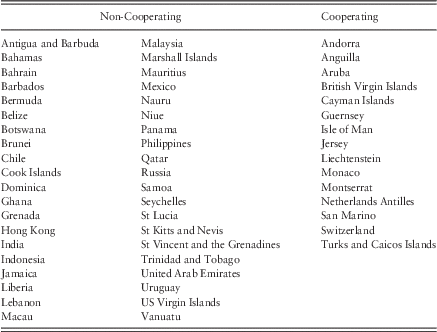
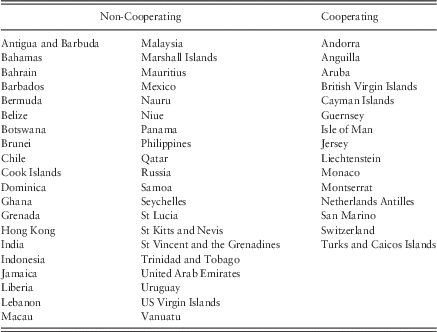
The Directive covers all EU member states along with 15 cooperating offshore centres displayed in Table 1. Plans for the Directive were announced in June 2003, negotiations were concluded at the end of 2004 and the Directive took effect on 1 July 2005. The Directive allows for cooperation along both conditions by giving cooperating jurisdictions two choices. They can either withhold tax on interest income earned by offshore entities whose beneficial owner is an EU resident, transferring 75% of the tax revenue to the owner’s home authorities, or they can report information on the interest income and ownership of the entity to the owner’s home authority. For 2005, the withholding tax was set at 15%, 20% starting in 2008 and 35% starting in 2011 (Johannesen Reference Johannesen2014, 48). The withholding tax replaces taxes levied in the home country.
Most EU countries adopted the information-exchange condition, whereas most cooperating offshore jurisdictions opted for the withholding condition. This is important as it allows offshore centres to retain their purpose and appeal as banking secrecy jurisdictions. Payment agents – banks, trusts, debt issuers or other entities or even individuals – in cooperating jurisdictions remit the withholding tax without disclosing the identity of the taxpayer, allowing them to remain anonymous.
Although the Directive marks a big change to the international tax environment for EU residents, the EC (2008) is itself aware of the Directive’s limitations. The Directive can be circumvented in three important ways, which are crucial to our empirical strategy and results. Our following interpretation of the Directive, particularly that it de facto affects legal persons, is not uncontroversial. In the Appendix, we provide additional detail on this section to substantiate our interpretation and assumptions.
First, the Directive only applies to EU and cooperating offshore jurisdictions. A look back to Table 1 shows that there exist many more non-cooperating offshore jurisdictions. EU residents can circumvent the Directive by transferring their entity to one of these non-cooperating jurisdictions while retaining beneficial ownership of their entity if they so choose.
Second, the Directive only applies to entities whose beneficial ownership is registered to EU residents. For example, the Directive effectively applies to the interest income earned by EU owners of a BVI entity if they are registered as such, but not if the entity’s beneficial ownership is registered to a non-EU resident through the use of a nominee or master client. This means that if EU residents transfer beneficial ownership of their entity to, say, a BVI resident, they are out of the Directive’s scope, even though the BVI is a cooperating jurisdiction.
Third, it is also possible for EU residents to replace their interest-yielding assets with structured finance products whose returns are not considered to be interest, and thus are not subject to the Directive (Klautke and Weichenreider Reference Klautke and Weichenridder2010; Johannesen Reference Johannesen2014).
Evidence consistent with tax evasion would therefore be declining beneficial ownership registered to EU residents, declining offshore activity growth in cooperating jurisdictions and a switch to structured finance products. We have no data to cover the latter type of evidence, but our empirical strategy exploits the first two types. We test for the substitution of EU for non-EU ownership and cooperative for non-cooperative centres.
Empirical strategy
We want to measure the Directive’s causal effect on EU-owned offshore entity growth. Following Johannesen (Reference Johannesen2014), our identification strategy exploits the fact that the Directive changed the international tax environment facing EU residents, but not non-EU residents. We use the post-1 July 2005 (the Directive’s implementation date) behaviour of non-EU-owned entities to proxy for the counterfactual post-Directive behaviour of EU-owned entities in the absence of the Directive to estimate a causal effect on offshore accounts. We do this in two ways.
First, we split our sample into two different time series. The first is our treatment series, which contains daily counts of offshore entities with EU-resident ownership. The second is our control series, which contains daily counts of offshore entities with non-EU-resident ownership as well as owners not resident in an offshore centre as defined by the OECD (2004). We then explore the changing time trends of these two series before and after the Directive; we implement the following:
 $$Count_{t} \,{\equals}\,\alpha \,{\plus}\,\beta _{1} Time_{t} \,{\plus}\,\beta _{2} Directive_{t} \,{\plus}\beta _{3} \,(Time_{t}\, {\times}\,Directive_{t} )\,{\plus}\,\theta {\mib{X}} _{t}\, {\plus}\,{\varepsilon}_{t} $$
where the dependent variable is the count on day t of incorporated offshore entities, Time is a daily time trend, Directive is a dummy that equals 1 for the post-Directive period, the last term interacts the previous two independent variables and under X we control for a set of covariates. The α and ε are a constant and an error term with standard properties, respectively. Estimating (1) separately for the treatment and control groups, β 3 shows us the change in trend in the post-Directive period. To be consistent with the substitution hypothesis, we expect the coefficient on the interaction term to be negative and statistically significant for the treatment series and positive for the control series. Our main estimation technique is a Poisson regression, which is designed for count data, and for dependent variables that follow a Poisson distribution.Footnote 2
Second, we pool the treatment and control series and estimate the standard multi-period difference-in-difference regression framework (Angrist and Pischke Reference Angrist and Pischke2009); we implement the following:
 $$Count_{{it}} \,{\equals}\,\alpha\, {\plus}\,\beta _{1} Time_{t}\, {\plus}\,\beta _{2} Directive_{t} \,{\plus}\,\beta _{3} \,(Treatment_{i}\, {\times}\,Directive_{t} )\,{\plus}\,\theta {\mib{X}} _{t} \,{\plus}\,{\varepsilon}_{{it}} $$
where i indexes treatment or control group observations, and β 3 now measures the average deviation from the general time trend in post-implementation periods. We expect this coefficient to be significant and negative, implying a downward break in trend in the incorporation of offshore entities owned by EU residents.
We cross-check the results of (1) and (2) using different estimation methods and by using different outcome variables.
Data
In 2012, the ICIJ received a hard drive, anonymously mailed to its director, Gerard Ryle, containing 260 gigabytes of files leaked from two organisations: TNET, based in Singapore, and CTL, based in the BVI. Both firms, which the ICIJ calls “offshore service providers” in its publications, set up overseas companies and trusts for clients around the world. TNET has offices in the BVI, the Cayman Islands, the Cook Islands, Hong Kong, Mauritius, Samoa, the Seychelles, Singapore and Taiwan, offering services in each of those jurisdictions. Its services include “customised corporate, trustee and fund administration and management services to private individuals, institutions and professional advisers and their clients around the world” (TNET 2015). CTL is headquartered in the BVI but also operates in other offshore jurisdictions, including the Bahamas and Belize (Norddeutscher Rundfunk 2013).
Among the leaked files were Microsoft Access databases that contained the firms’ operational data, including all the overseas entities that they set up for their clients. The ICIJ worked with database engineers to write scripts to produce a union of the two databases, clean the data in the resulting database using Talend ETL (extract, transform and load) software and model it as a single graph database with entities (companies and trusts), addresses and people as nodes and the relationships between them as edges (ICIJ 2013a, 2013b, 2013c, 2013d). The data set used in this article is the product of that process, released to the public by the ICIJ along with the publication of the investigation.
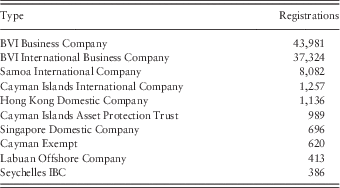
As illustrated by Table 2, the data set contains a large volume of companies registered in the BVI, which can be attributed to one of the original databases, from CTL, which is based in Tortola. It also reflects a global trend of the BVI as a popular offshore jurisdiction, with just under 0.5 million active offshore companies in a country with a population of 28,000, representing 40% of all offshore companies registered worldwide (World Bank 2011). We can get a sense of how representative these data are, or in other words how large these firms’ market share in offshore financial services provision was, by looking at the number of companies they registered versus the total number of companies registered. The cumulative number of company incorporations in the BVI by 31 December 2008, the end of our study period, was 414,620 (BVI FSC 2008, 1). The number of BVI incorporations registered by these two firms up to this point, as can be seen in Table 3, was 81,305 or 19.6% of the cumulative total. The second biggest number of registrations was for companies in Samoa. We do not have a cumulative total number of registrations for this jurisdiction, but we know that the number of registrations in 2008 alone was just 53 (Government of Samoa 2011, 84). If this annual number of registrations was constant, it would take 152 years to reach the 8,082 registrations in Table 2.
Entity types in the original data set
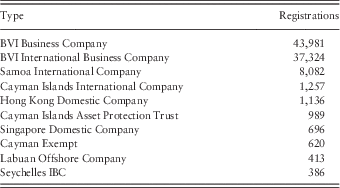
Notes: Samoa, Hong Kong, Singapore, Labuan and Seychelles are non-cooperative jurisdictions. British Virgin Islands (BVI) entities may be registered to BVI corporations rather than the actual country of residence, exempting them from the European Union’s Tax and Savings Directive. The only entities liable to domestic corporate income tax are Labuan (3%), Hong Kong (16.5%) and Singapore (17–20%). The only domestic withholding taxes are in Hong Kong (17–20%) and Singapore (10–15%).
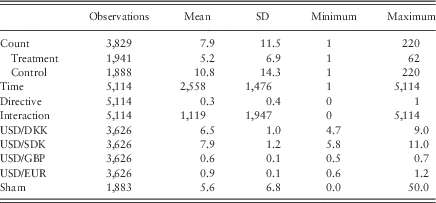
Summary statistics
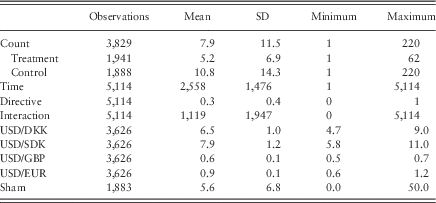
Notes: Count is the daily count of newly incorporated Treatment [European Union (EU)] and Control (non-EU) offshore entities. Time is a daily time trend, whose maximum number is the total number of days in the period. Directive equals 1 for days that fall under the EU Tax and Savings Directive. Interaction is an interaction term between the previous two variables.
USD/DKK=US dollar to Danish kronor exchange rate; SDK=Swedish kronor; GBP=British pound; EUR=euro; British Virgin Islands (BVI)/Treatment=ratio of BVI-registered and held entities to EU-registered entities.
The distinction between the top two types, BVI Business Company and BVI International Business Company, is worth pointing out. The BVI Business Companies Act came into force on 1 January 2005, replacing the BVI International Business Companies Act, partly as a result of external pressure. Under the previous BVI International Business Companies Act, companies were exempt from taxation in the BVI; now they may be liable for stamp duty, but only on the transfer of real estate and assets in a BVI company owning real estate in the BVI. The new Business Company Act came into force as the BVI set income tax at 0. Samoa, Hong Kong, Singapore, Labuan and Seychelles are non-cooperative jurisdictions in the Directive. BVI entities may be registered to BVI (“sham”) corporations rather than actual country of residence, exempting them from the EU Tax and Savings Directive, a fact that we empirically explore later. The only entities liable to domestic corporate income tax are Labuan (3%), Hong Kong (16.5%) and Singapore (17–20%). The only domestic withholding taxes are in Hong Kong (17–20%) and Singapore (10–15%).
Unfortunately, the data set contains no data other than the associated country of an individual that would allow us to build an accurate demographic picture of the offshore service providers’ clients and the officers of the registered companies.
Still, the ICIJ’s investigation showed that many of the offshore entities in the database were registered by CTL and TNET on behalf of “master clients” (ICIJ 2013a, 2013b, 2013c, 2013d), middlemen representing the real owners of those entities, whom the ICIJ has characterised as “shady operators”. In the case of CTL, master clients were required to perform due diligence and what is known in the sector as “know your client” (KYC) but were crucially not obliged to provide proof of that diligence to CTL (1999). The result, according to the ICIJ, was that CTL was investigated by the BVI’s Financial Services Commission, which determined that “CTL had breached the BVI’s anti-money laundering laws by failing to verify and record the identity of its clients” (ICIJ 2013a, 2013b, 2013c, 2013d). Indeed, the ICIJ found that 23 BVI companies registered by CTL were linked to money laundering from a Russian tax refund scam investigated by Hermitage Capital Management, a Russia-focussed hedge fund, and Sergei Magnitsky (of the 2012 United States Magnitsky Act), its legal representative in Russia. The investigation by the BVI Financial Services Commission spanned five years and led to the banning of CTL from taking on new clients until it was purchased by Equity Trust in 2009 and its new owners agreed to follow regulations. The stricter regulations led CTL staff to complain in internal e-mails that sales volumes had fallen 20% year on year and of “significant legal changes which many clients see as making the BVI a somewhat less ‘friendly’ place to base a company than other competing jurisdictions” (CTL 2008).
Our goal was to extract from these data files time series of the daily counts of incorporated offshore entities registered to EU and non-EU residents. To do this, we first filtered out all entities without home country and incorporation data, which are essential for our analysis. This leaves us with 126,686 entities. Second, although the data range from a record in 1918 (a likely source error) to a record in 2020 (future incorporation dates), we focus on the 1995 to 2008 period. Records from the 1918 to 1994 period only account for 1.39% of the sample, and records from the 2009 to 2020 period for another 2.19%. Very often during the excluded periods, there is only one entity per year, meaning that these years, although forming most of the period, contain little information. The resulting period is a year longer than Johannesen’s (Reference Johannesen2014) quarterly data set that runs from 1995 to 2007. This gives a total of 122,145 entities and a yearly median of 7,741 entities. As in the study by Johannesen (Reference Johannesen2014, 50), we limit this sample along two other dimensions.
First, we exclude entities belonging to offshore countries, that is, offshore entities registered as having an offshore country as their home country. BVI as a home country, for example, accounts for 54% of all entities. This most likely reflects the use of “sham” corporations, which we analyse in the following section. Including these offshore-registered entities would bias our results, as the Directive may have increased the use of “sham” corporations, because they in effect allow EU residents to register as residents in offshore countries, thus evading the withholding tax. This leaves us with 34,953 entities. Second, in our EU group, we only include countries that were already member states in 1995, leaving out those that joined in the 2004–2007 enlargement period. The later member states signed various agreements with offshore centres at more or less the same time they signed onto the Directive, and it is not possible to credibly disentangle the effects of the Directive versus the bilateral agreements. The 14 EU countries in our treatment group are as follows: Austria, Belgium, Finland, France, Germany, Greece, Ireland, Italy, Luxembourg, the Netherlands, Portugal, Sweden, Spain and the UK. The treatment group accounts for 29% of all 34,953 entities; the remainder are in the control group.Footnote 3
Table 3 summarises our main variables. The frequency of all observations is daily. The Treatment group variable shows a mean daily count of offshore entity incorporations of 5.2, with an SD of 6.9. We have 1,941 observations for the entire period. The gaps in the series do not necessarily imply 0 counts, but rather missing or cleaned data (exclusion on account of no home country values). For this reason, we err on the side of caution and leave those gaps as they are rather than impute 0 values. The same holds for the Control group variable, where we have 1,888 observations. Our strategy involves looking at estimated trends across the whole period in these incomplete series, so that we are in effect interpolating missing values.
The Control group has a higher mean value, at 10.8, as it is composed of many more countries than the Treatment group. The Time variable cumulatively adds each day in the sample, so that the length of our period is 5,114 days. We use this variable to estimate time trends in the values of the Treatment and Control groups over the whole period, as well as for pre- and post-Directive sub-periods. These sub-periods are identified using the Directive dummy variable, which takes a value of 0 for all days leading up to 1 July 2005, and a value of 1 for all remaining days. Interaction is our main variable of interest: it is an interaction of the previous two variables, and in the empirical analysis it shows us whether the trend growth of the treatment and control groups differs in the post-Directive period. We control for movements in major exchange rates, which provide a useful daily indicator of economic cycles around the world, which may affect the formation of offshore entities in the treatment versus control group. The rates, all against the USD, are for the Danish kronor, the Swedish kronor, the British pound sterling and the euro. They are from Global Financial Data (2015). The number of exchange-rate observations is less than the total number of days as currencies are not traded on weekends. The final variable, BVI/Treatment, is the ratio of BVI offshore entities with the BVI registered as their home address to the Treatment entities variable. In our empirical analysis, we use this ratio to model the growth of BVI-registered entities relative to EU-registered entities before and after the Directive. If the Directive led to more “sham” corporations, then we should expect this ratio to exhibit faster growth in the post-Directive period. We truncated this ratio making it a series of whole numbers, so that we can be consistent in our use of Poisson estimations for count data. The skewness statistics for the treatment and control groups are, respectively, 3.20 (mean of 5.2) and 6.34 (mean of 10.8), implying positive skews in line with a Poisson distribution.
Empirical results
Basic time trends
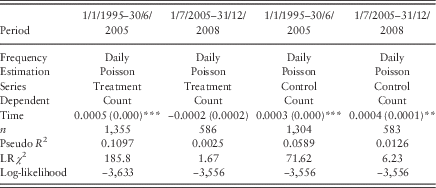
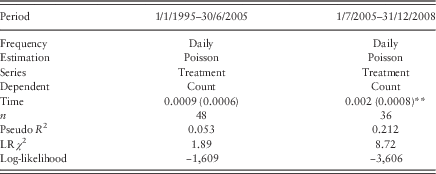
To get an initial feel for the data, Table 4 shows the results of four simple regressions. We regressed the daily treatment and control series on a time trend for a subsample ending a day before the Directive and then on a subsample beginning on the day of the Directive. For the treatment series, we get a positive and significant coefficient in the pre-Directive subsample, indicating positive growth, but in the post-Directive subsample we get a negative (but insignificant) coefficient, indicating a reversal in trend. Further, the control series yields positive and significant coefficients, the post-Directive coefficient being slightly larger, in both periods.
Time trends in treatment and control offshore entities
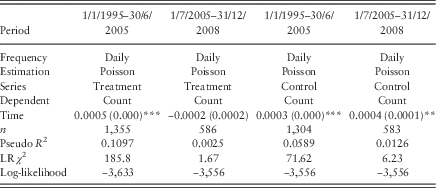
Notes: The dependent variable is the daily count of newly incorporated Treatment [European Union (EU)] or Control (non-EU) offshore entities. Time is a daily time trend. Estimated using Poisson count regressions. Robust standard errors in brackets.
Statistical significance: ***1 and **5%.
LR = Likelihood Ratio.
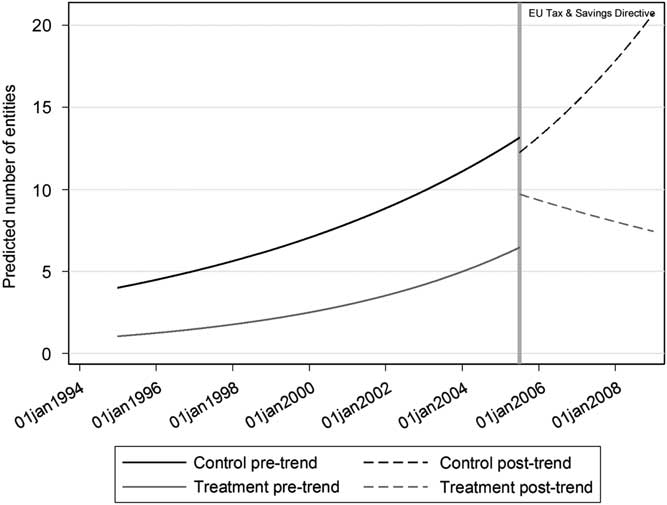
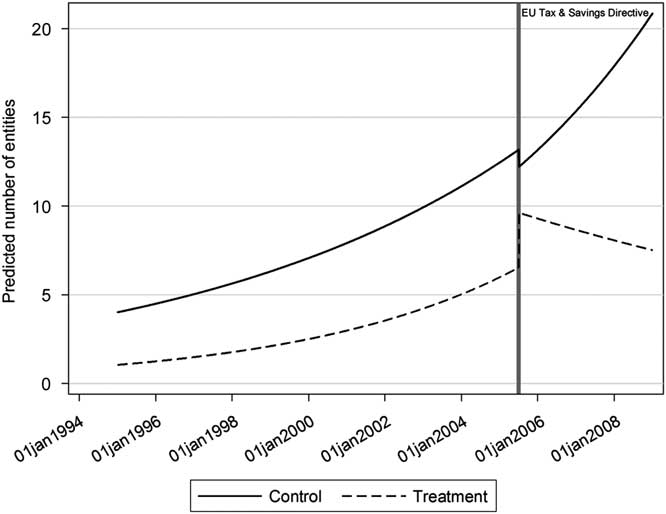
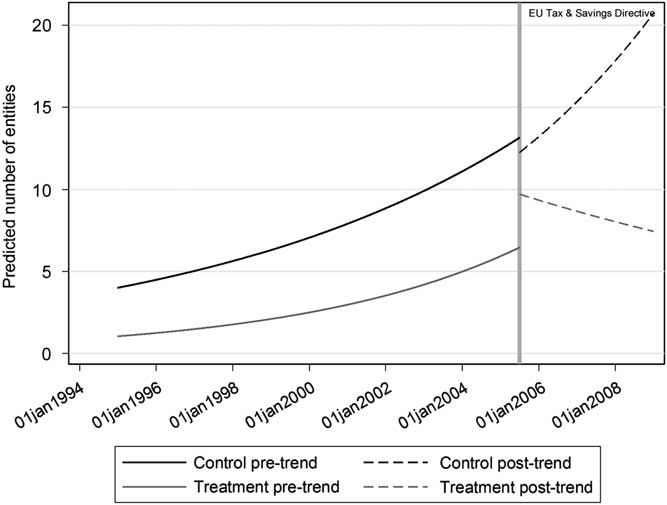
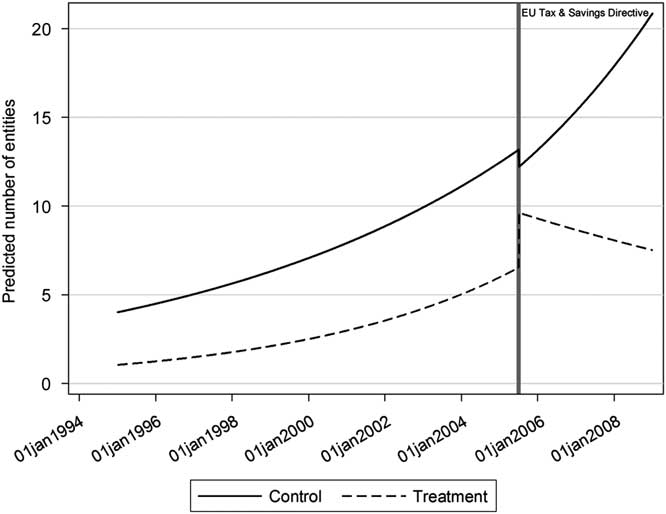
We use the coefficients from Table 4 to predict the time trends of both series before and after the Directive. The results are plotted in Figure 1. It is clear that both the treatment and the control series were growing in synchronisation before the Directive. This is an important point, as it implies that the treatment and control groups were similar before the Directive. Thereafter, the treatment series diverged from the control, indicating lower daily counts of offshore entities registered to EU residents. The control series continued on its upward trajectory.
Time trends in treatment and control offshore entities with no interaction term. Notes: Time trends estimated using results from Table 5.
The database also contains limited information on the dormancy dates – dates when offshore entities stopped being active – of entities. We should expect the Directive to give EU owners of offshore entities an incentive to close their existing entities and open new ones that are non-EU-owned. To get a handle on this, we ran the same specification as in Table 4 for our treatment series, but switched the dependent variable to daily counts of registered dormancies instead of incorporations. With this dependent variable, we should expect a significant and positive coefficient on the time trend for the post-Directive period – that is, an increase in the dormancies of EU-owned entities after the Directive’s implementation. This is supported by the results in Table 6. In the pre-Directive period, there is no significant trend of dormancies. In the post-Directive period, the trend is significant and positive: the post-Directive period was associated with an increase in the number of dormancies of EU-owned entities.
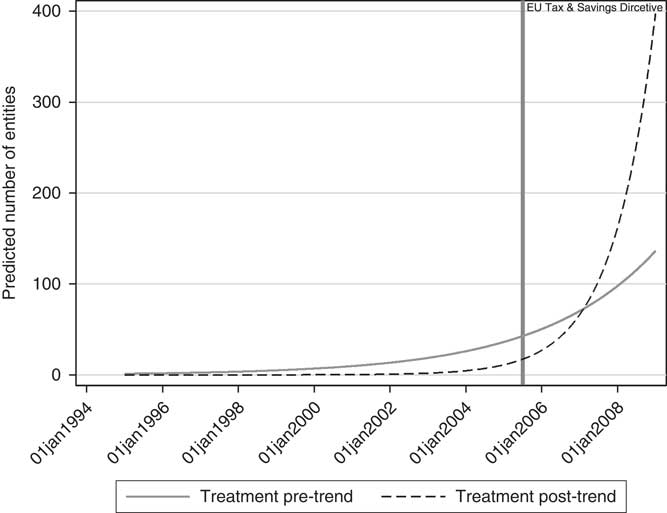
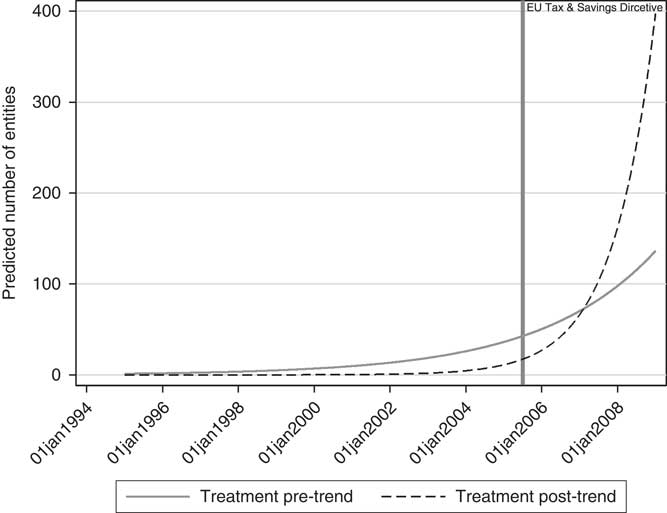
We predict a time trend of the dormancy series using the coefficient in the first column in Table 5 (the pre-Directive coefficient) and predict another using the coefficient in the second column of Table 5 (the post-Directive coefficient). The results are displayed in Figure 2. The first series shows a stable and gradual increase in the number of dormancies over time. The second series, however, shows a dramatic increase in the number of dormancies for the post-Directive period. By the end of the period, the first series predicts a dormancy count of around 150 compared with 400 for the second series.
Time trends in treatment entity closures with no interaction term. Notes: Time trends estimated using results from Table 6.
Time trends in dormancies of treatment entities
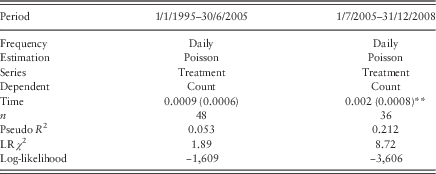
Notes: The dependent variable is the daily count of entities that registered as “dormant”. The “dormancy date” is the date on which the entity stopped being active. Treatment (European Union) refers to offshore entities. Time is a daily time trend. Estimated using Poisson count regressions. Robust standard errors in brackets.
**Statistical significance: 5%.
Although consistent with a sharp response to the Directive by EU entity owners, this simple exercise is limited. First, we are “manually” splitting the sample into two periods rather than using the whole length of the series and including an interaction and dummy term for the Directive period. Second, the dormancy series contains a very limited number of observations, making an inference unreliable. Third, neither estimation controls for currency movements; the differing trends in EU-owned and non-EU-owned entities may reflect different business cycles in different economies. Exchange rates provide useful daily time series that can help control for this. The following exercises seek to address these issues.
Baseline estimation
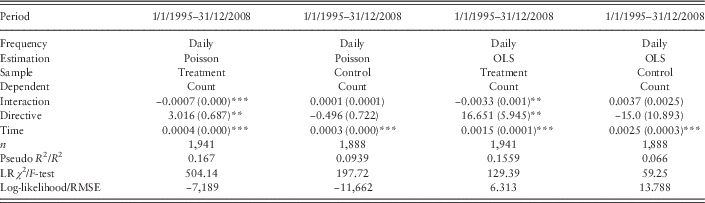
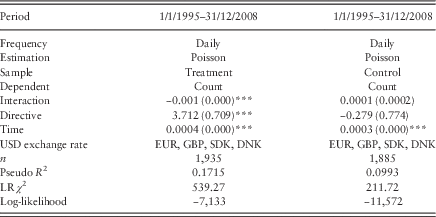
In Table 6, we run the full specification represented in model (1) for our control and treatment series. Column 1 contains the results for the treatment series. It shows positive and significant coefficients for the time trend and for the Directive dummy. The latter reflects the higher absolute daily count numbers in the post-Directive period, and the former reflects the overall positive trend growth for the length of the series. An explanation for this result is CLT and TNET gaining an increasingly larger share of the increasingly larger global offshore activity market. The interaction term, however, is negative and highly significant. This supports the sharp break in the trend we highlighted in Table 4 and Figure 1: a cut back on the number of offshore entities registered to EU owners.
Baseline estimation of treatment and control offshore entities
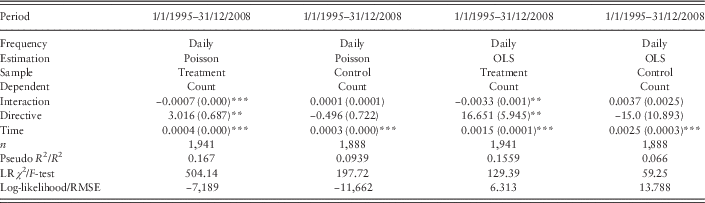
Notes: The dependent variable is the daily count of newly incorporated Treatment [European Union (EU)] or Control (non-EU) offshore entities. Time is a daily time trend. Directive is a dummy that takes one for all days when the Directive is in operation. Interaction is Directive×Time. Estimated using Poisson count regressions or ordinary least squares (OLS). The root mean square error (RMSE), R 2 and F-test refer to the OLS estimates. Robust standard errors in brackets.
Statistical significance: ***1 and **5%.
Is it a large effect? As this is a Poisson regression, the coefficient shows the difference in the logs of daily counts for a unit change in the independent variable. The interaction term thus implies that for every day in the post-Directive period the daily count drops by ×0.999 (exp[−0.0007]). Therefore, at the end of the 1,279 days of the post-Directive period, the mean daily count of 5.2 would drop to 2.1 (5.2×exp[−0.0007]1279) – that is, a reduction of 59%. This 59% figure represents the efficiency loss associated with the Directive’s introduction.
Although this is a large effect, the positive coefficients on the time trend and directive dummy imply that the Directive still did not give rise to a permanent downward-level shift in the daily growth of EU-owned entities. That it slowed down the growth of such entities but did not drop the level substantially perhaps speaks to a degree of effectiveness. Recall that a nonresponse is the ideal outcome for EU policymakers, as it means assets are being transferred from wealthy offshore entity owners to their home countries in the EU.
Column 2 shows the results for the control series. The results are expectedly different: a positive, but insignificant coefficient on the interaction term and a highly significant time trend coefficient. Columns 3 and 4 show ordinary least squares (OLS) estimates of the same specification, where the hierarchies and significance levels of the coefficients remain the same.
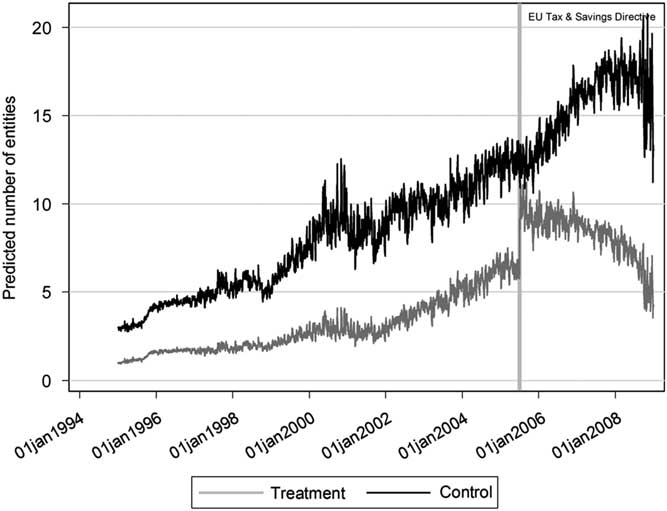
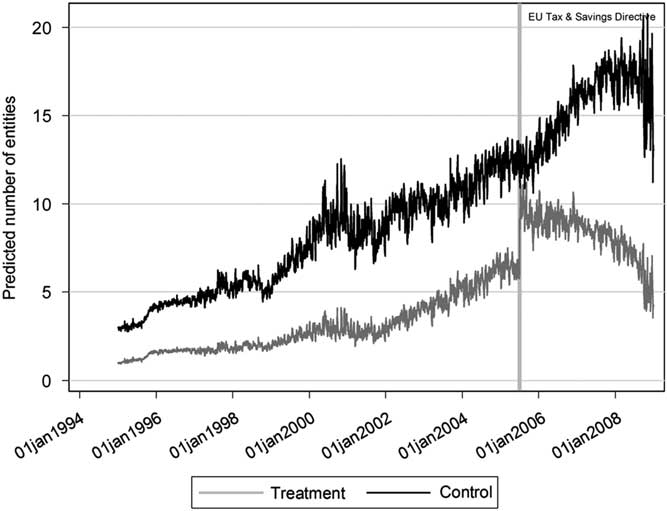
Strong support of the substitution hypothesis would require a positive and significant coefficient on the control series’ interaction term. Although this coefficient is positive, it is insignificant. Still, a clear divergence between the two series is clear in Figure 3, which uses the results in Table 6 to again predict the daily count series. That this matches Figure 1 so closely supports an EU-specific response to the Directive. Substitution is still possible, as it may be occurring for “home” countries not included in our sample. Although our data set constrains what we can do, we explore this issue in the final empirical exercise.
Time trends in treatment and control offshore entities with interaction term. Notes: Time trends estimated using results from the first and second columns in Table 7.
Preemptive response to the Directive
Next, we ask the following question – Was there also a response to the Directive before it was implemented? This is interesting in itself, but also because using the Directive’s implementation date as our cut-off point may be problematic if entity owners altered their tax status well in advance of the Directive.
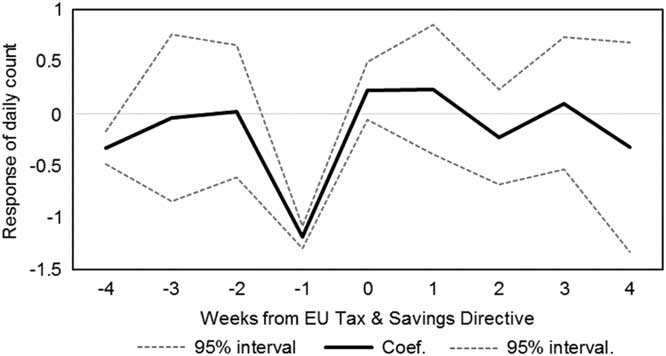
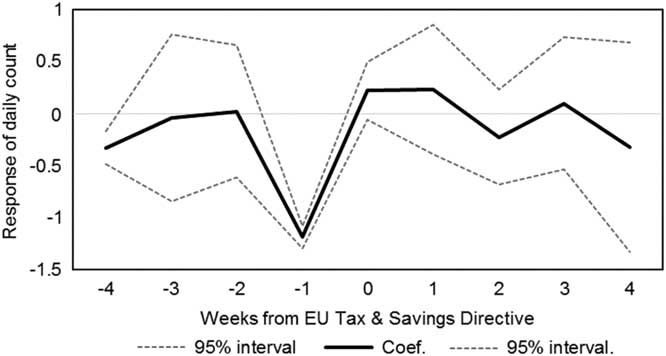
The high frequency nature of our data set allows us to narrow down variation much more than the quarterly intervals used by Johannesen (Reference Johannesen2014), who found outflows in the two quarters preceding and succeeding the Directive. For the coefficients and robust standard errors plotted in Figure 4, we estimated model (1) on the treatment series, extending it by including weekly dummy variables for the four weeks immediately before and after the Directive.Footnote 4 The “week 0” dummy variable is centred on the day of the Directive; increasing negative numbers indicate weeks further back in time from the Directive, and increasing positive numbers indicate weeks further forward in time from the Directive. The figure shows coefficients that are mostly below 0, but also insignificant. The two significant coefficients, however, are for “week 1”, with a z-score of −21.78, and for “week 4”, with a z-score of −4.12. We do not want to push too hard on Figure 4 as there is a lot of noise in the data, but the high level of significance on “week 1” indicates some movement of ownership out of the EU in the last few days of the pre-Directive period. As such, we are reassured that using the Directive’s implementation date as our cut-off point is reliable.
±4 weekly response of the treatment group to the Directive. Notes: Estimated by extending column 1 of Table 3 to include week dummy variables for 4 weeks before and 4 weeks after the Directive. Week 0 is centred on the day of the Directive. The two significant coefficients are for “week 1”, with a z-score of −21.78, and for “week 4”, with a z-score of −4.12. Coef. is the coefficient on the week dummy.
Pooled estimation
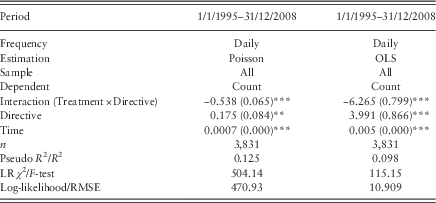
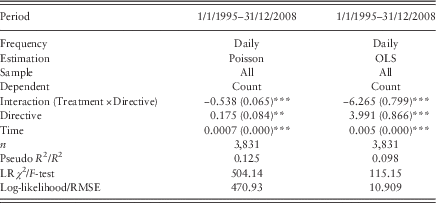
Here, we pool the treatment and control series, and replace the usual interaction term with an interaction between a dummy that identifies treatment observations only and the Directive dummy. Rather than comparing time trends by group, this pooled empirical setting allows us to measure how the time trend of treatment entities deviates from the general time trend in the post-implementation period. This is the standard time series difference-in-difference regression framework (Angrist and Pischke Reference Angrist and Pischke2009). The results are given in Table 7.
Pooled estimation
Notes: The dependent variable is the daily count of newly incorporated Treatment [European Union (EU)] and Control (non-EU) offshore entities. Time is a daily time trend. Directive is a dummy that takes 1 for all days when the Directive is in operation. Interaction is Directive×Treatment dummy. Robust standard errors in brackets.
OLS=ordinary least squares; RMSE=root mean square error.
Statistical significance: ***1 and **5%.
The Poisson estimation in the first column shows a highly significant and negative coefficient on the interaction term, implying that the treatment series deviated downwards significantly during the post-implementation period. The effect implies that the treatment group’s daily count for the post-Directive period was ×0.59 lower (exp[−0.538]) than that of the control group. In other words, as the control group’s post-Directive mean daily count was 15.1, the interaction term coefficient implies that the treatment group’s daily mean daily count was 8.9 (15.1×exp[−0.538]). This result also indicates that the difference in growth rates between the treatment and control series is statistically significant. The second column contains the results of an OLS estimation, which support the Poisson estimates. Although it is difficult to compare the OLS and Poisson coefficients on the interaction term, the ratios of their coefficients to their robust standard errors are similar: −7.83 for the OLS estimate against −8.21 for the Poisson estimate. In both cases, the post-implementation deviation of the treatment series from the general trend is negative, highly significant and large.
Controlling for exchange-rate movements
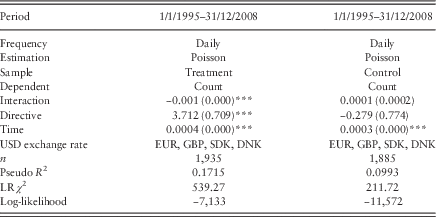
The divergence between our treatment and control series may reflect diverging economic conditions in the treatment versus the control group. We do not think this is likely, as the break in trend occurred in mid-2005, when all economic regions were growing in synchronisation, which continued well into the global financial crisis after which economic regions went into decline.Footnote 5 Still, exchange rates provide a useful daily-frequency control for differing economic conditions in home countries, as well as for the changing relative values of international wealth. In Table 9, we introduce as controls daily time series for the USD exchange rate with the euro, British pound sterling and Swedish and Danish kroners. As described in the data section, these currencies cover the EU countries included in our treatment series. The results remain unchanged: a negative and significant interaction term for the treatment series, but a positive and insignificant one for the control series.
Figure 5 uses the results in Table 8 to predict the daily counts. It shows that including exchange rates did not change the timing of the divergence either. In fact, Figure 5 shows that before the Directive there was some small degree of convergence of the treatment on the control series; it is only after the Directive that it diverged.
Time trends in treatment and control offshore entities with exchange-rate controls. Notes: Estimated using results from Table 9.
Controlling for major exchange rates
Notes: The dependent variable is the daily count of newly incorporated Treatment [European Union (EU)] or Control (non-EU) offshore entities. Time is a daily time trend. Directive is a dummy that takes 1 for all days when the Directive is in operation. Interaction is Directive×Time. Estimated using Poisson count regressions. Robust standard errors in brackets. All exchange rates with USD.
USD=US dollar; EUR=euro; GBP=British pound; SDK=Swedish kronor; DNK=Danish kronor.
Statistical significance: ***1 and **5%.
Sham corporations and substitution
To get a tighter specification on the substitution hypothesis, we looked into the proliferation of “sham corporations”. Transferring beneficial ownership of assets from an individual (natural person) beneficial owner to a corporation is a popular way of ensuring secrecy for tax evaders. Many offshore centres such as the BVI, Samoa or Panama specialise in incorporation and domiciliation services. Clients would approach their bank to set up a sham corporation in which they can deposit their funds. The bank would liaise directly with a firm in an offshore centre that offers incorporation services on behalf of its client. Working together, the bank and the incorporation services firm create an offshore holding company for the bank’s client, with the beneficial ownership residence being the country of the incorporation services firm. In this way, EU residents can evade the Directive’s scope without leaving the Directive’s area of jurisdiction: they are no longer the beneficial owners of the entity – the sham corporation is.
This is important in our context as it means EU residents can in effect substitute their residency. Say an EU resident owns an entity in the BVI. As it stands, this puts them in the scope of the Directive. If, however, the resident simply transfers beneficial ownership to a corporation or individual registered as resident in the BVI, then they are no longer in the Directive’s scope, despite the new owner being in the BVI, which is a cooperating jurisdiction.
Indeed, our data set points to the BVI as being a major offshore sham corporation jurisdiction. Some 54% of all entities in our data set are registered to an owner address in the BVI. This alone is suspicious as, unlike the Cayman Islands or Bermuda, the BVI does not have a large enough domestic financial sector to account for such a large share of the sample offshore account stock.
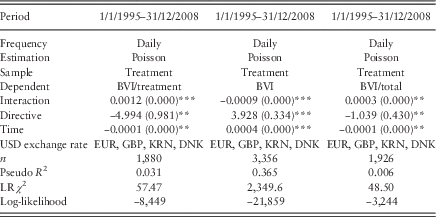
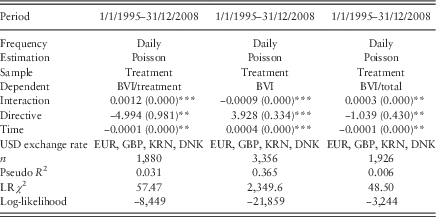
If offshore entity owners are making use of this substitution facility, then we should expect the number of entities that are both incorporated and owned in the BVI (rather than just incorporated) to increase relative to the number of EU-owned entities. For the dependent variable in Table 10, we calculated the ratio of the two series, truncating it so that the ratio is rounded to whole integers in order to keep the results comparable with previous tables. As expected, the coefficient on the interaction term has changed sign and retained a high level of statistical significance. This effect would have taken the sham ratio mean of 5.6 up to 25.9 (5.6×exp[0.0012]1279) from the start to the end of the post-Directive period: a 364% increase in the ratio.
The second column switches the dependent variable to the daily count of BVI-owned entities. Here, we see a large positive coefficient of the directive dummy, implying a higher count level, but a negative coefficient on the interaction term, implying a downward break in the ownership of BVI entities. This is seemingly at odds with our expectation of an increase in BVI ownership and the results in column 1, but this coefficient is capturing a general slowdown in offshore activity. The expectation is one of a substitution of EU ownership for BVI ownership rather than simple growth in BVI ownership. In column 3, we again express the BVI owner count as a ratio to the total entity count, and find coefficients that are the same in direction and significance as those in column 1. In short, the results in Table 9 are consistent with the substitution hypothesis.
Sham corporations and European Union offshore entities
Notes: The dependent variable in the first column is the truncated ratio of British Virgin Islands (BVI) entities whose home address is also in the BVI to treatment group entities. The dependent variable in second column is entities with BVI home address. The dependent variable in third column is the truncated ratio of BVI home address entities to total entity count (sum of treatment and control group counts). Time is a daily time trend. Directive is a dummy that takes 1 for all days when the Directive is in operation. Interaction is Directive×Time. Estimated using Poisson count regressions. Robust standard errors in brackets. All exchange rates with USD.
USD=US dollar; EUR=euro; GBP=British pound; DNK=Danish kronor.
Statistical significance: ***1 and **5%.
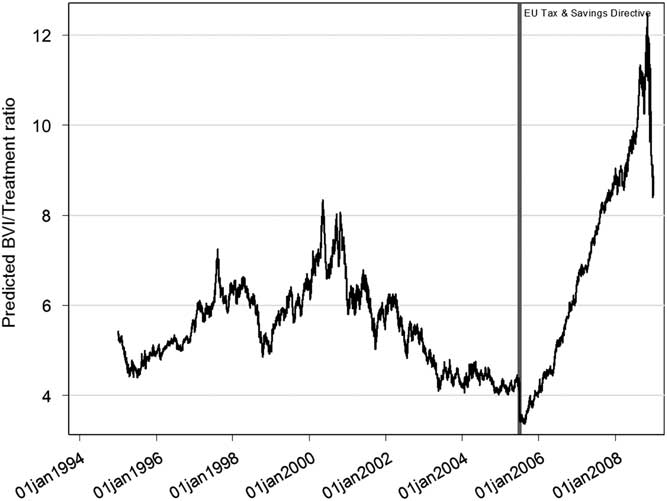
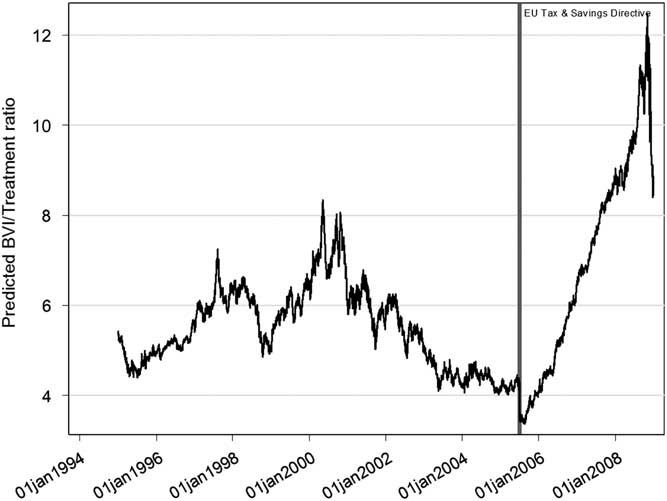
As with previous estimates, we use the main results – column 1 – in Table 9 to predict the ratio series. The result of this exercise in Figure 6 shows clearly a sharp increase in the count of BVI entities relative to EU entities in the weeks immediately succeeding the Directive. Further to this, the ratio was in decline for the five years preceding the Directive: this break in trend was not one of acceleration, but reversal – that is, the Directive led to a movement away from taxable entities and into nontaxable entities.
Time trends in British Virgin Islands (BVI)/treatment offshore entities with exchange-rate controls. Notes: Estimated using results from Table 10.
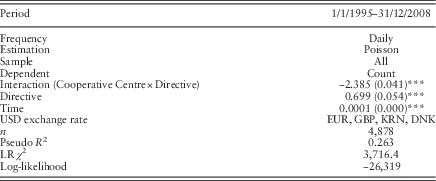
Finally, in Table 10, we exploit the difference between cooperative and non-cooperative offshore centres. The Directive gives EU residents fewer incentives to open new entities in, say, the BVI, where they might be registered as owners, but more incentives to open entities in jurisdictions such as Singapore, where the Directive does not apply regardless of the owner’s residence. We swap our treatment and control group dichotomy for a cooperative centre and non-cooperative centre one. The interaction term is now between a dummy that takes 1 if the entity is owned in a cooperative offshore centre and the usual directive dummy that takes 1 for the post-Directive period. The coefficient on this term is significant and negative, implying a large downward break in the trend of entity growth in cooperative centres. The effect implies that the cooperative group’s daily count for the post-Directive period was ×0.1 lower (exp[−2.385]) than that of the control group. In other words, as the non-cooperative group’s post-Directive mean daily count was 13.8, the interaction term coefficient implies that the cooperative group’s daily mean daily count was 1.4 (13.8×exp[−2.385]).
Cooperative and non-cooperative offshore centres
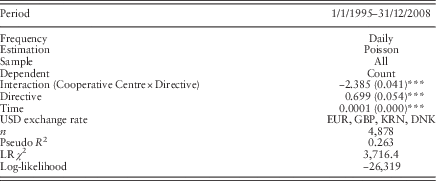
Notes: The dependent variable is the daily count of all offshore entities in both cooperative and non-cooperative jurisdictions. Time is a daily time trend. Directive is a dummy that takes one for all days when the Directive is in operation. Interaction is the entity’s location in either a cooperative (=1) or non-cooperative (=0) jurisdiction×Directive. Estimated using Poisson count regressions. Robust standard errors in brackets. All exchange rates with US dollar.
USD=US dollar; EUR=euro; GBP=British pound; KRN=Swedish krona; DNK=Danish krone.
Statistical significance: ***1%.
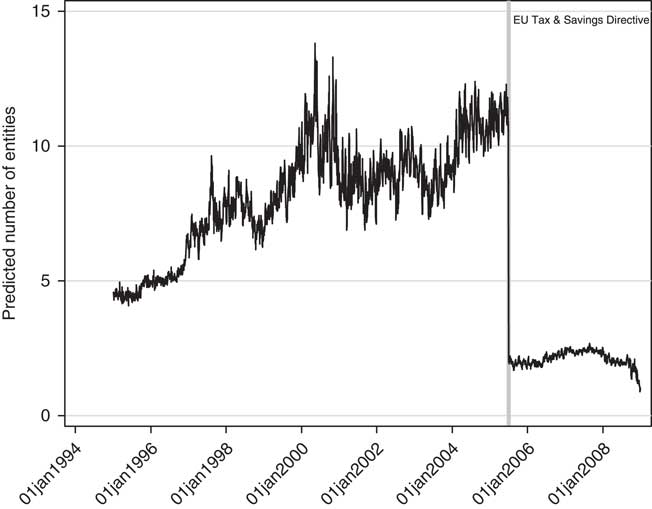
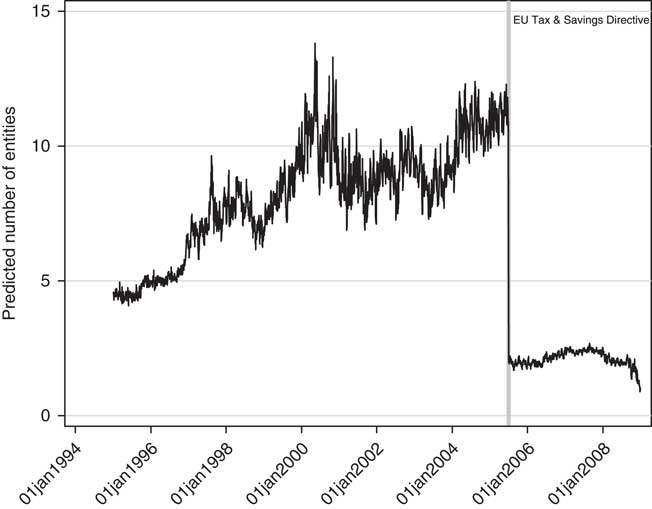
We get a sense of how large this effect is by using the results in Table 10 to predict the daily count of entities owned in cooperative jurisdictions. The results are displayed in Figure 7. The pre-Directive period was one of volatile but secular growth in the daily count of entities owned in cooperative centres. After the Directive, the daily count collapsed from a level of around 10 per day to 1.5 per day. We regard this result, along with Figure 6, as strong evidence of the substitution hypothesis.
Time trends in cooperative offshore entities with exchange-rate controls. Notes: Estimated using results from Table 10.
Conclusion
The 2005 EU Tax and Savings Directive targeted tax evasion by EU residents by introducing a 15% withholding tax on interest income earned in cooperating offshore centres. In this article, we tested the hypothesis that the implementation of the Directive led to a substitution of EU-owned offshore entities for non-EU-owned offshore entities on a novel data set covering individual offshore entities from 1995 to 2008. We did this by splitting our sample into EU-owned (our treatment group) and non-EU-owned (our control group) offshore entities, and examining the changing growth trends before and after the Directive in each group. We also examined the growth in entities owned in offshore centres outside the Directive’s jurisdiction relative to growth of entities within the Directive’s jurisdiction. According to our results, the Directive was associated with a substitution of EU for non-EU ownership and cooperating for non-cooperating jurisdictions. There are some caveats to bear in mind.
First, our data set is on individual entities rather than deposit amounts. This means that each observation is equally weighted, even though the entities may hold different asset values. Second, our data set is leaked from two offshore financial services firms and does not provide comprehensive international coverage. It is difficult to assess the severity of these constraints, but at the very least it fits with the research that does use asset values and more comprehensive data sets (Zucman Reference Zucman2013a; Johannesen Reference Johannesen2014; Johannesen and Zucman Reference Johannesen and Zucman2014). Further, our article adds to the debate in two ways. First, it brings new evidence to the debate that has so far been dominated by the same BIS data set (Johannesen and Zucman Reference Johannesen and Zucman2014). Second, the nature of our data set allows us to pick up higher frequency behaviour than is possible with the popular quarterly-aggregated data, and it allows us to test whether the entity-level response to the Directive differs from the country-level deposit response. We found a large reduction in the daily count of EU-registered accounts for the last week leading up to the Directive, for example. We also found that the entity-level response to the Directive is the same in direction and significance as the country-level deposit response.
The implications of our findings are that offshore tax evasion strategies are highly substitutable (Zucman Reference Zucman2013a; Johannesen Reference Johannesen2014). The Directive can be described as a partial effort to combat evasion, as it leaves scope for substitution. It only deals with interest income, allowing for different assets to be held; it only deals with assets that are directly owned, allowing for the use of sham corporations; and it only cooperates with specific offshore centres, the rest of which escape its jurisdiction. This calls for anti-evasion policies that are broader in scope and scale.
Acknowledgements
The authors thank Niels Johannesen and Hannes Fauser, participants at the INET Young Scholars Initiative-Macroeconomic Policy Institute Workshop in Berlin, for comments on an earlier draft, and two anonymous reviewers and the editor for helping us to improve the article.
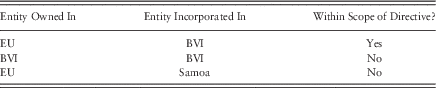
Appendix
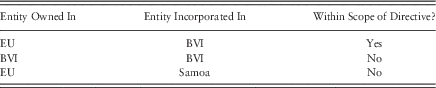
The first two points raised in the “Context” section – (1) the Directive only applies to EU and cooperating offshore jurisdictions and (2) the Directive only applies to entities whose beneficial ownership is registered to EU residents – are illustrated clearly in Table A.1. The first row shows that entities incorporated in, say, the BVI (a cooperative jurisdiction) and owned by EU residents fall within the scope of the Directive. EU residents can transfer beneficial ownership to, say, a resident in the BVI, giving us the situation in the second row where the offshore entity is no longer within the Directive’s scope. EU residents can also retain beneficial ownership and transfer their entity to a non-cooperating jurisdiction, say, Samoa, giving us the situation in the third row, where the entity is again not within the Directive’s scope.
Substitution of ownership and jurisdiction
A point of clarification is necessary here. According to Article 2(1) of the Directive, interest payments do not fall within the Directive’s scope if the beneficial owner of the interest payment is a legal person – an entity – rather than an individual – a natural person. This seemingly poses a problem for our study, which relies on entity data, and seemingly provides an opportunity for avoidance as beneficial owners can transfer ownership to entities, thereby evading the Directive’s focus on natural persons. However, to guard against this obvious loophole, Article 4(2) of the Directive includes a broadening of the definition of “paying agent”. When paying agents transfer interest income to another entity, they must “communicate the name and address of the entity and the total amount of interest paid” to the component authority of its Member State [EC 2003, Article 4(2)]. This exchange of information clause means that “look-through entities” and other interposing partnerships between the payer and recipient of interest payments cannot be used to avoid the Directive (Helminen Reference Helminen2011, 322).
This interpretation of the Directive – that it affects entities – is not uncontroversial. Some work excludes the possibility based on the de jure clauses (e.g. Rixen and Schwarz Reference Rixen and Schwarz2012, 157), but the evidence we present here shows that it does. It is difficult to provide an alternative explanation for the effects we find here. Also consider that the Directive’s stricter regulations led CTL staff to complain in internal e-mails that sales volumes had fallen 20% year on year and of “significant legal changes which many clients see as making the BVI a somewhat less ‘friendly’ place to base a company than other competing jurisdictions” (CTL 2008). Evidence aside, even if paying agents are paying directly to an entity they must, as we said above, report the identity of the ultimate beneficial owners if they know they are EU residents. They are duty-bound to find this out. In these cases, the paying agents “must look through this legal person or arrangement” (Panayi Reference Panayi2013, 70). This makes “the Savings Directive of relevance to persons other than individuals” (Panayi Reference Panayi2013, 70).
At every inter-entity interest payment within EU and cooperative jurisdictions, identity and residence information must be provided to the authorities. This evidence must show who the beneficial owner is. Paying agents are under the Directive bound to collect this information as per Article 3(2). A reluctance to share this information provides an incentive to move both entities and beneficial ownership out of the Directive’s reach.
Indeed, any entity incorporated in a Member State or cooperative jurisdiction to which interest is paid, or for which interest is secured for the benefit of the beneficial owner, is considered under the Directive to be a paying agent upon receiving the interest payment. When interest is paid or credited to an account held by such entity, it is considered an interest payment made by such an entity. In this way, the Directive “affects” or “covers” entities.
Beneficial owners can avoid this by (1) transferring their residence out of the EU, meaning the entity is not beneficially owned by an EU resident to begin with; (2) transferring their entity out of the EU or cooperative jurisdiction, meaning their entity is in an offshore centre that did not sign on to the Directive; or (3) doing both.