Dear Sir: A 26 year-old right-handed female was brought to the emergency department because of escalating behavioural changes since the previous day. She was dysphoric, agitated and aggressive because of the belief that her relatives and friends had been replaced by strangers who intended to harm her; she had already hit her mother. Her uncooperativeness precluded formal neurological examination, but she was disoriented to time and place. Hallucinations were absent. There were no known previous psychiatric or neurological disorders or any drug or toxic exposures; blood alcohol and urinary recreational drug screen were negative. She was admitted to the Psychiatric Department with the diagnosis of first psychotic episode. Risperidone 2 mg and lorazepam 2.5 mg were prescribed and symptoms resolved completely in 48 h.
Additional history exploration revealed other symptoms for the previous 2 years: occasionally she suddenly felt unwell, had palpitations and would squat in an attempt to prevent imminent perceived fainting; she would also wander around, awake but unresponsive, manipulating objects and her clothes, with occasional chewing movements, followed by recovery of consciousness after a few minutes – these seem to be complex partial seizures. The mother also described rare self-limited events consistent with generalised tonic–clonic seizures, during nocturnal sleep. They were both deeply convinced that the symptoms always emerged every month around the ‘full moon days', which was proven incorrect after careful analysis of the notes they kept. The patient had already seen several doctors (Neurology, Cardiology and Endocrinology), who had suggested a psychiatric disorder (non-epileptic psychogenic seizures), for no explanation had been found for the symptoms despite thorough investigation, including electroencefalogram (EEG), electrocardiogram (ECG), 24-h Holter monitoring, autonomic testing, hormonal screen and conventional brain magnetic resonance imaging (MRI). The patient had experienced an unusual high number of those episodes the day before the psychosis emerged. At the age of 3 months she suffered from meningitis and focal motor seizures of the left lower limb, which remitted after a few months of phenobarbital therapy; no apparent neurological damage had remained. The family history was negative.
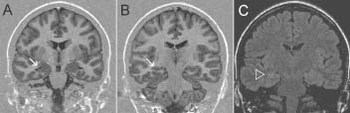
Two days after admission the neurological examination was completely normal; signs of repeated tongue biting were evident. Blood tests were normal, including renal, liver and thyroid function, HIV screen and syphilis serology. Scalp EEG showed infrequent slow wave paroxysms in the right temporal derivations. Brain MRI, including hippocampus-directed sequences, was carried out (Fig. 1). Right mesial temporal sclerosis was diagnosed and complete seizure remission occurred under anti-epileptic drugs (oxcarbazepine 600 mg bd, with later addition of lamotrigine up to 100 mg bd). The acute psychotic episode was interpreted as postictal psychosis (PIP).
Coronal brain MRI (T1-MPRAGE, 1.5 T) disclosed a smaller right hippocampus (A–B, arrows). Plate C (FLAIR) shows high signal intensity in the atrophied hippocampus (triangle). These are typical findings of mesial temporal sclerosis.

Epilepsy-related psychoses include ictal, interictal and postictal forms (Reference Kanner1). PIP emerges up to 1 week after the last seizure, typically following an increase in seizure frequency (Reference Kanner1,Reference Kanemoto, Takeuchi, Kawasaki and Kawai2). There is usually a latency period until symptom emergence (12–72 h); PIP lasts on average around 70 h, according to Kanner (Reference Kanner1), and symptom control may be achieved with low-dose antipsychotics or benzodiazepines. It is more frequently associated with temporal lobe epilepsy, particularly when mesial sclerosis is the underlying pathology (Reference Kanner1,Reference Kanemoto, Takeuchi, Kawasaki and Kawai2). The clinical presentation can be quite polymorphic and Capgras syndrome (CS), the delusional belief that people close to the patient have been replaced by impostors (Reference Devinsky3) has been reported in PIP (Reference Drake4). The diagnosis of epilepsy was delayed in this patient, probably because of the importance of vegetative symptoms with apparent loss of consciousness (differential: syncope) and the beliefs related to the moon (differential: psychiatric disorder). The clinical presentation and evidence of right mesial sclerosis are in consonance with the known association between CS and right hemisphere abnormalities (Reference Devinsky3). Timely recognition of PIP is crucial, allowing adequate management. Seizure control can prevent recurrence and progression to interictal psychosis, thus avoiding significant morbidity. Epilepsy should be kept in mind as a diagnostic possibility in psychosis (Reference Kanner1) and CS must alert the clinician for the possibility of an underlying neurological disorder (Reference Devinsky3). Although the literature on this matter is contradictory, an intriguing association has been reported between the full moon period and an increase in seizure-related emergency admissions (Reference Polychronopoulos, Argyriou, Sirrou, Huliara, Aplada, Gourzis, Economou, Terzis and Chroni5).
Andreia Norton 1 , João Massano 2,3 , Sertório Timóteo 1 , Isabel Pires 4 , Celeste Silveira 1,3