Introduction
Soybean [Glycine max (L.) Merr.] is a primary crop for human consumption and animal feed worldwide. This legume species is regarded as a moderately salt-sensitive crop (Munns and Tester, Reference Munns and Tester2008). Salt stress is reported to inhibit soybean germination, plant growth (Abel and MacKenzie, Reference Abel and MacKenzie1964; Wang and Shannon, Reference Wang and Shannon1999), nodule formation (Singleton and Bohlool, Reference Singleton and Bohlool1984) and seed yield (Parker et al., Reference Parker, Gascho and Gains1983). Salt stress also reduces the protein content of soybean seeds (Chang et al., Reference Chang, Chen, Shao and Wan1994; Wan et al., Reference Wan, Shao, Chen and Yan2002). Soybean germplasm has been shown to exhibit a spectrum of salt tolerance capabilities (Phang et al., Reference Phang, Shao and Lam2008). Shao et al. (Reference Shao, Song and Liu1986) reported that seven germplasms showed salt tolerance in all developmental stages, and 242, 85 and 85 germplasms showed salt tolerance in the young seedling, seedling and reproductive stages, respectively. Based on a large screening of soybean genetic resources, our research group identified several salt-tolerant soybean germplasms, such as FT-Abyara and Jin dou no. 6 (Hamwieh et al., Reference Hamwieh, Tuyen, Cong, Benitez, Takahashi and Xu2011). Such natural variation in soybean salt tolerance indicates that the development of cultivars with genetically enhanced salt tolerance should be feasible.
Abel (Reference Abel1969) reported a dominant gene, Ncl, controlling exclusive of chloride in soybean. Using DNA marker analysis, a major salt-tolerance quantitative trait locus, which corresponds to the Ncl locus, was mapped on soybean chromosome 3 (linkage group N) in different mapping populations (Lee et al., Reference Lee, Boerma, Villagarcia, Zhou, Carter, Li and Gibbs2004; Chen et al., Reference Chen, Cui, Fu, Gai and Yu2008; Hamwieh and Xu Reference Hamwieh and Xu2008; Hamwieh et al., Reference Hamwieh, Tuyen, Cong, Benitez, Takahashi and Xu2011; Ha et al., Reference Ha, Vuong, Velusamy, Nguyen, Shannon and Lee2013). Recently, Ncl has been isolated by map-based cloning (Guan et al., Reference Guan, Qu, Guo, Yu, Liu, Jiang, Chen, Ren, Liu, Tian, Jin, Liu, Hong, Chang, Gilliham and Qiu2014; Do et al., Reference Do, Chen, Vu, Hamwieh, Yamada, Sato, Yan, Cong, Shono, Suenaga and Xu2016) and association mapping approaches (Qi et al., Reference Qi, Li, Xie, Liu, Ni, Shao, Song, Yim, Tao, Wong, Isobe, Wong, Wong, Xu, Li, Wang, Guan, Sun, Fan, Xiao, Zhou, Phang, Liu, Tong, Chan, Yiu, Tabata, Wang, Xu and Lam2014). On the basis of analysis of the relationship between salt tolerance and Ncl expression levels in 124 soybean germplasms from different countries, Do et al. (Reference Do, Chen, Vu, Hamwieh, Yamada, Sato, Yan, Cong, Shono, Suenaga and Xu2016) found that Ncl expression level and salt tolerance had a significant positive correlation, suggesting that Ncl plays an essential role in contributing to salt tolerance in soybean, although other genes may also be involved.
Soybean is becoming an important crop in Indonesia. According to the Food and Agriculture Organization of the United Nations (FAOSTAT) (http://www.fao.org/faostat/en/#data/QC), the total area of soybean production in Indonesia in 2016 was 623,826 ha (13th in the world), and the total amount produced was 967,876 tonnes (14th in the world). Soybeans cultivated in Indonesia are exposed to diverse environmental stresses, such as drought, waterlogging and soil salinity. Soil salinity is not problematic across the whole country of Indonesia but is a serious problem in the dry season in tidal areas due to seawater erosion. Soybean was introduced in Indonesia from China in the 15th–16th centuries (Hymowitz, Reference Hymowitz, Boerma and Specht2004) and has a very long history of cultivation in the country. Many local soybean germplasms have been established through adaptation to local environmental conditions and food cultures. However, knowledge of Indonesian soybean germplasms is extremely limited. In this study, we evaluated 51 soybean germplasms with the aim of identifying salt-tolerant soybean genotypes to be used for the improvement of salt tolerance in soybean breeding.
Materials and methods
Plant materials
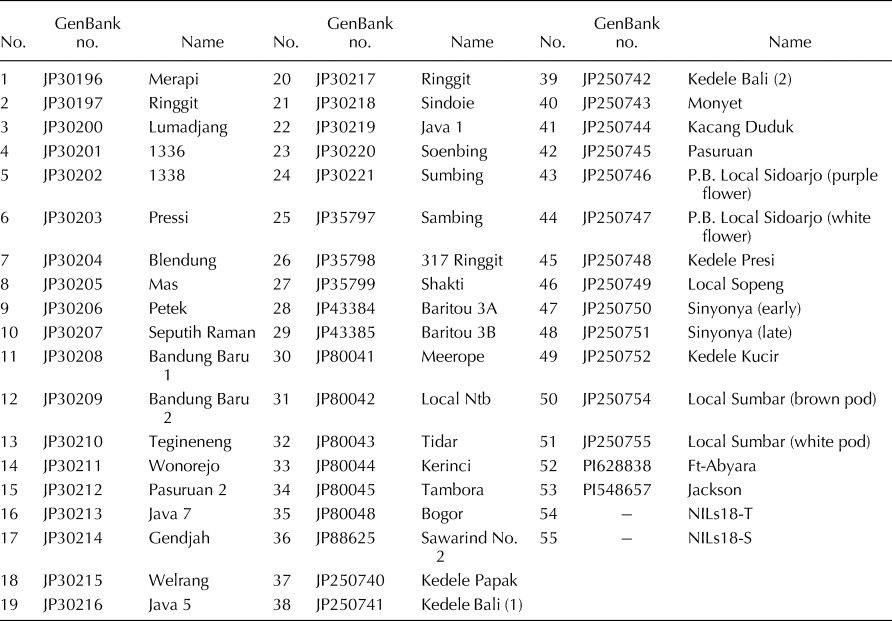
A total of 51 Indonesian soybean germplasms were evaluated for their salt tolerance. These accessions were provided by the Genetic Resources Center, NARO, Japan (http://www.gene.affrc.go.jp/index_en.php). The Indonesian soybean germplasm names and JP numbers are presented in Table 1. In addition, four soybean cultivars or lines [FT-Abyara (PI628838), Jackson (PI548657), NILs18-T and NILs18-S] were used as controls in the evaluation experiment. FT-Abyara is a salt-tolerant cultivar from Brazil (Hamwieh et al., Reference Hamwieh, Tuyen, Cong, Benitez, Takahashi and Xu2011). Jackson is a salt-sensitive soybean cultivar from the USA (Hamwieh and Xu Reference Hamwieh and Xu2008). NILs18-T is a salt tolerant near-isogenic line and NILs18-S is a salt-sensitive near-isogenic line, which have different alleles at the Ncl locus (Hamwieh et al., Reference Hamwieh, Tuyen, Cong, Benitez, Takahashi and Xu2011; Do et al., Reference Do, Chen, Vu, Hamwieh, Yamada, Sato, Yan, Cong, Shono, Suenaga and Xu2016).
Plant materials used in the current study

Evaluation of salt tolerance under hydroponic conditions
The method we used to evaluate salt tolerance was described in our previous study (Hamwieh and Xu Reference Hamwieh and Xu2008), with some additional modifications. In brief, soybean seeds for each genotype were planted in pots with vermiculite. After emergence, the seedlings were transferred into plastic containers (150 × 75 × 25 cm) filled with half-strength Hoagland and Arnon nutrient solution (pH = 6.5). A week after the transplantation, the seedlings were treated with half-strength Hoagland and Arnon solution (pH = 6.5) with either 60 mM of NaCl, or 0 mM NaCl (control). Salt concentration was increased by 20 mM per d by the addition of NaCl into the hydroponic solution. After 3 d, NaCl concentration had increased to 100 mM. The hydroponic solutions were replaced every 4–5 d during the soybean growth period. Six plants of each genotype were tested. When the salt-sensitive soybean cultivar/line control appeared to show salt toxicity symptoms of complete death (about 3 weeks after treatment), a salt tolerance rating (STR) for each genotype was scored based on the degree of leaf scorching of the soybean plants. The STR scale consisted of five grades, ranging from 1 to 5 (1, plants completely dead; 2, two-thirds or more of the leaves showing chlorotic symptoms, or only upside leaves surviving; 3, half of the leaves or fewer showing chlorotic symptoms; 4, one-third or less of the leaves showing chlorotic symptoms and 5, plants with normal, healthy leaves). The leaf chlorophyll content (SPAD value) for each genotype was measured using a chlorophyll meter (Konica Minolta SPAD-502). This SPAD value is proportional to the chlorophyll content in the leaves.
Confirming the selected salt-tolerant soybean germplasms under soil medium cultivation
To confirm the salt-tolerant soybean germplasms that were selected based on hydroponic evaluation, six salt-tolerant germplasms, one salt-sensitive soybean germplasm and two salt-tolerant NILs (NILs18-T and NILs18-S) were evaluated under soil medium cultivation in pots following the method described by Tuyen et al. (Reference Tuyen, Lal and Xu2010). Soybean seeds for each genotype were planted in 17 × 17 cm pots filled with upland field soil mixed with 1/5 vermiculite. Each genotype was planted in three pots. Ten days after emergence, soybean plants were thinned to five plants per pot, and then the pots were placed in a large plastic container (150 × 75 × 25 cm) containing saline water at a depth of 15 cm, which allowed the plants to uptake water through holes in the bottom of each pot. Soybeans were treated with 0 mM NaCl (control) or 100 mM NaCl. The positions of the pots in the container were changed every 4–5 d during the experiment to avoid any growth position preference. After cultivation for five weeks, the leaf SPAD value, STR and shoot dry weight were recorded for each pot.
Expression analysis of the salt tolerance gene Ncl in the Indonesian soybean germplasms
Soybean roots were collected from different soybean genotypes, frozen in liquid nitrogen, and stored at −80°C. Total RNA was extracted using Plant RNA Extraction Kit (QIAGEN, Japan) according to the manufacturer's protocol. The first strand cDNA was synthesized using the First Strand cDNA Synthesis Kit (Toyobo, Osaka, Japan). Real-time polymerase chain reaction (PCR) was performed using SsoFast™ EvaGreen® Supermix kit (BIO-RAD, Hercules, CA, USA) with the primers of Glyma03g32900_CDS6-F (5′-CCACCAACATGTCACGACTC-3′) and Glyma03g32900_CDS6-R (5′-ACCCCACGATTGACTAGCAC-3′). All the reactions were performed in a Bio-Rad CFX96™ machine (BIO-RAD, Hercules, CA, USA). The soybean actin gene (GenBank acc. no. V00450) was used as reference gene. The primers for amplifying the actin gene were SoyActin-F (5′-GAGCTATGAATTGCCTGATGG-3′) and SoyAct-R (5′-CGTTTCATGAATTCCAGTAGC-3′). The reaction included an initial 30 s denaturation step at 95°C, followed by 5 s at 95°C and 5 s at 55°C for 40 cycles. The PCR products were identified by melting curve analysis conducted over the range of 65–95°C at the end of each PCR run. The 2−ΔΔCt method was used to normalize the relative gene expression data in the qPCR assay (Livak and Schmittgen, Reference Livak and Schmittgen2001).
Results
Evaluation of salt tolerance for the 51 Indonesian soybean germplasms under hydroponic conditions
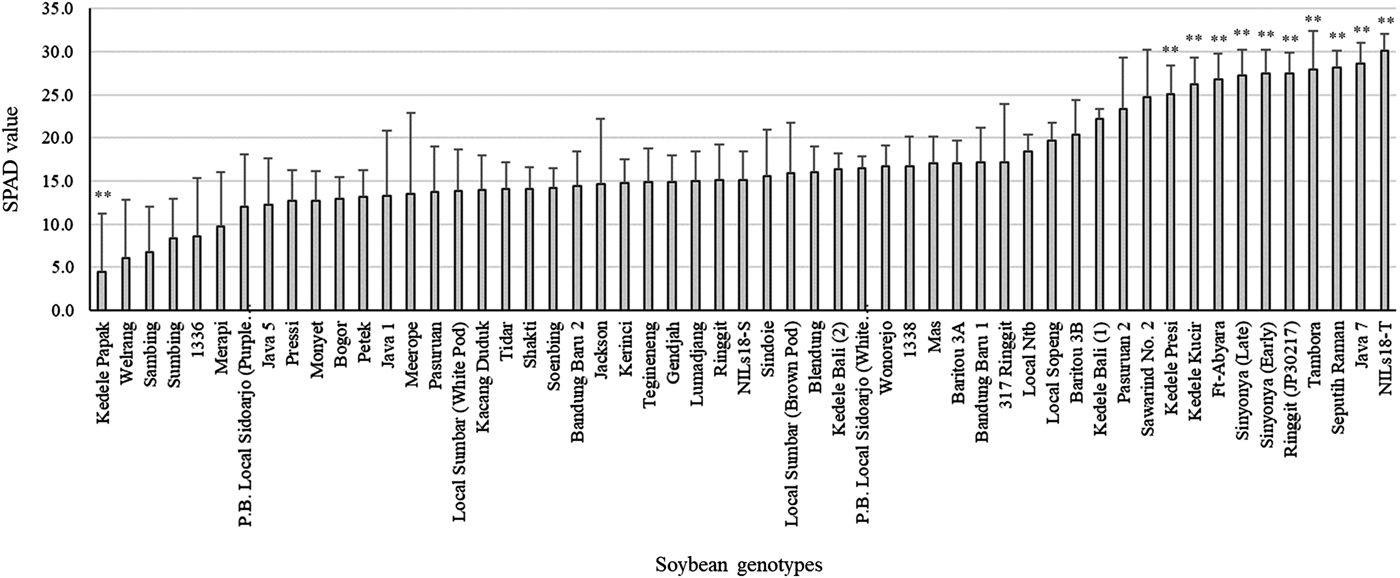
Salt stress caused severe leaf scorch for the salt-sensitive genotypes but caused either no damage or light damage for the salt-tolerant genotypes. There was wide variation in salt tolerance across the 51 Indonesian soybean germplasms. Figure 1 shows the leaf SPAD values of the 51 Indonesian soybean germplasms under salt stress condition. The 51 Indonesian soybean germplasms showed a continuous distribution of leaf SPAD values. Of these, Java 7, Seputih Raman, Tambora, Ringgit (JP30217), Sinyonya (early) and Sinyonya (late) showed significantly higher leaf SPAD values than the salt-sensitive cultivar Jackson. In contrast, there were no symptoms of salt damage for the soybean germplasms subject to control conditions. Similarly, Java 7, Seputih Raman, Tambora, Ringgit (JP30217), Sinyonya (early) and Sinyonya (late) also showed high STR values, ranged from 4.50 to 4.66 and were significantly higher than the salt-sensitive Jackson (STR = 2.17) (online Supplementary Fig. S1). The leaf SPAD values and the STRs showed a positive correlation (r = 0.9583**). Based on the evaluation experiment, the Indonesian soybean germplasms Java 7, Seputih Raman, Tambora, Ringgit (JP30217), Sinyonya (early) and Sinyonya (late) were identified as salt-tolerant germplasms.
Leaf SPAD values of the 51 Indonesian soybean germplasms and the control genotypes after salt treatment with 100 mM NaCl for about 3 weeks under hydroponic conditions. Data are shown with mean ± SD (n = 6). **Indicates a significant difference (P < 0.01) from the salt-sensitive control variety Jackson.

Confirmation of the selected soybean tolerance germplasm under soil medium cultivation
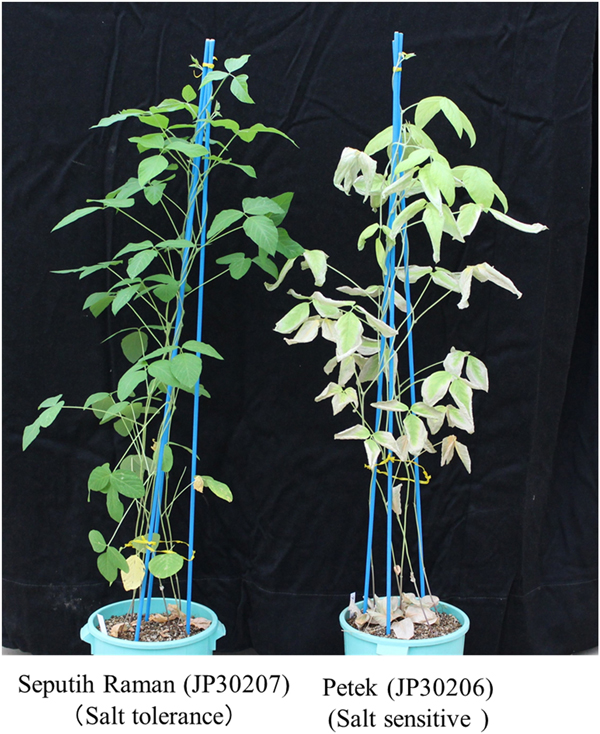
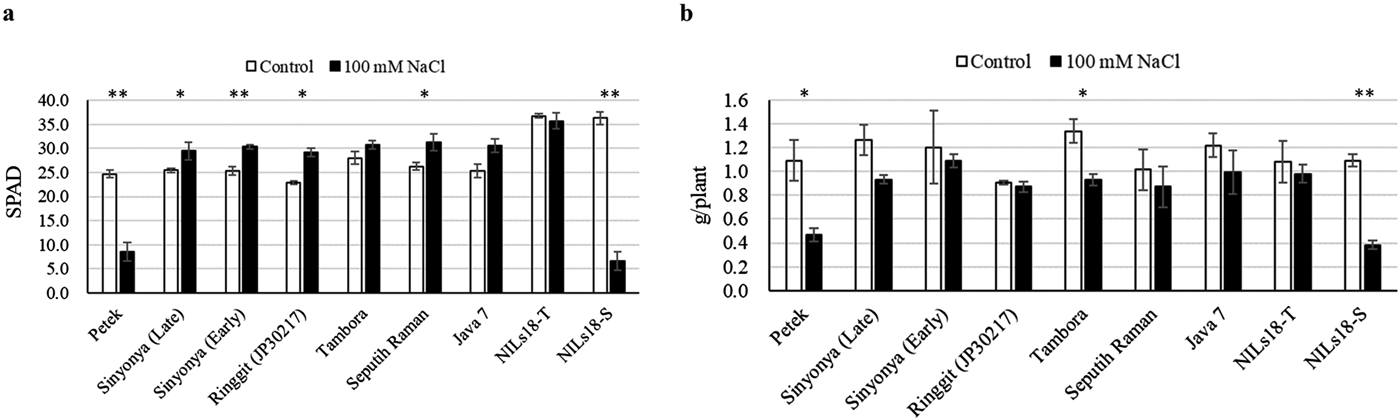
After salt treatment with 100 mM NaCl for around 5 weeks, the salt-sensitive genotypes (Petek and NILs18-S) showed obvious symptoms of salt damage, with scorched or dead leaves. In contrast, the salt-tolerant genotypes (Java 7, Seputih Raman, Tambora, Ringgit (JP30217), Sinyonya (early), Sinyonya (late) and NILs18-T) had no symptoms of salt damage (Fig. 2). The leaf SPAD values of the two salt-sensitive germplasms in the 100 mM NaCl condition were significantly lower than those in the control condition (Fig. 3a). In contrast, the leaf SPAD values of the six salt-tolerant genotypes in 100 mM NaCl were the same or even higher than those in the control condition (Fig. 3a). The leaf SPAD values ratio of salt treatment to control (S/C) for the salt-sensitive genotype Petek was 0.35, whereas the average S/C of leaf SPAD values was 1.04 for the six salt-tolerant genotypes. The STR values showed similar results for the genotypes tested in the soil medium conditions (data not shown).
Performance of the salt-tolerant soybean genotype Seputih Raman (left) and the salt-sensitive genotype Petek (right) after treatment with 100 mM NaCl for around five weeks under soil medium cultivation conditions.

Leaf SPAD values (a) and shoot dry weight (b) of the six selected salt-tolerant soybean genotypes after treatment with 100 mM NaCl for around 5 weeks under soil culture conditions. Data are shown with mean ± SD (n = 3). * and ** indicate significant difference between control and 100 mM NaCl treatment at P < 0.05 and P < 0.01 levels, respectively.

Overall, salt stress inhibited growth and resulted in smaller plant sizes for the nine soybean genotypes, including the six selected salt-tolerant genotypes, one salt-sensitive genotype and a pair of salt-tolerant NILs, NILs-18T and NILs-18S (Fig. 3b). The shoot dry weight average of the nine soybean genotypes was 0.84 g in the saline condition, whereas the value was 1.13 g in the control condition, with a S/C of 0.74. The average S/C of shoot dry weight was 0.80 for the six selected tolerant genotypes, whereas the value was 0.35 for the salt-sensitive genotype Petek. These results confirmed the salt tolerance of the germplasms selected based on the hydroponic screening.
The salt-tolerance gene Ncl contributed to the salt tolerance of the Indonesian soybean germplasms
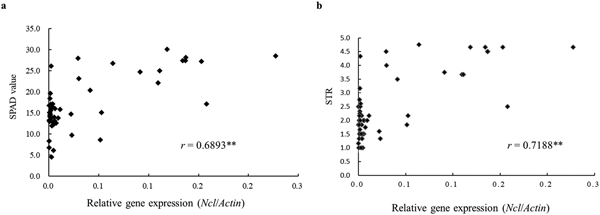
To understand the role of the salt tolerance gene Ncl, we analysed the expression level of Ncl and its correlation with salt tolerance in the 51 Indonesian soybean germplasms. We found a significant positive correlation between expression level and salt tolerance in terms of leaf SPAD value (r = 0.6893**) and (r = 0.7188**) (Fig. 4). All the salt-tolerant soybean germplasms selected based on hydroponic and soil medium cultivation [(Java 7, Seputih Raman, Tambora, Ringgit (JP30217), Sinyonya (early) and Sinyonya (late)] showed relatively higher Ncl expression. Their expression values were in the top 10 of the 51 Indonesian soybean germplasms. This result suggests that Ncl is essential for salt tolerance in the soybean germplasm collection.
Correlation between expression level of the salt tolerance gene Ncl and salt tolerance in terms of leaf SPAD value (a) and STR (b) value in the 51 Indonesian soybean germplasms.

Discussion
Soybean germplasm has been shown to display a range of salt-tolerance capabilities, from high to low (Phang et al., Reference Phang, Shao and Lam2008). Previously, we identified several salt-tolerant soybean germplasms, such as the Brazilian soybean cultivar FT-Abyara and the Chinese cultivar Jin dou no. 6 (Hamwieh et al., Reference Hamwieh, Tuyen, Cong, Benitez, Takahashi and Xu2011). In this study, we screened 51 Indonesian soybean germplasms and identified six genotypes [(Java 7, Seputih Raman, Tambora, Ringgit (JP30217), Sinyonya (early) and Sinyonya (late)] with high salt tolerance. The selected salt-tolerant germplasms were further confirmed through cultivation in soil medium. These soybean germplasms may be used for breeding salt-tolerant cultivars in Indonesia or other tropical countries. These salt-tolerant germplasms might be more easily used in local breeding programmes than those from other regions because these accessions are better adapted to the tropical environment compared with salt-tolerant genetic resources from other countries.
Of the 51 Indonesian soybean germplasms evaluated in the current study, two germplasms (JP30197 and JP30217) have the same name ‘RINGGIT’. Our salt tolerance evaluation revealed that JP30217 had higher salt tolerance; however, JP30197 was salt-sensitive. Based on the passport data in the Genetic Resources Center, NARO, Japan, the two germplasms have apparently different morphological traits, such as seed size, plant height and maturity date. These two soybean genotypes might have different origins, although they have the same variety name. Only the salt-tolerant ‘RINGGIT’ germplasm (JP30217) should be used as a salt tolerance donor in a breeding programme.
Recently, DNA marker-assisted selection (MAS) has been widely used in plant breeding to introduce a trait of interest to a specific variety. MAS is particularly useful in soybean breeding for enhancing salt tolerance because there is no need to perform the difficult evaluation of salt tolerance for selection of progenies in each breeding generation. Several DNA markers around Ncl, the most important salt tolerance gene in soybean, have been developed in our previous studies (Do et al., Reference Do, Chen, Vu, Hamwieh, Yamada, Sato, Yan, Cong, Shono, Suenaga and Xu2016). Using the salt-tolerant soybean germplasms identified in the current study combined with MAS technology would definitively accelerate the progress of soybean breeding for enhancing salt tolerance.
The significant correlation between salt tolerance and Ncl expression level implied that the salt tolerance gene Ncl contributed to the salt tolerance of the Indonesian soybean germplasms we studied. All the salt-tolerant germplasms [(Java 7, Seputih Raman, Tambora, Ringgit (JP30217), Sinyonya (early) and Sinyonya (late)] showed high expression of Ncl. This result is consistent with previous findings that used 123 soybean germplasms from different countries (Do et al., Reference Do, Chen, Vu, Hamwieh, Yamada, Sato, Yan, Cong, Shono, Suenaga and Xu2016). The Ncl gene was specifically expressed in root and higher expression of Ncl in the root resulted in lower accumulations of Na+, K+ and Cl− in the shoots and under salt stress (Do et al., Reference Do, Chen, Vu, Hamwieh, Yamada, Sato, Yan, Cong, Shono, Suenaga and Xu2016). The results obtained here again showed that Ncl is essential for salt tolerance in soybean. Although several salt-tolerant soybean germplasms were identified in the current study, their tolerance levels are not higher than the existing salt-tolerant soybean genotypes, such as FT-Abyara and NILs8-T, in which the salt tolerance was controlled by Ncl (Do et al., Reference Do, Chen, Vu, Hamwieh, Yamada, Sato, Yan, Cong, Shono, Suenaga and Xu2016). This is probably because the salt tolerance of these accessions is controlled by the same tolerance gene. The exploration of new salt-tolerant genetic resources is needed to find germplasms with salt tolerances higher than existing varieties. In the soybean accessions that had relatively low Ncl expression but showed high salt tolerance, such as Kedele Kucir and Local Sopeng, other gene(s) might be involved in producing such high tolerance.
Acknowledgments
The work was supported in part by the Grant-in-Aid from the Japan Society for the Promotion of Science (No. 24405021).
Supplementary material
The supplementary material for this article can be found at https://doi.org/10.1017/S1479262118000618