INTRODUCTION
Having the ability to define spirituality in a way that is congruent for most people is crucial to end-of-life research. Without a common method for defining spirituality, prior studies cannot be synthesized. Unfortunately, a common definition of spirituality has not been achieved. We propose that a suitable alternative to defining spirituality is to describe it through a framework consisting of its most common attributes. By reducing spirituality to common attributes, patients, researchers, and clinicians can describe spirituality according to each attribute individually, which taken together forms a more comprehensive view of spirituality as a whole. To identify the most common attributes of spirituality, 40 studies were analyzed to determine how researchers defined or described end-of-life spirituality. Our findings showed that five attributes were most often used to comprise those definitions or descriptions. The most commonly used attributes included “meaning,” “beliefs,” “values,” “connections,” and “self-transcendence,” and are utilized to frame spirituality for our research (Stephenson & Berry, Reference Stephenson and Berry2015).
Recent research conducted since these attributes were first identified continue to support them both in how spirituality is framed for research and through research findings. Best and colleagues (Reference Best, Aldridge and Butow2015) published a systematic review of physician practices for discussing spirituality and religion with patients. Their framing of spirituality was consistent with these attributes. They saw spirituality as associated with transcendence, connectedness, and meaning. Garssen and colleagues (Reference Garssen, Visser and de Jager Meezenbroek2012) sought to understand how cancer patients employed spirituality to adjust to having cancer. Reports of participants' spiritual experiences and convictions included several attributes, including meaning (cancer as a task), beliefs (in a supportive God and afterlife), and connections (with God through spiritual messages). Paiva et al. (Reference Paiva, Carvalho and Lucchetti2015) interviewed 30 caregivers of cancer patients receiving palliative care. Caregivers reported increasing faith, feeling more connectedness to God, holding greater value in religiosity and simplicity, and rethinking life issues (meaning). Penman and coworkers (Reference Penman, Oliver and Harrington2013) used phenomenology to understand the spiritual engagement of 4 patients with life-limiting illness and 10 of their caregivers. Three themes emerging from their study were “human values,” “managing relationships,” and “participating in religious practices.” Altogether, these findings support the proposed spiritual attributes. However, research showing that the attributes support spirituality in the everyday lives of people involved with dying is still needed.
The purpose of the present study was to explore spirituality among families with a parent in hospice using the framework of the five spiritual attributes. Families with a parent in hospice included ill parents/patients, well parents/caregivers, and adolescent children, and were chosen because existing data were available from two previous and related studies that sought to explore the strategies adolescents utilize when a parent is in hospice both prior to and after the parental death (Hansen et al., Reference Hansen, Sheehan and Stephenson2015; Sheehan et al., Reference Sheehan, Draucker and Christ2014; Reference Sheehan, Mayo and Christ2015). The first author became involved with these data during analysis of the second study, which conducted follow-up interviews with 15 participants from the original study mentioned above. Numerous references to spirituality were noted in participants' stories during this analysis. Therefore, a secondary analysis of all data from both studies was conducted for a more comprehensive view of spirituality for these participants. The aims of this analysis were to (1) determine the prevalence of the spiritual attributes within the participants' stories, and (2) assess how well the spiritual attributes support the essence of spirituality.
METHODS
Data from two previous studies contributed to this research (Hansen et al., Reference Hansen, Sheehan and Stephenson2015; Sheehan et al., Reference Sheehan, Draucker and Christ2014; Reference Hansen, Sheehan and Stephenson2015; Stephenson et al., Reference Stephenson, Sheehan and Hansen2015). The first used grounded-theory methods to understand the strategies adolescents employed to manage the impending death of a parent. Some 61 participants from 26 families were interviewed, representing 3 different family member cohorts of ill parents/patients, well parents/caregivers, and adolescents (aged 12–18 years). The interviews focused on the adolescents' experiences; however, all participants (parents and adolescents) also recounted rich stories about their day-to-day lives while having a parent in hospice.
The second study was a follow-up to the study cited above. A total of 15 follow-up interviews after the parental/spousal death were conducted with 6 surviving spouses and 9 adolescents from 6 families randomly selected from the original study's sample. The purpose of this second study was to obtain baseline information about how adolescents were managing after their parent's death and to assess the feasibility of conducting future longitudinal studies to assess coping strategies over time. A total of 76 interviews with parents and teens were available to be analyzed from the two previous studies as secondary analysis for this research.
Because spirituality was not asked about directly in either of these studies, we saw an excellent opportunity to examine the nature and prevalence of spirituality as part of these participants' everyday lives and within the context of the newly developed spiritual framework based on the five spiritual attributes (meaning, beliefs, connections, self-transcendence, and value). We assumed that, if spirituality was important to families involved in transitions toward one parent's death, it would naturally be included in their interviews, even without prompting by the interviewer. Our interest was in assessing the spiritual nature of the attributes as they were included in participants' descriptions of having a parent/spouse in hospice.
Permission to conduct the research was obtained from the respective university institutional review boards. Directed content analysis methods were used to analyze the data because these methods allow researchers to validate or extend an existing theory or framework, which in this case was the spiritual framework of attributes (Hsieh & Shannon, Reference Hsieh and Shannon2005).
There were two stages of data analysis. During the “individual coding stage,” the first and third authors read all 76 transcripts and coded them individually according to the five spiritual attributes (meaning, belief, connection, self-transcendence, and value). Each coder created tables to sort and compile text units that related to each attribute. The second coding stage was a “group coding stage,” where all three authors met to discuss the codes for reach consensus. The second author was the principal investigator for the original studies from which the data were drawn. Her in-depth familiarity with the data added a deeper understanding for this analysis. Codes not identified by both coders were discussed, and decisions about whether to include them were reached by consensus. Once all text units representing the attributes were discussed and finalized, each attribute table was examined to determine how they were experienced by participants. Those findings are reported below.
RESULTS
Prevalence of Spiritual Attributes
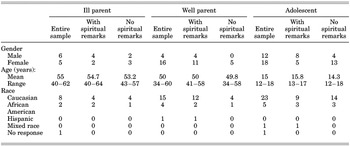
Our findings revealed that remarks about spirituality within the context of the attributes were a prevalent part of the stories participants told either about their own life-limiting illness or from living with a parent or spouse with a life-limiting illness. Spiritual themes emerged from 58 of the 76 interviews with 35 participants. Some 26 participants did not describe spiritual attributes, including 5 ill parents who were too weak or too tearful to complete the entire interview, 5 well mothers, and 17 adolescents. Younger adolescents were more likely to respond with short answers during interviews and less likely to elaborate on the details of their lives. Furthermore, they were focused on practical concerns and less likely to delve into spiritual themes. For example, a 12-year-old male described that having a sick father was “terrible” because “he is falling too much and calling for us,” demonstrating the practicality of his experience but not the emotional or spiritual impact. The demographics of participants who did and did not make spiritual references are summarized in Table 1.
Sample characteristics

Spiritual Attributes
Beliefs
Beliefs constituted the most frequent attribute described, with 61 references identified from 19 participants. Beliefs included religious and spiritual views about life and the afterlife, and belief systems were individualized and dynamic. They were individualized as to the degree to which participants believed or engaged in religious practice. While some participants used prayer and faith to cope with the life-limiting illness, others described no religious experiences. Beliefs were dynamic for several participants who questioned their beliefs after learning of the life-limiting diagnosis. This was best portrayed during a pre-death interview with a 13-year-old male whose father was dying from advanced prostate cancer. Despite having little experience with religious institutions and being a self-proclaimed atheist, this adolescent turned to prayer during his father's illness. As he related,
I am an atheist. I don't pray, obviously. But you know what? Last night I prayed. Somebody told me prayers help, so even though I don't believe there is a Higher Power, I sent that one out to whoever.
When asked for what he prayed, he said,
I prayed that my dad would get better and that he would come home [from the hospital] soon.
Many participants talked about the afterlife as a source of comfort. A 64-year-old ill father was comforted by his belief that his “Lord and Savior will make it [death] easy.” However, this was contrary to a 59-year-old ill father, whose uncertainty about an afterlife was distressing for him. Having engaged in a life of violence in which he had “hurt a lot of people,” he worried about retribution in the afterlife:
If there is such a thing as God, and that person, or those people that I did hurt are there and waiting for me, I am going to tell them I am going to be waiting for them, too.
The stories of both of these ill fathers illustrate the differences in how participants saw who was in charge of their dying. The first ill father saw his “Lord and Savior” as being in charge and had faith that He would make death an easy experience. Conversely, the second ill father questioned the existence of God and thought it possible that interactions with others after death would represent a continuation of his life on earth, making him in charge of how those interactions would play out.
Connections
Connections were the second most frequently discussed attribute, with 60 references made by 24 participants. Spiritual connections include valued relationships or newly experienced events that individuals have with themselves, others, nature, or a transcendent being or realm. Most spiritual connections described by participants had to do with the relationships they shared with family members and focused on how those relationships were impacted by the impending loss and the need to repair damaged relationships prior to death.
Several participants described strategies employed to manage their impending loss during the pre-death interviews, such as living in the moment, hoping for a better future, and writing letters. A 16-year-old male explained how he managed his father's impending death by living in the moment when he said,
I treasure the moments that I have with him and try not to look too far into the future where there might be something that I wouldn't want to see.
A 53-year-old well mother managed the knowledge of her husband's impending death by hoping that he would improve long enough “to do some stuff as a family and have some quality time.” Having a final opportunity to create family memories was similar to how several dying parents utilized letter writing as a way of creating legacies for their children. Letters not only conveyed valuable messages but also served as mementos to comfort adolescents after a parent's death. However, one father did not seize the opportunity for letter writing. In a post-death interview, a 48-year-old well mother explained why her husband was not able to write a letter to their children before his death:
He always hoped the chemo would work. I think he just couldn't let go of that, so he didn't write the letter.
Several participants explained the need to repair damaged relationships before the ill parent's death. In a pre-death interview, a 17-year-old male described his relationship with his mother as “troubled.” However, since receiving his mother's cancer diagnosis, he and his mother worked to improve their relationship. As his mother told him,
Every day you come home from school, I want to talk to you. I want you to come home and come to me, and we will talk about your day.
According to the adolescent, this allowed them to forge a better relationship and experience a closeness they did not have before. Conversely, a 46-year-old well mother acknowledged that she and her husband were often “not nice” to each other before he was diagnosed with end-stage heart disease, but that she made an intentional decision not to be kinder to him just because he was dying. As she explained,
Me and my husband have always been straightforward people, … and some of the things that we say to each other are not nice. I just feel bad when I do it now, but I still want him to know we are in the same relationship—now that he is a little sicker.
She wanted their relationship to stay the same and found comfort in the familiarity of their bantering. Changing her behavior toward him now would mean treating him differently because of his illness, which she did not want to do.
Meaning
Meaning was the third most frequent attribute discussed, with 31 references identified from among 13 participants. Spiritual meaning can include the meaning of life and significant events, the illness itself, or dying. For these participants, the process of searching for meaning was dynamic and ongoing in that it could change as new information was introduced and, therefore, rarely resolved until death. For some, the search for meaning caused them to revisit old memories that were reinterpreted to answer current questions or find strength. This was true for one 62-year-old ill father who was dying from a cancer with an unknown primary. He reflected on his life and remembered living through hard times. His memories provided encouragement in the face of his illness:
I remember the whoopings that I got … and you look back on and you say “Wait, I got them. I am still here. They didn't kill me—they made me a better person.”
Engaging in meaning-making elicited a wide range of responses from participants. For example, in one pre-death interview, a 46-year-old well mother described being empowered by helping her daughter find meaning in her father's life and death. She lamented that her daughter was “losing a father, someone to hold her when she is sad and tell her it is going to be okay.” Despite her awareness that there was nothing she could do to stop his death, she felt empowered by knowing that she could “stand behind her and let her know this means something.” Another participant, a 59-year-old ill grandmother who had guardianship of her granddaughter and was dying from non-Hodgkin's lymphoma, was troubled by her inability to find meaning for her granddaughter. When her granddaughter asked when she would die, the grandmother responded, “I don't know? When God decides.” The grandmother was not satisfied with her own explanation to her granddaughter and explained,
[My granddaughter] doesn't understand the concept that God takes somebody away, you know, and I am sure as hell not going to try to explain that, because I don't understand it myself.
This grandmother was able to identify a common question that she and her granddaughter shared but ultimately decided it was too difficult to answer. As she explained,
She is only 14 years old. That is going to take a long time, if you ever do, some people never do come to grips with [understanding death].
This grandmother was clearly distressed by her search for death's meaning; however, not all participants shared similar concerns.
In some cases, the emotionality associated with meaning was ambiguous. During one pre-death interview, a 58-year-old well parent described death as a double-edged sword:
Once that person passes off this earth, they're free. It is us who [are] here to suffer.
On the other hand, a 50-year-old well mother was neutral about life's meaning. Her position was factual and did not produce a positive or negative emotion:
I think we are all put here to learn a lesson and see how we handle situations. There is not a right or wrong.
One participant was ambivalent during the process of finding meaning in his life. As he reflected on parenting his daughter, he considered whether or not he had regrets and vacillated back and forth about whether it even mattered. As he recalled,
We both [he and spouse] did the best we could, and I don't regret it— Sometimes I do, but then …
He then delved deeper into the meaning of his parenting:
It hurts sometimes because I wasn't able to really do what I wanted to do with [my daughter], but I did the best I could. … I try to be a father to her, but I could be better.
The recognition that he “could have done better” seemed uncomfortable for him to think about, and he sought to comfort himself with the possibility that, if he could survive long enough, he would have another chance:
I am hoping one day I get up and all this will be gone [gesturing to the medical equipment], and I can look back and say, “Oh boy, it was worth it to wait.” I am waiting on that day. I do believe it is going to come, but I just got to wait [and] hope I can stay here long enough to wait.
Despite the impossible odds that his life-threatening illness would vanish one day, this thought gave him comfort in the present, demonstrating the ongoing nature of meaning-making.
Values
Values were the fourth most frequent attribute discussed by participants, with 30 references identified from among 13 participants. What held value for participants was evident through the stories they spontaneously shared with researchers. Time, traditions, and relationships were things that were previously taken for granted but became more valuable after learning that a parent was dying. In one pre-death interview, a 17-year-old son shared a conversation he had with his father and realized the importance of their relationship:
[My father] is like “You know, the thing is, you never know how good you got it until it is gone.” And I looked at him and started to tear up and thought, “Goddamn, he is right!”
Suddenly realizing how important his father's relationship was to him, he wished for more time but realized that their time together was limited by the illness. Similar stories were told about losing family traditions through illness. Holidays were a particularly difficult time for families who were not able to attend church services as they normally would or share family meals. However, simpler traditions were also missed, such as for a 41-year-old wife who was saddened when her husband became too weak to join the family at the dinner table: “It was a big deal for all of us to sit down and eat dinner together,” but now “we'll be at the table and he'll be sitting in his bed.”
Several family members longed for more time to create valuable memories. Time for a final family vacation or a family photo produced valuable memories that surviving members could hold onto after the parent's death. Families appreciated having the time to say goodbye while also wishing for more time. Occasionally, a deceased parent left gifts to their children—a locket for a daughter, a new tennis racket for a son. Having enough time to engage in these activities was highly valued. After her husband's death, one 52-year-old wife reflected on how thankful she was for leaving early for what would turn out to be the last family vacation because doing so allowed the family to create memories that would not have been possible otherwise. Her husband became symptomatic with lymphoma during their vacation, which forced them to return home early because of an illness from which he would not recover. According to this mother and wife,
We left a day early, and for that I will forever be thankful because that day made all the difference.
Self-Transcendence
Self-transcendence was the attribute discussed least often by participants, with only seven references identified. The authors speculate that participants were still closely engaged in the process of transition and loss and, for the most part, were unable to reflect on transcendence. When self-transcendence was described, it was portrayed as both process and outcome. The process of self-transcendence was viewed as the ability to move toward growth, acceptance, and enjoyment despite the death. Both well and ill parents discussed self-transcendence—adolescents did not. The process of self-transcendence was described by one 53-year-old well mother during a post-death interview as an unfolding initiated by God: “God picked me up, put me here, taught me, and let the rest unfold.” Self-transcendence as an outcome was directly linked to meaning-making and enhanced connections with others. Successful self-transcendence appeared as a positive emotional experience. For example, this same participant was momentarily able to transcend the devastation she felt from her husband's impending death:
I can still say that, as bad as all this is going through all of this, and as bad as it is knowing that I am losing him—and I am losing him—I am so blessed to have had him.
For her, the only thing worse than losing her husband to cancer would have been not known him at all.
DISCUSSION
The first research aim was to determine the prevalence of spiritual themes in two studies where the interviewers did not explicitly ask about spirituality. This is relevant because it speaks to the importance of spirituality within the day-to-day lives of participants dealing with a parent in hospice. If spirituality was truly important to these participants in this situation, then whatever information they conveyed without provocation by the interviewer's questions should represent what was uppermost on their minds at that point in time. We found that 35 of the 61 participants spontaneously told stories that included spirituality during their interview within the context of the five spiritual attributes, supporting the importance of spirituality for these participants.
The second study aim focused on how well the attributes described spirituality for family members. Because each of the spiritual attributes were identified in participants' stories, we propose that the five spiritual attributes of meaning, beliefs, connections, values, and self-transcendence continue to represent the essence of spirituality and provide a suitable spiritual framework within which to continue additional research. We also agree that the attributes that best explain spirituality must be reevaluated periodically as the understanding of spirituality becomes more sophisticated through additional research and social change.
Two interesting factors about the attributes emerged that warrant additional research because they could inform future end-of-life interventions: (1) who participants saw in charge of their situation, and (2) how family members theorized meaning. Issues of who was in charge of their lives and deaths appear to be closely aligned with participants' belief systems. Participants differed as to whether they saw themselves or a Higher Power as in control of their circumstances. How people perceive who had control at the end of life could at least partially explain why some patients become distressed in certain situations while others do not (Nixon & Narayanasamy, Reference Nixon and Narayanasamy2010). Stephenson and colleagues (Reference Stephenson, Draucker and Martsolf2003) interviewed six hospice patients and found that “who is in charge” was a subcategory of end-of-life spirituality. Similarly, Hermann (Reference Hermann2006) included “control” as one of the six spiritual needs. However, control was not a common descriptor used by end-of-life researchers to describe or define spirituality during the original literature review that yielded the spiritual framework and was therefore not included as a sixth common attribute (Stephenson & Berry, Reference Stephenson and Berry2015). Further research is needed to better understand how questions about who is in charge of life events, illness, and dying influence the dying process overall.
Another interesting finding was that several participants theorized about the meaning of the illness to better understand their circumstances. Helping patients and family members theorize about the meaning of their circumstances is the basis of several successful counseling approaches (Applebaum et al., Reference Applebaum, Kulikowski and Breitbart2015; Breitbart et al., Reference Breitbart, Rosenfeld and Pessin2015; Scheffold et al., Reference Scheffold, Philipp and Engelmann2015). Strategies aimed at helping nurses to assist patients with theorizing about meaning at the bedside could lead to useful interventions for persons struggling with spiritual distress, particularly when the source of that distress is due to an inability to find meaning. This is reminiscent of Powell's (Reference Powell2014) description of the differences between theoretical and atheoretical deaths, according to which theoretical deaths involve prolonged illnesses that provide time for the dying person to prepare for death, in part by theorizing about the meaning of events. In contrast, atheoretical deaths have a shorter duration, therefore limiting the time to theorize about death. Although Powell's work focused on the dying person, our study suggests that the process of theorizing can be extended to include the surviving members of families in which a parent is dying.
The findings from this research provide a glimpse into how families with adolescent children and a parent in hospice transition toward death together. These families did so by engaging in influential relationships with each other that sought to find meaning, share beliefs, and redefine what was valuable during vulnerable times of loss. However, the majority of research about meaning during this time is focused on the dying person. Little is known about how the family dynamics of spouses and children influence meaning while a loved one is dying. Studies explicating how caregivers find meaning in their caregiver role are well documented (Quinn et al., Reference Quinn, Clare and Woods2012; Yen & Lundeen, Reference Yen and Lundeen2006). However, an understanding of how providing care for a dying spouse or parent influences personal beliefs about the meaning of one's own life remains poorly understood. Adams and colleagues (Reference Adams, Mosher and Cannady2014) studied caregivers of newly diagnosed cancer patients and found that those who perceived a lack of family support had a decreased sense of meaning in life; and Kanacki et al. (Reference Kanacki, Roth and Georges2012) found that strong religious beliefs were associated with how spousal caregivers perceived meaning. How caregivers perceive the meaning of their own lives after experiencing a close loved one's death is less clear—and even less well understood for adolescents.
In addition to sharing stories that support possible future interventions, one participant reminded us of an essential principle of patient care: the need to approach patients without bias or assumptions. For example, relationships between couples that might be viewed as dysfunctional by healthcare providers may actually provide comfort. To avoid reacting with bias, health professionals must discuss the couple's relationship with them to determine if it is serving a purpose that might not be immediately apparent.
LIMITATIONS OF THE STUDY
The primary limitations of our research comes from the secondary nature of these data and the fact that participants were not interviewed about spirituality directly. It could be argued that this would affect the richness of the data; however, we believe that the everydayness of spirituality in participants' stories were well represented with this approach, while acknowledging that more explicit research that directly asks family members about spirituality is still needed. Viewing parental and adolescent data together could be viewed as a limitation, but we decided not to segregate the data because this allowed us to view end-of-life spirituality through a family lens. It is true that, developmentally, parents and adolescents would be in different places regarding death and spirituality, but we wanted to examine how developmental differences impact other family members. Our future research will use a family perspective, so we saw this as an excellent opportunity to look at how families transitioned into the death of a parent together. In conclusion, these findings should not negate the need for further research. To the contrary, this research underscores the need for additional research that explicitly asks ill parents, well parents, and adolescents about spirituality when a parent is dying.
CONCLUSION
Although the original research did not seek to describe the spirituality of family members with a parent in hospice, our participants did so anyway. Several interesting findings for end-of-life care emerged from these data that warrant additional research. First, the data validate spirituality as an important part of participants' day-to-day experiences. Second, it provides preliminary support that the five spiritual attributes can frame the essence of spirituality, although additional research that explicitly asks about the spiritual attributes is needed. And third, the data reveal a knowledge gap explaining how family interactions influence the dying process of a spouse or parent. With an ever-increasing need to work efficiently due to resource constraints, it is essential that end-of-life care providers be given better tools with which to deliver spiritual care. Framing spirituality according to common attributes that can be discussed individually offers one innovative way of reducing the complexity of spirituality into manageable increments, which could greatly enhance delivery of spiritual care.
ACKNOWLEDGMENTS
This research was funded by the National Institute of Nursing Research [no. R21NR012700] and a Kent State University Research Council Award.