Introduction
Chemical, biological, radiological, and nuclear (CBRN) disasters are caused by the accidental or deliberate release, dissemination, or impacts of CBRN agents. 1 The number of people affected by these types of disasters amounted to 9,716,000 in 2016. 2 The threat posed by the accidental or deliberate release of such agents and the re-emergence of novel infectious diseases like Ebola and Middle Eastern Respiratory Syndrome (MERS) appear to be increasing,Reference Ackerman, Binder and Iarocci 3 , 4 and preparedness for, and responses to, such events are becoming a critical issue.
Health care professionals including nurses, doctors, paramedics, and public health officers will be the first-response workforce for any disaster event that affects the health of a community. It is therefore imperative that all health professionals, particularly front-line responders, know how to respond effectively. The willingness of health professionals to respond, however, reportedly increases in situations where they perceive that they can work in relative safety and have appropriate knowledge and skills.Reference O’Sullivan, Dow and Turner 5 , Reference Veenema, Walden, Feinstein and Williams 6 Complicating a straightforward emergency response is the addition of CBRN factors which add an extra layer of complexity to the emergency response. For example, CBRN events have an additional “fear factor,” and it has been reported that health professionals may not respond to CBRN events as willingly as they would to a conventional disaster event.Reference Considine and Mitchell 7 - Reference Masterson, Steffen, Brin, Kordick and Christos 9 Considine and MitchellReference Considine and Mitchell 7 also reported a significant association between postgraduate qualifications and the willingness to respond among emergency nurses. They concluded that receiving appropriate training for nurses will increase their willingness to respond to a CBRN emergency. However, the current research suggests that health professionals have an insufficient knowledge or awareness of response to CBRN events.Reference O’Sullivan, Dow and Turner 5 , Reference Mitchell, Kernohan and Higginson 10
Furthermore, despite their assured role in emergency response, the evidence suggests that health professionals do not have access to appropriate education or training.Reference Corrigan and Samrasinghe 11 - Reference Chaput, Deluhery, Stake, Martens and Cichon 13 In particular, emergency-related education opportunities addressing CBRN events are limited and inconsistent.Reference Chaput, Deluhery, Stake, Martens and Cichon 13 Factors such as limited knowledge, skills, and awareness align with a lack of willingness to respond that signifies an overall perceived lack of preparedness for CBRN response among health professionals. This highlights the importance of access to CBRN information for health professionals. This paper will therefore aim to explore the literature to determine the availability, content, and evaluation of existing CBRN education programs for health professionals.
Methods
This review aims to describe the CBRN education that is currently available to health professionals, including the mode of delivery, content, and evaluation of the training. To achieve this purpose, an integrative review approach was used. The integrative approach for literature review is a method used when studies are so diverse in their method and methodologies that it is difficult to reach clear outcomes.Reference Torraco 14 , Reference Whittemore and Knafl 15 Further, TorraccoReference Torraco 14 claims that this approach is suitable for newly emerging themes that contribute an increasing body of knowledge, which may present inconsistencies and divergence between literature and observation of practice. As is the case with the CBRN literature, there is a wide variation not only in the types of education and training discussed, but also in the approach to disseminating the information. Therefore, an integrative approach has been deemed to be the most appropriate way to approach the review process.
Inclusion and exclusion criteria were identified to ensure that only articles pertinent to the research question were selected. Articles that met the following inclusion criteria were accepted for review:
-
∙ The main focus of the article was the content, delivery, or evaluation of a CBRN educational/training program for health professionals;
-
∙ Published in English or Japanese (as the main languages spoken by the authors); and
-
∙ Published between 2004 and 2016.
Articles were excluded on the basis of the following parameters:
-
∙ Published before 2004; and
-
∙ Only made mention of a CBRN educational/training program for health professionals with very limited discussion of content, delivery, or evaluation.
Once the inclusion and exclusion criteria were identified, the following electronic databases were searched: ProQuest (Ann Arbor, Michigan USA); Pubmed (National Center for Biotechnology Information, National Institutes of Health; Bethesda, Maryland USA); Science Direct (Elsevier; Amsterdam, Netherlands); Scopus (Elsevier; Amsterdam, Netherlands); Journals @ OVID (Ovid Technologies; New York, New York USA); Google Scholar (Google Inc.; Mountain View, California USA); Medline (US National Library of Medicine, National Institutes of Health; Bethesda, Maryland USA); and Ichuschi ver. 5 (Japanese database for health professionals). The following search terms were used: “disaster,” “chemical,” “biological,” “radiological,” “nuclear,” “CBRN,” “health professional,” “nurs*,” “paramedic,” and “doctor.” As well, the following Medical Subject Headings (MeSH) terms, “education,” “nursing,” “continuing,” “disasters,” “disaster planning,” or “bioterrorism” were also used wherever possible and appropriate.
Once the articles had been identified for review, a thematic analysis was undertaken to explore the main content of the courses. Braun and ClarkeReference Braun and Clarke 16 defined thematic analysis as a method for identifying, analyzing, and reporting patterns (themes) within data. The benefit of this approach is that data management is flexible and presented concisely.Reference Braun and Clarke 16 Therefore, this method of analysis would be useful to capture recurring themes that feature the critical content from the retrieved literature.
Results
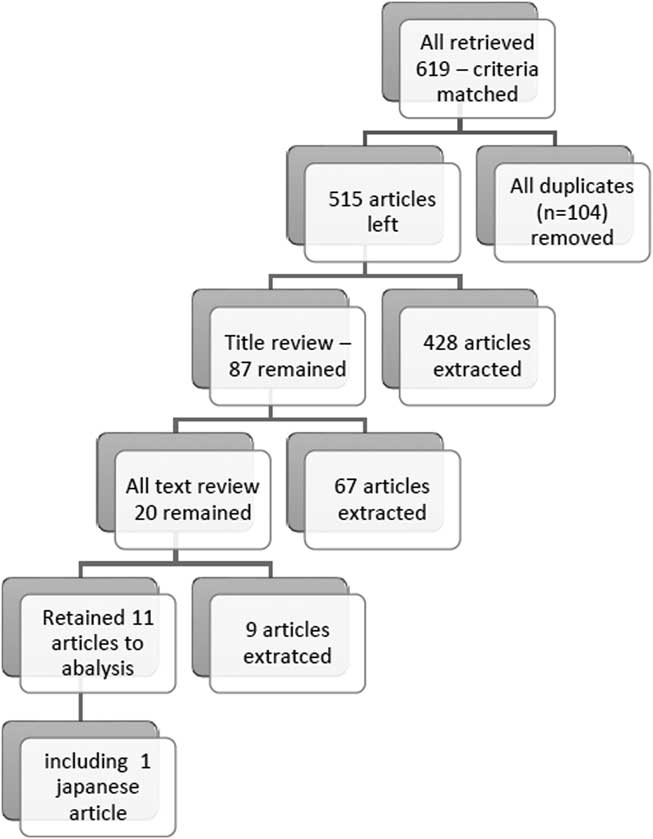
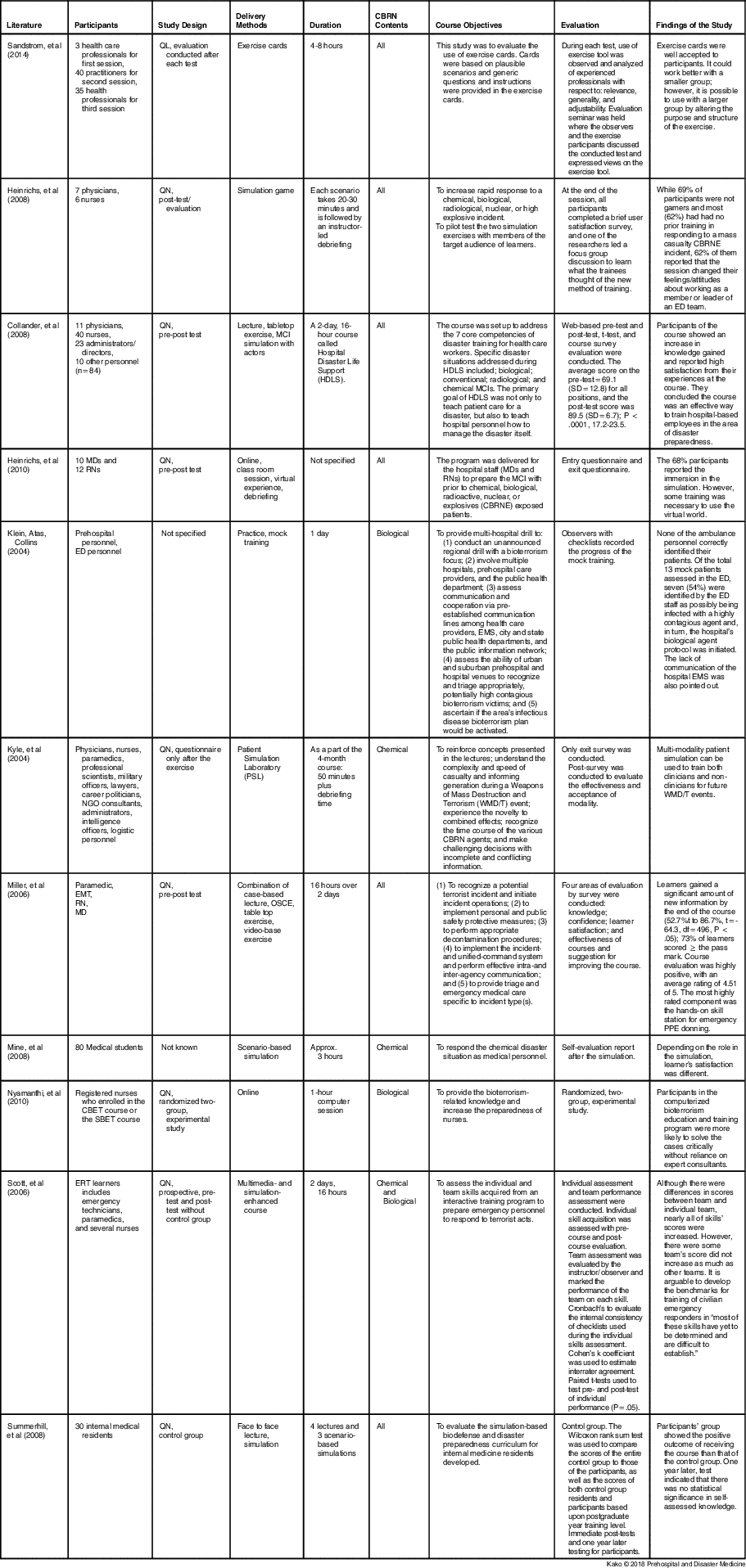
The literature search yielded a total of 619 articles (Figure 1). Upon the removal of duplicates, 87 articles remained for title review. There was a large number (n=76) of CBRN-related case reports about training and seminars in both the English and the Japanese literature. However, very few reported on course content, delivery, or evaluation and so were excluded from the review. A final total of 11 articles met the criteria for the review, and these are listed in Table 1.
Literature Selection Process.

The Summary Sheet of the Literature

Abbreviations: CBET, competency-based education training; CBRNE, chemical, biological, radiological, nuclear, or explosive; ED, emergency department; EMS, Emergency Medical Services; EMT, emergency medical technician; ERT, emergency response training; HDLS, Hospital Disaster Life Support; MCI, mass-casualty incident; MD, Medical Doctor; NGO, nongovernment organization; OSCE, Objective Structured Clinical Examination; PPE, personal protective equipment; RN, register nurse; SBET, simulation-based education training; WMD/T, Weapons of Mass Destruction and Terrorism.
In a majority of the selected studies (n=8), the course participants included a mixture of health professionals and hospital personnel.Reference Sandström, Eriksson, Norlander, Thorstensson and Cassel 17 - Reference Scott, Miller and Issenberg 24 Of the remaining five articles, one focused on nursing staff only,Reference Nyamathi, Casillas and King 25 two exclusively on medical officers,Reference Summerhill, Mathew and Stipho 26 , Reference Mine, Asahi and Okudera 27 and one had a variety of participants from different specialties including nursing, medicine, paramedicine, professional scientists, military officers, lawyers, consultants from nongovernment organizations, intelligence officers, and logistics officers.Reference Kyle, Via, Lowy, Madsen, Marty and Mongan 22 The remainder of the results were discussed under four headings which align with the purpose of the review: the availability of CBRN education for health professionals, the content, participant evaluation, and course evaluation.
Availability
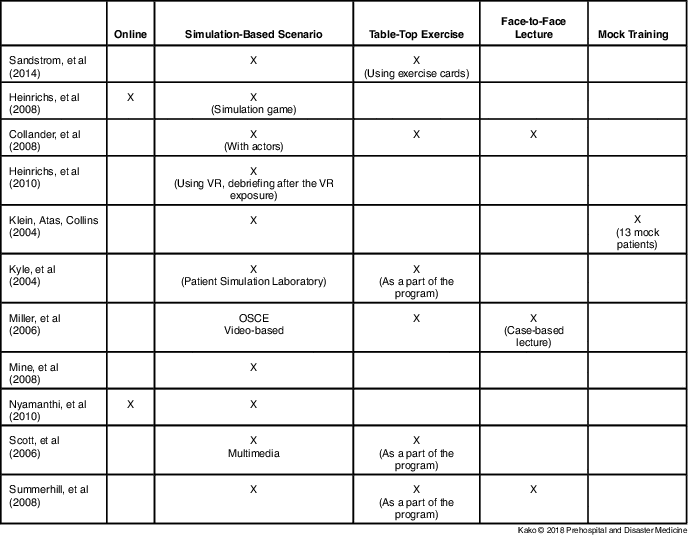
With the exception of the single article written in Japanese, all of the other articles were published in English. The articles described various types of delivery mode, such as online delivery, simulation sessions, table-top exercises, and face-to-face lectures. Simulation-based scenarios were the most common learning tool utilized in every course. Table 2 summarizes the modes of delivery. The duration of the courses varied from one hour to two days (in total, 16 hours).
Training Delivery Modes

Abbreviations: OSCE, Objective Structured Clinical Examination; VR, virtual reality.
Content
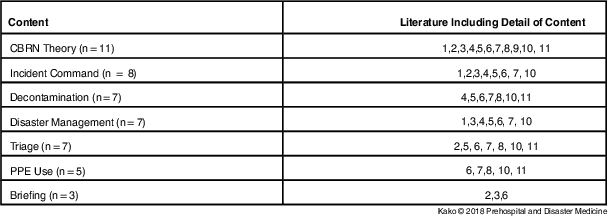
Thematic analysis of the content of the courses identified typical content areas which are outlined in Table 3. The most typical area of focus was CBRN theory (n=11) which was included in all the courses. This included defining of CBRN, the characteristics of the CBRN agents, the physiological impacts, and response procedures. Other content included incident command (n=8); decontamination (n=7); disaster management (n=7); triage (n=7); personal protective equipment (PPE) use (n=5); and post-training briefing (n=3). Activities that required larger room space and equipment, such as decontamination, PPE use, and triage, including their practical application, were only observed in courses with a longer duration.Reference Collander, Green, Millo, Shamloo, Donnellan and DeAtley 19 , Reference Klein, Atas and Collins 21 - Reference Scott, Miller and Issenberg 24 , Reference Summerhill, Mathew and Stipho 26
Top 7 Focused Contents from the Selected Literature

Abbreviations: CBRN, chemical, biological, radiological, and nuclear; PPE, personal protective equipment.
Approximately one-half of the courses (n=6) were typically structured to include a table-top exercise with scenarios and skills, such as demonstrating PPE and decontamination, followed by a post-course assessment.Reference Collander, Green, Millo, Shamloo, Donnellan and DeAtley 19 , Reference Kyle, Via, Lowy, Madsen, Marty and Mongan 22 - Reference Scott, Miller and Issenberg 24 , Reference Summerhill, Mathew and Stipho 26
Six courses contained all elements of CBRN.Reference Sandström, Eriksson, Norlander, Thorstensson and Cassel 17 - Reference Heinrichs, Youngblood, Harter, Kusumoto and Dev 20 , Reference Miller, Scott and Issenberg 23 , Reference Summerhill, Mathew and Stipho 26 Three courses focused only on the chemical elements,Reference Kyle, Via, Lowy, Madsen, Marty and Mongan 22 , Reference Scott, Miller and Issenberg 24 , Reference Mine, Asahi and Okudera 27 and three focused on only the biological elements.Reference Klein, Atas and Collins 21 , Reference Scott, Miller and Issenberg 24 , Reference Nyamathi, Casillas and King 25 There were no courses that focused exclusively on the radiological or nuclear elements.
The content was a driver for the duration of the training. For example, Collander, et alReference Collander, Green, Millo, Shamloo, Donnellan and DeAtley 19 and Miller, et alReference Miller, Scott and Issenberg 23 ran a two-day training course which included various types of CBRN disasters. On the other hand, the training reported by Klein, et alReference Klein, Atas and Collins 21 only focused on the biological elements during a one-day training course. The participants were broadly from emergency health services and health departments involving prehospital health professionals and emergency health professionals working in hospitals.
Participant Evaluation
Various methods were used to evaluate the participants’ acquisition of knowledge, including pre-post tests, performance assessments (including skills checklists), and exit surveys. Four studiesReference Collander, Green, Millo, Shamloo, Donnellan and DeAtley 19 , Reference Heinrichs, Youngblood, Harter, Kusumoto and Dev 20 , Reference Miller, Scott and Issenberg 23 , Reference Scott, Miller and Issenberg 24 conducted a pre- and post-test to evaluate the participants’ knowledge acquisition during the course through either hard-copy or in online mode. The measures used to evaluate the participants’ knowledge acquisition were competencies,Reference Collander, Green, Millo, Shamloo, Donnellan and DeAtley 19 participant knowledge levels,Reference Nyamathi, Casillas and King 25 confidence level to respond,Reference Miller, Scott and Issenberg 23 and participants’ self-evaluation of their skills acquisition.Reference Mine, Asahi and Okudera 27 All studies reported positive outcomes on the knowledge and skills acquired during training. Scott, et alReference Scott, Miller and Issenberg 24 specifically assessed individual skills acquisition by observing skills, such as PPE and the administration of the Mark I Kit (Meridian Medical Technologies, Inc.; Columbia, Maryland USA; DuoDote is currently replaced with Mark 1 Kit), which contains antidotes to treat nerve agents. Klein’s studyReference Klein, Atas and Collins 21 similarly involved drill observers to assess participants’ skills and knowledge acquisition with a checklist. This study included the only evaluation focusing on individual skills rather than evaluating via a survey after the training had been completed.
While most of Scott, et al’sReference Scott, Miller and Issenberg 24 evaluation focused on individual participants’ skills and knowledge, it also included a team performance assessment. Team performance was evaluated by an instructor/observer and marked according to performance on each skill set outlined for the course. Although teams had four rotations to perform skills on different scenarios, significant increases in knowledge and skills were already apparent after the first two rotations. Furthermore, Scott, et al’sReference Scott, Miller and Issenberg 24 study reported that the teams scored significantly lower on command and communication skills compared to the other skills in each scenario. While command and communication is a crucial element in the prehospital and emergency environments, the authors emphasized the inclusion of a training element that would enable participants to improve their communication.Reference Scott, Miller and Issenberg 24
In terms of the relationship between knowledge and retention, Summerhill, et alReference Summerhill, Mathew and Stipho 26 conducted a survey one year after completion of the training and reported that knowledge had diminished significantly compared to the survey conducted immediately after the training.
Course Evaluation
There were no studies that conducted an evaluation of a course in its entirety. Most evaluated only specific aspects, such as intervention use and training delivery mode. For example, four studiesReference Heinrichs, Youngblood, Harter and Dev 18 , Reference Kyle, Via, Lowy, Madsen, Marty and Mongan 22 , Reference Mine, Asahi and Okudera 27 , Reference Sandström, Eriksson, Norlander, Thorstensson and Cassel 28 used a participant exit survey to measure the effectiveness and acceptance of training interventions, such as training including simulation-based learning and virtual reality. Kyle, et alReference Kyle, Via, Lowy, Madsen, Marty and Mongan 22 reported positive outcomes of the usefulness and acceptance of multi-modality and high-fidelity patient simulations. The results of their survey indicated that the participants appreciated the authenticity of the scenario and claimed that its use added to the educational value of the course. Heinrichs, et alReference Heinrichs, Youngblood, Harter, Kusumoto and Dev 20 similarly reported positive attitudes towards the use of virtual reality, although with some technical limitations, particularly in relation to users needing to be familiar with the application of their avatar and other virtual functions. Lack of familiarity with the technology also affected the participants’ ability to respond to the scenario. Despite these limitations, the focus group discussions of this intervention were positive. In particular, interaction with a manikin made the experience more realistic. Even though there were no baseline evaluations conducted prior to the completion of these training courses, overall the surveys indicated that the participants had a positive attitude towards their learning and the use of the interventions in the training.
In relation to the delivery modes of the training, Sandstrom, et alReference Sandström, Eriksson, Norlander, Thorstensson and Cassel 28 reported that the post-evaluation focus group identified table-top exercise cards as a useful means to prompt communication and discussion among participants. Their study also claimed that small and homogeneous groups were effective in facilitating questions and engaging all participants. Their study highlighted that the flexibility of learning materials was the key element in preparing an effective course.Reference Sandström, Eriksson, Norlander, Thorstensson and Cassel 28
In contrast to the above evaluation studies with their focus on intervention use and delivery modes of training, Summerhill, et alReference Summerhill, Mathew and Stipho 26 and Nyamathi, et alReference Nyamathi, Casillas and King 25 investigated the overall effectiveness of their course. They compared a control group and a non-control group to evaluate effectiveness. While Summerhill, et alReference Summerhill, Mathew and Stipho 26 compared the group that received a CBRN training course to a group that did not, Nyamathi, et alReference Nyamathi, Casillas and King 25 compared groups that took part in a standard biological education training course with an online version. Summerhill, et alReference Summerhill, Mathew and Stipho 26 found that the knowledge of the group who took the training course was significantly better than those who did not. Nyamathi, et al’sReference Nyamathi, Casillas and King 25 findings agreed with those of Summerhill, et al’sReference Summerhill, Mathew and Stipho 26 study that participation in training improved the ability to solve cases in both sets of participants. In particular, the participants who took the online bioterrorism education and training program (the intervention for this study) were more likely to solve the cases critically and independently.
Synthesis of Findings
The prime objective of this review has been to explore the literature to determine the availability, content, and evaluation of existing CBRN education programs for health professionals. Three key findings have emerged from this review. Firstly, the review has highlighted a wide variation in mode of delivery and evaluation, making it difficult to compare and contrast CBRN courses. Secondly, only 11 CBRN courses emerged from the review and only three countries were represented as having CBRN programs for health professionals, which suggests a limited availability of such courses. Finally, as far as the authors of this review are aware, none of the courses have been evaluated for effectiveness in the context of actual CBRN response. Hence, it is difficult to draw conclusions as to which CBRN courses are most effective. These three key findings also suggest that there is a current paucity of investigation and knowledge in this area of study, particularly on the effectiveness of CBRN training delivery. Nevertheless, the integrative approach to the literature has highlighted the following points: the effectiveness of scenario-based training with high-modality and virtual reality and the inconsistency of evaluation methods in training and of the variety of structures of training.
Scenario-based training was presented as one of the most effective strategies for training in this review. This finding is supported by previous research; for example, Steadman, et alReference Steadman, Coates and Huang 29 compared full-scale simulation learning with problem-based learning. The study was conducted with fourth-year medical students in the USA, observing the students’ level of skills acquisition and knowledge. They concluded that scenario-based learning was a more effective way of learning in terms of the possibility of contextualizing what happens in real-world situations. Furthermore, a comparison between traditional teaching methods through a didactic style of teaching and simulation-based medical education (SBME) in medical and nursing education was addressed by McGaphie, et alReference McGaphie, Issenberg, Cohen, Barsuk and Wayne 30 and Alinier, et al.Reference Alinier, Hunt, Gordon and Harwood 31 In their meta-analytic review, McGaphie, et alReference McGaphie, Issenberg, Cohen, Barsuk and Wayne 30 investigated whether SBME with deliberate practice can lead to better results than traditional clinical education. Their study concluded that SBME with deliberate practice had higher merit than traditional clinical medical education in terms of specific clinical skills acquisition. Moreover, Alinier, et alReference Alinier, Hunt, Gordon and Harwood 31 found that intermediate fidelity simulation is an effective training delivery mode for small groups of students as it equips them with a competent level of technical skills in practice settings. HofmannReference Hofmann 32 also agreed that the use of purposive high-fidelity simulations can support skillful device handling, but also encourages students through effective and efficient learning. In the case of CBRN disaster training which requires specific skills such as PPE, decontamination, and triage, including these skills as essential components of CBRN training would be more effective and appropriate.
Emergencies happen in a broad context involving sections of, or entire communities, depending on the scale of the event. Scenarios can provide a realistic environment that enables participants to immerse themselves as if they were in an emergency situation. Although there are different modes with differing degrees of participation, such as desk-top, virtual reality, and high-modality simulation manikins, the inclusion of scenario-based training appears to be effective for CBRN training. Although knowledge development in the use of high-modality and virtual reality has emerged over time, little research has been conducted in this area with a specific focus on the CBRN context.
Moreover, due to high simulation technology use in training, depending on scale, objectives, and participants, it is important to consider affordability issues for the training organizers in relation to the financial and physical environment for conducting the training. HofmannReference Hofmann 32 also pointed this out, stating that the technology (high-fidelity simulation) is controlled by institutional perspectives such as technology status, disease status, and financial status. Whether such an approach can lead to success also depends on whether simulated aspects of real-world situations can be embedded into the simulation setting.
All courses reported positive outcomes both in terms of participants’ learning and the effectiveness of the courses. However, only minimal evaluation has been undertaken to determine the effectiveness of these courses for a real disaster response situation. All the studies used different interventions (ie, high-fidelity simulation, desk-top scenario-based, and online) which could have created difficulty in investigating the educational validity of training that involves looking up learning materials and measuring educational outcomes.Reference Hofmann 32 , Reference Issenberg and Scalese 33 The paucity of evaluation studies of CBRN courses would also have affected the development and systematization of this area of study, so further investigation on these issues will be required in future research.
Differences in the structure of training were due to differences in the objectives of the training courses. The training organizer would need to be responsible for constructing the training carefully to match the learning objectives of the participants. Resource availability would also be affected depending on the use of technology involving high-modality and vertical reality.
Limitations
It is important to note when considering the findings of this review that only the literature that presented an evaluation process to describe a CBRN course was included. Articles using other methodologies, such as case reports, were excluded from the review. It is possible, therefore, that some CBRN programs that are currently available have not been discussed as part of this review, and as well, some countries may be misrepresented as not having any CBRN programs when in fact they may well do. This review excluded grey literature that have been published by governments and international organizations. This exclusion may impact on missing out the guidelines for training and practical information for CBRN training.
Conclusion
Health professionals are essential first-line responders in CBRN emergency situations. This paper has explored the literature to determine the availability, content, and evaluation of existing CBRN education programs for health professionals. The outcome of the review indicates that the availability of such courses is still limited globally and they are not widely accessible to health professionals. This review has also identified a variety of training evaluation methods. While the effectiveness of high-fidelity, virtual reality, and simulation-based training is supported by previous research, further study will be necessary to establish evidence of the effectiveness of CBRN education in relation to delivery mode and training intervention.
Acknowledgement
The authors would like acknowledge Dr. Annie Murray and Dr. David Gillham for their assistance to set up the literature search frame and critical appraisal process.