Introduction
Improvement in women’s empowerment situation is a development issue around the world. However, measurement of women’s empowerment is not straightforward and depends on the cultural context of a country. Women’s empowerment can be seen as a process of which awareness, alternatives, resources, voice, agency and participation are integral parts. The logic of women’s empowerment is to enhance women’s ability to make choices over the areas in their lives that matter to them (Charmes & Wieringa, Reference Charmes and Wieringa2003). Studies have found that women’s rate of employment – a key indicator of women’s empowerment – has increased over the years around the globe. In Bangladesh it has increased noticeably, rising at 4.3% each year over the period 2000–2005. The number of rural women with an education level greater than that of their partner is also growing (World Bank, 2008), and more women are contributing significantly to their family’s household income. In Bangladesh, women are earning money for their households through microfinance programmes (Nazneen et al., Reference Nazneen, Hossain and Sultan2011). The more than 3 million women working in the garment sector in Bangladesh (International Monetary Fund, 2011) is another striking piece of evidence of women’s empowerment in Bangladesh (Kabeer et al., Reference Kabeer, Mahmud and Tasneem2011).
It is expected that an empowered women will enjoy more decision-making power within her family and have a greater chance of mobility. However, this may also make her more vulnerable to intimate partner violence (IPV) as her increased voice within the family may be regarded as a threat to male dominance. Intimate partner violence against women exists in almost all societies (Campbell et al., Reference Campbell, Jones, Dienemann, Kub, Schollenberger, O’Campo, Gielen and Wynne2002; Watts & Zimmerman, Reference Watts and Zimmerman2002) and is associated with considerable mortality (Campbell et al., Reference Campbell, Jones, Dienemann, Kub, Schollenberger, O’Campo, Gielen and Wynne2002; WHO, 2002). The highest rate of IPV in the world has been reported in Bangladesh, and the gender disparity in which this occurs is well recognized (Schuler & Islam, Reference Schuler and Islam2008). In Bangladesh, almost half of ever-married women (49.6%) have been the victims of physical violence, while 27.3% have experienced sexual abuse from their husbands (Bangladesh Bureau of Statistics, 2016). Moreover, there is evidence that in Bangladesh some forms of IPV are approved of culturally, and the social expectation is that husbands will guide their wives, especially when the spousal age difference is high, in every aspects of their lives. Surveys have revealed that even IPV victims themselves sometimes think that some forms of IPV were okay and justified (Sayem et al., Reference Sayem, Begum and Moneesha2012). Hence, in-depth research is required to address how the high rates of IPV and progress in women’s empowerment interact in Bangladesh (World Bank, 2008; Nazneen et al., Reference Nazneen, Hossain and Sultan2011).
Women’s empowerment, both economically and socially, may interact with IPV because women depend economically on men and tolerate some level of violence in return for economic and social support. If women’s income increases, this may decrease their risk of violence as their economic dependence decreases (Perova, Reference Perova2010). Their households become better off, so men feel less economic stress, which they might otherwise express through violence (Vyas & Watts, Reference Vyas and Watts2009). On the other hand, the risk of IPV may increase if men use violence as an instrument to disturb women’s market-oriented activity, take away women’s income or take authority over managing it (Hidrobo et al., Reference Hidrobo, Peterman and Heise2016). Studies suggest that the economic empowerment of women and girls can be an effective method of preventing or reducing violence against them (Fraser, Reference Fraser2012). However, an in-depth study by Mathur and Slavov (Reference Mathur and Slavov2013) revealed that domestic violence may be reduced with women’s economic empowerment, mainly among higher income groups. Studies in Bangladesh, though not nationally representative and mostly qualitative in nature, have suggested that women’s empowerment may influence their risk of IPV in complex and contradictory ways, and their risk may vary with specific forms of empowerment (Bates et al., Reference Bates, Schuler, Islam and Islam2004; Naved & Persson, Reference Naved and Persson2005; Schuler et al., Reference Schuler, Lenzi, Nazneen and Bates2014).
This study aimed to assess the association between women’s empowerment and IPV in Bangladesh through quantitative analyses using data from the nationally representative Demographic and Health Survey.
Methods
Study sample
The study was based on the 2007 Bangladesh Demographic and Health Survey (BDHS) (NIPORT et al., 2009), as this was the most recent BDHS data set to collect IPV-related information. The BDHS 2007 survey was the fifth in a series of national-level population and health surveys. The data were collected over a 5-month period from 24th March to 11th August 2007. The study sample comprised 3933 ever-married women aged 15–49 years. If a woman had been married more than once, information relating to her current marriage was considered.
Study variables
As decision-making and mobility are the most frequently studied domains of women’s empowerment (Ndola et al., Reference Ndola, Ashley, Megan, Jessica, Mellissa and Shayna2017), women’s empowerment was measured in four dimensions, namely: 1) mobility, 2) decision-making power, 3) employment status and 4) headship of the respondent in the household. Mobility had two categories: i) ability to go the medical/health centre and ii) ability to go outside the house. Decision-making had six categories: respondent’s ability to make a decision about i) spending own income, ii) household purchases for daily needs, iii) large purchases, iv) own medical treatment, v) their children’s health care and vi) visits to family or a relative’s house. These two measurements were given scores within a hypothetical range of 0 to 2 (using a modified form of scoring suggested by Hossain et al., Reference Hossain, Islam and Majumder2016). A respondent’s overall empowerment score was obtained by adding the scores of these four dimensions (1–4), giving a range of 0 to 20. If her overall empowerment score was 0 a respondent was considered to be ‘unempowered’; if her score was more than 0 but≤10, the respondent was considered to be ‘less empowered’; if her score was >10 she was regarded as ‘more empowered’.
Intimate partner violence was defined as i) physical or ii) sexual violence experienced by the respondent in her life time. Physical violence was measured with questions such as whether the respondent’s husband ever ‘pushed her, shook her, or threw something at her’, ‘slapped her’, ‘twisted her arm or pulled her hair’, ‘punched her with his fist or with something that could hurt her’, ‘kicked her’, ‘dragged her or beat her up’, ‘tried to choke her or burn her on purpose’ or ‘threatened or attacked her with a knife, gun, or any other weapon’. Sexual violence was considered by only one question, ‘Did your husband [ever] physically force you to have sexual intercourse with him even when you did not want to?’ A score of 1 was given if a respondent was abused physically (or sexually) and 0 otherwise (hypothetical values: 0, 1).
For employment status, unemployed respondents were assigned a score of 0, and employed respondents a score of 2. Similarly, if a respondent was not the household head she was given a score 0, and 2 otherwise.
Analysis
Binary logistic regression models were used to determine the influence of women’s empowerment on IPV while controlling for other covariates. All the relevant independent study variables and their interactions with women’s empowerment during the analysis were selected. Most of the variables were re-coded for the research analysis. Only significant relationships were kept in the final model.
Results
Descriptive analysis
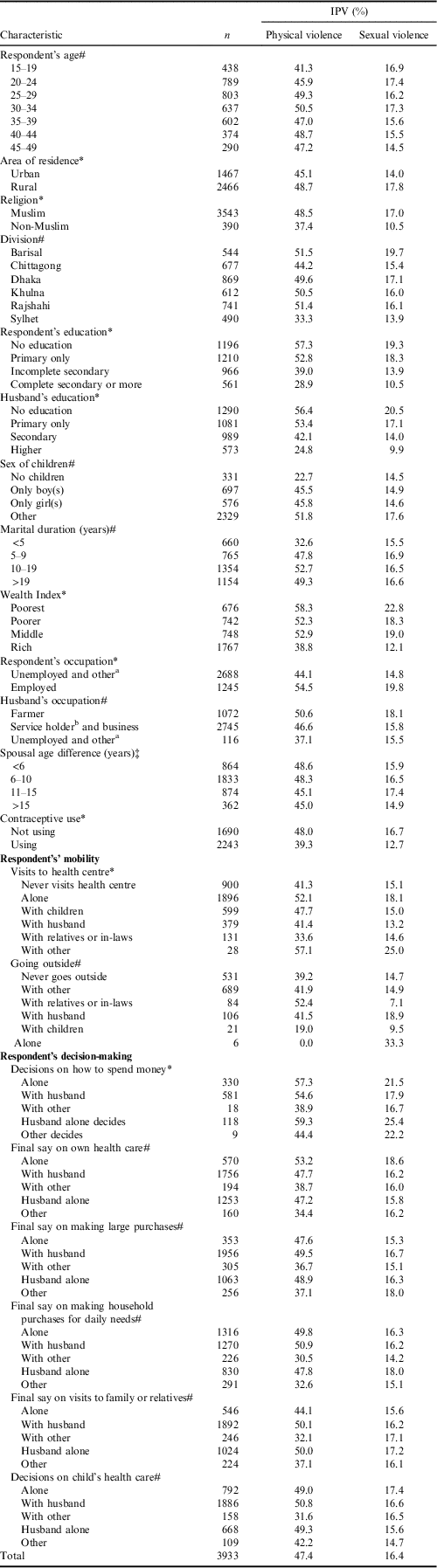
Data analysis revealed that about 65% of respondent women were ‘less empowered’ and 34.74% were ‘more empowered’; there were no unempowered women. About 47.4% of respondents had been abused physically by their husbands, while 16.4% reported having experienced sexual violence by their husbands (Table 1). Among the background characteristics considered, area of residence, religion, respondent’s education, partner’s education, wealth index, respondent’s occupation and contraceptive use were found to have significant associations with both experiencing physical and sexual violence. On the other hand, age of the respondent, Bangladesh division, sex of children, marital duration and partner’s occupation were found to have significant associations with experiencing physical violence. Furthermore, respondents being able to go to the health centre alone and decide on spending their own money were found to be significantly associated with both experiencing physical and sexual violence, while other components of mobility and decision-making were only significantly associated with experiencing physical violence (Table 1).
Intimate partner violence prevalence by demographic and socioeconomic characteristics of respondents and their husbands, 2007 BDHS

a Other means students and retired people.
b Service holders include rickshaw drivers, brick breakers, construction workers, domestic workers, factory workers, blue collar service works, semi-skilled labourers (carpenters, bus/taxi drivers) and professionals (medical workers, lawyers, accountants, teachers).
*Significant (to at least at p<0.005) for both physical and sexual violence; #significant for physical violence; ‡not significant.
Column percentages are not mutually exclusive. Multiple responses possible. The sum of the response categories for the questions on mobility and decision-making may not add up to 3933 due to missing cases.
Data analysis suggests that women from rural areas, Muslims, the less educated, those with a partner with less education, the poorest, the employed and those not currently using contraceptives were more likely to suffer from both physical and sexual violence. Furthermore, women with a marital duration of between 10 and 19 years and those with husbands employed in agriculture were more likely to experience physical violence by their husbands (Table 1).
Binary logistic regression analysis: physical violence
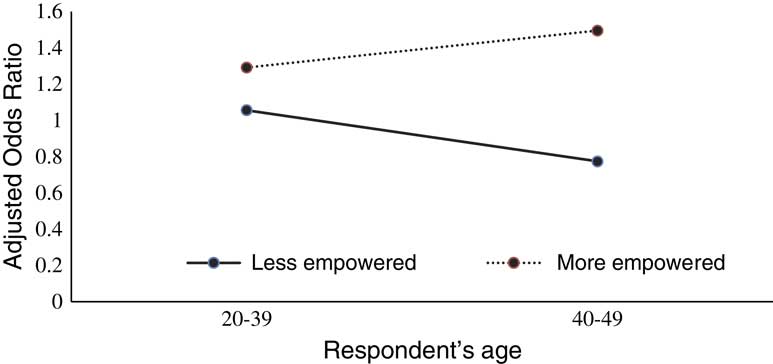
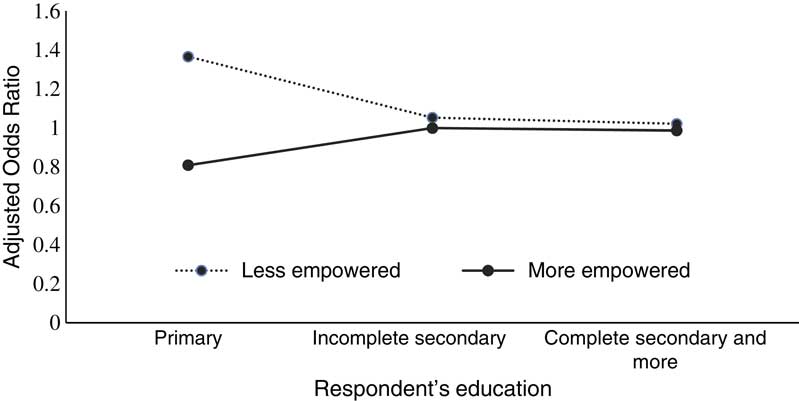
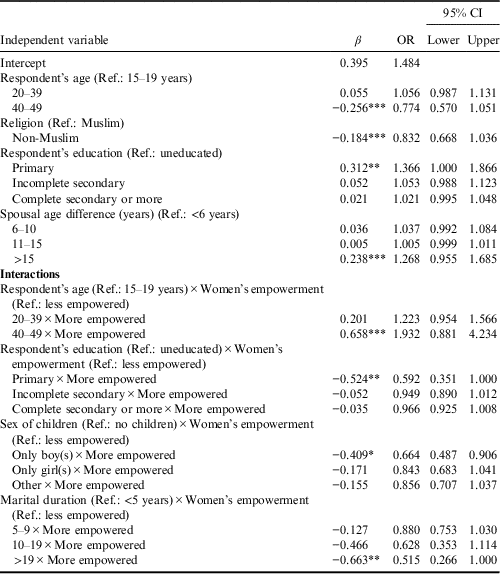
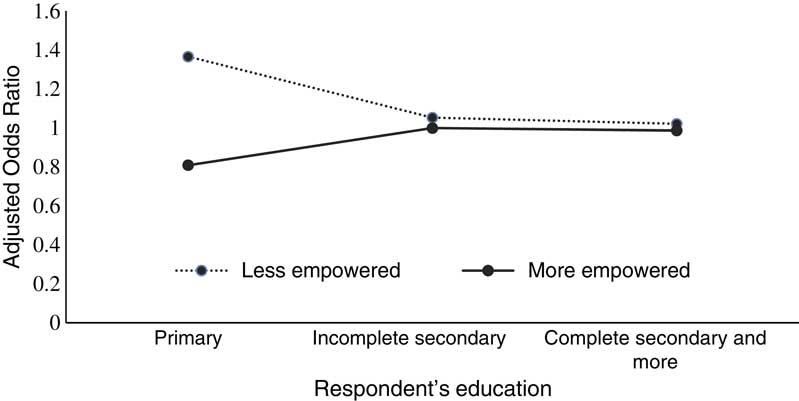
The relationship between experiencing physical violence and women’s empowerment was explored using binary logistic regression analysis. Exposure to physical violence (1=abused, 0=otherwise) was considered as the response variable (Table 2). Non-Muslim women were 0.83 times less likely to suffer from physical violence than their Muslim counterparts. When the spousal age difference was more than 15 years, the likelihood of a woman being physically abused was 1.27 times higher compared with when a woman had a spousal age difference of less than 6 years. Figure 1 shows that the likelihood of experiencing physical violence increased among more-empowered, older women. On the other hand, Fig. 2 suggests that, although the likelihood of physical violence was less among educated women, irrespective of their level of empowerment, there was a higher likelihood of experiencing physical violence among less-empowered, primary-educated women.
Interaction of respondent’s age and women’s empowerment level and the likelihood of experiencing physical violence.

Interaction of respondent’s education and women’s empowerment level and the likelihood of experiencing physical violence.
Binary logistic regression estimates of the effects of women’s empowerment on the likelihood of them experiencing physical violence by socioeconomic and demographic characteristics, 2007 BDHS

*p<0.01; **p<0.05; ***p<0.10.
Ref., reference category. OR, Odds Ratio.
The likelihood of being affected by physical violence among the less-empowered, childless women was more than among more-empowered women with only male children (Table 2). Also, the likelihood of suffering physical violence among less-empowered women with a marital duration of less than 5 years was higher than among more-empowered women with a marital duration of more than 19 years (Table 2).
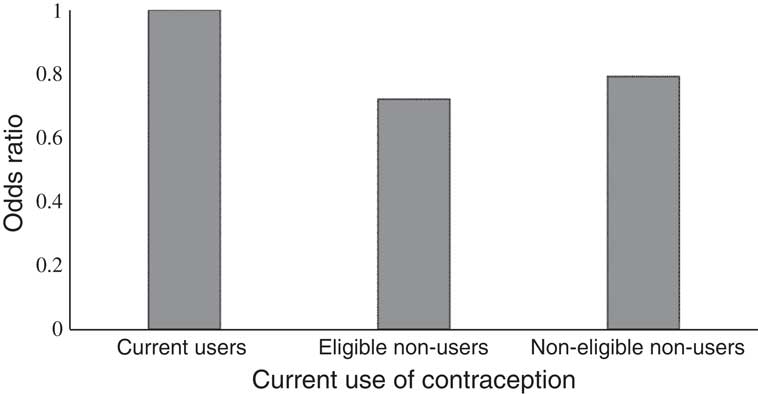
A separate model (not shown in Table 2) was fitted to evaluate the likely impact of respondents’ current use of contraception on the likelihood of experiencing physical violence, controlling for all relevant covariates (Table 2). Current use of contraception had a significant influence on physical violence (Fig. 3). More precisely, the likelihood of physical violence decreased for non-users of contraceptives (both eligible and non-eligible) compared with current users.
The effects of respondent’s current contraception use on the likelihood of experiencing physical violence.

Binary logistic regression analysis: sexual violence
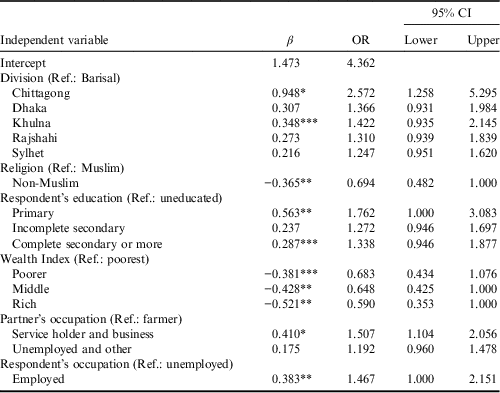
The results of the binary logistic regression model for sexual violence (1=abused, 0=otherwise) are presented in the Table 3. No significant relationship was found between women’s empowerment with the likelihood of experiencing sexual violence. However, some socioeconomic and demographic characteristics were identified that had influential effects on sexual violence. Women from Chittagong and Khulna divisions had 2.57 times and 1.42 times higher likelihoods, respectively, of being subjected to sexual violence by their husbands than women from Barisal division. Non-Muslim women were 0.69 times less likely to be affected by sexual violence than Muslim women. Respondents who were primary educated, and those who had completed secondary education and above, were respectively 1.76 times and 1.33 times more likely to experience sexual violence compared with their uneducated counterparts. This suggests that the poorest women were more likely to be affected by sexual violence. For example, rich women were 0.59 times less likely to suffer from sexual violence by their husbands compared with the poorest women. The wives of service holders and businessmen were 1.51 times more likely to be sexually abused by their husbands than the wives of farmers. Employed women were 1.47 times more likely to be sexually abused by their husbands than unemployed women. No significant effect of current use of contraception was observed.
Binary logistic regression estimates of the effects of women’s empowerment on the likelihood of experiencing sexual violence by socioeconomic and demographic characteristics, 2007 BDHS

*p<0.01; **p<0.05; ***p<0.10.
Ref.: reference group. OR, Odds Ratio.
Discussion
The main aim of this research was to explore the relationship between women’s empowerment and IPV in Bangladesh. Though no straightforward relationship was found, some subgroups of empowered women seemed to have experienced physical violence imposed by their husbands. More-empowered, older women were found to be more vulnerable to physical violence. This may be due to their greater involvement in the family and subsequent conflict over decision-making, such as spending their own income and issues related to children’s health care.
A nationally representative study revealed that more than 50% of the ever-married women aged 45 and above, and 56.2% of income earners in Bangladesh had been exposed to physical violence (Bangladesh Bureau of Statistics, 2016). The current study suggested that less-empowered, primary-educated women were more vulnerable to physical violence. This may be due to their lower status in terms of power relations compared with their husbands. In traditional societies, IPV seems to be a routine experience among women (Begum & Dey, Reference Begum and Dey2013), especially among those of lower status, whose husbands tend to be violent if their wives fail to meet their demands (Khatun & Rahman, Reference Khatun and Rahman2012). Also, such violence in many cases seems to be considered acceptable to the victims. Sayem et al. (Reference Sayem, Begum and Moneesha2012) found that about 49.5% of women in Bangladesh experiencing physical violence thought it was okay for a man to beat his wife. A recent study among ever-married women in Bangladesh revealed that 52.5% of primary educated, 48.3% of non-earners and 57.4% of the poorest women experienced physical violence by their partners in their life time (Bangladesh Bureau of Statistics, 2016). Muslim women seemed to experience more physical violence than non-Muslims in the current sample (Table 2), which may have been related to religious restrictions on mobility (Sayem et al., Reference Sayem, Begum and Moneesha2012) and on engagement in economic activities in some parts of society (Koenig et al., Reference Koenig, Ahmed, Hossain and Mozumder2003; Lamichhane et al. Reference Lamichhane, Puri, Tamang and Dulal2011).
The finding that women with a higher spousal age difference were more vulnerable to physical violence corroborates the findings of other studies (Schuler et al., Reference Schuler, Hashemi and Badal1998; Koenig et al., Reference Koenig, Ahmed, Hossain and Mozumder2003). Furthermore, the current study found that physical violence was more frequent among the younger cohorts, indicating that the same subset of women (with older husbands) are suffering from physical violence. More-empowered women with longer marital duration were less likely to suffer from physical violence. This may be due to the fact that with increased marital duration a more-empowered woman achieves some sort of protection against physical violence in Bangladeshi society. This is as expected, as with increased marital duration women are protected by their increased number of children. This is supported by the finding that more-empowered women with only boys were less likely to be affected by physical violence (Table 2). This was confirmed by Ghosh (Reference Ghosh2007) in a study on Indian women, which suggested that the likelihood of physical violence tended to decrease with increasing marital duration. However, the relationship between physical violence and marital duration is culture sensitive. For example, Kusanthan et al. (Reference Kusanthan, Mwaba and Menon2016) found the opposite result among Zambian women, where the prevalence of physical violence increased with increased marital duration.
Non-users of contraceptives were found to be less exposed to physical violence compared with current users. Eligible non-users of contraceptives (those not using due to husband’s opposition, religious opposition etc.) are more likely to compromise and avoid any conflict. On the other hand, non-eligible non-users do not need to face any conflict of opinion with their husbands, at least regarding contraception. These may be the reasons for lesser exposure to physical violence among non-users of contraceptives. A significant relationship between IPV and contraception use has also been reported in other studies (Williams et al., Reference Williams, Larsen and McCloskey2008; Maxwell et al., Reference Maxwell, Devries, Zionts, Alhusen and Campbell2015).
Prevalence of sexual violence and its determinants are very difficult to interpret in a cultural setting like Bangladesh, especially when the occurrence of sexual violence is determined by a single interview question and there is no situation analysis. Also, without probing questions there is a high possibility of under-reporting due to the sensitivity (religious and social desirability) of the content. This is a limitation of quantitative studies that fail to address religious and social desirability issues when addressing sexually intimate topics. Qualitative studies are more able to handle these issues efficiently. Paradata related to these type questions would give more insight into the findings. This study’s analysis suggested that women from Chittagong and Khulna division were more likely to experience sexual violence than those from Barisal division. This may be due to the distinctive sexual behaviour of males in these two divisions with their port cities. Caldwell et al. (Reference Caldwell, Pieris, Barkat-e-Khuda, Caldwell and Caldwell1999) reported that around half of the males from Chittagong under study had experienced premarital sexual relations. Also, some of them had had extramarital relationships. A similar finding was observed in Khulna, where 29% of condom users in the greater Khulna region were found to have had premarital sexual relationships and almost 7% of married men had had extramarital sex. Surprisingly, Folmer et al. (Reference Folmer, Alam and Sharif1993) observed similar behaviour in rural areas of Khulna.
Muslim women have been found to be more likely to suffer from sexual violence, and this may be due to sharia law (Jahan, Reference Jahan1994; Zaman, Reference Zaman1999; Sayem et al., Reference Sayem, Begum and Moneesha2012). The current study found that educated women experienced sexual violence more compared to their uneducated counterparts in Bangladesh. This may be due to the greater involvement of educated women in decisions related to coital relationships. Lamichhane et al. (Reference Lamichhane, Puri, Tamang and Dulal2011) supported this view by arguing that educated women tend to reject traditional gender roles, against the longstanding practice and beliefs of male-dominated society and thus making them more vulnerable to violence. A similar result was found by Kusanthan et al. (Reference Kusanthan, Mwaba and Menon2016) among Zambian women. They suggested that less-educated women were more likely to be submissive to their husbands and consequently avoid being sexually harassed. The results of the current study suggested that the poorest women in Bangladesh were more likely to be affected by sexual violence. Generally, these are the most vulnerable in terms of human rights, both in society and within the family. They are unlikely to raise their voice against unwanted sexual attention (timing, willingness) by their husbands and consequently surrender to such exploitation. This vulnerability seemed to decrease with increasing wealth status (Table 2). Again, sexual violence and its relationship with wealth status may be culturally sensitive and other studies may reveal different results (Heise, Reference Heise1998; Kishor & Johnson, Reference Kishor and Johnson2004; Kusanthan et al., Reference Kusanthan, Mwaba and Menon2016). For example, Zambian women in the middle wealth group were found to be more likely to experience sexual violence than poorer women (Kusanthan et al., Reference Kusanthan, Mwaba and Menon2016). Employed women in this study were found to be more likely to be sexually abused than unemployed women. The obvious reason is that employed women are empowered women and will take an active part in any coitus-related decision. Hence, the likelihood of disagreement and subsequent violence is greater. This has also been found to be the case in other cultural settings (Bhattacharya, Reference Bhattacharya2015; Kusanthan et al., Reference Kusanthan, Mwaba and Menon2016).
Women’s empowerment situation in Bangladesh has improved over the years. However, its benefit is not realized equally at every level of society, especially by socioeconomic class. It is a general assumption that women’s empowerment will reduce the prevalence of IPV. At the aggregate level this is the case in most developing countries, including Bangladesh. However, the continued existence of IPV among some sub-groups of empowered women cannot be ruled out. This study identified some groups of women in Bangladesh who are susceptible to IPV, despite having achieved higher empowerment. This requires special policy attention. Further research is needed to identify how to address this problem in vulnerable groups and ensure they benefit fully from their increased empowerment.
This is the only nationally representative quantitative study of this kind in Bangladesh to date, and it provides important policy information for decision-makers. It had to rely on the BDHS 2007 as information on IPV was not collected in the later rounds of the survey. However, the results will still be useful as structural and behavioural changes within Bangladeshi society occur very slowly. It is recommended that the BDHS includes IPV-related questions in future rounds. Also, the definition of sexual violence should be re-visited and more than one question should be used. Paradata related to IPV should be collected to help explain often complex results.
Ethical Approval. This research used the BDHS 2007 dataset for which no ethical approval was required.
Conflicts of Interest. The authors have no conflicts of interest to declare.
Funding. This research received no specific grant from any funding agency, commercial entity or not-for-profit organization.