Implications
Sweet narrow-leafed lupin (Lupinus angustifolius) seeds can be used in poultry feeds but in broilers some cultivars applied at levels over 30% induce high viscosity in small intestinal digesta. High viscosity negatively affects nutrients utilization and affects bacterial fermentation in distal parts of the gut. The ability to increase digesta viscosity by lupin cultivars cannot be precisely estimated by in vitro methods. For practical application when using narrow-leafed lupin seeds in broiler diets the cultivars of lower viscosity should be promoted or the upper limit of inclusion should be established.
Introduction
Controversies about the use of certain high-protein feeds in poultry nutrition (meat and bone meal, genetically modified soyabean meal) increase the demand for other vegetable protein feeds. Lupin seeds, particularly from modern low-alkaloid cultivars, provide an alternative to soyabean meal in poultry feeds. Furthermore, using lupin in feeds allows accredited organic farms to expand their feed base. Three species of lupin are grown in North-Western Europe: yellow lupin (Lupinus luteus), white lupin (Lupinus albus) and narrow-leafed lupin (L. angustifolius), sometimes referred to as white or blue lupin due to its white or blue flowers. For poultry, yellow and white lupin have better nutritional value than narrow-leafed lupin (Alloui et al., Reference Alloui, Smulikowska, Chibowska and Pastuszewska1994; Roth-Maier and Paulicks, Reference Roth-Maier and Paulicks2003; Smulikowska et al., Reference Smulikowska, Konieczka, Czerwinski, Mieczkowska and Jankowiak2014) due to their higher protein and fat content. However, narrow-leafed lupin is currently the most readily available species due to its better resistance to anthracnose.
The seeds of above mentioned three lupin species contain per kilogram dry matter (DM): 330 to 430 g CP, 54 to 105 g crude fat (CF), 320 to 400 g non-starch polysaccharides (NSP) and 76 to 120 g oligosaccharides, mainly of raffinose family (Gdala and Buraczewska, Reference Gdala and Buraczewska1996; Pisarikova and Zraly, Reference Pisarikova and Zraly2009). Lupin NSP consist mainly of cellulose, arabinoxylans and pectic polysaccharides, the last are complex highly branched structures consisting of rhamnogalacturonan main chains with extended side chains of α-arabinans and β-galactans (Cheetham et al., Reference Cheetham, Cheung and Evans1993). The constituent sugars of lupin NSP are glucose, galactose, arabinose, xylose, uronic acids, and less frequently mannose, rhamnose and fucose (Gdala and Buraczewska, Reference Gdala and Buraczewska1996). About 5% to 10% of lupin NSP is soluble (Evans et al., Reference Evans, Cheung and Cheetham1993; Kocher et al., Reference Kocher, Choct, Hughes and Broz2000).
Both, oligosaccharides and NSP of lupin are not digested in the broiler small intestine, but soluble NSP (sNSP) causes the viscosity of digesta in the distal parts of gastrointestinal tract (GIT) to increase (Kocher et al., Reference Kocher, Choct, Hughes and Broz2000). It is well established that high digesta viscosity caused by soluble arabinoxylans and β-glucans of cereals is negatively correlated with digestibility of nutrients and apparent metabolizable energy (AME) of diets in chickens. Moreover, it promotes bacterial activity in the distal parts of GIT with detrimental effect to gut health (Choct et al., Reference Choct, Hughes, Wang, Bedford, Morgan and Annison1996; Hübener et al. Reference Hübener, Vahjen and Simon2002). The anti-nutritive effect of lupin sNSP viscosity on digestion of nutrients and gut health in broilers is often underestimated.
The viscosity of lupin NSP varies between species. The viscosity of digesta increases with the amount of lupin seeds in the diet, and also increases along the small intestine, being greatest in ileum (Kocher et al., Reference Kocher, Choct, Hughes and Broz2000). In broilers fed diets with 30% to 40% of whole yellow and white lupin seeds the viscosity of ileal digesta has been found to be from 3 to 8 mPa·s (Mieczkowska et al. Reference Mieczkowska, Smulikowska and Nguyen2004 and Reference Mieczkowska, Jansman, Kwakkel and Smulikowska2005; Olkowski et al., Reference Olkowski, Classen, Wojnarowicz and Olkowski2005; Kaczmarek et al. Reference Kaczmarek, Hejdysz, Kubis, Kasprowicz-Potocka and Rutkowski2016). The values reported for broilers fed diets with 30% to 40% of narrow-leafed lupin were higher, from 12 (Kocher et al., Reference Kocher, Choct, Hughes and Broz2000) to 33 mPa·s (Olkowski et al., Reference Olkowski, Classen, Wojnarowicz and Olkowski2005).
Economic decisions concerning the inclusion of lupin seeds in poultry feed mixtures require an accurate determination of its AME. The referred AME values for poultry of narrow-leafed lupin seeds range from 6.5 to 9.1 MJ/kg (Alloui et al., Reference Alloui, Smulikowska, Chibowska and Pastuszewska1994; Roth-Maier and Paulicks, Reference Roth-Maier and Paulicks2003; Kaczmarek et al., Reference Kaczmarek, Kasprowicz-Potocka, Hejdysz, Mikuła and Rutkowski2014; Koivunen et al., Reference Koivunen, Partanen, Pertillä, Palander, Tuunainen and Valaja2016). Unfortunately, these data were not accompanied by measurements of respective ileal digesta viscosity. In broilers fed a wheat-based diet the AME value of diet increased with reduction of ileal viscosity (Annison, Reference Annison1995), suggesting that differences of published AME values of narrow-leafed lupin may depend on the NSP viscosity. If it is true, an in vitro method to predict the viscosity caused by different cultivars of lupin would be valuable both for plant breeders and feed manufacturers.
The aim of the trial was to study the effects of different cultivars of narrow-leafed lupin at two inclusion levels on AME of lupin, on viscosity of ileal digesta measured with different techniques, and on bacterial enzymes activity in the distal parts of the gut. In addition, two in vitro evaluation methods of lupin viscosity were compared.
Material and methods
Materials
Seeds of narrow-leafed lupin (L. angustifolius L.) of four cultivars with blue flowers – Kadryl, Regent, Dalbor and Bojar and one with white flowers – Tango, harvested in 2013 were purchased from Plant Breeding Station, Smolice (Poland). Seeds were ground in a disc-grinder to pass through a 3 mm sieve, analysed according to Association of Official Analytical (AOAC) (2005), and used for in vitro viscosity determination as well as in the experimental diets.
Animals and diets
Experimental procedures were approved by the 3rd Local Animal Care and Ethics Committee in Warsaw. The experiment was conducted on 154 female 21-day-old Ross 308 chickens. The birds were randomly allocated to 11 dietary treatments (14 birds each) and kept in individual balance cages (length 36 cm×width 36 cm×height 52 cm) each equipped with a feed and water supply and a tray for excreta collection. The average initial BW in each group was 1086±64 g. Throughout the study, birds were kept at a room temperature of 22°C on a light/dark cycle of 18/6 h. Birds had free access to water and received pelleted experimental diets.
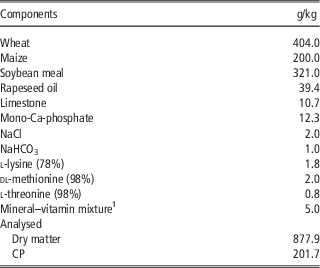
The reference diet based on wheat, maize and soyabean meal was prepared (Table 1) and its DM analysed. In all, 10 test diets were prepared containing one of five lupin meals (cultivars Kadryl, Regent, Dalbor, Bojar or Tango; C) combined with the reference diet at proportions (w/w) of 25 : 75 or 32 : 68 g/kg DM (low or high inclusion level; L). Chromium oxide was added to all diets as an indigestible marker at a ratio of 3 g/kg DM. Diets were mixed and cold-pelleted on a CL-2 CPM laboratory pellet mill (California Pellet Mill Co., CA, USA). Experimental diets were fed to the 11 groups of broilers for 6 days at daily ration of 100 g given in three meals. After a 2-day adaptation period, excreta from eight randomly chosen birds in each group were individually collected for 4 days and kept frozen at −18°C for future analysis (n=8). At the end of the experiment, all chickens in each group were sacrificed and ileum and caecum was removed. The digesta from each segment were gently squeezed and pooled by segment (two birds per sample) to provide sufficient material for analysis (n=7). Part of each sample was transferred to duplicate Eppendorf tubes (Merck, Darmstadt, Germany) and stored at −20°C before being used in bacterial enzymes activity determination. The ileal digesta were also used for two viscosity determinations: ileal viscosity immediate (IVI) performed immediately after collection and ileal viscosity frozen (IVF) in samples frozen at −18°C for 6 days.
Composition of the reference diet (g/kg) as-fed basis

1 Provided per kilogram diet: vitamin A 12 500 IU; vitamin D3 5000 IU; (mg) vitamin E 75; vitamin B1 3; vitamin B2 8; biotin 0.2; vitamin B6 5; vitamin B12 0.02; vitamin K3 3; nicotinic acid 55; folic acid 2; pantothenic acid 13; choline-Cl 350; Mn 120; Zn 100; Se 0.3; Cu 16; Fe 50; J 1.25; and Ca 1.125 g, coccidiostat narasin, nicarbazin 100 mg.
In vitro viscosity determination
For viscosity measurements, lupin meal samples were ground further in a cyclone mill fitted with a 0.5 mm screen. Viscosity was measured in vitro using two methods adapted from Bedford and Classen (Reference Bedford and Classen1993) and Smulikowska and Nguyen (Reference Smulikowska and Nguyen2001). Water extract viscosity (WEV) was measured as follows: 1 g of sample was mixed with 5 ml sodium acetate buffer (pH 5), the mixture was sealed and incubated for 30 min at 40°C in a shaking water bath, cooled on ice, centrifuged (10 min at 10 000×g, 4°C), and the viscosity of supernatant (0.5 ml aliquot) was measured using a Brookfield Digital cone/plate viscometer (model LVDV II+; Brookfield Engineering Laboratories, Stoughton, MA, USA). The viscometer was maintained at 40°C by connecting the sample cup to the water bath and measurements are given in mPa·s units (mPa·s=cP=0.01 dyn/s per cm2). Enzyme-treated extract viscosity (EEV) was measured in conditions imitating the first stages of in vivo digestion processes as follows: 1 g of sample was mixed with 3 ml 0.1 N HCl solution containing 2000 U pepsin/ml, sealed and incubated for 45 min at 40°C in a shaking water bath. Thereafter, 1 ml 1 M NaHCO3 solution containing 4 mg of pancreatin was added and the mixture was incubated as above for a further 2 h, then cooled on ice and centrifuged. The viscosity of the supernatant was measured as in the WEV method. Each sample of digesta was analysed in triplicate in separate runs.
In vivo viscosity determination
Viscosity in vivo was measured as follows. The samples of ileal digesta collected from chickens sacrificed after the digestibility trial were divided into two subsamples. One subsample was immediately centrifuged (10 min at 10 000×g, 4°C) and the viscosity of the supernatant (IVI) was measured as in the WEV method. The second subsample was stored at −18°C for 6 days, thawed, centrifuged and IVF value was measured as in the WEV method.
Bacterial enzyme activity
The glycolytic activity of bacterial enzymes (β-glucuronidase, α- and β-glucosidase, α- and β-galactosidase) in the ileal and caecal digesta was measured in terms of the rate of p-(o-)-nitrophenol release from nitrophenylglucosides, according to the method of Djouzi and Andrieux (Reference Djouzi and Andrieux1997) modified by Juśkiewicz et al. (Reference Juśkiewicz, Jankowski, Zduńczyk and Mikulski2006). The substrates used were: for β-glucuronidase, p-nitrophenyl-β-D-glucuronide; for α-glucosidase, p-nitrophenyl-α-D-glucopyranoside; for β-glucosidase, p-nitrophenyl-β-D-glucopyranoside; for α-galactosidase, p-nitrophenyl-α-D-galactopyranoside, for β-galactosidase, p-nitrophenyl-β-D-galactopyranoside (Sigma Chemical Co., St. Louis, MO, USA). Approximately 0.5 g of ileal or caecal digesta were diluted with phosphate buffer (0.1 M, pH 7.0) at a ratio of 1 : 10 (w/v), homogenized, sonicated twice for 30 s, then centrifuged at 10 000×g for 15 min. From the supernatant, 0.12 ml was taken, mixed with 0.18 ml substrate solution (5 mM) and incubated at 37°C. After 10 min, the reaction was stopped by adding 1.5 ml cold 0.25 M sodium carbonate solution. The p-(o-)nitrophenol concentration was measured in terms of its optical absorbance at 400 nm (p-nitrophenol) or 420 nm (o-nitrophenol). Each sample of digesta was analysed in triplicate in separate runs. Enzyme activity was expressed as micromol of product formed per minute (U) per gram of sample.
Chemical analyses
The representative samples of lupin seeds and diets were ground to pass a 0.5 mm sieve. The excreta were thawed, homogenized and sampled in triplicate for DM quantification, then dried for 12 h at 60°C, kept open to the air in room temperature for 48 h and ground to pass a 0.5 mm sieve. The seeds were analysed for DM, crude ash, nitrogen (CP=N×6.25), CF and crude fibre using methods 934.01, 942.05, 984.13, 920.39, 962.09 according to AOAC (2005). The gross energy (GE) was determined using a Parr adiabatic bomb calorimeter (KL-10; Precyzja, Bydgoszcz, Poland). In diets and excreta DM, N and GE was measured as above and chromic oxide was measured spectrophotometrically using wet ashing according to Kimura and Miller (Reference Kimura and Miller1957).
Calculations and statistics
Using calculation of CF as an example the following equation was used to calculate the apparent total tract (ATT) CF digestibility (D) and ATT nitrogen retention of diets:
 $$\eqalignno { & D_{{{\rm CF}}} \,{\equals}\, \{ {1{\minus}{\rm }[ {( {{\rm Cr}_{2} {\rm O}_{3} {\rm g}/{\rm kg}\,{\rm DM}\,{\rm diet}/ {\rm Cr}_{2} {\rm O}_{3} {\rm g}/{\rm kg}\,{\rm DM}\,{\rm excreta )}}}}\cr& \quad\quad\,\,\,{\rm x} \, ( {{\rm CF}\,g/{\rm kg}\,{\rm DM}\,{\rm excreta}/{\rm CF}\,{\rm g}/{\rm kg}\,{\rm DM}\,{\rm diet}} )} ]} \} $$
The apparent metabolizable energy value corrected to zero N retention (AMEN) of reference and test diets was calculated using the above equations and it was corrected to a zero nitrogen balance, assuming that 34.4 kJ/g N was retained (Hill and Anderson, Reference Hill and Anderson1958). Calculation of the AMEN of lupin was done according to Campbell et al. (Reference Campbell, Campbell and Blair1983) assuming additivity of the AMEN values of the reference (R) and the test (T) diet using the formula:
 $${\rm AME}_{{\rm N}} {\rm lupin}\,{\equals}\,\left[ {{\rm AME}_{{\rm N}} T-\left( {1{\minus}X} \right)\,{\rm AME}_{{\rm N}} {\rm R}} \right]\,/\,X$$
where X is the level of inclusion of lupin in the reference diet.
Differences between means of groups fed the lupin-containing diets were tested using two-way ANOVA as a 5×2 factorial design, which involved five lupin cultivars (C) and two dietary levels (L) of each cultivar as experimental factors. Differences were considered significant at P<0.05. An additional set of two contrasts was used to asses differences between birds fed the reference diet and birds fed test diets containing 250 or 320 g lupin/kg. Correlations between in vitro WEV and EEV values and between IVI values and other experimental data including IVF values were assessed using Pearson’s correlation calculated on a basis of the following formula:
 $$r_{{xy}} \,{\equals}\,{\mathop{\rm cov}} \,\left( {x,y} \right)/S_{x} S_{y} $$
where r xy is the Pearson’s correlation coefficient, cov (x,y) the covariance (covariation between x and y), S x S y are the standard deviations of the traits compared. All statistical analyses were performed using STATGRAPHICS® Centurion XVI ver. 16.1.03 software (Statistical Graphic Corporation, 1982–2010).
Results
Chemical composition and in vitro viscosity of lupin seeds
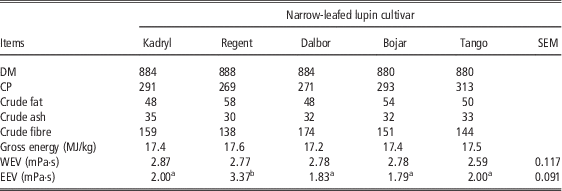
The chemical composition of lupin seeds and in vitro viscosity measured with two methods is shown in Table 2. The CP content in evaluated lupin cultivars averaged 287 g/kg, CF 52 g/kg, crude ash 32 g/kg and crude fibre 153 g/kg, respectively. Water extract viscosity value averaged 2.76±0.12 mPa·s, and did not differ between lupin cultivars. Enzyme-treated extract viscosity value averaged 1.9 mPa·s for four of the lupin cultivars, and was significantly higher (3.37 mPa·s, P<0.05) for Regent cultivar. There was no correlation between in vitro WEV and EEV values.
Chemical composition (g/kg as-fed basis unless stated otherwise) and in vitro viscosity of lupin seeds

DM=dry matter; WEV=water extract viscosity; EEV=enzyme-treated extract viscosity.
a,bMeans with different superscript letters within a row are significantly different at P<0.05.
Viscosity of ileal digesta and nutritional value of lupin
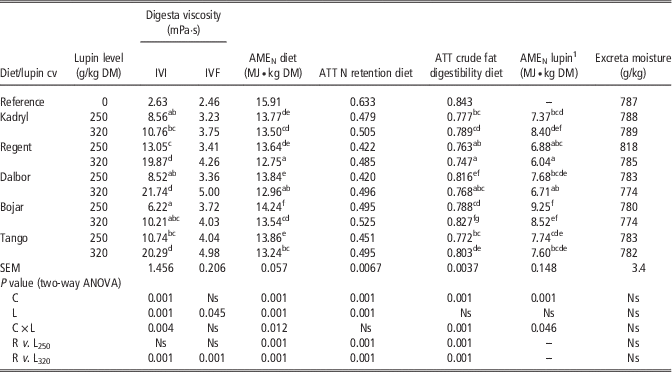
Broilers ate all portions of feed supplied. The IVI value was 2.63 mPa·s in the group fed the reference diet (Table 3). Ileal viscosity immediate values of all the groups fed test diets were higher compared with the reference group (P<0.05 and P<0.001 for 250 and 320 g lupin/kg, respectively). Generally, IVI was higher at the high than at the low lupin level, but the increase was only numerical in groups fed Bojar and Kadryl, and significant in groups fed Regent, Dalbor and Tango cultivars (significant C×L interaction; P<0.01). On average, IVI for Bojar and Kadryl were 8.27 and 9.66 mPa·s, respectively, and for Dalbor, Tango and Regent 15.1, 15.5 and 16.5 mPa·s, respectively. The IVF was 2.46 mPa·s in the digesta samples from the group fed the reference diet, it was not significantly increased for the groups fed the test diets with 250 g of lupin/kg, but was higher (P<0.001) for the groups fed the high lupin level. There was no difference in IVI values between lupin cultivars.
Effects of lupin cultivar (C) and dietary level (L) on ileal digesta viscosity measured immediately after collection (IVI) and after freezing (IVF), apparent total tract (ATT) N retention and crude fat digestibility coefficients of diets, apparent metabolizable energy (AMEN) of diets and lupins1 and excreta moisture

The reference (R) diet contained no lupin.
1 Calculated according to Campbell et al. (Reference Campbell, Campbell and Blair1983).
a,b,c,d,e,f,gDifferent superscript letters within columns indicate significant differences at P<0.05.
The AMEN of the reference diet was 15.9 MJ/kg DM, AMEN of all test diets were lower (P<0.001). The high inclusion level decreased AMEN to a similar extent in all cultivars, except for Kadryl that was less affected (significant C×L interaction, P=0.012, Table 3). ATT N retention from the reference diet was 0.633, and it was lower for all test diets (P<0.001). ATT N retention was higher for Bojar and Kadryl than for Regent, Dalbor and Tango cultivars (0.501 v. 0.461, on average, P<0.001), and it decreased with dietary lupin level (P<0.001) from 0.501 to 0.453 (P<0.001). ATT fat digestibility was in the reference group 0.843 and in all the test diets it was lower (P<0.001). No differences were observed between the low and the high inclusion levels for Kadryl and Regent, however, at the high inclusion level it was higher for Bojar and Tango but lower for Dalbor cultivar (significant C×L interaction; P<0.001).
Calculated lupin AMEN values ranged from 6.04 MJ/kg DM for Regent at the high dietary level to 9.25 MJ/kg DM for Bojar cultivar at the low dietary level. High inclusion level decreased AMEN value in all cultivars, except for Kadryl for which it increased (significant C×L interaction; P<0.05). Excreta moisture was similar in the reference and the lupin-containing diets and was not affected either by lupin cultivar or by dietary lupin level.
Bacterial enzyme activity
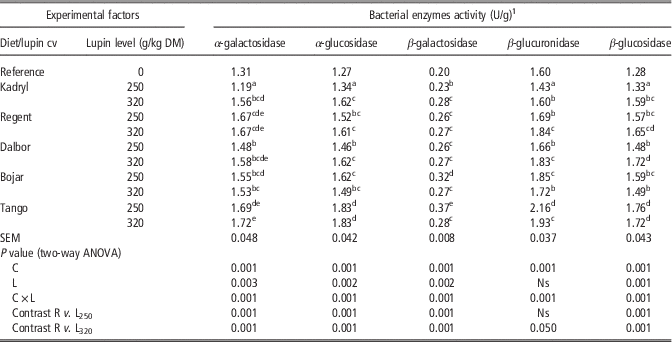
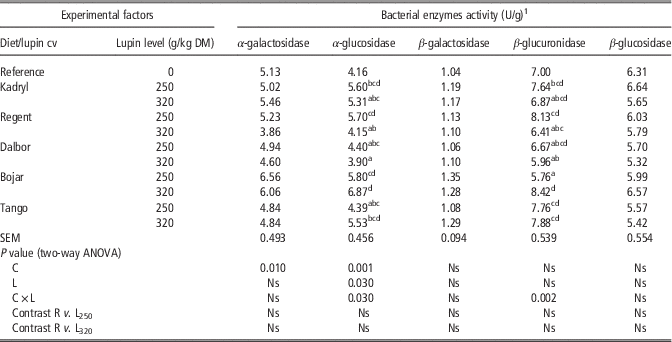
Overall, the lowest activity of bacterial enzymes measured in ileal digesta was associated with birds fed the reference diet, with exception of α-galactosidase and β-glucuronidase, which was lowest in birds feed the low level of Kadryl cultivar (Table 4). Analysis of contrasts revealed, that the activity of all bacterial enzymes in birds fed lupin was higher than in birds fed the reference diet (P<0.001 or P<0.05) except for the activity of β-glucuronidase at the low level of inclusion that was not significantly different. For Kadryl the activity of all bacterial enzymes in ileal digesta was higher for the high than for the low inclusion level, but not for the remaining four cultivars that had different responses depending on cultivar. There was significant C×L interaction for all enzymes (P<0.001).
Effects of lupin cultivar (C) and dietary level (L), on bacterial enzymes activity in ileal digesta of chickens

DM=dry matter.
The reference (R) diet contained no lupin.
1 U: μmol p-(o-)-nitrophenol released from respective nitrophenylglucosides per minute per gram of sample.
a,b,c,d,eDifferent superscript letters within a column indicate significant differences at P<0.05.
The activity of all bacterial enzymes in caecal digesta was generally higher compared with that in ileal digesta (Table 5). Analysis of contrasts revealed, that it did not differ between the birds fed the lupin-containing diets and the birds fed the reference diet. No significant effect were observed for the activity of β-galactosidase and β-glucosidase. On the other hand the α-galactosidase activity was higher in birds fed Bojar than those fed the other cultivars (6.31 v. 4.85 U/g; P<0.01). The α-glucosidase activity decreased (P<0.05) with the high level for Regent, and β-glucuronidase increased (P<0.05) with the high level for Bojar but these activities did not differ with inclusion level for remaining four cultivars (significant C×L interaction for these two enzymes; P<0.05).
Effects of lupin cultivar (C) and dietary level (L) on bacterial enzyme activity in caecal digesta of chickens

DM=dry matter.
The reference diet contained no lupin.
1 U: μmol p-(o-)-nitrophenol released from respective nitrophenylglucosides per minute per gram of sample.
a,b,c,dDifferent superscript letters within a column indicate significant differences at P<0.05.
Associations between viscosity of ileal digesta, nutritional value of lupin seeds and bacterial enzymes activity
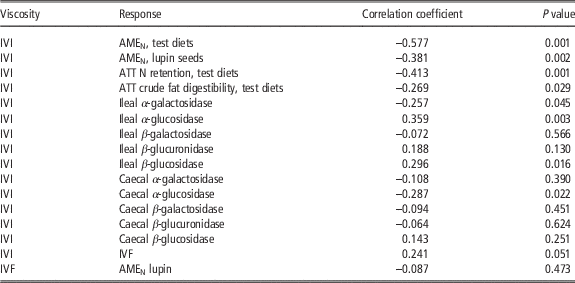
The correlations between IVI and other experimental data obtained for lupin-fed birds are shown in Table 6. Ileal viscosity immediate was negatively correlated with AMEN value of test diets (r=–0.577, P<0.001), ATT N retention of test diets (P<0.001), ATT CF digestibility of test diets (P=0.029) and AMEN of lupin seeds (r=–0.381; P<0.002). In terms of bacterial enzyme activity, IVI was positively correlated with ileal α- and β-glucosidase activity (P<0.003 and P=0.016, respectively), but it was negatively correlated with ileal α-galactosidase and caecal α-glucosidase activity (P=0.045 and P<0.022, respectively).
Pearson’s correlation coefficients calculated only for lupin-containing diets between viscosity of ileal digesta measured immediately after collection (IVI), apparent metabolizable energy (AMEN) of test diets and lupin seeds, apparent total tract (ATT) N retention and crude fat digestibility, microbial glycolytic enzymes activity in ileal and caecal digesta, and viscosity of ileal digesta measured after freezing (IVF)

Ileal viscosity immediate and IVF values were poorly correlated (P=0.051) and there was no significant correlation between IVF and AMEN value of lupin seeds. The in vitro viscosity values (WEV and EEV) were not correlated either with IVI values or with AMEN of lupin seeds.
Discussion
This study investigated the impact of lupin seed on the viscosity of digesta, the nutritional value of diet and on the bacterial enzymes activity in ileum and caecum of broilers. The content of CP and CF in lupin seeds were within the limits reported formerly for Polish narrow-leafed lupins cultivars (Alloui et al., Reference Alloui, Smulikowska, Chibowska and Pastuszewska1994; Gdala et al., Reference Gdala, Jansman, van Leeuven, Huisman and Verstegen1996; Kaczmarek et al., Reference Kaczmarek, Kasprowicz-Potocka, Hejdysz, Mikuła and Rutkowski2014). According to Domański et al. (Reference Domanski, Osiecka and Paczocha2013) the total alkaloid content in Regent, Dalbor and Bojar was below the limit of 200 mg/kg established by the EU, 240 mg/kg in Kadryl and 410 mg/kg in Tango cultivar. This demonstrates that the recent modification of lupin genotypes, directed towards improving of agronomic traits and lowering the alkaloid content, has been successful.
In addition to nutrients and anti-nutrients content, AMEN value is a key characteristic of broiler feedstuffs. In the present study two inclusion levels of tested lupins were used (250 and 320 g/kg). Lupins decreased dietary AMEN depending on cultivar and dietary level with the exception of Kadryl for which the effect of level was not significant. Calculated lupin AMEN values among cultivars ranged from 6.46 MJ/kg DM (Regent) to 8.89 MJ/kg DM (Bojar). They are within the range of published AME values of narrow-leafed lupin for poultry which is from 6.5 to 9.1 MJ/kg (Alloui et al., Reference Alloui, Smulikowska, Chibowska and Pastuszewska1994; Roth-Maier and Paulicks, Reference Roth-Maier and Paulicks2003; Kaczmarek et al., Reference Kaczmarek, Kasprowicz-Potocka, Hejdysz, Mikuła and Rutkowski2014; Koivunen et al., Reference Koivunen, Partanen, Pertillä, Palander, Tuunainen and Valaja2016). In the present study it was found, that increasing the dietary lupin level of cultivars, Dalbor, Regent and Tango from 250 to 320 g/kg caused a substantial increase in the ileal digesta viscosity. The level of these three cultivars should be limited in broiler feeds, especially given that an increase in digesta viscosity was accompanied by a reduction of their AMEN value.
The content of sNSP in lupins used in the study was not examined, but it is known that in addition to concentration of sNSP many physico-chemical characteristics of NSP particles are associated with digesta viscosity, among others the molecular weight, the stereo-structure, the extent of branching and a charge density at some pH allowing both hydrophobic and hydrophilic bonds interactions with other molecules (Annison, Reference Annison1995). The viscosity of digesta has been shown to impact on nutrient absorption, most information was gathered in studies on the use of different cereals and viscosity-reducing enzymes in broiler diets. Hübener et al. (Reference Hübener, Vahjen and Simon2002) showed that high viscosity slows the passage of digesta and reduces the content or conjugation status of bile acids, which reduce fat digestibility. Further, Smits et al. (Reference Smits, Veldman, Verstegen and Beynen1997 and Reference Smits, Veldman, Verkade and Beynen1998) and Smulikowska and Mieczkowska (Reference Smulikowska and Mieczkowska1996) reported that high digesta viscosity interferes with nutrient digestion and absorption and negatively affects both fat digestibility and the metabolizable energy value of broiler diets. Moreover, in the present study a negative correlation between ileal viscosity, ATT N retention and ATT fat digestibility was found.
In broilers, high digesta viscosity can impede digestion and absorption processes in the small intestine so NSP and undigested nutrients may accumulate in distal parts of gut altering the microbiota profile as well as its metabolic activity (Smits et al., Reference Smits, Veldman, Verkade and Beynen1998; Geier et al., Reference Geier, Torok, Allison, Ophel-Keller and Hughes2009). This contributes to NSP-degrading bacteria increasing in relative abundance, causing a shift in the composition of bacterial community towards species with higher metabolic activity (Hübener et al., Reference Hübener, Vahjen and Simon2002). It may be of some importance that, apart from NSP, narrow-leafed lupin also contains about 80 to 90 g/kg oligosaccharides, mainly α-galactosides from the raffinose series (Gdala and Buraczewska, Reference Gdala and Buraczewska1996; Kaczmarek et al., Reference Kaczmarek, Kasprowicz-Potocka, Hejdysz, Mikuła and Rutkowski2014; Zduńczyk et al., Reference Zduńczyk, Jankowski, Rutkowski, Sosnowska, Drazbo, Zduńczyk and Juskiewicz2014). In chickens, α-galactosides are not hydrolysed in the small intestine by digestive enzymes, but they may instead play an important role in enhancing the activity of glycolytic bacterial enzymes in distal parts of the gut (Mountzouris et al., Reference Mountzouris, Tsirtsikos, Kalamara, Nitsch, Schatzmayr and Fegeros2007; Zduńczyk et al., Reference Zduńczyk, Jankowski, Rutkowski, Sosnowska, Drazbo, Zduńczyk and Juskiewicz2014). In the present study, the activity of four out of five tested glycolytic bacterial enzymes in the ileal digesta was higher in birds fed lupin diets than in birds fed the reference diet. This indicates that bacterial activity in the ileum may be associated with the supply of sNSP and oligosaccharides. Patterns of microbial activity differed between intestinal segments. The activity of ileal α- and β- glucosidase in ileal digesta increased, but the activity of ileal α-galactosidase decreased with digesta viscosity. However, due to significant interactions between experimental factors it is not possible to conclude that different cultivars affected ileal microbiota activity in a different way. We cannot provide any accurate biological explanation for the difference in viscosity promoted by different lupin cultivars. It can be assumed, that the molecular weight, dimensions and branching of NSP particles in seeds of different lupin cultivars may differ.
The activity of all bacterial enzymes in caecal digesta was generally higher compared with that in ileal digesta but it did not differ between birds fed lupin-containing diets and birds fed the reference diet. Moreover, ileal viscosity has little effect on bacterial enzymes activity in caecum. It may indicate, that lupin NSP particles involved in viscosity development in ileum are still too big and probably cannot enter the caecum. It is known that only relatively small and/or soluble particles of digesta can enter the caecum.
Hübener et al. (Reference Hübener, Vahjen and Simon2002) reported that high viscosity slows the transit time of digesta through the ileum, giving more time for the fermentation activity of gut microbiota. The lack of correlation between ileal digesta viscosity and caecal β-glucuronidase activity found in the present study suggests that inclusion of narrow-leafed lupin in broiler diets is unlikely to cause adverse changes in microbiota composition. High microbial β-glucuronidase activity is considered an indicator of adverse changes in the gut microbiota, as it is indicative of increased Escherichia coli and Clostridium populations (Beaud et al., Reference Beaud, Tailliez and Anba-Mondolon2005). This ability to deal with diets rich in viscous NSP of lupin may improve in older birds. Zduńczyk et al. (Reference Zduńczyk, Jankowski, Rutkowski, Sosnowska, Drazbo, Zduńczyk and Juskiewicz2014) reported that the inclusion of 200 g/kg of narrow-leafed lupin into the diet of laying hens caused only negligible increases in digesta viscosity in ileum and enhanced the activity of five bacterial enzymes in the caecum. They found positive changes in population sizes of major bacterial groups in the caecum of hens fed a diet with 20% of narrow-leafed lupin – an increase in the counts of Lactobacillus, Enterococcus and Bifidobacterium sp. and a decrease in the counts of E. coli and bacteria of the genera Bacteroides, Prevotella and Porphyromonas compared with hens fed the control diet.
Overall, these results show that ileal viscosity caused by different lupin cultivars may have important impacts on digestive processes. This points to the need for an in vitro method of viscosity prediction, which would be a useful tool for both plant breeders and feed manufacturers. In vitro WEV method of measuring viscosity have been successfully implemented in the evaluation of cereals (McLeod et al., Reference McLeod, Gan, Scoles and Campbell1996) and of enzymes intended to improve the nutritional value of cereals for poultry (Bedford and Classen, Reference Bedford and Classen1993). In previous studies (Bedford and Classen, Reference Bedford and Classen1993; Smulikowska and Nguyen, Reference Smulikowska and Nguyen2001), viscosity measured in samples of rye after prolonged incubation with proteolytic enzymes (EEV) was significantly higher and more variable than viscosity measures obtained through the commonly used WEV method. This indicates that some viscous fibre components of rye are bound with protein, making the complexes insoluble but are released during incubation with proteolytic enzymes.
In the current study, no notable differences were found between L. angustifolius cultivars in their contribution to viscosity determined using the two in vitro methods, nor was there any correlation between the two in vitro measurements. This suggests that, in contrast to rye, the solubilization of lupin NSP needs more time and probably lupin NSP are not associated with proteins. Moreover, we found no correlation between the in vitro WEV or EEV values and AMEN determined in vivo. In a similar study on four cultivars of Polish narrow-leafed lupin, Kaczmarek et al. (Reference Kaczmarek, Kasprowicz-Potocka, Hejdysz, Mikuła and Rutkowski2014) found a significant negative correlation between WEV values and AMEN values, CF digestibility and ileal digestibility of some amino acids in broilers, despite the relatively small differences between WEV values (1.21–1.81 mPa·s).
The viscosity of digesta as reported in the literature is usually measured immediately after sample collection. Delayed viscosity measurements, following freezing for storage and subsequent thawing, allow for viscosity measurements in cases where the poultry farm is not equipped with the necessary laboratory equipment. The viscosity in frozen and thawed supernatants of ileal digesta have previously been investigated. In birds fed diets containing 350 g/kg of narrow-leafed or white lupin, L. angustifolius led to a doubling of ileal viscosity compared to L. albus (Kocher et al., Reference Kocher, Choct, Hughes and Broz2000). Similarly, birds fed diets containing NSP isolated from narrow-leafed lupin kernels showed a twofold increase in ileal viscosity when isolate inclusion levels grow from 50 to 150 g/kg (Hughes et al., Reference Hughes, Choct, Kocher and Van Barnevald2000). However, in both these studies, the viscosity in fresh digesta was not measured; it is likely that it was higher and more differentiated.
As already mentioned many physico-chemical characteristics of NSP are associated with digesta viscosity, among others the molecular weight, the stereo-structure, the extent of branching and a high charge density at some pH allowing both hydrophobic and hydrophilic bonds interactions with other molecules. In the present study, IVI values from chickens fed lupin-based diets ranged from 6.22 to 28.4 mPa·s, whereas IVF values, on average, were 40% to 78% lower than IVI. It indicates that some physico-chemical structures of lupin sNSP as well as its interactions with other particles present in digesta were partly destroyed by freezing and thawing. It is noteworthy that in birds fed the reference diet, IVF was only 6% lower than IVI. This may be due to the different structure of sNSP in the reference diet (mainly arabinoxylans originated from wheat) being less susceptible to freezing than the NSP of narrow-leafed lupin (mainly glucomannans), which it would be fruitful to confirm in further studies.
Conclusions
Cultivars of L. angustifolius lupin differ greatly in the viscosity caused by their sNSP in the gut of broilers. As high viscosity negatively correlates with AMEN values and affects the activity of gut microbiota, for practical application the establishment of an upper limit of narrow-leafed lupin seeds in broiler diets is recommended. These results also indicate that in vitro methods used in the study are not adequate and only in vivo measurements performed immediately after sample collection are strongly related to the nutritional value of narrow-leafed lupin cultivars for broilers. Further, these results suggest that lupin breeders should focus on improving the nutritional value of L. angustifolius by establishing genotypes with lower NSP viscosity and that the improvement of in vitro methods should be a subject of further investigations.
Acknowledgements
The study was conducted as part of the Polish Ministry of Agriculture and Rural Development project ‘Improvements in locally grown plant protein sources, their production and trading systems and the use in animal feeds’, and supported by the statutory funds of The Kielanowski Institute of Animal Physiology and Nutrition, PAS.