Haemolactia (the presence of blood in milk) is a clinical sign often observed in dairy cows, but also in other mammalian species (Ayaz, Reference Ayaz1999; George et al., Reference George, Divers, Ducharme, Divers and Peek2008; Purohit, Reference Purohit2014). The main causes of haemolactia are diapedesis due to hyperaemia during the post-calving period, trauma or mastitis. Milk can be slightly tinged with blood, clots can be observed or it can be pure blood. Milk with blood cannot be sold, therefore, in cases of haemolactia, farmers are concerned about economic loss, a waste of labour and a risk of mixture with suitable milk. Etamsylate (2·5-dihydroxy-benzene-sulphonate diethyl ammonium salt) is a synthetic haemostatic, anti-haemorrhagic and non-thrombogenic drug indicated in cases of capillary bleeding (Garay et al., Reference Garay, Chiavaroli and Hannaert2006). Etamsylate has been used in human and veterinary medicine for over 40 years in Europe. The first studies demonstrated an effect on primary haemostasis in several species (Laporte, Reference Laporte1961; Deacock and Birley, Reference Deacock and Birley1969; Vinazzer, Reference Vinazzer1980). In cows, the haemostatic action of etamsylate could be useful in reducing bleeding in cases of haemolactia. This study was designed to evaluate the efficacy of etamsylate (Hemo 125 mg/ml injectable solution, Ecuphar, Barcelona, Spain) in reducing the presence of blood in milk in dairy cows with the aim of reducing the number of days milk has to be discarded.
Materials and methods
All procedures involving animals were approved by the Ethics Committee of the University of Lleida (DAMM 0700) under EU legislation and in the spirit of good clinical practice for dairy cows.
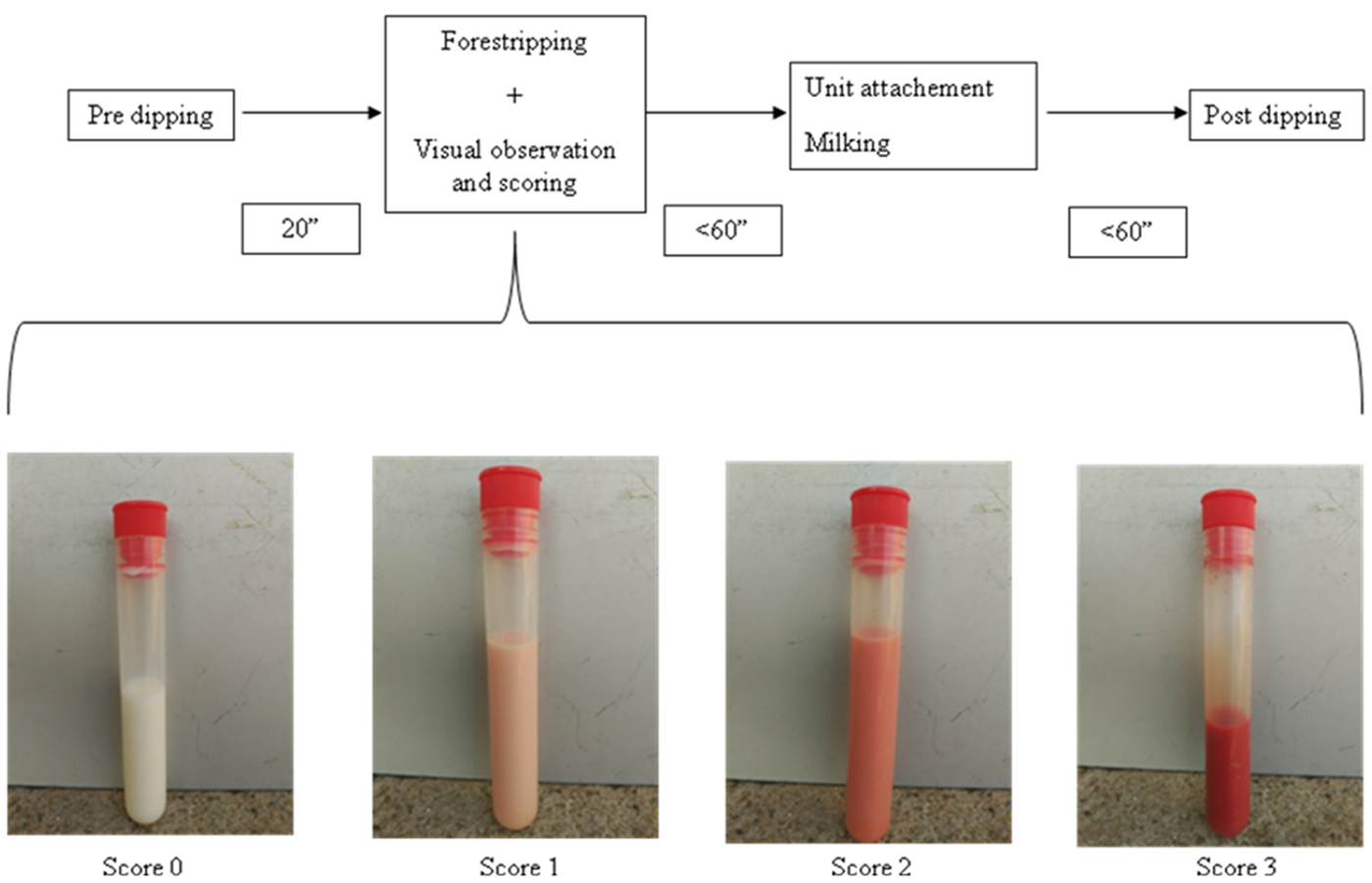
Cows with haemolactia from 9 dairy cow commercial dairy farms in Spain were included in the study. Farms milked between 135 and 1250 cows and milk yield ranged between 9100 and 11 500 kg of milk per cow (3·6% Fat and 3·3% Protein) in 305 d. Cows were housed in straw-bedded, free-stall barns and were fed a total mixed ratio consisting of corn silage, grass silage and concentrates. All lactating cows were under regular milk quality and mastitis control carried out by specialised veterinarians. Visual examination of milk and mammary gland palpation during the milking routine was mandatory. Each case of haemolactia was clinically scored as detailed in Fig. 1. Milk production was recorded daily for a period of 7 d starting at the time blood was detected in milk in each of the included cows. Causes of haemolactia were established as follows: Parturition (presence of blood in milk during the first 14 d in milk (DIM); this is considered physiological but with a negative impact on the amount of milk sold), mastitis (clinical, subclinical or chronic), trauma and defects (trauma with machinery, tools, buildings on the farm; over milking; stepping on the mammary gland and udder defects), or unknown (unknown cause of presence of blood in milk). When mastitis was diagnosed, the same treatment based on antibiotics and NSAID was applied for both groups (treatment and control negative group) in all farms.
Milking routine and clinical scoring for blood in milk. When haemolactia was observed, the case was clinically scored as follows: no blood (0), milk slightly tinged with blood (1), milk moderately tinged with blood (2), milk severely tinged with blood (3).

The study was designed as a randomised, blind and multicentre study. All cases fulfilling the inclusion criteria were randomised in two groups (the treatment group TG and the negative control group CG) following the randomisation list performed ad hoc for this study with the program nQuery Advisor. Cows in the TG received three consecutive daily doses of etamsylate at 15 mg/kg (equivalent to 2 ml of Haemo 125 mg/ml injectable solution/15 kg body weight), delivered intramuscularly (withdrawal period for milk: 0 d/ meat: 1 d). Cows included in the CG group received no treatment. Treatment was initiated as soon as blood in milk was detected. The primary variable for treatment efficacy evaluation was the number of days with the presence of blood in milk. As secondary variable, daily milk production was recorded for 7 d starting on the first day that blood was observed.
All statistical analyses were carried out using the Statgraphics Centurion XVII (Version 17.0.16). For all analyses, the individual cow was used as the experimental unit. The significance level (P) was set at 0·05. The variables included in the statistical analyses were classified as nominal (first parturition vs. multiparous cows), ordinal (parity), and quantitative non-continuous (number of days with the presence of blood in milk) or continuous (milk production). To show the homogeneity between experimental groups (TG and CG), a contingency table (χ2 test) was used to compare the nominal variables: primiparous vs. multiparous, initial blood scores and causes of haemolactia. With the aim of comparing the groups for parity, DIM and milk production at the beginning of the trial, the Mann−Whitney U test was performed. Statistical analyses were performed to compare the outcome variables between the two experimental groups (TG or CG). Thus, the number of days with the presence of blood in milk and the average milk production throughout the study (7 d) were compared between groups by means of a non-parametric Mann−Whitney U test. Finally, a survival analysis was carried out to decipher if the treatment with etamsylate shortened the duration of haemolactia vs. the control group.
Results
A total of 58 cases were included in the study, 31 in the TG and 27 in the CG. In total, 36·2% of the cases (n = 21) suffered from haemolactia during post-parturition period, 36·2% cows (n = 21) had a trauma in the mammary gland and/or teats, 12·1% suffered from mastitis (n = 7) and in 15·5% of the cows (n = 9) the cause of haemolactia was unknown. No significant association between the parity (primiparous/multiparous) and the experimental group (TG/CG) was detected. Further, no significant differences were detected between groups for DIM, the cause of haemolactia, initial blood score and milk production between experimental groups (TG/CG) at the beginning of the trial. These results showed the basal homogeneity between groups and allowed a comparison of the effect of treatment on the main response variables without the presence of confounding factors.
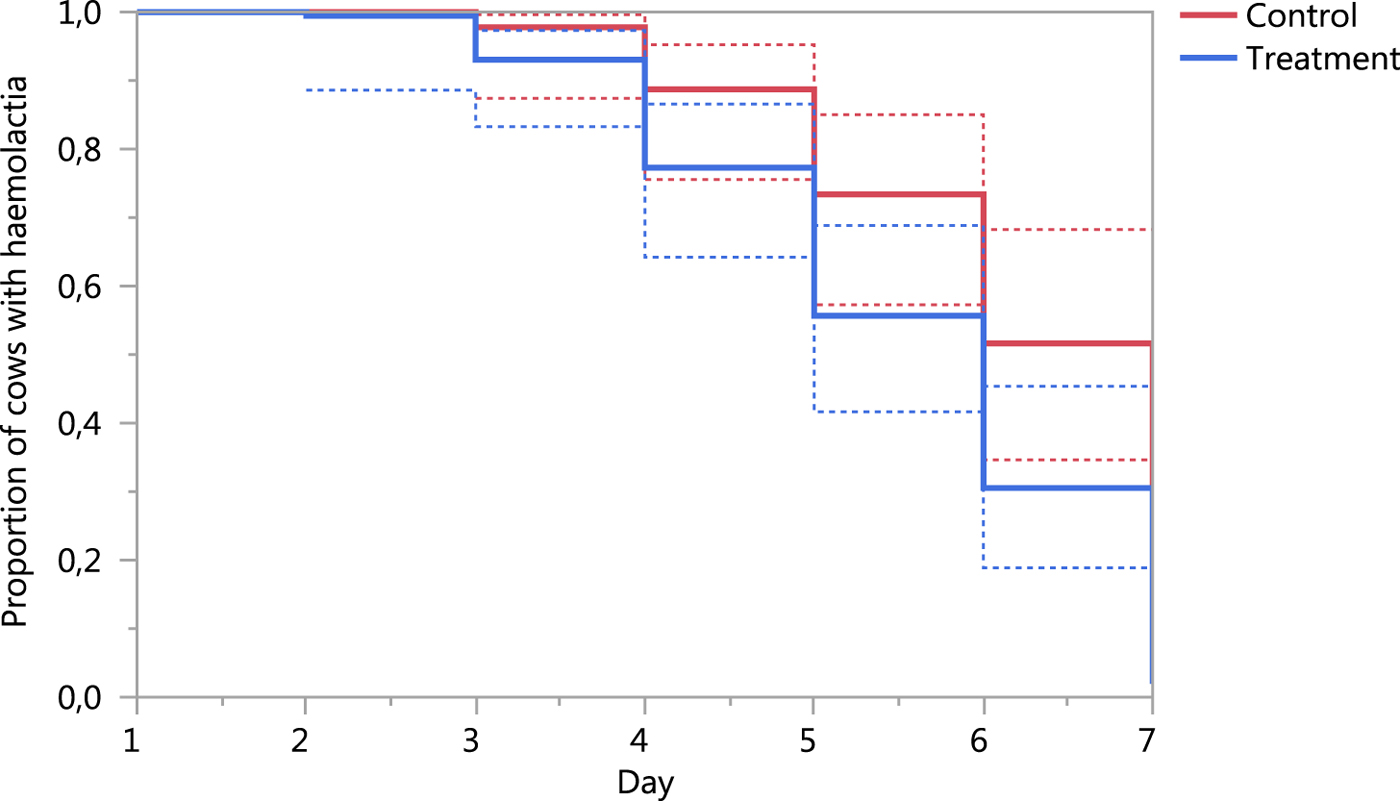
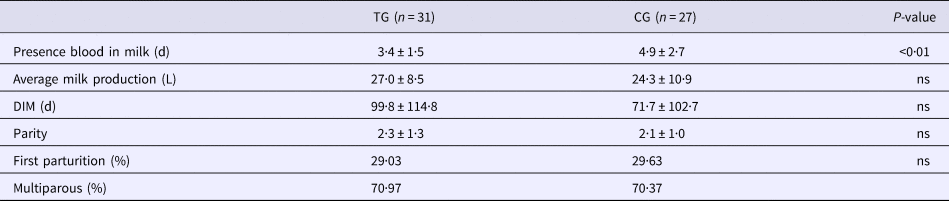
Significant differences between experimental groups (TG vs. CG) were observed for the days with a presence of blood in milk after treatment began including all the causes of haemolactia (TG = 3·4 ± 1·5 d and CG = 4·9 ± 2·7 d). This result was confirmed with the survival analysis (Fig. 2). Treatment with etamsylate significantly shortened (P < 0·05) the duration of haemolactia vs. the control group. Moreover, it should be noted that the length of haemolactia was significantly higher in both groups when the cause was parturition or trauma (parturition = 3·9 ± 0·5 d and trauma = 5·0 ± 0·5 d) compared to other causes (mastitis = 3·1 ± 0·9 d and unknown = 3·6 ± 0·7) but a significant reduction (P < 0·05) was consistently observed in TG vs. CG for all possible causes of haemolactia. Average milk production for the TG group (27·04 ± 8·53 litres) was higher than for the CG group (24·30 ± 10·87 litres) but the observed differences were not statistically significant (P = 0·056) (Table 1).
Survival analysis of the proportion (from 0 to 1) of cows with haemolactia in cows treated with etamsylate vs. controls after seven days of blood detection. Dotted lines represent the 95% confidence interval.

Effect of etamsylate treatment in cows with haemolactia (duration of the presence of blood in milk and average daily milk production for 7 d after blood detection)

ns, Non-significant; TG, treated group; CG, control group; DIM, days in milk.
Discussion
Different treatments and techniques have been studied to control or prevent haemolactia in cows: calcium solutions (Radostits et al., Reference Radostits, Blood and Gay2007), vitamin K, phytotherapy (Umadevy and Umakhanthan, Reference Umadevy and Umakhanthan2010), coagulants (Radostits et al., Reference Radostits, Blood and Gay2007; George et al., Reference George, Divers, Ducharme, Divers and Peek2008; Zuhair, Reference Zuhair2016), vasoconstrictors (Venkatesan, Reference Venkatesan2017), vitamin C, antioxidants, camphor (Raval et al., Reference Raval, Jani and Patel1998), antibiotics and blood transfusion (George et al., Reference George, Divers, Ducharme, Divers and Peek2008). Despite the large number of options for the treatment of haemolactia, many of these strategies lack conclusive data on cure rates, cure times and production differences between treated and untreated cows. Some of the proposed products are expensive, difficult to apply and/or cannot be applied to animals whose products are intended for human consumption. To the best of our knowledge, no previous studies have explored the use of etamsylate to treat cows diagnosed with haemolactia. According to our results, there should be registered products containing etamsylate to treat cows for haemolactia. Fortunately, there is available a registered medicinal product in Spain, Portugal, Cyprus and Malta.
In conclusion, the results clearly demonstrate that treatment with etamsylate is efficacious to reduce haemolactia. Our study paves the way for additional studies on the use of etamsylate in the treatment of haemolactia in dairy cows for their productive and economic benefits.