The Great Basin's caves and rockshelters afford excellent preservation of perishable artifacts such as baskets, mats, and sandals (Fowler and Hattori Reference Fowler, Hattori, Fowler and Fowler2008). Perishable artifacts can reveal clues about prehistoric technology, style, and, potentially, ethnicity rarely preserved in open-air sites (Adovasio Reference Adovasio, D'Azevedo and Sturtevant1986; Connolly and Barker Reference Connolly, Barker, Jenkins, Connolly and Aikens2004; Fowler Reference Fowler, Madsen and Rhode1994). Additionally, perishable artifacts can be directly dated, which may help elucidate when caves and rockshelters were occupied, even when those sites are plagued by stratigraphic mixing or illegal excavations. Traditionally, sandals have received less attention than baskets (Smith et al. Reference Smith, Ollivier, Barker, Camp, Harvey and Jones2016); however, over the past decade or so the sample of sandals that has been analyzed and radiocarbon dated has increased (Connolly and Barker Reference Connolly, Barker, Jenkins, Connolly and Aikens2004; Connolly et al. Reference Connolly, Barker, Fowler, Hattori, Jenkins and Cannon2016; Ollivier Reference Ollivier2016). As a result, major research foci have emerged, including efforts to explain apparent gaps in the radiocarbon sequences of Multiple Warp and Spiral Weft sandals—types found throughout the northwestern Great Basin (Connolly and Barker Reference Connolly, Barker, Jenkins, Connolly and Aikens2004).
In this paper, we present the results of technological analysis and AMS radiocarbon dating of 14 sandals from Last Supper Cave (LSC), a large cave in northwestern Nevada that contained a record of occupation spanning the Holocene (Felling Reference Felling2015; Layton and Davis Reference Layton and Davis1978; Smith et al. Reference Smith, Felling, Taylor and Layton2015). While some areas of the cave's deposits were intact, others were heavily disturbed by woodrats, who removed sandals and other artifacts from their primary contexts and redeposited them in large nests (Layton and Davis Reference Layton and Davis1978). Despite the fact that LSC lies between two major basketry regions (Adovasio Reference Adovasio, D'Azevedo and Sturtevant1986) and yielded a robust sample of sandals, until recently those materials were unstudied. Our results contribute to ongoing studies of how and when LSC was occupied. Furthermore, they help explain why Multiple Warp and Spiral Weft sandals display bimodal age distributions, which, in turn, provides clues about prehistoric land use in the northwestern Great Basin.
Background: Fiber Sandals in the Northwestern Great Basin
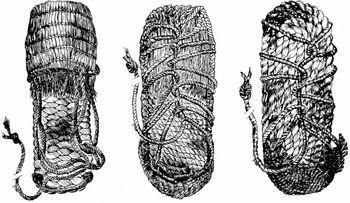
The northwestern Great Basin is home to the oldest footwear in the world. The Fort Rock sandal type was constructed beginning ca. 11,000 cal B.P., with the Multiple Warp and Spiral Weft sandal types appearing later (Connolly and Barker Reference Connolly, Barker, Jenkins, Connolly and Aikens2004; Connolly et al. Reference Connolly, Barker, Fowler, Hattori, Jenkins and Cannon2016). Prehistoric sandals were first reported by Cressman (Reference Cressman1942, Reference Cressman1943; Cressman et al. Reference Cressman, Williams and Krieger1940), who had been working in dry caves in the northern Great Basin. At Fort Rock Cave, Oregon, he recovered numerous sandals from beneath a layer of Mt. Mazama volcanic tephra now known to date to ca. 7600 cal B.P. (Bacon Reference Bacon1983). The sandals uncovered at Fort Rock Cave were constructed in a similar fashion, leading Cressman (Reference Cressman1942; see also Barker Reference Barker and Hockett2009; Connolly Reference Connolly, Aikens and Jenkins1994; Connolly and Barker Reference Connolly, Barker, Jenkins, Connolly and Aikens2004) to define the Fort Rock type and describe its distinguishing attributes: (1) a flat, close-twined sole constructed from heel to toe; (2) five rope warps that were left unspun at the toe and open-twined on top of the foot to form a toe flap (warp number is variable but always an odd number); (3) the absence of a heel pocket; and (4) a cord used to tie the sandal to the foot spun out from the toe flap (Figure 1).
Sandal types found in the northwestern Great Basin. Left to right: Fort Rock, Multiple Warp, and Spiral Weft. Image redrawn from Connolly and Barker (Reference Connolly, Barker, Jenkins, Connolly and Aikens2004:245) with permission from authors. Image credit: Oregon Museum of Natural and Cultural History.

Cressman (Reference Cressman1942) defined two other sandal types found at sites in the northern Great Basin: Multiple Warp and Spiral Weft (see also Barker Reference Barker and Hockett2009; Connolly Reference Connolly, Aikens and Jenkins1994; Connolly and Barker Reference Connolly, Barker, Jenkins, Connolly and Aikens2004). Multiple Warp sandals possess the following attributes: (1) a close- or open-twined sole comprised of 8–14 warps (although more have been observed, it is always an even number) constructed from the heel to the toe; (2) at the heel, the warps are arranged in a series of stacked arcs, rather than flat like Fort Rock warps, to form a heel pocket; (3) at the toe, warps are shredded and pulled back over the foot to form an open-twined toe flap; and (4) a tie system consisting of bindings, made from weft elements spun into cordage and looped back into the sole, and a skein of warp cord spun into cordage at the toe and used to bind the weft loops along the sole (Figure 1).
Spiral Weft sandals possess the following attributes: (1) twining begins at the center of the sole and radiates outward in a spiral fashion; (2) warps are aligned perpendicular to the long axis of the foot rather than parallel like the Fort Rock and Multiple Warp types; and (3) they often display a heel pocket but never a toe flap (see Figure 1). These types comprise the major sandal typology used by Great Basin researchers today (Connolly and Barker Reference Connolly, Barker, Jenkins, Connolly and Aikens2004).
Cressman and colleagues long held that humans had been in the Great Basin since the end of the Pleistocene (Cressman Reference Cressman1942, Reference Cressman1943, Reference Cressman1951; Cressman et al. Reference Cressman, Williams and Krieger1940), an opinion shared by few researchers at that time (e.g., Martin et al. Reference Martin, Quimby and Collier1947; Steward Reference Steward1940). Initially, he attempted to demonstrate that fact using associations between artifacts and ice-age fauna at northern Great Basin sites (e.g., the Paisley Five Mile Point Caves). With the development of radiocarbon dating in the 1950s, Cressman was vindicated when a Fort Rock sandal produced a date of 9053 ± 350 B.P. (Cressman Reference Cressman1951:308) or 11,211–9436 cal B.P.Footnote 1 Subsequent early dates on other Fort Rock sandals further supported Cressman's argument (Reference Cressman1942, Reference Cressman1943, Reference Cressman1951; Cressman et al. Reference Cressman, Williams and Krieger1940).
With a larger sample of dated specimens, we now know that Fort Rock sandals were constructed ca. 11,000–9200 cal B.P. (Connolly and Barker Reference Connolly, Barker, Jenkins, Connolly and Aikens2004:244; Connolly et al. Reference Connolly, Barker, Fowler, Hattori, Jenkins and Cannon2016:498). Most Fort Rock sandals have been recovered from sites in the northwestern Great Basin (Connolly and Barker Reference Connolly, Barker, Jenkins, Connolly and Aikens2004), although a Fort Rock sandal was recently found in southwestern Idaho (Plew and Willson Reference Plew and Willson2010) and another one was recently identified in collections from Lovelock Cave in western Nevada (Pat Barker, personal communication 2016), which extends the distribution of that type considerably to the south (Figure 2).
Location of Last Supper Cave and the distributions of the Fort Rock, Multiple Warp, and Spiral Weft sandal types (redrawn from Connolly and Barker Reference Connolly, Barker, Jenkins, Connolly and Aikens2004:248).

Around the time that Fort Rock sandals disappeared, Multiple Warp and Spiral Weft sandals emerged. Multiple Warp sandals first appeared ca. 9400 cal B.P. and were constructed until ethnographic times (Connolly and Barker Reference Connolly, Barker, Jenkins, Connolly and Aikens2004:248). Existing radiocarbon dates on Multiple Warp sandals display a bimodal distribution with an earlier period ca. 9400–7400 cal B.P. and a later period ca. 3400 cal B.P. to Euro-American contact (Connolly and Barker Reference Connolly, Barker, Jenkins, Connolly and Aikens2004:248). Multiple Warp sandals seem to remain unchanged across this 4,000-year gap, although that may be due to “an overly inclusive type definition” (Connolly and Barker Reference Connolly, Barker, Jenkins, Connolly and Aikens2004:248). Multiple Warp sandals have been found at sites across the northwestern Great Basin (Connolly and Barker Reference Connolly, Barker, Jenkins, Connolly and Aikens2004) (Figure 2). Spiral Weft sandals first appeared ca. 9700 cal B.P. and have been dated to as late as ca. 1400 cal B.P. (Connolly and Barker Reference Connolly, Barker, Jenkins, Connolly and Aikens2004:248). Spiral Weft sandals also display a bimodal age distribution with an earlier period ca. 9700–8500 cal B.P. and a later period ca. 1900–1400 cal B.P. (Connolly and Barker Reference Connolly, Barker, Jenkins, Connolly and Aikens2004:248). Like Multiple Warp sandals, Spiral Weft sandals appear to be unchanged in style and construction technique across this gap. Spiral Weft sandals occupy a smaller geographic range than Fort Rock and Multiple Warp sandals, but they are also restricted to the northwestern Great Basin (Connolly and Barker Reference Connolly, Barker, Jenkins, Connolly and Aikens2004) (Figure 2).
Foremost among unresolved questions associated with sandal technology are the gaps in the Multiple Warp and Spiral Weft radiocarbon sequences (Connolly and Barker Reference Connolly, Barker, Jenkins, Connolly and Aikens2004). Until now, it has been unclear whether the gaps are due to the small number of radiocarbon-dated Multiple Warp and Spiral Weft sandals (25 and 20, respectively) or hiatuses at sandal-bearing sites. With its rich and unstudied collection of fiber sandals, LSC offered the potential to contribute to this issue. Here we present the results of our technological analysis and radiocarbon dating of 14 sandals from LSC. We review the qualitative and quantitative attributes of the sandals, present radiocarbon dates obtained on them, and discuss their relevance to our understanding of prehistoric use of LSC and broader studies of sandal technology and land use in the northwestern Great Basin.
Materials and Methods
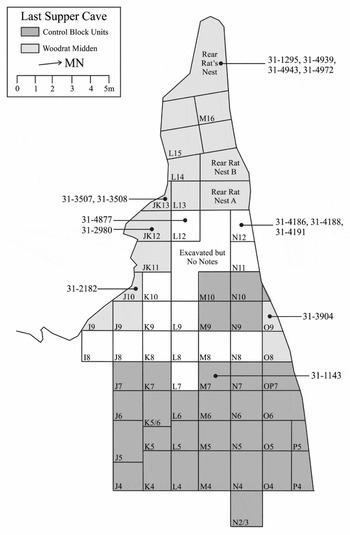
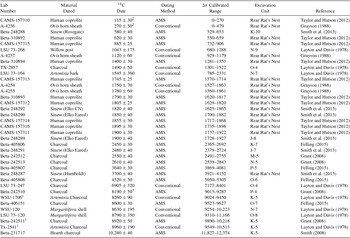
LSC is a large (9 × 21 m) cave in northwestern Nevada (Figure 3). The site was tested in 1968 and excavated in 1973–1974 by Thomas Layton and Jonathan Davis (Layton and Davis Reference Layton and Davis1978). They acknowledged that parts of the deposits—in particular areas along the walls and rear of the cave—were heavily disturbed by woodrat (Neotoma sp.) activity but argued that deposits near the front of the cave (referred to as the “Control Block”) were intact. Smith et al.’s (Reference Smith, Felling, Taylor and Layton2015; also see Felling Reference Felling2015) review of 37 radiocarbon dates on charcoal, wood, bone, coprolites, shell, and sinew attached to projectile points (Table 1), as well as the vertical distribution of time-sensitive projectile point types, from the site support Layton and Davis's (Reference Layton and Davis1978) claim that some deposits were undisturbed. Furthermore, while no samples returned ages between ca. 7200 and ca. 5300 cal B.P., Smith et al. (Reference Smith, Felling, Taylor and Layton2015:109) suggested that, because LSC contained the full sequence of Great Basin point types (excluding fluted), including 49 Northern Side-notched points (the primary Middle Holocene marker in the region [Oetting Reference Oetting, Aikens and Jenkins1994]), the site was used more or less continuously throughout the Holocene. Finally, because roughly one-third of the radiocarbon dates centered on ca. 1800 cal B.P., Smith et al. (Reference Smith, Felling, Taylor and Layton2015:111) concluded that LSC witnessed especially heavy use around that time.
Planview of Last Supper Cave showing locations of woodrat middens (light gray), Control Block units (dark gray), and sandals included in this study (redrawn from Smith et al. Reference Smith, Felling, Taylor and Layton2015:101).

Previously Reported Radiocarbon Dates from Last Supper Cave.

1 Tx-2541 and WSU-1706 are from one sample divided into two parts and sent to different laboratories. Grant (Reference Grant2008) subsequently redated carbon from the same sample using the AMS method and obtained a date of 8910 ± 50 14C B.P.
2 When calibrated to 2σ, the date extends beyond the present.
3 Smith and Kielhofer (Reference Smith and Kielhofer2011) erroneously reported the measured age of 8160 ± 50 14C B.P for this sample.
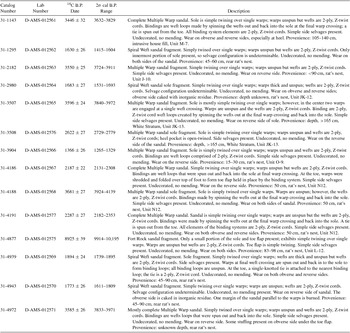
In recent years, several studies of the LSC assemblage have been published, including reports about obsidian artifacts (Smith Reference Smith2008, Reference Smith2009, Reference Smith2010; Smith and Kielhofer Reference Smith and Kielhofer2011), directly dated projectile points (Smith et al. Reference Smith, Barker, Hattori, Raymond and Goebel2013), macrobotanical remains (Grant Reference Grant2008), coprolites (Taylor and Hutson Reference Taylor and Hutson2012), site chronology (Smith et al. Reference Smith, Felling, Taylor and Layton2015), and lithic technological organization (Felling Reference Felling2015). While LSC also produced numerous perishable artifacts, there were no published studies of those materials prior to our study. As a first step toward analyzing the perishable artifacts and increasing our understanding of prehistoric sandal technology and chronology in the northwestern Great Basin, we selected 14 sandals for technological analysis and AMS dating. We selected the 14 specimens from a larger collection of ~50 sandals/sandal fragments from LSC because they were relatively complete and possess diagnostic attributes (e.g., number of warps, location of twining start, etc.) that enabled us to classify them. An additional 10 unstudied sandal fragments may also possess diagnostic attributes that could allow them to be assigned to particular types in the future. The sandals that we included in our study were recovered from various locations in the cave (Figure 3), but most came from along the sides and rear of the cave where woodrat midden (i.e., nest) construction had extensively distributed the deposits (Table 2). As such, most or all of the sandals were likely displaced from their primary contexts by post-depositional processes. Therefore, we established ages of the sandals through AMS dating.
Radiocarbon Dates and Descriptions of Last Supper Cave Sandals.

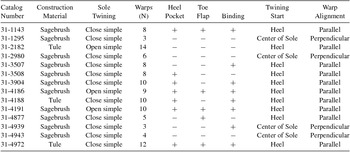
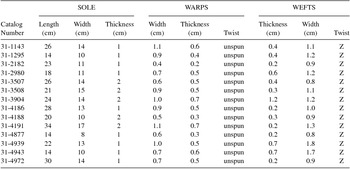
We also recorded a variety of qualitative and quantitative data related to attributes used to classify sandals. Qualitative attributes include the number of warps in the sole, the presence/absence of a heel pocket, the presence/absence of a toe flap, location of twining start (heel or center of sole), and the alignment of the warps to the long axis of the foot (parallel or perpendicular). Quantitative data include the maximum length, width, and thickness of each sandal/sandal fragment as well as warp and weft thickness (which represent an average of multiple measurements taken at several locations on each sandal). We recorded all data using Northern/Western Great Basin Twined Sandal Analysis forms developed by Pat Barker; terminology on that form is derived from Adovasio (Reference Adovasio2010) and Hurley (Reference Hurley1979).
Results
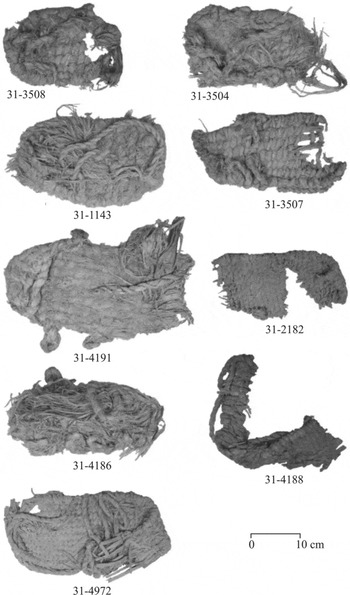
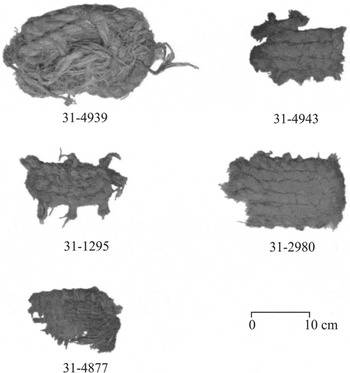
Tables 3 and 4 summarize the qualitative and quantitative data collected from the sandals. The sandals exhibit variation in warp count, presence/absence of heel pockets and toe flaps, and location of twining start, and Fort Rock (n = 1), Multiple Warp (n = 9), and Spiral Weft (n = 4) types are represented (Figures 4, 5). The age of the lone Fort Rock sandal (8925 ± 39 B.P., 10,195–9914 cal B.P.) fits well within the established range for that type (ca. 11,000–9200 cal B.P.). The ages of the nine Multiple Warp sandals are notable for three reasons. First, no Multiple Warp sandals returned dates older than ca. 4100 cal B.P., indicating that they all date to the latter of the two periods (but do extend the later period back by ~700 years). Second, five Multiple Warp sandals returned age ranges whose midpoints cluster between 4030 and 3730 cal B.P., and several of those dates overlap when calibrated to 2σ, suggesting that LSC saw a previously unrecognized period of heavy use around that time. Third, one specimen returned an age range whose midpoint is 1297 cal B.P., indicating that people continued to use Multiple Warp sandals until relatively late at LSC. The midpoints of the calibrated age ranges of the four Spiral Weft sandals fall between 1817 and 1297 cal B.P. and overlap in several cases, suggesting that they were deposited around the same time when LSC saw especially heavy use, including ca. 1800 cal B.P.
Qualitative Attributes of Sandals from Last Supper Cave.

Note: “+” = present; “−” = absent.
Quantitative Attributes of Sandals from Last Supper Cave.

Multiple Warp sandals from Last Supper Cave.

Spiral Weft (top rows) and Fort Rock sandals (bottom row) from Last Supper Cave.

Discussion and Conclusion
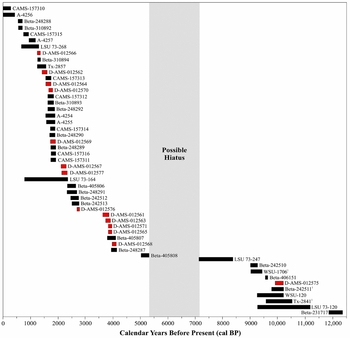
The 14 new dates on the sandals provide additional information about the history of occupation at LSC (Figure 6). Although they fail to corroborate a potentially aberrant Late Pleistocene date of 10,280 ± 40 B.P. (12,374–11,827 cal B.P.) obtained by Smith (Reference Smith2008:144), the Early Holocene date obtained on the Fort Rock sandal fits well with six other dates, indicating that LSC was first occupied ca. 11,000–10,000 cal B.P. Second, because five sandals returned early Late Holocene dates (ca. 4000–3700 cal B.P.) that correspond well with two previously reported dates, it now appears that LSC may have seen increased use around that time. Third, several sandals returned dates that support the idea that LSC was occupied extensively ca. 1800 cal B.P. Finally, none of the 14 sandals date to the Middle Holocene, a trend also reflected in the previously reported 37 dates (see Table 1). While Smith et al. (Reference Smith, Felling, Taylor and Layton2015:109) suggested that LSC was visited throughout the Holocene, when both the old and new dates from the site are considered together it appears increasingly likely that the cave was infrequently used ca. 7200–5300 cal B.P. Given the very large error and corresponding broad calibrated age range of sample LSU 73–247 (6905 ± 320 B.P., 8401–7177 cal B.P.), LSC may have witnessed an even longer period of diminished use during the Middle Holocene. Because the site contained 49 Northern Side-notched points (Smith et al. Reference Smith, Felling, Taylor and Layton2015), LSC was likely not completely abandoned during the entire Middle Holocene and instead may have hosted periodic short-term visits by logistical hunting parties.
2σ calibrated age ranges of Last Supper Cave radiocarbon dates arranged from youngest (top) to oldest (bottom). Sandal dates shown in red. Dates marked with “1” derived from the same charcoal sample.

The possibility that LSC was abandoned for much of the Middle Holocene fits well within broader trends in prehistoric land use during that period, a fact relevant to addressing the question of why both Multiple Warp and Spiral Weft sandals display bimodal age distributions. Our analysis of the LSC sandals was part of a larger project that incorporated data from all sandal-bearing sites (n = 19) in the northwestern Great Basin (Ollivier Reference Ollivier2016). Ollivier (Reference Ollivier2016) concluded that the probability of obtaining substantial gaps in the radiocarbon sequences of both the Multiple Warp and Spiral Weft types due to random chance was virtually nil given the number of dated specimens, range of dates, and durations of the gaps (sensu Rhode et al. Reference Rhode, Brantingham, Perreault and Madsen2014). Furthermore, Ollivier (Reference Ollivier2016) reviewed the radiocarbon sequences of the 19 sandal-bearing caves and rockshelters in the region, comparing when sandals were discarded at each location to when the sites were occupied and/or abandoned. In virtually every case, sandal-bearing sites were abandoned during part or all of the Middle Holocene. Ollivier (Reference Ollivier2016:88) concluded that the bimodal age distributions exhibited by Multiple Warp and Spiral Weft sandals reflect variability in cave and rockshelter use, rather than insufficient sampling or other factors (e.g., the waxing/waning of those styles). When caves and rockshelters witnessed heavy use during the Early and Late Holocene, sandals were discarded along with other artifact types. Conversely, when those sites were abandoned (obviously), no sandals were discarded. Researchers (e.g., Aikens et al. Reference Aikens, Connolly and Jenkins2011; Bedwell Reference Bedwell1973; Jenkins et al. Reference Jenkins, Connolly, Aikens, Jenkins, Connolly and Aikens2004) have long noted a shift from cave and rockshelters to open-air locales around the onset of the Middle Holocene, perhaps in response to changing local ecological conditions (Jenkins et al. Reference Jenkins, Connolly, Aikens, Jenkins, Connolly and Aikens2004:8). In the northwestern Great Basin, groups appear to have increasingly focused on upland springs (Fagan Reference Fagan1974) or wetlands farther out on basin floors away from caves and shelters predominantly situated on valley margins (Jenkins Reference Jenkins, Jenkins, Connolly and Aikens2004; Jenkins et al. Reference Jenkins, Connolly, Aikens, Jenkins, Connolly and Aikens2004; O'Connell Reference O'Connell1975). People almost certainly continued to manufacture and wear fiber sandals during those occupations; however, open-air sites simply do not offer the same excellent preservation conditions as caves and rockshelters (Aikens et al. Reference Aikens, Connolly and Jenkins2011). The decline in cave and rockshelter use in the northwestern Great Basin during the Middle Holocene may also reflect a period of relatively low population density in the region (Louderback et al. Reference Louderback, Grayson and Llobera2010). As climatic conditions improved during the Late Holocene, population levels increased (Louderback et al. Reference Louderback, Grayson and Llobera2010), groups returned to many caves and rockshelters in the northwestern Great Basin including LSC, and sandals reappear in the records of many such locations (Ollivier Reference Ollivier2016).
Acknowledgments
Tom Layton (San Jose State University, retired) made the original field notes and other documents from the Last Supper Cave excavations available. Anan Raymond (U.S. Fish and Wildlife Service), the Summit Lake Paiute Tribe, and the Nevada State Museum approved our requests to date the sandals from Last Supper Cave. Funding to date the sandals was provided by UNR's Sven and Astrid Liljeblad Endowment for Great Basin Studies. Tom Connolly (Oregon Museum of Natural and Cultural History) provided a great deal of unpublished information to Ollivier during his thesis research. Chantel Saban (University of Oregon) translated the Spanish abstract. We appreciate the efforts of the three anonymous reviewers and the editorial staff, who made the final version of our paper stronger.