Introduction
With real and perceived reductions in retirement income security and possible cutbacks in Medicare and Medicaid, many older Americans are following different pathways from work to full retirement. Recent statistics show that workforce engagement by older Americans has increased during the past 30 years. Between 1977 and 2007, employment among persons aged 65 and older increased 101 per cent; the number of employed men aged 65 and over rose 75 per cent, and employment among women aged 65 and older increased 147 per cent (Bureau of Labor Statistics 2008). Among baby-boomers, about 80 per cent report that they plan to remain in the paid labour force during their sixties and seventies (Freedman Reference Freedman2007).
The expectation for a longer work life is accompanied by the emergence of new, complex patterns of retirement. Instead of following the traditional retirement pattern (i.e. leaving a full-time career job for full retirement without re-entry), nearly 50 per cent of older Americans choose to reduce their workforce commitment gradually by taking a new job following retirement from a career job (bridge jobs), or continuing to work part-time with the same employer to supplement retirement benefits (phased retirement); many experience multiple transitions from employment to retirement (Cahill, Giandrea and Quinn Reference Cahill, Giandrea and Quinn2006; Maestas Reference Maestas2010; Purcell Reference Purcell2005). Although compelling research has been reported on retirement trends and patterns (e.g. Cahill, Giandrea and Quinn Reference Cahill, Giandrea and Quinn2006; Mutchler et al. Reference Mutchler, Burr, Pienta and Massagli1997; Williamson and McNamara Reference Williamson and McNamara2003), relatively little is known about the complex sequences of transitions in work-related status in later life. Describing these transitions in greater detail can help us understand better the pathways that older persons take to complete labour-force withdrawal. The purpose of this study is to investigate the dynamic process of retirement transition, focusing on a multi-dimensional measure of retirement and patterns of shifts over time between work and retirement status.
Work–retirement transitions
We frame our study of work–retirement transitions using the lifecourse perspective. The lifecourse perspective focuses in part on the roles of transitions and trajectories in understanding important outcomes in individual's lives (Elder Reference Elder1985). The lifecourse perspective is thus consistent with a focus on patterns of work over the adult lifecourse and the subsequent retirement transitions experienced by older workers (Mutchler et al. Reference Mutchler, Burr, Pienta and Massagli1997; Warner, Hayward and Hardy Reference Warner, Hayward and Hardy2010). Elder (Reference Elder1985) observes that the trajectories of individual lives can be envisioned as a sequence of transitions enacted over time. A transition is a discrete life change within a trajectory, while a trajectory is composed of a sequence of events and transitions in status that occur over an extended period of time. For many older persons, work–retirement trajectories may be characterised by a sequence of transitions, including full-time employment, part-time employment, unemployment, work-disability and labour-force non-participation. Late-life work transitions may include repeated work exits and re-entry, episodes of partial retirement, shifts to part-time employment, or exit through work-disability and death (Brown and Warner Reference Brown and Warner2008; Hayward, Hardy and Liu Reference Hayward, Hardy and Liu1994; Mutchler et al. Reference Mutchler, Burr, Pienta and Massagli1997; Warner, Hayward and Hardy Reference Warner, Hayward and Hardy2010).
At the person level, the meaning of retirement has both objective and subjective components. As Ekerdt notes in his observations regarding the new frontiers for work and retirement research in later life, ‘The designation of the retirement status is famously ambiguous because there are multiple overlapping criteria by which someone might be called retired, including career cessation, reduced work effort, pension receipt or self-report’ (2010: 70). Retirement scholars have commented on the complexity of the retirement concept and the difficulty in measuring this experience for more than 60 years (see Beehr and Bowling Reference Beehr, Bowling and Wong2013; Clark Reference Clark1988; Denton and Spencer Reference Denton and Spencer2009; Donahue, Orbach and Pollack Reference Donahue, Obach, Pollack and Tibbits1960; Ekerdt Reference Ekerdt2010; Ekerdt and DeViney Reference Ekerdt and DeViney1990; Gustman and Steinmeier Reference Gustman and Steinmeier2000; Hardy Reference Hardy, Settersten and Angel2011; Henretta Reference Henretta, Binstock and George2001; Szinovacz and DeViney Reference Szinovacz and DeViney1999). Thus, one of the vexing characteristics of research on the retirement process is variability in the way labour-force attachment and withdrawal are conceptualised, operationalised and measured. No single indicator is sufficient to capture fully the complexity of the work to retirement process. Researchers have been puzzling over the issue of how to define retirement during the past half century, and multiple criteria have been devised and used to assign retirement status. Despite the possible ambiguity and heterogeneity of retirement definitions, Ekerdt and DeViney (Reference Ekerdt and DeViney1990) suggested criteria such as pension receipt, reduced work hours or earnings, and self-definition are useful and necessary for measuring the complexity of the retirement transition experience.
Many people never retire, at least from a subjective point of view. Persons who do not consciously acknowledge themselves as retired sometimes obtain an alternative status, such as disabled (the ‘unretired retired’ according to Gibson Reference Gibson1987; see also Zsembik and Singer Reference Zsembik and Singer1990) or chronically unemployed. Even when people retire, they may re-enter the labour market (unretire), and retire again (Ekerdt Reference Ekerdt2010). Thus, retirement is not necessarily an absorbing state – anyone who reports no work hours for a given period of time may return to the labour force and those who say they are retired may change their self-image, returning to full-time or part-time work either because of work's intrinsic value or because of shortfalls in resources, or both. Further, someone who has not worked for a long period of time, or who has never worked, may (re)join the labour force later in life.
Using the lifecourse approach to understand late-life labour-force behaviour, Mutchler et al. (Reference Mutchler, Burr, Pienta and Massagli1997) examined the extent to which exits from the labour force were crisp versus blurred transitions for a sample of men aged 55–74. They found about one-quarter of respondents from the 1984 Survey of Income and Program Participation experienced at least one transition in labour-force participation over a 28-month observation period. More than half of the observed transitions were blurred, that is, multiple transitions occurred among the employed, unemployed and not working statuses; while less than half (40%) experienced a crisp exist, that is, a single transition from employment to full retirement (Mutchler et al. Reference Mutchler, Burr, Pienta and Massagli1997).
Reversing a long-term trend, many older workers remain in the labour force beyond the traditional retirement age (Mermin, Johnson and Murphy Reference Mermin, Johnson and Murphy2007; Purcell Reference Purcell2005). These workers often take bridge jobs to fill the gap between full-time employment and complete workforce withdrawal (Cahill, Giandrea and Quinn Reference Cahill, Giandrea and Quinn2006). Using data from the Health and Retirement Study (HRS; 1992–2002), Cahill, Giandrea and Quinn (Reference Cahill, Giandrea and Quinn2006) estimated that more than half of the respondents took bridge jobs before complete labour-force withdrawal. Bridge jobs are becoming more prevalent among members of more recent cohorts (Giandrea, Cahill and Quinn Reference Giandrea, Cahill and Quinn2009). Using HRS data, Maestas (Reference Maestas2010) documented that older workers followed different pathways to retirement and estimated that between 48 and 60 per cent of the older workers experienced labour-force re-entry within six years of retirement. Warner, Hayward and Hardy (Reference Warner, Hayward and Hardy2010) found that about 29 per cent of men and 35 per cent of women experienced reversible retirement, i.e. multiple workforce exits and re-entry. Work-disability is another pathway out of the labour force (Brown and Warner Reference Brown and Warner2008; Henretta Reference Henretta1992). The probability of work-disability is quite low relative to non-disabled retirement and declines with age in both men and women; transition from employment to work-disability usually occurs before age 62, pointing to the impact of Social Security eligibility rules on labour-force exits (Warner, Hayward and Hardy Reference Warner, Hayward and Hardy2010). Thus, the existing evidence shows considerable variability in transition pathways to full retirement.
Prior studies on retirement transition were restricted to respondents with relatively steady employment history (e.g. Cahill, Giandrea and Quinn Reference Cahill, Giandrea and Quinn2006), those in the labour force (e.g. Maestas Reference Maestas2010) or with full-time career jobs (e.g. Giandrea, Cahill and Quinn Reference Giandrea, Cahill and Quinn2009) at the initial observation point. Persons who had already exited – usually older persons, women and the less healthy – were systematically excluded, thus the studies were unlikely to generate findings that were nationally representative. To overcome these limitations in selecting study subjects, a representative sample of both men and women – those in and out of the labour force at baseline – was included, and the overall patterns of moving in and out the labour force were examined in this study.
Correlates of the work–retirement process
The lifecourse perspective on work and retirement also takes into consideration lifecourse capital (e.g. human, economic, social and health capital) that is related to transitions between labour-market attachment and retirement (O'Rand Reference O'Rand and Hudson2005). Research has identified many influential factors, including gender, age, race, ethnicity, family background, health, socio-economic status and work characteristics (e.g. Brown and Warner Reference Brown and Warner2008; Carr and Kail Reference Carr and Kail2012; Hardy Reference Hardy, Settersten and Angel2011; McNamara and Williamson Reference McNamara and Williamson2004; Moen, Dempster-McClain and Williams Reference Moen, Dempster-McClain and Williams1992). These factors are briefly discussed below.
Due to gender differences in work trajectories, pension availability, employment opportunities, family responsibilities and job discrimination, women and men undergo different labour-market experiences and retirement processes (e.g. Pienta, Burr and Mutchler Reference Pienta, Burr and Mutchler1994; Wong and Hardy Reference Wong and Hardy2009; Wright Reference Wright2012). Specifically, women often have an unstable attachment to the labour force, especially early in the adult lifecourse, and many move more quickly into retirement than men (Warner, Hayward and Hardy Reference Warner, Hayward and Hardy2010). Researchers argue that women's retirement behaviour is more complex than men's, often linked to marital status, their spouses' work and retirement behaviour, and childbearing history, among other factors (e.g. Brown and Warner Reference Brown and Warner2008; Pienta Reference Pienta2003; Smith and Moen Reference Smith and Moen2004; Warner and Hofmeister Reference Warner, Hofmeister, Blossfeld, Buchholz and Hofäcker2006; Wong and Hardy Reference Wong and Hardy2009). Given the recent rise in older women's labour-force participation and the narrowing gap between men's and women's work experience (Burr and Mutchler Reference Burr and Mutchler2007), it is important to understand the dynamic retirement process for both women and men and to examine the relationship between lifecourse factors and the work–retirement continuum.
Further, work and retirement behaviour varies by age, race and ethnicity (Choudhury and Bridges Reference Choudhury and Bridges2009; Flippen and Tienda Reference Flippen and Tienda2000). Health shapes work behaviour in different ways, depending upon other work-related characteristics such as marital status and economic status (Mutchler et al. Reference Mutchler, Burr, Massagli and Pienta1999). Sufficient economic resources enable older workers to undergo smooth exists from the labour force (Mutchler et al. Reference Mutchler, Burr, Pienta and Massagli1997). Also, higher-educated and higher-income workers are more likely to continue working, take bridge jobs or return to work after retirement than their counterparts (Kim and DeVaney Reference Kim and DeVaney2005; Maestas Reference Maestas2010; Mutchler et al. Reference Mutchler, Burr, Pienta and Massagli1997). Those in lower-status occupations and those with shorter work histories have fewer opportunities to accumulate wealth, thus they may delay workforce withdrawal (Brown and Warner Reference Brown and Warner2008; Pienta, Burr and Mutchler Reference Pienta, Burr and Mutchler1994; Rogowski and Karoly Reference Rogowski and Karoly2000).
In sum, there are a number of conceptual and methodological challenges that condition our understanding of the dynamic nature of the work–retirement process. Included among these challenges are inconsistent definitions of labour market attachment and the process of retirement, with most studies relying on a single objective or subjective indicator. With these issues in mind, the first aim of this study is to identify a latent structure of work–retirement transition. Based on multi-dimensional indicators of retirement, the latent structure variable will promote a more in-depth understanding of the dynamic process of work–retirement transitions. This study contributes to the research literature by building on the scholarship of others who recommend a nuanced view of the retirement process (e.g. Beehr and Bowling Reference Beehr, Bowling and Wong2013; Denton and Spencer Reference Denton and Spencer2009; Ekerdt Reference Ekerdt2010; Ekerdt and DeViney Reference Ekerdt and DeViney1990; Warner, Hayward and Hardy Reference Warner, Hayward and Hardy2010). The use of single criteria may yield equivocal findings; the use of multiple criteria allows the ambiguity of the work–retirement concept to be managed, if not fully resolved (Ekerdt and DeViney Reference Ekerdt and DeViney1990). The second aim of the study is to describe patterns of transitions within the latent work–retirement structure. Because retirement is a process, examining the patterns of transitions among work–retirement statuses will contribute to our understanding of the myriad versions of the blurred and crisp work–retirement nexus. The third aim of the study is to examine the extent to which demographic, health, family, work history and economic factors are related to occupying distinct statuses within the latent work–retirement structure at baseline. As many factors are likely to contribute to the underlying pattern of work–retirement latent statuses among men and women, an exploratory examination of these relationships is provided, pointing the way for future studies to examine more complex models of transitions and trajectories in the work–retirement process.
Research design
Data source and study sample
Data were drawn from four consecutive waves of the Health and Retirement Study (HRS: 1998, 2000, 2002 and 2004), a nationally representative panel survey of Americans age 51 and older. Additional waves were considered but sample size demands combined with the large size of the contingency table needed for the latent transition analysis made it impossible to converge on a solution with more than four waves of data. This time period precedes the Great Recession and thus the results are not likely to be influenced by the macro-economic forces associated with this economic downturn. Sensitivity analysis using observations from the 2000–2006 waves yielded similar results as found in the analyses using the 1998–2004 waves, thus lending confidence to the findings reported below.
Beginning in 1998, the HRS expanded to include several birth cohorts: those born between 1931 and 1941; those born in 1923 or earlier (original AHEAD sample); those born between 1924 and 1930; and those born between 1942 and 1947. Respondents between the ages of 51 and 74 at baseline (1998) who self-identified as non-Hispanic White, non-Hispanic Black or Hispanic were included. Respondents who were grouped into the ‘other races’ category were excluded due to the small number of cases (N=290). Respondents aged 75 and older were also excluded because labour-force activity drops off precipitously after age 75 (Warner, Hayward and Hardy Reference Warner, Hayward and Hardy2010). In the study sample, only 176 respondents aged 75 and above were in the labour force in 1998.
Missing data were dealt with in two different ways. First, missing data for the indicators of the work–retirement latent statuses described below were handled directly within the latent transition analysis (LTA) model. The LTA models used a full-information maximum likelihood technique to account for missing data. Respondents with missing data were included in the analysis and analysed together with the respondents who had complete data. The result is that respondents with missing values in one or more waves contributed less information to the work–retirement latent status model parameters than respondents with complete data. In other words, model parameter estimates were adjusted on the basis of the available information provided, depending on the structure of the missing information present in the model (Collins and Lanza Reference Collins and Lanza2010). This approach maximised sample size. The analytical sample for the LTA models included 5,762 men and 7,519 women. Because age-structured Social Security and employer-based pension systems influenced labour-force exit (e.g. Warner, Hayward and Hardy Reference Warner, Hayward and Hardy2010), the baseline sample was stratified by age group and sex. Latent work–retirement status models were estimated for four sub-samples: men aged 51–59 (N=2,242), men aged 60–74 (N=3,520), women aged 51–59 (N=3,094) and women aged 60–74 (N=4,413).
Second, for the multinomial logistic regression analyses that examined the factors associated with being in one of the latent work–retirement statuses, respondents with missing values were excluded on a list-wise basis. To minimise the number of respondents with missing values, the covariates were taken from the RAND HRS data file, which contains cleaned and imputed information for many variables from the original HRS data files (e.g. income and net worth). Variables that were not imputed by RAND and therefore contained missing values were race (N=3), marital status (N=8), education (N=43) and self-rated health (N=3). The final sample for the multinomial logistic regression analysis included 5,734 men and 7,501 women.
Measures
The observed indicators used to identify the latent variable of work–retirement status at each wave included number of hours worked weekly, work-disability status, receipt of retirement pension benefits and self-reported retirement status. Although not routinely included as an indicator of retirement status (Denton and Spencer Reference Denton and Spencer2009), work-disability has been shown in the literature to be a common pathway out of the labour force (Warner, Hayward and Hardy Reference Warner, Hayward and Hardy2010). Thus, this indicator is introduced to acknowledge this as an alternative labour-force status.
Weekly hours worked
Respondents were first asked whether they were working for pay; if so, they were then asked about how many hours they worked each week. Those not working for pay were assigned 0 hours. Weekly hours worked was coded as 1=0 hours, 2=1–34 hours and 3=35 hours or more (for a similar approach, see Aaronson and French Reference Aaronson and French2004; Brown and Warner Reference Brown and Warner2008). Alternatively, we estimated models with a four-category measure of hours worked (i.e. 0, 1–15, 16–30, 31+ hours), which yielded similar results to the models using the above three-category variable. For reasons of parsimony, to follow a standard approach in the literature and to improve the interpretation of parameter estimates from the LTA models, we relied on the three-category version of hours worked (see below).
Work-disability status
The HRS introduced the following question to determine current job status: ‘Now I'm going to ask you some questions about your current employment situation. Are you working now, temporarily laid off, unemployed and looking for work, disabled and unable to work, retired, a home-maker, or what?’ Respondents who were classified as ‘disabled and unable to work’ were categorised as work-disabled (1=work-disabled; 0=not work-disabled).
Retirement pension benefit receipt
Respondents were classified as having received a retirement pension benefit if they indicated they received Social Security retired worker pension benefits or if they received an employer-sponsored pension benefit. The variable was coded as 1=received either Social Security retired worker pension benefits or an employer-sponsored benefit or both, and 0=did not receive any pension benefit.
Self-reported retirement status
In the original HRS question for self-reported retirement status, persons who were home-makers or who had not recently worked were classified as ‘irrelevant’ with respect to whether they were retired. Rather than discard these cases or combine them into an amorphous category, the original self-reported retirement status question and the current job status question (see above) were used together to place these respondents in an appropriate category in the new self-reported retirement variable. Respondents were categorised as ‘not retired’, ‘partly retired’ or ‘completely retired’ if they reported one of these statuses in the original self-reported retirement status question. Respondents who reported being home-makers in the question regarding current job status (see above) and who were assigned by the HRS as ‘irrelevant’ on the original self-reported retirement question were categorised as ‘home-makers’ in the new self-reported retirement variable. Because only four males reported being home-makers, they were excluded from subsequent analyses. Respondents who were classified as ‘irrelevant’ on the self-reported retirement question by the HRS, and who were not home-makers, were categorised as ‘completely retired’ if they were classified as retired in the current job status question. If they were classified as disabled and unable to work in the current job status question, they were assigned to the work-disabled status variable (see above). If they were classified as in the labour force, they were classified as not retired in the new self-reported retirement variable. Using the strategy described here, there were three self-retirement categories for men (not retired, partly retired, completely retired) and four self-retirement categories for women (not retired, partly retired, completely retired, home-maker).
Covariates
A number of covariates were introduced to explore what factors were related to being in a specific work–retirement status at baseline. Age was coded as a continuous variable, ranging from 51 to 74 years at baseline. Race and ethnicity were measured with a set of dichotomous variables, including non-Hispanic White (reference group), non-Hispanic Black and Hispanic. Education was measured as number of years of completed school (range 0–17). Self-rated health was measured with a set of dichotomous variables, including as excellent (reference group), very good, good, fair or poor. Marital status and spouse's work status were combined into a set of five dichotomous variables: married with spouse working (reference group); married with spouse not working; divorced or separated; widowed; never married. Number of children was coded as a set of dichotomous variables with no children (reference group), one or two children, three or four children, and five or more children. Annual household income in US dollars (range 0–7,903,681) and non-housing net worth in US dollars (range −3,636,749–25,250,000) were transformed by the natural log to account for the skewness in the distributions of these measures. Job tenure was measured as a continuous variable with years worked on the longest job held (range 0–59.1 years). Occupation was measured as occupation type for the longest job and categorised into three dichotomous variables: professional/managerial (reference group), sales/clerical, and others. Age, education, income, net worth and job tenure were used as continuous covariates, as suggested in previous research (e.g. Brown and Warner Reference Brown and Warner2008; Clarke, Marshall and Weir Reference Clarke, Marshall and Weir2012; Pienta and Hayward Reference Pienta and Hayward2002).
Analytic strategy
First, descriptive characteristics for the total sample and by gender are reported, including the indicators of the latent work–retirement status variable used in the latent transition analysis and the covariates used in the multinomial logistic regression analyses. The latent work–retirement status indicators are described for the total sample at each of the four waves (1998–2004). The data used in the multinomial logistic regression models were not weighted because these models controlled for variables used by the HRS staff to construct the post-stratification weights (age, gender and race), which scholars have argued should deliver unbiased estimates (Winship and Radbill Reference Winship and Radbill1994).
Second, dynamic latent structure models are identified for the four age–sex sub-samples using LTA that yielded specific latent work–retirement statuses, the prevalence of these statuses over time and three sets of transition matrices. LTA is a longitudinal extension of latent class analysis (LCA). LCA is a multivariate statistical model employed to identify an underlying grouping variable (i.e. a latent class variable) that is not observed but is inferred from a set of categorical indicators (see Lanza, Patrick and Maggs Reference Lanza, Patrick and Maggs2010). According to Lanza, Patrick and Maggs (Reference Lanza, Patrick and Maggs2010), a latent class variable takes a person-centred approach for consolidating several dimensions of behaviour, allowing individuals to be assigned to an appropriate latent class based on their shared behaviour patterns. When LCA is extended to estimate transitions over time in latent class membership, it develops into LTA, where the term ‘latent class’ is replaced by ‘latent status’, indicating individuals may change membership in latent classes over time (Lanza, Patrick and Maggs Reference Lanza, Patrick and Maggs2010). As documented in a large body of literature, it is quite challenging to measure retirement status with a single indicator due to its multi-dimensional and dynamic nature. Nevertheless, LTA lends itself well to the study of retirement, based on its measurement model that relies on multiple criteria and the analytic model that captures the transitions among latent statuses. Through LTA, we are able (a) to assess multiple dimensions of the retirement concept (i.e. retirement benefits/pension receipt, reduced work hours, self-definition), (b) to provide a portrait of the logical intersections of the various dimensions, (c) to identify classes of individuals with distinct profiles in the work–retirement transition, and (d) to observe work–retirement trajectories over time. Compared with an observed variable approach (or, manifest variable approach), a latent variable approach provides a parsimonious summary of retirement behaviour and subjective evaluation profiles and transitions, allowing for the most distinct behaviour and subjective retirement profiles and transitions to emerge (Lanza, Patrick and Maggs Reference Lanza, Patrick and Maggs2010).
The LTA proceeded in the following sequence. Using maximum likelihood estimation, a best fitting model was identified; one that most likely represented the underlying data. A series of models were estimated with two to seven latent statuses and then compared the results from each to identify the latent structure of the work–retirement transition. Under circumstances where model degrees of freedom (df) are relatively small, it is possible to estimate absolute model fit using the likelihood-ratio G 2 statistic. However, in LTA, df tends to be very large because df increases exponentially with each additional wave of observation. Under these circumstances, the distribution of the G 2 statistic is unknown and cannot be used to evaluate absolute model fit. Nevertheless, the G 2 statistics were reported for each sub-sample to show the improvement in model fit as each latent status was added. Instead, a relative model fit approach was used to select the best fitting model among the competing models. Two key considerations were also used for selecting the best fitting model (Collins and Lanza Reference Collins and Lanza2010). The first was parsimony; models were chosen that described the underlying data with the fewest parameters. The second was researcher assessment of the interpretability of the latent statuses within the model. With these two considerations in mind, two information criteria model fit statistics were examined: Akaike's Information Criterion (AIC) and Bayesian Information Criterion (BIC). Smaller values represent a better fit to the underlying data. SAS version 9.2 was used to estimate these models (Lanza and Collins Reference Lanza and Collins2008). The parameters used to identify the best fitting models for each sub-sample are described in the Results section.
Three parameters from the LTA model were used to describe the latent statuses. Item-response probabilities indicate the relationship between latent status membership and the observed items measured at each time-point. When an observed variable is strongly related to the latent variable, the array of item-response probabilities across the latent statuses for that variable clearly differentiates the latent statuses. Item-response probabilities near 0 and 1 represent the high extent to which all members of the latent status are likely to provide the same observed responses (Collins and Lanza Reference Collins and Lanza2010). Item-response probabilities were restricted to be equal across time to improve estimation and model identification. Latent status prevalence, or the latent status membership probability, represents the proportion of the sample expected to be in each latent status at each time-point. Transition probabilities describe the probability of being in a given latent status at time t, conditional on being in a specific latent status at time t − 1 (Collins and Lanza Reference Collins and Lanza2010). That is, transition probabilities provide a summary of the transition from status to status over time. The parameters necessary for describing and labelling the latent statuses for each sub-sample are presented in the Results section.
Last, the relationships between the latent work–retirement statuses and the covariates identified above were examined for the baseline sample only (the first observation period, 1998). The analyses were based on a multinomial logistic regression model, where one latent status served as the reference category (full-time worker, see below) for each age–sex sub-sample. The parameter estimates for the covariates represented the likelihood of being in one of the other latent statuses relative to the full-time worker status (odds ratios were reported).
Results
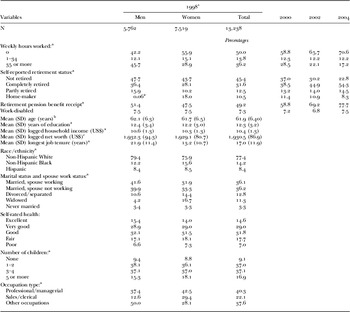
Univariate and bivariate characteristics of the sample are provided in Table 1. Gender differences were found in all variables except disability and self-rated health. Compared with men, women were more likely to report zero working hours, but less likely to receive a retirement pension. Also, women tended to be younger, non-Hispanic Black, divorced/separated or widowed, less educated, have less household income and lower net worth. Women reported shorter tenure on jobs and a higher percentage held professional/managerial and sales/clerical occupations than men.
Descriptive characteristics for gender differences in observed indicators and covariates

Notes: 1. Bivariate analyses (chi-square tests and t-tests) were conducted to identify gender differences. 2. Excluded from subsequent analyses due to small sample size (N=4). Descriptive statistics were reported for the whole sample in 2000, 2002 and 2004 on four indictors of the latent statuses. SD: standard deviation.
Significance levels: Gender difference is statistically significant at baseline: ap<0.001, bp<0.01, cp<0.05.
Considering the work and retirement indictors over time, hours worked steadily declined; an increasing percentage of respondents reported they were retired and received Social Security retired worker pension benefits or an employer-sponsored pension; but a relatively stable proportion reported a disability that prevented them from working. Also the percentage working part-time, 1–34 hours (13.8% in 1998 and 12.2% in 2004) and self-reporting partially retired (12.5% in 1998 and 14.5% in 2004) did not change appreciably over the six-year period.
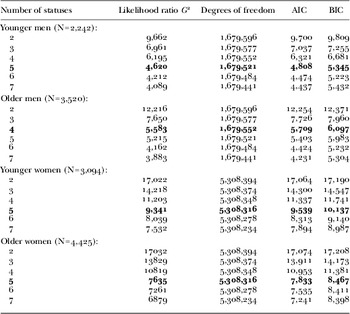
To describe a latent variable of work–retirement status and to explore how that variable changed over time, a latent structure modelling strategy was implemented. LTA models with two to seven latent statuses were estimated; the AIC and BIC fit statistics were compared to identify the number of statuses that provided the optimal balance of model fit, parsimony and interpretability of the latent statuses (Table 2). In the four sub-samples, the models with three or more latent statuses represented better fit to the data than did the two-status model, as demonstrated in the dramatic decrease in the model fit statistics. After examining the competing models (three to seven latent statuses), the results showed a relatively large reduction in the model fit statistics occurred between the four-status and five-status models. Based on the principles of parsimony and interpretability, the four-status model was selected for older men and the five-status models were selected for the younger men and women from both age groups.
Model fit statistics used to identify the best fitting latent status models

Notes: AIC: Akaike Information Criterion. BIC: Bayesian Information Criterion. The rows highlighted with bold typeface are identified as the models that best fit the data.
Latent structure of work–retirement status and transitions for men
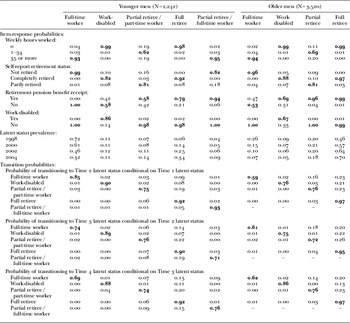
Item-response probabilities, latent statuses prevalence and transition probabilities between time-points for men are provided in Table 3. The item-response probabilities sum to 1.00 down the columns for each indicator within a given latent status and may be interpreted as percentages by multiplying by 100. For both younger and older men, the item-response probabilities (marked in bold) suggested the following four latent statuses: full-time worker, work-disabled, partial retiree and full retiree. In the sample of younger men, partial retirees were further distinct between partial retiree working full-time and partial retiree working part-time. This distinction appeared in the five-status and six-status models for older men as well; however, the overall pattern of item-response probabilities did not clearly differentiate among the latent statuses, indicating the model with five or more statuses did not fit the data as well as the four-status model.
Item-response probabilities, latent status prevalence and transition probabilities for latent status membership for men

In both samples of men, respondents falling into the full-time worker status were most likely to report working 35 hours or more (younger men 93%, older men 94%), not retired (younger men 99%, older men 96%), not receiving a retirement pension (younger men 100%, older men 53%) and did not have a disability preventing them from working (100% for both groups). Men in the work-disability status were likely to report zero hours worked (99% in both samples), were likely to be completely retired (younger men 82%, older men 88%) and were disabled (younger men 86%, older men 67%). One difference between younger and older men with respect to work-disability status was that 58 per cent of the younger sample did not report receiving a retirement pension, whereas 69 per cent of the older men reported receiving benefits, a result of age-structured institutional eligibility rules.
Respondents in the latent partial retiree status reported working between 1 and 34 hours (younger men 62%, older men 69%), being partly retired (81% for both groups), receiving a retirement pension (younger men 58%, older men 96%) and not experiencing a disability preventing them from working (younger men 98%, older men 100%). Respondents in the full retiree status reported no hours worked (younger men 98%, older men 99%), being completely retired (younger men 92%, older men 97%), receiving a retirement pension (younger men 79%, older men 99%) and not experiencing a disability preventing them from working (younger men 98%, older men 99%). For the younger men, an additional latent status was discovered, partial retiree working full-time, with these members of this latent status reporting working 35 hours or more (95%), self-reporting as not retired (82%), receiving a retirement pension (94%) and experiencing no disability preventing them from work (100%).
The overall prevalence of latent status membership at each time-point is also presented in Table 3. Compared with younger men in 1998, older men were more likely to belong to the full retiree status (46% older men versus 6% younger men), but less likely to be in the full-time worker status (26% older men versus 72% younger men). Over the six-year period, the relative proportion of the sample occupying the full retiree status increased for both groups (younger men 6 to 34%, older men 46 to 70%). By contrast, membership in the latent full-time worker status decreased over this same period (younger men 72 to 32%, older men 26 to 7%). For older men, the latent partial retiree status prevalence changed slightly (18 to 21%); whereas for younger men, the prevalence of the partial retiree status increased for those working full-time (4 to 9%) and part-time (7 to 14%). From 1998 to 2004, membership in the latent work-disabled status decreased (9 to 5%) among older men but remained relatively stable (11%) among younger men.
Transition probabilities identifying changes in the patterns of latent work–retirement status between each two-wave sequence for men are presented in Table 3. The probabilities sum to 1.00 across the rows and may be interpreted as percentages by multiplying by 100. In both samples, male respondents were most likely to be members of the same status for each pair of consecutive observation points, as indicated by the diagonal entries of each transition probability matrix (marked in bold). However, reading across the rows the probability matrix also showed considerable change in latent status membership over time. The largest change in latent work–retirement status membership occurred in the full-time worker status. For example, among older men, 41 per cent of full-time workers experienced transitions between 1998 and 2000. Among these men, 2 per cent moved to the work-disabled status, 16 per cent moved to the partial retiree status and 23 per cent moved to the full retiree status. Also, men in both age groups who were in the remaining work–retirement statuses were most likely to transition to the full retiree status. For example, among the younger men 8 per cent of those in the latent work-disabled status transitioned to the full retiree status between 1998 and 2000; among older men, 23 per cent of those in the partial retiree status moved to the full retiree status during the same period. Among partial retirees, the probabilities of moving to the full-time worker status and the work-disabled status were relatively small (0–4%) over time. Transition from full retiree status to partial retiree status was relatively stable among younger men, 7–10 per cent (full-time and part-time combined), with 3–4 per cent changing to partial retiree status among older men. These transition patterns were similar across each two-wave comparison in the six-year observation period, with an increase in transition rates occurring during the later observation periods. Not surprisingly, older men demonstrated higher probabilities of transition to full retiree status than younger men.
Latent structure of work–retirement statuses and transitions for women
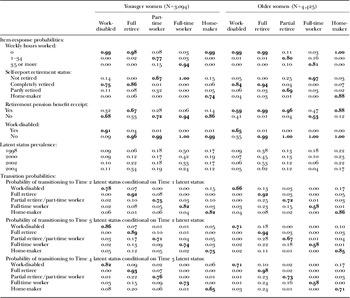
Item-response probabilities, latent statuses prevalence and transition probabilities for the samples of younger and older women are presented in Table 4. Five latent statuses were identified for both groups of women: work-disabled, full retiree, part-time worker/partial retiree, full-time worker and home-maker. For younger women, a part-time work status was identified, which was distinguished from the partial retiree status identified for older women. Younger women in the latent part-time work status were likely to report being not retired (67%) and not receiving a retirement pension (72%); whereas older women in the partial retiree status were likely to report being partly retired (69%) and receiving a retirement pension (96%). For the other latent work–retirement statuses, item-response probabilities were generally comparable. For example, those in the latent home-maker status were likely to report working zero hours (younger women 99%, older women 100%), being home-makers (younger women 74%, older women 88%) and not experiencing a disability preventing them from working (younger women 99%, older women 100%); however, younger women (14%) were less likely to report receiving a retirement pension than older women (88%).
Item-response probabilities, latent status prevalence and transition probabilities for latent status membership for women

The prevalence of the latent statuses for women, also presented in Table 4, showed that the latent work-disabled status was the smallest group and was relatively stable among younger women (9–11%). For older women, the prevalence of the work-disabled group decreased from 9 to 5 per cent from 1998 to 2004. Membership in the full retiree status increased over time, from 6 to 34 per cent among younger women and from 38 to 62 per cent among older women. Further, the prevalence of the full-time worker status declined from 50 to 24 per cent among younger women and from 18 to 4 per cent among older women. Part-time worker status among younger women remained relatively stable (17–19%) between 1998 and 2004 and partial retiree status among older women also remained relatively stable (12–13%) over time.
The transition probabilities reported in Table 4 demonstrated, as did the results for men, that there was a considerable amount of stability across any two-year observation period. Also, as with the sample of men, there were, however, important transitions across time. For instance, women in the latent work-disabled status were most likely to transition to the latent home-maker and full retiree statuses. Among younger women in the work-disabled status in 1998, 15 per cent moved to the latent home-maker status and 7 per cent moved to the full retiree status in 2000. Among all the latent statuses, full retiree status members were least likely to change for both samples of women. About 10 per cent of the younger women and 3 per cent of the older women transitioned to part-time worker status or partial retiree status, respectively. Part-time worker status members (younger women) and partial retiree status members (older women) were most likely to move to full retiree status. Younger women in the part-time latent status moved to home-maker status with less frequency over time (10 to 1%) while older women in the partial retiree status moved to home-maker status at a stable, but low rate (3 to 4%) from 1998 to 2004. Generally, women in the latent full-time worker status from both age groups were most likely to shift to the latent full retiree status, followed by part-time worker (younger women)/partial retiree status (older women), and least likely to move to the latent work-disabled or latent home-maker status. Finally, women in the home-maker status who changed status membership over time were likely to transition to full retiree status at an increasing rate (younger women 1 to 20%, older women 8 to 24%).
Correlates of work–retirement latent statuses
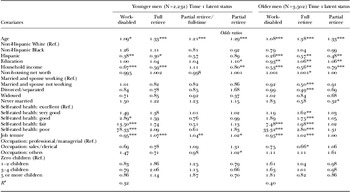
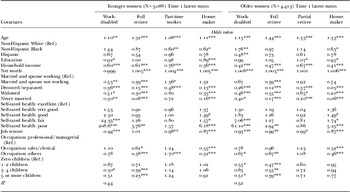
Multinomial logistic regression analyses were used to examine which factors were related to latent status membership at baseline (1998) for men (Table 5) and for women (Table 6). Full-time worker status served as the reference group for both age groups of men and women. Odds ratios larger than 1.0 indicated an increased probability of membership in an alternative status, whereas odds ratios smaller than 1.0 indicated a decreased probability of membership in one of the other work–retirement latent statuses.
Results of multinomial logistic regression analysis at baseline for latent work–retirement status membership for men1

Note: 1. The reference group is full-time worker. Ref.: reference group.
Significance levels: * p<0.05, ** p<0.01, *** p<0.001.
Results of multinomial logistic regression analysis at baseline for latent work–retirement status membership for women1

Note: 1. The reference group is full-time worker. Ref.: reference group.
Significance levels: * p<0.05, ** p<0.01, *** p<0.001.
Age, household income and self-rated health exhibited similar effects for each age–sex sample. For both men and women, older respondents were more likely than younger respondents to be in one of the other work–retirement statuses relative to the full-time worker status. This demonstrated in part the institutional effects (e.g. pension eligibility) of age in the work–retirement process. In general, higher household income was associated with a lower likelihood of being in one of the other statuses relative to full-time worker status across age groups for men and women. Not surprisingly, compared to those with excellent health, respondents reporting poor or fair health were far more likely to be in the work-disabled status. Compared to those with excellent health, those reporting poor or fair health were also more likely to be in the full retiree status for older men and women, and among women, in the home-maker status.
Race, Hispanic ethnicity, education and job tenure had mixed effects on the contrast of latent status membership by age–sex group. For younger men, compared with non-Hispanic Whites, Hispanics were less likely to be in the work-disabled and full retiree statuses. For older men, Hispanics were less likely than non-Hispanic Whites to be in one of the other three work–retirement statuses relative to full-time worker status. For both younger and older men, no differences in work–retirement statuses were observed between non-Hispanic Blacks and Whites. For younger women, non-Hispanic Blacks were less likely than non-Hispanic Whites to be in the latent part-time worker and home-maker statuses compared to those in the full-time worker status; whereas for older women, non-Hispanic Blacks were more likely to be in the work-disabled status but less likely to be in the home-maker status than non-Hispanic Whites. Finally, compared to older non-Hispanic White women, older Hispanic women were less likely to be in the work-disabled status than the full-time work status.
Higher-educated men in both age groups were more likely than less educated men to be in the partial retiree status relative to the full-time worker status. For older men, higher education was also related to a higher likelihood of being in the full retiree status and a lower likelihood of being in the work-disabled status. For younger women, higher education was related to a lower likelihood of being in the work-disabled status; higher education was also related to a lower likelihood of being in the home-maker status for both younger and older women. Generally, women with a longer work history were less likely to be in the other work–retirement statuses relative to the full-time work status; however, for men from both age groups, longer job tenure was related to a higher likelihood of being in one of the retirement statuses, with a lower likelihood of being in the latent work-disabled status.
Non-housing net worth, marital status, occupation type and number of children were also related to membership in the work–retirement latent statuses. With few exceptions, female respondents with more economic resources were more likely to be in one of the other work–retirement statuses relative to the full-time worker status. Marital status was generally not important for men but for women of both age groups, marital status was related to work–retirement status. Compared to women who were married with spouse working, women in the non-married statuses and women whose spouse was not working were less likely to be in one of the other four statuses relative to the full-time worker status (the exception is for younger women in the part-time worker status who were married with spouse not working). Compared to those whose longest held job was in a professional and managerial occupation, women with occupations in sales, clerical and other positions were less likely to be in the other work–retirement statuses relative to the full-time worker status (the exception is for part-time worker status among younger women). Finally, women with more children were less likely to be in the full retiree status and the work-disabled status relative to full-time worker status.
Discussion
Retirement is a complex concept and often a dynamic process with one or more transitions between full-time, part-time and non-work statuses (objective indicators), overlapping with potentially transient self-evaluations of retirement status (subjective indicators). Results from this study and others show that work–retirement transitions are not always crisp but rather the movement in and out of specific statuses is often blurred (e.g. Mutchler et al. Reference Mutchler, Burr, Pienta and Massagli1997). Our study reinforced results from earlier studies by using number of work hours, work-related disability status, retirement pension receipt and self-reported retirement status to define a latent work–retirement construct. The results showed both the stability of these statuses and the movement in and out of these statuses over a six-year observation period, using nationally representative data from the HRS. This study contributed to the research literature by addressing the multi-dimensional latent structure of retirement and capturing the flows in and out of the workplace, condensing a variety of conceptualisations of retirement from the empirical literature (Beehr and Bowling Reference Beehr, Bowling and Wong2013; Denton and Spencer Reference Denton and Spencer2009; Donahue, Obach, and Pollack Reference Donahue, Obach, Pollack and Tibbits1960; Ekerdt Reference Ekerdt2010; Ekerdt and DeViney Reference Ekerdt and DeViney1990; Warner, Hayward and Hardy Reference Warner, Hayward and Hardy2010). The developmental process of retirement transition was difficult to characterise along a single dimension when based only on hours worked (a labour market measure), retirement pension receipt, self-assessed retirement, or work-disability, all of which were commonly used in previous research (Denton and Spencer Reference Denton and Spencer2009; Warner, Hayward and Hardy Reference Warner, Hayward and Hardy2010). The multi-faceted construct of retirement was captured with LTA and the models identified multiple, meaningful and qualitatively distinct work–retirement transition patterns.
While the results generally confirm those of other studies, to our knowledge none of the existing research captures the underlying complexity of the work–retirement process. The full retiree status was a relatively stable, absorbing state. However, full-time worker status members tended to shift to one of the other statuses, while members of the partial retiree and the work-disabled statuses transitioned primarily towards full retirement. Despite lower prevalence estimates of partial retirement, our findings are consistent with previous studies (e.g. Cahill, Giandrea and Quinn Reference Cahill, Giandrea and Quinn2006; Quinn Reference Quinn2010) that identified partial retirement as an option for those who were not ready or able to exit the labour force completely; especially among men aged 51–59. The overall prevalence of the partial retiree status, along with transition probabilities to the partial retiree status from other statuses, increased between 1998 and 2004. Further, the results suggested complex combinations of pathways to full retirement; for example, full-time workers may have moved to the work-disabled status (possibly receiving disability insurance or Supplemental Security Income benefits, not measured here), then moved to full retirement status with retired worker benefits; or, they may have moved to another job while claiming Social Security retired worker pension benefits, and then gradually reduced hours of work before finally moving to full retirement – both in terms of actual behaviour and in terms of self-perception of retirement status.
Similar to results provided by Warner, Hayward and Hardy (Reference Warner, Hayward and Hardy2010), the overall prevalence of the work-disabled status was low and relatively stable among persons age 51–59, gradually declining among older men and women. The transition from the work-disabled status to full retiree status for women and men or to home-maker status for women suggested people are responding to the age-structured eligibility benefits of Social Security and may indicate gendered differences in the pathway to workforce exit for those who initially claim work-disability status. When the members of the latent work-disabled status reach their sixties, they may have redefined their status according to age norms associated with retirement and eligibility for Social Security benefits. However, some older women are not eligible for Social Security benefits due to their short work histories and marital status, and thus, may choose home-maker status.
Gender differences were also found in the types of work–retirement statuses identified in the LTA models, as well as differences in latent status transitions. A sizeable proportion of women were identified as being in the home-maker status, whereas men were not identified as being in the home-maker status because so few of them self-identified as such in the question on current job status. This is likely related to the gendered notions about home-maker status as a labour market category. This may change as newer cohorts of women and men enter the retirement stage of the lifecourse. As shown in the results of the LTA model, younger women initially identified as being in the home-maker status do move into the employment, retirement and work-disabled statuses. Although familiar increases in full-retirement status and decreases in full-time work status over personal time were identified, partial retirement was also shown to have increased over time in younger men but remained at about the same levels among older men and women. It will be informative to demonstrate with more recent data what factors influenced the trends in partial retirement by age group and gender, especially given the volatile shifts in the global economy.
The results also showed how an array of individual factors were related to the likelihood of occupying the unique latent work–retirement statuses. Women were more likely to be out of the labour force than men, but exhibited similar transition patterns from full-time worker to other statuses, possibly indicating a narrowing of the gap between men's and women's work experiences (Burr and Mutchler Reference Burr and Mutchler2007). Like previous research, our analyses showed that family characteristics and work histories shaped the work–retirement status differently for men and women (Moen Reference Moen1996; Pienta and Hayward Reference Pienta and Hayward2002; Williamson and McNamara Reference Williamson and McNamara2003). Generally, in the latent structure model of work–retirement presented here, unmarried women were more likely to be in the full-time worker status than married women with working spouses; women with more children were less likely to be in the full retiree status, suggesting possibly a return to work after meeting family care demands. Having shorter work histories and lower-status occupations were related to a decrease in the likelihood of being in the full retiree and home-maker status compared to being in the full-time worker status. Increasing age and high levels of household net worth increased the likelihood of being in an alternative latent status as compared to being in the full-time worker status. Conversely, as education and household income increased, the likelihood of occupying retirement and non-work statuses decreased. These findings point to the importance of lifecourse capital in shaping the work–retirement process, especially for women.
This study has limitations that should be considered when interpreting the results. This study leaves unaddressed other potential pathways out of the labour force, including institutionalisation and death (Warner, Hayward and Hardy Reference Warner, Hayward and Hardy2010). In addition, the LTA model used in this study was limited in its capacity to handle more than a handful of observation periods with a large number of response items, thus not allowing for the examination of trends in work–retirement transition over a longer period of observation. While many types of transitions among latent work–retirement statuses were examined, a full evaluation of the trajectories or pathways to full retirement remains elusive with this type of modelling approach. Further, the analysis of factors associated with work–retirement statuses was conducted at baseline only. Further research should examine what factors are related to transitions, including relevant time-invariant and time-varying characteristics. Also, other factors associated with work–retirement transitions (e.g. employment and unemployment cycles) and individual reasons for retirement (Nordenmark and Stattin Reference Nordenmark and Stattin2009) should be further explored for a more comprehensive understanding of the process.
Despite these limitations, this study contributes to our understanding of the dynamics of retirement process by identifying a latent structure of the work–retirement process and by examining transitions among work–retirement statuses framed within a multi-dimensional lifecourse approach. The latent status measures of the work–retirement process have robust measurement properties, including increased validity, for capturing the distinct phases of this dynamic behaviour. Like other research, this study confirms multiple workforce withdrawals and re-entries towards complete labour-force exit. One avenue for further research is to compare similar models for different birth cohorts, including the baby-boom cohort. Studies should also include data covering the recent economic recession which may show that older Americans have an increased probability of remaining in the labour force for a longer period of time under the influence of the larger socio-economic contexts.