INTRODUCTION
Toxoplasmosis, a zoonosis caused by the protozoan, Toxoplasma gondii, is probably the most widespread human parasitosis in developed countries. In immunocompetent humans, post-natally acquired toxoplasmosis is either inapparent or is accompanied by cervical lymphadenopathy with fever, joint pain, headache and tiredness (Jones et al. Reference Jones, Kruszon-Morgan, Wilson, McQuillan, Navis and McAuley2001). The acute disease promoted by rapidly dividing tachyzoites usually spontaneously proceeds to the latent toxoplasmosis. During latent toxoplasmosis, the parasite survives in the form of bradyzoites in tissue cysts, usually providing immunity against re-infection for the rest of the host's life. Latent toxoplasmosis is generally considered to be clinically asymptomatic; however, it is accompanied by specific changes in the personality profile, behaviour and psychomotor performance (Havlíček et al. Reference Havlíček, Gašová, Smith, Zvára and Flegr2001; Flegr et al. Reference Flegr, Zítková, Kodym and Frynta1996; Lindová et al. Reference Lindová, Novotná, Havlíček, Šmídová, Skallová, Kolbeková, Hodný, Kodym and Flegr2006). The most damaging form of toxoplasmosis is congenital toxoplasmosis. In pregnant women with the acute form of infection, the parasite can infect the placenta and, after a lag period, also the fetus. Approximately 20% of infants with congenital infection have severe disease. Approximately 70% are asymptomatic at birth but can later develop clinical signs, i.e. slower neurological and mental development and late chorioretinitis (Tenter et al. Reference Tenter, Heckeroth and Weiss2000).
For neonates born to mothers with latent toxoplasmosis, neither pathological changes nor health damage due to maternal toxoplasmosis have been reported. Possible effects of latent toxoplasmosis on the risk of abortion were speculated (Kimball et al. Reference Kimball, Kean and Fuchs1971); however, this speculation has not been confirmed in later studies (Giorgino and Maga, Reference Giorgino and Maga1981; Quablan et al. Reference Quablan, Jumaian, Abu-Salem, Hamadelil, Mashagbeh and Abdel-Ghani2002). Pregnant women with latent toxoplasmosis have been reported to have seemingly younger (less developed) fetuses at pregnancy week 16 and longer pregnancy (Flegr et al. Reference Flegr, Hrdá and Kodym2005; Kaňková and Flegr, Reference Kaňková and Flegr2007). Several explanations for this finding were suggested, including retarded fetal growth in Toxoplasma-infected women.
Recently, a protective effect of RhD positivity against latent toxoplasmosis-associated impairment of psychomotor performance has been observed in 3 independent sets of male blood donors, 1 set of male conscripts (Novotná et al. Reference Novotná, Havlíček, Smith, Kolbeková, Skallová, Klose, Gašová, Pisačka, Čechovská and Flegr2008), 1 set of female students (Flegr et al. Reference Flegr, Novotná, Lindová and Havlíček2008a) and 1 set of military drivers (Flegr et al. Reference Flegr, Klose, Novotna, Berenreitterová and Havlíček2009). The first 2 studies have shown that RhD-positive subjects, especially the heterozygotes, are protected against toxoplasmosis-associated prolongation of reaction times and the third study has shown that RhD-positive drivers are protected against toxoplasmosis-associated increase of risk of traffic accident. The RhD protein, a product of the RHD gene, is a major component of the Rh blood group system and carries the strongest blood group immunogen, the D antigen. The structure homology data suggest that the RhD protein acts as an ion pump of uncertain specificity and unknown physiological role. This antigen is absent in a significant minority of the human population (RhD negatives) due to the RHD deletion.
Until now, only the protective effects of RhD-positivity against psychomotor deterioration (Novotná et al. Reference Flegr, Zítková, Kodym and Frynta2008; Flegr et al. Reference Flegr, Zítková, Kodym and Frynta2008a, and personality changes and ageing (Flegr et al. Reference Flegr, Novotná, Fialová, Kolbeková and Gašová2010)) have been studied. It is not known whether RhD-positive subjects are also protected against other effects of toxoplasmosis on human behaviour (Lindová et al. Reference Lindová, Novotná, Havlíček, Šmídová, Skallová, Kolbeková, Hodný, Kodym and Flegr2006, Reference Lindová, Kuběna, Šturcová, Křivohlavá, Novotná, Rubešová, Havliček, Kodym and Flegr2010), level of testosterone (Flegr et al. Reference Flegr, Lindova and Kodym2008b), sex ratio (Kaňková et al. Reference Kaňková, Šulc, Nouzová, Fajfrlík, Frynta and Flegr2007a, b) and embryonic development (Flegr et al. Reference Flegr, Hrdá and Kodym2005; Kaňková and Flegr, Reference Kaňková and Flegr2007) or length of pregnancy (Kaňková and Flegr, Reference Kaňková and Flegr2007). In the present study, we searched for differences in the response of RhD-positive and RhD-negative mothers to latent Toxoplasma infection, namely a maternal weight before pregnancy, an increase of pregnancy weight gain, fetal bioparameters, birth length and birth weight of newborns, by analysing clinical records of 1053 pregnancies.
MATERIALS AND METHODS
Subjects
The experimental set consisted of clients of 2 clinics (Reproductive Medicine Centres in Prague 5 and Prague 8). The experimental design was a cohort study. With the help of the personnel from these clinics, anonymous data were collected on the progress of 1053 pregnancies. The original data set included records of all clients tested for toxoplasmosis from 1996–2004 who were Czech citizens and resided in Prague. Women were tested for toxoplasmosis at about pregnancy week 16. The presence of antibodies against Toxoplasma was diagnosed with the indirect immunofluorescence test at dilutions between 1:8 and 1:1024. The samples with specific fluorescence visible at a 1:16 or higher dilution were considered as Toxoplasma-infected. Clinical records comprised maternal anti-Toxoplasma antibody titres, maternal age, number of previous deliveries, number of previous abortions, maternal weight before the pregnancy and at pregnancy weeks 16, 20, 30 and about 36, Rh factor, newborn's sex and birth weight and length, date of the last menstrual period, pregnancy length estimated based on the first ultrasound (mostly between pregnancy weeks 8 and 12), and fetal ultrasound data (biparietal diameter, abdominal circumference, femur length) obtained approximately at pregnancy weeks 20 and 30.
The study was approved by the Institutional Review Board of the Charles University, Faculty of Sciences and complied with the current laws of the Czech Republic.
Statistical analysis
The SPSS 16.0 was used for all statistical testing including General Linear Model (GLM) tests (the more robust analogy of ANOVA and ANCOVA test) and testing of statistical assumptions (normality of data and normality of residuals using Shapiro-Wilks tests and residual graphs, homogeneity of variances using Levene's test for homogeneity of variances). The significance was shown as two-tailed p and strength of effects was shown as two-tailed p and η 2 (analogy of R2 of ANOVA, reflecting part of total variability of a dependent variable that can be explained by a particular factor). Maternal weight before pregnancy had a non-normal distribution, and therefore we log-transformed the data prior to analysis. Other statistical tests were performed with raw, non-transformed data; however, there was practically no difference between the results obtained with and without log transformation of the maternal weight gain data.
RESULTS
The mean maternal age was 30 years (range 19–44 years). The data set included 642, 342, 58, 10 and 1 records of the first, second, third, fourth and fifth pregnancy, respectively. Thirty-six women gave birth to twins whose data were excluded from the data set. Women with incomplete clinical records (e.g. without results of some clinical tests) were excluded from particular statistical tests. Our final set consisted of 979 mothers. Among 785 (80·2%) Toxoplasma-free mothers, 139 (17·7%) were RhD negative and among 194 (19·2%) Toxoplasma-infected mothers, 27 (13·9%) were RhD negative. The mean maternal weight before pregnancy was 61·86 kg and mean maternal weight gains were 2·63 kg, 4·66 kg, 9·92 kg, and 13·73 kg at pregnancy weeks 16, 20, 30 and 36, respectively.
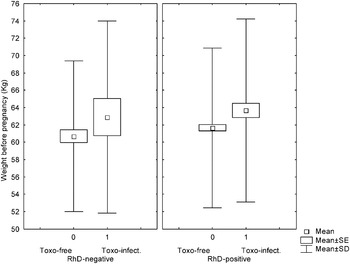
We analysed the influence of toxoplasmosis and RhD on maternal weight before pregnancy. Toxoplasma-infected mothers had higher mean weight than Toxoplasma-free mothers (63·56 kg and 61·48 kg, respectively). The difference was significant in a simple general linear model with toxoplasmosis (toxo) and maternal age as independent variables (P=0·023, η 2=0·005); however, the analysis with RhD, toxo and maternal age as independent variables showed no effect of toxo (P=0·114, η 2=0·002). Similarly, the effect of neither RhD (P=0·313, η 2=0·001) nor toxo-RhD interaction (P=0·886, η 2<0·001) on maternal weight before pregnancy was significant (Fig. 1). The continuous predictor maternal age has significantly positive influence on maternal age both in the model with the RhD variable (P=0·001, η 2=0·011) and the simple model without the RhD variable (P=0·001, η 2=0·011).
Differences in maternal weight before pregnancy between Toxoplasma-infected and Toxoplasma-free and RhD-negative and RhD-positive women. The y-axis shows the mean weight (in kg) in Toxoplasma-free (left part of each panel), Toxoplasma-infected (right part of each panel), RhD-negative (left panel) and RhD-positive (right panel) women. The boxes and spreads show standard errors and standard deviations, respectively.

The influence of toxo-RhD interaction on maternal weight gain at pregnancy weeks approximately 16, 20 and 30 was evaluated by the GLM in sets of 900, 933 and 936 mothers, respectively. The models contained the independent binary variables toxo, sex of newborn child and RhD and continuous variables maternal age, maternal weight before pregnancy and presumptive pregnancy length (age of the fetus in days). The sex of the newborn child and maternal weight before pregnancy had no effect on maternal weight gain and therefore, these factors were excluded from final testing. The effect of toxo was significant in pregnancy weeks 16 (P=0·006, η 2=0·009) and 20 (P=0·049, η 2=0·004) and nearly significant in pregnancy week 30 (P=0·073, η 2=0·003). The effect of RhD was significant in pregnancy week 16 (P=0·001, η 2=0·012) but was not significant in pregnancy weeks 20 (P=0·127, η 2=0·003) and 30 (P=0·333, η 2=0·001). The effect of toxo-RhD interaction was significant in pregnancy weeks 16 (P<0·001, η 2=0·019), 20 (P=0·010, η 2=0·007) and 30 (P=0·049, η 2=0·004). The continuous predictor maternal age was significant in pregnancy weeks 16 and 20 (P<0·001, η 2=0·017 and P<0·001, η 2=0·014, respectively) and was nearly significant in pregnancy week 30 (P=0·068, η 2=0·004).
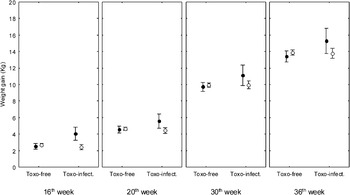
The exact pregnancy length was not estimated with ultrasonography at the last examination at around pregnancy week 36. Therefore, the influence of toxo-RhD interaction on maternal weight gain in pregnancy week 36 in the set of 958 mothers was analysed by GLM in the model with the binary variables toxo and RhD and continuous variable maternal age. The effect of toxo was significant (P=0·037, η 2=0·005) while the effect of RhD was not significant (P=0·321, η 2=0·001) but the effect of toxo-RhD interaction was significant again (P=0·016, η 2=0·006). The effect of the continuous predictor maternal age was not significant (P=0·657, η 2<0·001). At all 4 time-points, i.e. in pregnancy weeks 16, 20, 30 and about 36, maternal weight gain was the highest in Toxoplasma-infected and RhD-negative mothers and this effect was always significant. The difference of about 1600 g observed in pregnancy week 16 (4·12 kg in 25 RhD-negative, Toxoplasma-infected vs. 2·44 kg in 127 RhD-negative, Toxoplasma-free, 2·65 kg in 590 RhD-positive, Toxoplasma-free and 2·35 kg in 158 RhD-positive, Toxoplasma-infected mothers) remained approximately constant until the end of pregnancy (Fig. 2).
The effect of toxo-RhD interaction on maternal weight gain in pregnancy weeks 16, 20, 30 and 36. The y-axis shows the mean weight gain (in kg) in Toxoplasma-free (left part of each panel), Toxoplasma-infected (right part of each panel), RhD-negative (black circles) and RhD-positive (empty circles) women. The spreads indicate the 95% confidence intervals.

The effect of toxoplasmosis on maternal weight gain was analysed separately for RhD-negative and RhD-positive women. The effect of toxo on maternal weight gain in pregnancy weeks 16, 20, 30 and 36 was significant in RhD-negative mothers (week 16: P=0·001, η 2=0·073; week 20: P=0·012, η 2=0·040; week 30: P=0·027, η 2=0·031; week 36: P=0·009, η 2=0·041) but was not significant in RhD-positive mothers (week 16: P=0·083, η 2=0·004; week 20: P=0·420, η 2=0·001; week 30: P=0·826, η 2<0·001; week 36: P=0·654, η 2<0·001). The effect of maternal age on maternal weight gain was observed in both RhD-negative women (week 16: P=0·011, η 2=0·043; week 20: P=0·096, η 2=0·018; week 30: P=0·484, η 2=0·003; week 36: P=0·558, η 2=0·002) and RhD-positive women (week 16: P=0·003, η 2=0·012; week 20: P=0·001, η 2=0·014; week 30: P=0·091, η 2=0·004; week 36: P=0·496, η 2=0·001).
As toxoplasmosis is known to influence the secondary sex ratio (Kaňková et al. Reference Kaňková, Šulc, Nouzová, Fajfrlík, Frynta and Flegr2007a, Reference Kaňková, Kodym, Frynta, Vavřinová, Kuběna and Flegrb) and the effect of toxo-RhD interaction on maternal weight gain could be just a side-effect of different developmental rates of male and female fetuses, we analysed the maternal weight gain separately for mothers who gave birth to male and female newborns. The effect of toxo-RhD interaction on maternal weight gain was significant in pregnancy week 16 (P<0·001, η 2=0·026), nearly significant in pregnancy weeks 20 (P=0·075, η 2=0·006) and 36 (P=0·082, η 2=0·006) but was not significant in pregnancy week 30 (P=0·182, η 2=0·003) in mothers of male newborns. In mothers of female newborns, the effect of toxo-RhD interaction on maternal weight gain was significant in pregnancy week 16 (P=0·040, η 2=0·011), nearly significant in pregnancy week 20 (P=0·067, η 2=0·008) but was not significant in pregnancy weeks 30 (P=0·121, η 2=0·006) and 36 (P=0·100, η 2=0·007).
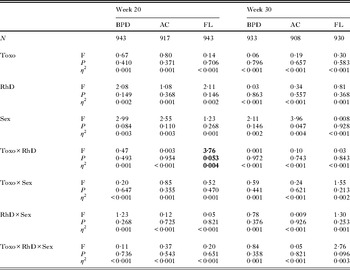
To investigate whether toxoplasmosis also influences fetal growth, we analysed the effect of toxo-RhD interaction on fetal bioparameters measured by ultrasound at pregnancy weeks 20 and 30. Two continuous variables maternal age and pregnancy length estimated from the date of the last menstrual period were included into the models (and appeared significant in all models). As the sex of newborns is known to influence the fetal bioparameters, birth weight and birth length, we analysed this model with a third fixed factor, sex of newborn. Toxo-RhD interaction had no effect on fetal bioparameters at pregnancy weeks 20 and 30 in the whole study set (Table 1). Similarly, toxo, RhD and toxo-RhD interaction had no effect on birth length and birth weight, results not shown.
Fetal ultrasonography data in Toxoplasma-infected and Toxoplasma-free women at pregnancy weeks 20 and 30

DISCUSSION
The present study showed that RhD-negative women with latent toxoplasmosis gained more weight during pregnancy than RhD-negative, Toxoplasma-free women or RhD-positive women. The difference was greatest in early pregnancy. In week 16, the mean maternal weight gain in 25 Rh-negative Toxoplasma-infected women was 4·12 kg compared to 2·50 kg in the other study groups. We also confirmed the earlier observation that Toxoplasma-infected women had higher weight before pregnancy than Toxoplasma-free women.
The difference in maternal weight gain was not a side effect of higher sex ratio in Toxoplasma-infected mothers or differences in male and female fetal growth, as the same difference was observed in analyses performed separately for women with male and female children. Toxoplasmosis (and RhD) had no detectable effect on fetal growth or birth length and birth weight. Therefore, the higher pregnancy weight gain in Toxoplasma-infected RhD-negative mothers was probably due to higher weight of maternal tissues or higher volume of anmniotic fluid and placental tissues. To answer this important question, further data on maternal post-delivery weight would be needed.
Toxoplasma-free and Toxoplasma-infected women differ in several personality traits including Cattell's superego strength. Therefore, they could also differ systematically in time and regularity of visiting their gynecologist during pregnancy. This could systematically influence the observed pregnancy weight gain. To minimize this source of systematic error, we included length of pregnancy at the pre-natal visit into our statistical models. Theoretically, the length of pregnancy estimated from the first fetal ultrasound (performed usually at pregnancy weeks 8–12) could be systematically underestimated in Toxoplasma-infected women who show a lower embryonic developmental rate than Toxoplasma-free mothers (Kaňková and Flegr, Reference Kaňková and Flegr2007). Therefore, we also analysed the models either without the covariate length of pregnancy or with the length of pregnancy estimated from the date of the last menstrual period. All 3 categories of models provided approximately the same results (results not shown), which indicated that possibly underestimated length of pregnancy in Toxoplasma-infected women was not responsible for observed phenomena.
We confirmed the earlier observation of Abrams et al. (Reference Abrams, Carmichael and Selvin1995) that pregnancy weight gain is positively related to maternal age. Our data showed that both RhD-negative and RhD-positive women accounted for this phenomenon. This suggests that RhD positivity probably protects against the effect of toxoplasmosis but not against the effect of age. It must be remembered, however, that the reported protective effects of RhD-positivity against Toxoplasma-induced decrease of psychomotor performance were only transient in RhD-positive homozygotes (Novotná et al. Reference Novotná, Havlíček, Smith, Kolbeková, Skallová, Klose, Gašová, Pisačka, Čechovská and Flegr2008). While the presence of a population of RhD-positive homozygotes can only partly mask the protective effects of RhD-positivity against latent toxoplasmosis-associated effects, it is probably much more difficult to demonstrate such protective effects of RhD-positivity against age-associated affects on the population containing RhD-positive homozygotes as the old RhD-positive homozygotes are expected to lack any protection.
Monitoring the gestational weight gain is important for epidemiological and public health purposes. This indicator is correlated with infant growth (Abrams and Selvin, 1995) and may be related to maternal outcomes such as reproductive health and chronic disease risk (Strauss and Dietz, Reference Strauss and Dietz1999). Prospective studies identified gestational weight gain as a predictor of both infant birth weight (Abrams et al. Reference Abrams, Carmichael and Selvin1995; Scholl et al. Reference Scholl, Hediger, Schall, Ances and Smith1995; Hickey et al. Reference Hickey, Cliver, McNeal, Hoffman and Goldenberg1996) and pre-term delivery (Schieve et al. Reference Schieve, Cogswell, Scanlon, Perry, Ferre and Blackmore-Prince2000). Excessive gestational weight gain is associated with increased risk of post-partum weight retention (Scholl et al. Reference Scholl, Hediger, Schall, Ances and Smith1995; Olson et al. Reference Olson, Strawderman, Hinton and Pearson2003) and increased risk of caesarean section (Johnson et al. Reference Johnson, Longmate and Frentzen1992; Scholl et al. Reference Scholl, Hediger, Schall, Ances and Smith1995). Our data showed that RhD-negative women with latent toxoplasmosis gained weight more rapidly during the first trimester of pregnancy. A similar effect has already been found in smokers (Abrams et al. Reference Abrams, Carmichael and Selvin1995). Gestational weight gain during the first trimester is also positively associated with maternal age and with hypertension (Abrams et al. Reference Abrams, Carmichael and Selvin1995; Dawes and Grudzinskas, Reference Dawes and Grudzinskas1991). It can be generalized that excessive weight gain in the first trimester of pregnancy usually implies a negative effect of some internal (genetic or epigenetic) or external (environmental) factor(s).
The major limitation of the present study is the absence of data on RHD genotype of the pregnant women. A published case-control study performed on a large sample of blood donors showed that RhD-positive heterozygotes are resistant to the pathological effect of toxoplasmosis while RhD-positive homozygotes are resistant only temporarily – their psychomotor performance decreases with length of the infection (Novotná et al. Reference Novotná, Havlíček, Smith, Kolbeková, Skallová, Klose, Gašová, Pisačka, Čechovská and Flegr2008). The psychomotor performance of RhD-negative homozygotes decreases immediately after the infection (Novotná et al. Reference Novotná, Havlíček, Smith, Kolbeková, Skallová, Klose, Gašová, Pisačka, Čechovská and Flegr2008). Our population of RhD-positive pregnant women contains both RhD-positive heterozygotes and RhD-positive homozygotes (some of them with a relatively low concentration of anti-Toxoplasma antibodies and therefore relatively old infection). The contamination of the protected population of RhD-positive heterozygotes by an unknown number of possibly non-protected RhD-positive homozygotes probably decreased the power of our tests and the strength of the observed effects.
Three recent studies (Novotná et al. Reference Novotná, Havlíček, Smith, Kolbeková, Skallová, Klose, Gašová, Pisačka, Čechovská and Flegr2008; Flegr et al. Reference Flegr, Novotná, Lindová and Havlíček2008a, Reference Flegr, Klose, Novotna, Berenreitterová and Havlíček2009) have reported a protective effect of the RhD-positive phenotype, especially RhD heterozygosity, against the negative effect of latent toxoplasmosis on psychomotor performance of infected subjects. The present results indicate that the RhD-positive phenotype could also protect against a broader spectrum of detrimental effects of latent toxoplasmosis. The physiological role of RhD protein (an ion pump of uncertain specificity present in the red blood cell membrane) is unknown. Similarly, the mechanism of effects of toxoplasmosis on psychomotor performance (Havlíček et al. Reference Havlíček, Gašová, Smith, Zvára and Flegr2001), length of pregnancy (Kaňková and Flegr, Reference Kaňková and Flegr2007) or sex ratio (Kaňková et al. Reference Kaňková, Šulc, Nouzová, Fajfrlík, Frynta and Flegr2007a, Reference Kaňková, Kodym, Frynta, Vavřinová, Kuběna and Flegrb) is unclear. Until the role of RhD protein in human physiology and the mechanism of toxoplasmosis-associated changes are elucidated, any speculation about the physiological and molecular mechanisms of the protective effect of RhD-positivity in pregnant Toxoplasma-infected women would be rather premature.
FINANCIAL SUPPORT
This research was supported by grants 151/2006/B-Bio/PrF (Grant Agency of Charles University), and 0021620828 (Czech Ministry of Education, Youth and Sport). The study was approved by the IRB of Charles University, and complied with the current laws of the Czech Republic.