Introduction
Social anxiety is among the most commonly reported and disabling of the co-morbidities in people with psychosis (Birchwood et al. Reference Birchwood, Trower, Brunet, Gilbert, Iqbal and Jackson2007; Michail & Birchwood, Reference Michail and Birchwood2009). The processes that underlie its development in psychosis remain unclear as there is no evidence that it is directly linked to psychosis -vulnerability or symptoms (Pallanti et al. Reference Pallanti, Quercioli and Hollander2004; Michail & Birchwood, Reference Michail and Birchwood2009). In social anxiety in general, a developmental psychopathology framework has been adopted (Ollendick & Hirshfeld-Becker, Reference Ollendick and Hirshfeld-Becker2002; Hayward et al. Reference Hayward, Wilson, Lagle, Kramer, Killen and Taylor2008) according to which there is evidence for continuity of social anxiety symptoms from childhood to adolescence and the involvement of multiple and interacting factors. Among the most prominent of these are early temperamental and behavioural traits including behavioural inhibition, shyness, neuroticism and shame proneness, which have shown to increase susceptibility for the later development of social anxiety disorder (SAD) (Dalrymple & Herbert, Reference Dalrymple and Herbert2007; Bienvenu et al. Reference Bienvenu, Hettemma, Neale, Prescott and Kendler2008; Schofield et al. Reference Schofield, Coles and Gibb2009). Shame proneness in particular has received considerable attention in the literature, where its relationship with social anxiety has been theoretically and empirically validated (Buss, Reference Buss1980; Averill et al. Reference Averill, Diefenbach, Gretchen, Mellings, Breckenridge and Lusby2002; Mills, Reference Mills2005).
Shame and social anxiety in non-psychosis
Shame is an emotion that affects the personal identity of the individual (Kaufman, Reference Kaufman1993) and is triggered when the individual believes they hold qualities that are unattractive or unfavourable (e.g. having a mental illness) and could therefore lead to social rejection and loss of social status (Gilbert, Reference Gilbert, Gilbert and Andrews1998, Reference Gilbert2000). Shame is seen as an involuntary submissive reaction in an attempt to defend oneself from being down-ranked and serves the function of inhibiting further attacks to the self and to one's social identity. Gilbert (Reference Gilbert, Gilbert and Andrews1998) makes a distinction between internal and external shame. Internal shame refers to negative or critical perceptions the individual has about their own behaviour (self-evaluation); external shame relates to how one thinks others see oneself (usually in a negative way) and involves a social comparison process during which the individual becomes an object in the eyes of others.
Shame and social anxiety, although not similar, share some common underlying processes. One of these, according to Gilbert (Reference Gilbert, Gilbert and Andrews1998, Reference Gilbert2000), is fear of negative evaluation and rejection. A shame episode is similar to social anxiety to the extent that both are characterized by significant apprehension accompanied by heightened self-consciousness, fear of exposure and evaluative concerns (Gilbert & Trower, Reference Gilbert, Trower and Crozier1990; Fischer & Tangney, Reference Fischer and Tangney1995). Based on this, Mills (Reference Mills2005) suggested that shame could be a vulnerability factor for the development of social anxiety through the shared process of self-consciousness. The use of safety behaviours has also been identified as a common process in shame and social anxiety (Gilbert, Reference Gilbert, Gilbert and Andrews1998, Reference Gilbert2000). These are behaviours intended to minimize or prevent imminent threat resulting from situations that entail negative evaluation and rejection and can include avoiding eye contact, withdrawal from social interactions or showing signs of submissiveness to prevent a potential ‘attack’ to the self (Salkovskis, Reference Salkovskis1991). When encountered with social threats, safety behaviours are used in both shame and social anxiety as a way of minimizing the perceived danger and its consequences (e.g. being down-ranked or humiliated), thus ‘saving’ the self.
Shame and social anxiety in psychosis
In psychosis, developmental risk factors such as trauma, dysfunctional attachment relationships and emotional difficulties (Read & Argyle, Reference Read and Argyle1999; Read et al. Reference Read, Agar and Argyle2003; Janssen et al. Reference Janseen, Krabbendam, Bak, Hanssen, Vollebergh, de Graaf and van Os2004; Johnstone et al. Reference Johnstone, Ebmeier, Miller, Owens and Lawrie2005; Owens et al. Reference Owens, Miller, Lawrie and Johnstone2005) are present during the prodrome phase and before symptom formation. The presence of these developmental risk factors has been suggested to predispose individuals to shame and increase sensitivity to ‘put-downs’ by others (Lutwark & Ferrari, Reference Lutwark and Ferrari1997; Gross & Hansenn, Reference Gross and Hansenn2000). For example, studies on attachment and dysfunctional parenting styles (Lutwark & Ferrari, Reference Lutwark and Ferrari1997; Gross & Hansenn, Reference Gross and Hansenn2000) have shown that early maladaptive attachment relationships and parental overcontrol and overprotection were related to the later development of shame proneness. Therefore, in individuals with psychosis it is proposed that there is an established vulnerability to shame linked to early developmental anomalies. We have argued that shame proneness is likely to be catalysed by the stigma attached to the diagnosis of mental illness (Birchwood et al. Reference Birchwood, Trower, Brunet, Gilbert, Iqbal and Jackson2007). Psychosis is considered as a highly stigmatized condition (Thornicroft et al. Reference Thornicroft, Brohan, Rose, Sartorius and Leese2009) and, as with any type of social stigma, this can affect the social identity of the individual by suggesting qualities that deviate from the norm and are socially discrediting (Goffman, Reference Goffman1963). Individuals with psychosis are aware of the social stereotypes surrounding mental illness and some may even accept and endorse these (Hayward & Bright, Reference Hayward and Bright1997; Angermeyer & Matschinger, 2004). This internalization of stigma or self-stigma leads to increased shamefulness, particularly when individuals agree with the stigma and the associated negative responses (Corrigan & Watson, Reference Corrigan and Watson2002a, Reference Corrigan and Watsonb) and furthermore assume responsibility or engage in self-blame (Lewis, Reference Lewis, Gilbert and Andrews1998). Self-blame is required to elicit feelings of shamefulness as a result of being stigmatized (Lewis, Reference Lewis, Gilbert and Andrews1998). In individuals with psychosis, appraisals of shame and social unattractiveness are significant (Birchwood et al. Reference Birchwood, Mason, Macmillan and Healy1993, Reference Birchwood, Iqbal, Chadwick and Trower2000a) and lead to feelings of loss of social status, humiliation and entrapment (Rooke & Birchwood, Reference Rooke and Birchwood1998).
Therefore, we argue that psychotic individuals are developmentally vulnerable to shame and, in this context, receiving a diagnosis of mental illness makes the social stigma attached to mental illness difficult to resist and individuals can internalize and accept the stigma and the cultural stereotypes surrounding mental illness. This internalized stigma subsequently leads to increased shamefulness. However, the processes by which these appraisals of shame might contaminate social interaction in people with psychosis is not understood.
Aim of the study
The aim of this study was to examine the relationship between shame cognitions, shame proneness and perceived loss of social status in people with first-episode psychosis (FEP) and SAD. The following hypotheses were tested:
(1) People with SAD (with or without psychosis) will report higher levels of shame proneness and lower perceived social status, compared to those with no social anxiety.
(2) People with psychosis and SAD will hold stronger negative appraisals about psychosis in terms of (a) shame arising from the illness and perceived social rejection and (b) loss of social status, inability to escape the diagnosis and to control the illness, compared to those with psychosis alone.
Method
Sampling
Inclusion criteria
Four groups of participants aged between 16 and 35 years were sampled with: (a) non-psychotic SAD, (b) FEP, (c) FEP with SAD (FEP/SAD) and (d) healthy controls. All participants were assessed using the Schedules for Clinical Assessment in Neuropsychiatry (SCAN; WHO, 1999) by M.M. who received formal trainingFootnote 1Footnote † to criterion levels of reliability. Individuals in the SAD group were required to conform to ICD-10 (WHO, 1993) criteria for social anxiety (F40.1); and in the FEP group, to ICD-10 criteria for schizophrenia or related disorder (F20, 22, 23), in the absence of a primary diagnosis of organic disorder. An age-matched community sample with no psychiatric disorders was drawn from the general population and invited to take part in the study.
Recruitment
Participants with FEP were recruited from consecutive cases managed in the Early Intervention Service of Birmingham and Solihull Mental Health National Health Service (NHS) Foundation Trust, UK. The service manages all cases of FEP, age 14–35 years, in Birmingham. People with SAD were recruited through a self-help organization, Social Anxiety UK (www.social-anxiety.org.uk), and through local community mental health teams.
Assessments
Social anxiety
Two scales widely used together in the social phobia literature were administered. The Social Interaction Anxiety Scale (SIAS; Mattick & Clarke, Reference Mattick and Clarke1998) is a 20-item scale measuring anxiety in interpersonal encounters. Using a cut-off score of 36, the SIAS has been demonstrated to discriminate between social anxiety, other anxiety disorders and community samples (Peters, Reference Peters2000) with a sensitivity of 0.93 and positive predictive value (PPV) of 0.84. The Social Phobia Scale (SPS), designed to be administered alongside the SIAS, is used to detect and assess performance anxiety in situations where the individual fears they are being observed and scrutinized by others (e.g. carrying a tray across a cafeteria, eating/drinking in public).
Psychosis
The Positive and Negative Syndrome Scale (PANSS; Kay et al. Reference Kay, Fiszbein and Opler1987) includes scales of positive symptoms, negative symptoms and general psychopathology and is used widely in schizophrenia research.
Cognitive appraisals of psychosis
The Personal Beliefs about Illness Questionnaire (PBIQ; Birchwood et al. Reference Birchwood, Mason, Macmillan and Healy1993) measures patients' beliefs about their psychotic illness and its impact on their future goals and roles (loss), social status (shame), social marginalization (group fit) and the extent to which their illness is perceived to trap the individual, preventing them from asserting their aspired identity and role (entrapment). This measure has been widely used to study patients' adaptation to psychosis (Birchwood et al. Reference Birchwood, Iqbal, Chadwick and Trower2000b) and has extensive psychometric validation including retest reliabilities of the scales from 0.77 to 1.0 and Cronbach's α from 0.68 to 0.77.
Shame
The Other as Shamer Scale (OAS; Goss et al. Reference Goss, Gilbert and Allan1994) is an 18-item self-report scale that measures judgments about how the self is evaluated by others (e.g. ‘I think that other people look down on me’). The frequency with which individuals share such feelings and experiences is rated on a five-point Likert scale (0–4). The OAS is a modification of the Internalized Shame Scale (ISS; Cook, Reference Cook1993), which is used to assess self-evaluations (internal shame) and therefore covers trait shame. The OAS was developed to assess external shame, i.e. shame received by others (Goss et al. Reference Goss, Gilbert and Allan1994). The scale was found to correlate highly with the ISS (r = 81), indicating that the OAS can be used as a measure of shame proneness (trait shame) and moreover that shame involves both self and other evaluations (Goss et al. Reference Goss, Gilbert and Allan1994). Cronbach's α was found to be 0.92 supporting its high internal consistency. It has been widely used in the literature (Gilbert, Reference Gilbert2000; Birchwood et al. Reference Birchwood, Trower, Brunet, Gilbert, Iqbal and Jackson2007).
Social status
The Social Comparison Scale (SCS; Gilbert & Allan, Reference Gilbert and Allan1994) was designed to assess individuals' judgments of their rank/status and group fit. The scale includes six bipolar items: inferior–superior, less competent–more competent, likable–less likable, less reserved–more reserved, left out–accepted, different–same. The first five items are referred to as rank items and the sixth item, which measures the degree of perceived similarity with others, is called social comparison/group fit. Each item is rated on a 10-point scale according to how people perceive themselves in relation to their social others. Higher scores indicate higher perceived status. Cronbach's α for the rank scale was reported as 0.87, indicating good internal reliability (Gilbert & Allan, Reference Gilbert and Allan1994), and the test–retest reliability over a 4-month period was 0.84 (Gilbert et al. Reference Gilbert, Price and Allan1995).
Results
The sample
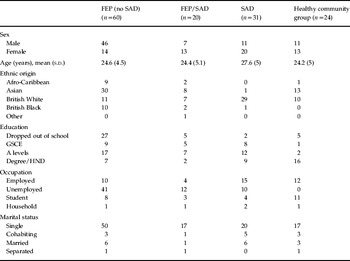
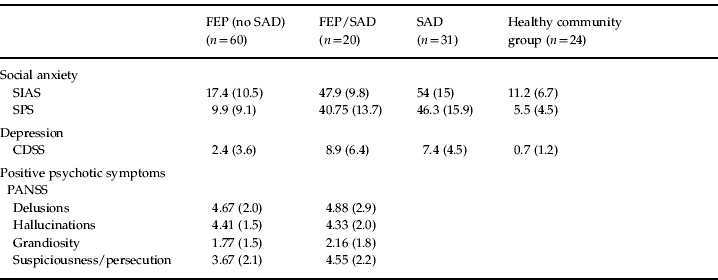
Of the 84 patients with FEP who were approached to take part in this study, 80 (95.2%) consented. Twenty (25%) out of these 80 people with FEP received an ICD-10 diagnosis of social anxiety disorder (FEP/SAD) based on the SCAN. All 20 scored above the cut-off points on both the SIAS (>36) and the SPS (>26). An age-matched healthy control group (n = 24) was also recruited. Table 1 presents information on the demographic characteristics of the samples. The mean age of those in the SAD group was approximately 3 years more than those in the other groups. Both SAD groups showed a female excess whereas in the FEP (no SAD) group the expected male excess was observed. χ2 tests showed significant differences in ethnicity (χ212 = 59.7, p < 0.01), education (χ29 = 43.5, p < 0.01) and occupation (χ29 = 42.3, p < 0.01) but not in marital status (χ29 = 9.1, n.s.). These differences reflect the expected higher functioning of the non-psychotic socially anxious participants. The main clinical characteristics of the sample are presented in Table 2. The two social anxiety groups with (FEP/SAD) and without psychosis (SAD) reported similar severity levels of social anxiety and avoidance (SIAS: F 1,49 = 2.55, n.s., SPS: F 1,49 = 1.65, n.s.). Similar levels of depression were also reported (F 1,49 = 0.26, n.s.), with 64.5% of the SAD and 65% of the FEP/SAD groups shown to be at least moderately depressed (Michail & Birchwood, Reference Michail and Birchwood2009). The two psychotic groups (with and without social anxiety) reported no significant differences in the overall occurrence of delusions (F 1,69 = 0.137, n.s.), including delusions of grandiosity (F 1,69 = 0.76, n.s.) and persecution (F 1,69 = 2.24, n.s.); similarly, the level of hallucinations did not differ between the two groups (F 1,69 <1, n.s.).
Demographic characteristics of participants

s.d., Standard deviation; FEP, first-episode psychosis; SAD, social anxiety disorder.
Clinical characteristics of the sample (means/s.d.)
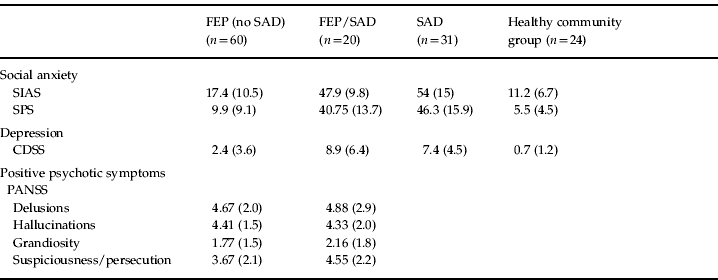
s.d., Standard deviation; FEP, first-episode psychosis; SAD, social anxiety disorder; SIAS, Social Interaction Anxiety Scale; SPS, Social Phobia Scale; CDSS, Calgary Depression Scale for Schizophrenia; PANSS, Positive and Negative Syndrome Scale.
Hypothesis 1
(a) Shame proneness and social status
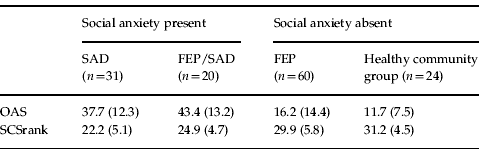
A 2 × 2 between-subjects multivariate analysis of variance (MANOVA) was performed with SAD (present, absent) and psychosis (present, absent) as independent variables and shame proneness (OAS) and social rank (SCSrank) as dependent variables (Table 3). The multivariate model was significant for SAD (F 2,130 = 71, p < 0.01). In line with the hypothesis, people with SAD (with or without psychosis) reported significantly higher levels of shame proneness (F 1,135 = 123.1, p < 0.01) and lower perceived social rank (F 1,135 = 49.6, p < 0.01) compared to those without social anxiety. The social anxiety × psychosis group interaction did not reach significance (p = 0.1). The results also show that levels of shame proneness (p = 0.41) and social status (p = 0.28) were similar in the social anxiety groups with (FEP/SAD) versus without (SAD) psychosis. These findings indicate that shame proneness and low perceived social status are features of social anxiety, irrespective of the presence of psychosis.
Mean scores (s.d.) of psychosis and social anxiety groups in the OAS and SCSrank
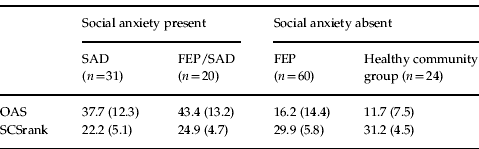
s.d., Standard deviation; OAS, Other as Shamer Scale; SCS, Social Comparison Scale; SAD, social anxiety disorder; FEP, first-episode psychosis.
Hypothesis 2
(b) Shame and social rejection arising from psychosis
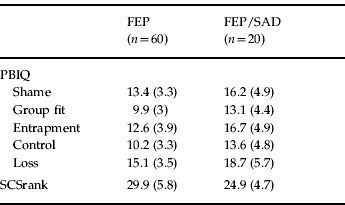
We tested whether individuals with psychosis and social anxiety experienced greater levels of shame and perceived social rejection arising from their mental illness and the associated stigma, compared to those with psychosis but without social anxiety. The multivariate test with the PBIQ shame and group fit as dependent variables showed that the overall model was significant (F 2,77 = 6.8, p < 0.05). Univariate comparisons showed that PBIQ shame (F 1,79 = 8, p < 0.05) and group fit (F 1,79 = 13.7, p < 0.01) were each significantly higher in people with psychosis and social anxiety (FEP/SAD) compared to those with FEP alone (Table 4).
Mean scores (s.d.) of FEP and FEP/SAD groups in the PBIQ and SCS
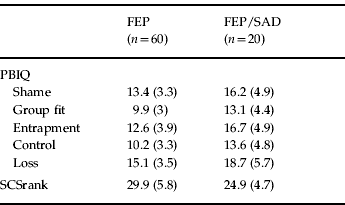
s.d., Standard deviation; FEP, first-episode psychosis; SAD, social anxiety disorder; PBIQ, Personal Beliefs about Illness Questionnaire; SCS, Social Comparison Scale.
Loss of social status, control and entrapment in social anxiety and psychosis
To examine whether people with psychosis and social anxiety perceived their psychotic illness to be more entrapping, less controllable and conferring lower social status, compared to those with psychosis alone, a MANOVA was calculated with PBIQ entrapment, control, loss of status and social role and SCS rank as dependent variables. The results show that the multivariate model was significant (F 4,75 = 5.6, p < 0.01). Those with psychosis and SAD reported higher levels of PBIQ entrapment (F 1,79 = 14.5, p < 0.01), loss of social goals (F 1,79 = 12, p < 0.01), poorer illness control (F 1,79 = 13.1, p < 0.01) and lower perceived social status (F 1,79 = 12, p < 0.01), compared to those without SAD (Table 4).
Discussion
Shame proneness and social anxiety
The findings of this study show that, whether in the context of psychosis or not, shame cognitions are a feature of SAD. Shame proneness accompanied by perceived loss of social status was significantly elevated in those with social anxiety (with or without psychosis) compared to those without. Those with FEP and social anxiety expressed similarly high levels of vulnerability to shame as their counterparts without psychosis. The focus of and the triggers for this shame sensitivity, which seems to be present in both socially anxious psychotic and non-psychotic people, warrant further clarification. Is the content of the shame cognitions in co-morbid social anxiety and psychosis the same as in those with social anxiety alone? For example, does the diagnosis of psychosis and its associated stigma lead to fear of this being revealed and seen by others as ‘ill’, ‘mad’ or ‘schizophrenic’ in social interactions? The results from the second hypothesis are significant in identifying the nature and underlying processes of these shame cognitions in social anxiety in psychosis.
Shame, social rejection and appraisals arising from psychosis
The FEP/SAD group expressed significantly greater negative appraisals arising from their stigmatizing illness compared to the FEP (no SAD) group alone. These appraisals involved: (a) shame and feelings of humiliation as a result of being diagnosed with a stigmatizing illness, accompanied by feelings of rejection by others in their social environment; and (b) appraisals of entrapment and loss of control over the illness. Perceived loss of social life goals and lowered social status were also significantly more prominent in the socially anxious psychotic group (FEP/SAD) compared to the non-socially anxious (FEP, no SAD).
The findings of this study are consistent with those of earlier studies (Gumley et al. Reference Gumley, O'Grady, Power and Schwannauer2004; Birchwood et al. Reference Birchwood, Trower, Brunet, Gilbert, Iqbal and Jackson2007) reporting that dysfunctional appraisals held by socially anxious psychotic people were characterized by shamefulness, humiliation and perceived rejection by others.
These findings are the first to show that shameful thinking plays a significant role in social anxiety in psychosis, as it does in non-psychotic social anxiety. It is important to delineate how this operates in psychosis and how such shame promotes behaviours of avoidance and withdrawal leading to social anxiety. According to Gilbert (Reference Gilbert1992, Reference Gilbert1997), shame arises from individuals and their behaviours, which are perceived to have an unattractive or socially undesirable quality. For example, being overweight, having an eating disorder or a physical disfigurement are all considered to confer shame and social rejection and are associated with significant stigma (Andrews, Reference Andrews1995, Reference Andrews1997; Thompson et al. Reference Thompson, Coovert and Stormer1999; Thompson & Kent, Reference Thompson and Kent2001; Swan & Andrews, Reference Swan and Andrews2003). To avoid these adverse consequences of shame, individuals may engage in behaviours of avoidance, concealment or withdrawal, which are considered to be the hallmarks of shame. In social anxiety, such behaviours prevent individuals from communicating their perceived as visible anxiety symptoms (e.g. sweating, blushing, shaking) and hence ‘protect’ them from being exposed to unfavourable evaluation; with the addition of psychosis, it is the diagnosis of mental illness that constitutes the unattractive quality and the social stigma attached to this. We have emphasized that this stigma is internalized and endorsed by people with psychosis who accept their ‘schizophrenic’ identity. This self-stigma leads to increased shamefulness and fear of the illness being revealed to others because of the consequences of this discovery (e.g. social exclusion, marginalization). Hence it is predicted that people with psychosis will attempt to conceal their stigmatized identity to prevent or minimize this threat. Concealment operates as a safety behaviour that is suggested to serve two functions: (a) a preventive function whereby the aim is to avert or minimize the anticipated threat (i.e. discovery) and (b) a protective function to ‘save’ the individual from the consequences of such a social threat, for example being shamed, humiliated and rejected by others. However, any use of concealment as safety behaviour may be counterproductive as it can contaminate social interaction by promoting behaviours of submissiveness, avoidance and withdrawal in people with psychosis. The counterproductive use of such safety behaviours has received empirical support in studies of social anxiety (McManus et al. Reference McManus, Sacadura and Clark2008). It is argued, therefore, that the use of concealment as a form of safety behaviour in socially anxious psychotic individuals will operate in an analogous way (i.e. to prevent discovery of the stigmatized identity) and may entail similar consequences.
Entrapment and social anxiety in psychosis
An important finding of this study concerns the significantly elevated levels of entrapment and loss of control over the illness reported in the socially anxious psychotic group compared to the non-socially anxious. The role of defeat and entrapment in psychopathology has attracted considerable attention in the literature (Gilbert & Allan, Reference Gilbert and Allan1998; Taylor et al. Reference Taylor, Wood, Gooding, Johnson and Tarrier2009, Reference Taylor, Gooding, Wood, Johnson, Pratt and Tarrier2010, Reference Taylor, Gooding, Wood and Tarrier2011); however, their relationship to social anxiety remains unclear (Taylor et al. Reference Taylor, Gooding, Wood and Tarrier2011). Entrapment refers to the desire to escape from a certain situation (e.g. mental illness) and the perception that all escape routes are blocked with no way forward or likelihood of improvement (Gilbert & Allan, Reference Gilbert and Allan1998). External entrapment refers to entrapment by external circumstances or events and internal entrapment relates to entrapment within internally generated thoughts and feelings (Gilbert & Allan, Reference Gilbert and Allan1998). According to Taylor et al. (Reference Taylor, Gooding, Wood and Tarrier2011), feeling defeated and trapped by a situation or an event could lead individuals to perceive themselves as inferior and subordinate compared to others, hence activating negative appraisals about the self. These dysfunctional self-beliefs increase the possibility of individuals appraising social situations, particularly those that might be evaluative in nature such as meeting new people, as potentially threatening and dangerous to their self-esteem and social status. Therefore, engaging in, or even the anticipation of engaging in, such encounters could significantly increase levels of anxiety and distress.
In people with psychosis, the imminent threat refers to the discovery of the mental illness by others and the consequences entailed in terms of social rejection and exclusion. We suggest that feeling trapped by a stigmatized illness such as psychosis (external entrapment) and by internal thoughts and feelings of what the schizophrenic identity means for the individual and their place in the social hierarchy (internal entrapment) could trigger negative appraisals about the self (i.e. ‘I am inferior compared to others because I cannot escape from my illness; I feel worthless and inadequate compared to others’). These negative self-appraisals may increase sensitivity to social situations where the perceived threat (i.e. the discovery of mental illness by others and fear of being socially ostracized) is present and imminent. This subsequently triggers anxiety and leads to behaviours aiming at mitigating the threat such as avoidance or withdrawal from social interactions and showing signs of submissiveness to prevent a potential ‘attack’ from others.
Methodological issues and limitations
This is the first study to undertake a detailed analysis of the role of shame in SAD in psychosis by directly comparing a psychotic with a non-psychotic socially anxious group.
This was a cross-sectional study and, although important links were revealed between shame cognitions, perceptions of social rank and social anxiety, causal relationships cannot be inferred. In our analyses of shame and negative appraisals resulting from psychosis, we did not test for the possible impact of concurrent depressed mood. Given, however, the significant phenomenological and developmental overlap between depression and social anxiety consistently reported in both epidemiological and clinical studies (Stein et al. Reference Stein, Tancer, Gelernter, Vittone and Uhde1990, Reference Stein, Fuetsch, Muller, Hofler, Lieb and Wittchen2001; Kessler et al. Reference Kessler, Stang, Wittchen, Stein and Walters1999; Wittchen et al. Reference Wittchen, Stein and Kessler1999), controlling for depression in analyses concerning negative appraisals of psychosis entails the risk of controlling for social anxiety itself as these are indivisible characteristics of social anxiety. This is supported by the significantly elevated levels of depression reported in those with social anxiety (with or without psychosis) compared to those with psychosis only (Michail & Birchwood, Reference Michail and Birchwood2009). The inter-relationship between depression and anxiety has received considerable attention; Shorter & Tyrer (Reference Shorter and Tyrer2003), commenting on this overlap, have argued that the representation of depression and anxiety on the current diagnostic criteria as distinct clinical entities is rarely seen in practice. Tyrer (Reference Tyrer2001) also questioned the sharp division between anxiety and depression in the diagnostic systems and suggested their unitary classification as nervousness or cothymia. Given, therefore, the endemic nature of depression and its significant overlap with social anxiety in our group, it would not be meaningful to statistically control for depressed mood.
Clinical implications
The findings of this study have significant implications for psychological interventions and treatments of symptoms of social anxiety and associated distress in psychosis. Cognitive behaviour therapy (CBT) is recommended for people with psychosis (NICE, 2009), but its focus and evaluation has revolved primarily around the reduction of psychotic symptoms, and not for co-morbid depression and social anxiety. Furthermore, psychological interventions such as CBT for the treatment of affective disorders developed for non-psychotic populations are proposed for the management of affective dysfunction when this is co-morbid in psychosis (Halperin et al. Reference Halperin, Nathan, Drummond and Castle2000; Kingsep et al. Reference Kingsep, Nathan and Castle2003). This could be problematic because, according to Tarrier (Reference Tarrier2005), for such treatments to be effective, they would need to adapt to the specific nature of symptoms and difficulties experienced by people with psychosis. The findings of this study suggest that the ‘conventional’ CBT for social anxiety in psychosis could be considerably enhanced with an additional focus on shame and entrapment cognitions linked to psychosis and accompanying concealment behaviours, which are suggested to form part of the safety behaviour repertoire of socially anxious psychotic individuals. Safety behaviours are particularly problematic for people with SAD as they prevent disconfirmation of their unfounded beliefs (e.g. ‘the only reason I didn't muddle my words is because I memorized what I was supposed to say’) and, moreover, have the opposite from the desired effect; for example, avoid talking or eye contact during social interactions might come across as a socially inept behaviour. Research has provided empirical support for the role of safety behaviours in maintaining dysfunctional cognitive appraisals and also for the impact of reducing or dropping safety behaviours on symptoms of social anxiety and related appraisals (Wells et al. Reference Wells, Clark, Salkovskis, Ludgate, Hackmann and Gelder1995; Kim, Reference Kim2005). We predict that a randomized controlled trial testing the effectiveness of a CBT intervention in targeting shameful cognitions, alongside perceptions of entrapment, and reducing or eliminating concealment-linked behaviours would be effective in psychosis.
Acknowledgements
We thank Professor P. Trower for his constructive feedback on earlier versions of this manuscript. Professor Birchwood was part-funded by the National Institute for Health Research (NIHR) through the Collaborations for Leadership in Applied Health Research and Care for Birmingham and Black Country (CLAHRC-BBC). The views expressed in this publication are not necessarily those of the NIHR, the Department of Health, or the University of Birmingham.
Declaration of Interest
None.