The prevalence of rheumatoid arthritis (RA) is estimated to be 0.5–1.0 percent worldwide, but the progressive nature of the disease and its onset in early or middle life means that patients can live for 30 or more years with the disease (Reference Silman and Hochberg24). The disease has a considerable social and economic impact, and the costs to society associated with RA are substantial, as the disease can rapidly lead to restricted joint mobility, chronic pain, fatigue, and functional disability, with approximately one-third of patients unable to work within 10 years of disease onset (Reference Katz12;Reference Pincus, Callahan and Sale21;Reference Young, Dixey and Kulinskaya27). There are at present several different treatment options available to patients who are diagnosed with RA. These include analgesics such as non-steroidal anti-inflammatory drugs (NSAIDs), disease modifying anti-rheumatic drugs (DMARDs) and anti-tumor necrosis factor agents (TNFs).
The chronic and progressive nature of the disease calls for a life-time model approach in economic evaluations of the clinical benefit of treatment strategies (Reference Kobelt, Lindgren, Singh and Klareskog15). The majority of previously published economic evaluations of TNF treatments have been based on data from clinical trials and assumptions have had to be made on disease progression for all treatment arms after trial follow-up (Reference Chen, Jobanputra and Barton7). Sometimes TNF treatment is also assumed to discontinue after trial follow-up, resulting in a shorter treatment duration modeled than standard in clinical practice. However, trial-based economic evaluations look at the potential for cost-effective use of healthcare resources and are important for early adoption decision making.
The development of patient registries such as the Swedish Rheumatology Quality Register (SRQ) enables important complementary analyses of cost-effectiveness of TNF use in RA. The registry data represents real-world use compared with the more selective and controlled nature of the trial-based data. Using large patient cohorts from clinical practice ensure high external validity of the assessments. Disease progression while on treatment can also be tracked over longer time compared with data from clinical trials which generally have shorter follow-up. Moreover, using registry data enable incorporation of real-world data on drug discontinuation patterns in the economic evaluation.
The objective of the present study was to estimate the cost-effectiveness of infliximab treatment in patients with RA as it has been used in Swedish clinical practice, using data from the STURE registry (Stockholm TNF-alpha follow-up registry, a part of SRQ). Where needed, the data have been complemented with published data, including rate of natural disease progression, costs, and utilities.
MATERIALS AND METHODS
The cost-effectiveness of infliximab treatment compared with natural progression (i.e., no biologic treatment) is estimated in this current study, reflecting how infliximab actually has been used in Swedish clinical practice. It was assumed that all patients irrespective of treatment arm (infliximab or natural progression) were receiving an oral DMARD treatment throughout the simulation. The analysis had a societal cost perspective, and costs and effects were assigned in yearly cycles in the model.
Model
The model used for this study was a Markov cohort model programmed in TreeAge. It was programmed in line with a previously published model (extensively described elsewhere) with five health state categories based on the Health Assessment Questionnaire Disability Index (HAQ) with cutoff points at HAQ 0.6, 1.1, 1.6, and 2.1 (Reference Kobelt, Jonsson, Young and Eberhardt13). For this current assessment, two health states according to the twenty-eight joint count Disease Activity Score (DAS28) were added as a component in the model at a cut of at DAS28 3.2, in line with the model structure used in more recent publications of RA (Reference Kobelt, Lindgren, Lindroth, Jacobson and Eberhardt14;Reference Kobelt, Lindgren, Singh and Klareskog15). Health states and disease progression in the updated model were hence based on both functional status (HAQ) and disease activity (DAS28).
In each cycle, patients can transit to states of high or low disease activity, other HAQ states, remain in the same HAQ state, or die. There is also a risk of discontinuing treatment in each cycle, after which the patients will remain in an off-TNF treatment state for the remaining follow-up time.
STURE Registry Data
Patient level data were retrieved from the STURE registry (Stockholm TNF-alpha follow-up registry). The data set contained 637 patients who had initiated infliximab treatment as their first-line anti-TNF therapy sometime between 1999 and 2008, which constitute more than 90 percent of infliximab-treated patients in the Stockholm region. The mean age at start of infliximab therapy was 54.4 years and 77 percent were women. The maximum follow-up was almost 10 years, with a mean of 5.1 years, and the mean disease duration at start of infliximab therapy was 10 years. The mean HAQ score at start of therapy was 1.38, and almost all patients were in an active disease state. Data from the registry on initial distribution over HAQ and DAS28 categories, transition probabilities (specifics below), and infliximab usage were used in the model, estimated separately for each subgroup of patients included in the analysis.
Transition Probabilities
Transition probabilities were defined as transitions between health states of functional status (HAQ) and disease activity (DAS28) as well as the probability of discontinuing treatment. Data from the registry suggested that during the first year after treatment initiation, there is a higher rate of discontinuation as well as a larger drop in HAQ and DAS28 than in subsequent years. Transition probabilities for the first and subsequent years were, therefore, estimated separately.
The observed HAQ transitions during the first year were elicited from the data set. For subsequent years, the average HAQ change while remaining on therapy was computed, resulting in an average annual HAQ change of 0.0026. This rate was thereafter used to estimate the transition probabilities for subsequent years. DAS28 transitions during the first year were obtained from the observed transitions in the data set. The category of disease activity reached during the first year of treatment was assumed to prevail in subsequent years, given that the patients remained on therapy. This assumption was based on the minor DAS28 changes observed in subsequent years in the registry data.
Discontinuation was estimated using a logistic regression during the first year where HAQ at start of therapy and initiating treatment after 2003 had an effect on the discontinuation rate. The rate of discontinuation in subsequent years was estimated using a Weibull distribution, because it is better fitted for modeling data with hazard rates that increase or decrease over time. HAQ at baseline, initiating treatment after 2003, and time since start of therapy all had an effect on the discontinuation function in subsequent years.
After discontinuation of therapy, patients were assumed to revert to their baseline HAQ score and an active disease state. All patients in the off-treatment state (i.e., after discontinuing therapy in the infliximab arm and all patients in the comparator arm) were assumed to consistently be in an active disease state. Patients who had discontinued infliximab therapy were also assumed to have the same annual HAQ progression rate as in the comparator arm, that is, 0.065 (Reference Brennan, Bansback, Reynolds and Conway5). This estimate was taken from the UK Early Rheumatoid Arthritis Study (ERAS) of 145 patients who had failed two DMARDs. In a sensitivity analysis, a progression rate of 0.031 was tested, based on a review of HAQ progression by Scott et al. that used average results of HAQ progression from several studies (Reference Scott, Pugner and Kaarela23). The estimate of 0.065 was used for the base case because the patient population it was derived from better reflects the patients receiving TNF treatments than the lower estimate, which is based on several different cohorts of patients.
Mortalities
Age- and gender-specific normal mortality rates were obtained from Statistics Sweden 2007 and used in the model. The published evidence of RA-specific mortality is conflicting. Some studies showed that there was an increased mortality linked to functional status and disease activity whereas other studies were not able to demonstrate such an increase in mortality associated with RA during the first 10 years of follow-up (Reference Chehata, Hassell and Clarke6;Reference Kroot, Leeuwen and Rijswijk16;Reference Lindqvist and Eberhardt19;Reference Riise, Jacobsen, Gran, Haga and Arnesen22;Reference Symmons, Jones, Scott and Prior25;Reference Yelin, Trupin, Wong and Rush26). However, in line with a previous cost-effectiveness assessment of RA, it was assumed that patients with a HAQ score >1.1 had a relative mortality rate of 1.3 and 2.0 for low and high disease activity, respectively (Reference Kobelt, Lindgren, Lindroth, Jacobson and Eberhardt14). The contribution of increased mortality to the incremental cost-effectiveness ratio (ICER) was tested in sensitivity analyses.
Utilities
Utilities were derived from an empirical study by Kobelt et al. (Reference Kobelt, Lindgren, Lindroth, Jacobson and Eberhardt14) and assumed to be driven by the current HAQ state of the patient and by disease activity. In Kobelt et al., utilities were stratified according to the Global Visual Analog Scale (VAS) for disease activity in contrast to this current assessment which uses DAS28 for disease activity. Studies have, however, demonstrated a correlation between the VAS and DAS28 scales and Kobelt et al. (Reference Kobelt, Lindgren, Lindroth, Jacobson and Eberhardt14) demonstrated that a VAS cutoff of ≥40 is equivalent to the DAS28 cutoff of >3.2, separating low from high disease activity in the present study. VAS was, therefore, used as a proxy for disease activity in this assessment.
Costs
All costs are transformed from SEK prices of 2007 to Euros using the average exchange rate for 2007 (derived from Riksbanken). Where appropriate, costs were inflated using Swedish national inflation rates.
Intervention costs were based on the observed dosages of infliximab in the STURE registry. The data suggested that there has been a shift in dosing patterns over time, from a lower initial dose followed by dose titration in the earlier years of the registry data to a higher initial dose but rather stable dose over the course of treatment in later years. This trend may be explained by increased experience with effective infliximab dosing as well as access to alternative TNF treatments on the market, introducing switches as an alternative to dose titration. Observed usage of infliximab from 2004 to 2008 in the registry were used in the model to best reflect current clinical practice. The price per 100-ml vial for infliximab was €601 and the estimated administration cost per infusion was €206 (Reference Leden17). The total observed milligrams taken in the registry data was divided by eight infusions the first year and six in subsequent years, in line with Swedish treatment recommendations (Reference Jacobsson, Lindroth, Marsal, Bergström and Kobelt11). The total annual costs of intervention were estimated to €12,177 the first year and €12,117 in subsequent years, excluding waste of potentially unfinished vials. The intervention cost including maximum vial waste was tested in a sensitivity analysis. The cost of one oral DMARD (methotrexate) was added in both arms at an estimated annual cost of €24 (derived from FASS, Pharmaceuticals in Sweden 2007).
The direct and indirect costs were based on an empirical study by Kobelt et al., where costs were stratified by functional status based on Swedish registry data (Reference Kobelt, Lindgren, Singh and Klareskog15). Direct costs included all healthcare and community services as well as investments, devices, transportation, and informal help. Indirect costs included early retirement due to RA as well as long and short-term sick leave.
Costs for added life-years were also included in this assessment, derived from Ekman et al. (Reference Ekman, Zethraeus, Dahlstrom and Hoglund9). Meltzer (Reference Meltzer20) argues that, if a treatment strategy affects mortality, the difference between consumption and production for patients, commonly referred to as cost in added life-years (CiALYs), should be included in cost-effectiveness analyses. For example, the Swedish National Pharmaceutical Benefits Board, TLV, requires inclusion of these costs in their reimbursement decision making.
Both costs and effects were discounted with 3 percent annually, in line with Swedish recommendations for cost-effectiveness analyses.
Adverse Events
Several clinical trials and registry studies have indicated that TNF treatments of RA are associated with an increased risk of adverse events (AE), although not always reaching significance or having enough follow-up time to give stable results (Reference Askling, Fored and Brandt2;Reference Askling, Fored and Brandt3;Reference Chen, Jobanputra and Barton7;Reference Geborek, Crnkic, Petersson and Saxne10). Data on AE have, therefore, often been omitted from health economic analyses of TNF treatments. Information concerning adverse events was not available in the data set abstracted from the STURE registry for infliximab patients, and is, therefore, based on published literature of TNF patients. The data are, however, also based on Swedish registry data, making it suitable for this current analysis. The crude incidence of tuberculosis (TB) was found to be 77 per 100,000 for patients on TNFs and 20 per 100,000 for biologics naive patients, giving an excess risk of TB for patients on TNF of 0.00057 (Reference Askling1). This could occur at any time during the treatment cycle, but for modeling purposes, it was assumed that all TB incidences occurred during the first year of TNF treatment. Askling et al. (Reference Askling, Fored and Brandt3) have also demonstrated that TNF treatment has been associated with one additional serious infection (leading to hospitalization) per 66 subjects during the first year. The additional risk decreases with time on treatment (negative after the second year) and is not significant for subsequent years of treatment. Only first year risk of an infection was, therefore, included.
The Swedish cost of a serious infection and TB are based on Swedish DRG prices (Linköping University Hospital 2008, Stockholm—Gotland region 2009). The cost of TB is estimated at €5,909 and a serious infection at €3,814 by taking the average cost of sepsis, pneumonia, urinary tract infection, respiratory infection, and bronchitis. Data on the average number of hospital days required for treatment of adverse events were based on UK data from NHS Trusts National Schedule of Reference Costs 2006–07; a serious infection resulted on average in 6 hospital days and TB in 10 days. It was assumed that patients experiencing an adverse event had their pretreatment utility during the time of hospitalization (equivalent to an average utility decrement of 0.11 for the time spent in hospital). Because of the uncertainty in these estimates, a one time utility decrement of 0.2 was assumed for adverse events in a sensitivity analysis.
Subgroup Analyses
The STURE registry data suggest a change in treatment patterns over time, identifying a shift to infliximab use earlier in the course of the disease in more recent years compared with earlier years of the infliximab life cycle where treatment was initiated later in the course of the disease. This is reflected both in shorter disease duration and lower baseline HAQ values at treatment initiation in more recent years. Based on disease duration at start of infliximab therapy, subgroups of patients in the data set with earlier-stage RA (defined as first quartile of disease duration) and later-stage RA (defined as fourth quartile of disease duration) were, therefore, analyzed separately and compared with the base case, enabling a reflection of how the cost-effectiveness have been affected by this shift in treatment strategy.
Sensitivity Analyses
Deterministic sensitivity analyses were performed on the base-case scenario. Table 1 below indicates which variables were changed, their base-case values and values in deterministic analyses. A best- and worst-case scenario were also performed, also detailed in the Table.
Variable Values for Base-Case and Sensitivity Analyses

RR, relative risk; CiALYs, cost in added life-years.
RESULTS
Base Case
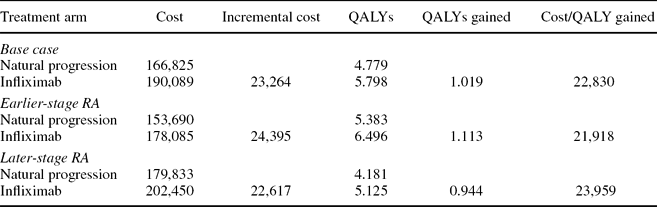
Infliximab treatment, as it has been used in Swedish clinical practice, was compared with natural progression (i.e., no biological treatment). The results indicated that, for patients at 54 years of age at start of therapy, infliximab treatment was associated with a gain of 0.203 (0.298 undiscounted) life-years compared with natural progression, equivalent to 2.4 (3.6 undiscounted) months over a 20-year follow-up. The gain in quality-adjusted life-years (QALYs) associated with infliximab treatment was 1.019 (1.287 undiscounted) (Table 2). Infliximab was also associated with an incremental cost of €23,264, resulting in an ICER of €22,830 (SEK211,136 or US$31,230). The analysis of earlier- and later-stage RA indicated that the ICER was lower for patients with earlier-stage RA and higher for patients with later-stage RA compared with base case. Patients with earlier-stage RA incurred higher incremental costs and QALYs, whereas for patients with later-stage RA, both incremental costs and QALYs were lower than in base case.
Base-Case, Earlier-, and Later-Stage RA Results of Infliximab Compared to Natural Progression (€2007)

RA, rheumatoid arthritis; QALY, quality-adjusted life-year.
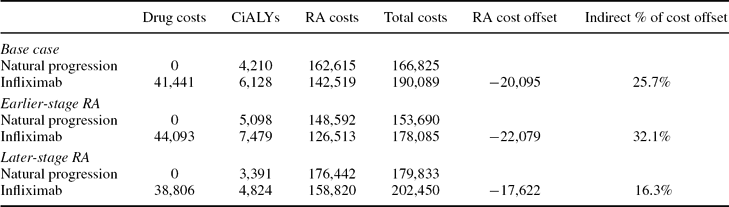
The results presented in Table 3 indicate that the cost-offset (difference in RA costs between infliximab treatment and natural progression without biologic treatment) was −€20,095, of which 25.7 percent consisted of indirect costs. The cost-offset increased for patients with earlier-stage RA and the proportion of indirect costs also increased for this subgroup of patients, whereas the opposite was seen for patients with later-stage RA.
Cost-Offset of Infliximab Therapy Compared to Natural Progression for Base-Case, Earlier- and Later-Stage RA (€2007)

Note. Methotrexate for both treatment arms is included as a direct cost and therefore fall under RA costs in the table.
RA, rheumatoid arthritis; CiALYs, cost in added life-years.
Sensitivity Analyses
Extensive deterministic sensitivity analyses were conducted on the base-case scenario. Figure 1 below depicts the variables with the largest impact on the ICER. Age at start of treatment initiation and the rate of natural disease progression had the largest effect on the ICER. The results from one-way sensitivity analyses range from €18,000 to €47,000. The best-case scenario resulted in an ICERs of €8,360 and the worst-case scenario €67,237. For 54-year-old patients, the best- and worst-case scenarios resulted in ICERs of €9,758 and €42,448, respectively (omitted from the figure).
High and low value of sensitivity analyses of infliximab compared with natural progression (€2007).

DISCUSSION
A commonly referred threshold for cost-effectiveness in Sweden is €65,000 per QALY gained (18). An intervention below this threshold would generally be considered a cost-effective use of societal resources providing good value for money. This assessment of cost-effectiveness of infliximab use in RA patients compared with natural progression falls well within this value benchmark, including the estimated ICERs in all deterministic sensitivity analyses.
Kobelt et al. (Reference Kobelt, Jonsson, Young and Eberhardt13) demonstrated that it was potentially cost-effective and good value for money to treat RA patients with infliximab based on clinical trial data, and this current analysis confirmed that infliximab has provided good value for money as infliximab has actually been used in clinical practice. Two-year treatment duration in the Kobelt model produced an ICER of €16,100, whereas this current assessment generated an ICER of €22,830 (Reference Kobelt, Jonsson, Young and Eberhardt13). There are, however, difference in model structure (Kobelt et al. did not incorporate DAS28 transitions) and input data which explain the difference in results together with the longer treatment duration modeled in this current assessment (Kobelt et al. assumed infliximab discontinuation for all patients at trial end, whereas the current study had a continuous discontinuation function leading to longer mean treatment duration).
This assessment was based on real-world data representing clinical practice, including data on drug effectiveness and discontinuation rates. The mean follow-up of first-line infliximab patients in the data set was 5.1 years with a maximum of almost 10 years and, therefore, only minor assumptions had to be made while patients remained on therapy. This gives the model high external validity. Models based on clinical trials, on the other hand, often need to make assumptions on the time after trial follow-up but the advantage is that the trial data are randomized and controlled which enables comparisons between treatment options (high internal validity). In this study, the comparator arm was natural progression without biological treatment, which was based on published results from the ERAS study and not on STURE registry data (Reference Brennan, Bansback, Reynolds and Conway5). This reflects perhaps the most important limitation to cost-effectiveness assessments based on real-world data; while the information on infliximab patients during the course of treatment is satisfactory, the information of the comparator arm is imperfect. Real-world data on what would have happened to the patients had they not used infliximab or another biologic agent is unknown because biologics are currently the standard treatment. In this respect, trial-based assessments are more straight-forward. The two approaches should be regarded as good compliments to each other and because infliximab use based on clinical trial data already have been published, overall conclusion of the cost-effectiveness of infliximab can now be drawn (Reference Kobelt, Jonsson, Young and Eberhardt13).
The base-case results indicated that there was an associated gain in life-years and QALYs with infliximab treatment. The difference between life-years gained and QALYs gained indicated that the benefits from infliximab treatment are mainly driven by gains in quality of life rather than effects on survival. Deterministic sensitivity analyses produced ICERs in the range from €18,000 to €47,000 SEK, which still remained below commonly used thresholds for cost-effectiveness. The results also indicate that it is potentially more cost-effective to treat patients with earlier- than later-stage RA. An analysis of the cost composition of these results demonstrated that the gain from treatment was to a higher degree driven by indirect costs for patients with earlier-stage RA than for later-stage RA. This is explained by the cost structure of direct and indirect costs where direct costs have a larger difference between HAQ health states than indirect costs have and the ratio direct/indirect costs vary by HAQ category. Nevertheless, the difference between the cohorts was not large and the overall effect on the ICER was marginal. A limitation to this analysis is, however, that the comparator arm is the same as in the base-case scenario. These two subgroups of RA patients may not have failed two DMARDs on average, and may, therefore, have another rate of disease progression in the absence of a biological treatment than is assumed for base case. Nevertheless, the results of these analyses give an indication that there may be differences between subgroups of patients and a shift in treatment patterns over time that require further analysis.
Therapy with biological agents, including infliximab, may entail risk for adverse events (AE) beyond those expected with conventional DMARD therapy (Reference Chen, Jobanputra and Barton7;Reference Geborek, Crnkic, Petersson and Saxne10). In this current assessment, AE leading to discontinuation of infliximab treatment are accounted for by means of the discontinuation rates derived from the registry. After discontinuation, a patient moves to a worse health state, which suggests higher costs and lower utility. Rates of AE leading to hospitalization and its associated disutility and costs were derived from published data and included in the analysis. Still, sensitivity analyses of AE indicated that the effects of including AE on the results are minor because of the low incremental risk of AE.
Previously published cost-effectiveness analyses of infliximab treatment compared with no biological treatment (conventional DMARD treatment) have produced ICERs of €3,000 to €66,000 (Reference Doan, Chiou and Dubois8). The differences in results between the studies are dependent on country of origin, model assumptions, treatment duration, and follow-up time. Most of the articles were based on data from clinical trials, in some cases complemented with registry data beyond trial follow-up. An assessment of several TNF treatments (from the UK NHS perspective) by Brennan et al. used registry data to estimate the cost-effectiveness of TNF treatment compared with conventional DMARDs, producing a base-case ICER of approximately €30,000 (£23,882, only including direct costs) (Reference Brennan, Bansback and Nixon4). Thus, the results from both base case and deterministic sensitivity analyses in this present study, are in line with previously published studies.
In conclusion, the results fell well below established benchmarks for cost-effectiveness in Sweden. The results, therefore, indicated that infliximab treatment for RA has provided good societal value for money in Swedish clinical practice, compared with a scenario of no biological treatment.
CONTACT INFORMATION
Ingrid Lekander, MSc (ingrid.lekander@i3innovus.com), Project Leader, i3 innovus, Klarabergsviadukten 90, Hus D, 111 64 Stockholm, Sweden; PhD student, MMC, LIME, Berzelius Väg 3, 171 77 Stockholm, Sweden
Fredrik Borgström, PhD (Fredrik.borgstrom@i3innovus.com), Vice President, HE&OR, i3 innovus, Klarabergsviadukten 90, Hus D, 111 64 Stockholm, Sweden; Adjunct lecturer, MMC, LIME, Berzelius Väg 3, 171 77 Stockholm, Sweden
Patrick Svarvar, PhD (patrick.svarvar@spcorp.com), Health Outcomes & Pricing Manager, Tryggve Ljung, MD, PHD (tryggve.ljung@spcorp.com), Medical Director, Schering-Plough Sweden, Hälsingegatan 47, P.O. Box 6185, 10233 Stockholm, Sweden
Cheryl Carli, PhD (cheryl.cullinane-carli@karolinska.se), Researcher, Ronald van Vollenhoven, PhD, MD (ronald.vanvollenhoven@ki.se), Associate Professor, Department of Medicine, Karolinska Institutet, Hus 53 Norrbacka, 171 76 Stockholm, Sweden