A major goal in disaster medicine and public health preparedness is to develop and maintain a highly capable disaster response workforce. 1 - Reference Gebbie, Weist and McElligott 4 This requires a robust competency model to guide the recruitment and training of disaster health workers from many disciplines. Competent workers by definition possess competencies specific to their jobs and roles. Competencies describing the essential knowledge and skills for training of disaster health personnel were previously identified through expert consensus.Reference Subbarao, Lyznicki and Hsu 5 - Reference Walsh, Subbarao and Gebbie 7 In earlier work,Reference King, North and Larkin 8 we described attributes of effective disaster responders and leaders, identified by emergency medical services (EMS) and disaster response leaders in focus groups. Ten provisional categories of these attributes were suggested by the data (described in detail in our previous article): Adaptable/Flexible, Calm/Cool, Character, Cognition, Communication, General knowledge, ICS knowledge and skill, Performs role, Problem-solving/Decision-making, and Teamwork/Interpersonal skills. These categories include innate worker attributes and characteristics not easily developed through training; as such, this typology significantly expands our understanding of the elements of competence as has been reflected in existing knowledge and skills-oriented competency sets. A robust competency model, therefore, must be inclusive of essential attributes perhaps not easily developed through training yet quite useful in recruitment and selection of personnel.
A study was conducted to determine opinion-leader perceptions of the essential attributes of successful disaster leaders and responders, using an open-ended survey. Additionally, the study was designed to attempt replication of our earlier findings with a larger and more diverse group of EMS professionals, and to assess the adequacy of the earlier categories developed from the focus group study when applied to the survey data.
METHODS
The University of Texas Southwestern Medical Center Institutional Review Board determined that this survey research was exempt from full IRB review. Participation in the survey was voluntary and anonymous. The survey was conducted at an annual conferenceReference Flynn 9 attended by jurisdictional emergency medical services (EMS) personnel from throughout the nation. A paper questionnaire was distributed to all of the approximately 140 attendees present in a general conference session. Sufficient time (15 minutes) was set aside between 2 presentations to complete the survey. The survey asked 2 open-ended questions: “What do you think are the key characteristics of a successful disaster/MCI first responder?” and “What do you think are the key characteristics of a successful disaster/MCI leader (eg, EMS Director)?” Sufficient space was provided on the page for handwritten responses. The survey also gathered basic demographic information about the respondents (sex, age, and current job title). Respondents were grouped by age (eg, 20-29) and job roles (eg, EMS responder).
Ten thematic categories were established in a previous study using focus groups to identify attributes of disaster responders and leaders.Reference King, North and Larkin 8 The specific survey responses were initially inspected by the researchers to gain an overview of the content generated. The content was remarkably similar whether referring to leaders or responders, and the content was similar to that generated by the focus groups in our earlier study.Reference King, North and Larkin 8
Two raters (RVK and CSN) independently categorized each survey response into 1 or more of the 10 attribute categories or a newly created category, if needed, achieving excellentReference Fleiss 10 interrater reliability (kappa=0.91; calculated only on scored response pairs with at least 1 rater assignment to at least 1 theme). Interrater agreement was resolved by discussion between the raters. The thematic category codes for all survey responses were entered into a SAS 9.4 (Cary, NC) database for analysis. Frequencies for all attribute categories were calculated. Category frequencies were compared between higher and lower level command groups using chi-square statistics, substituting Fisher’s exact tests when expected cell sizes were <5. Frequencies of attributes for leaders vs. responders were compared using McNemar’s test to adjust for repeated measures from the same respondents.
RESULTS
A total of 132 questionnaires (an estimated 94%) were returned. Of the respondents, 100 (75.8%) were male. The number and percent of respondents in each age group were: 20-29 (13; 9.9%), 30-39 (32; 24.2%), 40-49 (40; 30.3%), 50-59 (38; 28.8%), and 60 or above (8; 6.1%), with 1 respondent’s age group missing (0.8%). Respondents’ job roles included EMS leaders, that is, chiefs, commanders, captains, and directors (41; 31%); EMS responder roles were paramedics and emergency medical technicians (51; 38.6%) and medical directors (24; 18.2%). An additional 27 respondents (20.1%) were a mix of educators, coordinators, and other responders. There was some overlap due to some respondents listing more than 1 role; consequently, the given percentages sum to greater than 100%.
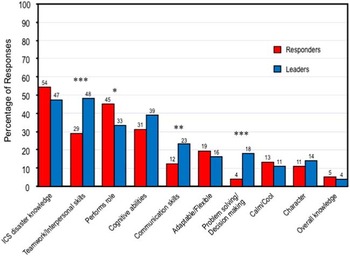
The 2 independent researchers were able to code all of the responses into 1 or more of the existing 10 categories of attributes and thus did not need to create any new categories. Four categories contained a response percentage (combining leader and responder attribute data) higher than 50%: ICS disaster knowledge (65%), Teamwork/Interpersonal skills (56%), Performs role (54%), and Cognitive abilities (51%). The remainder of the categories contained a response percentage of less than one-third: Communication skills (32%), Adaptable/Flexible (31%), Problem solving/Decision-making (22%), Calm/Cool (21%), Character (21%), and Overall knowledge (9%).
Figure 1 presents the percentages of responses coded into each category in descending order from left to right, based on combined leader and responder attribute data, showing the differences between the percent of responses indicating attributes of leaders vs responders in each category. Attributes mentioned more often for leaders than for responders were Problem-solving/Decision-making (McNemar’s statistic=11.64, df=1, P<0.001), Teamwork/Interpersonal skills (McNemar’s statistic=11.92, df=1, P<0.001), and Communication skills (McNemar’s statistic=7.35, df=1, P=0.007). One attribute, Performs role, was mentioned more often for responders than for leaders (McNemar’s statistic=5.83, df=1, P=0.016).
Frequency of Responses Coded into Each Category for Responders and Leaders.

DISCUSSION
Using open-ended questions, we surveyed experienced EMS personnel attending a national conference with a goal of identifying attributes of effective disaster response leaders and responders. In our previous focus group study, key opinion leaders identified 10 preliminary categories of such attributes. The present study of conference attendees builds upon the findings of the earlier study by demonstrating that survey data can be reliably coded into the same 10 categories developed from the focus group data, thus achieving an important first validation step of replicating the applicability of these categories. The researchers were careful to avoid influencing the respondents: Attendees were not informed of the categories, no presentations on this topic were given at the conference, and our earlier study had not yet been published. This study, together with the focus group study that preceded it, have resulted in a set of attributes consistently perceived by experienced EMS personnel to be associated with effectiveness of disaster responders and leaders. Three attribute categories had the highest overall frequency of coded responses in both of our studies: ICS knowledge/Skills, Teamwork/Interpersonal skills, and Performs role. In the current survey study, leaders and responders both agreed on the same top 4 categories, including the top 3 mentioned above plus Cognitive abilities.
Strengths of the study included a 94% participation rate, which limited the potential for participation bias within this sample, and the diverse EMS and disaster response roles represented (eg, emergency medical technician, paramedic, EMS chief, nurse, and physician), the use of open-ended survey questions to avoid constraining the responses to predetermined content, and the existence of predefined categories from our earlier study.Reference King, North and Larkin 8 A limitation of the study was that the pre-defined categories developed in our earlier study may not represent how other researchers would categorize the identified attributes. Another limitation is that the sample consisted solely of attendees at a single national conference for emergency response personnel; thus, the findings may not represent the opinions of other groups of emergency response personnel.
To possess the essential competencies for a job or role has been referred to as having the right stuff.Reference King, North and Larkin 8 , Reference Wolfe 11 This research begins to identify the most important attributes perceived by members of the EMS and disaster response community to define the right stuff of disaster responders and leaders. As we found in our earlier study,Reference King, North and Larkin 8 effective performers are perceived by highly experienced emergency response leaders to need much more than their everyday job skills: They require specific knowledge pertaining to incident command, and they need skills in teamwork, communication, problem-solving, and decision-making. Certain personal characteristics are also deemed essential, such as the ability to remain calm and cool under stress, think on one’s feet, and adapt to change. Many of these personal characteristics are congruent with previously described disaster-based virtues such as prudence, vigilance, and resilience.Reference Larkin and Arnold 12
A comprehensive set of competencies can be especially useful both in the design of training programs for the disaster health workforce and in recruitment and selection of personnel optimally suited for the various jobs and roles. Competencies that define required knowledge, skills, and attitudes are the standard underpinnings of training, although selection of personnel who already possess such competencies is ideal. Competencies pertaining to personal attributes, such as calmness under pressure and flexibility, are more difficult to train and thus are better suited to selection of individuals with these characteristics.
The attributes identified in this study can be incorporated in new and existing competency frameworks. Once the attributes have been incorporated, guidance and tools can then be developed to support implementation of competency based processes of recruitment, selection, training, supervision, and performance management, which are essential to the development and maintenance of the effective disaster health workforce that is so critical to the nation’s disaster response capability.
Further research is needed to (1) ascertain the elemental knowledge, skills, attitudes, traits, and behaviors that constitute each of the attributes identified in this study; (2) determine how these attributes can best be measured and whether any existing, validated instruments are applicable; and (3) investigate how these attributes have served well in actual disasters when applied by effective disaster responders and leaders.
CONCLUSIONS
Attributes of effective disaster medical responders and leaders were identified by emergency response leaders and validated with a wider group of emergency response personnel. These attributes have been organized into 10 categories: ICS disaster knowledge, Teamwork/Interpersonal skills, Performs role, and Cognitive abilities, Communication skills, Adaptable/Flexible, Problem solving/Decision-making, Calm/Cool, Character, and Overall knowledge. The attributes identified in this study may inform further research and development related to competencies for the disaster medical response workforce by describing the types of knowledge, skills, behaviors, abilities, and personal characteristics that distinguish effective performers.