Single motherhood, although in many societies no longer of a symbol of socially degenerate behavior, remains associated with numerous risks and disadvantages. Single mothers experience disadvantages in the labor market and are at greater risk of poverty. They also tend to be less politically active, which is most visible with regard to their electoral participation. Politics has traditionally not been particularly attentive to or generous regarding the needs of single mothers as either women or mothers. Social policies in many societies continue to follow a male breadwinner model based on a gendered division of labor within the household (Korpi Reference Korpi2000; Lewis Reference Lewis1992; Millar and Rowlingson Reference Millar and Rowlingson2001). In this article, I investigate single mothers’ voting behavior by comparatively analyzing the impact of social policies on their likelihood of participating in an election. I therefore ask whether family policies aimed at reconciling the responsibilities at the workplace and home can foster the political participation of women whose resources would otherwise predict electoral abstention.
Disadvantage not only depresses overall political participation but also tends to exert the biggest impact on people with the fewest resources. Because those with greater resources are the most likely to participate politically, when these aggregate resources are more unevenly distributed, so, too, is voter turnout (Solt Reference Solt2008). Beyond the importance of individual resources, the influence of public policy on political participation must also be considered (Detraz and Peksen Reference Detraz and Peksen2018). This idea, known as the policy feedback approach, emphasizes that policies influence recipients much like formal political institutions do. They, too, can transmit norms and impose rules and regulations and can thereby transform politics itself (Campbell Reference Campbell2012). Policies can confer material benefits upon people; that is, greater resources enhance participatory capacity. Moreover, policy commitments to women and families can send the message that their interests are protected and valued, thereby enhancing political efficacy, which is viewed as essential for democratic political engagement (Mettler and Soss Reference Mettler and Soss2004).
This study contributes to the literature on political participation by examining the ways in which family policies influence single mothers’ decisions to vote in 25 European countries. By looking at broader sets of policies over a large group of countries, this study sheds light on how policies can shape the political participation of vulnerable groups by investigating whether family policies moderate the relationship between single mothers’ resources and political participation. Following a discussion of voting and single motherhood, I discuss the effects of public policy on political participation. After deriving the hypotheses, I introduce the data, variables, and methods used. To test the relationships between single mothers’ voting propensity and family policies, I compare individual decisions to vote in 25 European democracies using logistic multilevel analysis. Additional analyses examine the marginal effects of the policies on voting for different income groups to test whether a uniform effect is exerted across groups, or if the effect varies in strength (or even direction) depending on a woman's income. I conclude with a discussion of the results as well as opportunities for future research.
SINGLE MOTHERS’ ELECTORAL PARTICIPATION
The people with the fewest resources, such as education, income, or social networks, are also those who are the least likely to vote (Brady, Verba, and Scholzman Reference Brady, Verba and Scholzman1995). Although the gender gap in voting has dissipated significantly over the past decades (Abendschön and Steinmetz Reference Abendschön and Steinmetz2014; Bennett and Bennett Reference Bennett and Bennett1989; Burns Reference Burns, Katznelson and Milner2002), being part of a partnership has long been found to increase the likelihood that one will take part in politics (Campbell et al. Reference Campbell, Converse, Miller and Stokes1960). For example, people who live with a partner have the advantage that they can discuss upcoming elections with another adult in the household, which can increase interest in politics (Beck Reference Beck1991). Spouses and partners may furthermore be persuasive in getting the other partner to vote (Stoker and Jennings Reference Stoker and Jennings1995), and they can consolidate the administrative tasks involved with registering or filling out absentee ballots (Wolfinger and Wolfinger Reference Wolfinger and Wolfinger2008). Dissolution of a partnership may entail the loss of a mobilizing partner. Divorced, widowed, and single parents are at greater risk of social isolation, which has also been shown to drive down turnout rates (Hobbs, Christakis, and Fowler Reference Hobbs, Christakis and Fowler2014). Because divorce frequently results in stress and disrupted family routines, going to vote may not top the divorcée's list of priorities, particularly when young children are involved. “Family intensive” stages of life have been found to be associated with lower levels of political engagement (Quaranta and Dotti Sani Reference Quaranta2018).
Wolfinger and Wolfinger (Reference Wolfinger and Wolfinger2008) find that within a year after the dissolution of their marriage, 40%–50% of women in the United States move; changing one's place of residency, in turn, is associated with a decreased likelihood of voting (Kern Reference Kern2010). Turning specifically to single parents, raising children alone invariably requires a time commitment that may not allow for political participation. Although it does not require an ongoing commitment on the part of the voter, voting is nevertheless an act that must be scheduled into one's day and may require prior registration. Wolfinger and Wolfinger (Reference Wolfinger and Wolfinger2008) show that separated parents had an 11% lower turnout rate in the 2000 US presidential election than their married counterparts, and of the persons who had never been married, fewer than half voted.
Having children outside of marriage has also been shown to depress the probability of voting. Single parents, particularly women, tend to be younger (Wu, Bumpass, and Musick Reference Wu, Bumpass, Musick, Wu and Wolfe2001) and have less education (Korenman, Kaestner, and Joyce Reference Korenman, Kaestner, Joyce, Wu and Wolfe2001), two factors negatively related to voting. Single mothers are also at a much greater risk of poverty than childless and partnered individuals, a pattern that holds true in nearly all countries, albeit to varying degrees (Brady and Burroway Reference Brady and Burroway2012). In other words, the intersection of lone parenthood, be it by choice, death, or divorce/separation, and single mothers’ disproportionately low levels of both income and education does not bode well for their likelihood of voting.
Although those with greater resources (Brady, Verba, and Scholzman Reference Brady, Verba and Scholzman1995; Verba and Nie Reference Verba and Nie1972; Wolfinger and Rosenstone Reference Wolfinger and Rosenstone1980) participate more than those with fewer resources, regardless of socioeconomic background, single mothers’ electoral participation tends to be comparatively lower. Moreover, despite EU gender-equality targets, increased female labor-market participation and educational attainment, as well as an evolving view of modern families, this group of women is generally less politically involved. Although they are at greater relative risk of poverty, the degree of risk varies markedly across European countries, from around 2% in Sweden and Finland to nearly 15% in the United Kingdom and Italy (Mirsa et al. Reference Mirsa, Moller, Strader and Wemlinger2012). Beyond the well-documented individual characteristics that may hinder electoral participation, the question now involves how the political context affects single mothers’ turnout.
Public Policy and Single Mothers
Citizens’ participation can influence the outcomes of politics, but do the policy outcomes themselves influence political engagement? Campbell (Reference Campbell2003) argues that they do: Policies can have both negative and positive effects on participation. First, they may distribute (and redistribute) the resources needed for political mobilization that might otherwise be lacking. Policies can also motivate people to become interested in politics due to the personal stakes that policies have for people's lives. If a policy targets a program that directly affects the individual, he or she may be more likely to take part in politics due to personal stakes. Policies may therefore pique interest in certain issues or politics in general (Shore Reference Shore2019, 96–111).
Policies have the potential to foster political and civic skills (Mettler, Reference Mettler2002). “Depending on their design features, public policies of many types may help citizens learn how to deal effectively with government and allow them to experience the art of collective policy decisions” (Mettler and Soss Reference Mettler and Soss2004, 62). Moreover, policies can have interpretive effects: They may send signals to groups that they are entitled to certain benefits, goods, or services (Pierson Reference Pierson1993). The messages policies send can inform citizens about their standing in the community (Schneider and Ingram Reference Schneider and Ingram1997) or “whether the government is responsive to their concerns, thereby encouraging engagement, passivity, or even alienation” (Wichowsky and Moynihan Reference Wichowsky and Moynihan2008, 909; see also Mettler Reference Mettler2002; Soss Reference Soss1999). The effects policies have on their citizens “feed back into political systems, producing spirals in which groups’ participatory and policy advantages (or disadvantages) accrue. Citizens’ relationships with government, and their experiences at the hand of government policy, help determine their participation levels and in turn, subsequent policy outcomes” (Campbell Reference Campbell2003, 2).
FAMILY POLICIES IN EUROPE AND SINGLE MOTHERS’ POLITICAL PARTICIPATION
Increasing female labor-market participation, shifting patterns of industrial relations, and transformations of the family have posed enormous challenges to models of social welfare centering on the male breadwinner that emerged after World War II. Not only do women comprise a much larger share of the labor force than 70 years ago, but women are increasingly occupying the roles once dominated by men: breadwinner and head of household. Esping-Andersen warns that despite what appear to be positive and modernizing developments, without new social policy, the new order of gender relations “may also be the harbinger of new inequalities and possibly even of greater social polarization” (2009, 3).
Single-parent households are no longer a novelty, nor are they necessarily something that resulted from tragedy or the dissolution of a marriage. In an era in which nearly half of all marriages end in divorce, many women are choosing to remain unmarried. In short, marriage and parenthood are increasingly becoming decoupled. Despite these developments, it remains very difficult for women in many countries to pursue both a career and the desire for motherhood without a partner. The policies described in this section are a (nonexhaustive) selection of attempts to reconcile work and care responsibilities. They should have particular relevance for single mothers because they are arguably the ones who face some of the greatest hurdles in achieving this balancing act.
Despite the recent development that women are outperforming men in terms of educational attainment, their labor-force participation and earnings continue to lag behind. When women have children, they are likely to experience the so-called child penalty, that is, the loss of potential earnings associated with becoming a mother. Due to birth-related career interruptions and the responsibilities parents of young children face, many women encounter substantial difficulties returning to the labor force and/or their pre-child earning potential. This penalty is greatest for women with high levels of education, as they have an overall greater earning potential. Women with less education are also penalized; their career interruptions tend to be longer and more frequent (Esping-Andersen Reference Esping-Andersen2009). Adding to this situation is the trend that rates of divorce and single motherhood tend to be increasingly skewed toward women with fewer resources. Although divorce is clearly negatively related to education in the United States, this relationship is not nearly as strong in Europe, with some countries even exhibiting a weakly positive relationship between divorce and educational attainment. That being said, the negative relationship is a fairly recent phenomenon; the risk of divorce has increased for people with lower levels of education if they married after 1940 (Dronkers Reference Dronkers2015). The patterns of education and single motherhood vary across European states, and in countries where single motherhood remains a relatively rare phenomenon, an educational gradient is not found (Härkönen Reference Härkönen2017). However, an increased risk of poverty and material and social deprivation has occurred across all European states. Although the magnitude of this risk varies across countries, single mothers are nevertheless at greater risk than two-parent households, and this holds for all countries.
Because unemployment, low educational attainment, and single motherhood all tend to disproportionately cluster among the lowest income deciles, the prognosis for single mothers’ political participation does not look too promising. The economic disadvantages this group of mothers faces are likely to spill over into the political sphere, a development which could ultimately leave these women with but a faint whisper of a political voice. If, on the other hand, single mothers have ways in which to reconcile their work aspirations with their responsibilities as mothers and are thus integrated both into the labor market and society as a whole, the negative effects of single motherhood on political participation should be far less pronounced.
The welfare state insures against risks associated with single motherhood, insurance that a spouse or partner, with a second income and childrearing support, could otherwise provide. How strong the negative impact of lone motherhood will be on these women's political participation depends partly on the extent to which the state can counter the socioeconomic penalty of single motherhood (Härkönen Reference Härkönen2017). What can the state due to reduce this penalty? Lewis (Reference Lewis2006) argues that a combination of time, money, and services are necessary to secure gender equality and to give women real choice in terms of their roles as mothers and their participation in the public sphere. Time covers both time to work and time to care; money is needed both for purchasing child care and to cover the increased costs that raising children entails; services generally center on child care. In examining family policies and their impact on single mothers’ political participation, I draw on Lewis’ three dimensions and add a fourth—policies that aim to improve single mothers’ labor market position.
Leave Generosity
Maternity leave programs are extremely important to all mothers, single and partnered. However, not all leave programs are equally generous. If paid maternity leave is too short, mothers may opt to remain out of the labor force longer because the costs of child care may exceed her benefit of returning to work after a short period. This effect should be most acute for low-skilled and low-earning single mothers. The literature on maternity leave also tends to find that maternity leave that is too long may pose challenges for women trying to re-enter the labor market after such a long period away. However, the problem of leave length is only a problem if the leave is not sufficiently funded (Esping-Andersen Reference Esping-Andersen2009; Lewis Reference Lewis2006; Mirsa, Moller, and Budig Reference Mirsa, Moller and Budig2007). Generous leave programs are thus thought to positively affect single mothers’ electoral participation, since they have been shown to bolster women's labor-market attachment (Ruhm Reference Ruhm1998). Such policies may also send the message to women that their skills both as employees and their responsibilities as mothers are valued and protected, thereby enhancing their political efficacy. Thus, I have formulated the following hypothesis and its corollary:
H 1:
Greater leave generosity should be associated with a greater likelihood of voting.
H 1a:
The positive effect of leave programs is strongest for women with lower incomes.
As their future earning potential is lower, low income mothers are less able to put money aside for incidentals, such as birth-related career interruptions. Thus, they stand to benefit most from the poverty reducing effects of paid leave (Nieuwenhuis and Maldonado Reference Nieuwenhuis and Maldonado2015).
Family Cash Benefits
In addition to the time a single mother needs to care for young children, she also incurs additional costs associated with things such as feeding, clothing, housing, and educating a child. Beyond the benefits she may receive during her maternity leave, cash transfers are important to defray the costs later on. The aim of cash transfers for families is to generally reduce inequalities between families with and without children. Although transfers that are based on means testing may result in a high marginal tax rate in the case of dual-earner households, and thereby provide a disincentive for a mother to remain employed (Rubery et al. Reference Rubery, Smith, Fagan and Grimshaw1997), this negative incentive should not apply to lone-parent households. Cash transfers have furthermore been shown to be extremely effective in reducing single-parent poverty (Bradshaw, Keung, and Chzhen Reference Bradshaw, Keung, Chzhen, Nieuwenhuis and Maldonado2018; Maldonado and Nieuwenhuis Reference Maldonado and Nieuwenhuis2015). If sufficiently generous, transfers low-income single mothers receive may greatly reduce the socioeconomic penalty of single motherhood. They are furthermore likely to create personal stakes for recipients who rely on them, thereby increasing the saliency of politics for their everyday lives. Due to the resources and personal stakes generated by cash transfers as well as their potential to send messages to their recipients that their needs are valid and heard, I hypothesize the following:
H 2:
Single mothers are expected to be more likely to vote in countries where family cash expenditures are greater.
H 2a:
The benefits of these policies are greatest for women with low incomes because their livelihoods depend on these transfers to a greater extent.
Child Care
Child care is arguably the most important dimension of the work/care balance: Nearly all single and partnered parents need child care if they are to participate in the labor market. However, the availability and affordability is even more crucial for single mothers because they do not have the option of weighing the costs of caring or working across a dual earner household. If child care is too costly or places for her children are not available, a single mother may need to rely on transfers rather than working. By financing or subsidizing child care, particularly for children under the age of three, the state is able to directly combat the child penalty. Mirsa et al. (Reference Mirsa, Moller and Budig2007) reported that child care is particularly beneficial for reducing the poverty risk of young single mothers. In their study of North American and European mothers, they found that greater spending on child care strengthens women's labor market opportunities and decreases the risk of impoverishment. The positive effect of childcare spending on women's labor market participation and incomes was greatest for women with fewer resources because women who earned more were likely to be able to pay for child care themselves. Generously state-funded or subsidized child care is therefore thought to positively affect single mothers’ labor market participation and overall resources. By enabling single mothers to work, childcare investments may signal to them that their needs are valued, which may foster political efficacy (Marx and Nguyen Reference Marx and Nguyen2018). Moreover, such programs should increase the saliency of politics because mothers personally benefit from childcare subsidies. Thus, I posit the following hypothesis and corollary:
H 3:
Single mothers are more likely to vote in countries that place a greater policy focus on child care.
H 3a:
This positive effect is greatest for low- and middle-income women, that is, women who are less able to afford to privately purchase these services.
Active Labor Market Policies
Although not part of family policy per se, active labor market policies (ALMPs) are designed to foster the labor market integration of low-skilled and unemployed persons, two categories that single mothers disproportionately occupy. As part of the new welfare policies that emerged during the mid- to late 1990s and focused on full adult employment (Knijn, Martin, and Millar Reference Knijn, Martin and Millar2007), such policies may be able to foster independence and emancipation through labor market participation. Critics of ALMPs point out that they do not contribute to social citizenship in the welfare state because they are needs based and not rights based and that they challenge the no-strings-attached norms of universalism. On the other hand, evidence from in-depth case studies of ALMP programs in Norway and New Zealand report positive outcomes for single parents’ employment as well as positive personal experiences by participants who indicated that programs were sensitive to their responsibilities as parents (Skevik Reference Skevik2005). Due to the particular relevance of ALMPs in cases of job loss or low-paying work, their ability to reduce poverty by facilitating employment, and the finding that single parents are more likely to be employed in countries with a greater policy focus on ALMPs (Esser and Olsen Reference Esser, Olsen, Nieuwenhuis and Maldonado2018), ALMPs should be of particular relevance to single mothers with the fewest resources. In sum, I hypothesize the following:
H 4:
Greater investment in ALMPs will foster low-income single mothers’ societal and labor market integration, which, in turn, positively influences their likelihood to vote.
Data, Variables, and Methodological Approach
The remainder of article puts the hypothesized relationships between the policies and the individual propensity to vote to the empirical test. The following analyses examine single mothers’ electoral participation in 25 European countries: Belgium, Bulgaria, Cyprus, Czech Republic, Denmark, Estonia, Finland, France, Germany, Greece, Hungary, Iceland, Ireland, Italy, Lithuania, Netherlands, Norway, Poland, Portugal, Slovakia, Slovenia, Spain, Sweden, Switzerland, and the United Kingdom. Data for the dependent variable, voting (yes/no), come from the European Social Survey (ESS). Only respondents who indicated that they were eligible to vote were included in the analyses. Single mothers do not constitute large parts of overall populations in Europe; moreover, they are likely to have been undersampled in the ESS because face-to-face surveys require a considerable time commitment, something single mothers often do not have. The rounds have therefore been pooled over the period 2008 to 2012, comprising rounds 4 through 6 of the ESS. The final sample consists of 3,136 single mothers between the ages of 18 and 54—the ages between which family policy would potentially have the greatest impact. A single mother is defined as a female respondent who indicated having children in the household and not living with a partner.Footnote 1 They accounted for approximately 21% of all mothers with children in the home in the sample in the same age range.
Table 1 provides an overview of single mothers along key characteristics and provides a comparison with partnered mothers. Across all countries, single mothers had lower incomes and education levels. Figure 1 shows the average self-reported turnout for both single and partnered mothers across 25 countries. The vertical line represents the average turnout for all countries and mothers, 76%. The average turnout rate for single mothers across all countries was 66.7% (partnered mothers have a turnout rate of 78.7%). With but a few exceptions, partnered mothers voted at higher rates than single mothers. These figures represent self-reported electoral participation and do not perfectly correspond to actual turnout rates. Although no reliable cross-country statistics on voting rates of single mothers are available, it is quite likely that the self-reported turnout for this group of women is overreported.Footnote 2
Overview of single and partnered mothers

Source: European Social Survey rounds 4–6

Policy Variables
To test the effects of family policy on single mothers’ voting, I examine the impact of four policy variables. The macro-level explanatory variables refer to the mean value between the years 2007 and 2011.Footnote 3 Leave generosity is measured as the duration in weeks of maternity leave multiplied by the replacement rate (i.e., the percentage of previous earnings). To capture the money dimension of family policy, I considerd the total cash family benefit expenditures as a percentage of the GDP. A state's commitment to family services is measured as the percentage of the GDP spent on child care and early childhood education. Lastly, ALMPs were captured as ALMP expenditure as a percentage of the GDP. The relevant data were obtained available from the OECD's Social Expenditure Database as well as Eurostat's European System of Integrated Social Protection Statistics (ESSPROS).
I controlled for a number of individual as well as contextual factors in the analyses. At the individual level, the key variable of interest is a single mother's income; I hypothesized that the effects of the various family and employment policies may have differential effects depending on income. Age, educational attainment (low, medium, or high), employment status, and whether or not she lives in an urban area were considered. These individual attributes, which mainly correspond to resources, have been frequently identified in the extant literature as some of the most prominent covariates of voting (Brady, Verba, and Scholzman Reference Brady, Verba and Scholzman1995; Wolfinger and Rosenstone Reference Wolfinger and Rosenstone1980). Finally, the presence of other adults (and per definition of single mothers, a nonspouse/-partner) in the household was also considered; other adults are potentially political discussion partners (Beck Reference Beck1991) or can help out financially or with housework and child care.
I included additional country-level variables to account for the differences in the electoral systems and sociocultural contexts. The design of the electoral system has been shown to influence the calculus of voting. Most prominently, highly disproportional electoral systems tend to exert a dampening effect on electoral participation (Blais Reference Blais2006; Jackman and Miller Reference Jackman and Miller1995; Karp and Banducci Reference Karp and Banducci2008; Lijphart Reference Lijphart1997). I also controlled for the effect of compulsory voting laws (both their severity and degree of enforcement) on the individual decision to vote (data are from IDEA) (Franklin Reference Franklin1999; Panagopoulos Reference Panagopoulos2008; Singh Reference Singh2011). Because the countries included have diverse histories, a variable indicating whether a state has a socialist legacy was added. Finally, I controlled for the share of women in the labor force to capture differences in women's employment patterns. A higher share of women in the labor force indicates greater sociopolitical integration of women. This information was obtained from the OECD.
I examined the effects of policies on the individual decision to participate in an election. Since both the research question and the nature of the data (individuals nested in national contexts) imply hierarchical structures, multilevel analysis was the most appropriate analytical technique. Because the dependent variable, whether or not the respondent voted, is dichotomous, I used logistic multilevel regression models.
EMPIRICAL RESULTS
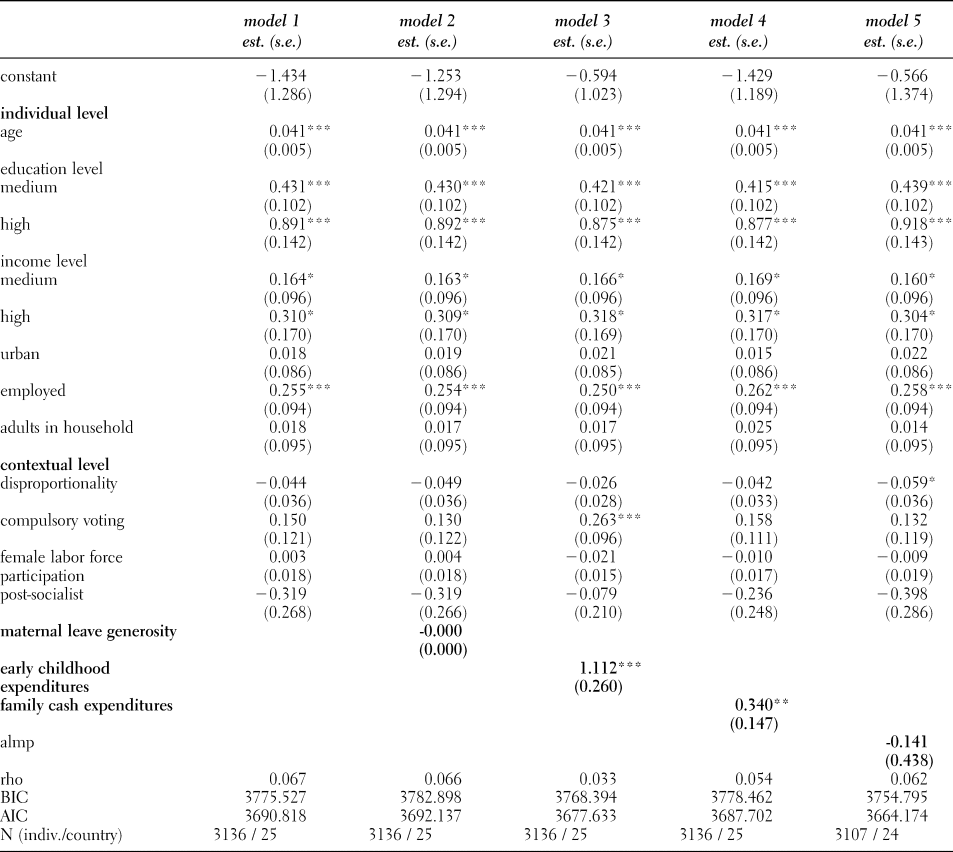
Beginning with a baseline model (model 1 in Table 2) with the individual and country controls, the subsequent models tested the effects of the various policy variables on single mothers’ electoral participation. The last models (6 and 7) tested the hypotheses regarding group-specific effects: Did the policy effects vary depending on income? I then calculated the marginal effects of the policy variables on single mothers’ turnout for each of the income groups. Because only 25 countriesFootnote 4 were included in the analyses and the country controls already added several level-2 variables, I did not test these policies simultaneously. Moreover, multicollinearity between the policy variables was an issue.
Multilevel analyses of single mothers’ propensity to vote

Notes: Logistic regression, standard errors in parentheses. * p < 0.10, ** p < 0.05, *** p < 0.01
Starting with model 1, many of the ‘usual suspects’ performed as expected. Mirroring findings for the general population, single mothers with both more income and education were more likely to vote. Age positively influenced the propensity to vote. Although living in an urban setting compared to a rural one appears to have had a negligible effect on the likelihood of voting, employed mothers (compared to the unemployed) were significantly more likely to have said they voted. The presence of other adults in the household does not appear to have contributed to the explanation of voting. The coefficients of the country controls, although pointing in the right direction, were, with a few exceptions, insignificant in the models.
Models 2 through 5 included the four policy variables discussed in the previous section. Although the coefficient for maternal leave generosity (model 2) was negative, indicating that more generous maternity leave schemes negatively influenced a single mother's likelihood of voting, this effect was not significant. Since hypothesis 1 was not supported, its corollary was not further tested. Likewise, moving to model 5, increased spending on active labor market policies was negatively associated with the probability that a single mother will vote. Support for hypothesis 4 was therefore not found. As in model 2, however, this policy effect appears to have been negligible. Turning to models 3 and 4, the signs of the coefficients corresponded with the hypothesized relationships: Both an increase in early childhood expenditures and greater cash spending on families were associated with an increased likelihood of taking part in an election. These results are in accordance with the predictions of hypotheses 2 and 3. The portion of the variance in voting activity that could be attributed to differences between countries dropped from 6.7% to 3.3% when early childhood expenditures were included and to 5.4% when family cash expenditures were included.
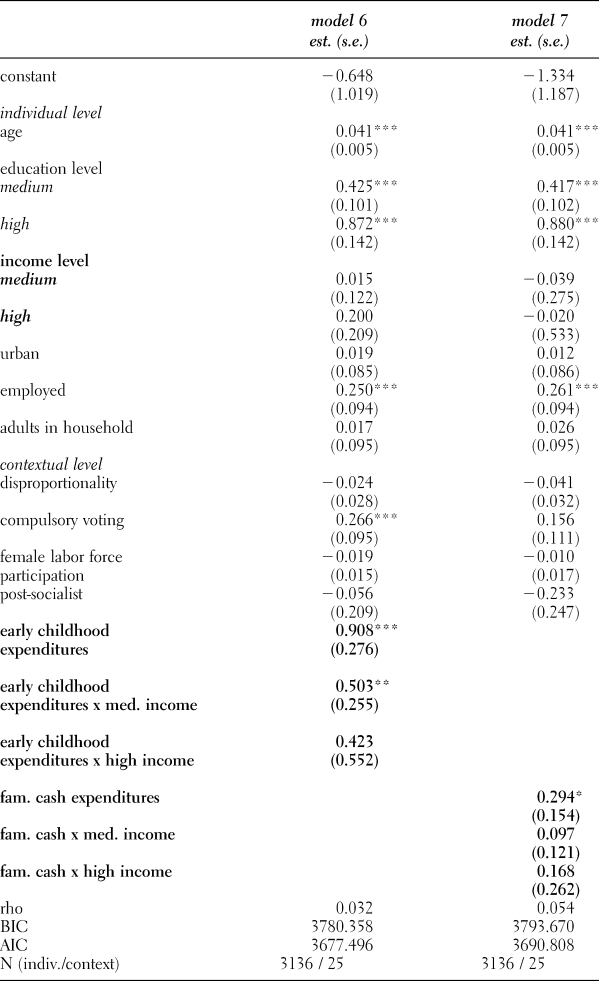
Models 6 and 7 in Table 3, which included cross-level interactions between the significant policy variables from models 3 and 4, respectively, tested the hypotheses regarding group-specific effects (the conditional hypotheses- H2a and H3a.). In other words, was the electoral participation of single mothers with lower (or higher) incomes influenced to a greater (or lesser) extent by the family policy measures? The single coefficients for the policy variables showed the effect of that policy on the voting likelihood of single mothers with the lowest incomes—income deciles 1 to 3. In both models, the effects of expenditures on both family cash benefits and early childhood services were positive and highly significant for women in the lowest income groups. The interaction terms in models 6 and 7 refer to the effects for the two higher income categories. Interpreting the effects of interaction terms, however, is not always a straightforward undertaking. Considering first the significance of the interaction terms, we see whether the policy effect on voting for the higher incomes categories is actually different than the effect for the lowest category. In model 6, the effect of early childhood expenditures on single mothers’ voting differed for women in the middle-income group as compared to low-income mothers. The effect for the group of highest earners was not significantly different than that for low-income mothers. In model 7, the effect of cash expenditures on voting likelihood was positive for all income groups. To determine whether there were significant interaction effects for the income categories, marginal effects for the respective groups were calculated.
Multilevel analyses of single mothers’ propensity to vote: Policy x income interactions

Notes: Logistic regression, standard errors in parentheses. * p < 0.10, ** p < 0.05, *** p < 0.01
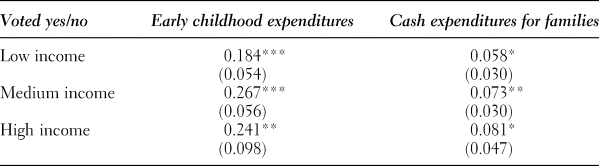
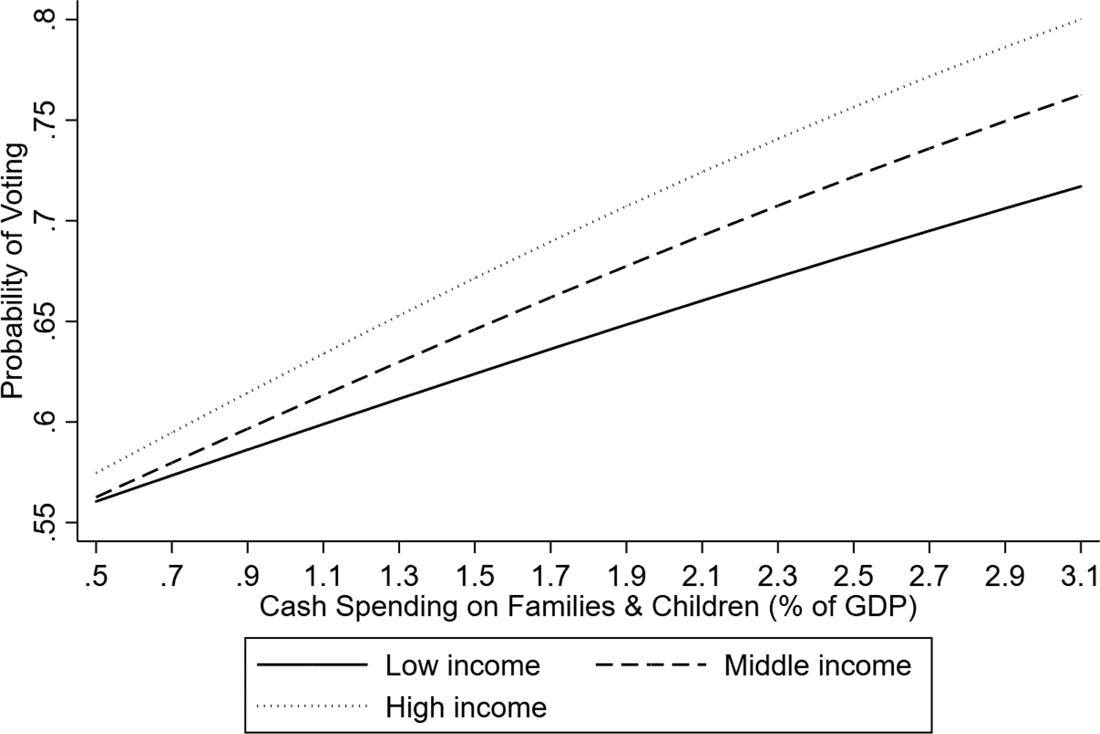
The marginal effects of the family policies on the voting likelihood for single mothers in different income groups can be found in Table 4. First considering the effects of early childhood expenditures, regardless of income, this type of government spending had a positive and significant impact on single mothers’ propensity to vote. The effect was largest for women in the middle-income categories. These results partially confirm hypothesis H3a. Although cash spending on families also had an across-the-board positive effect on single mothers’ likelihood of voting, an increase in family cash benefit outlays had the largest impact for women in the highest income category. Hypothesis H2a is therefore not supported. Overall, policies influenced single mothers’ likelihood of voting differently depending on their income level. These differences are best illustrated graphically.
Marginal effects of family policies by income level

Standard errors in parentheses. * p < 0.10, ** p < 0.05, *** p < 0.01.
Other values held at means.
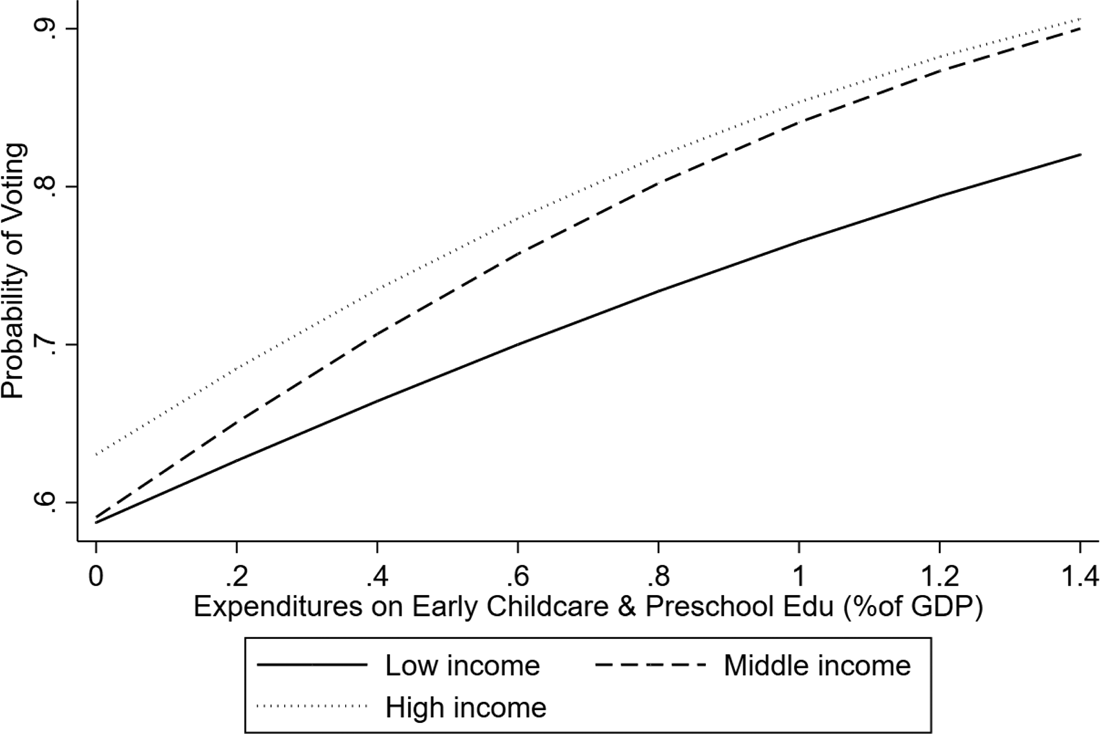
Figure 2 shows single mothers’ voting probabilities across the levels of expenditure on early child care and preschool education as a percentage of GDP. The likelihood of voting goes up for all income groups as expenditures on young children increase, the effect is strongest for women in middle-income groups. Even at the highest levels of expenditures, however, a gap between middle and higher income mothers and lower income mothers is evident. Although this type of expenditure is associated with an increased likelihood of voting, electoral participation remains stratified by income. A similar and more pronounced pattern is apparent in Figure 3, which illustrates single mothers’ voting probabilities across levels of cash spending on families. Although all groups of women are more likely to have voted in countries with more generous family expenditures, the gap between rich and poor is wider.
Expenditures on early childcare and preschool and predicted turnout.

Cash spending on families and children and predicted turnout.

Alternative Specifications
These results do, however, require further testing. When dealing with a relatively small number of countries, single level-2 units can quickly exert a large effect on country-level effects. Further analyses not presented here, wherein the full models were run repeatedly, each time excluding 1 of the 25 countries, yielded results similar to those obtained with all countries. I also tested models that included interactions with mothers’ education and the policy variables (see also Stadelmann-Steffen Reference Stadelmann-Steffen2011). Given that income and education tend to be closely related, these results were very similar to the original model specification with income. Single motherhood has a variety of causes; thus, I ran additional models with controls for divorce/dissolved legal partnership, separation, widowhood, and never having been married/in a legal partnership. The inclusion of these additional individual-level variables did not substantively alter the results, nor were there differences found between the voting likelihood of, for example, divorced versus widowed single mothers.Footnote 5
To test whether the results of the cash expenditure variable could be due to the fact that it is a coarse-grained aggregate measure, I tested variations of this variable using expenditures for means-tested and non–means-tested family cash benefits (also available from the ESSPROS database). The coefficient for means-tested expenditures was insignificant, although a pattern similar to total cash benefits was found with regard to non–means-tested expenditures. As benefits that are non–means-tested tend to be more generous, it is likely that it is this portion of the total benefits driving the significant relationship with voting. Finally, to explore whether the effect is simply a general welfare state effect, I ran additional models that incorporated dummy variables for welfare regime types (Social Democratic, liberal, continental, Southern European, and Eastern European) rather than specific policies (Esping-Andersen Reference Esping-Andersen1990; Ferrera Reference Ferrera1996). Compared to single mothers in Social Democratic welfare regimes, single mothers were less likely to vote in all other regimes. Interactions between the respective regime variables and income did not, however, indicate that the type of regime itself moderates the strength of the relationship between income and voting. These findings suggest that the broad labels associated with a regime approach may mask within-regime–type variation with regard to family policies. All additional analyses are available upon request.
CONCLUSIONS
In this study, I explored the ways in which different public policies designed to reconcile work and care, as well as improve labor market chances, influence single mothers’ propensity to vote. Against the background of the policy feedback approach, I have argued that public policies can foster political participation. I hypothesized that in states where there is a greater policy focus on family measures that would likely be highly beneficial to single mothers, these mothers would be more likely to vote. Such policies not only improve the financial situation of single mothers (which corresponds to the resource effect for voter turnout) and their ability to participate in the labor market (greater societal integration should also foster political integration), but they can create personal stakes for the mothers who rely on these benefits and services, thereby increasing the salience of politics for these women. Moreover, as numerous authors have pointed out (Kumlin Reference Kumlin2004; Mettler Reference Mettler2002; Schneider and Ingram Reference Schneider and Ingram1997; Soss Reference Soss1999; Wichowsky and Moynihan Reference Wichowsky and Moynihan2008), policies can send signals to people about where they stand in the community and about whether their interests are valued and protected. These analyses have revealed that not all family policies influence single mothers’ propensity to vote, nor do they do so in uniform ways. For example, although leave generosity seems to have no effect on voting, early childhood expenditures do seem to matter, and for all groups of single mothers. Cash expenditures on families were likewise found to exert a positive and significant effect on single mothers’ likelihood of voting. Although voting in more generous welfare states was higher, women in the upper-income categories seemed to benefit more. This is likely a Matthew effect: “The benefits of government spending on social policy disproportionately accrue to middle- and upper-class relative to other social groups” (Pavolini and van Lancker Reference Pavolini and van Lancker2018, 879). Although the impact of single motherhood on social and political integration seems to be lessened in more generous policy contexts, policies are unable to completely erase the participatory gap.
These analyses are exploratory in nature. Future studies should take a more fine-grained look at the different types of policies and programs available to parents and single mothers because aggregated spending measures are unable to fully capture important qualitative differences in national family policies. A further avenue to explore is policy change: Are single mothers (or certain groups of single mothers) sensitive to changes and cutbacks? Maternity leave policies, in particular, have undergone numerous changes in several European countries over the past decades (DICE Database 2015). Perhaps more time is needed to witness a political impact of such policy changes (Pierson 2004). The present study focused solely on voting, arguably the central means of political influence for most citizens. Political behavior is, of course, not limited to casting one's vote; people can be involved in politics in numerous other ways. Participation in demonstrations and protesting are often thought to be motivated by grievances (Kern, Marien, and Hooghe Reference Kern, Marien and Hooghe2015). Have cuts in social spending, for example, served to mobilize vulnerable groups, such as low-income single mothers? Examining alternative forms of political participation in conjunction with policy change would allow us to further study the consequences of austerity across Europe.
Getting at the “lived experience” remains a challenge for many studies linking political behavior and public policies (Campbell Reference Campbell2012). Because large-scale surveys generally do not include detailed information on social program use and experiences (Shore and Tosun Reference Shore and Tosun2019), such approaches need to be complemented with more fine-grained qualitative work. Qualitative studies on single mothers’ political participation would be better suited to capturing issues of race and ethnicity and the ways in which multiple sources of disadvantage affect political behavior.
Finally, issues surrounding single mothers’ economic situations, their labor market participation, and their political behavior are not solely the concerns of women, or even simply poor women. These issues ultimately have consequences for the inequality between and within genders. Moreover, as children's life chances in most societies remain tied to their parents, the children of single mothers stand to inherit disadvantage across multiple spheres. Considered in tandem with the importance of childhood and adolescent socialization and political participation and attitudes, the prospects for these children in terms of their future political engagement do not appear particularly promising.