INTRODUCTION
Kelp forests are highly valuable and complex ecosystems (Costanza et al., Reference Costanza, dÁrge, de Groot, Farber, Grasso, Hannon, Limburg, Naeem, ÓNeill, Paruelo, Raskin, Sutton and van den Belt1997) with wide distribution over cold and temperate seas around the world (Dayton, Reference Dayton1985; Steneck et al., Reference Steneck, Graham, Bourque, Corbett, Erlandson, Estes and Tegner2002). Even though at large scales it is difficult to discern between natural and anthropogenic impacts (Dayton et al., Reference Dayton, Tegner, Edwards and Riser1998), overfishing, global warming and other human-driven pressure have shown significant effects on kelp forests (Steneck et al., Reference Steneck, Graham, Bourque, Corbett, Erlandson, Estes and Tegner2002; Ling et al., Reference Ling, Johnson, Frusher and Ridgway2009; Connell & Russell, Reference Connell and Russell2010; Wernberg et al., Reference Wernberg, Thomsen, Tuya, Kendrick, Staehr and Toohey2010; Harley et al., Reference Harley, Anderson, Demes, Jorve, Kordas, Coyle and Graham2012).
European kelp forests currently are one of the most human-impacted coastal ecosystems, which might lead to an enormous loss of biodiversity and valuable resources (Airoldi et al., Reference Airoldi, Balata and Beck2008). This impoverished condition is deemed to hamper their resilience to global warming (Philippart et al., Reference Philippart, Anadón, Danovaro, Dippner, Drinkwater, Hawkins, Oguz, O'Sullivan and Reid2011; Harley et al., Reference Harley, Anderson, Demes, Jorve, Kordas, Coyle and Graham2012) and other impacts (Ling et al., Reference Ling, Johnson, Frusher and Ridgway2009; Russell et al., Reference Russell, Thompson, Falkenberg and Connell2009; Wernberg et al., Reference Wernberg, Russell, Moore, Ling, Smale, Campbell, Coleman, Steinberg, Kendrick and Connell2011).
Among consumers putatively important in the ecosystem's functioning, kelp fishes deserve particular attention since they are key species that provide relevant commercial and recreational resources (Harvey et al., Reference Harvey, Fletcher and Shortis2001; Steneck et al., Reference Steneck, Graham, Bourque, Corbett, Erlandson, Estes and Tegner2002; Harley et al., Reference Harley, Anderson, Demes, Jorve, Kordas, Coyle and Graham2012). Moreover, there is growing concern about recreational fisheries worldwide (Schroeder & Love, Reference Schroeder and Love2002; Cooke & Cowx, Reference Cooke and Cowx2006; Lewin et al., Reference Lewin, Arlinghaus and Mehner2006). Thus, the inclusion of recreational fisheries in the management of the coastal ecosystems has recently been encouraged by the EU (Council of the European Union, 2008a; European Parliament & Council of the European Union, 2013). However, there are few studies on the fish populations targeted by recreational fisheries (Kearney, Reference Kearney2001; Arlinghaus, Reference Arlinghaus2006; Pawson et al., Reference Pawson, Glenn and Padda2008), especially in the case of recreational spear fishing (Jouvenel & Pollard, Reference Jouvenel and Pollard2001; Morales-Nin et al., Reference Morales-Nin, Moranta, García, Tugores, Grau, Riera and Cerdà2005; Pita & Freire, Reference Pita and Freire2014). Spear fishers mainly target top predators (Lloret et al., Reference Lloret, Zaragoza, Caballero, Font, Casadevall and Riera2008; Pita & Freire, Reference Pita and Freire2016), ecologically and economically key components of marine ecosystems that are very vulnerable to fishing (Cheung et al., Reference Cheung, Pitcher and Pauly2005, Reference Cheung, Watson, Morato, Pitcher and Pauly2007) and other anthropogenic impacts (Maxwell et al., Reference Maxwell, Hazen, Bograd, Halpern, Breed, Nickel, Teutschel, Crowder, Benson, Dutton, Bailey, Kappes, Kuhn, Weise, Mate, Shaffer, Hassrick, Henry, Irvine, McDonald, Robinson, Block and Costa2013). This situation is particularly perturbing in southern European countries, with a strong tradition of spear fishing (Pawson et al., Reference Pawson, Glenn and Padda2008), where spear fishers are competing for space and resources with commercial fishers (Coll et al., Reference Coll, Linde, García-Rubies, Riera and Grau2004; Lloret et al., Reference Lloret, Zaragoza, Caballero, Font, Casadevall and Riera2008; Pita & Freire, Reference Pita and Freire2016).
In this scenario, a European legal framework for the protection of coastal rocky reefs hosting kelp forests and associated flora and fauna has been developed (Council of the European Union, 2008b). Some of the measures designed to improve the conservation of these ecosystems include the creation of Marine Protected Areas (MPAs) in Europe (European Parliament & Council of the European Union, 2008). Marine Protected Areas are valuable management tools for conservation purposes (Willis et al., Reference Willis, Millar, Babcock and Tolimieri2003), that also provide benefits to fishery management (Roberts et al., Reference Roberts, Hawkins and Gell2005), especially to sedentary fishes (Hilborn et al., Reference Hilborn, Stokes, Maguire, Smith, Botsford, Mangel, Orensanz, Parma, Rice and Bell2004). However, the design of MPAs has not always been entirely based on scientific advice (Allison et al., Reference Allison, Lubchenco and Carr1998; Roberts, Reference Roberts2000; Hilborn et al., Reference Hilborn, Stokes, Maguire, Smith, Botsford, Mangel, Orensanz, Parma, Rice and Bell2004). In this context, deeper knowledge of kelp ecosystems functioning is needed to set up effective ecosystem-based management measures like MPAs (Steneck et al., Reference Steneck, Graham, Bourque, Corbett, Erlandson, Estes and Tegner2002; Schiel & Foster, Reference Schiel and Foster2015).
In particular, information about the functional role of kelp fish species, including their trophic relationships, is important for the understanding of how their removal impacts other species in the ecosystems, thus improving effective long-term management (Fantle et al., Reference Fantle, Dittel, Schwalm, Epifanio and Fogel1999; Steneck et al., Reference Steneck, Graham, Bourque, Corbett, Erlandson, Estes and Tegner2002; Madin et al., Reference Madin, Gaines, Madin and Warner2010). In addition, knowledge on trophic relationships informs MPA managers by determining if these species are appropriate for that approach, and helps in the identification of ecologically significant species that should be monitored to evaluate how effective any management approach is (Steneck et al., Reference Steneck, Graham, Bourque, Corbett, Erlandson, Estes and Tegner2002; Schiel & Foster, Reference Schiel and Foster2015; Wernberg et al., Reference Wernberg, Bennett, Babcock, de Bettignies, Cure, Depczynski, Dufois, Fromont, Fulton, Hovey, Harvey, Holmes, Kendrick, Radford, Santana-Garcon, Saunders, Smale, Thomsen, Tuckett, Tuya, Vanderklift and Wilson2016). Unfortunately, the trophic ecology of kelp fish assemblages remains largely unknown in many regions of the North-east Atlantic.
Among these regions, Galicia (NW Spain) is a paradigmatic case because it is in the southern range margin of European kelp forests (Bárbara et al., Reference Bárbara, Cremades, Calvo, López-Rodríguez and Dosil2005). Ecological information about range margin populations is especially valuable to understand the influence of global threats, to which they are particularly vulnerable (Travis & Dytham, Reference Travis and Dytham2004).
In Galicia, global warming has already reduced the intensity of the up-welling system governing large-scale macro-ecological processes of the coastal ecosystems (Bode et al., Reference Bode, Alvarez-Ossorio, Cabanas, Miranda and Varela2009). Consequently, the dominant kelp communities of this region, mainly constituted by algae of the families Phyllariaceae and Laminariaceae (Bárbara et al., Reference Bárbara, Cremades, Calvo, López-Rodríguez and Dosil2005) and that serve as foundation species by creating habitat for other organisms (Orland et al., Reference Orland, Queirós, Spicer, McNeill, Higgins, Goldworthy, Zananiri, Archer and Widdicombe2016), are being progressively replaced by smaller warm-temperate species (Fernández, Reference Fernández2016). Furthermore, Galician kelp fishes have greatly reduced their abundances in recent decades (Pita & Freire, Reference Pita and Freire2014). Habitat degradation and destruction (Pita et al., Reference Pita, Freire and García-Allut2008; Doldán-Garcia et al., Reference Doldán-Garcia, Chas-Amil and Touza2011), combined with extensive pollution (Beiras et al., Reference Beiras, Bellas, Fernández, Lorenzo and Cobelo-García2003; Franco et al., Reference Franco, Viñas, Soriano, de Armas, González, Beiras, Salas, Bayona and Albaigés2006; Bellas et al., Reference Bellas, Fernández, Lorenzo and Beiras2008) may have played their part in a scenario where climate change is an added challenge (O'Brien et al., Reference O'Brien, Fox, Planque and Casey2000; Attrill & Power, Reference Attrill and Power2002; Baudron et al., Reference Baudron, Needle, Rijnsdorp and Tara Marshall2014; Montero-Serra et al., Reference Montero-Serra, Edwards and Genner2015). Moreover, a powerful fishing sector is operating in Galicia (Villasante, Reference Villasante2012), where kelp forest fishes has been traditionally targeted by both artisanal (Freire & García-Allut, Reference Freire and García-Allut2000) and recreational fisheries, which include spear fishing and rod and line fishing (Pita & Freire, Reference Pita and Freire2016). To cope with this situation, in recent years three MPAs have been created in Galicia: The Maritime-Terrestrial National Park of the Atlantic Islands of Galicia, aimed at conservation (Jefatura del Estado de España, 2002) and two MPAs with partial restrictions on fishing, the marine reserve of fishing interest ‘Los Miñarzos’ (Xunta de Galicia, 2007) and the marine reserve of fishing interest ‘Ría de Cedeira’ (Xunta de Galicia, 2009). However, the three MPAs are facing management difficulties and doubts about their effectiveness have arisen (Velando & Munilla, Reference Velando and Munilla2011; Perez de Oliveira, Reference Perez de Oliveira2013; Fernández-Vidal & Muiño, Reference Fernández-Vidal and Muiño2014).
In order to describe for the first time food habits of a coastal kelp fish assemblage targeted by spear fishers in Galicia, the ratio between the stable isotopes of nitrogen (15N/14N, expressed as δ15N) and of carbon (13C/12C, expressed as δ13C) have been used in this paper. Since the use of stable isotopes does not allow assessment of the relative contribution of prey with similar stable isotope compositions, fish stomach content analyses were also used to assess their concordance with the results of the stable isotopes analyses. Furthermore, to assess if trophic habits are consistent across the species' geographic ranges, a comparison with other studies on the same fish species was performed. Therefore, the information on the trophic ecology of the investigated fish assemblage can be used to assess potential effects of fishing, among other impacts on fish communities and kelp ecosystems. Therefore, the results of this paper will contribute to the conservation of the NE Atlantic kelp forest ecosystems by facilitating decision-making procedures.
MATERIALS AND METHODS
Study area and sample collection
Kelp forests are mainly constituted in Galicia by Laminaria hyperborea (Gunnerus) Foslie, 1884, L. ochroleuca Bachelot de la Pylaie, 1824 and Saccorhiza polyschides (Lightfoot) Batters, 1902 (Bárbara et al., Reference Bárbara, Cremades, Calvo, López-Rodríguez and Dosil2005), while fish species that inhabit these ecosystems are dominated by the families Gadidae, Sparidae and Labridae (Pita et al., Reference Pita, Fernández-Márquez and Freire2014; Pita & Freire, Reference Pita and Freire2016). Moreover, spear fishers tend to catch abundant species like Dicentrarchus labrax (Linnaeus, 1758), Diplodus sargus (Linnaeus, 1758) and Labrus bergylta (Ascanius, 1767) (Pita & Freire, Reference Pita and Freire2014).
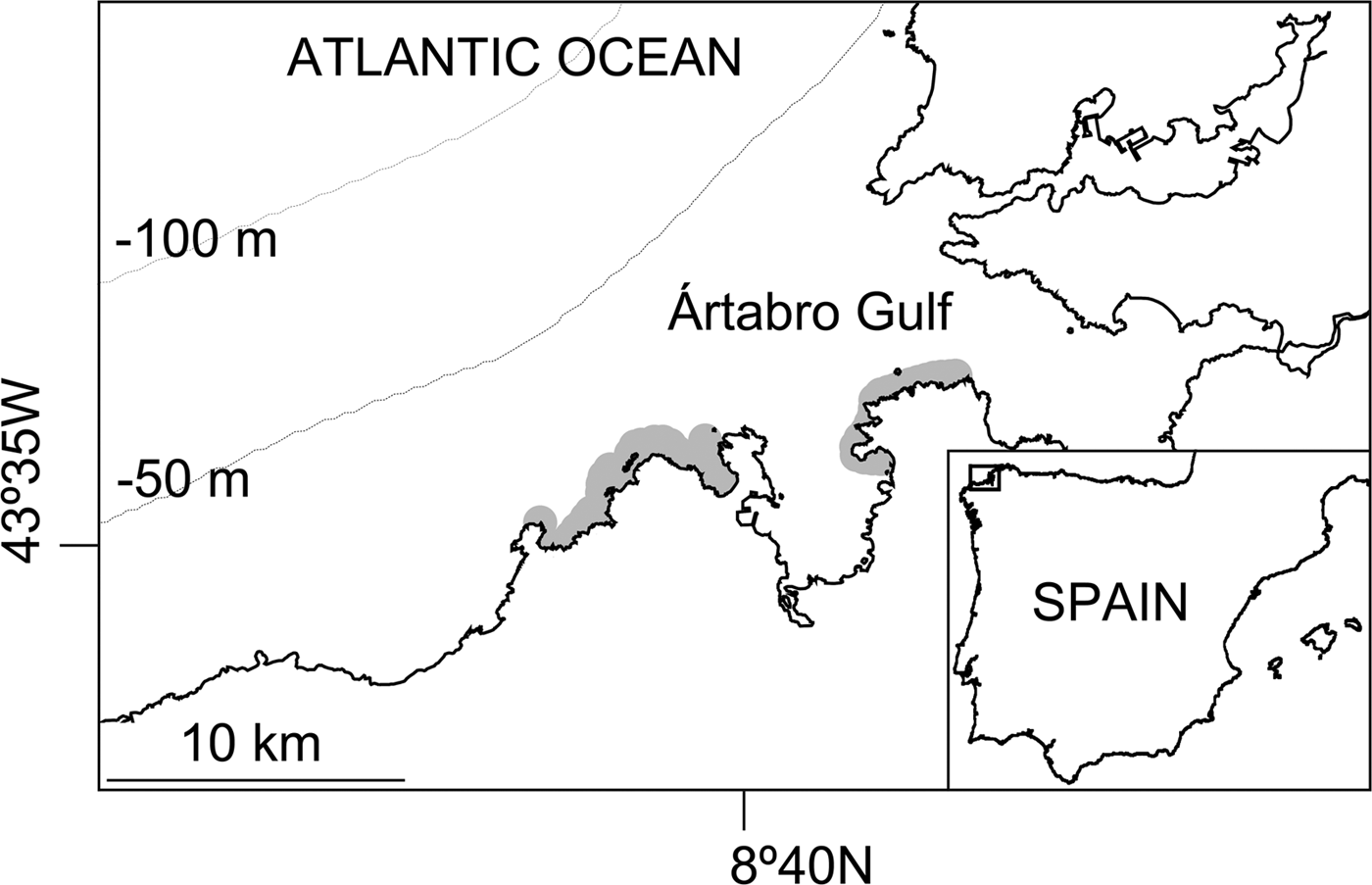
In June 2005, two recreational fishing competitions lasting 5 h each were held in the rocky reefs of the Ártabro Gulf, an open, oceanic bay located in the NW of Galicia with extensive kelp forests (Figure 1). Recreational fishers (29 fishers in each competition) caught 275 fishes with spear guns, at depths not exceeding 30 m. During the subsequent process of identification and weighing of catches, and to avoid interference with the normal progress of the competitions, the organization allowed the researchers to take a limited number of fish samples. Within these limitations, fish samples were taken of the widest possible range of sizes of each of the available species.
Map of the study area in the Ártabro Gulf showing in grey shade the coastal rocky reefs where the sampled fishes were caught by spear fishers.

Since it has been suggested that there are two morphotypes of L. bergylta (Almada et al., Reference Almada, Casas, Francisco, Villegas-Ríos, Saborido-Rey, Irigoien and Robalo2016; Quintela et al., Reference Quintela, Danielsen, Lopez, Barreiro, Svåsand, Knutsen, Skiftesvik and Glover2016), that differ in their colour (i.e. ‘Pinto’, a spotted and reddish form, and ‘Maragota’, plain greenish or brown; Villegas-Ríos et al., Reference Villegas-Ríos, Alonso-Fernández, Fabeiro, Bañón and Saborido-Rey2013), they were treated separately in this paper.
Fishes were measured (total length to the nearest mm) and weighed, stomachs were preserved in 70% alcohol, while ~1 cm3 of dorsal muscle of each fish was collected and, following Carabel et al. (Reference Carabel, Verísimo and Freire2009), refrigerated for less than 3 h, frozen and stored at −30 °C.
STOMACH CONTENTS
Stomach contents were analysed macroscopically under a binocular microscope and identified to the lowest possible taxonomic level. Thereafter, a per cent index of relative abundance for prey was estimated (McComish, Reference McComish1967; Klarberg & Benson, Reference Klarberg and Benson1975), based on an assessment of the percentage contribution by volume of each food category to the total contents (Pillay, Reference Pillay1952), and corrected by the degree of filling of the stomach (Frost, Reference Frost1943):
 $${\rm RA}_{ij} = V_i \times F_j \,(\% ),$$
where RAij is the relative abundance of prey i in stomach j, V i is the estimated percentage of the stomach j volume occupied by prey item i and F is an index of the filling of the stomach j; full (F j = 1), mid (F j = 0.5) and empty (F j = 0). Thereafter, the RA per prey item and species was obtained and scaled down to a percentage basis (RAsp). Parasites and inorganic items were excluded.
ISOTOPIC COMPOSITION
The ratio between the stable isotopes of nitrogen (δ15N) increases on average by 3.4 ± 1‰ (SD) with each of trophic transfer, while the ratio between the isotopes of carbon (δ13C) increases only by 0.4 ± 1.3‰ (Minagawa & Wada, Reference Minagawa and Wada1984; Post, Reference Post2002). Therefore, δ15N can be used to determine the number of trophic levels between a consumer and the base of the food web, while δ13C is commonly used to evaluate the source of the carbon, e.g. to distinguish carbon fixed by benthic or planktonic primary producers (Pinnegar & Polunin, Reference Pinnegar and Polunin2000). Moreover, isotopic enrichment can be affected by the different rates of renewal of organic tissues (Tieszen et al., Reference Tieszen, Boutton, Tesdahl and Slade1983; Lee-Thorp et al., Reference Lee-Thorp, Sealy and van der Merwe1989). Thus, tissues with low turnover rates, such as muscle, integrate isotopes accumulated over long periods of time (months) of the animal's life (Raikow & Hamilton, Reference Raikow and Hamilton2001) enabling greater accuracy in the inference of feeding habits than conventional analysis of stomach content.
Muscle samples were lyophilized by a Telstar Cryodos −50 for 48 h, and subsequently reduced to a fine powder using an agate mortar. To analyse the stable isotopic composition (C and N) in the tissues, three replicates per fish sample were processed, although only the mean isotopic composition of the replicates was used in the analyses. The samples were processed by a Thermo Finnigan Flash EA 1112 elemental analyser, coupled to a Thermo Finnigan Deltaplus mass spectrometer of isotope ratios. Isotopic ratio of C (δ13C) and N (δ15N) were calculated as:
 $${\rm \delta} X = \left[ {\left( {\displaystyle{{R_{{\rm Sample}}} \over {R_{{\rm Standard}}}}} \right) - 1} \right] \times 10^3, $$
where X is 13C or 15N and R is the ratio 12C/13C or 14N/15N. R standard was the Pee Dee belemnite for C and atmospheric air for N. No corrections were made in relation to the presence of lipids in the samples due to the low lipid content in fish muscle tissues (Freire et al., Reference Freire, Carabel, Verísimo, Bernárdez and Fernández2009).
The trophic level of each species was estimated according to the model developed by Hobson & Welch (Reference Hobson and Welch1992):
 $${\rm TL} = 1 + \displaystyle{{\left( {\delta ^{15} N_{{\rm Sample}} - \delta ^{15} N_{{\rm Reference}}} \right)} \over {3.4}},$$
where TL is the trophic level of the sampled fish using as reference the average δ15N of potential available sources of food in the studied ecosystem, i.e. 6.3‰ in this case, estimated from mean values of benthic algae, sedimentary organic matter and pelagic suspended particulate organic matter obtained from Carabel et al. (Reference Carabel, Godínez-Domínguez, Verísimo, Fernández and Freire2006). Following Post (Reference Post2002) the average enrichment by trophic level used in the formula was 3.4‰. A TL close to 2 corresponds to an herbivore, a TL close to 3 to a carnivorous diet, and a TL close 4 to carnivores that eat other carnivores. Apex predators have a TL close to 5.
Data analyses
The δ13C and δ15N values obtained for the studied fish species were compared using the non-parametric rank sum Kruskal–Wallis test. In the case of a significant difference with the Kruskal–Wallis test, a post-hoc analysis was conducted using pairwise Mann–Whitney U tests. Adjusted P-values for multiple comparisons were estimated with the Holm adjustment method (Holm, Reference Holm1979). Tests and calculations were obtained with the statistical software R v3.3.2 (R Core Team, 2016).
The trophic components of niche space can be quantified by using stable isotopic ratios (Bearhop et al., Reference Bearhop, Adams, Waldron, Fuller and MacLeod2004). Thus, Newsome et al. (Reference Newsome, Martinez del Rio, Bearhop and Phillips2007) defined isotopic niche as an area (in δ-space) with isotopic values (δ-values) as coordinates. Although isotopic niche and trophic niche are not the same, they are likely to be tightly correlated (Jackson et al., Reference Jackson, Inger, Parnell and Bearhop2011). Therefore, in this paper trophic niches of fish species were identified by using the EM (Expectation-Maximization) algorithm initialized by model-based hierarchical clustering for parameterized Gaussian mixture models of the δ13C and δ15N paired values with the Mclust tool of the mclust package (Fraley et al., Reference Fraley, Raftery, Murphy and Scrucca2012) of R v3.3.2 (R Core Team, 2016). Best model (between six and nine clusters) was selected by using Bayesian Information Criterion (BIC), and the species' centroids and their confidence interval ellipse were obtained (Fraley & Raftery, Reference Fraley and Raftery2002).
RESULTS
Stomach content
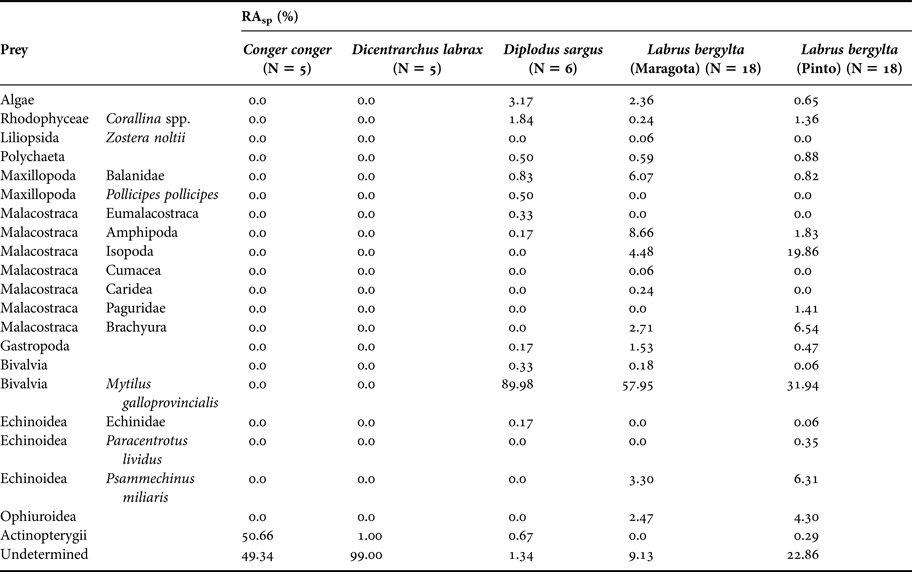
Stomach contents of 52 fishes of four different species were analysed: Conger conger (Linnaeus, 1758) (N = 5), Dicentrarchus labrax (N = 5), Diplodus sargus (N = 6) and Labrus bergylta (N = 36). The two morphotypes of L. bergylta were analysed separately: Pinto (N = 18) and Maragota (N = 18) (Table 1).
Percentage of relative abundance by species (RAsp) of the prey items present in the stomach content of the kelp fish species, identified to the lowest possible taxonomic level.

For comparison purposes, taxonomic level class was provided when possible. Sample size for each fish species is identified (N).
Only three fish stomachs were completely empty, seven stomachs contained parasites (Platyhelminthes, mainly Digenea), while inorganic items, like plastics or small stones were present in five stomachs. A total of 21 different preyed taxa were identified in the stomachs. Mytilus galloprovincialis (Lamark, 1819) was the prey with the higher mean relative abundance (RA = 66.61 ± 36.85%), followed by Isopoda (RA = 27.53 ± 33.95%), Psammechinus miliaris (P.L.S. Müller, 1771) (RA = 18.11 ± 19.10%) and Brachyura (RA = 11.21 ± 13.20%). The remaining prey accounted for 7.04 ± 16.42%, while undetermined items accounted for 25.13 ± 27.42%.
Fishes were the only identified prey for C. conger (RAsp = 50.66%) and D. labrax (RAsp = 1.0%), probably because of the high incidence of unidentified prey in their stomachs (49.3% and 99.0%, respectively). Mytilus galloprovincialis was the main prey for D. sargus (RAsp = 89.98%), Maragota (RAsp = 57.95%) and Pinto (RAsp = 31.94%), even though they preyed upon a large range of species (12, 15 and 16 identified prey items, respectively). In this regard, Amphipoda (RAsp = 8.7%) and Isopoda (RAsp = 19.9%) were also important prey for Maragota and Pinto, respectively (Table 1).
Isotopic composition
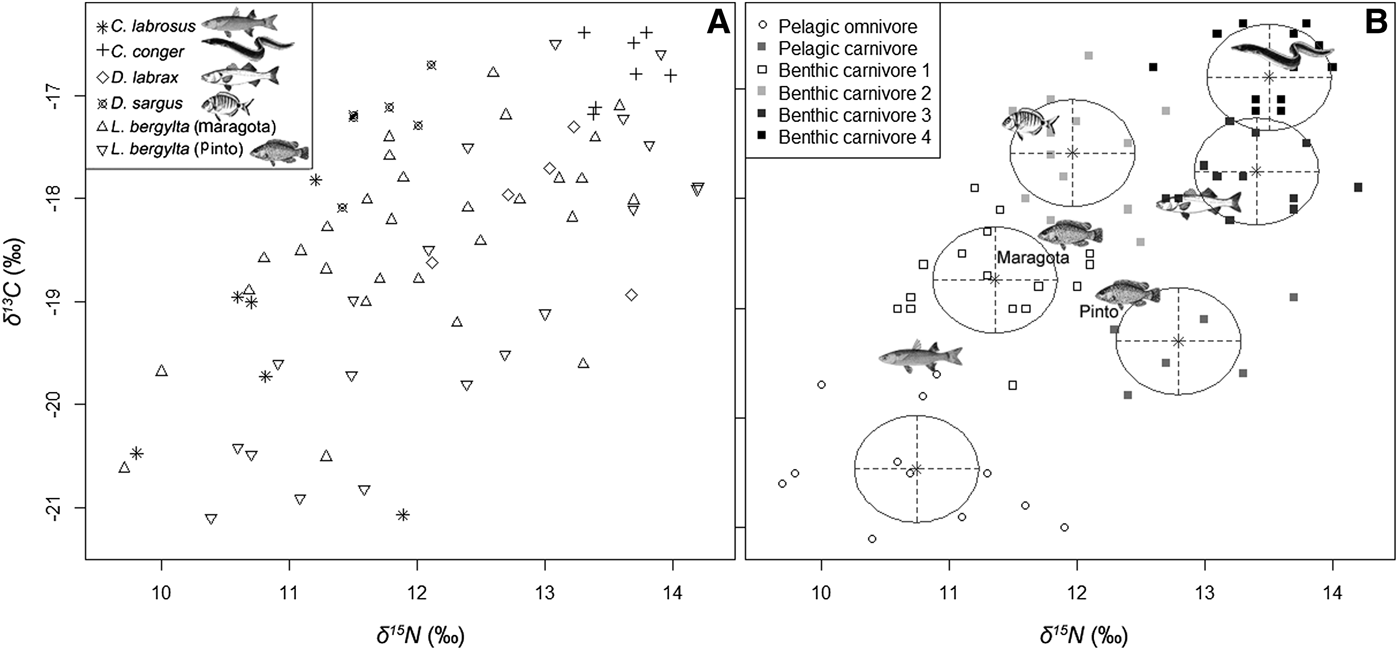
Muscle tissues of 73 fishes of five different species were sampled: Chelon labrosus (Risso, 1827) (N = 6), C. conger (N = 7), D. labrax (N = 5), D. sargus (N = 6) and L. bergylta (N = 49; Maragota, N = 29 and Pinto N = 20, were also independently analysed) (Figure 2A).
Diagrams showing: (A) the δ13C and δ15N content in muscular tissues of the kelp fish studied species; and (B) groups of δ13C and δ15N values (trophic niches) obtained by hierarchical clustering analyses. The symbols of each cluster were categorized into the nominal trophic niches formerly identified in the area by Freire et al. (Reference Freire, Carabel, Verísimo, Bernárdez and Fernández2009). The centroids and confidence interval ellipses of each cluster are also shown, while images of the fish species were plotted in their mean δ13C and δ15N values.

There were significant differences between fish species in relation with the content in δ13C (Kruskal–Wallis χ2 = 27.91, P < 0.001) and δ15N (Kruskal–Wallis χ2 = 23.09, P < 0.001), and only some of the paired comparisons, mainly involving the two morphotypes of L. bergylta were non-significant (Table 2). Therefore, except in the case of L. bergylta, it was shown that the fish species followed diverse feeding strategies.
Paired Mann–Whitney tests used to evaluate differences in δ13C and δ15N content in muscular tissues of kelp fish species.

The value of the statistic W is shown. The tests were considered significant when the adjusted P-values for multiple comparisons, estimated following a Holm procedure, were <0.05 (significant comparisons are highlighted in bold type).
Six trophic niches were obtained after hierarchical clustering of δ13C and δ15N paired values (the uncertainty in the classification with respect to the optimal BIC values, 0.34 of a maximum on 1, was moderately low for 75% of the data). Following the nominal trophic niches previously identified in the area by Freire et al. (Reference Freire, Carabel, Verísimo, Bernárdez and Fernández2009), four of the identified trophic niches could be associated with benthic predators, while pelagic trophic niches could be divided between predators and omnivores (Figure 2B). Visual inspection of mean isotopic values of the studied fish species (including both morphotypes of L. bergylta) showed distributions that in general fitted with the identified trophic niches (Figure 2B).
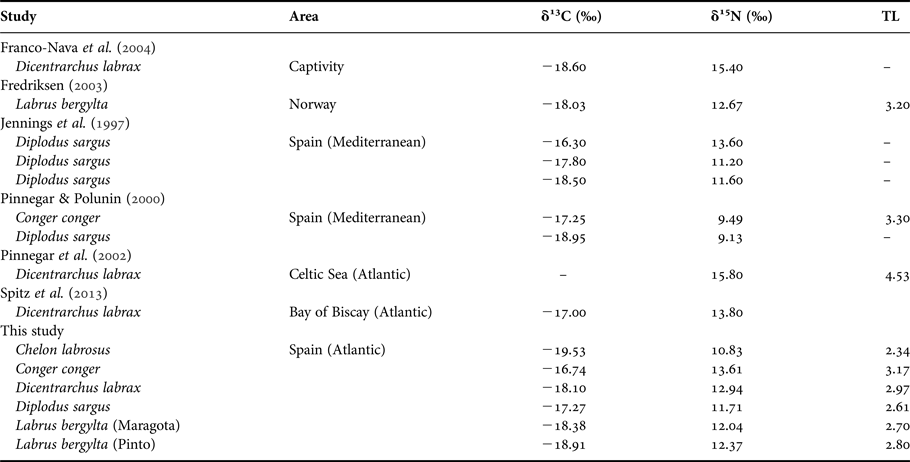
Moreover, the trophic level (TL) of the fish species showed that C. labrosus was the only pelagic omnivore, while all the others showed carnivorous diets (Table 3). Furthermore, C. conger and D. labrax can be considered between secondary and tertiary consumers of the kelp forest ecosystems, as the length of the food chain estimated here was 3.2 (Table 3).
δ13C and δ15N content in muscular tissues and estimated trophic level (TL) of kelp fish species.

Mean weight and total length of analysed fishes is also provided for informative purposes.
DISCUSSION
Analyses of fish stomach contents have been traditionally used to study the feeding habits of fish (Hyslop, Reference Hyslop1980), but the use of stable isotope ratios in organic tissues is increasingly popular (Peterson & Fry, Reference Peterson and Fry1987; Brodeur et al., Reference Brodeur, Smith, McBride, Heintz and Farley2017). Therefore, δ13C and δ15N have been used extensively to study ecological relationships of different marine animals (e.g. Bucci et al., Reference Bucci, Showers, Rebach, DeMaster and Genna2007; Freire et al., Reference Freire, Carabel, Verísimo, Bernárdez and Fernández2009), including coastal fishes (e.g. Hansson et al., Reference Hansson, Hobbie, Elmgren, Larsson, Fry and Johansson1997; Melville & Connolly, Reference Melville and Connolly2003; Correia et al., Reference Correia, Barros and Sial2011). Furthermore, stable isotope content in fish tissues has been already used as valuable inputs in fisheries management (e.g. Weidman & Millner, Reference Weidman and Millner2000; Jennings et al., Reference Jennings, Greenstreet, Hill, Piet, Pinnegar and Warr2002; Pinnegar et al., Reference Pinnegar, Jennings, O'Brien and Polunin2002).
The average enrichment in δ15N per trophic level in any given ecosystem (and used in this study) is 3.4‰, but it may be quite variable (Minagawa & Wada, Reference Minagawa and Wada1984; Post, Reference Post2002). On the other hand, standard values used in trophic level estimations typically include δ15N of local organisms as baseline references. As an example, Fredriksen (Reference Fredriksen2003) used δ15N = 4.4‰ as a reference in kelp forests ecosystems of Norway, while the reference obtained by Carabel et al. (Reference Carabel, Godínez-Domínguez, Verísimo, Fernández and Freire2006) in similar kelp ecosystems and used in this paper was 6.3‰. Isotopic data estimated for the same species in different studies should be compared with care, for example, the trophic levels shown in this paper are lower than those that would be obtained by using 4.4‰ as a reference.
However, it can be concluded that the trophic attributes of the kelp fish species shown in this study by analysing δ15N and δ13C contents are consistent with those attributed to these species in other European regions (a comparison can be found in Table 4). Moreover, although the low number of fish stomachs analysed in this study may be considered insufficient to characterize diet, results have proven to be useful to support the analysis of isotopes and obtain a global interpretation.
δ13C and δ15N values and trophic level (TL) of fish species in different studies.

The values obtained in this paper are shown for comparison purposes.
Previous studies on the food webs of the study area (Carabel et al., Reference Carabel, Godínez-Domínguez, Verísimo, Fernández and Freire2006; Freire et al., Reference Freire, Carabel, Verísimo, Bernárdez and Fernández2009), showed δ13C values that indicate that Conger conger and Diplodus sargus fed mainly on benthic organisms of the area. By contrast, Chelon labrosus consumes organisms and/or organic matter related to pelagic environments, while Dicentrarchus labrax and the two morphotypes of Labrus bergylta showed intermediate values. Therefore, these last species use less selective feeding strategies (Table 3).
The relatively high values of δ15N in tissues of C. conger and of D. labrax and the associated trophic levels (Table 3), as well as the high frequency of fishes in their stomachs (despite the large amount of unidentified prey in the latter) (Table 1), indicate that these species are important predators of the European coastal ecosystems, from the Mediterranean (Pinnegar & Polunin, Reference Pinnegar and Polunin2000) to the Atlantic (Pinnegar et al., Reference Pinnegar, Jennings, O'Brien and Polunin2002; Spitz et al., Reference Spitz, Chouvelon, Cardinaud, Kostecki and Lorance2013). However, both predators differed in relation to the origin of the organic matter; the sedentary and benthic lifestyle of C. conger (Pita & Freire, Reference Pita and Freire2011) is consistent with the δ13C content showed in this study (Tables 3 and 4) and in the Mediterranean (Pinnegar & Polunin, Reference Pinnegar and Polunin2000) (Table 4). Furthermore, it is also consistent with a specialist diet (Bauchot & Saldanha, Reference Bauchot, Saldanha, Whitehead, Bauchot, Hureau, Nielsen and Tortonese1986). Conversely, D. labrax was less dependent on benthic sources of C than C. conger, as shown by their relative δ13C content (Table 3), which may indicate that it can also feed on pelagic prey in the water column, as stated by Spitz et al. (Reference Spitz, Chouvelon, Cardinaud, Kostecki and Lorance2013). Furthermore, this is also consistent with an active and complex spatial behaviour on a large geographic scale (Fritsch et al., Reference Fritsch, Morizur, Lambert, Bonhomme and Guinand2007; Pita & Freire, Reference Pita and Freire2011) and suggests more generalist feeding habits (Kelley, Reference Kelley2009). Moreover, Franco-Nava et al. (Reference Franco-Nava, Blancheton, Deviller and Le-Gall2004) found similar results to that shown in this paper, while lipid extraction could explain the relatively lower values shown by Spitz et al. (Reference Spitz, Chouvelon, Cardinaud, Kostecki and Lorance2013) (Table 4).
Isotopic signatures of D. sargus shown in this study were also similar to those obtained in the Mediterranean Sea by Jennings et al. (Reference Jennings, Renones, Morales-Nin, Polunin, Moranta and Coll1997) (Table 4). Furthermore, molluscs and fishes (Pinnegar & Polunin, Reference Pinnegar and Polunin2000) and molluscs and algae (Sala & Ballesteros, Reference Sala and Ballesteros1997) were the main prey for D. sargus in the Mediterranean, while algae and echinoderms (Figueiredo et al., Reference Figueiredo, Morato, Barreiros, Afonso and Santos2005) and crustaceans and molluscs (Leitão et al., Reference Leitão, Santos and Monteiro2007) were the main preys in the Azores and southern Portugal, respectively. In this paper, molluscs were by far the main prey of D. sargus, followed to a substantially lesser extent by algae, crustaceans and fish, which could explain the different isotopic signatures shown by Pinnegar & Polunin (Reference Pinnegar and Polunin2000) (Table 4), while echinoderms were almost absent from the diet (Table 1). This variety of prey in different geographic areas suggests a rather opportunistic predator behaviour.
Similarly, L. bergylta showed in this study a similar isotopic signature (Table 4) to fishes from Northern Europe (Fredriksen, Reference Fredriksen2003). However, as shown by Figueiredo et al. (Reference Figueiredo, Morato, Barreiros, Afonso and Santos2005) in the Azores Islands, by Dipper et al. (Reference Dipper, Bridges and Menz1977) in the Isle of Man and by Norderhaug et al. (Reference Norderhaug, Christie, Fosså and Fredriksen2005) in Norway, crustaceans are the main prey through the distribution area of the species, while in this paper molluscs, Mytilus galloprovincialis in particular, were more relevant in its diet (Table 1).
Regarding stable isotopes analysis for the study of the trophic niches of the kelp fish assemblage, δ13C and δ15N values were extremely useful. In fact, all the studied fish species could be associated with a trophic niche (Figure 2B). However, it is remarkable that the high degree of variation in the isotopic signatures shown by both morphotypes of L. bergylta led to some degree of niche overlap with one or another species of the assemblage (Table 2; Figure 2). This niche overlap was even shown with respect to D. sargus, a species with a differentiated diet behaviour in nearby areas of the Atlantic (Figueiredo et al., Reference Figueiredo, Morato, Barreiros, Afonso and Santos2005).
Furthermore, there was some degree of diet overlap between the two morphotypes of L. bergylta (Table 2). Although benthic prey seem to be more important for Maragota than for Pinto (Table 1), these differences could be due to the larger size of Pintos in general (Villegas-Ríos et al., Reference Villegas-Ríos, Alonso-Fernández, Fabeiro, Bañón and Saborido-Rey2013), and also in this paper (Table 3), that might allow them to hunt other fish in the water column (Table 1). However, as stated by Almada et al. (Reference Almada, Casas, Francisco, Villegas-Ríos, Saborido-Rey, Irigoien and Robalo2016), these results provide insufficient support to the view that the two morphotypes should be treated separately in fisheries management (Villegas-Ríos et al., Reference Villegas-Ríos, Alonso-Fernández, Fabeiro, Bañón and Saborido-Rey2013; Quintela et al., Reference Quintela, Danielsen, Lopez, Barreiro, Svåsand, Knutsen, Skiftesvik and Glover2016).
Predatory fishes are good indicators of ecosystem health (e.g. Christensen et al., Reference Christensen, Guénette, Heymans, Walters, Watson, Zeller and Pauly2003; Myers & Worm, Reference Myers and Worm2003; Myers et al., Reference Myers, Baum, Shepherd, Powers and Peterson2007). Subsequently, they can be used to infer general trends for the whole community (Molloy et al., Reference Molloy, Anticamara, Rist and Vincent2010), even when dealing with complex fish-kelp interactions (Peterson et al., Reference Peterson, Summerson, Thomson, Lenihan, Grabowski, Manning, Micheli and Johnson2000; Efird & Konar, Reference Efird and Konar2014). In this sense, the fishes studied in this work are important species in terms of abundance (Pita et al., Reference Pita, Fernández-Márquez and Freire2014; Pita & Freire, Reference Pita and Freire2016) and trophic role of the kelp forest ecosystems (Arim et al., Reference Arim, Abades, Laufer, Loureiro and Marquet2010; Rooney & McCann, Reference Rooney and McCann2012). Furthermore, the length of the food chain estimated here (3.2) is consistent with full lengths estimated by Hall & Raffaelli (Reference Hall and Raffaelli1993) for all types of ecosystems. Consequently, the ecological role of the fish species studied here is very relevant for the ecosystem functioning of the kelp forests of the NE Atlantic and for their fisheries management.
Taking this into account, and since D. labrax is the only species with seasonal and access restrictions, along with limitations of their fishing opportunities in a European context (Council of the European Union, 2015), a combination of initiatives to increase the effectiveness of traditional top-down regional management (e.g. Macho et al., Reference Macho, Naya, Freire, Villasante and Molares2013; Pita et al., Reference Pita, Fernández-Vidal, García-Galdo and Muíño2016) and the creation of MPAs (European Parliament & Council of the European Union, 2008) are the main management measures expected to improve the sustainability of the kelp fish assemblages in the future. The relevance of M. galloprovincialis in the diet of D. sargus and L. bergylta (Table 1) is an important finding. Coastal managers must ensure that this mollusc is available, for example when developing plans to create new coastal MPAs to protect kelp ecosystems. Furthermore, a very relevant mussel culture is developed in Galicia, mainly based in the growing of small mussels extracted from rocks (Pérez-Camacho et al., Reference Pérez-Camacho, González and Fuentes1991). Since small mussels are also the main prey for D. sargus and L. bergylta, the exploitation of the wild mussels by aquaculture farmers must be controlled, evaluated and regulated.
Herbivores are also important elements to consider in marine ecosystems (Madin et al., Reference Madin, Gaines, Madin and Warner2010). If their abundances are increased, for example after a reduction of their predators, the kelp forests could be severely altered (Steneck et al., Reference Steneck, Graham, Bourque, Corbett, Erlandson, Estes and Tegner2002; Byrnes et al., Reference Byrnes, Stachowicz, Hultgren, Randall Hughes, Olyarnik and Thornber2006; Harley et al., Reference Harley, Anderson, Demes, Jorve, Kordas, Coyle and Graham2012). In this regard, antagonistic ecological relationships between sea urchins and kelp forests have been well established in the literature (Harley et al., Reference Harley, Anderson, Demes, Jorve, Kordas, Coyle and Graham2012). Therefore, the presence of sea urchins in the diet of the kelp fishes, relevant in the case of L. bergylta (Table 1), has potential implications for ecosystem management since the reduction of the abundances of this fish could hamper the resilience of kelp forests to grazing by sea urchins. Consequently, the trophic role of L. bergylta shown in this study is relevant for the management of the European kelp forest ecosystems. For instance, this species could be considered a keystone species (Simberloff, Reference Simberloff1998) and, therefore, monitoring programmes on this species can be useful, e.g. for setting minimum requirements for the conservation of kelp forests and for the planning of MPAs (Roberge & Angelstam, Reference Roberge and Angelstam2004). Further research would be desirable to identify potential benefits and tradeoffs of the use of L. bergylta as a keystone species, but in the meantime, it is urgent to reverse human impacts that have severely reduced the abundances of this fish in the last decades (Pita & Freire, Reference Pita and Freire2014, Reference Pita and Freire2016).
ACKNOWLEDGEMENTS
The authors thank to Mr Enrique Brandariz and Mr Manuel Segade, former chairman and secretary of the FEGAS for their valuable support.
FINANCIAL SUPPORT
This research was funded by the Autonomous Government of Galicia, Xunta de Galicia: PECOS project under Grant PGIDIT05RMA10301PR, and RECREGES project under Grant ED481B2014/034-0.