INTRODUCTION
Marine benthic littoral communities are mainly dominated by sessile animals which depend on food transported by marine currents reaching their retention structures. Despite this apparent limitation, these animals, named suspensivores, represent one of the most successful trophic strategies in all the oceans (Gili & Coma, Reference Gili and Coma1998). The key to their success lies largely in their high efficiency for catching any suitably sized particle carried by the currents. In general, they are considered omnivores (Coma et al., Reference Coma, Ribes, Gili and Hughes2001) and the selection of prey relates almost exclusively to the limitations of their size and anatomy (Riisgård & Larsen, Reference Riisgård and Larsen2005). The capture mechanisms are very varied and respond to the steps proposed by the Aerosol Theory (Rubenstein & Koehl, Reference Rubenstein and Koehl1977): a suspensivore community develops a collection of strategies that allows for the retention and subsequent capture of suspended particles at the organism, colony or community level. Thus, the most efficient way to retain particles is to be positioned in front of a dominant flow and offer resistance to it. In this way, it has been observed that a large quantity of particles that circulate close to the bottom, or to the benthic community, disappears from the water column, and it is assumed that these particles are retained as food by the benthic organisms (Buss & Jackson, Reference Buss and Jackson1981). The majority of these observations have been carried out in experiments with in situ incubation chambers or by studying particle depletion between one area of the benthic community and another.
The studies on the feeding of coral reefs are especially well-known. They indicate that a reduction of phytoplankton cells in the water column that moves over corals (Fabricius et al., Reference Fabricius, Benayahu and Genin1995) or inside reefs is due to their capture by the corals (Fabricius et al., Reference Fabricius, Yahel and Genin1998). The capture of phytoplankton, especially by corals, and other sessile organisms, gives them a remarkable role as herbivores, even though they are generally considered as omnivores that capture predominantly detritus and zooplankton, as well as obtaining a large part of their carbon demand from the metabolism of symbiotic algae (Sebens, Reference Sebens, Pandian and Vernberg1987). It has been assumed that almost all the retained particles form part of the diet of the benthic organisms (Shimeta & Jumars, Reference Shimeta and Jumars1991) and the energy gained from the retained particles could cover their energetic requirements (Lesser et al., Reference Lesser, Witman and Sebens1994). However, this approach has led to obvious uncertainty, since it could not be confirmed that everything retained was digested and assimilated. Subsequent studies, such as those of Widding & Schichter (Reference Widdig and Schlichter2001) who used the same species, have cast doubt on these assumptions. These authors, using methods with 14C-labelled microalgae showed that, in the majority of cases, the algae ingested only covered 26% of the energetic demand. This difference was due to two possibilities: one that everything retained was not assimilated and, that there was an additional food source. The ingestion rate varied according to the density of the available particles and reached a maximum of 90% in some corals (Widding & Schichter, Reference Widdig and Schlichter2001) although in these cases the ingested food hardly covered 5% of the energetic demand of the coral.
Although it seems certain that phytoplankton are extracted or retained from the flow that circulates close to suspensivore communities, it still has to be demonstrated if they are actually assimilated efficiently. In other active suspensivore organisms, such as the bivalve molluscs (Mohlenberg & Riisgård, Reference Mohlenberg and Riisgård1979), it is widely demonstrated that they filter and feed on a large quantity of phytoplankton cells. However, what happens with passive suspensivores still has to be demonstrated, especially those that are considered predominantly carnivores that feed on zooplankton, particularly the benthic hydrozoans (Gili et al., Reference Gili, Alvà, Coma, Orejas, Pagès, Ribes, Zabala, Arntz, Bouillon, Boero and Hughes1997). In studies carried out on their trophic ecology, it has been demonstrated that they are voracious carnivores and the captured prey cover their energetic demand perfectly (Barangé et al., Reference Barangé, Zabala, Riera and Gili1989). At the same time, they are species that grow very rapidly and it is thought that this is due to high ingestion and assimilation rates (Coma et al., Reference Coma, Ribes, Gili and Zabala1998). Although cells of phytoplankton have been detected in the stomachs of some species, there is still a doubt as to whether they digest them and whether they contribute to their metabolic requirements.
Therefore, the main aim of this study was to demonstrate the capacity of a ‘carnivorous’ benthic hydrozoan to assimilate phytoplankton cells, as well as determine the mechanisms that make assimilation a rapid and efficient process. This objective will help confirm the relevant role of the group in marine trophic chains and, especially, the importance of phytoplankton consumption in a wide variety of organisms, including those that until now have been considered as basically carnivores, and in the transfer of energy from the plankton to the benthos.
MATERIALS AND METHODS
Field sampling
Eudendrium racemosum were collected from the Medes Islands (north-western Mediterranean, 40° 02′55″N 3° 13′30″E) at 10 a.m. on 22 July 2000. The colonies were located at a depth of 5 m, a seawater temperature of 21°C. All the colonies were maintained together in a container filled with filtered marine water at the same sampling temperature and with a low water flux provided by two water pumps.
Feeding experiment
After 10 hours of starvation, 10 colonies were rinsed and held in a container filled with 400 ml filtered marine water. Then, 50 ml of a saturated culture of the diatom Thalassiosira weissflogii were added. Replicate samples, each containing a minimum of 6 polyps, were collected after 10, 20, 30 and 60 minutes, and fixed immediately (see below). As a control for histology, a sample was collected just before the food was added (at 0 minutes).
Tissue processing for LM and TEM
For both LM and TEM, the samples were fixed in 1% (w/v) paraformaldehyde, 0.1% (v/v) glutaraldehyde in 0.1 M cacodylate buffer for 2 hours at room temperature. Primary fixation was followed by post-fixation with 1% (w/v) osmium tetroxide in 0.1 M cacodylate buffer for 1 hour. Embedding was performed in Spurr's resin, according to standard procedures. Semi-thin sections were stained with methylene blue and ultrathin sections with uranyl acetate and lead citrate. Semi-thin sections were observed and photographed with a Reichert–Jung Polyvar 2 optical microscope and the ultrathin sections with a Hitachi H-600 AB or MT 800 transmission electron microscope.
Determination of the phytoplankton ingestion rates
Eudendrium racemosum colonies were transported to the laboratory in seawater and in an ice-cooled reservoir. Once in the laboratory, the polyps were manually cleaned of Caprella sp. episymbionts and then deposited in 0.2 µm filtered seawater for 21–30 hours, to allow for digestion of all previously captured material. They were kept in small glass containers in a temperature-regulated container at 16°C with a diel light cycle.
A young laboratory culture of T. weissflogii was used that was diluted ten-fold in 0.2 µm filtered seawater. To this solution, different numbers of Eudendrium polyps (on the hydrocaulus) in replicated glass containers (from 0 to 40 polyps per container) were added. A total of 10 polyps were also deposited directly in the Thalassiosira culture. Incubations lasted for 22 hours with manual agitations every 7–10 hours. A 12:12 light:dark cycle was maintained and the containers were incubated at about 1000 µE s−1m−1. The algae were detected by their red autofluorescence, and algal abundance was determined at the start and end of incubation by means of a Becton & Dickinson FACSCalibur flow cytometer. A 10 µm latex bead standard solution, previously calibrated against Becton & Dickinson TruCount beads, was used to convert the algal events detected to algal cells per unit volume.
Incorporation of diatom labelled carbon
Eudendrium racemosum colonies were transported to the laboratory in seawater and the polyps were maintained in seawater for 2 days in a temperature-regulated container at 16°C with a diel light cycle. After two days they were treated and held as described for the determination of phytoplankton ingestion rates.
A young laboratory culture of T. weissflogii at 2.2 ± 0.3 105 cells ml−1 was labelled with a total of 80 µCi (2 µCi ml−1) 14C-bicarbonate for 24 hours. The 14C solution was prepared after adding sea salts (0.035 g SIGMA sea salts per ml) to a bicarbonate solution kept in distilled water. A control sample was maintained containing no radioactivity but including the sea salt solution. 2 ml of the labelled diatom solution was added to each of 8 glass vials, each containing 10 Eudendrium polyps (on the hydrocaulus) in 20 ml 0.2 µm filtered seawater. Two more vials, each containing 10 polyps of Eudendrium and the labelled diatom solution, were fixed in 2% final formaldehyde solution. Two more samples, with Eudendrium, but without radioactive diatoms were established in order to determine the rate of phytoplankton ingestion by flow cytometry, following the method explained above. All samples were kept for 24 hours in a 12:12 light:dark cycle and incubated at approximately 150 µE s−1 m−1. Incubations were terminated with the addition of 1 ml formaldehyde solution (2% final).
Samples incubated with non-radioactive diatoms were processed as above to determine the final diatom concentration and, thus, the rates of diatom ingestion. The radioactive samples were processed as follows:
Five ml of each untreated sample were separated for total organic carbon determination (TOC samples), and these were used for measurements of total respiration in the samples. Then, the polyps were extracted from each glass vial under a binocular microscope and rinsed three times in 0.2 µm filtered seawater for 2, 5 and 20 minutes. Subsequently, the 10 polyps of each colony, including theirbases were separated from the hydrocaulus and placed in a labelled vial. One ml of 1 N NaOH was placed in each vial with the polyps and those with the remaining hydrocaulus, vortex mixed and boiled for 1 hour at 85°C. Afterwards, 10 ml of Packard UltimaGold XR radioactivity cocktail was added and the samples were left for approximately 2 days before counting. The rest of the sample (15 ml) was filtered through a GF/F Whatman fibre glass filter to separate the radioactivity remaining in the diatoms (denominated POC) from radioactivity dissolved in the water (DOC). The filters were left in a fume hood in an HCl atmosphere for 12 hours to eliminate the inorganic 14C. TOC and DOC samples received 1 ml of 1 N HCl, and were agitated for 12 hours under HCl vapours. 5 ml of the DOC and TOC samples were added to 15 ml of Packard UltimaGold XR radioactivity cocktail, and the POC samples were also deposited in 10 ml of Packard UltimaGold XR radioactivity cocktail. All samples were counted in a Beckman scintillation counter for 5 minutes in the 14C programme. The radioactivity was determined in each diatom cell from the controls with no polyp.
RESULTS
Morphology and histology
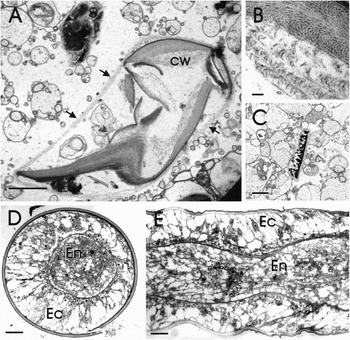
Five minutes after the start of the incubations, diatoms were observed in the upper part of the gastric cavity and in the hypostome of the polyps. After 10 minutes, diatoms had already been incorporated, by phagocytosis, into the gastrodermal cells, while ingested diatoms occupied almost all the epithelium of the gastric cavity. Some of the diatoms in the gastric cavity retained the two valves but many loose valves were also observed.
Inside the gastrodermal cells the diatoms, together with some algal residues, were enclosed inside a thin non-membranous envelope (Figure 1A), which was most probably the secretion from hypostomal or gastric mucous cells. Many valves were detached from the diatoms by the contractions of the mouth and oral tentacles, and together with initial extracellular digestion probably produced structural alterations (observed as a loss of continuity) in the diatom cell wall. A detailed view of the diatom cell wall showed a process of degradation in the cellulose fibres (Figure 1B). In the interior of the cytoplasm of the gastrovascular cells, the diatom siliceous valves were observed partially degraded and surrounded by a poorly defined membrane that corresponded to a glycoprotein type of material. The pores and silicon structure of the valves were observed in various stages of degradation. The valve appeared to be fragmented and partially degraded, showing the siliceous fraction basically devoid of the thick mucilaginous matrix (Figure 1C).
(A) Cell wall (cw) of an ingested Thalassiosira after 20 minutes' digestion, engulfed by a gastrodermal cell. The diatoms are enclosed inside a thin non-membranous envelope (arrows); (B) an enlarged view of a marginal region of the enclosed diatom cell wall showing overlapping degradation processes affecting both fibres and microfibrils of cellulose; (C) cytoplasm of a gastrodermal cell containing a fragment of a silicified valve from an ingested diatom, also enclosed by a non-membranous envelope; (D) transverse; and (E) longitudinal sections of the basal hydrocaulus, showing the two main histological layers, the gastrodermis (En) surrounded by the epidermis (Ec). Scale bars: (A) 1 m; (B) 0.1 µm; (C) 1 µm; (D) and (E) 25 µm.

Also, 20 minutes after the onset of digestion it was not possible to observe the hydrocaulus canal (see Figure 1) which was occluded due to the fact that the gastrodermis was largely contracted. This contraction was in consequence of transient vacuole-like dilations, which are a characteristic of the hydrocaulus gastrodermal cells (Figure 1C & D). This observation correlated with continuous food transport along the stolons and hydrocauli of hydroid colonies.
Phytoplankton ingestion rates
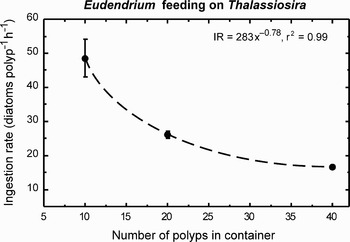
Eudendrium racemosum fed on cells of the diatom T. weissflogii under conditions of incubation, after a period of starvation, and with the diatoms as the sole food item. In the presence of approximately 15,000 diatoms ml−1, Eudendrium fed on the diatoms with rates ranging from 16 to 55 diatoms polyp−1 h−1. In a dense (80,000 cells ml−1) suspension of T. weissflogii, the polyps did not feed on them, and no decrease in diatom concentration was detected after 22 hours. The feeding rates per polyp were higher with a lower amount of polyps in the containers (Figure 2), which is indicative of ‘trophic shadowing’.
Ingestion rates of diatoms by colonies of Eudendrium racemosum at three concentrations of polyps per container (see text for details).

Incorporation of diatom labelled carbon
Eudendrium racemosum fed on the diatom cells of the genus Thalassiosira in the second experiment with a rate similar to that of the first experiment, with 42 ± 4 diatoms polyp−1 h−1 for 10 polyps and a diatom concentration of 20,000 cells ml−1.
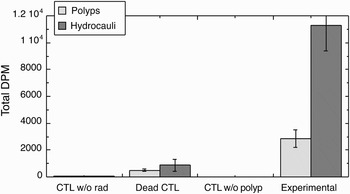
A clear accumulation of radioactivity was observed in the different parts of the polyps. There was more accumulation of diatom 14C in the hydrocauli than in the polyps (Figure 3) but once scaled to the biomass of the different parts, this value was similar. Then there was no more accumulation in the hydrocauli than in the polyps. A polyp weighing approximately 10 µgC with the hydrocaulus of 10 polyps weighing 450 µgC, gave 23.5 dpm per µgC of polyp, and 25.4 dpm per µgC of hydrocaulus. It was calculated that each diatom cell accumulated 0.75 dpm of radioactivity. Thus, in the hydrocaulus, labelled C corresponding to 34.1 diatoms per µgC of hydrocaulus (or 7700 diatoms) was detected, while in the polyps, labelled C corresponding to 31.6 diatoms per µgC of polyp (i.e. 175 diatoms per polyp) was measured.
Accumulation of radioactivity per mg of c weighed in the different parts of the colony of Eudendrium racemosum. Two experimental sets are considered, with dead colonies and live colonies. CTL w/o rad: control containers, no label. Dead CTL: control containers with dead colonies, labelled. CTL w/o polyp: control containers, without polyp. Experimental: same containers with live colonies, labelled.

The measurement of labelled DOC indicated a relatively large fraction of unassimilated labelled carbon which probably corresponded either to bacterial assimilation of dissolved primary production or to non-specific feeding of Eudendrium on diatoms.
DISCUSSION
The benthic hydrozoans have been considered by numerous authors as carnivores that capture mainly zooplankton prey by use of nematocysts (stinging cells) (see reviews by Boero, Reference Boero1984; Gili & Hughes, Reference Gili and Hughes1995). In detailed studies of the stomach contents, diatoms and other phytoplankton cells have always been seen, even to the point of them being considered as the main part of the diet (Orejas et al., Reference Orejas, Gili, Alvà and Arntz2000). The presence of phytoplankton cells inside the gastric cavity has been considered as evidence that they could be ingested and metabolized, not only in hydrozoans but also in other benthic cnidarians. In addition, the fact that phytoplankton decrease in the water column when in contact with cnidarian colonies, especially over coral reefs, has been considered sufficient evidence to demonstrate herbivory of these cnidarians. However, these aspects have been questioned recently, since the data of cell depletion in the vicinity of cnidaria and the presence of cells in their gastric cavities do not necessarily mean that they are ingested (Widding & Schichter, Reference Widdig and Schlichter2001). The phytoplankton cells, simply by hydrodynamic effect and physical retention of particles, could disappear from the water column, settle or be ingested but not digested.
In hydrozoans, it is known that phytoplankton cells, especially diatoms, once captured by the tentacles and introduced through the mouth into the hypostome, suffer a rapid process of degradation (Bouillon, Reference Bouillon, Grassé and Doumenc1995) partially inside a pseudo-membrane vacuole such as been observed in other organisms (Herring et al., Reference Herring, Cohan, Welnhofer, Mills and Morris1999). The observation that the majority of the diatoms observed in the gastric cavity are not whole confirms the fact that extracellular digestion is very rapid. Separation of the valves is probably produced by mechanical disruption before phagocytosis. These processes are very rapid and happen before the prey reach the walls at the base of the gastrovascular cavity (Bouillon & Houvenaghel, Reference Bouillon and Houvenaghel1970). It has been pointed out that the hydrozoans have two types of parallel digestion, the extracellular and the intracellular (Bouillon, Reference Bouillon, Grassé and Doumenc1995). The experiments in our study have confirmed this fact and, above all, that both types of digestion may act simultaneously.
The valves are phagocytosed by the gastrovascular cells instead of being expelled by the mouth, as is seen with the exoskeletons of other prey such as crustaceans (Bouillon, Reference Bouillon, Grassé and Doumenc1995). In the interior of the gastrovascular cells, the degradation and final absorption of the food within a glycoprotein envelope occurs. This process apparently allows for rapid degradation of the protein part of the valve, so that the hydrozoans benefit from the digestible parts of the skeleton. The silica is probably subsequently eliminated by external excretion via the gastric cavity and mouth.
The hydrocaulus and the stolon (hydrorhiza) function as a transport system that works by contraction or by changes in the cellular volume (Marfenin, Reference Marfenin1985). When the cells of the central canal wall contract, the circuit opens and allows the circulation of matter. Is this like a primitive form of peristalsis? This process is known as vacuole-like dilations (VLDs; Schierwater et al., Reference Schierwater, Piekos and Buss1992) and allows the rapid transfer of matter that has been previously digested in the polyps. Generally, the polyps operate as the functional digestive units and the hydrocaulus represents the transport system (Lunger, Reference Lunger1963; Bouillon, 1995). This system is very rapid, as shown in this study, since in less than 20 minutes from the start of incubation radioactive markers were already detected in the hydrocaulus.
The known assimilation efficiency for hydrozoans is very high at between 60 and 89% (Barangé et al., Reference Barangé, Zabala, Riera and Gili1989), which is less than the high rate of 94% for E. racemosum found in the current study. These rates are similar to those of other cnidarians, irrespective of the size of the benthic or planktonic prey (Sebens, Reference Sebens, Pandian and Vernberg1987). Now it has been confirmed that diatoms are digested and assimilated it can be concluded that diatoms are a preferential food of many hydrozoan species where they may form up to 95% of their prey (Gili et al., Reference Gili, Alvà, Pagès, Klöser and Arntz1996).
Our results are rather high values and should be taken as maxima, since such values would mean that most of the ingested diatom 14C would have ended up in the Eudendrium tissue (efficiency 94%) whereas it could be expected that a certain percentage should have been respired by the polyps. The known assimilation efficiency for hydrozoans is very high at between 60 and 89% (Barangé et al, Reference Barangé, Zabala, Riera and Gili1989), which is less than the high rate of 94% for E. racemosum found in the present study. Since it was not possible to measure how much of the carbon in the diatoms was labelled, the quantity of diatom carbon assimilated by the polyps could not be calculated, but these rates are similar to those of other cnidarians, irrespective of the size of the benthic or planktonic prey. Now it has been confirmed that diatoms are digested and assimilated it can be concluded that diatoms are a preferential food of many hydrozoan species where they may form up to 95% of their prey (Gili et al, 1996).
The daily feeding rates observed for E. racemosum in the laboratory were 795.24 µg C polyp−1 day−1 with prey concentrations of 15 × 103 ml−1. At a common Mediterranean diatom concentration of 2.5 × 10⁵ l−1 (Delgado et al., Reference Delgado, Latasa and Estrada1992) the daily catch rate would be 25.9 µg C polyp−1 day−1, which is very close to that calculated for a natural diet of 22.9 µg C polyp−1 day−1 (Barangé & Gili, Reference Barangé and Gili1988). With high diatom concentrations, E. racemosum could cover 100% of its daily demand only with this type of prey. Considering a greater catch rate and a higher assimilation rate than that previously known for this species, its growth efficiency is 71.5% compared to that already known and calculated from the prey observed in the stomach contents, which was 58%. At high prey concentrations, and considering the high feeding rates measured by E. racemosum, hydrozoans can achieve by high growth rates (Gili & Hughes, Reference Gili and Hughes1995), which confirms them as excellent colonizers. Temporary explosive growth periods enable them to occupy almost 100% of the available substrate.
Eudendrium racemosum is an example of the hydrozoan potential for rapid colonization and growth. It is a potential based on a very efficient digestive system with double extracellular and intracellular digestions that act synchronously at a high assimilation efficiency. The rapid circulation of digested food material through the hydrocaulus to the stolon allows for its rapid growth and colonization of the substrata. These organisms are at the same time capable of capturing prey from a wide size spectrum, ranging from bacteria (Boero et al., in press) to prey larger than the polyps themselves (Harris, Reference Harris1990). Therefore, they are opportunist species that adapt very well to the variable and stochastic conditions of littoral marine systems.
ACKNOWLEDGEMENTS
This paper was presented at the Sixth Workshop of the Hydrozoan Society held in the Marine Biological Association Laboratory at Plymouth, UK, in June 2007. This study is dedicated to our companion and friend Francesc Pagès who died unexpectedly one week before the start of the Workshop that he was organizing. He had insisted that we present this study at the meeting, and this situation reminds us of the tremendous work he did for the Hydrozoan Society and in the study of the hydrozoans. We are grateful to Núria Cortadellas, Almudena García and Eva Fernández from the Scientific-Technic services of the University of Barcelona for their help with Microscopy.