Introduction
Glutathione S-transferase (GST, EC 2.5.1.18) is a multifunctional super enzyme encoded by several genes. It is widely distributed in eukaryotes and prokaryotes, and plays a major role in the detoxification of both endogenous and xenobiotic compounds. GSTs catalyze the reaction between reduced glutathione (GSH) and xenobiotics (drugs, industrial products, pesticides, herbicides, environmental pollutants, carcinogens, etc.), which leads to the inactivation and excretion of toxic substances (Habig et al., Reference Habig, Pabst and Jakoby1974; Enayati et al., Reference Enayati, Ranson and Hemingway2005; Vararattanavech et al., Reference Vararattanavech, Prommeenate and Ketterman2006; Oakley, Reference Oakley2011). Some GSTs also have peroxidase and isomerase activity, and react directly with reactive oxygen species such as superoxide anion (O−2), hydrogen peroxide (H2O2), and the hydroxyl radical (HO•) to convert them to their reduced forms and protect cells from oxidative damage (Hayes et al., Reference Hayes, Flanagan and Jowsey2005; Oakley, Reference Oakley2011). GSTs are also involved in the synthesis of steroids and prostaglandins, decomposition of the aromatic amino acids phenylalanine and tyrosine (Board et al., Reference Board, Baker, Chelvanayagam and Jermiin1997), and the intracellular transport of hydrophobic compounds (such as hemoglobin, bilirubin, hormones and drugs) (Feng et al., Reference Feng, Davey, Pang, Primavera, Ladd, Zheng, Sohi, Retnakaran and Palli1999). In addition, GSTs play an important role in the inhibition of apoptosis (Adler et al., Reference Adler, Yin, Fuchs, Benezra, Rosario, Tew and Ronai1999; Cho et al., Reference Cho, Lee, Park, Ryoo, Kang, Park and Choi2001; Ryoo et al., Reference Ryoo, Huh, Lee, Yoon, Cho and Choi2004; Piaggi et al., Reference Piaggi, Raggi, Corti, Pitzalis, Mascherpa, Saviozzi, Pompella and Casini2010).
So far, six classes of GSTs have been identified in insects, four of which are homologous with the mammalian cytosolic GST family and correspond to the mammalian GST classes omega, sigma, theta and zeta. The other two are insect-specific GST classes delta and epsilon (Ranson & Hemingway, Reference Ranson and Hemingway2005; Lumjuan et al., Reference Lumjuan, Stevenson, Prapanthadara, Somboon, Brophy, Loftus, Severson and Ranson2007) Most insect GSTs belong to the delta and epsilon classes (Fournier et al., Reference Fournier, Bride, Poirie, Berge and Plapp1992; Board et al., Reference Board, Russell, Marano and Oakeshott1994; Snyder et al., Reference Snyder, Walding and Feyereisen1995; Huang et al., Reference Huang, Hu, Yao, Wu, Chiang and Sun1998; Ranson et al., Reference Ranson, Rossiter, Ortelli, Jensen, Wang, Roth, Collins and Hemingway2001, Reference Ranson, Claudianos, Ortelli, Abgrall, Hemingway, Sharakhova, Unger, Collins and Feyereisen2002; Vontas et al., Reference Vontas, Small, Nikou, Ranson and Hemingway2002; Tu & Akgul, Reference Tu and Akgul2005; Claudianos et al., Reference Claudianos, Ranson, Johnson, Biswas, Schuler, Berenbaum, Feyereisen and Oakeshott2006; Lumjuan et al., Reference Lumjuan, Stevenson, Prapanthadara, Somboon, Brophy, Loftus, Severson and Ranson2007). The insect-specific delta and epsilon families represent the major insecticide-resistant GSTs in insects. Moreover, they play a vital role in the metabolism of detoxifying pesticides and protecting tissues against oxidative damage and oxidative stress (Singh et al., Reference Singh, Coronella, Beneš, Cochrane and Zimniak2001; Vontas et al., Reference Vontas, Small and Hemingway2001; Li et al., Reference Li, Schuler and Berenbaum2007).
The genome sequencing of the silkworm, a model organism of Lepidoptera, has been completed, and GSTs in the silkworm have been investigated (Goldsmith et al., Reference Goldsmith, Shimada and Abe2005; International Silkworm Genome Consortium, 2008). Yamamoto et al. (Reference Yamamoto, Zhang, Miake, Kashige, Aso, Banno and Fujii2005, Reference Yamamoto, Zhang, Banno and Fujii2006) cloned and expressed the GST genes BmGSTt1 and BmGSTs1, which belong to the theta and sigma family in the silkworm, and found that these two genes were expressed in the fat body, midgut, hemolymph, silk gland, testis and ovaries and had high catalytic efficiency for 4-Hydroxynonenal (4-HNE) and 1-chloro-2,4-dinitrobenzene (CDNB) conjugation. In 2009, Yamamoto cloned the BmGSTo2 and BmGSTz2 genes and obtained their recombinant protein. BmGSTo2 was reported to have a strong affinity for organophosphate insecticides, and increased the resistance of lepidopteran insects against such insecticides. Moreover, BmGSTz2 was reported to improve resistance to permethrin (Yamamoto et al., Reference Yamamoto, Nagaoka, Banno and Aso2009a , Reference Yamamoto, Shigeoka, Aso, Banno, Kimura and Nakashima b ). In 2011, Yu found that the expression of BmGSTe8 increased after silkworms were treated with a lethal dose of phoxim, which suggests that BmGSTe8 might play an important role in improving the insecticide tolerance of silkworm larvae. In 2013, Yamamoto et al. (Reference Yamamoto, Aso and Yamada2013) studied the properties of the enzyme BmGSTe4 (BmGSTE) by inducing the expression of this proteins in Escherichia coli.
In our previous study, 23 putative cytosolic GSTs were identified in the silkworm genome using bioinformatics, but apart from this, very few studies have been conducted on the function of these genes. BmGSTe4 is an epsilon-class GST gene, but surprisingly, its expression is almost absent in the main detoxifying tissues, such as the fat body, midgut and blood cells, and it is mainly expressed in the head and epidermis (Yu et al., Reference Yu, Lu, Li, Fang, Zuo, Dai, Zhang and Xiang2008). This implies that BmGSTe4 may not have detoxification functions in the silkworm. To investigate this gene further, in this study, we successfully cloned the silkworm Bombyx mori GSTe4 (BmGSTe4) and further studied its functions.
Materials and methods
Cell lines
Human embryonic kidney 293 (HEK293) cells (obtained from Dr Xu Wei, the College of Biological Engineering, Chongqing University, China) were routinely maintained in Dulbecco modified Eagle medium (Nissui Pharmaceutical Co. Ltd., Tokyo, Japan) supplemented with 10% heat-inactivated fetal bovine serum (FBS; Gibco, USA) and 100 U ml−1 penicillin–streptomycin (Gibco, USA) at 37°C and 5% CO2 in air. Spodoptera frugiperda (SF-9) cells were cultured in Grace medium (Gibco, USA) containing 10% FBS, penicillin (200 U ml−1), and streptomycin (200 U ml−1) at 27°C.
B. mori rearing and tissue dissection
The silkworm strain Dazao was reared on mulberry (Morus L. spp.) leaves under a stable photoperiod of 12:12 (L:D) h at 25.1°C and 80.5% relative humidity. Day 3 fifth instar larvae were surface sterilized in 75% ethanol for 2–3 min, rinsed thoroughly in sterile water and placed on ice. The eight tissues (fat body, head, epidermis, midgut, blood, silk gland, testis, and ovary) of day 3 of fifth instar larvae were dissected and rinsed three times in lepidopteran saline (110 mM KCl; 15 mM MgCl2; 4 mM NaCl; 4 mM CaCl2), and frozen by immersion in liquid nitrogen.
Cloning of BmGSTe4 and plasmid construction
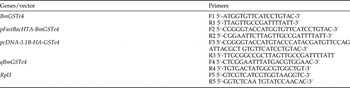
Total RNA was extracted from the head and epidermis of day 3 of fifth instar larvae using an RNeasy Mini kit (Qiagen, Germany) according to the manufacturer's instructions and contaminating genomic DNA was eliminated using RNase-free DNase (Promega, USA). First-strand cDNA was synthesized from 2 μg of total RNA by AMV Reverse Transcriptase (Promega, USA) according to the manufacturer's protocol. In brief, first-strand cDNA was generated in a 25-μl reaction volume containing 1 μg total RNA, 2 pM oligo (dT18), 20 U RNase inhibitor, and 5 U AMV reverse transcriptase. BmGSTe4 cDNA was amplified by PCR with the primers F1 and R1 (table 1) and cloned into the PGEM-T-Simple vector (Takara, Japan) and sequenced. The BmGSTe4 cDNA was then cloned into the KpnI/EcoR I site of the donor plasmid pFastBacHT A (Invitrogen, USA) with primers F2 and R2 (table 1) to construct pFastBacHTA-BmGSTe4 with a His-tag at the N-terminal. Then, the donor plasmid for bacmid construction was introduced into competent DH10Bac cells to prepare the DNA, and BmGSTe4 was subcloned into the KpnI-NotI site of the pcDNA3.1His/myc-tagged (pcDNA3.1B) vector (Invitrogen, USA), with the primers F3 and R3 (table 1) to produce pcDNA-3.1B-HA-GSTe4, with a hemagglutinin (HA) tag at the N-terminal for transient expression of BmGSTe4 in the SF-9 cells and HEK293 cells.
List of primers used in this study.

BmGSTe4 expression analysis
Quantitative real-time reverse transcription PCR (qRT-PCR) was performed using the primers F4 and R4 (table 1), and the cDNA template from the head and epidermis of the day 0, day 3, and day 4 fourth instar larvae, fourth instar larvae in the molting phase, and day 0 fifth instar larvae. The reaction conditions were as follows: 95°C/3 min, and 40 cycles of 95°C/5 s, 60°C/30 s. To confirm the amplification of the specific product, the following cycles were continued for melting curve analysis: from 65°C, the temperature was gradually increased by 0.5°C/s to 95°C, with data acquisition every 1 s. The reaction was performed in a total volume of 15 μl using SYBR Green PCR reagents (Invitrogen, USA), and SYBR green was used for fluorescence detection of the PCR product using MyiQ (Bio-Rad, USA). The silkworm housekeeping gene encoding ribosomal protein L3 (BmRpl3: GenBank accession no. NM_001043661.1) was used as an internal control for normalization of sample loading with the primers F5 and R5 (table 1) (Matsuoka & Fujiwara, Reference Matsuoka and Fujiwara2000). All the experiments were performed in triplicate and the relative gene expression was calculated according to the equation of 2−ΔCT (Livak & Schmittgen, Reference Livak and Schmittgen2001) using the Microsoft Excel.
All the data (expressed as the mean ± SD values of triplicate experiments) were analyzed using the unpaired Student's t-test after normalization. Differences were considered significant at P < 0.05.
Eukaryotic expression of BmGSTe4
Using the Bac-to-Bac® Baculovirus Expression System kit (Invitrogen, USA), eukaryotic expression of BmGSTe4 was determined in the SF-9 cells, according to the manufacturer's instructions. For infections, the appropriate number of cells was plated and the next day, the medium was removed and cells were infected by diluting the virus at a multiplicity of infection of 10 in a minimal amount of the Grace medium (Gibco, USA) just enough to cover the cells. A mock infection was performed by treating the cells with vehicle (media) only. One hour after incubation at 27°C, fresh medium was added. The cells were harvested at 72 h after the infection for analysis.
GST activity
The SF-9 cells were washed three times with PBS to remove the residual culture medium, and lysed for 15–20 min with 1× BugBuster protein extraction reagent (Dianova, USA) at 37°C. The enzyme activity of GST was spectrophotometrically measured by the method of Habig et al. (Reference Habig, Pabst and Jakoby1974). Briefly, 0.01 ml of the SF-9 cells lysates of wild-type baculovirus and the Bac-BmGSTe4 baculovirus was added to 1 ml of 50 mM sodium phosphate buffer (pH 6.5) containing 0.5 Mm 1-chloro-2,4-dinitrobenzene (CDNB) and 5 mM GSH as substrates. Changes in absorbance at 340 nm min−1 were monitored at 30°C and converted into moles of CDNB conjugated per minute per milligram of protein, using the molar extinction coefficient of the resultant 2,4-dinitropheny-1-glutathione (ε340 = 9600 M−1 cm−1).
Expression analysis of BmGSTe4 by phoxim treatment
Day 3 fifth instar larvae were exposed to the 50% lethal concentration (LC50) of phoxim at a certain concentration gradient via the mulberry leaves for 2 h; and the LC50 value of the day 3 fifth instar silkworm larvae against phoxim was 2.5 mg l−1 (Yu et al., Reference Yu, Fang, Zuo, Dai, Zhang and Lu2011). To mimic pesticide fumigation, pure phoxim immersed in cotton was placed in a closed box with the silkworm for 2 h. The silkworms were fed fresh mulberry leaves, and the head and epidermal tissues of the silkworms from each group (n = 50) were collected for RNA extraction and RT–PCR analysis. From each sample, 2 μg of total RNA was reverse-transcribed to first-strand cDNA using SuperScriptTM III reverse transcriptase (Invitrogen, USA) in a reaction volume of 20 μl with the oligodT18 primer. RT–PCR was performed using gene-specific primers and Taq DNA polymerase. The primers used were F4 and R4 (table 1). The reaction conditions and cycles for melting curve analysis were as described before for BmGSTe4 expression analysis above.
Transient transfection and UV treatment
To study the effect of BmGSTe4 overexpression on cells, we transfected pcDNA-3.1B- HA-GSTe4 into HEK293 cells till they covered more than 80% of the petri dish. Transient transfection was performed using X-treme GENE HP DNA (Roche, Switzerland) following the manufacturer's instructions. Twenty-four hours after transfection, a part of the cells were used for protein extraction for western blotting analysis, to detect the protein expression of BmGSTe4 using the anti-HA antibody (Invitrogen, USA). The detailed experimental method is shown in the western blotting analysis section. The remaining cells were irradiated with a UVC lamp (30 J m−2, 254 nm) for 4, 6, 8, and 10 min using SpectrolinkerXL-1000 (Spectronics, USA). Then, fresh medium was added and the cells were incubated for 24 h.
Western blotting analysis
The infected cells and transfected cells were washed twice with ice-cold PBS (pH 7.4), harvested by gentle scraping and collected by centrifugation at 800 g for 10 min at 4°C. The pellet was resuspended in 1 × BugBuster (Novagen) buffer incubated on ice for 30 min, and boiled for 10 min. It was then separated by 12% sodium dodecyl sulfate polyacrylamide gel electrophoresis (SDS-PAGE). Then the proteins were transferred to polyvinylidene difluoride (PVDF) membranes (Roche, Switzerland) immersed in ice-cold transfer buffer (25 mM Tris–HCl, 192 mM glycine, and 20% methanol). The membrane was blocked with 5% bovine serum albumin in 0.1% TBST (200 mM Tris [pH 8.0], 1.37 M NaCl, and 1% Tween-20) for 1.5 h at room temperature, incubated with the primary antibodies (antibodies against His and HA [Invitrogen, USA] and caspase 3 [Beyotime, China]) at room temperature for 1 h, and then washed and incubated with the secondary antibodies (peroxidase-conjugated anti-mouse secondary antibody [Beyotime, China]). The immunoblot was visualized using ECL Plus Western Blotting Detection Reagents (Amersham, USA).
Flow cytometric analysis
Apoptosis was examined by staining with the Annexin-V-Fluos staining kit (Beyotime, China). After incubations, floating as well as adherent cells that were later trypsinized were pooled and centrifuged at 500 g for 10 min. The pelleted cells were washed with PBS. Thereafter, the cells were centrifuged again and resuspended in 100 μl of Annexin-V-Fluor and PI labeling solution for 10 min. The stained cells were analyzed by flow cytometry, and the fluorescence emission was measured at 530 nm (Alexa Fluor 488). The percentage of apoptotic cells was calculated using the Cellquest software (BD Biosciences, USA). We performed the experiment in triplicate.
Results
Molecular characterization of BmGSTe4
Based on the sequence that we previously submitted (GenBank accession number EF506489), we cloned the BmGSTe4 gene. Sequencing revealed that the open reading frame of BmGSTe4 is composed of 654 bp, which encode 217 amino acid residues. The theoretical molecular mass and pI of putative GST were determined to be 25.3 kDa and 6, respectively. Comparison of this sequence with those deposited in the Bidirectional Recurrent Neural Network (http://scratch.proteomics.ics.Uci.edu/) revealed sequence similarity to other GSTs with regard to the β-α-β-α-β-β-α structural motif at the N-terminal, the α-helices present at the C-terminal, and a conserved serine loci, i.e., the GST catalytic center, near the N-terminus (fig. 1a). Comparison of the sequence with the GST sequences deposited in the NCBI Blast program online showed that the silkworm GSTe4 had 43% homology with Drosophila DmGSTe9 (CG17534) and DmGSTe2 (CG17523), 35 and 42% homology with Anopheles gambiae AgGSTE1 (AF316635) and AgGSTE2 (AF316636) respectively, and 47% homology with the Plutella xylostella PxGST3 (U66342) (fig. 1a). We analyzed the expression of BmGSTe4 in eight tissues of day 3 fifth instar larvae by RT-PCR, and we found that BmGSTe4 was mainly expressed in the epidermis and head and the expression was negligible in the other tissues (data not shown), which is consistent with the results of Yu et al. (Reference Yu, Fang, Zuo, Dai, Zhang and Lu2011). Moreover, the expression of BmGSTe4 was highly in day 0 to day 3 fourth instar larvae, started to decrease from day 4 and was the lowest in the fourth instar larvae in the molting phase; moreover, it abruptly increased in the head and epidermis tissues of the day 0 fifth instar larvae (fig. 1b).
Molecular characterization of BmGSTe4 (A) Sequence comparison between BmGSTe4 and other GSTs. The other amino acid sequences are from Anopheles gambiae, Plutella xylostella and Drosophila melanogaster. α and β represent the α helix and β fold, respectively. Identical amino acid residues are indicated by an asterisk (*). The catalytic active site (serine loci) is indicated with a red box. (B) Expression of BmGSTe4 in the head and epidermis during the development of the silkworm larvae. L4D0, day 0 of the fourth instar phase; L4D3, day 3 of the fourth instar phase; L4D4, day 4 of the fourth instar phase; 4molt, molting in the fourth instar phase; L5D0, day 0 of the fifth instar phase.

Overexpression and GST activity assay of BmGSTe4
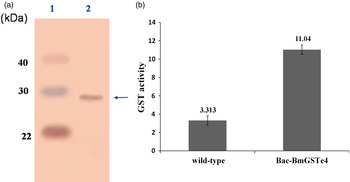
BmGSTe4 was successfully over-expressed in SF-9 cells with the pFastBacHT A vector. After 72 h of recombinant baculovirus infection, western blot analysis of the proteins extracted from the SF-9 cell lines revealed the presence of a specific protein band with size that was similar to the predicted size of BmGSTe4 (fig. 2a). The GST activity of Bac-BmGSTe4 cells was three times that of the control (11.04 μmol mg−1 protein per minute vs. 3.31 μmol mg−1 protein per minute), which indicates that exogenously expressed BmGSTe4 protein has good biological activity (fig. 2b).
BmGSTe4 eukaryotic expression. (A) Western blotting for eukaryotic expression of BmGSTe4. Lane 1, Pre-stained protein used as the molecular weight marker (14–94 kDa); Lane 2, BmGSTe4 extracts. (B) GST activity analysis. ‘Wild-type’ and ‘Bac-BmGSTe4’ represent the SF-9 cells infected with wild-type and recombinant baculovirus, respectively.

Effect of phoxim on BmGSTe4 expression in the head and epidermis
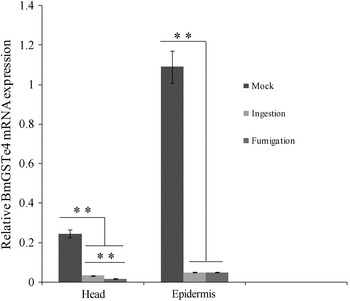
The primary role of GST in insects is defense against endogenous toxic substances, and Organophosphorus (OP) insecticide phoxim is a broad-spectrum insecticide that is often used to control lepidopteran pests in China. In order to investigate whether BmGSTe4 plays a role in detoxification, we detected the expression of BmGSTe4 in the head and epidermis after exposure the silkworms to phoxim via either fumigation or ingestion (licking of the mulberry leaves). RT-PCR analysis showed that the expression of BmGSTe4 in the head tissue decreased significantly by 7.73 times when the silkworm licked the phoxim off the mulberry leaves (P < 0.01); in the case of insects that were fumigated, the expression significantly decreased by 14.47 times (P < 0.01). The expression was 1.87 times higher in the fumigation group compared to the ingestion group (significant at P < 0.01). With regard to the epidermal tissue, BmGSTe4 expression decreased by 22.37 times after phoxim ingestion (significant at P < 0.01). With phoxim fumigation, BmGSTe4 expression decreased by 22.10 times compared to the control group (P < 0.01). However, the difference between the ingestion group and fumigation group was not significant (fig. 3).
Phoxim-induced expression of BmGSTe4 in the silkworm. Silkworms were exposed to phoxim either via fumigation or by ingestion as a result of licking of mulberry leaves on which phoxim (50% lethal concentration) was applied. BmRpl3 was used as the internal control. The data shown the mean ± SD value of triplicates experiments. *P < 0.05; ** P < 0.01. Unpaired Student's t-test.

Effect of BmGSTe4 overexpression on apoptosis
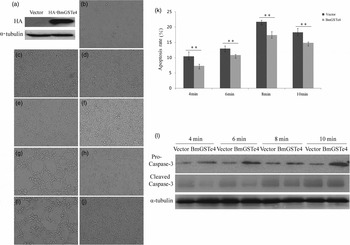
HEK293 cells were transfected with pcDNA3.1B or HA-tagged BmGSTe4. After 24 h of cell transfection, western blot analysis of the protein level revealed the presence of a specific protein band of size that was similar to the predicted size of BmGSTe4 (fig. 4a). Then, the transfected cells were exposed to UV radiation for 4, 6, 8 and 10 min, incubated for 24 h, and then examined by light microscopy. As the time of UV radiation increased, the number of cells detached and floating increased in the pcDNA3-transfected (fig. 4c, e, g, i) in contrast to the non-irradiated controls (fig. 4b). However, the cells transfected with BmGSTe4 (fig. 4d, f, h, j) showed less morphological changes after UV treatment. The results of flow cytometric analysis also showed that BmGSTe4 inhibited the HEK293 cell apoptosis induced by UV (fig. 4k). Caspase-3 is one of the main caspase in the apoptotic pathway, and a crucial step in apoptosis is caspase cleavage (Fan et al., Reference Fan, Wu, Jin and Yin2005; Martin & Ouchi, Reference Martin and Ouchi2005). To further study the function of BmGSTe4-induced inhibition of apoptosis, we examined the cleavage of caspase 3 as an indicator of apoptosis and found that the caspase 3 cleavage was dependent on the time of UV treatment (fig. 4l), and that caspase 3 cleavage showed a decrease in cells transfected with BmGSTe4 compared with cells transfected with pcDNA3.1B after exposing to UV radiation (fig. 4l).
Effect of BmGSTe4 overexpression on UV-induced apoptosis. (A) Western blotting analysis of the overexpression of BmGSTe4. (B–K) Morphology of HEK293 cells examined by light microscopy (magnification ×20). HEK293 cells were transfected with pcDNA3.1B (A, without UV; B, C, E, G, UV irradiation for 4, 6, 8, and 10 min, respectively) or BmGSTe4 (D, F, H, J, UV irradiation for 4, 6, 8, and 10 min, respectively), and were then incubated for 24 h after UV treatment (UV-C, 30 J m−2). (K) Detection of the apoptosis by flow cytometric analysis: 4, 6, 8, and 10 min represent the time of UV irradiation. The apoptosis rate was calculated as Q2 + Q3 on the scattergram in the supplemental figure. The data shown are the mean ± SD value of triplicates experiments. Error bars represent standard deviations from three independent replicates. *P < 0.05, **P < 0.01, unpaired Student's t-test. (L) HEK293 cells were UV irradiated (UV-C, 30 J m−2). Twenty-four after UV irradiation, the total cell lysates were prepared and separated by SDS–PAGE. Samples were immunoblotted with the indicated antibodies.

Discussion
The BmGSTe4 gene was cloned and identified in our previous study. In the phylogenetic tree, BmGSTe4 was found clustered together with the other epsilon family members, so it was classified in the epsilon family (Yu et al., Reference Yu, Lu, Li, Fang, Zuo, Dai, Zhang and Xiang2008). Further studies showed that the BmGSTe4 amino acid sequence was very similar to that of other species, such as A. gambiae (AgGSTE2-AF316636 and AgGSTE1-AF316635), the P. xylostella (PxGST3-U66342), and D. melanogaster (DmGSTe9-CG7534, DmGSTe2-CG 7525). Moreover, the BmGSTe4 sequence was similar to that of other GSTs with regard to a conserved serine site present near the catalytic center located in the N-terminal sequence (Armstrong, Reference Armstrong1997). This amino acid site is also present in the theta family; however, it is replaced by a tyrosine site in the alpha, mu, and pi families (Board et al., Reference Board, Coggan, Wilce and Parker1995; Reinemer et al., Reference Reinemer, Prade, Hof, Neuefeind, Huber, Zettl, Palme, Schell, Koelln, Bartunik and Bieseler1996; Rossjohn et al., Reference Rossjohn, McKinstry, Oakley, Verger, Flanagan, Chelvanayagam, Tan, Board and Parker1998; Sheehan et al., Reference Sheehan, Meade, Foley and Dowd2001). We also found that the enzymatic activity of BmGSTe4-overexpressing cells (infected with the Bac-BmGSTe4 recombinant virus) is three times that of normal cells, and the results are consistent with those of Yamamoto et al. (Reference Yamamoto, Aso and Yamada2013), which indicated that the recombinant protein has good GST activity. These results confirmed that BmGSTe4 belonged to the GST family in the silkworm.
Although detoxification is one of the main functions of insect GST (Board et al., Reference Board, Russell, Marano and Oakeshott1994), we found that BmGSTe4 was mainly expressed in the head and epidermis, and that there is almost no expression in the main detoxifying tissues such as the fat body, midgut, and blood cells. Moreover, the expression of BmGSTe4 in the head and epidermis significantly decreased but it did not significantly increase in the detoxifying tissues (fat body and midgut) after exposure of the silkworms to phoxim, which suggests that the function of BmGSTe4 is different from that of BmGSTe2 and BmGSTe8 in detoxifying tissues: the expression of BmGSTe2 and BmGSTe8 increased after the silkworms were exposed to phoxim, which indicates that the two proteins play a role in detoxification (Gui et al., Reference Gui, Hou, Liu, Qin, Li and Jin2009; Yu et al., Reference Yu, Fang, Zuo, Dai, Zhang and Lu2011). Further, exposure of the silkworms to phoxim via ingestion or fumigation showed that the expression level of BmGSTe4 in the epidermis had not changed significantly; however, there was a significant difference in its expression in the head, in which the effect of fumigation was much more significant than that of ingestion. From these findings, we summarized that the main function of BmGSTe4 may not be merely detoxification, and that it may also have other important physiological functions.
During in vitro studies, in which cells were transfected with BmGSTe4, UV-induced apoptosis was inhibited, and the inhibition was more obvious with the time, which indicates that BmGSTe4 expression protected the cells against UV irradiation. This is also in agreement with other studies on the role of GST in the inhibition of apoptosis. In 1999, Adler et al. (Reference Adler, Yin, Fuchs, Benezra, Rosario, Tew and Ronai1999) found that GSTPi overexpression inhibited the JNK activity in mouse fiber cells and suppressed dopamine-induced apoptosis via inhibition of JNK activity in PC12 cells (Ishisaki et al., Reference Ishisaki, Hayashi, Suzuki, Ozawa, Mizukoshi, Miyakawa, Suzuki and Imamura2001). Moreover, overexpression of hGSTA2-2 in K562 cells attenuated the cytotoxic effects of H2O2 and other oxidants and protected against H2O2-induced apoptosis by blocking SAPK/JNK and caspase 3 activation (Tjalkens et al., Reference Tjalkens, Valerio, Awasthi and Petersen1998). Overexpression of GSTM1-1 also prevented apoptosis induced by H2O2 or UV treatment in mice (Cho et al., Reference Cho, Lee, Park, Ryoo, Kang, Park and Choi2001; Ryoo et al., Reference Ryoo, Huh, Lee, Yoon, Cho and Choi2004). Recently, Piaggi et al. (Reference Piaggi, Raggi, Corti, Pitzalis, Mascherpa, Saviozzi, Pompella and Casini2010) found that overexpression of GSTO1-1 was related to the activation of survival signals, inhibition of the apoptosis pathway, and the prevention of apoptosis induced by cytotoxic drugs in HeLa cells. Therefore, we think that the BmGSTe4 may play a role in the inhibition of apoptosis in the silkworm. However, we aligned the amino acid sequences and found that the similarity of BmGSTe4 with the published GST genes is relatively low in the C-terminal region, which region has been reported to be critical for suppressing apoptosis. Furthermore, the silkworm undergoes complete metamorphosis in which apoptosis plays an important role: it involves the removal of the old epidermis and generation of a new one during the molting phase. The expression of anti-apoptotic genes is maintained at a low level for programmed cell death in the process of removal of the epidermis; conversely, the expression level of pro-apoptotic genes is significant high to maintain the normal development of the silkworm during the un-molting phase. Our data are very consistent with the expected results. The expression level of BmGSTe4 gene was extremely low during the molting phase in the head and epidermis of silkworm, however, the level was higher during the pre-molting and next phase, including vigorous feeding phase. According to these results, therefore, we suggested that BmGSTe4 may have an anti-apoptotic role during metamorphosis in the silkworm, which will be further confirmed in future studies.
In conclusion, the BmGSTe4 gene in the silkworm is sensitive to insecticides, which is an impactful finding in biological pesticide research. Moreover, BmGSTe4 may inhibit cell apoptosis and therefore could have important applications in the modification of bioreactors seeded with cells and screening of anticancer drugs.
Supplementary Material
The supplementary material for this article can be found at http://www.journals.cambridge.org/BER
Acknowledgements
This work was supported by grants from the National High-tech R&D Program of China (Grant No. 2013AA102507), the National Natural Science Foundation of China (Grant Nos 31172269, and 31272505) and the Specialized Research Fund for the Doctoral Program of Higher Education (Grant No. 20120182110010).