INTRODUCTION
Sigalionidae is one of six polychaete families known as ‘scale worms’, in which the dorsal cirri of alternating segments are modified to form overlapping elytra which cover all or most of the dorsum (Fauchald, Reference Fauchald1977). The family mostly comprises long and slender medium-sized to large individuals, with up to several hundreds of segments (Hutchings, Reference Hutchings, Beesley, Ross and Glasby2000; Rouse & Pleijel, Reference Rouse and Pleijel2001).
The genus Pholoides was first assigned to the family Sigalionidae (Pruvot, Reference Pruvot1895). Later on, the genus Peisidice was described by Johnson (Reference Johnson1897) for the species Peisidice aspera, and Darboux (Reference Darboux1900) established the family Peisidicidae to acommodate this genus, but this was largely ignored. Hartman (Reference Hartman1959, Reference Hartman1968) placed Peisidice in the family Acoetidae and Pholoides in the Sigalionidae, as a synonym of Pholoe. A few years later, Hartman & Fauchald (Reference Hartman and Fauchald1971) resurrected the family Peisidicidae and described Peisidice bermudensis. In 1977, however, Fauchald established the family Pholoididae, based upon Pholoides, as a new name for Peisidicidae. The author included Parapholoe Hartmann-Schröder, Reference Hartmann-Schröder1965 in this family. Pettibone (Reference Pettibone and Parker1982) resurrected the family Pholoidae Kinberg, 1858, in which she included Pholoides (including Peisidice) and Pholoe. A few years later this same author synonymized Paraeupholoe Hartmann-Schröder, Reference Hartmann-Schröder1962 and Parapholoe with Pholoides, and the family Pholoididae became a subjective synonym of the family Pholoidae (Pettibone, Reference Pettibone1992). In a recent work, the genus Pholoides was replaced in the Sigalionidae family based on molecular data (Norlinder et al., Reference Norlinder, Nygren, Wiklund and Pleijel2012).
To date there are four recognized Pholoides species, with Pholoides brasiliensis sp. nov. described in this study and one species whose generic assignment to Pholoides is uncertain (Pettibone, Reference Pettibone1992; Read & Fauchald, Reference Read and Fauchald2013).
Sigalionids are widely distributed and are quite common in benthic samples, although they are rarely present in large numbers (Hutchings, Reference Hutchings, Beesley, Ross and Glasby2000). The species of this family can be found in areas ranging from the intertidal zone to the continental shelf and slope depths, and also occur in estuarine habitats (Hutchings & Murray, Reference Hutchings and Murray1984; Blake, Reference Blake, Blake, Hilbig and Scott1995b). Most sigalionids burrow rapidly in mud or sand, but some species have been recorded from coarse substrates or living in association with coralline algae, shells and bryozoans; in addition, a few groups are tubiculous (Pettibone, Reference Pettibone1970; Hutchings, Reference Hutchings, Beesley, Ross and Glasby2000). Pholoides species can be found on various muddy and sandy substrata, in crevices, stone or mixed bottoms, from shallow water up to approximately 2000 m depth.
Most helpful for the identification of Pholoides species is the review of the family Pholoidae, by Pettibone (Reference Pettibone1992), which provides descriptions and illustrations of the three species in the genus known so far. Other works, including those from Blake (Reference Blake, Blake, Hilbig and Scott1995a), Barnich & Fiege (Reference Barnich and Fiege2003) and Imajima (Reference Imajima2003), also provide good descriptions of the genus and species.
MATERIALS AND METHODS
The material reported in this study originates from south-east Brazil (Espírito Santo, Rio de Janeiro and São Paulo States). The specimens were collected during two large projects that were engaged in clarifying the Brazilian coast marine biota: REVIZEE/South Score/Benthos/MMA ‘Program of the Evaluation of the Living Resources of the Exclusive Economic Zone’ (for details see Amaral et al., Reference Amaral, Lana, Fernandes, Coimbra, Amaral and Rossi-Wongtschowski2004) and HABITATS/CENPES/PETROBRAS—‘Campos Basin Environmental Heterogeneity’. The polychaetes were fixed in 4% formalin and preserved in 70% ethanol. Measurements were made using compound microscopy and stereomicroscopy. Length was measured from the anterior margin of the prostomium to the posterior border of the last segment (not including the pharynx, if everted) and width was measured at the widest segment, excluding the parapodia and chaetae. The specimens were examined under a stereomicroscope and digital images were recorded with a digital camera. Scanning electron microscope (SEM) photographs were taken with a JEOL JSM-5800 LV equipment following standard methods. The examined material is deposited in the Museu de Zoologia Prof Adão José Cardoso of the Instituto de Biologia, Universidade Estadual de Campinas, São Paulo, Brazil (ZUEC).
SYSTEMATICS
Class POLYCHAETA Grube, 1850
Family SIGALIONIDAE Malmgren, 1867
Genus Pholoides Pruvot, Reference Pruvot1895
Pholoides brasiliensis sp. nov.
(Figures 1–3)
Pholoides brasiliensis sp. nov.: (A, B) complete specimen with elytra, dorsal view; (C) complete specimen without elytra, dorsal view; (D–F) prostomium, dorsal view; (G) anterior region, dorsal view, with details of left tentacular cirrus and palp. MA, median antenna; P, palp; TC, tentacular cirrus.

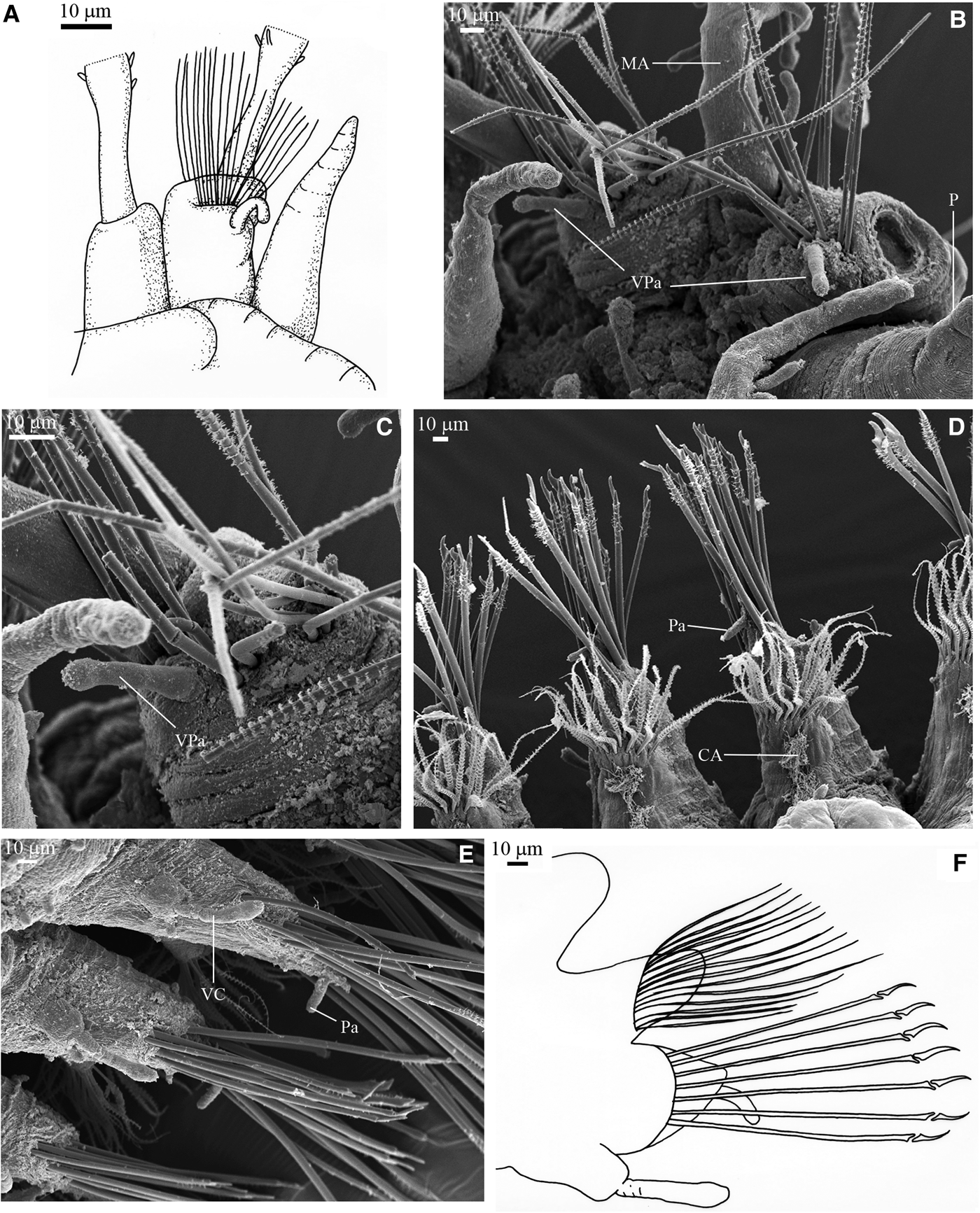
Pholoides brasiliensis sp. nov.: (A–C) anterior region, ventral view, with details of the ventral papilla; (D) parapodia from median region, dorsal view; (E) parapodia from median region, ventral view; (F) parapodium from median region, posterior view. CA, ciliated area; Pa, papilla; VC, ventral cirri; Vpa, ventral papilla.
Pholoides brasiliensis sp. nov.: (A) elytron from anterior region; (B) elytron from median region; (C) parapodia from anterior region, dorsal view, with details of capillaries notochaeta; (D) neurochaeta falcigers. Sp, spinous chaeta.
TYPE MATERIAL
Holotype of Pholoides brasiliensis sp. nov.: ZUEC 11612; 22°31′7.116″S 40°31′32.874″W; 137 m; 3 July 2009; 1 specimen (spm).
Paratypes of Pholoides brasiliensis sp. nov. (9 specimens (spms)): ZUEC 11613; 23°10′4.258″S 41°3′6.679″W; 105 m; 21 February 2009; 2 spms. ZUEC 10495; 23°36′14.972″S 41°21′30.073″W; 145 m; 1 July 2009; 7 spms.
COMPARATIVE TYPE MATERIAL
Holotype of Pareupholoe fimbriata: (ZMH P-14022); Isla Santa, Bahia Coisco, north of Chimbote, Peru; 9 m; 24 April 1956.
NON-TYPE MATERIAL (380 SPECIMENS)
ZUEC 6141; 23°49′90″S 43°14′40″W; 138 m; 15 February 1998; 12 spms. ZUEC 6142; 23°17′30″S 42°42′60″W; 100 m; 16 February 1998; 1 spm. ZUEC 6143; 23°36′54″S 42°09′86″W; 187 m; 16 February 1998; 9 spms. ZUEC 6144; 23°26′70″S 42°14′05″W; 131 m; 17 February 1998; 1 spm. ZUEC 6146; 23°41′26″S 41°44′26″W; 149 m; 17 February 1998; 1 spm. ZUEC 6150; 23°26′20″S 41°15′82″W; 146 m; 28 February 1998; 1 spm. ZUEC 6151; 23°08′07″S 41°00′84″W; 100 m; 1 March 1998; 23 spms. ZUEC 6152; 24°20′844″S 44°09′913″W; 258 m; 10 January 1998; 14 spms. ZUEC 6153; 24°20′844″S 44°09′913″W; 258 m; 10 January 1998; 1 spm. ZUEC 6154; 24°20′844″S 44°09′913″W; 258 m; 10 January 1998; 1 spm. ZUEC 6155; 24°20′844″S 44°09′913″W; 258 m; 10 January 1998; 1 spm. ZUEC 6156; 24°17′129″S 44°12′179″W; 163 m; 10 January 1998; 1 spm. ZUEC 6157; 24°17′129″S 44°12′179″W; 163 m; 10 January 1998; 2 spms. ZUEC 6158; 26°27′75″S 44°30′351″W; 165 m; 11 January 1998; 2 spms. ZUEC 6159; 26°27′75″S 44°30′351″W; 165 m; 11 January 1998; 6 spms. ZUEC 6160; 26°27′75″S 44°30′351″W; 165 m; 11 January 1998; 2 spms. ZUEC 6164; 24°49′699″S 44°44′965″W; 153 m; 12 January 1998; 1 spm. ZUEC 6166; 25°11′005″S 44°56′6″W; 168 m; 12 January 1998; 7 spms. ZUEC 6168; 25°11′005″S 44°56′6″W; 168 m; 12 January 1998; 2 spms. ZUEC 6165; 25°11′005″S 44°56′6″W; 168 m; 12 January 1998; 1 spm. ZUEC 6163; 24°49′699″S 44°44′965″W; 153 m; 12 January 1998; 2 spms. ZUEC 6167; 25°11′005″S 44°56′6″W; 168 m; 12 January 1998; 18 spms. ZUEC 6169; 25°36′988″S 45°13′571″W; 380 m; 13 January 1998; 11 spms. ZUEC 6170; 25°36′988″S 45°13′571″W; 380 m; 13 January 1998; 3 spms. ZUEC 6171; 25°36′988″S 45°13′571″W; 380 m; 13 January 1998; 1 spm. ZUEC 6174; 25°36′988″S 45°13′571″W; 380 m; 13 January 1998; 10 spms. ZUEC 6173; 26°31′269″S 46°34′377″W; 270 m; 19 January 1998; 1 spm. ZUEC 6177; 29°14′672″S 47°50′669″W; 506 m; 22 March 1998; 1 spm. ZUEC 10503; 23°36′14.438″S 41°21′29.888″W; 142 m; 1 March 2009; 1 spm. ZUEC 10494; 23°36′14.903″S 41°21′29.953″W; 143 m; 1 March 2009; 2 spms. ZUEC 10473; 23°10′4.780″S 41°3′6.553″W; 107 m; 21 February 2009; 2 spms. ZUEC 10470; 23°10′5.075″S 41°3′6.121″W; 105 m; 21 February 2009; 8 spms. ZUEC 10507; 23°10′4.258″S 41°3′6.679″W; 105 m; 21 February 2009; 19 spms. ZUEC 10517; 23°11′30.269″S 41°0′47.888″W; 150 m; 21 February 2009; 3 spms. ZUEC 10485; 23°11′28.980″S 41°0′49.645″W; 117 m; 21 February 2009; 21 spms. ZUEC 10500; 23°11′29.016″S 41°0′49.451″W; 106 m; 21 February 2009; 16 spms. ZUEC 10518; 22°46′54.841″S 41°3′33.651″W; 78 m; 22 February 2009; 1 spm. ZUEC 10478; 22°52′1.983″S 40°57′28.958″W; 92 m; 22 February 2009; 2 spms. ZUEC 10502; 22°57′28,366″S 40°50′30.283″W; 142 m; 21 February 2009; 3 spms. ZUEC 10481; 22°57′29.140″S 40°50′30.582″W; 143 m; 21 February 2009; 1 spm. ZUEC 10505; 22°19′32.127″S 40°37′18.980″W; 75 m; 15 March 2009; 1 spm. ZUEC 10504; 22°31′7.850″S 40°31′32.592″W; 139 m; 23 February 2009; 2 spms. ZUEC 10475; 22°23′39.087″S 40°20′40.989″W; 153 m; 23 February 2009; 6 spms. ZUEC 10506; 22°23′38.946″S 40°20′42.055″W; 153 m; 23 February 2009; 1 spm. ZUEC 10509; 22°4′14.420″S 40°6′59.597″W; 91 m; 25 February 2009; 6 spms. ZUEC 10490; 22°4′14.344″S 40°6′59.499″W; 91 m; 25 February 2009; 4 spms. ZUEC 10486; 22°4′14.157″S 40°6′59.543″W; 92 m; 25 February 2009; 5 spms. ZUEC 10472; 22°6′10.670″S 40°3′6.481″W; 154 m; 24 February 2009; 6 spms. ZUEC 10489; 21°43′9.996″S 40°11′30.593″W; 73 m; 9 March 2009; 2 spms. ZUEC 10492; 21°42′53.723″S 40°10′15.249″W; 98 m; 9 March 2009; 8 spms. ZUEC 10471; 21°42′53.939″S 40°10′16,213″W; 98 m; 9 March 2009; 2 spms. ZUEC 10491; 21°42′53.677″S 40°10′16.159″W; 99 m; 9 March 2009; 13 spms. ZUEC 10479; 21°22′58.975″S 40°19′42.346″W; 52 m; 5 March 2009; 1 spm. ZUEC 10511; 21°22′59.169″S 40°19′41.518″W; 52 m; 5 March 2009; 1 spm. ZUEC 10512; 23°36′14.970″S 41°21′30.165″W; 145 m; 1 July 2009; 1 spm. ZUEC 10476; 23°10′5.207″S 41°3′6.453″W; 107 m; 2 July 2009; 11 spms. ZUEC 10516; 23°10′5.307″S 41°3′6.623″W; 107 m; 2 July 2009; 8 spms. ZUEC 10483; 23°10′5.037″S 41°3′7.563″W; 107 m; 2 July 2009; 2 spms. ZUEC 10493; 23°12′8.687″S 40°59′35.742″W; 141 m; 2 July 2009; 2 spms. ZUEC 10520; 23°12′8.737″S 40°59′35.592″W; 142 m; 2 July 2009; 2 spms. ZUEC 10501; 23°12′8.577″S 40°59′35.662″W; 142 m; 2 July 2009; 5 spms. ZUEC 10519; 22°46′54.819″S 41°3′33.001″W; 77 m; 3 July 2009; 1 spm. ZUEC 10521; 22°52′2.108″S 40°57′29.073″W; 92 m; 3 July 2009; 5 spms. ZUEC 10477; 22°57′28.059″S 40°50′30.307″W; 142 m; 3 July 2009; 2 spms. ZUEC 10496; 22°57′28.439″S 40°50′30.307″W; 143 m; 3 July 2009; 3 spms. ZUEC 10474; 22°31′7.826″S 40°31′32.004″W; 138 m; 3 July 2009; 1 spm. ZUEC 10513; 22°31′7.116″S 40°31′32.874″W; 137 m; 3 July 2009; 1 spm. ZUEC 10487; 22°31′7.516″S 40°31′32.534″W; 138 m; 3 July 2009; 2 spms. ZUEC 10498; 22°23′39.088″S 40°20′41.226″W; 150 m; 4 July 2009; 1 spm. ZUEC 10482; 22°3′38.669″S 40°6′59.326″W; 89 m; 6 July 2009; 11 spms. ZUEC 10510; 22°3′39.049″S 40°6′59.816″W; 90 m; 6 July 2009; 4 spms. ZUEC 10497; 22°3′38.379″S 40°6′59.406″W; 90 m; 7 July 2009; 6 spms. ZUEC 10499; 22°6′10.639″S 40°3′6.304″W; 149 m; 7 July 2009; 3 spms. ZUEC 10484; 22°6′12.959″S 40°3′5.184″W; 150 m; 7 July 2009; 4 spms. ZUEC 10488; 21°43′10.326″S 40°11′30.843″W; 72 m; 8 July 2009; 5 spms. ZUEC 10515; 21°42′53.895″S 40°10′14.920″W; 97 m; 7 July 2009; 2 spms. ZUEC 10508; 21°42′53.795″S 40°10′15.120″W; 98 m; 7 July 2009; 3 spms. ZUEC 10514; 21°22′58.615″S 40°19′41.014″W; 53 m; 21 July 2009; 1 spm. ZUEC 10480; 21°9′9.813″S 40°16′7.837″W; 103 m; 21 July 2009; 2 spms. ZUEC 10522; 22°36′27.435″S 40°22′29.455″W; 726 m; 25 June 2008; 1 spm. ZUEC 10525; 22°19′57.789″S 40°1′59.201″W; 707 m; 7 July 2008; 1 spm. ZUEC 10523; 22°20′50.700″S 40°2′58.163″W; 705 m; 7 July 2008; 3 spms. ZUEC 10524; 22°7′39.877″S 39°54′15.005″W; 680 m; 8 February 2009; 1 spm. ZUEC 11389; 22°46′54.978″S 41°3′32.960″W; 77 m; 22 February 2009; 1 spm. ZUEC 11365; 22°31′8.084″S 40°31′32.077″W; 139 m; 23 February 2009; 1 spm. ZUEC 11377; 22°3′45.625″S 40°9′59.188″W; 75 m; 25 February 2009; 1 spm. ZUEC 11387; 22°6′10.540″S 40°3′6.632″W; 153 m; 24 February 2009; 1 spm. ZUEC 11364; 21°43′10.040″S 40°11′30.704″W; 73 m; 9 March 2009; 2 spms. ZUEC 11381; 21°22′58.813″S 40°19′41.885″W; 52 m; 5 March 2009; 4 spms. ZUEC 11390; 21°22′59.169″S 40°19′41.518″W; 52 m; 5 March 2009; 1 spm.
DIAGNOSIS
Body short, with up to 34 segments. Elytra on segments 2, 4, 5 and 7, continuing on alternate segments to the end of the body. Prostomium oval and poorly bilobed; median antenna on ceratophore in anterior notch, without auricles or lateral antennae. Tentaculophores with a bundle of notochaetae and single tentacular cirrus on the dorsal side and a prominent papilla on the ventral side. Parapodia biramous, notopodia and neuropodia with subconical acicular lobes; neuropodia with a long papilla subdistally.
DESCRIPTION
Size range of material examined 0.7–6.0 mm long (holotype 2.5 mm), 0.2–1.2 mm wide (holotype 1.0 mm) and 11–34 segments (holotype 28 segments). Body subrectangular, tapering slightly anteriorly and posteriorly, flattened ventrally, convex dorsally (Figure 1A–C); mid-dorsum with globular tubercles (Figure 1C, E); ventral surface of body slightly papillate.
Prostomium and tentacular segment fused; prostomium oval and poorly bilobed (Figure 1D–F); two pairs of eyes, anterior pair slightly larger than posterior pair (Figure 1D–F); median antenna with large ceratophore on anterior border of prostomium, long style enlarged subdistally (Figure 1E, F), with long papillae and filiform clavate tip; (Figure 1E, F); lateral antennae absent. Tentaculophores anterior and lateral to prostomium, each with bundle of long capillary notochaetae on inner side, one long tentacular cirrus (similar to median antenna) on outer side (Figure 1D–G) and prominent papilla on ventral side (Figure 2A–C). Palps stout, extending ventral and lateral to tentaculophores, with rugose surface and rows of minute papillae (Figure 1D–G). Eversible muscular pharynx with nine dorsal and nine ventral border papillae and two pairs of jaws.
Elytra on bulbous elytrophores present on segments 2, 4, 5 and 7, and then continuing on alternate segments to the end of the body, nearly covering the dorsum completely (mid-dorsum of posterior region uncovered) (Figure 1A, B). Dorsal tubercles on segments without elytra nodular, with small distal papilla. Elytra large and subtriangular, with faint concentric rings and few papillae on surface (Figure 3A, B); margins with long papillae, some of them bifurcate (Figure 3A, B).
Parapodia biramous; notopodia smaller than neuropodia (Figure 2D, F), notopodial lobes rounded and subconical (Figure 2F), with cilia on the median region (Figure 2D) and numerous long, curved, spinose notochaetae tapering to capillary tip (Figure 3C). Neuropodia with conical prechaetal acicular lobe with a prominent papilla subdistally (Figure 2E, F) and shorter postchaetal lobe. Neurochaetae stouter than notochaeta, compound, with shafts spinous subdistally and blades short, spinous and falcate with unidentate tips (Figure 3D). Ventral cirri shorter than neuropodia, without papillae and slightly annulated (Figure 2E, F). Pygidium with a pair of anal cirri.
ETYMOLOGY
The species is named P. brasiliensis because it is the first species of the genus from Brazilian waters.
TYPE LOCALITY
South-east Brazil (Espírito Santo, Rio de Janeiro and São Paulo States).
HABITAT
The specimens of P. brasiliensis sp. nov. were found at depths ranging from 52 to 726 m, in sandy sediment.
DISCUSSION
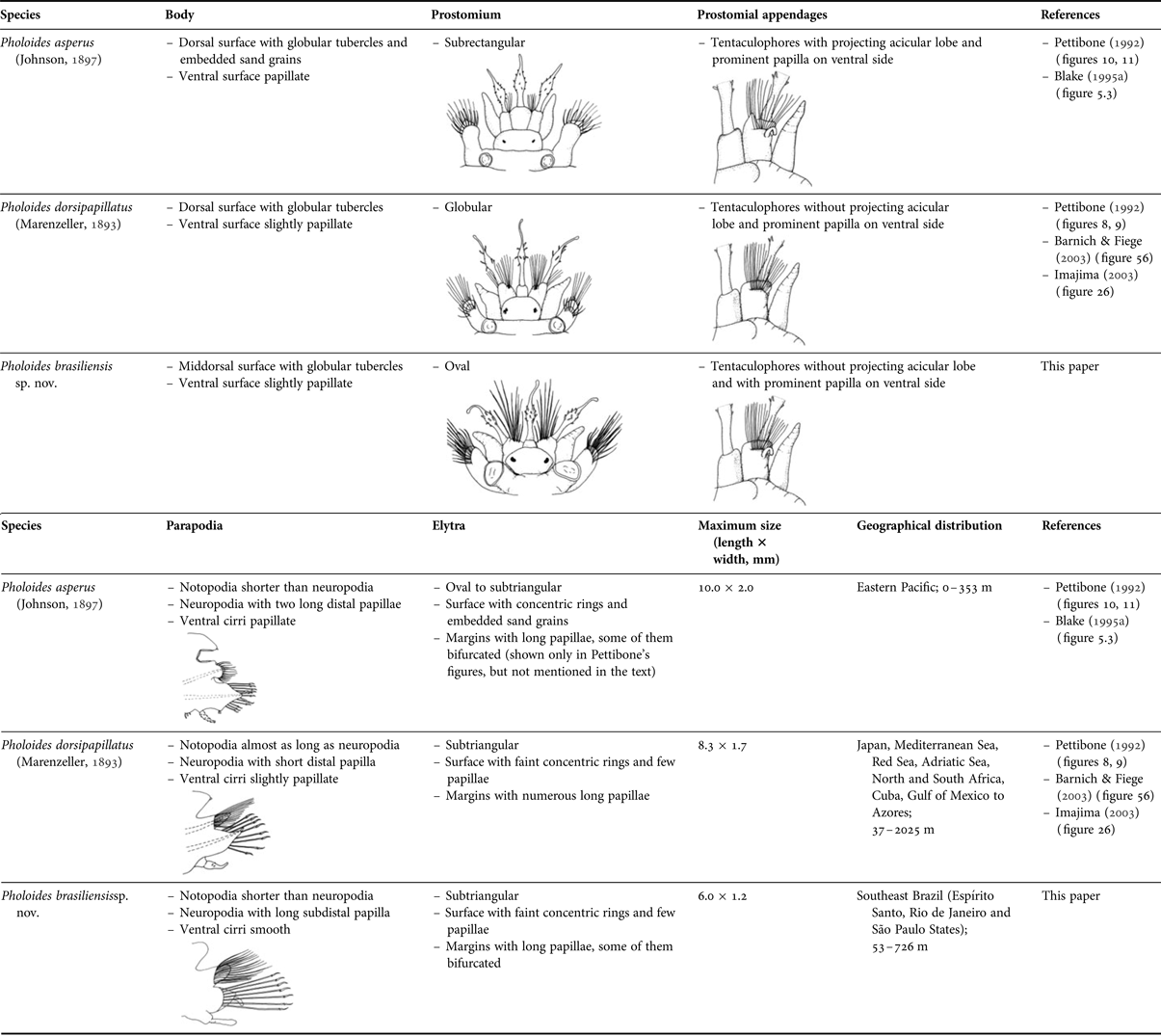
The genus Pholoides actually contains four species. Three of them are presented in Table 1 (P. dorsipapillatus, P. asperus and P. brasiliensis sp. nov.).
Comparison among Pholoides species (Figures of P. asperus and P. dorsipapillatus are modified from Pettibone, Reference Pettibone1992).
The generic assignment of Pholoides mendeleevi (Averincev, 1978), however, remains doubtful. This species was originally described as a Pholoe species, but it was subsequently placed in Pholoides by Pettibone (Reference Pettibone1992). It agrees with the latter genus in having tentaculophores with notochaetae, in the shape and papillation of the single pair of tentacular cirri and median antenna and in the details of the elytra and chaetae. However, P. mendeleevi has two additional short papillate appendages arising from the medioventral sides of tentaculophores, which could be ventral tentacular cirri, not yet known for Pholoides. For this reason, the new combination is somewhat doubtful (Pettibone, Reference Pettibone1992).
Pholoides brasiliensis sp. nov. differs from other species in the genus due to its long papilla in the subdistal region of the neuropodia (Figure 2E, F). Pholoides dorsipapillatus has neuropodia with a short distal papilla (Pettibone, Reference Pettibone1992, figure 9C, F) and P. asperus has two long distal papillae (Pettibone, Reference Pettibone1992, figure 10F, I, J). Pareupholoe fimbriata Hartmann-Schröder, Reference Hartmann-Schröder1962 (young specimen of Pholoides asperus according to Pettibone, Reference Pettibone1992) also has a single papilla on the neuropodial conical acicular lobe, however, it is positioned distally (Pettibone, Reference Pettibone1992; figure 11B, C; Hartmann-Schröder, Reference Hartmann-Schröder1962, plate 3, figures 8, 9) instead of subdistally. Furthermore, P. fimbriata has a papillate ventral cirri (Pettibone, Reference Pettibone1992; figure 11B, C; Hartmann-Schröder, Reference Hartmann-Schröder1962, plate 3, figures 8, 9) while P. brasiliensis has ventral cirri without papillae and slightly annulated (Figure 2E, F). The analysis of the holotype of Pareupholoe fimbriata showed that it is incomplete; the anterior region and head are absent and most of the parapodial lobes are broken. For this reason, the differences mentioned above between Pareupholoe fimbriata and Pholoides brasiliensis are mainly based on the descriptions and illustrations of Pettibone (Reference Pettibone1992) and Hartmann-Schröder (Reference Hartmann-Schröder1962).
Similar to P. dorsipapillatus, P. brasiliensis sp. nov. has tentaculophores without projecting acicular lobe (Figure 2A–C; Pettibone, Reference Pettibone1992, figure 9B), however, it has a prominent papilla on the ventral side of the tentaculophores (Figure 2A–C), such as P. asperus (Pettibone, Reference Pettibone1992, figure 10C, D). This papilla was called a rudimentary tentacular cirrus by Hartmann-Schröder (Reference Hartmann-Schröder1965), perhaps because all other members of the Pholoidae and Sigalionidae are known to have a pair of tentacular cirri.
Another interesting character of P. brasiliensis sp. nov. is that elytral papillae can be bifurcate (Figure 3B). The same feature is shown in figure 11F in Pettibone (Reference Pettibone1992) for P. asperus, but it is not mentioned in the text.
Despite the fact that Pholoides has been recently placed into the Sigalionidae family based on molecular data (Norlinder et al., Reference Norlinder, Nygren, Wiklund and Pleijel2012), the morphological characteristics of this genus, such as the compound falcigers with short blades and the short, subrectangular body with few segments, are more similar to the ones found in Pholoidae species.
ACKNOWLEDGEMENTS
We would like to thank Tatiana Steiner from UNICAMP for her valuable assistance in describing the polychaetes and Décio Gomes for the line drawings.
FINANCIAL SUPPORT
We gratefully acknowledge CNPq (project REVIZEE-South Score) and CENPES/PETROBRAS (project HABITATS), for funding and providing the specimens here examined, especially Dr Ana Paula Falcão, who kindly invited us to participate in the HABITATS project. We would also like to thank CNPq for the Master's scholarship.