


Introduction
Climate change is destabilizing ecosystems and societies worldwide through the effects of extreme weather events such as storms, heatwaves and drought (ONU, 2022). Climate warming is mainly caused by burning fossil fuels that emit gases and intensify the greenhouse effect (Allen et al., Reference Allen, Macalady, Chenchouni, Bachelet, McDowell and Vennetier2010). Globally, the climate is becoming increasingly unstable, and this is directly impacting biodiversity (Bellard et al., Reference Bellard, Bertelsmeier, Leadley, Thuiller and Courchamp2012; Costa-Coutinho et al., Reference Costa Coutinho, Jardim, Miranda and Castro2022) by affecting local climatic conditions (McCullough et al., Reference McCullough, Davis and Williams2017). This puts species under stress and drives acclimatization, adaptation, migration and extinction (Kotak et al., Reference Kotak, Larkindale, Lee, von Koskulldöring, Vierling and Scharf2007; Bellard et al., Reference Bellard, Bertelsmeier, Leadley, Thuiller and Courchamp2012; Kunert et al., Reference Kunert, Hajek, Hietz, Morris, Rosner and Tholen2022). Generalist species are able to tolerate a wide range of conditions and have broad ecological niches (Ulrich et al., Reference Ulrich, Wasteneys, Hoy-Skubik and Alongi2023). In contrast, specialist species, which are adapted to specific conditions (Richmond et al., Reference Richmond, Breitburg and Rose2005), are more sensitive to disturbances and climatic changes and may be more easily driven to extinction (Evangelista et al., Reference Evangelista, Kumar, Stohlgren, Jarnevich, Crall, Norman and Barnett2008; Leão et al., Reference Leão, Reinhardt, Nic Lughadha and Reich2021).
Conifers are particularly vulnerable to changing environmental conditions because they are unable to adapt or disperse in short timeframes. Their long evolutionary history, ancient conserved traits and limited dispersal capacity put them at risk of extinction (Farjon, Reference Farjon2017; Rueda et al., Reference Rueda, Godoy and Hawkins2017). As the climate becomes less suitable (Soja et al., Reference Soja, Tchebakova, French, Flannigan, Shugart and Stocks2007; Bernardinis et al., Reference Bernardinis, Cobos, Brum, Marques, Peterson, Carlucci and Zwiener2023), they may suffer from stress and die, reducing population size and distribution (Silva et al., Reference Silva, Da, Ribeiro, Thiesen Brum, Soares-Filho, Loyola and Michalski2018). Research is needed to identify the likely impacts of climate change on their current geographical distribution to inform conservation planning (Ludwig et al., Reference Ludwig, Mangel and Haddad2001; Kozlowski & Song, Reference Kozlowski and Song2022). Information on future climate scenarios can be used to assess the potential impacts of global warming on conifers and their ability to survive within their current ranges (Pacifici et al., Reference Pacifici, Foden, Visconti, Watson, Butchart and Kovacs2015; Foden et al., Reference Foden, Young, Akçakaya, Garcia, Hoffmann and Stein2019).
Climatic stress occurs when conditions no longer correspond to the environment to which the species is adapted (Allen et al., Reference Allen, Macalady, Chenchouni, Bachelet, McDowell and Vennetier2010). This can affect development (Bogachev et al., Reference Bogachev, Gafurov, Iskandirov, Kaplun, Kayumov and Lyanova2023), physiology (Hanley et al., Reference Hanley, Arndt, Livesley and Szota2021), and growth and reproduction (Pascual et al., Reference Pascual, Segarra-Medina, Gómez-Cadenas, López-Climent, Vives-Peris and Zandalinas2022). Temperature fluctuations outside the optimal range (Kotak et al., Reference Kotak, Larkindale, Lee, von Koskulldöring, Vierling and Scharf2007) and changes in water availability (Fuchs et al., Reference Fuchs, Schuldt and Leuschner2021) can lead to thermal and water stress (Su et al., Reference Su, Xiao, Peng, Che and Zhao2024). Physiological damage as a result of reduced oxygen availability can impact photosynthesis efficiency (Kunert et al., Reference Kunert, Hajek, Hietz, Morris, Rosner and Tholen2022) and lead to cell death, causing weakening, increased susceptibility to pathogens and ultimately plant death (Curiel Yuste et al., Reference Curiel Yuste2019; Pascual et al., Reference Pascual, Segarra-Medina, Gómez-Cadenas, López-Climent, Vives-Peris and Zandalinas2022). These stresses can also precipitate phenological changes such as the timing of flowering and fruiting, as well as affecting growth and development (Correa-Lima et al., Reference Correa Lima, Varassin, Barve and Zwiener2019). Climate change, acting alongside anthropogenic pressures such as deforestation, habitat fragmentation, pollution and overexploitation, reduces the resilience of trees and increases their mortality rate. This also affects the provision of ecosystem services, which may cause environmental, social and economic losses (van der Geest et al., Reference van der Geest, de Sherbinin, Kienberger, Zommers, Sitati, Roberts and James2018).
Conifers are gymnosperms of the division Coniferophyta (Farjon, Reference Farjon2017). In Brazil, conifers are represented by two families: Araucariaceae and Podocarpaceae (Flora e Funga do Brasil, 2022; MMA, 2022; MS, 2022). Araucaria angustifolia (Bertol.) Kuntze is the only native representative of the Araucariaceae in Brazil (Flora e Funga do Brasil, 2022) having originated in the southern hemisphere during the division of the supercontinent Gondwana during the Cretaceous (Dutra & Stranz, Reference Dutra and Stranz2003). It is mainly found in southern Brazil and a small part of north-east Argentina (Carlucci et al., Reference Carlucci2021; Souza, Reference Souza2021). The Podocarpaceae family comprises nine species of native Brazilian conifers, eight in the genus Podocarpus and one in the genus Retrophyllum (Flora e Funga do Brasil, 2022). Despite their occurrence across Brazil, little is known about the distribution of Brazilian conifers apart from A. angustifolia and the widely distributed Podocarpus lambertii Klotzsch ex Endl. and Podocarpus sellowii Klotzsch ex Endl.
Climate change is expected to result in biodiversity loss globally. In Brazil, it may cause significant negative impacts on native conifers, leading to population declines and potential extinction. We aimed to identify the level of impact that this group of plants will face and the consequences for the individual species. We found great variation in the number of records of species occurrence, with the distribution of A. angustifolia relatively well known and others such as Retrophyllum piresii (Silba) largely unknown. We here equate the number of data points with population size and their distribution to known range. We hypothesized that species with large ranges in broad habitat types distributed across more than one phytogeographic domain and vegetation type would be generalists and, consequently, less vulnerable to climate change.
Methods
Species selection
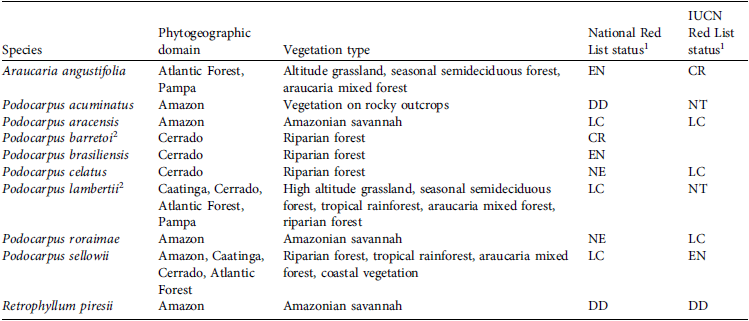
We identified conifer species native to Brazil in 20 of the 26 states and in the Federal District. We used Flora e Funga do Brasil (2022), managed by the Jardim Botânico do Rio de Janeiro research institute, because it brings together Brazilian and international taxonomic experts, making it a reliable source for accurate species identification. We also considered records of occurrence in Argentina, Bolivia, Ecuador, Peru and Venezuela, representing the natural distribution of the species and their respective habitats and environmental conditions. We used information from the Reflora Virtual Herbarium (Flora e Funga do Brasil, 2022) to characterize the following species: A. angustifolia, Podocarpus acuminatus Laubenf., Podocarpus aracensis Laubenf. & Silba, Podocarpus barretoi Laubenf. & Silba, Podocarpus brasiliensis Laubenf., Podocarpus celatus Laubenf., P. lambertii, Podocarpus roraimae Pilg., P. sellowii and R. piresii. Of these, P. lambertii and P. barretoi are endemic to Brazil (Flora e Funga do Brasil, 2022). The national (CNCFlora, 2022) and global (IUCN, 2025) conservation status of these 10 species is indicated in Table 1. We preferentially use the national Red List assessment as we are analysing the exposure of conifers to climate change in the Brazilian context (CNCFlora is the principal source for the pressures on species in Brazil). For P. acuminatus, P. celatus and P. roraimae, categorized as Data Deficient or Not Evaluated nationally, we preferentially use their global assessment.
The 10 conifer species native to Brazil, with their phytogeographic domain, the vegetation types in which they occur, and their national (CNCFlora, 2022) and global (IUCN, 2025) Red List conservation status. See main text for an explanation of the use of the national and global Red List categories. Podocarpus barretoi and Podocarpus brasiliensis are recognized as distinct species nationally (CNCFlora, 2022) but are treated as synonyms on the IUCN Red List and therefore do not have a global categorization.

Table 1 Long description
The table presents data on 10 conifer species native to Brazil. It includes three columns: Species, Phytogeographic domain and Vegetation type, National Red List status, and IUCN Red List status. The table has 10 rows, each representing a different conifer species. Row 1: Araucaria angustifolia, Atlantic Forest, Pampa, Altitude grassland, seasonal semideciduous forest, araucaria mixed forest, EN, CR. Row 2: Podocarpus acuminatus, Amazon, Vegetation on rocky outcrops, DD, NT. Row 3: Podocarpus aracensis, Amazon, Amazonian savannah, LC, LC. Row 4: Podocarpus barretoi, Cerrado, Riparian forest, CR. Row 5: Podocarpus brasiliensis, Cerrado, Riparian forest, EN, NE. Row 6: Podocarpus celatus, Cerrado, Riparian forest, LC, LC. Row 7: Podocarpus lambertii, Caatinga, Cerrado, Atlantic Forest, Pampa, High altitude grassland, seasonal semideciduous forest, tropical rainforest, araucaria mixed forest, riparian forest, LC, NT. Row 8: Podocarpus roraimae, Amazon, Amazonian savannah, NE, NE. Row 9: Podocarpus sellowii, Amazon, Caatinga, Cerrado, Atlantic Forest, Riparian forest, tropical rainforest, araucaria mixed forest, coastal vegetation, LC, EN. Row 10: Retrophyllum piresii, Amazon, Amazonian savannah, DD, DD. The table provides a comprehensive overview of the distribution and conservation status of these conifer species in Brazil.
1 LC, Least Concern; NT, Near Threatened; EN, Endangered; CR, Critically Endangered; DD, Data Deficient.
2 Endemic to Brazil.
Occurrence data
We obtained occurrence data from the Global Biodiversity Information Facility (GBIF, 2023; Supplementary Material 1) and speciesLink (2023). After compilation, the data were curated to identify and correct any errors and inconsistencies in location details such as country of occurrence, latitude and longitude, or scientific names (Velazco et al., Reference Velazco, Villalobos, Galvão and de Marco Júnior2019). We removed data points that did not match the known species distribution, such as occurrence in incorrect states, countries or continents, or locations in the sea, urban centres, botanical gardens or herbaria where the likelihood of populations existing naturally were minimal (Ribeiro et al., Reference Ribeiro2022). For Araucaria angustifolia we also considered information from Flora e Funga do Brasil (2022), Tropicos (2022) and Bernardinis et al. (Reference Bernardinis, Cobos, Brum, Marques, Peterson, Carlucci and Zwiener2023). We then filtered the cleaned data, removing duplicate occurrence points within the same 30-second pixel (Supplementary Table 1; Varela et al., Reference Varela, Anderson and García Valdés2014).
Climate data
From WorldClim (Fick & Hijmans, Reference Fick and Hijmans2017) we obtained four bioclimatic variables related to temperature and water availability, which are key factors influencing the distribution of conifer species: temperature seasonality (standard deviation of monthly mean temperature × 100; BIO4), maximum temperature of the warmest month (mean of maximum monthly temperatures for warmest month of the selected period; BIO5), annual precipitation (sum of monthly mean precipitation; BIO12) and precipitation seasonality (coefficient of variation of monthly precipitation; BIO15; O’Donnell & Ignizio, Reference O’Donnell and Ignizio2012). Using Spearman’s rank correlation coefficient, we confirmed there were no correlations between these four variables (Supplementary Fig. 1).
Future climate data were obtained from global climate models (GCMs) for different scenarios of greenhouse gas emission trends translated by shared socioeconomic pathways (SSPs; IPCC, 2021). We selected three models with high accuracy for climate data in Brazil (Firpo et al., Reference Firpo, Guimarães, Dantas, Silva, Alves, Chadwick, Llopart and Oliveira2022): CMCC-ESM2, which has 81% accuracy for temperature-related data, IPSL-CM6A-LR with 78% accuracy for precipitation-related data, and the intermediate model MRI-ESM2-0, which is the most accurate and moderate for both temperature (71%) and precipitation (75%). Although CMCC-ESM2 is the best model for temperature, it has 58% accuracy for precipitation, and although IPSL-CM6A-LR is the best model for precipitation, it has only 43% accuracy for temperature.
We selected two emission scenarios: SSP245, which has optimistic future trends as a result of possible mitigation actions to reduce greenhouse gas emissions, and SSP585, which has pessimistic trends based on high and continuous greenhouse gas emissions in the future as a result of society’s failure to curb climate change (Kriegler et al., Reference Kriegler, O’Neill, Hallegatte, Kram, Lempert, Moss and Wilbanks2012). We selected the period 2041–2060 for both scenarios, hereafter referred to as 2050. The scenarios were obtained from WorldClim (2020), with a resolution of 30 seconds (c. 1 km2), which captures local climate variations most accurately (Varela et al., Reference Varela, Anderson and García Valdés2014).
Climate exposure analysis
We identified the current maximum and minimum values of each climatic variable for each species by overlaying the occurrence points of each species with each of the four bioclimatic variables using packages dismo (Hijmans et al., Reference Hijmans, Phillips, Leathwick and Elith2017), raster (Hijmans et al., Reference Hijmans, van Etten, Sumner, Cheng, Baston and Bevan2020), sp (Bivand et al., Reference Bivand, Pebesma and Gomez-Rubio2013) and rgdal (Bivand et al., Reference Bivand, Keitt, Rowlingson, Pebesma, Sumner and Hijmans2010) in R 4.2.1 (R Core Team, 2022). We extracted the value of each pixel of each bioclimatic variable corresponding to each occurrence point (Foden et al., Reference Foden, Young, Akçakaya, Garcia, Hoffmann and Stein2019) and identified the current highest and lowest values for each of the 10 species (Supplementary Tables 2 & 3, respectively). These values theoretically demonstrate the physiological tolerance limits for each species in the present climate (1970–2000). The data used to characterize the present correspond to those provided by WorldClim for 1970–2000 (Silva et al., Reference Silva, Da, Ribeiro, Thiesen Brum, Soares-Filho, Loyola and Michalski2018).
We identified values outside the optimal evolutionary range as anything above the maximum and below the minimum for each bioclimatic variable in the SSP245 and SSP858 scenarios. We recorded the total number of occurrence points that fell outside the climatic tolerance of each species for 2050 for each variable and each scenario (Supplementary Figs 2–4). We defined five levels of exposure to climate change based on the per cent of occurrence points that exceeded the original range of conditions for each species: very low exposure (< 1% of occurrence points outside the climatic tolerance range), low exposure (1–24%), high exposure (25–49%), very high exposure (50–74%) and extreme exposure (75–100%).
Generalists and specialists
We tested our hypothesis that generalist species would be less exposed to climate change than specialists by considering the number of occurrence points as a proxy for the species range size, and the number of phytogeographic domains and vegetation types in which the species occurs as a proxy for habitat breadth (Flora e Funga do Brasil, 2022). We considered species occurring in only one phytogeographic domain and vegetation type as specialists and those occurring in more than one as generalists (Table 1). We classified three conifer species as generalists and seven as specialists. Although A. angustifolia is considered by some to be a specialist species because it is restricted to high elevations with mild temperatures (Ferri, Reference Ferri2017), we grouped it with P. lambertii and P. sellowii as a generalist species (Pardini et al., Reference Pardini, Faria, Accacio, Laps, Mariano-Neto and Paciencia2009; Caiafa & Martins, Reference Caiafa and Martins2010). Podocarpus acuminatus, P. aracensis, P. barretoi, P. brasiliensis, P. celatus, P. roraimae and R. piresii were all classified as specialist species.
Results
Mapping the occurrence of the 10 native conifer species across Brazil up to 2022 (Fig. 1) demonstrates that all will be vulnerable to future climate change. None of the 10 species have zero exposure to unfavourable changes of any of the four bioclimatic variables and all are expected to be affected to some degree by maximum temperature of the warmest month and precipitation seasonality (Fig. 2). Seven of the 10 species will be exposed to some level of stress caused by increased temperature seasonality by 2050 (Fig. 2). Eight species are expected to be affected by fluctuations in annual precipitation in the SSP245 scenario and nine in the SSP585 scenario (Fig. 2). We identified values exceeding the maximum observed at present for temperature seasonality, maximum temperature of the warmest month, and precipitation seasonality, and values below the minimum observed at present for annual precipitation.
Distribution of the 10 conifer species native to Brazil (Araucaria angustifolia, eight species of Podocarpus and Retrophyllum piresii; Table 1), in Brazil and neighbouring countries, based on occurrence records, after correcting for errors and inconsistencies in location details (see text for details). (Readers of the printed journal are referred to the online article for a colour version of this figure.)

Level of exposure of the 10 conifer species native to Brazil (Fig. 1) to unfavourable changes of four bioclimatic variables (i.e temperature seasonality, maximum temperature of the warmest month, annual precipitation and precipitation seasonality under an optimistic (SSP245) and pessimistic (SSP585) climate scenario projected to 2050 based on the intermediate MRI-ESM2-0 global climate model. Colour of the bars indicates the level of exposure to climate change along a gradient from very low exposure to extreme exposure. Total exposure summarizes the overall level of exposure for the species as the mean of the per cent values for the four bioclimatic variables. (Readers of the printed journal are referred to the online article for a colour version of this figure.)

With intermediate model MRI-ESM2-0, there was no significant difference in the level of exposure experienced in the two climate scenarios by the different conifer species (Fig. 2). Only P. lambertii is predicted to experience greater exposure to climatic stress with increasing greenhouse gas emissions, from very low exposure in the SSP245 scenario to low exposure in the SSP585 scenario. Araucaria angustifolia, P. lambertii, and P. sellowii are expected to be the least affected species across all four bioclimatic variables (Fig. 2); all three species had very low (0%) exposure to least one variable and low exposure (1–24%) to the other variables. Proportionally more populations of the other seven species are expected to be exposed to future climatic stress, with R. piresii, P. acuminatus, P. barretoi and P. brasiliensis at greatest risk (Fig. 2). The other two models predicted different impacts. The IPSL-CM6A-LR model, which exhibits higher accuracy for precipitation, predicted three additional species in the extreme exposure category for bioclimatic variables related to temperature under the SSP585 scenario, compared with the intermediate MRI-ESM2-0 model (Supplementary Fig. 5). The CMCC-ESM2 model, which demonstrates higher accuracy for temperature, predicted, under both climate scenarios, eight additional species with no exposure to the annual precipitation bioclimatic variable, compared with the intermediate MRI-ESM2-0 model, highlighting how lower accuracy for precipitation affects exposure outcomes (Supplementary Fig. 5).
Considering the intermediate MRI-ESM2-0 model, species with the highest number of occurrence points and the largest range size, indicating a wider tolerance of environmental conditions, were predicted to be less exposed and therefore less vulnerable to the effects of climate change (Fig. 3, Supplementary Fig. 6, Supplementary Table 4). The results from the two climate scenarios were similar for these species (Fig. 3). Plots of predicted exposure to climate change against range size for the four climate variables under the two scenarios did not indicate any apparent relationship between exposure level and the conservation status of individual species (Fig. 3).
Relationship between per cent exposure to each of four bioclimatic variables (annual precipitation, temperature seasonality, maximum temperature of the warmest month and precipitation seasonality; Fig. 2) and species range size (Fig. 1) for each of the 10 conifer species native to Brazil under an optimistic (SSP245) and pessimistic climate scenario (SSP585) projected to 2050 based on the intermediate MRI-ESM2-0 global climate model, with the national Red List category (CNCFlora, 2022) of each species. Data points for the two climate scenarios overlap for some species. The number of occurrence points (species range size) is log10 transformed to reduce the effect of outlier values. The climate scenario lines demonstrate the response trend for each variable.

Fig. 3 Long description
The image contains four scatter plots, each depicting the relationship between species range size and exposure to different bioclimatic variables under two climate scenarios. Panel A: Annual precipitation. The x-axis represents the log10 species range size, and the y-axis represents the percent exposure to climate change. The plot shows a negative trend where species with larger range sizes have lower exposure to changes in annual precipitation. Panel B: Temperature seasonality. The x-axis represents the log10 species range size, and the y-axis represents the percent exposure to climate change. This plot also shows a negative trend, indicating that species with larger range sizes are less exposed to changes in temperature seasonality. Panel C: Maximum temperature of the warmest month. The x-axis represents the log10 species range size, and the y-axis represents the percent exposure to climate change. The plot shows a negative trend, suggesting that species with larger range sizes are less exposed to changes in maximum temperature. Panel D: Precipitation seasonality. The x-axis represents the log10 species range size, and the y-axis represents the percent exposure to climate change. This plot shows a negative trend, indicating that species with larger range sizes are less exposed to changes in precipitation seasonality. Each plot includes data points for different species, represented by various colors and shapes, and lines indicating the response trend for each climate scenario. The species are labeled with different colors and shapes, and the climate scenarios are represented by solid and dashed lines. The conservation status of each species is also indicated by different shapes.
Discussion
How will thermal stress affect Brazilian conifers?
The climate in Brazil will generally be warmer and drier in the future, potentially compromising the survival of conifers because their physiological tolerances will be exceeded. Our results for the two temperature-related variables indicate that conifers will be subject to thermal stress. Temperature seasonality values that are above the present maxima indicate a higher occurrence of extreme weather events in the future, with colder winters and hotter summers, possibly including episodes of heatwaves and frosts (O’Donnell & Ignizio, Reference O’Donnell and Ignizio2012). The thermal instability reflected by this variable is expected to affect the prevalence of conifers (Brandes et al., Reference Brandes2021; Xie et al., Reference Xie, Du, Xu, Ran and Wang2022) by reducing the number of trees able to develop and reach the reproductive phase, directly affecting population dynamics (Boucher et al., Reference Boucher, Gauthier, Thiffault, Marchand, Girardin and Urli2020). Our results for maximum temperature of the warmest month indicate that in the future environments inhabited by Brazilian conifers will experience higher maximum temperatures during the summer, which can cause indirect damage to trees as a result of changes in soil nutrient availability (Hanson & Weltzin, Reference Hanson and Weltzin2000) and direct damage from pests and disease (van Mantgem et al., Reference van Mantgem, Stephenson, Byrne, Daniels, Franklin and Fulé2009). A warming climate will influence the dispersal of pathogens and affect their survival rates (Pureswaran et al., Reference Pureswaran, Roques and Battisti2018), and thermal stress will weaken the trees and make them more susceptible to attack by these pathogens (Jactel et al., Reference Jactel, Koricheva and Castagneyrol2019). Thermal stress can also alter soil surface temperature, reducing seedling development and delaying population regeneration (Rank et al., Reference Rank, Maneta, Higuera, Holden and Dobrowski2022). The collective consequences of climate warming will negatively affect conifers, potentially conferring advantages on angiosperms (Peñuelas & Sardans, Reference Peñuelas and Sardans2021).
How will water stress affect Brazilian conifers?
Conifers in Brazil will be subject to water stress in the future, which is likely to act as a selective force for tree survival (Varas-Myrik et al., Reference Varas Myrik, Sepúlveda-Espinoza, Fajardo, Alarcón, Toro-Núñez, Castro-Nallar and Hasbún2022). Our results for annual precipitation indicate that rainfall distribution and water availability may be reduced, leading to drier environments, increasing the incidence of fires (Vitali et al., Reference Vitali, Buntegen and Bauhus2018), decreasing soil moisture and causing damage to plants, eventually leading to mortality (Xie et al., Reference Xie, Du, Xu, Ran and Wang2022) and contraction of species ranges (Camarero et al., Reference Camarero and Gazol2021).
Future climate scenarios suggest that seasonal precipitation will change, with rainfall less evenly distributed throughout the year. As a consequence of the altered rainfall regime, long periods of drought may occur, which may lead to reduced radial growth (Wang & Yang, Reference Wang and Yang2021) and higher plant mortality (Camarero et al., Reference Camarero and Gazol2021). Trees in Amazonia, including species of Podocarpaceae, are already suffering from the intensification of the dry season (Esquivel-Muelbert et al., Reference Esquivel-Muelbert, Baker, Dexter, Lewis, Brienen and Feldpausch2019) and climate change may increase the pressures on them. Podocarps tend to be more disadvantaged by water stress because their smaller stature and shallow root depth make them vulnerable to drought (Esquivel-Muelbert et al., Reference Esquivel-Muelbert, Baker, Dexter, Lewis, Brienen and Feldpausch2019). Araucarias struggle with water stress because of their low tolerance to xylem failure and inefficient strategies, such as isohydric behaviour, to deal with water shortage (Varas-Myrik et al., Reference Varas Myrik, Sepúlveda-Espinoza, Fajardo, Alarcón, Toro-Núñez, Castro-Nallar and Hasbún2022). In more extreme climates, periods of heavy rain can saturate the soil, directly affecting dissolved oxygen availability, hindering oxygen absorption by roots and causing nutrient leaching (Abbass et al., Reference Abbass, Qasim, Song, Murshed, Mahmood and Younis2022) and root decay (Catford & Jansson, Reference Catford and Jansson2014). Waterlogged soils also hinder root anchorage, which may prevent the establishment of mature individuals (Abbass et al., Reference Abbass, Qasim, Song, Murshed, Mahmood and Younis2022). Araucaria angustifolia would be more susceptible to these consequences as it is intolerant of waterlogged and nutrient-poor soils (Bernardinis et al., Reference Bernardinis, Cobos, Brum, Marques, Peterson, Carlucci and Zwiener2023).
Consequences of the exposure of Brazilian conifers to climatic change
In response to stresses linked to changes in temperature and precipitation, plants may alter their geographical distribution by migrating to areas with more suitable conditions (Pauchard et al., Reference Pauchard, García, Zalba, Sarasola, Zenni, Ziller and Nuñez2015; Blanco-Cano et al., Reference Blanco Cano, Navarro Cerrillo and GonzálezMoreno2022). By their nature, this is a slow process and in the meantime ecosystems can become dominated by trees poorly adapted to their preferred climatic space (Esquivel-Muelbert et al., Reference Esquivel-Muelbert, Baker, Dexter, Lewis, Brienen and Feldpausch2019), leading to disruption of biodiversity (Foster, Reference Foster2001; Bello et al., Reference Bello, Cintra, Barreto, Vancine, Sobral-Souza, Graham and Galetti2021; Mesacasa et al., Reference Mesacasa, Macagnan, Fiaschi and Dechoum2022). There will also be reductions in ecosystem services provided by conifers, including the creation of microclimates (Rivers et al., Reference Rivers, Newton and Oldfield2023), protection of fauna and soil, production of food (such as the nut-like seed of A. angustifolia) and other forest resources (Tagliari et al., Reference Tagliari, Bogoni, Blanco, Cruz and Peroni2023), landscape attributes, tourism and cultural identity (Almeida et al., Reference Almeida, Trovarelli and Massi2023). Trees growing at high altitudes, such as A. angustifolia, P. lambertii, and P. sellowii (Manfredi, Reference Manfredi2014; Flora e Funga do Brasil, 2022; Bernardinis et al., Reference Bernardinis, Cobos, Brum, Marques, Peterson, Carlucci and Zwiener2023), will be less impacted by climate changes because the topography can buffer climatic disturbances and serve as a cold and wet refuge (Wilson et al., Reference Wilson2019). However, even the relatively small changes predicted in more optimistic future climate scenarios can alter species distribution in the landscape (Albrich et al., Reference Albrich, Rammer and Seidl2020). Endemic species tend to have narrower environmental tolerance limits and limited genetic variability (Bussotti et al., Reference Bussotti, Pollastrini, Holland and Brüggemann2015), making them vulnerable to extinction. This is typified by P. barretoi, which is an endemic specialist species (Flora do Brasil, 2022) categorized as Critically Endangered.
Although we interpret our results in terms of tolerance limits, we cannot predict the behaviour of conifers in Brazil in response to climatic stressors because we have limited knowledge of their phenotypic and genotypic plasticity. Studies addressing this topic have focused on commercially important conifers or those distributed in North America (Grulke, Reference Grulke2010; Valladares et al., Reference Valladares, Matesanz, Guilhaumon, Araújo and Balaguer2014). Podocarpus lambertii can adapt to drier and warmer environments through stomatal changes (Locosselli & Ceccantini, Reference Locosselli and Ceccantini2012) but we found no studies addressing the ecology of other Podocarpaceae species in Brazil. In addition, there may be variations in resilience and sensitivity to climate among populations of a species (McCullough et al., Reference McCullough, Davis and Williams2017). Thus, we need more data on the ability of these organisms to adapt to new climatic conditions and to maintain their current distribution (Lancaster & Humphreys, Reference Lancaster and Humphreys2020).
An exception is A. angustifolia, the distribution of which under different future climate change scenarios has been relatively well studied (Bernardinis et al., Reference Bernardinis, Cobos, Brum, Marques, Peterson, Carlucci and Zwiener2023). This conifer has the capacity to adapt to different environmental conditions (light intensity) through morphological changes, indicating a certain level of plasticity (Franco et al., Reference Franco, Lúcia and Dillenburg2007; Olguin et al., Reference Olguin, Moretti, Pinazo, Gortari, Vera Bahima and Graciano2020). This could allow the physical characteristics of this species to evolve in response to climate change, enabling it to maintain its current distribution or migrate to new areas, assuming successful reproduction and dispersal (Bernardinis et al., Reference Bernardinis, Cobos, Brum, Marques, Peterson, Carlucci and Zwiener2023). It has also been hypothesized that A. angustifolia depends on major disturbances such as cyclones to open up the forest canopy, thereby increasing light availability and allowing it to regenerate in the understorey (Souza, Reference Souza2021). Large-scale disturbances such as cyclones are expected to become more frequent with climate change, potentially favouring A. angustifolia. However, araucaria forests impacted by cyclones are often invaded by bamboos that suppress regeneration of most trees (Liebsch et al., Reference Liebsch, de Maçaneiro, Galvão, Marques and Mikich2019), and A. angustifolia is a mast-seeding species widely consumed by seed predators (Bogoni et al., Reference Bogoni2020). With regional extinction of large vertebrates (defaunation) increasingly prevalent, leading to disruption of top-down control and the consequent increase in araucaria seed predators, especially rodents, regeneration in most araucaria forest fragments is threatened (Kotovicz, Reference Kotovicz2023).
Conclusion
Despite considering both optimistic and pessimistic climate scenarios of greenhouse gas emissions, we found similar levels of exposure of Brazilian conifers to unfavourable future conditions regardless of the severity of climate change. This result indicates the sensitivity of this group of plants: many species will be exposed to climatic stress even in the most optimistic emission scenario (SSP245). We also found that specialist species are the most vulnerable, especially small populations with a restricted geographical distribution.
Our study took a conservative approach by applying the precautionary principle, not focusing on projecting species distribution or overestimating their environmental tolerances. However, the current distribution of the 10 conifer species may not reflect their optimal climatic conditions, because of a lag in their response to past climate changes (Gaüzère et al., Reference Gaüzère, Iversen, Barnagaud, Svenning and Blonder2018). Our predictions carry a certain level of uncertainty derived from the complexity of natural systems and the uncertainty of the climate models themselves; the future is unknown and society may take a different course in its efforts to alter greenhouse gas emissions. The low number of conifer occurrence records and the paucity of information on the biology of several species limited our research. We also acknowledge the limitations of our discrete approach in classifying species as generalists or specialists. This is a result of the inherent uncertainty in the mapping of phytogeographical domains and vegetation types. These environments may be subject to varying degrees of degradation and ecological succession. Furthermore, some species may disperse beyond suitable habitats (Devictor et al., Reference Devictor, Julliard and Jiguet2008). We note that the selected time interval (2040–2060) may not be sufficient for slow-growing, long-lived species (Talluto et al., Reference Talluto, Boulangeat, Vissault, Thuiller and Gravel2017) such as A. angustifolia, and therefore, our findings should be interpreted with caution.
Nevertheless, climate change is becoming increasingly intense and rapid, which may shorten the time available for species’ responses. Moreover, species may already be experiencing some degree of climate-related stress, which although not resulting in immediate mortality may impair their reproductive efficiency and consequently reduce population sizes (Pacifici et al., Reference Pacifici, Foden, Visconti, Watson, Butchart and Kovacs2015). Finally, our climate exposure analysis did not encompass other determinants of the ecological niche, such as soil properties, dispersal capacity and biological interactions with predators, pollinators and seed dispersers, all of which exert constraints on habitat suitability (Peterson et al., Reference Peterson, Soberón, Pearson, Anderson, Martínez-Meyer, Nakamura and Araujo2011; Trappes et al., Reference Trappes, Nematipour and Krohs2022).
Despite these limitations, we hope that our assessment of the potential impacts of climate change on all known Brazilian conifer species encourages discussion and brings greater visibility to the conservation of this plant group, both in Brazil and globally. Future studies are required on biome shifts and species adaptations in the more tropical Podocarpus species, including analyses of their geographical distribution and elevational ranges, to examine how they may respond to climate change, and fieldwork is required to search for and document new populations, to be documented with appropriate herbaria accessions. Further research is also needed on the biology of Brazilian conifers, alongside ecophysiological studies that determine their tolerance limits to temperature and water availability. Finally, in addition to relevance for policy actions needed to reduce greenhouse gas emissions and mitigate the impacts of climate change, our findings are relevant to wider society: the establishment of protected areas for conifers needs to be discussed and implemented to safeguard the persistence of this ancient plant lineage.
Author contributions
Study design, data curation, data analysis and interpretation: all authors; writing: RCM; revision: LFC-T, FTB, MBC; project oversight: MBC.
Acknowledgements
We thank Bruno Roberto Ribeiro and Isabela Galarda Varassin for their suggestions for improving this article, and Victor Zwiener for kindly sharing distributional data for Araucaria angustifolia. This work was supported by Coordination for the Advancement of Higher Education Personnel (CAPES), a Foundation of the Brazilian Ministry of Education. RCM and LFC-T received graduate fellowships (Finance Code 001) and FTB a postdoctoral fellowship from CAPES-Brazil. MBC was funded by CNPq-Brazil (grant #310857/2022-8).
Competing interests
None.
Ethical standards
This research abided by the Oryx guidelines on ethical standards.
Data availability
Supporting data are provided in the Supplementary Material of this article.
Supplementary material
The supplementary material for this article is available at doi.org/10.1017/S0030605325101762


 Open access

