Implications
This study reports the initial outcomes deriving from the application of the approach developed in the Animal Welfare Indicators (AWIN) project to assess the welfare status of stabled sport and leisure horses. For the first time, the authors present an innovative approach to collecting welfare data in a harmonized way that could prove useful for creating a common database of the general welfare status in different horse categories.
Introduction
Horses are a peculiar species: they can be classified as farm or companion animals; they can be owned for several reasons ranging, for example, from use in animal-assisted therapies to food production. It follows that horses are managed heterogeneously and they are exposed to diverse welfare issues. For the same reasons, the assessment of horse welfare poses several challenges to researchers, for example, collecting data in different housing systems, or linking equids to their responsible person (World Horse Welfare and Eurogroup for Animals, 2015). A scientifically sound method to assess horse welfare on-farm represents the foundation for a strategic plan aimed at improving the welfare of horses. A subsequent step includes the collection of reliable and uniform data in different countries to identify the most relevant welfare issues. By definition, harmonization is to create the possibility to combine data from heterogeneous sources into integrated, consistent and unambiguous information products. Harmonized data collection is essential in order to obtain a reliable picture of horse welfare conditions in different countries on which to base a roadmap to its improvement. Although significant progress has been made in this field over the past 15 years (Pritchard et al., Reference Pritchard, Lindberg, Main and Whay2005; Burn et al., Reference Blokhuis, Veissier, Miele and Jones2010; Neijenhuis et al., Reference Neijenhuis, De Graaf-Roelfsema, Wesselink, Van Reenen and Visser2011; Vervaecke et al., Reference Vervaecke, Boydens, De Nil and Laevens2011; Popescu and Diugan, Reference Popescu and Diugan2013; Visser et al., Reference Visser, Neijenhuis, de Graaf-Roelfsema, Wesselink, de Boer, van Wijhe-Kiezebrink, Engel and van Reenen2014), limited data on welfare of European horses is yet available.
The AWIN project, funded by the European Commission in the Seventh Framework Programme, aimed to improve the welfare of several species, including horses, by developing scientifically sound and practical on-farm welfare assessment protocols (Battini et al., Reference Battini, Stilwell, Vieira, Barbieri, Canali and Mattiello2015; Dalla Costa et al., 2016). AWIN research was grounded on and progressed from the approach defined in the Welfare Quality® research project (Botreau et al., Reference Burn, Pritchard and Whay2007; Blokhuis et al., Reference Burn, Dennison and Whay2010; Rushen et al., Reference Rushen, Butterworth and Swanson2011) and by Visser et al. (Reference Visser, Neijenhuis, de Graaf-Roelfsema, Wesselink, de Boer, van Wijhe-Kiezebrink, Engel and van Reenen2014). As for horses, AWIN research was not only focussed on developing a welfare assessment protocol grounded on valid animal-based indicators (Dalla Costa et al., Reference Dalla Costa, Minero, Lebelt, Stucke, Canali and Leach2014), but also on finding innovative methods to standardize on-farm data collection (Dai et al., Reference Dai, Dalla Costa, Battini, Barbieri, Minero, Mattiello and Canali2014). This study aims to report the first outcomes of the AWIN approach on the development of a strategy to improve horse welfare: it presents the results of on-farm assessment and the use of a harmonized data collection system.
Material and methods
Facilities and horses
The welfare of horses stabled in 40 facilities in Italy (n=20) and in Germany (n=20) was assessed between March and July 2014. Considering that the number of horses stabled in each facility can be very different and that this can be associated with specific welfare issues, a stratified random sample of very small (⩽4 horses), small (5 to 10 horses), medium (11 to 30 horses) and large (>31 horses) horse facilities was selected. All the selected facilities were contacted over the phone and participated in the study on a voluntary basis. In each facility, all the single-stabled horses (for at least half of the day) ≥5 years old were included in the study. A total of 355 sport and leisure horses (females=146; geldings=190; stallions=19), of different breed and riding discipline (show jumping=118; dressage=22; western=18; endurance=8; eventing=8; school=28; leisure=73; pet=12; other=40; NA=28), aged between 5 and 33 years old (mean=12.7) were assessed.
Assessors
Three veterinarians (two females and one male), aged between 30 and 37 years, experienced in horse behaviour and welfare, were recruited to perform the assessments. Before carrying out the on-farm evaluation, they underwent a joint training period to learn how to perform and score all the indicators included in the AWIN welfare assessment protocol for horses (AWIN, 2015a). The training of assessors consisted of two phases: first e-learning and then face to face. The e-learning phase was developed in order to reduce time and costs related to the face-to-face training, without losing accuracy in the assessment. Each welfare indicator was transferred into a learning object organized in different sections: description, how to assess, how to score, examples and self-assessment exercises. The online material was available to the trainees for 1 month (December 2013). Then, a face-to-face training phase lasting 2 days and consisting of theoretical and practical on-farm training was performed in order to acquire the practical skills necessary to perform and score all the indicators accurately and reliably. During the training on-farm, assessors worked in pairs with silver standard, that is, two AWIN researchers with experience in assessing horse welfare. Both phases ended with an assessment of learning: as for the e-learning phase, assessors had to answer 58 questions (including videos and/or pictures); whilst at the end of the face-to-face phase, assessors conducted live assessments of horses until they performed a minimum of five consecutively accurate assessments. The training was considered complete when the assessors achieved ⩾80% agreement with the silver standard, on both e-learning and live scoring.
Welfare assessment
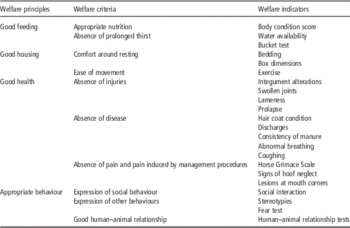
The assessment was conducted using the AWIN welfare assessment protocol for horses. This document (AWIN, 2015a) reports the description, the assessment and scoring methods of the welfare indicators used in the current work. The AWIN welfare assessment protocol for horses is based on the Welfare Quality® principles and criteria, developed following the methods reported by Dalla Costa et al. (Reference Dalla Costa, Dai, Lebelt, Scholz, Barbieri, Canali, Zanella and Minero2016) and includes animal, resource and management-based indicators (Table 1) evaluated in terms of their validity, reliability and feasibility. In the current study, the welfare assessment was conducted at least 1 h after feed distribution, as recommended in the protocol.
Names of the Animal Welfare Indicators (AWIN) for horse welfare assessment presented by principles and criteria

Detailed descriptions of each welfare indicator are reported in the AWIN welfare assessment protocol for horses (AWIN, 2015a).
Data collection
A digital system to collect, store and download the indicators included in the AWIN welfare assessment protocol for horses was created (Dai et al., Reference Dai, Dalla Costa, Battini, Barbieri, Ferrari, Minero, Mattiello and Canali2015b); the AWINHorse app was developed for Android devices and it is now freely available on Google Play Store (AWIN, Reference Asknes and Mejdell2015b). A preliminary version of the AWINHorse app was installed on tablets or smartphones and tested on-farm in order to evaluate its feasibility during the assessments. The welfare assessors learned how to use the app to collect data on-farm during their training.
Statistical analysis
Data collected on-farm by assessors were downloaded from the app to a comma-separated value file before performing descriptive statistics using SPSS statistical package (IBM Corp., 2012). The proportion of horses with different scores for each welfare indicator was calculated. For the fear test (Dai et al., 2015a; Gorecka-Bruzda et al., 2011), minimum, maximum values and means and standard deviations were calculated; an ANOVA was used to identify possible links between fear behaviour shown by horses (e.g. freezing, prancing, vigilance, defecation/urination) (Le Scolan et al., Reference Kennedy, Schwabe and Broom1997; Wolff et al., Reference Wolff, Hausberger and Le Scolan1997; Christensen et al., Reference Christensen, Keeling and Nielsen2005; Forkman et al., Reference Forkman, Boissy, Meunier-Salaün, Canali and Jones2007) and the latency to approach the novel object in the fear test. Latency was considered the dependent variable, and fear behaviour was introduced in the model as fixed effect. Data were tested for normality using a Kolmogorov–Smirnov test. As variables were not normally distributed, a χ 2 test was used to identify a possible relationship between variables.
Results
This section initially reports, for each welfare principle presented in Table 1, the results of the welfare assessment; then explores feasibility aspects related to the data collection system.
On-farm welfare assessment
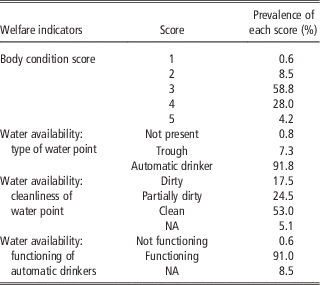
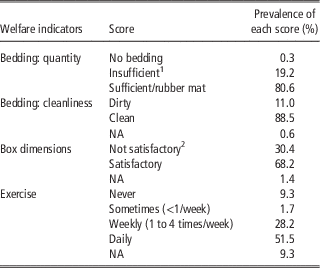
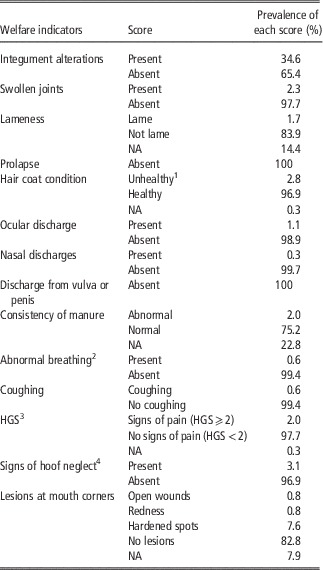
No safety issues were encountered and time required to perform the assessment varied from 5 to 25 min/horse. For each welfare indicator, the proportions of horses with different scores are reported in Table 2 (for the principle ‘good feeding’), Table 3 (‘good housing’), Table 4 (‘good health’) and Table 5 (‘appropriate behaviour’).
Results of the Animal Welfare Indicators (AWIN) welfare assessment protocol for horses related to the principle ‘good feeding’

NA=not applicable.
Detailed descriptions of different scores for each welfare indicator are reported in the AWIN welfare assessment protocol for horses (AWIN, 2015a).
Results of the Animal Welfare Indicators (AWIN) welfare assessment protocol for horses related to the principle ‘good housing’

NA=not applicable.
Detailed descriptions of different scores for each welfare indicator are reported in the AWIN welfare assessment protocol for horses (AWIN, 2015a).
1 Insufficient bedding=floor areas not covered by bedding are clearly visible.
2 Not satisfactory=the area of the box is less than the satisfactory dimensions reported in the Swiss Animal Welfare Ordinance (2008).
Results of the Animal Welfare Indicators (AWIN) welfare assessment protocol for horses related to the principle ‘good health’

NA=not applicable; HGS=Horse Grimace Scale.
Detailed descriptions of different scores for each welfare indicator are reported in the AWIN welfare assessment protocol for horses (AWIN, 2015a).
1 Unhealthy coat=dull, dry coat with or without rough coat.
2 Abnormal breathing=it is characterized by an exaggerated effort to breathe under standard climate conditions and at rest.
3 HGS=it is a standardized method to evaluate changes in a horse facial expression due to pain (Dalla Costa et al., Reference Dalla Costa, Minero, Lebelt, Stucke, Canali and Leach2014).
4 Signs of hoof neglect=hooves are overgrown, rarely trimmed or trimmed incorrectly.
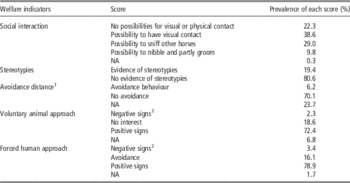
Results of the Animal Welfare Indicators (AWIN) welfare assessment protocol for horses related to the principle ‘appropriate behaviour’

NA=not applicable.
Detailed descriptions of different scores for each welfare indicator are reported in the AWIN welfare assessment protocol for horses (AWIN, 2015a).
1 Avoidance distance=presence of any avoidance behaviour.
2 Negative signs=any signs of aggressive behaviours such as trying to bite and/or kick.
As regards the principle ‘good feeding’ (Table 2), most of the assessed animals enjoyed appropriate nutrition (body condition score (BCS)=3). Extreme scores, BCS=1 and BCS=5, were observed in a few cases, whereas dressage horses presented a significantly higher prevalence (54.5%; χ 2 P=0.002) of overweight subjects (BCS>3) compared with different riding disciplines. Our results show that the vast majority of horses had free access to a water point. However, the water points were often dirty or partially dirty, meaning that they were not checked or cleaned regularly by the stable staff.
As regards the principle ‘good housing’ (Table 3), bedding provided to the horses was in the majority of cases sufficient and clean; however, box dimensions were scored as satisfactory only in 68.6% of cases.
About half the horses had the possibility to exercise (free or ridden) on a daily basis. Remarkably, this study uncovered that 9.3% of subjects did not have the chance to get out of their box. In these cases, reported justifications were as follows: ‘the owner does not have time to ride the horse’, ‘the horse is old and no paddock for free exercise is available’, ‘giving the horse the possibility to spend free time in the paddock increases the risk of injuries’. Sometimes, it was not possible to gather information about exercise (proportion of NA in Table 3) because the stable manager was not always available to answer the questions for every horse present in the stable. In the considered sample, the majority of show jumping horses (60.5%) spent <2 h/day outside their box, the situation was different for dressage and leisure horses with a proportion of 22.7% and 16.4%, respectively.
As regards the principle ‘good health’ (Table 4), the majority of the horses did not present swollen joints, lameness, prolapse, unhealthy coat, discharges, abnormal breathing, coughing, signs of pain (Horse Grimace Scale (HGS) score<2), hoof neglect and lesions at mouth corners. The most frequent integument alteration was alopecia, followed by superficial skin lesions and swellings. The HGS score was ⩾2 in 2% of cases, always linked with other signs of pain (e.g. lameness). Lesions at mouth corners sometimes were not assessed (NA) because handlers were not available to hold the horse’s head. In some cases, the horse was head shy and it was not safe to touch the corners of the mouth to assess the possible presence of lesions. It was not possible to evaluate lameness (NA) for 14.4% of horses. Another indicator that could not be assessed in quite a high number of cases was the faeces evaluation (manure), as most of the time boxes were clean at the moment of the inspection and no faeces were present.
Table 5 reports results regarding the principle ‘appropriate behaviour’. In 22.3% of cases, horses had no possibility to interact with conspecifics, not even visually.
In our sample, evidence of stereotypic behaviour (e.g. cribbing, weaving) was significantly related to the reduced possibility of social contact (χ 2 P=0.001). Most particularly, western riding horses presented the highest prevalence of these behaviours (27.8%) and they also had the highest prevalence of lack of social contact (27.8%).
Most of the assessed horses showed a positive reaction to an unknown human interacting with them during three behavioural tests, with a small prevalence of horses showing avoidance or negative reaction. Testing the avoidance distance to a human approaching the box door was not possible in 23.3% of the cases, mostly when horses were inattentive to the human presence.
In the fear test, after the novel object was dropped in the box, the horses needed 34±52 s (MIN=0 s, MAX=285 s) to approach it. Latencies were significantly related to the presence of behavioural fear reactions (e.g. freezing, prancing, vigilance, defecation/urination) (ANOVA, P<0.01).
Data collection system
All three assessors successfully completed both phases of training, reaching a good level of agreement with the silver standard (⩾80%).
All our assessors quickly learned how to use the digitalized system to collect data and upload it to a server. Thanks to the use of tablets or smartphones, in 1 or 2 min the assessors were able to insert the data for a particular horse and upload it to a central server. When an internet connection was not available on-farm, data could be stored on the device and sent to the server later on. The use of tablets on-farm caused some minor difficulties: as these devices could be cumbersome, horses sometimes approached and sniffed them, thus interfering with some of the behaviour tests; the use of smartphones that can be safely stored in a pocket could reduce these problems.
Discussion
The results highlight that the approach described in this paper was useful to assess the welfare status of stabled sport and leisure horses. Even though no cases of cruelty and no major welfare problems were encountered, the authors consistently uncovered issues such as being overweight, unsatisfactory box dimensions, long periods of confinement and lack of social interaction. These issues are unsurprisingly similar to those reported as commonly perceived by respondents to a recent European survey (World Horse Welfare and Eurogroup for Animals, 2015). The number of facilities assessed was relatively limited; for this reason, the sample of horses assessed does not necessarily represent the welfare status of all horses in Europe, because conditions vary within and between countries. Obesity is a serious and largely under-reported equine welfare and health problem (Wyse et al., Reference Wyse, McNie, Tannahill, Murray and Love2008); overweight horses are predisposed to the development of several pathological conditions such as hyperlipaemia, laminitis and osteoarthritis (Watson et al., Reference Watson, Murphy and Love1992; Geor, Reference Geor2008). The prevalence of overweight horses found in the current study is in line with the findings of Visser et al. (Reference Visser, Neijenhuis, de Graaf-Roelfsema, Wesselink, de Boer, van Wijhe-Kiezebrink, Engel and van Reenen2014), confirming that, fat subjects are becoming more common than thin ones. Unlike other issues, this one can be addressed by changes to husbandry practices such as nutrition management and exercise routine.
Box dimension can affect the lying behaviour of horses: Raabymagle and Ladewig (Reference Raabymagle and Ladewig2006) observed that when insufficient lying space is provided, horses do not lie in lateral recumbency and they are unlikely to achieve paradoxical sleep. As for the AWIN protocol, box dimensions were considered satisfactory when responding to the requirements of the Swiss Animal Welfare Ordinance (2008). In order to prefigure the impact and consequences deriving from any possible large-scale prescriptions about horse box dimensions, it is essential to obtain a representative picture of their actual characteristics in the relevant geographical areas.
Our results show that horses can be confined for long period of time. Spending some time outside the box is important to prevent health and behavioural problems (Cooper and Albentosa, Reference Cooper and Albentosa2005; Visser et al., Reference Visser, Neijenhuis, de Graaf-Roelfsema, Wesselink, de Boer, van Wijhe-Kiezebrink, Engel and van Reenen2014), as for example, it has long been known that respiratory problems are closely associated with improper housing microclimate (Halliwell et al., Reference Halliwell, McGorum, Irving and Dixon1993) and that activity level affects the presence of abnormal locomotory behaviours (McGreevy et al., Reference McGreevy, Cripps, French, Green and Nicol1995a). An increasing number of organizations of the equine sector nowadays agree that many common horse welfare problems, including the lack of adequate free exercise, would be effectively improved by the promotion of responsible ownership (World Horse Welfare and Eurogroup for Animals, 2015). Horses are social animals, in nature they rely on survival strategies centred on the formation of cohesive social bonds within their family or bachelor bands (Mills and Nankervis, Reference Mills and Nankervis1999), and interacting with conspecifics is a basic behavioural need. Frustration of this need represents a serious welfare issue that can lead to the development of undesired behaviours (McGreevy et al., Reference McGreevy, Cripps, French, Green and Nicol1995a; Cooper and Albentosa, Reference Cooper and Albentosa2005). In our sample, lack of social interaction is common. The prevalence of stereotypic behaviour, we found, is in line with findings of previous studies on sport and leisure horses (Kennedy et al., Reference Le Scolan, Hausberger and Wolff1993; McGreevy et al., Reference McGreevy, French and Nicol1995b; Muñoz-Alonzo et al., Reference Muñoz-Alonzo, Medina Vera, Cruces Leal and Briones Luengo2015). For example, McGreevy et al. (Reference McGreevy, Cripps, French, Green and Nicol1995b) reported that the prevalence of stereotypies for dressage, eventing and endurance horses ranged from 19.5% to 32.5% and found that the time a horse spends out of the stable is negatively correlated with an increased risk of abnormal behaviour. Therefore, if the stable is constructed so that horses cannot have any social contact, it should be remodelled as soon as possible and, in the meanwhile, different solutions should be implemented, for example, offering daily access to paddocks where horses can interact with conspecifics.
Other minor welfare issues encountered were that water points were not regularly cleaned by the stable staff.
In this study, as in the case of overweight horses, a key role is played by education on the importance of evaluation of body condition and regular checks to ensure that water points are clean and no blockages are present.
As regards the principle good health, that is patently of primary importance for horse welfare, some of the present findings seem to differ from what is described elsewhere in the literature (Neijenhuis et al., Reference Neijenhuis, De Graaf-Roelfsema, Wesselink, Van Reenen and Visser2011; Asknes and Mejdell, 2012; Visser et al., Reference Visser, Neijenhuis, de Graaf-Roelfsema, Wesselink, de Boer, van Wijhe-Kiezebrink, Engel and van Reenen2014). For example, Visser et al. (Reference Visser, Neijenhuis, de Graaf-Roelfsema, Wesselink, de Boer, van Wijhe-Kiezebrink, Engel and van Reenen2014) in their inspiring paper reported a prevalence of lameness (4.8%), higher than that registered by the authors (1.7%). The discrepancies with these studies are probably due to the different degrees of sensitivity of their indicators, which required more extensive training (i.e. 1 week on-farm) and a deeper understanding of animal handling (i.e. evaluation of horses trotting in a straight line on a firm underground for 40 m). In fact, grade 3 lameness on the American Association of Equine Practitioners (AAEP) Lameness Grading Scale is difficult to observe at a walk (Dyson, Reference Dyson2011). It is known that back pain is a potentially highly relevant welfare problem in sport and leisure horses (Visser et al., Reference Visser, Neijenhuis, de Graaf-Roelfsema, Wesselink, de Boer, van Wijhe-Kiezebrink, Engel and van Reenen2014); however, its accurate assessment requires extensive training and considerable animal handling. For this reason, a specific indicator for back pain was not included in the AWIN welfare assessment protocol. Despite the commitment to select and develop highly feasible indicators, some practical issues posed difficulties during this research. Lameness assessment consisted of walking the horse outside its box on a hard and even surface. The main feasibility issue in this case was that the stable manager would not always take the responsibility for moving the horse out of its box without the owner’s formal consent. Whereas on the one hand this result highlights the possible constraints that can be faced assessing animal-based measures on-farm, on the other it suggests that handling problems that could lead to safety issues are relatively frequent. This should be addressed by teaching the owners how to prevent them through the adoption of appropriate handling techniques, taking into account the behaviour and learning characteristics of the horses.
As the relationship between horses and humans relies on repeated interactions, our results indicate that most of our horses maintained a positive relationship with humans (showing positive reaction in all the tests), this being of paramount importance to prevent negative emotional states and reactions potentially leading to accidents (Hausberger et al., Reference Hausberger, Roche, Henry and Visser2008). Sometimes, we found that horses were inattentive towards humans, even if the assessors signalled their presence (clicking three times with the tongue); this result may be because, in some cases, the human–horse interactions are neutral, even if neither negative nor positive.
The training formula, online and face to face, proved to be valuable, as it limited the time spent with the trainer to 2 days. In previous studies, the time needed for reliable training of assessors ranged from 8 days to 6 months (Burn et al., Reference Botreau, Veissier, Butterworth, Bracke and Keeling2009; Visser et al., Reference Visser, Neijenhuis, de Graaf-Roelfsema, Wesselink, de Boer, van Wijhe-Kiezebrink, Engel and van Reenen2014). Our experience demonstrated that the AWINHorse app is friendly and practical to use and it does not require a long training period. The app permits insertion of data reducing possible errors of transcription and immediately provides an output of welfare status that can be used to open a dialogue with the stable manager. Furthermore, once uploaded, data are immediately available for further analysis on the server. Therefore, the app would be a useful tool for the development of an accessible data repository on animal welfare and for increasing data and knowledge accessibility to all European countries. The digitalized data collection system proved to be feasible on-farm, it should however be applied in other contexts (e.g. working horses, competitions) to further evaluate its potential in improving the efficiency of welfare data collection.
Our findings suggest that education of horse owners and stable managers is needed to make them more aware of some aspects of horse welfare and incentivize the uptake of the information. This study presents, for the first time, an innovative data collection system that could prove useful in creating a larger and more geographically distributed database of welfare issues in horses. As regards the welfare assessment, there are still some important challenges to address. Although the AWIN protocol reports suggestions for adaptation to some specific management situations (group housed horses), further scientific research is needed and it is forecast that the protocol will be updated for use in different conditions in the light of new scientific knowledge.
Acknowledgements
The authors thank Alberto Carrascal at Daia Solutions for his programming expertise and collaboration in developing the AWINHorse app. The authors are grateful to all the horse owners who allowed them to enter their facilities. Finally, the authors thank Kirk Ford for his extensive and professional revisions of language. The AWIN project (FP7-KBBE-2010-4) has received funding from the European Union Seventh Framework Programme for research, technological development and demonstration.