





Outside School Hours Care (OSHC) services offer structured care for primary/elementary school-aged children, before and after school and during school holiday/vacation periods(1). These services present a valuable opportunity to support children’s nutrition and healthy eating behaviours(Reference Crowe, Probst and Weaver2). In Australia, OSHC services are the second most common form of childcare with 582 020 children enrolled, representing over 40 % of all children in childcare . In the USA, approximately 14 % of school-aged children participate in out-of-school time programs(3,4) . The scale and reach of these services across high-income countries highlights their potential to influence nutrition-related outcomes for large numbers of children.
This potential is particularly important given the ongoing concerns about inadequate dietary intake among children globally across high-income countries(Reference Passarelli, Free and Shepon5). In Australia, 36 % of children and adolescents aged 2–17 years do not consume the recommended amount of fruit and 96 % do not meet vegetable intake recommendations(6), with similar patterns observed in the USA(Reference Saavedra7). This highlights the importance of settings where children spend substantial time, including OSHC, for supporting children’s dietary quality, food literacy and the development of healthy eating habits during childhood.
Synthesised evidence from school-based nutrition interventions has demonstrated improvements in children’s diet quality and food environments within schools(Reference Dudley, Cotton and Peralta8). However, less is known about the effectiveness of nutrition interventions in OSHC. Although OSHC services may be co-located on school grounds, they are often independently operated or run offsite(9). As a result, findings from school-based interventions cannot be assumed to translate directly to OSHC contexts. While a recent systematic review examined physical activity interventions in OSHC(Reference Virgara, Phillips and Lewis10), no comprehensive synthesis of the evidence on nutrition interventions in this setting has been conducted. A significant gap therefore exists in synthesising the effectiveness of nutrition interventions specifically designed for OSHC settings. This systematic review addresses this gap by examining the efficacy and effectiveness of nutrition interventions for children aged 4–12 years in OSHC environments.
Methods
The study protocol was registered in PROSPERO (https://www.crd.york.ac.uk/prospero/) by LP on 27 August 2020 (no. CRD42020185441). The Preferred Reporting Items for Systematic Reviews and Meta-Analyses (PRISMA) 2020 guidelines informed the reporting(Reference Page, McKenzie and Bossuyt11), and data were synthesised according to intervention outcomes.
Study eligibility criteria
Studies were eligible if they were from a peer-reviewed journal, written in English and reported data from centre-based OSHC services. Included studies evaluated interventions aimed at improving nutrition-related outcomes in the OSHC setting and reported at least one predefined primary outcome (e.g. dietary intake, food provision, staff practices or nutrition-related environments).
Population
Studies included primary/elementary school-aged children aged 4–12 years attending OSHC services. Studies were eligible if most participants were in this age range. For this review, OSHC services were defined as formal, structured, ongoing group childcare services that operated before and/or after school hours and/or during school holidays or vacation periods. Services may be operated by schools, community groups or non-government organisations (e.g. YMCA) or third-party providers (e.g. private childcare service companies) in a school, community setting or childcare-specific facility.
Intervention
Eligible studies evaluated nutrition interventions delivered within existing OSHC services operating consistently during the school week or year. Nutrition did not need to be the primary outcome of the intervention, provided at least one nutrition-related outcome was reported. Interventions included, but were not limited to changes to food provision or menus; environmental interventions (e.g. kitchen equipment or nutrition promotion materials); facilitated nutrition activities (e.g. educator-led games or activities) or staff nutrition promotion behaviours (e.g. staff verbally encouraging nutrition-related behaviours, or role modelling healthy eating) and nutrition-related policy changes. Interventions focusing on nutrition alone or alongside other health behaviours (e.g. physical activity) or health conditions (e.g. obesity) were included.
Outcomes
Primary outcomes included changes in children’s dietary behaviour, food provision, staff practices, staff training, policies and nutrition environment factors. Additional outcomes were child weight status (reported as BMI, BMI z-score or BMI percentile), heart rate, blood pressure and quality of life. Studies were required to report quantitative outcome data. Process and cost evaluations were also eligible.
Study designs
Eligible study designs were randomised controlled trials (RCT), quasi-experimental, non-randomised or single-group pre-post studies. Comparators for RCT were usual practice; wait-list controls or alternative interventions (i.e. comparing two types of nutrition interventions).
Exclusion criteria
Studies were excluded if they reported only qualitative data, were not conducted in centre-based OSHC services, lacked pre-post measures or were delivered through one-off or activity-based programs (e.g. scouts, dance programs and sporting clubs).
Search strategy
A systematic search was conducted in Scopus, MEDLINE (EBSCO), Education Research Complete (including ERIC), PsycINFO and Web of Science databases by LP on 10th August 2020 and was updated by LP on 8th February 2024. No publication year limit was applied. Additional articles were included by manually checking the references lists of the articles. In each database, the search strategy included terms related to three major themes: outside school hours care, healthy eating/nutrition and intervention. The entire search strategy is presented in online supplementary material, Supplemental File 1.
Study selection and data extraction
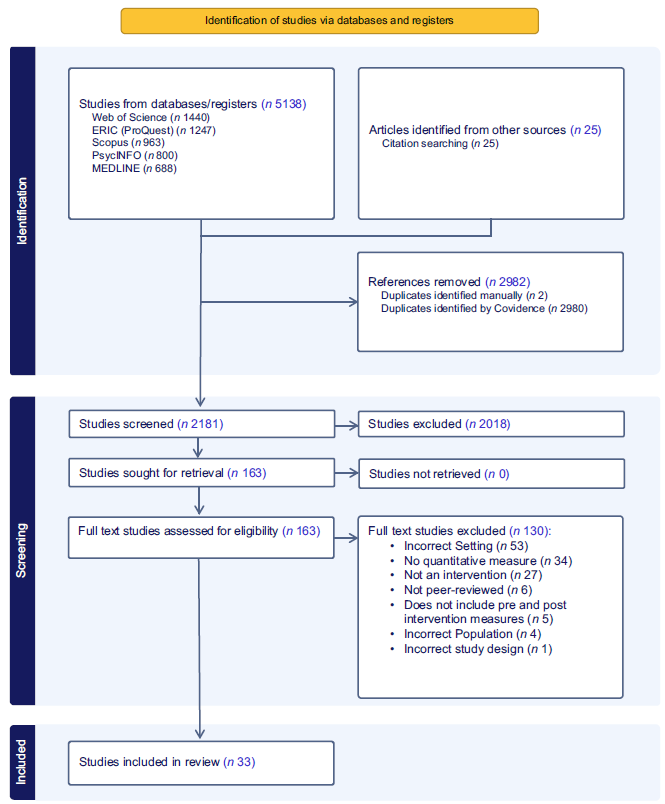
All references were managed in Mendeley (Version 2.135.0, 2024), then screened in Covidence (2024). Two reviewers (LP and one additional reviewer: JN, RC, AW or SR) independently screened titles and abstracts (Figure 1). Full texts were independently assessed against eligibility criteria by two reviewers (LP and one additional reviewer: MH, JN, RC, AW or SR). Studies deemed as ineligible were recorded with reasons for ineligibility in the PRISMA flowchart (Figure 1). Several studies reported results based on the same sample and/or the same intervention. To avoid duplication of results and to attribute more weight to these studies, only the study that had the highest methodological quality (e.g. RCT with larger sample size v. one-group pre-post pilot study) or that reported the most information (e.g. baseline, post-test and follow-up data v. baseline and post-test data only) was included for further analysis(Reference Shaheen, Shaheen and Ramadan12).
Preferred Reporting Items for Systematic Reviews and Meta-Analyses (PRISMA) (flow chart(Reference Page, McKenzie and Bossuyt11) showing selection of the studies included in the present systematic review.

Figure 1. Long description
A flowchart illustrating the selection process of studies included in a systematic review of Outside School Hours Care services. The flowchart is divided into three main sections: Identification, Screening, and Included. In the Identification section, studies are sourced from databases/registers and other sources. Studies from databases/registers include Web of Science (1440), ERIC (ProQuest) (1247), Scopus (963), PsycINFO (800), and MEDLINE (688), totaling 5138 studies. Articles identified from other sources include citation searching (25). A total of 2982 references are removed due to duplicates identified manually (2) and by Covidence (2980). In the Screening section, 2181 studies are screened, resulting in 2018 studies being excluded. 163 studies are sought for retrieval, with none not retrieved. These 163 studies are assessed for eligibility, and 130 full-text studies are excluded for reasons such as incorrect setting (53), no quantitative measure (34), not an intervention (27), not peer-reviewed (6), does not include pre and post intervention measures (5), incorrect population (4), and incorrect study design (1). Finally, 33 studies are included in the review.
Data were extracted independently by two reviewers (LP and one additional reviewer: MH, JN, PA or AW). LP independently conducted the first extraction for all included articles, and MH, JN, PA or AW independently performed the second data extraction. Discrepancies were resolved via a consensus discussion; a third reviewer was not required to resolve disagreements. Data were extracted onto a piloted data extraction form developed for this review.
Data extracted included: background and general information; basic study details; population and setting; methods; participant descriptives; intervention and comparison group details; outcome descriptions; results and other relevant information, e.g. cost of intervention, limitations and process evaluation.
Risk of bias
Two authors (LP and one additional reviewer: MH, JN, PA or AW) assessed risk of bias at the outcome level for each included study using the Cochrane Collaboration’s revised risk-of-bias tool for randomised trials (ROB 2) for RCT and Cluster RCT(Reference Higgins, Sterne and Savovic13) and risk of bias in non-randomised studies of interventions (ROBINS-I) for non-RCT(Reference Sterne, Hernán and Reeves14). Using ROB 2, bias was assessed across the following domains: bias arising from the randomisation process, bias due to deviations from intended interventions, missing outcome data, measurement of the outcome and selection of the reported result. A ‘high’ risk of bias was assigned when the trial was judged to be at high risk of bias in at least one domain or if there were some concerns across multiple domains that lowered confidence in results(Reference Sterne, Savović and Page15). An overall judgement of ‘some concerns’ was assigned if there were concerns in at least one domain and no ‘high’ risk of bias in any domains(Reference Sterne, Savović and Page15). A ‘low’ risk of bias was assigned where there was low risk of bias on all criteria(Reference Sterne, Savović and Page15). Two review authors (LP and one additional reviewer: MH, JN, PA or AW) made judgements independently and met to resolve any discrepancies by consensus.
The ROBINS-I tool was used to evaluate the risk of bias in the included non-randomised studies, provides a structured framework for assessing bias across seven domains: bias due to confounding, bias in selection of participants into the study, bias in classification of interventions, bias due to deviations from intended interventions, bias due to missing data, bias in measurement of outcomes and bias in selection of the reported result. Each domain was systematically assessed using signalling questions to inform judgements, with studies categorised as having low, moderate, serious or critical risk of bias.
Results
Study selection and characteristics
A total of 5138 records were retrieved from the database searches, and an additional twenty-five records through reference list screening (Figure 1). After removing duplicates, 2181 titles and abstracts were screened, and 163 full-text articles were assessed for eligibility. Of these, 130 were excluded. The characteristics of the remaining thirty-three articles, representing thirty-three unique studies and approximately 13 880 participants, are detailed in Table 1. Publication years ranged from 2004 to 2024. Most studies (91 %) were conducted in the USA (n 30)(Reference Heerman, Elsakary and Sommer16–Reference Rinderknecht and Smith45). The remainder were from Australia (n 2)(Reference Forde, Costello and Devine46,Reference Cooke, Sangster and Eccleston47) and Norway (n 1)(Reference Beinert, Roed and Vik48). Most studies included before- and after-school services, with one also providing vacation care. After screening was completed, we identified a systematic review of physical activity interventions in OSHC that was published in 2020(Reference Virgara, Phillips and Lewis10), we therefore made the decision to remove interventions that solely focused on physical activity from the review. The numbers indicated in the PRISMA flow chart (Figure 1) include studies that met the physical activity search terms in the search strategy of the methods section.
Summary of the studies in the present systematic review

Table 1. Long description
A table summarizing studies in a systematic review. The table has 33 rows and 5 columns. Column headers are Study, Year, Country, Participants, and Services. Row 1: Study 1, 2004, USA, 420, Before and after school. Row 2: Study 2, 2005, USA, 500, Before and after school. Row 3: Study 3, 2006, USA, 480, Before and after school. Row 4: Study 4, 2007, USA, 510, Before and after school. Row 5: Study 5, 2008, USA, 490, Before and after school. Row 6: Study 6, 2009, USA, 500, Before and after school. Row 7: Study 7, 2010, USA, 470, Before and after school. Row 8: Study 8, 2011, USA, 480, Before and after school. Row 9: Study 9, 2012, USA, 490, Before and after school. Row 10: Study 10, 2013, USA, 500, Before and after school. Row 11: Study 11, 2014, USA, 480, Before and after school. Row 12: Study 12, 2015, USA, 490, Before and after school. Row 13: Study 13, 2016, USA, 500, Before and after school. Row 14: Study 14, 2017, USA, 470, Before and after school. Row 15: Study 15, 2018, USA, 480, Before and after school. Row 16: Study 16, 2019, USA, 490, Before and after school. Row 17: Study 17, 2020, USA, 500, Before and after school. Row 18: Study 18, 2021, USA, 480, Before and after school. Row 19: Study 19, 2022, USA, 490, Before and after school. Row 20: Study 20, 2023, USA, 500, Before and after school. Row 21: Study 21, 2024, USA, 470, Before and after school. Row 22: Study 22, 2010, Australia, 20, Before and after school. Row 23: Study 23, 2015, Australia, 26, Before and after school. Row 24: Study 24, 2020, Norway, 4, Before and after school. The table shows that most studies were conducted in the USA, with a few from Australia and Norway. The number of participants varies across studies, with the majority focusing on before and after school services.
OSHC, Outside School Hours Care; FV, fruit and vegetable; HOP’N, Healthy Opportunities for PA and Nutrition; HEPA, Healthy Eating and Physical Activity; ASP, After School Program.
Ten studies were cluster RCT(Reference Perry, Flanagan and Velasquez19,Reference Lee, Barrett and Daly22,Reference Beets, Weaver and Turner-McGrievy26,Reference Beets, Turner-McGrievy and Weaver27,Reference Weaver, Moore and Huberty29,Reference Weaver, Beets and Hutto31,Reference Kenney, Giles and deBlois34,Reference Lee, Okechukwu and Emmons35,Reference Branscum, Sharma and Leigh Wang38,Reference Dzewaltowski, Rosenkranz and Geller42) , two were individual RCT(Reference Brown, Harris and Heil23,Reference Beets, Weaver and Turner-McGrievy24) and twenty-one were quasi-experimental non-randomised trials(Reference Heerman, Elsakary and Sommer16–Reference Rieder, Moon and Joels18,Reference Wieland, Biggs and Brockman20,Reference Helmick, Esmond and Hedrick21,Reference Cown, Grossman and Giraudo25,Reference Weaver, Beets and Beighle28,Reference Nabors, Burbage and Woodson30,Reference Beets, Tilley and Weaver32,Reference Beets, Tilley and Turner-Mcgrievy33,Reference Weaver, Beets and Saunders36,Reference Weaver, Beets and Saunders37,Reference Slusser, Sharif and Erausquin39–Reference Iversen, Nigg and Titchenal41,Reference Hauser, Goldberg and Wilde43–Reference Beinert, Roed and Vik48) . Sample sizes ranged from 10 to 1810 child participants. The target audience for the interventions varied with twelve studies focusing on children alone(Reference Heerman, Elsakary and Sommer16–Reference Perry, Flanagan and Velasquez19,Reference Cown, Grossman and Giraudo25,Reference Nabors, Burbage and Woodson30–Reference Beets, Tilley and Weaver32,Reference Branscum, Sharma and Leigh Wang38,Reference Slusser, Sharif and Erausquin39,Reference Iversen, Nigg and Titchenal41,Reference Rinderknecht and Smith45) , nine solely on educators(Reference Lee, Barrett and Daly22,Reference Beets, Weaver and Turner-McGrievy24,Reference Weaver, Beets and Beighle28,Reference Weaver, Moore and Huberty29,Reference Kenney, Giles and deBlois34,Reference Weaver, Beets and Saunders36,Reference Hauser, Goldberg and Wilde43,Reference Forde, Costello and Devine46,Reference Beinert, Roed and Vik48) , five targeting both children and educators(Reference Wieland, Biggs and Brockman20,Reference Beets, Turner-McGrievy and Weaver27,Reference Weaver, Beets and Saunders37,Reference Dzewaltowski, Rosenkranz and Geller42,Reference Mozaffarian, Wiecha and Roth44) , two focusing on directors alone(Reference Helmick, Esmond and Hedrick21,Reference Beets, Tilley and Turner-Mcgrievy33) , two on children and directors(Reference Beets, Weaver and Turner-McGrievy26,Reference Lee, Okechukwu and Emmons35) , one on directors and educators(Reference Cooke, Sangster and Eccleston47) and two on children and parents(Reference Brown, Harris and Heil23,Reference Carson and Reiboldt40) . The children ranged in age from 4 to 17 years, with most studies reporting a range of 5 to 12 years (Table 1).
The intervention duration ranged from 7 weeks(Reference Cown, Grossman and Giraudo25,Reference Forde, Costello and Devine46) to 3 years(Reference Carson and Reiboldt40,Reference Dzewaltowski, Rosenkranz and Geller42) , with most interventions lasting 2–8 months. The median duration was 12 weeks (interquartile range: 8–24 weeks). Intervention session frequency and length varied. For example, two interventions comprised weekly 30-minute sessions(Reference Heerman, Elsakary and Sommer16,Reference Cown, Grossman and Giraudo25) , one intervention involved 2-h sessions 3 d per week(Reference Perry, Flanagan and Velasquez19) and one included monthly modules(Reference Lee, Barrett and Daly22). The median frequency was two sessions per week (interquartile range: 1–3 sessions/week). The median session duration was 40 min (interquartile range: 30–60 min). Eighteen studies (45 %) included follow-up assessments, ranging from 3 to 12 months post-intervention.
Twenty-two studies explicitly reported a theoretical underpinning for their intervention, while the remaining eleven did not describe a theory basis. Social Cognitive Theory(Reference Perry, Flanagan and Velasquez19,Reference Wieland, Biggs and Brockman20,Reference Lee, Barrett and Daly22,Reference Branscum, Sharma and Leigh Wang38,Reference Dzewaltowski, Rosenkranz and Geller42,Reference Hauser, Goldberg and Wilde43,Reference Rinderknecht and Smith45) and Social Ecological Models(Reference Wieland, Biggs and Brockman20,Reference Lee, Barrett and Daly22,Reference Weaver, Beets and Beighle28,Reference Lee, Okechukwu and Emmons35,Reference Weaver, Beets and Saunders36,Reference Dzewaltowski, Rosenkranz and Geller42) were the most frequently cited theoretical frameworks used. Others included Theory of Human Motivation(Reference Beets, Weaver and Turner-McGrievy24,Reference Beets, Weaver and Turner-McGrievy26,Reference Beets, Turner-McGrievy and Weaver27) , 5M Model(Reference Weaver, Beets and Beighle28,Reference Weaver, Beets and Saunders37,Reference Forde, Costello and Devine46) , Ecological Model of Physical Activity(Reference Brown, Harris and Heil23), Systems Framework Conceptual Model(Reference Beets, Tilley and Weaver32,Reference Beets, Tilley and Turner-Mcgrievy33) and Master Teaching Theory(Reference Hauser, Goldberg and Wilde43).
Types and components of nutrition interventions
Of the thirty-three included studies, thirteen focused solely on nutrition(Reference Heerman, Elsakary and Sommer16,Reference Helmick, Esmond and Hedrick21,Reference Beets, Weaver and Turner-McGrievy24–Reference Beets, Turner-McGrievy and Weaver27,Reference Beets, Tilley and Weaver32,Reference Beets, Tilley and Turner-Mcgrievy33,Reference Lee, Okechukwu and Emmons35,Reference Mozaffarian, Wiecha and Roth44,Reference Rinderknecht and Smith45,Reference Cooke, Sangster and Eccleston47,Reference Beinert, Roed and Vik48) , while nineteen combined nutrition with physical activity and/or sedentary screen time(Reference Rieder, Moon and Joels18–Reference Wieland, Biggs and Brockman20,Reference Lee, Barrett and Daly22,Reference Brown, Harris and Heil23,Reference Weaver, Beets and Beighle28–Reference Weaver, Beets and Hutto31,Reference Kenney, Giles and deBlois34,Reference Weaver, Beets and Saunders36–Reference Hauser, Goldberg and Wilde43,Reference Forde, Costello and Devine46) . One study incorporated a broader focus including youth advocacy, psychosocial outcomes and physical activity, with nutrition as a secondary element(Reference Kim, Jones-Bynes and Botchwey17).
Nutrition intervention components varied widely and included:
-
Direct nutrition education for children (n 6), focusing on fruit and vegetable intake, reduction of sugary foods(Reference Kim, Jones-Bynes and Botchwey17–Reference Wieland, Biggs and Brockman20,Reference Brown, Harris and Heil23,Reference Cown, Grossman and Giraudo25) , water consumption(Reference Lee, Okechukwu and Emmons35) and cooking skills and food preparation (n 1)(Reference Heerman, Elsakary and Sommer16)
-
Staff training and capacity building (n 20) delivered both in-person and online(Reference Wieland, Biggs and Brockman20–Reference Lee, Barrett and Daly22,Reference Beets, Weaver and Turner-McGrievy24,Reference Beets, Weaver and Turner-McGrievy26–Reference Weaver, Moore and Huberty29,Reference Weaver, Beets and Hutto31,Reference Kenney, Giles and deBlois34–Reference Weaver, Beets and Saunders37,Reference Slusser, Sharif and Erausquin39,Reference Dzewaltowski, Rosenkranz and Geller42–Reference Mozaffarian, Wiecha and Roth44,Reference Forde, Costello and Devine46–Reference Beinert, Roed and Vik48)
-
Menu changes (n 14) (Reference Kim, Jones-Bynes and Botchwey17,Reference Helmick, Esmond and Hedrick21,Reference Lee, Barrett and Daly22,Reference Beets, Weaver and Turner-McGrievy24,Reference Beets, Weaver and Turner-McGrievy26,Reference Beets, Turner-McGrievy and Weaver27,Reference Weaver, Moore and Huberty29,Reference Weaver, Beets and Hutto31–Reference Beets, Tilley and Turner-Mcgrievy33,Reference Dzewaltowski, Rosenkranz and Geller42,Reference Mozaffarian, Wiecha and Roth44,Reference Cooke, Sangster and Eccleston47,Reference Beinert, Roed and Vik48)
-
Policy changes (n 11)(Reference Wieland, Biggs and Brockman20,Reference Helmick, Esmond and Hedrick21,Reference Beets, Weaver and Turner-McGrievy24,Reference Beets, Weaver and Turner-McGrievy26,Reference Beets, Turner-McGrievy and Weaver27,Reference Weaver, Moore and Huberty29,Reference Weaver, Beets and Hutto31–Reference Kenney, Giles and deBlois34,Reference Cooke, Sangster and Eccleston47)
-
Multi-component programs (n 20) integrating nutrition with physical activity(Reference Rieder, Moon and Joels18–Reference Wieland, Biggs and Brockman20,Reference Lee, Barrett and Daly22,Reference Brown, Harris and Heil23,Reference Beets, Weaver and Turner-McGrievy26,Reference Weaver, Beets and Beighle28–Reference Weaver, Beets and Hutto31,Reference Kenney, Giles and deBlois34,Reference Weaver, Beets and Saunders36–Reference Hauser, Goldberg and Wilde43,Reference Forde, Costello and Devine46)
-
Family or parental involvement (n 3)(Reference Brown, Harris and Heil23,Reference Kenney, Giles and deBlois34,Reference Carson and Reiboldt40)
-
Youth advocacy and leadership (n 1)(Reference Kim, Jones-Bynes and Botchwey17)
-
Social marketing and community partnerships (n 2)(Reference Kim, Jones-Bynes and Botchwey17,Reference Wieland, Biggs and Brockman20)
A detailed summary of each intervention’s components and mode of delivery is provided in Table 1. Notably, none of the included interventions utilised digital tools such as mobile applications as a delivery mode.
Control group conditions
Among the twelve RCT, control groups were assigned to usual practice in six studies,(Reference Perry, Flanagan and Velasquez19,Reference Brown, Harris and Heil23,Reference Beets, Weaver and Turner-McGrievy26,Reference Beets, Turner-McGrievy and Weaver27,Reference Lee, Okechukwu and Emmons35,Reference Dzewaltowski, Rosenkranz and Geller42) wait-list control in five studies(Reference Lee, Barrett and Daly22,Reference Beets, Weaver and Turner-McGrievy24,Reference Weaver, Moore and Huberty29,Reference Weaver, Beets and Hutto31,Reference Kenney, Giles and deBlois34) and one compared an alternative intervention(Reference Branscum, Sharma and Leigh Wang38). Among the non-randomised experimental studies, the majority did not have a comparison group; however, two studies employed a cross-over design where participants or services were their own control(Reference Rieder, Moon and Joels18,Reference Mozaffarian, Wiecha and Roth44) , two drew comparisons with usual-care(Reference Helmick, Esmond and Hedrick21,Reference Slusser, Sharif and Erausquin39) , another used non-participants as controls(Reference Cown, Grossman and Giraudo25) and two compared alternative intervention formats(Reference Nabors, Burbage and Woodson30,Reference Hauser, Goldberg and Wilde43) .
Outcomes measured, measurement tools and intervention results
The included studies assessed outcomes across three levels: (1) individual-level dietary intake, behavioural and anthropometric outcomes (2) service-level changes in food provision, staff practices and centre environments and (3) policy-level implementation and process evaluation outcomes. The studies contributing to each domain, along with the measurement tools used and intervention results, are summarised below.
Individual-level dietary intake, behavioural and anthropometric outcomes
Children’s dietary intake (n 13)
Measures included types and frequency of foods and beverages consumed, measured via self-reported dietary intake questionnaires or food diaries or direct observation of foods and beverages consumed(Reference Kim, Jones-Bynes and Botchwey17,Reference Wieland, Biggs and Brockman20–Reference Brown, Harris and Heil23,Reference Beets, Weaver and Turner-McGrievy26,Reference Nabors, Burbage and Woodson30,Reference Beets, Tilley and Weaver32,Reference Lee, Okechukwu and Emmons35,Reference Branscum, Sharma and Leigh Wang38–Reference Iversen, Nigg and Titchenal41) . Several studies reported significant findings, including increases in children’s fruit and/or vegetable intake(Reference Nabors, Burbage and Woodson30,Reference Branscum, Sharma and Leigh Wang38,Reference Iversen, Nigg and Titchenal41) and water intake(Reference Lee, Barrett and Daly22,Reference Lee, Okechukwu and Emmons35,Reference Branscum, Sharma and Leigh Wang38) . Non-significant improvements were reported in one study regarding fruit and vegetable consumption,(Reference Carson and Reiboldt40) while another found a significant reduction in discretionary food consumption(Reference Slusser, Sharif and Erausquin39).
Children’s nutrition-related practices and psychosocial outcomes (n 8)
These studies examined nutrition knowledge, attitudes, self-efficacy, food preferences and children’s food-related behaviours, most commonly measured using self-report questionnaires(Reference Heerman, Elsakary and Sommer16,Reference Rieder, Moon and Joels18–Reference Wieland, Biggs and Brockman20,Reference Brown, Harris and Heil23,Reference Cown, Grossman and Giraudo25,Reference Slusser, Sharif and Erausquin39,Reference Carson and Reiboldt40,Reference Rinderknecht and Smith45) . Five studies identified a significant increase in children’s nutrition knowledge(Reference Perry, Flanagan and Velasquez19,Reference Brown, Harris and Heil23,Reference Cown, Grossman and Giraudo25,Reference Slusser, Sharif and Erausquin39,Reference Carson and Reiboldt40) and one in children’s ability to make healthier food choices(Reference Perry, Flanagan and Velasquez19). Non-significant improvements were reported for children’s self-efficacy and motivation for fruit and vegetable intake in two studies(Reference Rieder, Moon and Joels18,Reference Wieland, Biggs and Brockman20) . Significant improvements were observed in child-level nutrition-related behaviours, such as cooking self-efficacy, food preferences and willingness to try fruit and vegetables(Reference Heerman, Elsakary and Sommer16). An intervention that aimed to improve dietary self-efficacy significantly improved self-efficacy among children, especially those with overweight(Reference Rinderknecht and Smith45).
Anthropometric measures (n 8)
Anthropometric measures were primarily assessed using BMI, BMI z-scores or BMI percentiles(Reference Rieder, Moon and Joels18–Reference Wieland, Biggs and Brockman20,Reference Brown, Harris and Heil23,Reference Branscum, Sharma and Leigh Wang38,Reference Slusser, Sharif and Erausquin39,Reference Iversen, Nigg and Titchenal41,Reference Dzewaltowski, Rosenkranz and Geller42) . Among the studies that measured BMI, the ‘Club Fit’ multi-component intervention observed a correlation between attendance and decreased BMI z-score (Pearson r = −0·33, P = 0·01)(Reference Wieland, Biggs and Brockman20), the ‘Generations Health’ multi-component intervention demonstrated a reduced BMI z-score of 0·15(Reference Brown, Harris and Heil23) and the ‘Catch Kids Club’ multi-component intervention resulted in a greater reduction in children with overweight or obesity (40·6 % to 37·5 % (−3·1 %)) compared with usual care (46·7 % to 44·7 % (−2·0 %)) P < 0·001(Reference Slusser, Sharif and Erausquin39). Only the Generations Health intervention was an RCT; the Club Fit and Catch Kids Club were non-randomised experimental studies. There were no changes in BMI reported in the other studies.
Service-level changes in food provision, staff practices and service environments
Changes in food provision, the service environment and staff practices (n 17)
These outcomes included the alignment of foods and beverages provided in OSHC settings with dietary guidelines, staff confidence, food preparation practices, nutrition-related interactions with children and broader service-level changes to food purchasing and meal practices; measured through direct observation, staff practice and confidence questionnaires and food purchase audits(Reference Kim, Jones-Bynes and Botchwey17,Reference Lee, Barrett and Daly22,Reference Beets, Weaver and Turner-McGrievy24,Reference Beets, Weaver and Turner-McGrievy26–Reference Beets, Tilley and Turner-Mcgrievy33,Reference Weaver, Beets and Saunders36,Reference Weaver, Beets and Saunders37,Reference Hauser, Goldberg and Wilde43,Reference Mozaffarian, Wiecha and Roth44,Reference Forde, Costello and Devine46,Reference Beinert, Roed and Vik48) . Numerous studies reported significant improvement in provision of fruit and vegetables(Reference Kim, Jones-Bynes and Botchwey17,Reference Lee, Barrett and Daly22,Reference Beets, Weaver and Turner-McGrievy24,Reference Beets, Weaver and Turner-McGrievy26,Reference Beets, Turner-McGrievy and Weaver27,Reference Weaver, Beets and Hutto31–Reference Beets, Tilley and Turner-Mcgrievy33,Reference Mozaffarian, Wiecha and Roth44) . Some studies reported significant improvements in water(Reference Beets, Weaver and Turner-McGrievy24,Reference Weaver, Moore and Huberty29) , decreased provision of salty snacks(Reference Beets, Tilley and Turner-Mcgrievy33) and sugar-sweetened beverages and sugar-sweetened foods(Reference Beets, Weaver and Turner-McGrievy24,Reference Beets, Weaver and Turner-McGrievy26,Reference Nabors, Burbage and Woodson30–Reference Beets, Tilley and Turner-Mcgrievy33) . Improved staff confidence in menu planning, nutrition information access and recipe preparation were found where interventions incorporated education and staff training(Reference Forde, Costello and Devine46). Staff nutrition-focused training interventions that targeted staff behaviours also reported statistically significant increases in staff verbally promoting healthy eating, in staff educating children about nutrition, children preparing food and distributing food and a decrease in staff eating unhealthy foods(Reference Weaver, Beets and Beighle28,Reference Weaver, Beets and Saunders36,Reference Weaver, Beets and Saunders37) . A study comparing the effectiveness of training delivery methods (face-to-face, standard online and enhanced interaction online) for after-school program leaders reported all modalities significantly improved leader knowledge (P < 0·001), but there were no significant differences between groups in knowledge gain or lesson success; however, face-to-face leaders implemented significantly more lessons than enhanced interaction group leaders (P = 0·013)(Reference Hauser, Goldberg and Wilde43). Improvements in food purchasing and meal practices were also found, particularly in studies incorporating nutrition training for OSHC staff(Reference Beinert, Roed and Vik48). However, this study was not adequately powered to detect statistically significant changes.
Policy-level implementation and process evaluation outcomes
Policy implementation, adoption and process evaluation (n 11)
Studies assessed the development, adoption and implementation of nutrition policies; staff implementation fidelity and cost-effectiveness of interventions, measured using administrative records, census data, site director self-report surveys, structured implementation tracking logs and written document reviews (e.g. menus, receipts and nutrition documentation) such as the Healthy Afterschool Activity and Nutrition Document tool.(Reference Helmick, Esmond and Hedrick21,Reference Lee, Barrett and Daly22,Reference Beets, Weaver and Turner-McGrievy26,Reference Beets, Turner-McGrievy and Weaver27,Reference Weaver, Moore and Huberty29,Reference Weaver, Beets and Hutto31–Reference Beets, Tilley and Turner-Mcgrievy33,Reference Lee, Okechukwu and Emmons35,Reference Forde, Costello and Devine46,Reference Beinert, Roed and Vik48) . In one policy adoption focused study, a significant reduction in sugar-sweetened beverage consumption was observed at policy sites (−0·58 oz; P = 0·022). However, overall snack quality did not significantly improve post-adoption due to limited implementation of the recommended standards(Reference Helmick, Esmond and Hedrick21). The potential of policy-driven changes to enhance children’s dietary quality in OSHC settings was also demonstrated in the STEP-HE intervention which saw snack food improvements such as reduced calories, and increased fibre, protein and polyunsaturated fat (Reference Beets, Turner-McGrievy and Weaver27). In addition, one of the studies evaluating the Out-of-school Nutrition and PA intervention found a statistically significant improvement in the comprehensiveness of written nutrition policies across several policy domains and enhanced staff capacity to write OSHC health-promoting policies(Reference Kenney, Giles and deBlois34). The NRG@OOSH Project intervention, involving policy support, training and resources, demonstrated a statistically significant increase in food quality scores (increased from 51 % to 69 % (P < 0·0001)), implementing planned menus (increased from 40 % to 81 % (P < 0·004)) and nutrition policies (increased from 32 % to 78 % (P < 0·001))(Reference Cooke, Sangster and Eccleston47).
A study exploring the level of implementation of the Strategies to Enhance Practice (STEP) framework program(Reference Weaver, Moore and Huberty29) found improvements in snack quality among both high and low implementers. However, the high-implementing services saw greater change from baseline to follow-up (effect size difference ranged from 0·34 to 0·87). In another study evaluating the impact of the STEP framework on OSHC services implementation of nutrition standards, no significant difference was found between high and low implementers within the intervention group for nutrition outcomes, both groups improved similarly(Reference Weaver, Beets and Hutto31). Studies evaluating the impact on community partnerships to improve quality of snacks served and cost-effectiveness demonstrated improved nutritional quality of snacks while reducing costs(Reference Beets, Tilley and Weaver32,Reference Beets, Tilley and Turner-Mcgrievy33) .
The most consistent evidence relates to multi-level, multi-component interventions focused on the inclusion of staff training and changing food provision, menu planning or nutrition policy at the service level. Multiple studies reported statistically significant improvements in fruit and vegetable availability, reductions in discretionary foods and sugar-sweetened beverages and improvements in snack nutrient quality when nutrition standards, procurement policies or menu changes were implemented(Reference Beets, Weaver and Turner-McGrievy24,Reference Beets, Weaver and Turner-McGrievy26,Reference Beets, Turner-McGrievy and Weaver27,Reference Beets, Tilley and Turner-Mcgrievy33,Reference Kenney, Giles and deBlois34,Reference Cooke, Sangster and Eccleston47) .
Risk of bias in studies
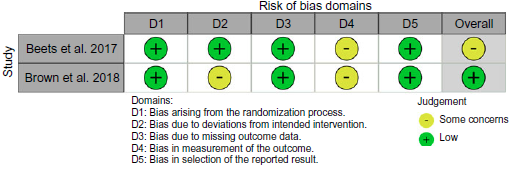
Figures 2–4 summarise the risk of bias assessment for the thirty-three included studies, using ROB 2 for RCT (individual and cluster RCT) and ROBINS-I for non-randomised trials. All studies had an overall ‘low risk of bias’ or ‘some concerns/ moderate risk of bias’. No studies had any criteria that were ‘high risk/ serious risk/ or critical risk of bias’. In the cluster RCT (Figure 3: Cluster RCT; ROB2-Cluster), Domain 1: bias arising from the randomisation process and Domain 5: bias in selection of the reported result were the most frequently rated as ‘some concerns. In the two individual RCT (Figure 4: ROB2), Domain 2 (bias due to deviations from intended intervention) and Domain 4 (bias in measurement of the outcome) were the primary domains of concern. In the non-randomised studies (Figure 2: ROBINS-I), the most common ‘moderate’ domain criterion was Domain 1: bias due to confounding. Domain 2: bias regarding selection of participants was also moderate in several studies, while Domain 4: bias due to deviations from intended intervention was moderate risk in a small number of studies. Most other domains were low risk, particularly Domain 3: bias due to classification of interventions, Domain 5: missing outcome data, Domain 6: measurement of outcomes and Domain 7: selection of the reported result. Overall, the risk of bias across included studies was judged to be low to moderate.
ROBINS-I risk of bias domains.

Figure 2. Long description
A table titled ROBINS-I risk of bias domains. The table has 21 rows and 8 columns. The columns are labeled D1, D2, D3, D4, D5, D6, D7, and Overall. The rows are labeled with study names and years. The table assesses the risk of bias in seven domains for each study. The domains are: D1: Bias due to confounding, D2: Bias due to selection of participants, D3: Bias in classification of interventions, D4: Bias due to deviations from intended interventions, D5: Bias due to missing data, D6: Bias in measurement of outcomes, D7: Bias in selection of the reported result. The judgment for each domain is indicated by colored circles: yellow for moderate, green for low, and blue for no information. Row 1: Weaver et al. 2014 (a), D1: yellow, D2: yellow, D3: green, D4: green, D5: green, D6: yellow, D7: green, Overall: yellow. Row 2: Beets et al. 2014 (b), D1: yellow, D2: yellow, D3: green, D4: green, D5: green, D6: yellow, D7: green, Overall: yellow. Row 3: Cooke et al. 2007, D1: yellow, D2: yellow, D3: green, D4: green, D5: green, D6: yellow, D7: green, Overall: yellow. Row 4: Forde et al. 2021, D1: yellow, D2: yellow, D3: green, D4: green, D5: green, D6: yellow, D7: green, Overall: yellow. Row 5: Carson et al. 2011, D1: yellow, D2: yellow, D3: green, D4: green, D5: green, D6: yellow, D7: green, Overall: yellow. Row 6: Helmick et al. 2019, D1: yellow, D2: yellow, D3: yellow, D4: green, D5: green, D6: yellow, D7: green, Overall: yellow. Row 7: Weaver et al. 2016, D1: yellow, D2: yellow, D3: yellow, D4: green, D5: green, D6: yellow, D7: blue, Overall: yellow. Row 8: Cown et al. 2017, D1: yellow, D2: yellow, D3: yellow, D4: green, D5: green, D6: yellow, D7: green, Overall: yellow. Row 9: Mozaffarian et al. 2010, D1: yellow, D2: yellow, D3: yellow, D4: green, D5: green, D6: yellow, D7: green, Overall: yellow. Row 10: Iversen et al. 2011, D1: green, D2: green, D3: green, D4: green, D5: green, D6: green, D7: green, Overall: green. Row 11: Rinderknecht et al. 2004, D1: yellow, D2: yellow, D3: green, D4: green, D5: green, D6: yellow, D7: green, Overall: yellow. Row 12: Slusser et al. 2013, D1: green, D2: green, D3: green, D4: green, D5: green, D6: green, D7: green, Overall: green. Row 13: Weaver et al. 2014 (b), D1: green, D2: green, D3: green, D4: green, D5: green, D6: green, D7: green, Overall: green. Row 14: Rieder et al. 2021, D1: green, D2: green, D3: green, D4: green, D5: green, D6: green, D7: green, Overall: green. Row 15: Wieland et al. 2020, D1: yellow, D2: yellow, D3: green, D4: green, D5: green, D6: yellow, D7: green, Overall: yellow. Row 16: Hauser et al. 2010, D1: green, D2: green, D3: green, D4: green, D5: green, D6: green, D7: green, Overall: green. Row 17: Beets et al. 2014 (a), D1: yellow, D2: yellow, D3: green, D4: green, D5: green, D6: yellow, D7: green, Overall: yellow. Row 18: Beinert et al. 2024, D1: yellow, D2: yellow, D3: green, D4: green, D5: green, D6: yellow, D7: green, Overall: yellow. Row 19: Heerman et al. 2021, D1: green, D2: green, D3: green, D4: green, D5: green, D6: green, D7: green, Overall: green. Row 20: Nabors et al. 2014, D1: green, D2: yellow, D3: green, D4: green, D5: green, D6: green, D7: green, Overall: green. Row 21: Kim et al. 2021, D1: green, D2: green, D3: green, D4: green, D5: green, D6: green, D7: green, Overall: green.
ROB2-cluster risk of bias domains.

ROB2 risk of bias domains.

Discussion
This systematic review synthesised evidence from thirty-three studies evaluating nutrition interventions and demonstrates that OSHC service interventions can support improvements in food environments and staff nutrition-related practices, particularly where interventions target the service food provision, menu planning or policy. Many interventions led to improvements in the alignment of foods provided with nutrition guidelines. However, results were inconsistent across studies. Few studies reported intervention fidelity and implementation processes, which limited interpretation of why interventions demonstrated varying effects.
Improvements in nutrition-related outcomes were most consistently observed in interventions that directly modified food provision, menu planning or nutrition policy at the service level. These approaches were associated with improvements in fruit and vegetable availability, reductions in discretionary foods and sugar-sweetened beverages and improvements in snack nutrient quality(Reference Cooke, Sangster and Eccleston47) (Reference Beets, Weaver and Turner-McGrievy26) (Reference Beets, Turner-McGrievy and Weaver27) (Reference Kenney, Giles and deBlois34) (Reference Beets, Weaver and Turner-McGrievy24) (Reference Beets, Tilley and Turner-Mcgrievy33). While many of these interventions incorporated staff training or implementation support, evidence appears to suggest that changes to the food environment were the most important driver for improvements. This finding closely aligns with findings from systematic reviews of physical activity interventions in OSHC settings, which demonstrate that interventions targeting organisational policy, scheduling and the physical environment are more effective and sustainable that those relying primarily on education or individual behaviour change alone(Reference Virgara, Phillips and Lewis10,Reference Beets, Beighle and Erwin49) .
Eight studies in this review assessed anthropometric outcomes such as BMI(Reference Rieder, Moon and Joels18–Reference Wieland, Biggs and Brockman20,Reference Brown, Harris and Heil23,Reference Branscum, Sharma and Leigh Wang38,Reference Slusser, Sharif and Erausquin39,Reference Iversen, Nigg and Titchenal41,Reference Dzewaltowski, Rosenkranz and Geller42) , with few reporting significant changes (Reference Wieland, Biggs and Brockman20,Reference Brown, Harris and Heil23,Reference Slusser, Sharif and Erausquin39) . Consistent with systematic reviews of physical activity interventions in OSHC settings, limited anthropometric outcomes are likely due to short intervention durations, general population samples (rather than focusing on those above a healthy weight) and the multifactorial determinants of weight status rather than intervention effectiveness(Reference Virgara, Phillips and Lewis10,Reference Beets, Beighle and Erwin49) .
Staff play an important role in shaping the food environment and modelling healthy behaviours in OSHC settings. While several studies highlighted significant improvements in educator confidence and nutrition-related practices following training(Reference Weaver, Beets and Beighle28,Reference Weaver, Beets and Saunders36,Reference Weaver, Beets and Saunders37,Reference Forde, Costello and Devine46) , interventions providing educator training alone may result in improvements in knowledge, confidence and self-efficacy but generally did not report improvements in food provision or service-level nutrition environments. This also aligns with evidence from childcare and school settings, which indicates that staff training may improve capability but requires reinforcement through structured routines, leadership, policy and ongoing support (Reference Day, Sahota and Christian50–Reference Shoesmith, Hall and Wolfenden53). Given the predominant casual and part-time OSHC workforce, high staff turnover and time-pressured work environment, it is important that any nutrition-focused initiatives including training need to be embedded in organisational policy and everyday procedures to ensure continuity of practices, not reliant on one-off interventions(Reference Crowe, Probst and Weaver2,Reference Forde, Costello and Devine46,Reference Crowe, Probst and Norman54–Reference Woods, Probst and Norman56) .
Although many interventions incorporated multiple components, the heterogeneity of intervention designs and outcome measures made it difficult to determine whether multicomponent approaches are more effective than interventions with a single focus. A recent systematic review and meta-analysis of school-based nutrition interventions found that multicomponent strategies were more effective than education-only or environment-only approaches for improving dietary outcomes. Although this review was focused on the school setting, these findings suggest that multi-level intervention designs may be more likely to support sustained nutrition outcomes and warrant further exploration within the OSHC context(Reference Nury, Stadelmaier and Morze57).
Strengths and limitations
This review is the first to systematically assess the impact of nutrition interventions in OSHC settings and followed a rigorous and transparent methodology. There were several limitations. A meta-analysis was not feasible due to substantial heterogeneity in study designs, outcome measures and data collection methods. Most studies were conducted in the USA and published in English, which may limit the generalisability of findings. Search terms were informed by previous systematic reviews in this setting(Reference Virgara, Phillips and Lewis10,Reference Beets, Beighle and Erwin49,Reference Marttinen, Rodrigues and Nuñez-Enriquez58) ; however, it is noted that there may be terms used in other jurisdictions that the authors were unaware of.
Implications for policy and practice
In line with this review’s findings, comprehensive nutrition policies are important for improving dietary environments in OSHC across all levels of influence: policy, professional development, family and child engagement. Regular monitoring and evaluation are also essential to assess fidelity, support implementation and guide continuous improvement. OSHC services represent an important setting for nutrition promotion, as they provide regular contact with children during periods when food provision, role modelling and social learning can influence dietary behaviours. However, while children’s health and well-being are a central focus of OSHC services, policies across jurisdictions are varied, and nutrition promotion is generally not recognised as a major priority(59). Achieving improvements in this setting requires coordinated involvement from multiple stakeholders and adequate resourcing. OSHC operates in a complex system involving educators, service leadership, children, families and regulatory and policy contexts(Reference Virgara, Phillips and Lewis10,Reference Kenney, Giles and deBlois34) . Consistent with broader health promotion literature, multi-level and multistakeholder approaches that integrate policy, environmental and social influences are more likely to support sustainable improvement(Reference Mikkelsen, Novotny and Gittelsohn60).
Identified gaps and future directions
This review highlights several key gaps in the literature. There were limited studies that focused on intervention fidelity, economic analysis or culturally tailored interventions for diverse populations. Additional gaps include the lack of digital tool integration (such as mobile applications), despite evidence supporting their effectiveness in nutrition education and behaviour change among school-aged populations.(Reference Rosati, Regini and Pauls61,Reference Schoeppe, Alley and Van Lippevelde62) Given the typically young, casualised and time-constrained OSHC workforce, the accessibility and appeal of digital tools may be suited to this setting. Future OSHC interventions should therefore explore app-based platforms for staff training and support(Reference Natale, Howe and Velasquez63).
Conclusion
This systematic review demonstrates the potential of OSHC settings to promote nutrition among children aged 4–12 years. Interventions that directly modified food provision, menu planning and nutrition policy at the service level showed most consistent improvements in nutrition-related outcomes. However, few studies reported intervention fidelity, implementation processes or cost-effectiveness. Future research should prioritise multi-level interventions that include policies, services, educators, children and families. Studies incorporating digital tools to support services in nutrition promotion should also be explored.
Supplementary material
For supplementary material accompanying this paper visit https://doi.org/10.1017/S1368980026103206
Acknowledgements
The authors wish to acknowledge Dr Susan Furber for providing guidance throughout the development of the study.
Financial support
This research has been conducted with the support of the Australian Government Research Training Program Scholarship. This work was supported by the Prevention Research Support Program, funded by the New South Wales Ministry of Health. We declare the funding body has had no influence on the study design, data collection, analysis, interpretations of the findings or writing of this manuscript.
Conflict of interest
All authors declare that they have no conflicts of interest.
Author contributions
L.P.: Conceptualisation-Equal, Data curation-Lead, Formal analysis-Lead, Investigation-Equal, Methodology-Equal, Project administration-Lead, Writing – original draft-Lead, Writing – review & editing-Equal; J.N.: Data curation-Equal, Investigation-Equal, Methodology-Equal, Supervision-Equal, Writing – review & editing-Equal; A.D.O.: Conceptualisation-Equal; A.J.W.: Data curation-Supporting, Investigation-Supporting, Writing – review & editing-Supporting; P.A.: Data curation-Supporting, Investigation-Supporting, Writing – review & editing-Supporting; R.K.C.: Writing – review & editing-Supporting; S.T.R.: Writing – review & editing-Supporting; M.L.H.: Conceptualisation-Equal, Data curation-Supporting, Formal analysis-Supporting, Investigation-Equal, Methodology-Equal, Supervision-Lead, Writing – review & editing-Equal
Ethics of human subject participation
Not applicable.




 Open access

