Insights into two major problems in modern history might lie in the scrawly penstrokes of Britons living in a port on the southern coast of England at the turn of the nineteenth century. Explanations both for the abolition of slavery and for the development of the ideal type of the modern social movement have pointed to the role of parliamentary petitioning in British communities of this period. The eventual emancipation of enslaved people in the Americas marked a crucial disjuncture in colonial and postcolonial economies, alongside striking transformations in humanitarian sentiment, international relations, and racial power across the Atlantic world. At the same time, the rise of abolitionism in Britain and elsewhere has fascinated sociologists exploring the development of social movement campaigns as institutionalized features of democracies and, often, the engines for creating them. However, the personnel and practices of political mobilizations can only be understood through close attention to their wider context. A broader understanding, paradoxically, depends on highly focused investigation of cases in which rich documentation reflects the broader political and associational culture from which support for a range of different campaigns or causes might emerge. This article presents a microhistory of abolitionist petitioners in the provincial town of Plymouth to understand such larger historical processes. A prosopography of local antislavery organizers enables us to see how the campaign emerged alongside a wider associational culture and to suggest how moral distaste translated into innovative political action through established political and social institutions.
Thanks to a lively literature debating the end of slavery in comparative perspective, petitioning is often highlighted as a feature of the popular mobilization that distinguished Anglo-American antislavery activism from revolutionary or elite abolitions elsewhere in the Atlantic world (Drescher Reference Drescher2009: 743–47; Janse Reference Janse2015: 123–25; Oldfield Reference Oldfield2013: 3). Attention to popular abolitionism led a recent generation of historians to emphasize sociocultural explanations for British legislation abolishing the slave trade in 1807 and colonial slavery in 1833, rather than the logic of new economic interests in the next phase of capitalist development (Bender Reference Bender1992; Brown Reference Brown2006: 12–23; Drescher Reference Drescher2011). However, while we may understand the origins of antislavery sentiment better than ever before (Brown Reference Brown2006; Carey Reference Carey2012), we still lack explanations for the novel popular expression of that sentiment as a national campaign in the late eighteenth and early nineteenth centuries (Andrews Reference Andrews2007: 1232; Palmer Reference Palmer2009; Quirk and Richardson Reference Quirk and Richardson2010). A microhistory of one petitioning community cannot determine the relative power of economic concerns, slave resistance, and moral anxieties in deciding the votes of parliamentarians, but it can help to explain the mobilization of political pressure upon those legislators.
Sociologists have studied Britain’s antislavery movement as “possibly the very first full-fledged social movement” and an example of campaigns that “institutionalized the mass production of popular protest” (Stamatov Reference Stamatov2011: 444–45, 449; Tilly Reference Tilly2004: 155; Tilly and Tarrow Reference Tilly and Tarrow2007: 1–2, 11–12). Charles Tilly confirmed how the “smashing success of antislavery mobilization made the social movement campaign a model” for others in Britain and overseas. He located this crystallization of earlier forms of contentious performance in the commercial expansion, communications improvement, and the national “parliamentarization” of politics in Britain at the turn of the nineteenth century (Tilly Reference Tilly2008: 126, 133; Tilly and Wood Reference Tilly, Wood, Diami and McAdam2003: 156). This article grounds Tilly’s macrohistorical process in a microhistory of Plymouth. As we shall see, this new contention relied upon old and new local structures for national campaigns. This study offers an insight into the world of those local leaders who acted as “middlemen,” not only “receiving claims from their own constituencies” but also initiating, and placing themselves at the head, of wider public engagement (Tilly Reference Tilly1995: 264).
Petitions, Plymouth, and Antislavery
Plymouth makes for an attractive local case study due to the survival of particularly rich archival sources, not because the town was exceptional or typical of abolitionist communities. The port’s pioneering role in the English slave trade, with Sir John Hawkins’s voyage to Guinea in 1562 (Worth Reference Worth1873: 36, 61), does not seem to have moved any special guilt amongst residents. Plymouthians were not the first Britons to petition parliament to abolish the slave trade—though they do hold a claim to one significant contribution to the antislavery movement. Thomas Clarkson, a founder of the London-based Society for Effecting the Abolition of the Slave Trade, visited the town in November 1788 and encouraged the formation of a local committee. Innovatively, the Plymouthians used a description of the Liverpool slave ship Brookes, drawn from parliamentary hearings on the slave trade, to create a graphic illustration of conditions for enslaved Africans shipped to the British West Indian colonies (Oldfield 1995: 99–100, 163–66). This diagram of the Brookes was quickly reproduced in London, and it would become the iconic image of commodified Africans pressed between the decks of British ships as well as a touchstone for later abolitionist campaigns (Clarkson Reference Clarkson1808, II: 25, 90; Wood Reference Wood1997).
However, the main activity of successive generations of Plymouth’s abolitionists was to contribute petitions to the national campaign. As the text accompanying the Brookes schematic insisted, “[P]eople would do well to consider that it does not often fall to the lot of individuals, to have an opportunity of performing so important a moral and religious duty.”Footnote 1 In seeking to persuade their townsmen of their proper role, the committee alluded to the novelty of the campaign against the slave trade. For example, their appeal was qualitatively different from the petition, 30 years earlier, of the Corporation and “principal inhabitants” asking for a change the local act governing the relief of Plymouth’s poor (Journal of the House of Commons, xxviii: 520). Signatures in moral condemnation of the slave trade or, later, slavery, broke from the general pattern of private petitions for local “improvement” bills or even more numerously signed “responsive petitions,” offering economic concerns about parliamentary legislation, from 1688 onward (Corfield Reference Corfield1982: 159; Innes and Rogers Reference Innes, Rogers and Peter2000: 536–38; Loft Reference Loft2016). Plymouthians had, before 1788, petitioned on other matters of public contention; because of the closed nature of the Corporation, it had been one of the boroughs to salute, but never condemn, the king’s suppression of the American insurrection (Bradley Reference Bradley1990: 395–97, 410–11). Without approval from the Corporation, some Plymouthians had supported Charles Wyvill’s parliamentary reform movement of 1780 (Black Reference Black1963: 72, 101; Namier Reference Namier, Namier and Brooke1964; Worth Reference Worth1890: 156). Even so, in joining the national campaigns against the slave trade and later slavery, the town’s “political entrepreneurs” perfected the translation of familiar techniques of petitioning into sustained, popular campaigning (Sweet Reference Sweet and Hoppit2003; Tilly Reference Tilly1995: 149).
If the actual petitions survived in the parliamentary archives, then historians of abolitionism would already have completed sophisticated prosopographical analysis of the signatories. That would have enabled us, long ago, to research the social background of petitioners—using trade directories and other records—and to test how far they represented particular economic interests or social classes. However, the destruction of manuscript petitions through routine housekeeping or the burning of the Palace of Westminster 1834 denies us this opportunity, except in the case of a few petitions to the Lords from 1806 (Drescher Reference Drescher1994: 143). The only alternative is to infer the occupational structure of petitioners to the House of Commons from their collective self-descriptions as members of a certain church (Drescher Reference Drescher1986: 128–30). Still, surviving municipal documents in Plymouth provide the opportunity to glimpse abolitionism as part of a broader culture of public subscription and signatory affiliation. Using these, it is possible to reconstruct the networks of those who organized abolitionist meetings in what was, by 1801, England’s sixth-biggest settlement (Chalkin Reference Chalkin2001: 78–79).
Abolitionists exploited the same local mechanisms they knew from town politics, where local men commonly initiated a meeting by signing a requisition to the mayor. This requisition was effectively a municipal petition—praying for the mayor to convene a local meeting at which the propriety of petitioning parliament, altering civic regulations, or fundraising for a charitable cause could be discussed openly in the Guildhall (Morris Reference Morris1990: 184–86). For Plymouth, requisitions record the signatures of the 45 men who called for one or more of the abolitionist meetings in 1814, 1826, and 1828. These can be added to the names of the 1788 committee to build an intergenerational glimpse of provincial abolitionism. Using trades directories, electoral records, and other local sources, it is possible to build a prosopography of the men who translated a national call into municipal action.Footnote 2 Private correspondence and even the personal diary of one key organizer further illuminate the political world that lay behind different phases of abolitionist mobilization.
Unsurprisingly, all these sources confirm the privileged social status of men who would take a leading role in municipal affairs throughout these decades. For example, Sir William Elford, who chaired the 1789 Plymouth committee against the slave trade, was one of three partners in a bank. He was a member of the South Devon militia, and he would later serve with his unit in suppressing the 1798 rebellion in Ireland. He began his public service as mayor of nearby Plympton in 1773 and represented Plymouth in Parliament (1796–1806). Though he ultimately lost his seat, his support for the government won him a baronetcy from his Tory friends and, fleetingly, a safe seat elsewhere. He continued to play a leading role in the town for some years after, holding the magisterial and municipal office of Recorder from 1797 until 1833 (Fisher Reference Fisher and Thorne1986a, Reference Fisher and Thorne1986b; Owen Reference Owen and Cannadine2004). He was clearly a driving force amongst Plymouth’s first generation of abolitionists, and his connections made him a conduit between national and local affairs.
The other key figure was Henry Woollcombe, a solicitor and ultimately Elford’s successor as Recorder. Like Elford, he was a supporter of Pitt and enemy of Jacobinism.Footnote 3 The lawyer served as the town’s mayor in 1814, and in June of that year he accepted a requisition to hold a new anti–slave trade meeting. Because Henry Woollcombe was a keen diarist, we can see that he, as much as Elford, linked Plymouth to a new wave of national petitioning after Napoleon’s first defeat. Woollcombe had traveled to London the previous month to attend the anniversary meeting of the British and Foreign Bible Society. There he heard William Wilberforce describe how peace in Europe risked Britain’s sinful complicity in restoring the French slave trade, which might now resume if not prohibited by Napoleon’s successors (Wilberforce and Wilberforce Reference Wilberforce and Wilberforce1838: 128, 178–81; Woollcombe 1814: 33). Woollcombe already knew William Allen of London and other abolitionist leaders of the African Institution well enough that they had approached him in 1811 to assist a Sierra Leonean in the town; the unfortunate Aaron Richards had been press ganged aboard a ship heading for Plymouth, and the London committee had obtained papers from the Admiralty to secure his freedom.Footnote 4 It seems likely, then, that Woollcombe as mayor did not simply accede to the request to call a meeting in 1814 but actively encouraged the signatories, including both his own brother and Elford.
The subsequent meeting of “very numerous and respectable” inhabitants unanimously approved an address and noted that while they “have partaken in Joy and Exultation which the Abolition of that most criminal Measure diffused throughout this Country, they cannot but experience a proportionable Degree of Disappointment, at this appearing to confederate in the Revival of it.”Footnote 5 This corporate expression of humanity and pressure did not preclude participation in similar addresses from other levels of government: Elford, at a meeting of the leading figures from across Devon who assembled in the city of Exeter on August 10, 1814, steered the group toward a single address to the Prince Regent, rather than splitting the county’s congratulations at victory against France from their resolutions on the slave trade issue (Trewman’s Exeter Flying Post, August 11, 1814: 4). The scale of popular mobilization from across the country took the government by surprise, but that very popularity reflected the foreign target and less contentious nature of petitioners’ prayer. In many ways, the 1814 campaign represents abolitionism at its safest and most conservative; asking to curb the French slave trade, seven years after British abolition, was a demand that even Caribbean slave owners could get behind (Allen Reference Allen2009; Huzzey Reference Huzzey, Robert and Richard2015: 18–20; Turley Reference Turley1991: 65–66).
The emergence, in the 1820 s, of a campaign demanding the emancipation of enslaved West Indians would be far more critical of the United Kingdom’s own policies. An 1823 meeting, called after the mayor received a requisition “signed by Sixty respectable Individuals,” agreed a petition for “the gradual abolition of Slavery” alongside encouragement of other European powers to abolish their own slave trades.Footnote 6 After the government accepted the less ambitious goal of ameliorating the worst excesses of slavery, Plymouthians agreed at a March 1824 town meeting to petition Parliament in support of those resolutions.Footnote 7 Frustratingly, the requisitions for these two meetings do not survive, but those for 1826 and 1828 do reveal the continuity of personnel seeking to impose ameliorative measures on grudging West Indian colonies. Three of the four speakers at Plymouth’s 1824 meeting would sign a requisition, two years later, to renew the pressure on parliament (Trewman’s Exeter Flying Post, March 4, 1824: 2). Every man signing the 1828 requisition had supported the previous one.Footnote 8
It seems likely that Plymouth’s abolitionists settled upon amelioration as their most prominent demand because it held out hope of the broadest range of support for the resultant petition. Henry Woollcombe, who chaired the 1826 meeting, recorded in his diary that they had “convened to petition Parliament promptly to ameliorate & gradually to abolish slavery” even though the mayoral requisition had referred to “the mitigation of Negro Slavery.”Footnote 9 Regardless, Plymouthians did not embrace the more radical push for immediate emancipation after 1823 (Davis Reference Davis2014: 263–64). Rather, the town’s antislavery committee contributed to the Society for Effecting the Mitigation and Gradual Abolition of Slavery from 1825 onward, either donating money or purchasing significant quantities of publications (Anti-Slavery Society 1827: 22, 26; 1829: 8, 13). The chemist John Prideaux corresponded directly with the Anti-Slavery Society’s headquarters in London, procuring its tracts and issues of the Anti-Slavery Reporter.Footnote 10 In 1831, an article in that journal reported on one of Plymouth’s 1831 antislavery meetings and confirmed that Prideaux, Henry Woollcombe, and other veterans of the cause remained active in the final push for emancipation (Anti-Slavery Reporter, January 7, 1831: 50).
The fact that signatories to requisitions often emerged as the leading speakers at subsequent meetings suggests a genuine interest in the cause. John Prideaux’s 1825 correspondence with a solicitor in the neighboring town of Devonport, about plans to raise an antislavery petition there, shows the degree of planning that went into such efforts. He advised, presumably based on his own experience, a private meeting “for the purpose of drawing up a requisition, framing resolutions of a petition, & arranging the business & settling the part each individual shall take, in a public meeting.”Footnote 11 Whether they sought to associate themselves—and their town—with the antislavery cause for selfless or selfish reasons, such people clearly wanted to lend their names publicly. The printing and distribution of the mayor’s response to a requisition—often bearing the names of those who signed it—underlines the performative nature of signing requisitions. So too does the concern of meetings for the insertion of their resolutions in the press and the public location of petitions in the Guildhall.Footnote 12 In this sense, requisitions functioned like—and often also triggered public meetings to elicit—charitable subscriptions as demonstrations of virtue as well as encouragement of further support (Flew Reference Flew2015: 21–24; Morris Reference Morris1990: 208–18). Reprinted requisitions, even more than the manuscript petitions they initiated, could be conspicuous statements of virtue as well as opinion (Carpenter Reference Carpenter2016).
The very request for approval of petition meetings is a clue as to the moderate politics and privileged status of those signing a mayoral requisition. The subsequent petitions—not to mention radical petitions of this period organized without any approval from local authorities—would include a far more diverse range of signatories. A greater anxiety about the respectability of those signing mayoral requisitions probably explains some notable absences from the 1826 and 1828 initiatives: Sir William Elford and his business partner, John Tingcombe, disappeared from parts of public life, including these documents, following the failure of their bank in 1825. Elford would subsequently be a target, not a leader, of municipal activism because he refused to resign as Recorder despite his absenteeism (Welch Reference Welch1964: 334). More fundamentally, the requisitions hide a broader subscriptional culture of petitioning and public fundraising, which extended to citizens who were less wealthy or less male. Indeed, women were named as subscribers in routine appeals for funds to help British prisoners in France or the wives and children of soldiers evacuated from Spain and Portugal; in the latter case a large number are named as donors of clothing.Footnote 13 The initial 1789–90 fundraising by Plymouth abolitionists included money pledged from female donors, often the wives and daughters of male committee members; one “maid servant” from the nearby village of Modbury subscribed a few shillings too (Sherborne Mercury, December 8, 1788; January 19, 1789; February 16, 1789). By 1831, a Plymouth ladies’ antislavery association contributed to the work of the itinerant lecturers of the Agency Committee (Agency Committee 1832: 13). Requisitions obscure this wider activism.
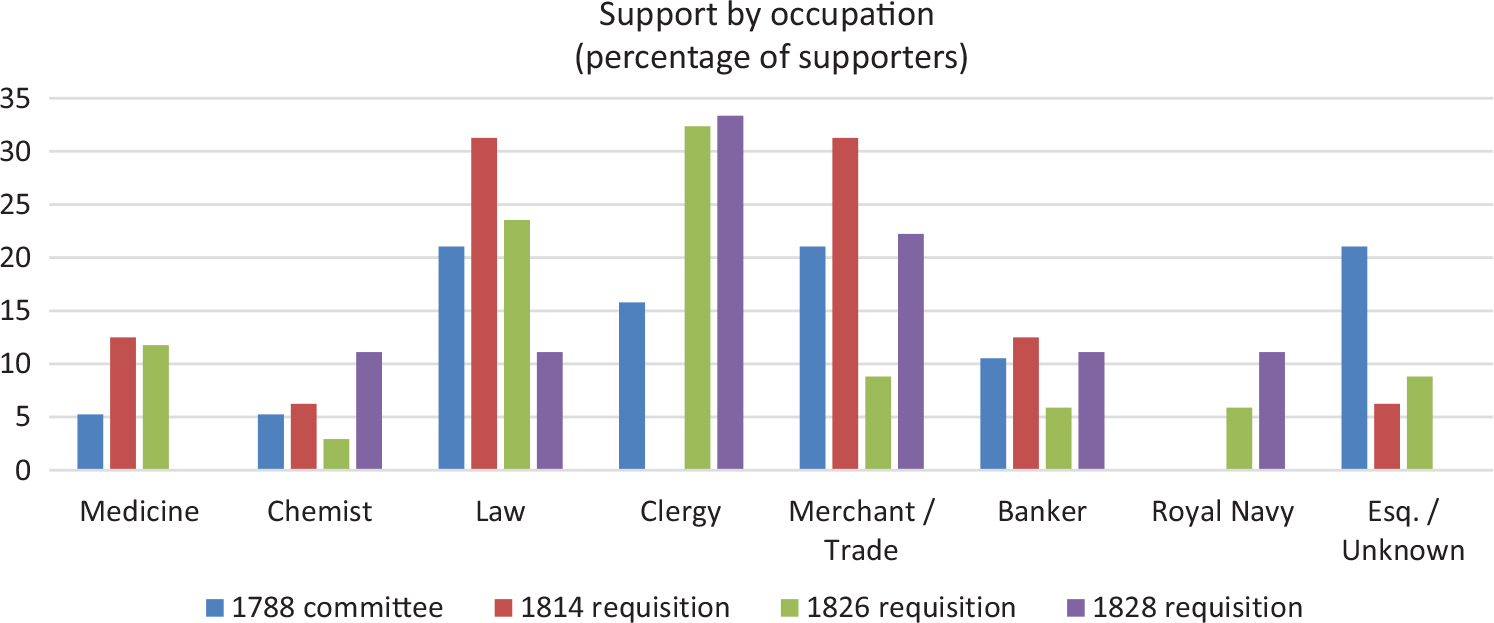
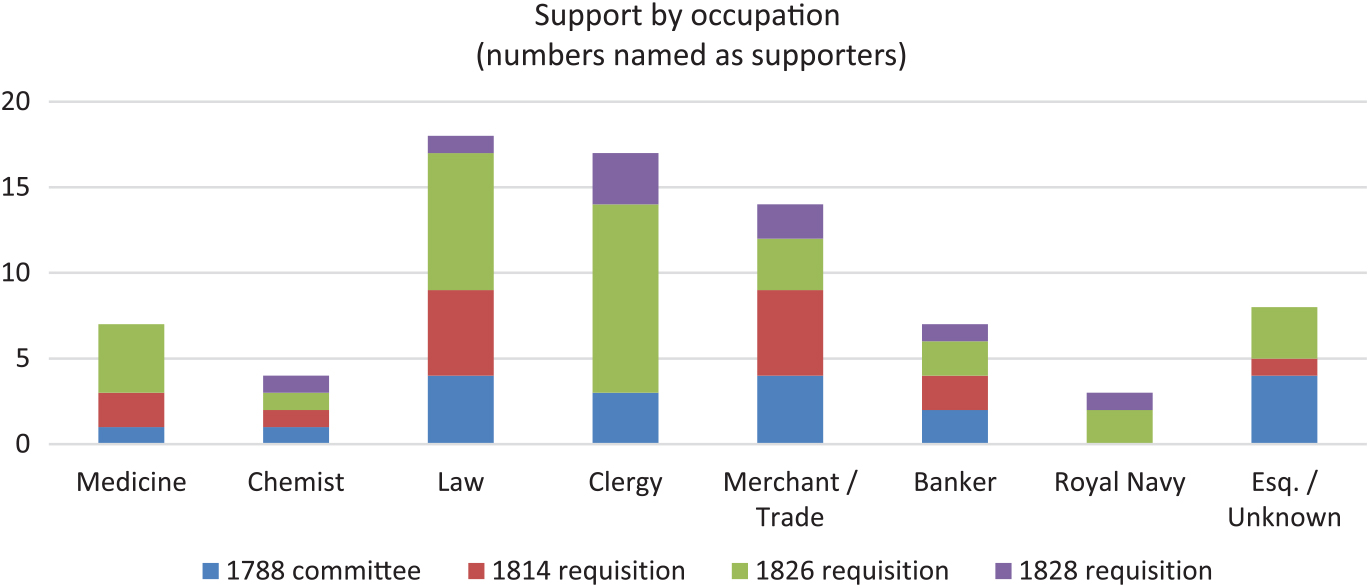
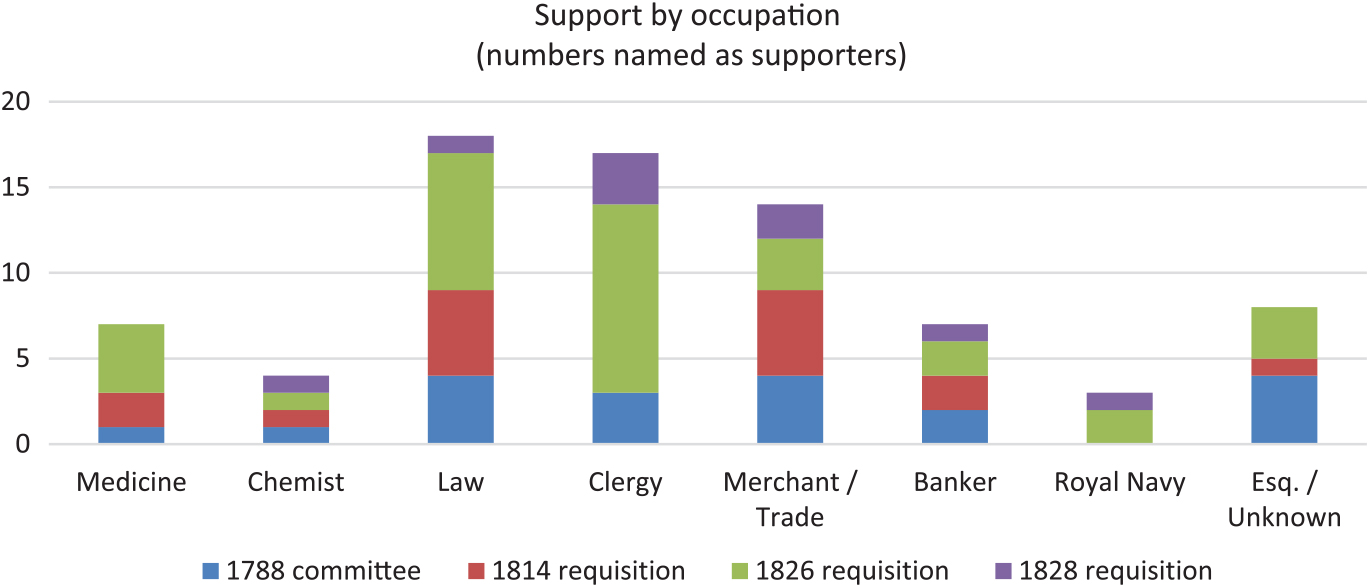
However, in the absence of surviving petitions through which we might glimpse the broader social reach of abolitionism, we can answer some questions about the changing structure of political mobilization in this period and the identities of those who organized local antislavery campaigns (Figures 1 and 2). In particular, we can identify a leading role for the learned professions, in step with their rising prominence in the later eighteenth and early nineteenth centuries (Hilton Reference Hilton2006: 166–74). Lawyers, medics, and clerics offered “civic leadership” but also a network of civic exchange because they corresponded and “lived and worked across the country” as a function of their work (Corfield Reference Corfield1995: 26–29, 214–16). Attorneys played a particularly important role, providing nearly a quarter of the signatures on the largest requisition, in 1826. Of the 13 presidents of Plymouth’s Law Society before 1828, nine—including the first, Henry Woollcombe—signed at least one antislavery requisition (Plymouth Law Society 2016). The Law Society had emerged in 1815 from those attorneys amongst the proprietors and subscribers of the Public Library, founded by one of their number in 1810; both were institutions found increasingly often in other towns, which could be transposed to Plymouth (Anon. 1823: 9; Corfield Reference Corfield1995: 83; Robson Reference Robson1959: 44). Amongst the doctors supporting abolition, Robert Butler Remmett, Joseph Collier Cookworthy, and Woollcombe’s brother William were very active in the Medical Society, founded in 1794 (Square Reference Square1889: 1–2, 10). The lawyers and physicians, then, tended to come from the most professionally active of their number, keenly importing to their town the institutions increasingly common across the country (Clark Reference Clark2000: 114–16).
Percentages of occupations of those supporting 1814, 1826, and 1828 requisitions against the slave trade or slavery, compared to the committee of the 1788 slave-trade abolition committee.

Occupations of signatories to 1814, 1826, and 1828 requisitions regarding slavery compared to the 1788 slave-trade abolition committee, by percentage.
Religion and Antislavery
The invisibility of Plymouth’s clergy in 1814—if it is more than chance—might reflect the civic focus of pushing for anti–slave trade measures alongside the traditional patriotic victory address. Back in 1788–90, Plymouth’s abolitionist committee had benefited from clerical subscriptions and stirring sermons from local preachers (Oldfield 1995: 99). One of those preachers who joined the committee, Robert Hawker, was an eminent evangelical and vicar of St. Charles’s parish church until he died in 1827 (Carter Reference Carter and Sir David2004; Oldfield 1995: 99; Sherborne Mercury, January 10, 1789). It is puzzling that his signature is absent from the 1826 effort because he supported a requisition for a meeting to oppose Catholic Emancipation just a few months before his death.Footnote 14 The Rev. John Hatchard, vicar for the sister parish of St. Andrew’s, happily signed both. Yet the difference might be explained by the fact that Hawker and Henry Woollcombe had long ago fallen out over what the latter called “the peculiarity of his [Hawker’s] doctrine.” The solicitor also complained “that he [Hawker] must be at the head of every thing, he could not bear to play a subordinate part.”Footnote 15 Beyond such personal divisions, the broader trend confirms, however, a central role by the 1820 s for the clergy of the established church and protestant dissent in mobilizing their flocks (Turley Reference Turley1991: 66–67). This tactic was also used successfully by local associations connected to denominational campaigns, including the Church Missionary Society (CMS) from 1825, and interdenominational initiatives, such as the Irish Union Society formed in 1827 to fund Sunday Schools in Ireland (Church Missionary Society 1829: 183; Sunday School Society 1830: 38).
Henry Woollcombe confided to his diary in 1813 that “all serious works such as schools, Bible Society &s. receive their principal support from dissenters” while, he felt, many of his fellow churchmen merely “make a cry against Roman Catholics & Protestant Dissenters & will do any thing to oppress & keep them down.” This complaint was prompted by his frustrations in seeking confederates to raise funds for a new Anglican chapel, given the booming population of the town, but it also captures the ways in which nonconformists—adept at such ventures as church building—were his allies in other activities.Footnote 16 The Anglican Rev. John Hatchard, who as vicar of St. Andrew’s was not averse to making a cry against Roman Catholics, still shared this perspective, having grown up amidst the overlapping initiatives of Clapham evangelicals as the son of their favorite printer and bookseller (Pottle Reference Pottle and Cannadine2004). Hence, the younger Hatchard, in an 1819 sermon chastising national sin and political radicalism, identified the Bible Society’s salutary success as the result of a “spirit of union” between “individuals of every denomination” (Hatchard Reference Hatchard1819: 17–18). In rather different ways, both Woollcombe and Hatchard recognized the vitality of nonconformity in Devon and across the country, and so antislavery fitted into a wider pattern of local, ecumenical alliance building.
Indeed, religious activism united the lay supporters of antislavery as much as their occupations or denominations. Given the origin of the CMS alongside antislavery fervor in Clapham, it is perhaps unsurprising to find local personnel active in both movements (Elbourne Reference Elbourne, John, Colin and Stephen1993). Nearly a quarter of Plymouth’s antislavery enthusiasts in 1826 were also CMS supporters—and a majority of these were laymen (Church Missionary Society 1829: 183). William Prance, who had built a sailcloth business, was a Baptist and the local organizer for his denomination’s missionary society (Baptist Magazine, September 1820: 395). The draper Richard Derry was treasurer of the local Religious Tract Society and a trustee of the Congregationalist church (Anon. 1827: 9).Footnote 17 John Thicknesse, a Captain in the Royal Navy, signed the 1826 and 1828 requisitions, as well as one opposing Catholic Emancipation. His presence in these initiatives is perhaps explained by his religious devotion, which saw him take in active role in the Bethel Society for proselytizing to sailors and the CMS (Church Missionary Society 1829: 183; Trewman’s Exeter Flying Post, November 28, 1822: 4). The poor representation of the Royal Navy, otherwise a significant part of Plymouth’s community, should not be a surprise, given the service’s traditional hostility to abolition (Burroughs Reference Burroughs, Robert and Richard2015: 5). Of course, the absence of sailors from the 1814 requisition reflects their military deployment during the war as much as a political choice. Yet Thicknesse’s particular enthusiasm, like that of others, seems to confirm an interdenominational range of pious enthusiasts—more than any particular profession—as the bedrock of abolitionism.
Thanks to the well-networked Society of Friends, members of local Quaker families were a key source of antislavery energies, in Plymouth as elsewhere. These Friends were largely interrelated, through a dizzying network of marriages, but also cooperated through organizations such as the Peace Society, of which the banker Walter Prideaux was the treasurer (Anon. 1827: 9; Burke Reference Burke1838: 314–20). The anti–slave trade donors of 1788–89 included members of the three Quaker dynasties named by Clarkson in his memoirs as key supporters in the town, and all those families were represented amongst the requisitioners of the 1820 s (Clarkson Reference Clarkson1808, II: 8). The chemist Francis Fox, for example, provided an important bridge between the 1788 slave trade committee, on which he had served, and later initiatives against slavery; Fox was one of a small group, alongside Henry Woollcombe, who met informally to discuss social questions. Another of their compatriots was Henry Gandy, whose father had been a supporter of the original committee and Hatchard’s predecessor as vicar of St. Andrew’s (Stevens and Welch Reference Stevens and Welch1962: 576; Stunt Reference Stunt2015: 39). It appears that Woollcombe’s early work for the London abolitionists, in 1811, saw him deputizing for Fox as their agent in Plymouth.Footnote 18 Fox died in 1812 and would be remembered as “firm and bold, when he found it his place to act as a Christian moralist and philanthropist” and “a liberal and zealous promoter of public works of benevolence” (Forster Reference Forster1829: 47–49). The fact that he did so alongside Anglicans was typical of antislavery and other initiatives in the town (Selleck Reference Selleck1967: 239–52).
In understanding how faith and ideology spur political action, historians do not often have the luxury of windows into men’s or women’s souls (Bradley Reference Bradley1990: 38–42). Henry Woollcombe figures so largely in this study because he was exceptionally active in a range of initiatives. These are extensively recorded in his diary, which he also used to work through theological anxieties and dilemmas. So we can trace, for example, how he found solace from his sister’s death when he read in the Quarterly Review that the mortal plane was “a trial of character and discipline of virtue” and that in “the very notion of a state of probation evil must be included” to ensure “a situation of moral trial” (Quarterly Review, December 1812: 368).Footnote 19 This was a view of life as an “ethical obstacle course,” as Boyd Hilton characterizes the “the age of atonement” (Hilton Reference Hilton1991: 8–9). It is easy to see why the solicitor busied himself in antislavery amongst other good works and prayed in 1826 “to God, that the stain on our country may be gradually removed.”Footnote 20 While cynics might suspect he was performing his piety for his diary and in his public roles, the journals of this “political entrepreneur” seem to fit a common pattern of private spirituality, without any clear expectation of a wider audience (Steinitz Reference Steinitz2011: 29–31).
Economic Interests and Associational Culture
If there was any close relationship between antislavery sentiments and particular economic interests, then we might expect to find that link amongst the tradesmen and merchants calling for petition meetings. However, these men were bakers and brewers and drapers, not sugar refiners hoping to break the West Indians’ monopoly. In fact, despite talk about a sugar refinery, one did not emerge in Plymouth until after British emancipation, and so it is hard to link abolitionism to refiners’ traditional enmity toward Caribbean proprietors (Burt Reference Burt1816: 166–70; Williams Reference Williams1944: 163–65; Worth Reference Worth1873: 253). Surprisingly, the town’s commercial and mercantile classes were actively concerned by a lack of trade with the West Indies and wanted to develop one. Henry Woollcombe, in his role as Deputy Chairman of the Chamber of Commerce, chaired a meeting in 1816 to consider the future prospects of Plymouth; envying the wealth that cities such as Liverpool had gained from transatlantic trade, the assembled townsmen hoped to emulate such successes while, as one put it, “abstaining from what is repugnant to humanity.” The same Robert Fuge who spoke on that occasion in favor of a sugar trade with Jamaica—and subsequently sent a ship to the island—signed the 1814 anti–slave trade requisition (Burt Reference Burt1816: 137; III: 166–70; Bennett Reference Bennett2011). Of course, the effort to suppress France’s slave trade in 1814 was compatible with West Indian business interests. By the 1820s, when agitation targeted British slave owners, we might expect to find a co-identity between antislavery and free-trade agitation, as economic explanations for emancipation have posited (Williams 1944).
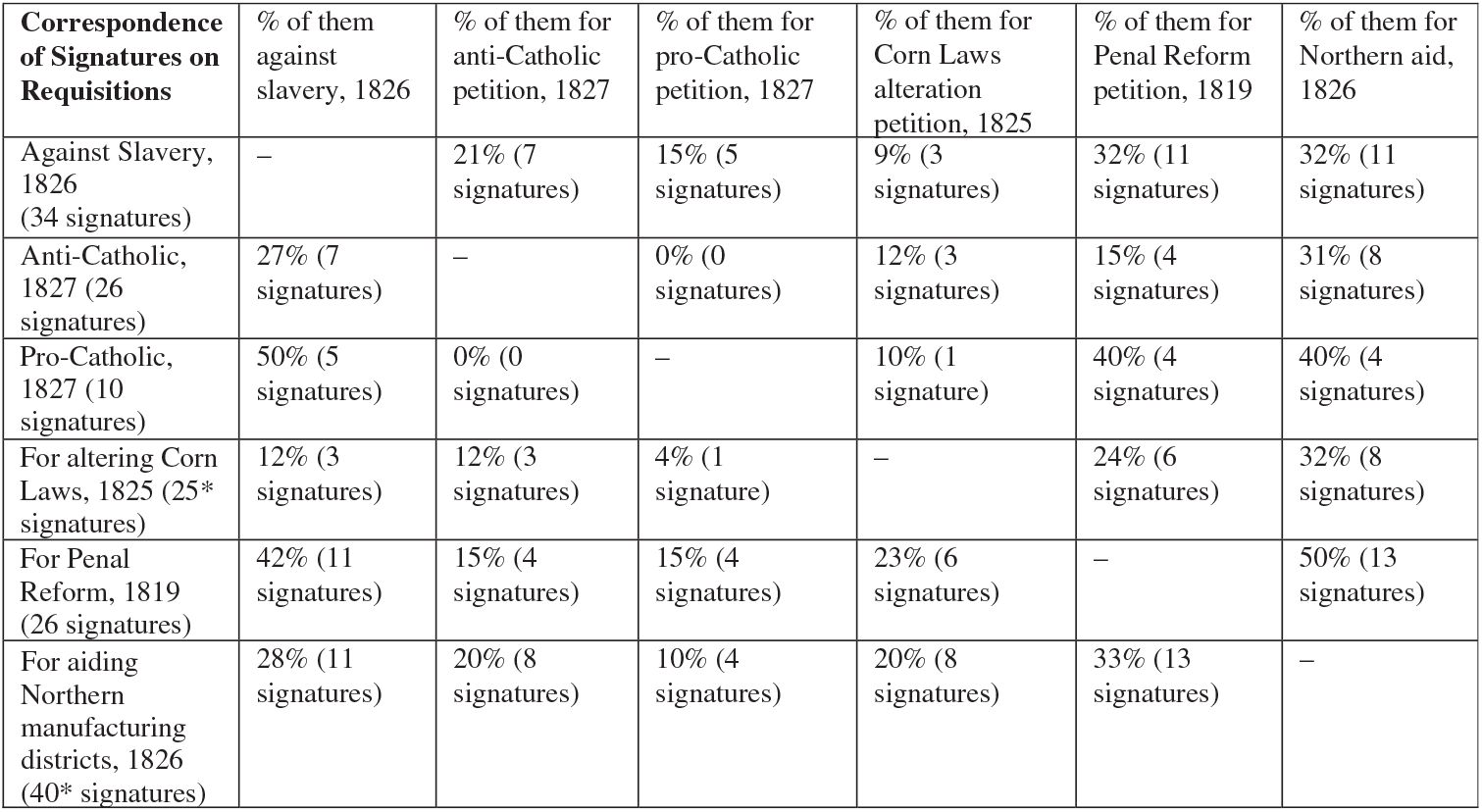
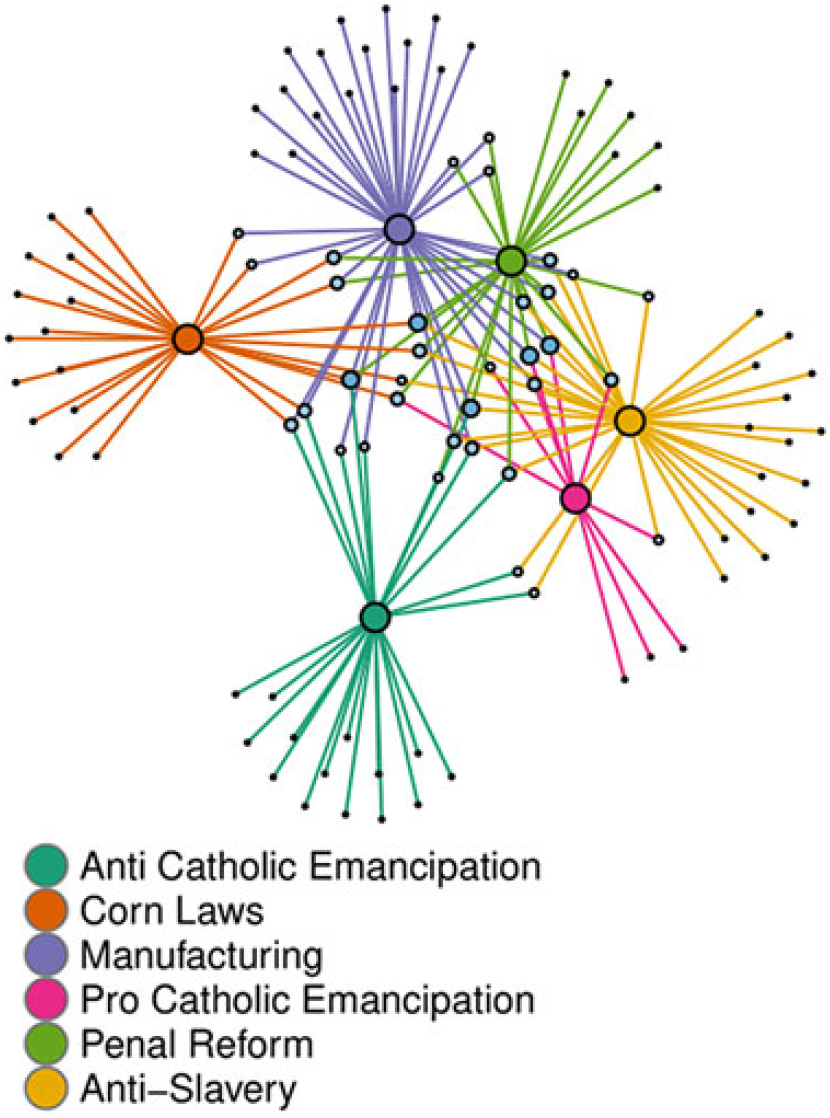
However, the correlation between abolition and free trade appears strongest in Plymouth in the last years of the Napoleonic wars. By contrast, if we compare the numerously signed 1826 antislavery requisition with others from the same decade, it appears that enthusiasts for that cause were not especially likely to be promoting free trade (Figure 3). Yet, looking across the decades, a further six abolitionists of the 1820 s had been involved in opposing the corn laws in 1814–15, and so, it seems likely, remained hostile to protectionism. This confirms an affinity between the urban champions of “the Manufacturing and Commercial Part of the Nation, and the Community at large” and those concerned about slavery.Footnote 21 In a growing port town, such a link is not too surprising. However, even when counting the corn-law opponents of 1814–15 alongside those of 1825, the correlation with free trade is no stronger for antislavery than other issues. Comparing the signatories of a series of requisitions from the period 1819 to 1827 permits us to see the common pool of men who initiated meetings for petitions or subscriptions on a broad range of subjects (Figure 3).Footnote 22 Half of those seeking liberal penal reforms in 1819, for example, also sparked a subscription to relieve distress in the manufacturing districts of northern England in 1826. The small numbers of signatories involved mean that we should not read too much into the proportions supporting any particular pair of requisitions, but we might at least conclude that no greater link is apparent between slavery and the keenest agitators of economic policy and those raising moral and cultural questions (Figure 4).
Correspondence of signatures on mayoral requisitions for public meetings, 1819–27. Asterisk denotes lists including business partnerships.
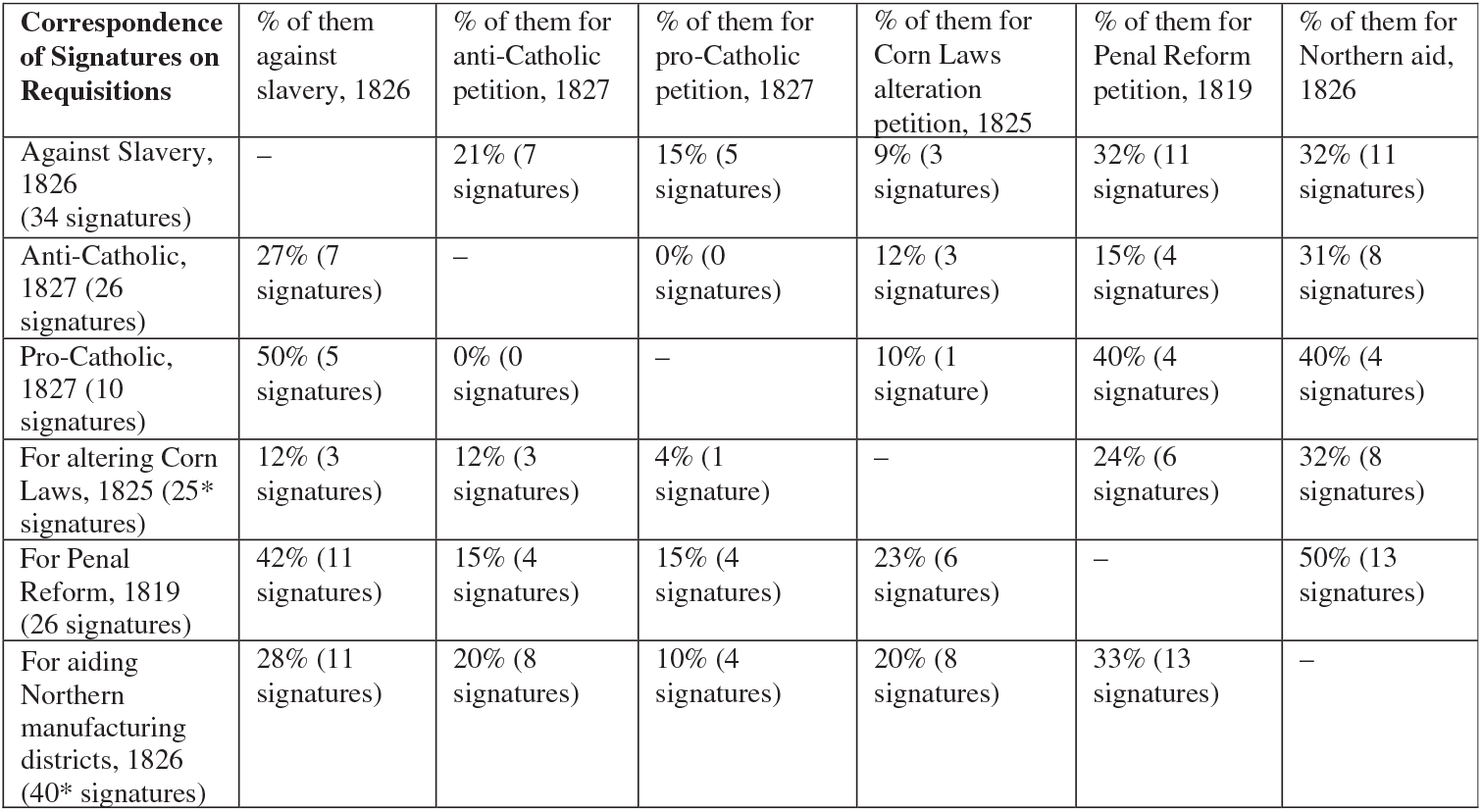
FIGURE 4.

Particularly notable, though, are the divisions between Plymouthians over the political emancipation of Roman Catholics. Antislavery enthusiasts took key roles on both the liberal and intolerant sides of this question in 1827, as public notices reveal (Trewman’s Exeter and Plymouth Gazette, March 10, 1827: 3). By 1829, anti-Catholic petitions from the town and also individual congregations captured thousands of supporters, weighed against just 50 signatures on a rival one supporting Emancipation. It is tempting to imagine that the disappearance of Hatchard and some other clergy from the 1828 antislavery requisition might reflect lingering resentment toward Henry Woollcombe and John Prideaux, who had been prominent voices on the unpopular side of the question (Jenkins Reference Jenkins and Fisher2009a). However, it is problematic to read too much into the absence of signatories from requisitions, given that their role was to encourage and publicize a cause rather than collate an exhaustive list of supporters for it. The strong interest in both sides of the Roman Catholic question certainly underlines the vitality of religion, as we would expect, for Plymouth’s abolitionists.
They were also linked through a bewildering range of civic institutions with cultural or philanthropic aims. Of the 21-strong committee for Plymouth’s proprietary library in its first year, 1810–11, eight signed the 1814 anti–slave trade requisition—and a further four had donated money to the 1780 s committee or would sign later requisitions against slavery (Bautz Reference Bautz, Mark and Kyle2017; Lattimore Reference Lattimore1982). Of even greater importance was the Plymouth Institution, which grew out of Francis Fox and Henry Woollcombe’s discussion circle, becoming a formal body in 1812 (Stevens and Welch Reference Stevens and Welch1962: 576). Around a third of the founding members of the Plymouth Institution took some part in abolitionism (Plymouth Institution 1871: 156; Rowe Reference Rowe1821: 50). In fact, three of them would be at the forefront of a row between those who wished to retain a select membership and others, such as Woollcombe, who wished to “be less influenced by the accidental circumstances of birth and fortune, than by the more solid qualities of intellectual attainments and moral worth” (Stevens and Welch Reference Stevens and Welch1962: 576–77). Such squabbles had been long forgotten by the time the Institution acquired a new Athenaeum building in 1819. Rev. Robert Lampen told his colleagues on that occasion that God “gave us reason, not for idle speculation or personal distinction, but for the completion of a more glorious destiny, as the enlightened adorers of his greatness, and the humble imitators of his moral perfections” (Lampen Reference Lampen1830: 4–5). Such an ethic may have lain behind the intellectual curiosity of his fellow abolitionists Rev. T. S. Tozer, a serious botanist (Jones and Kingston Reference Jones and Kingston1829: 90), and John Prideaux, an amateur geologist (Prideaux Reference Prideaux1830). These men were clearly part of what literary scholar Dafydd Moore has described as “a regional enlightenment based upon the ideals of sociability and polite learning” (Moore Reference Moore2009: 758).
No one better illustrates these efforts than Samuel Rowe, a young printer-turned-priest with a range of intellectual interests. Studying at Jesus College, Cambridge, Rowe was deeply impressed by William Paley’s scholarship and published well-regarded abstracts of his works (Goodwin and Baigent Reference Goodwin, Baigent and Cannadine2004; Stunt Reference Stunt2015: 20–22). Clearly, by the time he returned to Devon in the mid-1820 s, he was already a zealous abolitionist because those abstracts included his own footnote observing that the pursuit of slightly cheaper sugar meant that “the tears and groans, and blood, of myriads of Africans, ascended to the throne of Divine Justice, crying for vengeance against their unnatural European brethren!” (Rowe Reference Rowe1824: 96). His collaboration with Woollcombe and Prideaux would extend in the late 1820 s from antislavery into antiquarianism, as they shared their studies of stone circles and other “druidical antiquities” on Dartmoor (Rowe Reference Rowe1830: 181). Rowe and Woollcombe added to a growing fashion for towns to produce histories and tourist guides boasting of their town’s local specialities and national importance (Corfield Reference Corfield1982: 186–87; Lattimore Reference Lattimore1982: 87; Rowe Reference Rowe1821; Sweet Reference Sweet1997: 236–39, 277–80; Woollcombe Reference Woollcombe1812). Helping to purge the national sin of slavery might, too, demonstrate civic virtue and importance, to the gratification and satisfaction of a town’s leading citizens.
Municipal Politics, Partisanship, and Antislavery
Therefore, it is important to consider the formal political roles of those supporting antislavery in their town, as well as their private initiatives and associations. Back in 1792, Thomas Oldfield judged Plymouth’s parliamentary politics to be “a most convincing proof of that want of reform in our representative system” that had motivated him to compile his national survey of British boroughs. His radical, polemical account pointed out that a small oligarchy ran the Corporation and hence controlled the membership of those few hundreds of freemen who could choose two parliamentary representatives for 20,000 inhabitants (Oldfield Reference Oldfield1792, I: 236–41). The town’s antislavery efforts unfolded against the backdrop of a struggle over power in the Corporation whereby a group of freemen sought, firstly, to break the hold of the oligarchical Aldermen and, secondly, to defend their own privileges against the demands of the greater masses of freehold property owners. Some of Plymouth’s abolitionists appear to have been associated with the Shoulder of Mutton Club, a society that met in “a small house of entertainment (not a regular inn) so named” and hosted dinners, featuring the eponymous dish (Wright Reference Wright and Wright1891: xvi). Their feasts marked St. Patrick’s Day because that was the day in 1803 when they had won a famous victory for the privileges of the town’s freemen at the Lent Assize court. One chronicler reckoned it marked a “Revolution of the Borough” because the centuries-long aldermanic control of the mayoralty gave way to a freeman’s franchise and hence a succession of mayoral victories for the club’s candidates (Baron Reference Baron1846: 14, 17, 49).
Antislavery support drew from the old guard, including Elford and Joseph Pridham, and the Mutton men, including William Langmead. Because the latter group subsequently squabbled amongst themselves, it is not easy to discern where individuals’ allegiances lay. Henry Woollcombe’s election as mayor for 1814 relied on the votes of both Thomas Cleather, the mayor whose behavior first provoked the freemen, and John Clark Langmead, whose mayoral victory in 1803 signaled the Mutton revolution. None of those who supported his opponent, George Bellamy, signed an antislavery requisition, though we might guess that some of them supported the eventual petition. By 1815, Woollcombe was elected an alderman in controversial circumstances, apparently against the wishes of many of his fellow freemen. Given that almost half of the 1814 anti–slave trade signatories were aldermen or members of the common council, and the reformist Lockyers stayed clear, it would be wholly misleading to link abolitionist requisitions to municipal reform (Welch Reference Welch1962: 329–33).Footnote 23 What is clear, however, is that meetings to raise petitions against the slave trade or slavery came from amongst different factions of those jostling for local authority, in the same way they would all regularly sponsor other civic or charitable meetings.Footnote 24
When it comes to party politics and parliamentary reform, the relationship was also mixed. The success of patrons within the Admiralty in electing the brewer Philip Langmead as member of Parliament (MP) coincided with the Mutton campaign for his son. The “higher parts of the corporation,” having been “overwhelmed by the democracy” of freemen, supported an effort to champion the voting rights of all freeholding property owners. This failed and did not help to save Sir William Elford’s career as MP for the borough in 1806, notwithstanding his government support (Brooke Reference Brooke1964: 17–28; Fisher, Reference Fisher and Thorne1986a; Fisher, Reference Fisher and Thorne1986b; Thorne Reference Thorne and Thorne1986, I: 29). In the 1820s, the naval officers and MPs Sir George Cockburn and Sir Thomas Martin continued to enjoy support from the freemen. Although, by 1831, Woollcombe and his fellow abolitionists Joseph Collier Cookworthy and Rev. John Macaulay were speaking to meetings in favor of parliamentary reform, this did not prevent the attorney supporting Cockburn for personal reasons. At the 1832 election, following the Reform Act, seven abolitionists served on Liberal townsman Thomas Bewes’s election committee, against only two for Cockburn’s abortive effort (Escott Reference Escott and Fisher2009; Jenkins Reference Jenkins and Fisher2009a, Reference Jenkins and Fisher2009c; Plymouth Weekly Journal, July 12, 1832: 2). When we examine the committees of the Devonshire county candidates, for whom many Plymouthians could also vote, abolitionists split evenly in 1830 between the committees of the ultra-Tory Edmund Bastard, the Whig Lord Ebrington, and the Canningite Sir Thomas Acland (Trewman’s Exeter and Plymouth Gazette, August 7, 1830: 1; Jenkins Reference Jenkins and Fisher2009b, Reference Jenkins and Fisher2009d, Reference Jenkins and Fisher2009e, Reference Jenkins and Fisher2009f).
Antislavery support, then, drew from a range of political sympathies, not neatly aligned with parties, Protestant ascendency, or parliamentary reform. The passage of the Reform Act would prove crucial in securing the votes of MPs for West Indian emancipation, though candidates who supported and opposed reform would similarly pledge their antislavery commitment in the 1832 borough election (Plymouth Weekly Journal, July 12, 1832). Henry Woollcombe, now Recorder, was eager to ensure that slavery was the Whig ministry’s next priority. When Lord John Russell, the architect of the Reform Act, visited the town in 1832 as part of his campaign to win one of Devon’s county seats, the former mayor insisted that “wherever reforming principles were adopted, slavery could no longer exist” (Plymouth and Devonport Weekly Journal, September 20, 1832: 3). Yet it did not follow that those initiating petitions—let alone signing them—shared Woollcombe’s warmth for political reform.
Rethinking Abolitionism as a Social Movement
What, then, does a prosopography of antislavery requisitions in a busy port town tell us about the abolitionist movement, the role of petitions, or new models of social movement in this period? While it may not be surprising to find that provincial abolitionism was organized by civic, religious, cultural, and political enthusiasts within the local elite, a glimpse into the world of the petition mongers casts new light on antislavery as a “social movement.” Indeed, placed in its local context, abolitionism seems less exceptional. Antislavery activities developed organically alongside charitable and religious fundraising appeals, municipal meetings called by requisition, other parliamentary petitions, and a flourishing associational culture. Rather than finding particular commercial, denominational, or partisan links between our requisitioners, the success of antislavery lay in crossing these divisions. The very first committee boasted of donations from Anglicans, such as Elford and the grammar school master Rev. John Bidlake, alongside Quakers, such as Francis Fox and the Cookworthy clan, just as other local appeals and national subscriptions might do. Provincial antislavery societies, as much as their London leaders, emerged as part of a revitalized world of religious networks and evangelical initiatives (Clark Reference Clark2000: 104–9; Stamatov Reference Stamatov2011). Plymouth, in 1788 and afterward, developed the same “Dissent-Low-Church alliance,” which James Bradley identified as a key ingredient of popular petitioning in support of radical MP John Wilkes or the American colonists in other boroughs and counties (Bradley Reference Bradley1990: 413).
Given a longer eighteenth-century tradition of parliamentary petitioning, we should beware of overstating the novelty of abolitionist petitioning (Innes and Rogers Reference Innes, Rogers and Peter2000: 562–64; Turley Reference Turley1991: 64–67; Wilson Reference Wilson1995: 158–64, 227, 274). What made abolitionist petitioning different was its cumulative scale and persistence—across decades—both nationally and locally. That relied not only on strong national organization but also lifetime or intergenerational supporters, such as the prominent Plymouthians we have traced, to make those petitions happen. Indeed, the requisitions, as documents, capture this role for established and aspiring local leaders as the crucial link between the cross-class petition signers sketched by Seymour Drescher and the disciplined, commercially savvy London organizers highlighted by John Oldfield (Drescher Reference Drescher1986: 70; Oldfield 1995: 106–9).
As the method of triggering meetings to raise funds, addresses, petitions, or institutions, requisitions linked together those other activities that abolitionists used to muster local antislavery support. Even in unincorporated towns, such as the precocious Manchester, organizers drew on the practices of associational life and corporate politics in publicizing committees and raising meetings to launch their petitions (Drescher Reference Drescher1986: 70). Use of an official building, for a meeting and as the place to leave a petition, was useful, yet not essential. As mayor of Plymouth in 1820, George Eastlake rejected a requisition for a Guildhall meeting condemning the King George IV’s effort to divorce Queen Caroline. But the fact that the well-known requisitioners went ahead with their meeting in private premises—and generated a petition with far better support than the rival loyal address—only underlines the critical organizational role of those initiating such a request (Fisher Reference Fisher and Fisher2009). In contrast to truly democratic and radical movements, such as the petitioners considered by Robert Poole’s article in this issue, abolitionists in Plymouth and most other places could rely on municipal leaders, officially or in a personal capacity, to follow their well-worn routines. Plenty of “gentlemen,” such as Henry Woollcombe, resented occasions when “the Rabble” hijacked more open county meetings for their own petitions and addresses.Footnote 25
Plymouth’s abolitionism developed, then, within a thickening jungle of local institutions, sharing personnel—most often, but not just, the ubiquitous Woollcombe—and strategies. The rich associational life of Plymouth’s abolitionists suggests that antislavery fits alongside other spiritual, philanthropic, scientific, professional, and intellectual endeavors. Reconstructing the world of Plymouth’s petition mongers has confirmed a wider picture of the associational culture that permitted “the formation of individual moral identity and the simultaneous constitution of social boundaries” (Wach Reference Wach1996: 302). If voluntary groups were not new in the 1780s, nonetheless they proliferated in the following decades as urban growth yielded assertive professionals and civic crises beyond the grasp of older-monied county elites (Clark Reference Clark2000: 88–96; Morris Reference Morris1983: 95–99, 104–9). In their local context, antislavery groups were only sophisticated and innovative in directing associational culture toward national political pressure. Because colonial reform clearly required parliamentary intervention, antislavery mobilization anticipated a later pattern of voluntary societies in directing their energies toward soliciting government action (Clark Reference Clark2000: 466–67; Morris Reference Morris1983: 96).
This conclusion, then, while confirming “the growing assertiveness of the middle classes in the public sphere” (Oldfield 1995: 127–29, 187), points to the ways in which antislavery campaigning drew upon, and developed alongside, other local institutions. Tilly and Wood, in arguing for the “parliamentarization of popular contention” in this period, acknowledged “the authorized local assemblies of residents, parishioners, ratepayers, or electors that persisted from the eighteenth to the nineteenth centuries but became increasingly important as arenas for debate of national political issues.” While “local power holders and members of local communities continue to make claims, but become less frequent objects of claims” in their study of meetings reported in newspapers, an emphasis on “parliamentarization” may overlook the extent to which many meetings could be triggered by requisitions to a sheriff or mayor, whether they complied with the request (Tilly and Wood Reference Tilly, Wood, Diami and McAdam2003: 156). In many parts of the country, these requisitions seem to have acted as proto-petitions, asking for sanction to deliberate and, ultimately, to petition Parliament or another source of authority.
Moreover, from the vantage of a microhistory, the multiplication of meetings and petitions on national questions arose as part a growing municipalization of associational life through improvement schemes, voluntary institutions, and congregational collaboration (Quirk and Richardson 2010: 263–79; Stamatov Reference Stamatov2011; Tilly Reference Tilly2008: 126, 133). The provincial organizers functioned as “middle men” of mobilization, ensuring a porousness between the national society and its local supporters. A county attorney, such as Henry Woollcombe, had dined with William Pitt the Younger in his youth; sustained regular intercourse with London society, including Plymouth-born celebrities such as the painter Benjamin Haydon; and called in the revered engineer John Loudon McAdam to deliver turnpike roads (Gill Reference Gill1983: 10–17). Abolitionist organizing fitted into a similar pattern of local emulation and national integration.
Far from parochializing antislavery petitioning, this interpretation emphasizes that the “parliamentarization of popular contention” was undergirded by collective claims to hold meetings and, hence, continued to build upon local contentious performances. Of course, many more case studies would be necessary to confirm the particularities of this microhistory of Plymouth. However, the pluralism amongst antislavery’s local patrons, within that social milieu recorded in surviving sources, seems to support multicausal explanations of its popularity (Palmer 2009). While abolitionism was not a cloak for any particular economic interests, it was only possible thanks to the social associations, religious voluntaryism, and political institutions wrought by economic change in the past century. Abolitionists were active in many other initiatives, but did not draw exclusively from the keenest free traders, friends of religious liberty, or parliamentary reformers. The largely respectable, religious character of abolitionism could capture a particularly broad range of local leaders who pursued personal salvation, individual aggrandizement, or municipal pride using the increasingly familiar tools of associational culture. The popularity of antislavery petitioning, reflected in signatures from a far broader range of Britons, probably lies in its appeal to a host of different anxieties, permitting the mobilization of congregations, networks, and affinities in ways few other issues could. Certainly, that reflects the experiences of Plymouth’s “middle men” who made national campaigns happen in their own town.
Archival Sources
William Allen to Henry Woollcombe, July 7, 1811: 710/439, PWDRO.
Thomas Kennedy to Mr. Burnard, 1814: 1/699/7, PWDRO;
Robert Lampen to Henry Woollcombe, March 22, 1824: 710/597, PWDRO.
“Plan of an African ship’s lower deck,” 1788: 17562/1, Bristol City Council Record Office.
John Prideaux to W. P. Blackmore, February 10, 1825: 147, PWDRO.
Manuscript antislavery requisition, May 20, 1828: 1/669/9, PWDRO.
Manuscript anti–slave trade petition, 1814: 1/669/5, PWDRO.
Manuscript requisition against Catholic Emancipation, March 1, 1827: 1/667, PWDRO.
Manuscript requisition, May 25, 1809: 1/653/1, PWDRO.
Manuscript requisition for penal reform, March 1819: 1/650, PWDRO.
Manuscript requisition in favor of infant schools, September 6, 1827: 1/653/2, PWDRO.
Manuscript subscription for British prisoners in France, 1805: 1/646/4/5, PWDRO
Printed anti–slave trade resolutions, July 4, 1814: 1/669/4, PWDRO.
Printed antislavery requisition, February 14, 1826: 1/669/8, PWDRO
Printed mayoral notice of antislavery meeting, February 16, 1824: 1/669/19, PWDRO.
Printed mayoral notice of antislavery meeting, April 4, 1823: 1/669/20, PWDRO.
Printed resolutions and subscription for education of the poor, June 8, 1809: 1/653/1, PWDRO.
Printed resolutions of meeting for alteration of the corn laws, March 2, 1815: 1/648, PWDRO.
Printed resolutions of meeting opposing the corn laws, May–June 1814: 1/648, PWDRO.
Printed resolutions of meeting to express joy at peace, May 20, 1814: 1/655/7, PWDRO.
Printed requisition for distress of manufacturing districts: 1/646/4/26, PWDRO.
Printed requisition for alteration of corn laws, June 16, 1825: 1/648, PWDRO.
Printed subscriptions for relief of wives and children arrived from Spain and Portugal: 1/646/4/9, PWDRO.
“State of the poll” broadside, September 1813: 710/733, PWDRO.
Henry Woollcombe diary, 1796–1803: 710/391, PWDRO.
Henry Woollcombe diary, 1813–14: 710/394, PWDRO.
Henry Woollcombe diary, 1826–28: 710/397, PWDRO.
Archival Collections
“Plan of an African ship’s lower deck,” 1788: 17562/1, Bristol City Council Record Office.
Plymouth Corporation records: 1, PWDRO.
Woollcombe papers: 710, PWDRO.