Introduction
Keratin-associated proteins (KAPs) are physical components of wool fibres and form a medium that cross-links another physical constituent, the keratin intermediate filaments (KIFs). The KAPs are encoded by small intron-less genes, and to date 33 functional KAP genes, called KRTAPs, that belong to 16 dissimilar ovine KAP families (KAP1-KAP8, KAP11, KAP13, KAP15, KAP20, KAP22, KAP24, KAP26 and KAP28) have been identified (Gong et al., Reference Gong, Zhou, Forrest, Li, Wang, Dyer, Luo and Hickford2016, Reference Gong, Zhou, Bai, Li, Li, Wang, Luo and Hickford2019; Li et al., Reference Li, Zhou, Gong, Zhao, Hu, Luo and Hickford2017a, Reference Li, Zhou, Gong, Zhao, Wang, Liu, Luo and Hickford2017b, Reference Li, Gong, Zhou, Wang, Liu, Li, Luo and Hickford2018; Bai et al., Reference Bai, Wang, Zhou, Gong, Tao and Hickford2019). Of these genes, 15 encode high sulphur-KAPs, seven encode ultra-high sulphur-KAPs and 11 encode high-glycine-tyrosine (HGT)-KAPs.
The amount of KAP protein derived from each group differs spatially and developmentally inside the wool fibre (Powell and Rogers, Reference Powell, Rogers, Goldman and Steinert1990), with the most noteworthy variation being observed with the HGT group, where their abundance varies greatly. It ranges from less than 1% in Lincoln sheep wool to between 4 and 12% in Merino wool (Gillespie, Reference Gillespie, Goldman and Steinert1990). A decrease in the content of HGT-KAPs has been reported to be at least partly responsible for the felting lustre mutant phenotype described in Merino sheep (Li et al., Reference Li, Ouyang, Rogers and Bawden2009). The HGT-KAPs are mainly found in the orthocortex of the wool fibre and they are the first group of KAPs to be expressed, soon after the production of the KIFs (Rogers, Reference Rogers2006). This suggests that the HGT-KAPs may play a key role in regulating the characteristics of wool fibres.
Associations between variation in HGT-KRTAPs and wool traits in different breeds of sheep have been observed. For example in Merino-cross sheep, variation in KRTAP6-1 and KRTAP6-3 was described as being associated with the mean fibre diameter (MFD)-associated traits (Zhou et al., Reference Zhou, Gong, Li, Luo and Hickford2015; Li et al., Reference Li, Zhou, Gong, Zhao, Wang, Luo and Hickford2017c), variation in KRTAP20-1 was associated with wool yield (Yield) and the MFD-associated traits (Gong et al., Reference Gong, Zhou, Bai, Li, Li, Wang, Luo and Hickford2019), variation in KRTAP20-2 was associated with the mean fibre curvature (MFC) (Bai et al., Reference Bai, Gong, Zhou, Tao and Hickford2018) and variation in KRTAP22-1 was associated with yield and the MFC (Li et al., Reference Li, Zhou, Gong, Zhao, Wang, Liu, Luo and Hickford2017b).
In Chinese Tan sheep, variation in KRTAP6-1 was reported to affect fibre length and the degree of crimping (ratio of straightened length to crimped length) (Tao et al., Reference Tao, Zhou, Gong, Yang, Ma, Cheng, Ding, Li and Hickford2017a) and variation in KRTAP8-2 was associated with the degree of crimping (Tao et al., Reference Tao, Zhou, Yang, Gong, Ma, Ding, Li and Hickford2017b). KRTAP8-1 was the first (in 1987) ovine HGT-KAP gene identified (Kuczek and Rogers, Reference Kuczek and Rogers1987), with five variant sequences subsequently being reported (Gong et al., Reference Gong, Zhou, Plowman, Dyer and Hickford2012), but little investigation of the effect of KRTAP8-1 variation on wool traits has been undertaken, the exception being the research of Chen et al. (Reference Chen, Zeng, Hui, Zhao and Jia2011) who revealed associations between KRTAP8-1 and wool fibre diameter in Chinese sheep. The aim of the current study was therefore to genotype KRTAP8-1 in Southdown × Merino-cross sheep (a cross designed to produce heavier lambs with fine wool) and to determine whether there was any association between variation in KRTAP8-1 and selected wool traits.
Materials and methods
This research was undertaken under the provisions of the Animal Welfare Act 1999 (New Zealand Government) and the collection of sheep blood drops by the nicking of ears is specifically covered by Section 7.5 Animal Identification, in: Code of Welfare: Sheep and Beef Cattle (2016); a code of welfare issued under the Act. The study was therefore considered to be exempted from the need to gain ethics approval.
Sheep investigated and wool samples
Three hundred and ninety-one Southdown × Merino-cross lambs (Southdown sires, Merino ewes) from six sire-lines were investigated. Each lamb was tagged with an identification number at birth, and the gender, date of birth, birth rank (i.e. whether it was a single, twin or triplet), sire (single-sire mating) and dam (recorded at birth) were recorded. All the lambs and ewes were managed as a single mob prior to weaning at 14 weeks. Following separation into gender groups (that were farmed under similar management regimes), the lambs were all shorn at 12 months of age. At shearing, the total greasy fleece weight (GFW) was measured, and a sample collected from the mid-side region of each sheep for wool trait measurement using International Wool Textile Organization standardized methods, at the New Zealand Wool Testing Authority Ltd (Napier, NZ). This included measurement of yield, mean staple length (MSL), mean staple strength (MSS), MFD, fibre diameter standard deviation (FDSD), coefficient of variation of fibre diameter (CVFD), MFC and prickle factor (PF; the percentage of fibres of diameter larger than 30 microns). Clean fleece weights (CFW) were calculated from the GFW and Yield measurements.
A blood sample from each lamb was collected onto TFN paper (Munktell Filter AB, Sweden) and genomic DNA was purified using the technique described in Zhou et al. (Reference Zhou, Hickford and Fang2006).
Genotyping of ovine KRTAP8-1
A 258-bp fragment that covered the entire intron-less coding sequence of ovine KRTAP8-1 was amplified using the polymerase chain reaction (PCR) primers described by Gong et al. (Reference Gong, Zhou, Plowman, Dyer and Hickford2012). These primers were 5′-CATTCCCTGCTCTCCAAGC-3′ and 5′-GAGAAGATTCCATGCCTCTG-3′, and they were synthesized by Integrated DNA Technologies (Coralville, IA, USA). The PCR amplifications were performed in a 15-μl reaction containing the purified genomic DNA present on one punch 1.2-mm of the TFN paper, 150 µm of each dNTP (Bioline, London, UK), 2.5 mm Mg2+, 0.25 µm of each primer, 0.5 U of Taq DNA polymerase (Qiagen, Hilden, Germany) and 1× reaction buffer supplied with the enzyme. The thermal profile for amplification consisted of an initial incubation for 2 min at 94 °C to denature the templates, followed by 35 cycles of 30 s at 94 °C, 30 s at 60 °C and 30 s at 72 °C. This was then followed by a final incubation for 5 min at 72 °C to extend incomplete amplicons. The amplifications were undertaken in Bio-Rad S1000 thermal cyclers (Bio-Rad, Hercules, CA, USA).
The PCR products were analysed using a single-stranded conformational polymorphism method (Gong et al., Reference Gong, Zhou, Plowman, Dyer and Hickford2012). A 0.7-μl aliquot of each reaction was mixed with 7 µl of gel loading dye (0.025% bromophenol blue, 0.025% xylene-cyanol, 98% formamide, 10 mm ethylenediaminetetraacetic acid [EDTA]) and after denaturation at 95 °C for 5 min in a heating block, the samples were placed in wet ice and immediately loaded on to 16 cm × 18 cm, 14% acrylamide: bisacrylamide (37.5:1) (Bio-Rad) gels. Electrophoresis was carried out in Protean II xi cells (Bio-Rad), at 250 V for 18 h and 25 °C, in 0.5 × Tris/Borate/EDTA buffer. The PCR amplicons of the earlier recognized variants (Gong et al., Reference Gong, Zhou, Plowman, Dyer and Hickford2012) were included in each gel as reference standards, to enable identification of the variants present in each sample. The gels were silver-stained using the technique of Byun et al. (Reference Byun, Fang, Zhou and Hickford2009).
Statistical analyses of associations
All the statistical associations were undertaken using Minitab version 16 (Minitab Inc., State College, PA, USA). Firstly, Pearson correlation coefficients were calculated to test the strength of the relationship between the ten wool traits: GFW, CFW, Yield, MFD, FDSD, CVFD, MSL, MSS, CURV and PF.
Generalized linear mixed-effect models (GLMMs) were employed to assess the effect of the absence or presence of specific variants, on the ten wool characteristics that had been measured, or calculated. Only those variants that occurred at a frequency over 5% were analysed. The lambs' sire and gender were found to affect (P < 0.05) all the traits, and so they were included in the models as random and fixed factors, respectively. The birth rank of the lambs was not found to affect wool traits, and accordingly it was not incorporated in the models.
Unless otherwise indicated, all P values were considered statistically significant when P < 0.05, and trends were noted when 0.05 ⩽ P < 0.10.
Results
Variants of KRTAP8-1 in Southdown × Merino-cross sheep
All of the five earlier identified KRTAP8-1 variants (Gong et al., Reference Gong, Zhou, Plowman, Dyer and Hickford2012) were observed in the Southdown × Merino-cross sheep, and no new variants were identified. Eight genotypes were detected in total. The most common genotype was AA (occurred at a frequency of 50.4%), followed by AB, AD, BD and AC (with frequencies of 16.1, 9.0, 8.4 and 6.1%, respectively). The remaining genotypes, CD, BC and AE were rare, with frequencies of 4.1, 3.8 and 2.0%, respectively. The individual variant frequencies were 67.0, 14.2, 7.0, 10.7 and 1.0% for A, B, C, D and E, respectively.
Association between KRTAP8-1 variants and wool traits
In the 391 Southdown × Merino-cross lambs investigated, variant E was rare and only found in eight sheep. This variant was not included in the association analyses and those eight sheep were removed from the study, leaving 383 sheep for the association analyses.
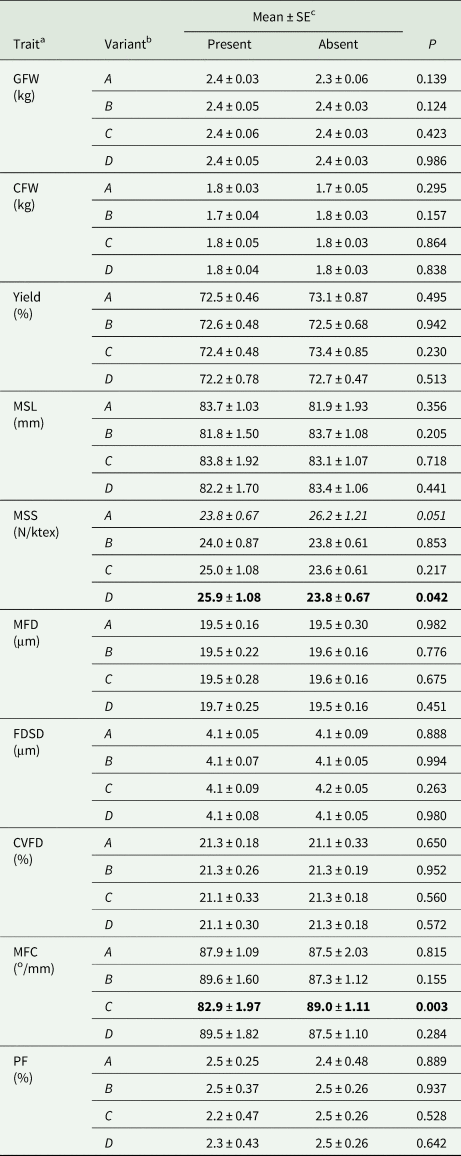
Variation in KRTAP8-1 was found to be associated with MFC and MSS (Table 1). The presence of variant C was associated with a decrease in MFC (P = 0.003). The presence of D was associated with an increase in MSS (P = 0.042), whereas the presence of A had a trend of association with decreased MSS (P = 0.051). Associations were not detected with other wool traits.
Association of KRTAP8-1 variants with various wool traits

a GFW – Greasy Fleece Weight; CFW – Clean Fleece Weight; MFD – Mean Fibre Diameter; FDSD – Fibre Diameter Standard Deviation; CVFD – Coefficient of Variation of Fibre Diameter; MSL – Mean Staple Length; MSS – Mean Staple Strength; MFC – Mean Fibre Curvature; PF – Prickle Factor (percentage of fibres over 30 μm).
b A total of 363 sheep were included in the model when the eight sheep with variant E (that occurred at a frequency under 5%) were excluded. Variant A was present in 319 sheep and absent in 64 sheep, variant B was present in 111 sheep and absent in 272 sheep, variant C was present in 55 sheep and absent in 328 sheep, and variant D was present in 84 sheep and absent in 299 sheep.
c Predicted means and standard errors of those means derived from GLMMs, with P < 0.05 being in bold and 0.05 ≤ P < 0.10 being in italicised.
Discussion
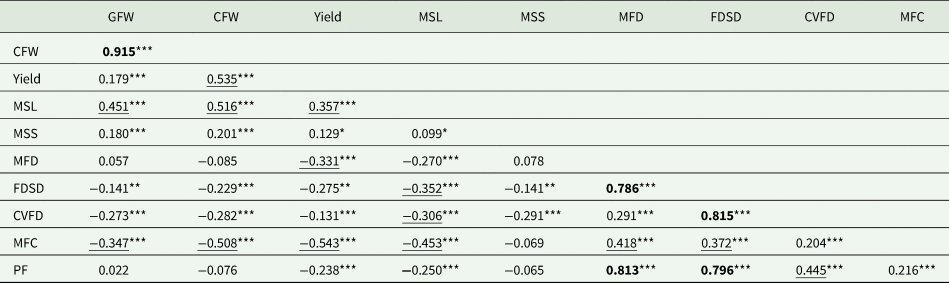
The current study has identified associations between KRTAP8-1 variation and wool MSS and MFC in Southdown × Merino-cross lambs. Given that MSS and MFC had a negligible correlation with each other (Table 2), the associations detected with these two wool traits suggest KRTAP8-1 has independent effects on MSS and MFC. This is supported by the observation that different variants of KRTAP8-1 were found to be associated with variation in MSS and MFC.
Pearson correlation coefficients between various wool traits (n = 391)a
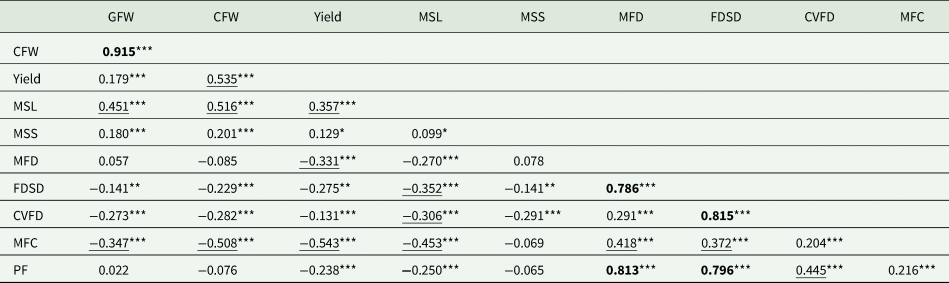
GFW, greasy fleece weight; CFW, clean fleece weight; MSL, mean staple length; MSS, mean staple strength; MFD, mean fibre diameter; FDSD, fibre diameter standard deviation; CVFD, coefficient of variation of fibre diameter; MFC, mean fibre curvature; PF, prickle factor (percentage of fibres over 30 µm).
a Correlations with |r| > 0.7 are in bold, and those with 0.3 < |r| ⩽ 0.7 are underlined. *P < 0 0.05; **P < 0.01; ***P < 0.001.
Unlike Chen et al. (Reference Chen, Zeng, Hui, Zhao and Jia2011), no associations were found between KRTAP8-1 and MFD in the current study. Chen et al. (Reference Chen, Zeng, Hui, Zhao and Jia2011) reported two single nucleotide polymorphisms (SNPs) (and three alleles) of KRTAP8-1, g.1026 T/C and g.1130 C/T (locations given relative to GenBank sequence X05639), but these SNPs were not found in the current study, and full sequences were not provided by Chen et al. (Reference Chen, Zeng, Hui, Zhao and Jia2011), so comprehensive sequence comparisons cannot be undertaken. Together, the current findings and those of Chen et al. (Reference Chen, Zeng, Hui, Zhao and Jia2011) suggest that KRTAP8-1 is a polymorphic gene.
Variant D has a nucleotide substitution at c.100 when compared to other variants, and this substitution would result in an amino acid change of asparagine to tyrosine at position 34 of the protein (Asp34Tyr). Despite both asparagine and tyrosine being neutral and polar amino acids, this substitution would affect the glycine and tyrosine content of the protein, which is an important characteristic of the HGT-KAPs, including KAP8-1. Endrizzi et al. (Reference Endrizzi, Huang, Kiser and Stewart2006) described the covalent immobilization of proteins through dityrosine cross-links in structural proteins, and thus variation in tyrosine levels may affect the ability of the protein to cross-link with intermediate filaments, and consequently affect the mean fibre staple strength.
In contrast, variant C does not contain any nucleotide substitution that would lead to an amino acid change, but instead has a ‘silent’ nucleotide substitution at c.39, when compared to other variants. Whether this substitution is functionally important is unknown, but research with other genes has revealed that silent nucleotide substitutions can affect mRNA stability and influence protein synthesis (Duan et al., Reference Duan, Wainwright, Comeron, Saitou, Sanders, Gelernter and Gejman2003) and thus the substitution observed in variant C may affect KRTAP8-1 expression. Recent research has revealed that wool fibre curvature is determined by the relative length of the orthocortical and paracortical cells (Harland et al., Reference Harland, Vernon, Woods, Nagase, Itou, Koike, Scobie, Grosvenor, Dyer and Clerens2018). Given that the HGT-KAPs are predominantly present in the orthocortical cells, the expression of the KAP8-1 protein may affect the length of the orthocortical cells and consequently the curvature of the fibre. This would, however, require further investigation, including potentially a study of orthocortical cell length in wools of differing genotype.
The associations detected in the current study for KRTAP8-1 are different from the effects described for other KRTAPs clustered on the same chromosome, including KRTAP6-1, KRTAP6-3, KRTAP15-1, KRTAP20-1, KRTAP20-2, KRTAP22-1, KRTAP26-1 and KRTAP28-1. In Merino-cross and NZ Romney sheep, variation in KRTAP6-1 and KRTAP6-3 was found to be associated with MFD-associated wool traits (Zhou et al., Reference Zhou, Gong, Li, Luo and Hickford2015; Li et al., Reference Li, Zhou, Gong, Zhao, Wang, Luo and Hickford2017c, Reference Li, Gong, Zhou, Wang, Li, Liu, Luo and Hickford2019), KRTAP15-1 was reported to affect wool yield (Li et al., Reference Li, Gong, Zhou, Wang, Liu, Li, Luo and Hickford2018), KRTAP20-1 was found to be associated with GFW, wool yield and MFD-associated traits (Gong et al., Reference Gong, Zhou, Bai, Li, Li, Wang, Luo and Hickford2019), KRTAP20-2 was found to be associated with MFC (Bai et al., Reference Bai, Gong, Zhou, Tao and Hickford2018), KRTAP22-1 was found to be associated with MFC (Li et al., Reference Li, Zhou, Gong, Zhao, Wang, Liu, Luo and Hickford2017b), KRTAP26-1 was found to be associated with MSL and MFD-associated traits (Li et al., Reference Li, Zhou, Gong, Zhao, Hu, Luo and Hickford2017a) and KRTAP28-1 was found to be associated with MFD (Bai et al., Reference Bai, Wang, Zhou, Gong, Tao and Hickford2019). An association with variation in MFC has been reported for KRTAP20-2 and KRTAP22-1 (Li et al., Reference Li, Zhou, Gong, Zhao, Wang, Liu, Luo and Hickford2017b; Bai et al., Reference Bai, Gong, Zhou, Tao and Hickford2018), but an effect on MSS has not been reported for any other KRTAP on this chromosome, despite a quantitative trait loci for MSS having been detected on chromosome 11 in a region containing other KRTAPs and KRTs (Rogers et al., Reference Rogers, Hickford and Bickerstaffe1994).
MSS is a raw wool characteristic that influences the efficiency of processing in combing-type wools, and it has become the second most important trait determining the clean price of combing wools after MFD (https://cn.nzwta.co.nz/assets/Docs/technical-details/length-and-strength.pdf). MFC affects the crimping of wool fibres, and it is of interest to wool producers, as low-fibre curvature is associated with softness of handle and low resistance to compression of both raw and scoured wool (McGregor and Naebe, Reference McGregor and Naebe2016). The associations detected in the current study suggest that selection for variant D and against variant A would lead to increased MSS, while selection for variant C would lead to decreased MFC. This suggests that KRTAP8-1 could potentially be used as a gene-marker to improve both MSS and MFC.
Acknowledgements
The authors would like to thank Freeman Fang for technical support and Andrea Hogan for collecting wool trait data.
Financial support
This work was financially supported by the Lincoln University Gene-Marker Laboratory, the AGMARDT Postdoctoral Fellowship to HG and the New Zealand Guardian Trust for the Vernon Willey Trust Fellowship to HZ.
Conflict of interest
None.
Ethical standards
Not applicable.