The bleaching of petroleum, lubricating oils and natural oils in industry has been investigated for many years and has received extensive public attention (Alves et al., Reference Alves, Silva, Campos, Torres, Dutra and Macedo2016; Li et al., Reference Li, Wu, Petit, Gates, Yang, Yu and Zhou2019). The most important adsorbent used in bleaching processes is bleaching clay, because bleaching clay performs not only colour removal, but also removal of organic matter (Abdel-Gawad et al., Reference Abdel-Gawad, Hashad and Elgemeie2014). The solid waste clay is known as spent bleaching clay (SBC), which contains large amounts of residual oil (Tsai et al., Reference Tsai, Chen, Hsieh, Sun and Lai2003; Sujana et al., Reference Sujana, Pradhan and Anand2009; Jabariyan & Zanjanchi, Reference Jabariyan and Zanjanchi2012; Eliche-Quesada et al., Reference Eliche-Quesada and Corpas-Iglesias2014). The SBC is mainly disposed of as landfill, and only a small proportion is recovered for reuse or recycling because disposing of it as landfill is the cheapest and simplest method of disposal of this waste (Geleel et al., Reference Geleel, Atwa and Sakr2013). However, the untreated spent clay pollutes the environment and threatens valuable natural resources. Therefore, the disposal of SBC has become the focus of much scientific research (Guerrero & Hogland, Reference Guerrero, Mass and Hogland2013; Santana et al., Reference Santana, Gomes, Neves, Lira, Menezes and Segadaes2014; Wilke et al., Reference Wilke, Ramanathan, LaChance, Tamalonis, Aldersley, Joshi and Ferris2014; Cantuaria et al., Reference Cantuaria, de Almeida Neto, Nascimento and Vieira2016; Sutcu, Reference Sutcu2015; Yuan et al., Reference Yuan, Chadwick, Zhang, Li, Chen, Luo, Du, He and Peng2016).
In China, the most common practice is to dispose of SBC as landfill or in incineration units. These methods of disposal inevitably impose environmental hazards (Boukerroui & Ouali, Reference Boukerroui and Ouali2000; Chang et al., Reference Chang, Tai and Huang2006; Boey et al., Reference Boey, Ganesan and Maniam2011; Malakootian et al., Reference Malakootian, Fatehizadeh, Yousefi, Ahmadian and Moosazadeh2011; Zhou et al., Reference Zhou, Zhao, Wang, Chen and He2016). According to strict environmental regulatory restrictions, landfill disposal or incineration have been prohibited in developing countries because of rapid industrial growth and the concomitant rapid increase in the amount of waste material generated (Lee et al., Reference Lee, Seng and Liew2000; Lu et al., Reference Lu, Zhang, Zhou, Hu, Ge, Xia, Zhao, Wang, Jing, Li and Zhang2018, Reference Lu, Wang, Lee, Zhang, Zhang, Tahir, Jing, Liu and Zhang2019). In order to minimize the large amount of disposed SBC and its pollution risk, the conversion and reuse of this waste material has recently attracted considerable interest (Mana et al., Reference Mana, Ouali, Lindheimer and de Menorval2008, Reference Mana, Ouali, de Menorval, Zajac and Charnay2011; Wambu et al., Reference Wambu, Muthakia and Shiundu2009; Sakizci et al., Reference Sakizci, Alver, Alver and Yörükoğullari2010; Li et al., Reference Li, Luan, Zeng and Shi2011; DíazGómez-Treviño et al., Reference DíazGómez-Treviño, Martínez-Miranda and Solache-Ríos2013; Cilla et al., Reference Cilla, de Melo Cartaxo, Menezes, delima Santana and de Araujo Neves2016). Two main methods have been employed for the regeneration of SBC, namely: (1) calcination or burning (Tsai et al., Reference Tsai, Chen, Hsieh, Sun and Chien2002); and (2) washing and solvent extraction (Mana et al., Reference Mana, Ouali and de Menorval2007; Boey et al., Reference Boey, Ganesan, Maniam and Ali2011; Hussin et al., Reference Hussin, Aroua and Daud2011; Morrow et al., Reference Morrow, Yazaydin, Krishnan, Bowers, Kalinichev and Kirkpatrick2013; Unuabonah et al., Reference Unuabonah, Günter, Weber, Lubahn and Taubert2013; Wang et al., Reference Wang, Wang, Song, Wei, Ding and Xiao2013). The main drawback of the calcination method is that it may lead to structural collapse and inactivation of the samples. Alternatively, although solvent extraction is simple and rapid, it does not remove completely the oil adsorbed on SBC (Occelli & Biz, Reference Occelli and Biz2000; Eren & Afsin, Reference Eren and Afsin2008; Darvishi & Morsali, Reference Darvishi and Morsali2011; Luan et al., Reference Luan, Li and Shi2011). Therefore, an efficient extraction method for the regeneration of SBCis needed (Meziti & Boukerroui, Reference Meziti and Boukerroui2012; Makhoukhi et al., Reference Makhoukhi, Villemin and Didi2013).
In this study, the regeneration of SBC was implemented through the combination of a two-phase solvent-extraction system and ultrasonic treatment. The ultrasonic treatment is generally accompanied by cavitation phenomena, which result in the formation of bubbles at the interface area between the extracting agent used and the adsorbed oil. The continued collapse of these bubbles then provides an uninterrupted flow of microstreams and microwaves, thus maintaining efficient mixing and accelerating mass transfer (Mostafa et al., Reference Mostafa, Mohamed and Sherouk2019). The effects of ultrasonic irradiation on the specific surface area and pore volume of the samples were studied, therefore. In addition, the ultrasonic irradiation-created waves are significant in ensuring the high levels of reactivity and stability of SBC for the treatment of specific environmental contaminants (e.g. methylene blue; MB). This method opens up a new approach to the recovery and utilization of waste clay and provides a new method for obtaining a high-performance adsorbent for treating dye wastewater from industrial solid waste.
Experimental
Materials
The pristine commercial bleaching clay (CBC) and SBC samples were supplied by Dushanzi refinery (Xinjiang, China). Ethanol, sodium hydroxide, n-hexane, concentrated sulfuric acid (98 wt.%), phenolphthalein and sodium acetate were analytically pure reagents. Kerosene was procured from Tianjin Shengao Chemical Reagent Co., Ltd (Tianjin, China). Asphalt was procured from the Research Institute of Urumqi Petrochemical Corporation (Xinjiang, China). MB was procured from Tianjin Bodi Chemical Co., Ltd (Tianjin, China).
Determination of residual oil content in SBC
The amount of residual oil present in SBC was determined by extracting the SBC with n-hexane and ethanol as the extracting agents. Typically, 20 g of SBC was added to a mixed solvent of 10 mL ethanol and 40 mL n-hexane, followed by sonication for 120 min in an ultrasound cleaner (model KQ5200E). The mixture obtained was centrifuged at 2000 rpm for 5 min. Then, the yellow-brown supernatant organic phase was transferred into a flask. The process was repeated until the extracted solution was colourless, and the accumulated supernatant solution was dried using a rotary vacuum evaporator. The amount of brown oil was calculated using the following formula: Oil content (%) = M 1/M 2 × 100, in which M 1 and M 2 are the masses of oil and SBC obtained, respectively.
Regeneration of SBC
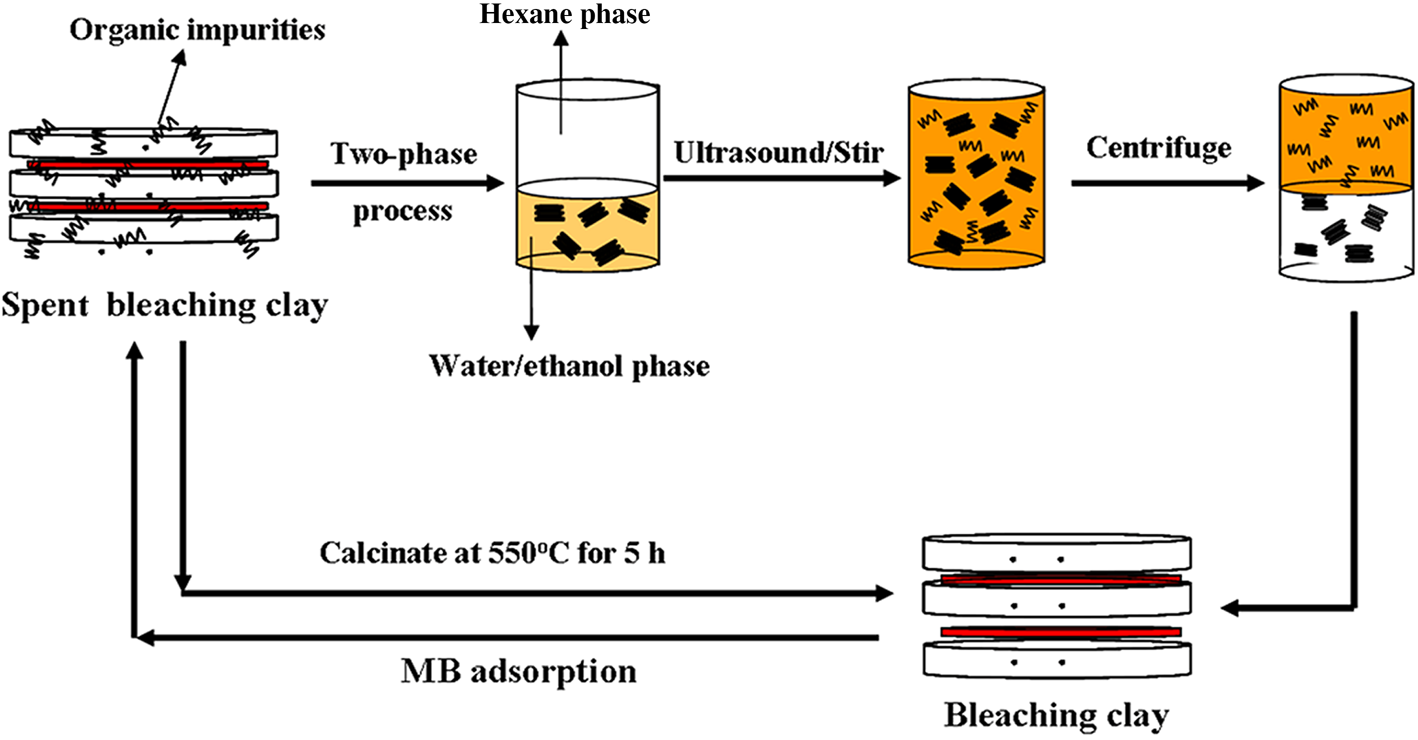
The regeneration of SBC was performed in an aqueous two-phase system composed of n-hexane, ethanol and water. The process was as follows: (1) 200 mL of hexane, 150 mL of ethanol and 150 mL of water were mixed with 100 g of SBC in a three-necked flask and were homogenized with an electric mixer; then (2) the flask was immersed in an ultrasound water bath with the temperature set at 65 ± 5°C for 2 h at a working frequency of 40 kHz and a power of 200 W; the emulsion-like mixtures obtained were separated immediately by centrifugation. The upper part was the organic layer and the lower part was the regenerated bleaching clay. The regenerated clay was washed several times with distilled water, dried at 80°C overnight and stored in a desiccator for further analysis. The schematic diagram for the regeneration of SBC is shown in Fig. 1. As a comparison, a stirring process for the regeneration of SBC was also conducted. The regenerated clays from the ultrasonic and stirring processes were denoted as ultrasonic-SBC (USBC) and stirring-SBC (SSBC), respectively.
Schematic illustration of the regeneration of SBC. MB = methylene blue.
Sulfuric acid is effective at modifying and improving the textural properties of clays. Therefore, it was selected as the clay modifier in this study. The process was as follows: 30 g samples (USBC or SSBC) were added to a solution of water (54 mL) and concentrated sulfuric acid (9 mL) and mixed at room temperature for 6 h. Then, the mixed samples were activated in water bath at 95°C for 4 h. After centrifugation, the precipitated solids were washed several times with distilled water until they reached a pH value of 6 and then dried at 80°C for 12 h. The final samples obtained were labelled as acidified-USBC (AUSBC) and acidified-SSBC (ASSBC).
Characterization
The decolourization rate, activity degree, free acid content, moisture content, particle size, filtration rate and tap density of the as-prepared samples were determined by the method described in the Chemical Industry Standard of the People's Republic of China (HG/T 2569-2007) (see Supplementary Material). The samples obtained were characterized by scanning electron microscopy (SEM; LEO1450VP, Germany), thermogravimetric analysis (TGA; STA449F3, Germany), Fourier-transform infrared spectroscopy (FTIR; EQUINOX55, Bruker) and UV-visible (UV-Vis) absorption spectra (Shimadzu, model UV-2550, Japan). The Brunauer–Emmett–Teller-specific surface area (S BET), pore volume and average pore size of the samples were measured using low-temperature nitrogen physisorption at 77 K within the vapour pressure range (P/P 0) of 0.01–0.99 (Quantachrome, USA). Prior to measurement, the samples were degassed at 150°C for 8 h.
Adsorption studies
Methylene blue, a cationic dye commonly used for colouring paper and dyeing cotton, wool and silk, was selected for the simulated organic wastewater (Namasivayam & Kavitha, Reference Namasivayam and Kavitha2002). The adsorption capacities of MB on CBC, AUSBC and ASSBC were examined. Adsorption studies were carried out by adding 25 mg of adsorbent to 50 mL of MB aqueous solution (2.5 × 10⁻⁵ mol L–1) and stirring in the dark for the desired time interval. Then, the concentration of MB in the supernatants was examined using a UV-Vis spectrophotometer at predetermined time intervals (0, 1, 5, 15 and 25 min).
Results and discussion
Preliminary study
The residual oil obtained from SBC was characterized. The residual oil recovered from SBC via hexane–ethanol extraction was dark brown in colour. It was transparent without suspended solids. The total amount of oil extracted from SBC was 11.75% oil mass within the 2 h extraction time.
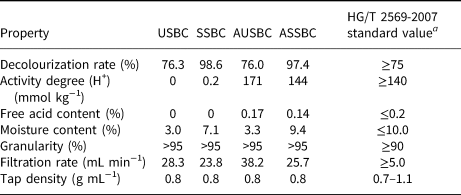
The test results of the regenerated clay were performed according to the Chemical Industry Standard of the People's Republic of China (HG/T 2569-2007) (see Supplementary Material for the details of the algorithm implemented). Comparing the activated clay indices with values for HG/T 2569-2007 (Table 1 & Supplementary Table S1), most indices (including decolourization rate, free acid content, moisture content, granularity, filtration rate and tap density) of the regenerated clay attained or exceeded the standard values (Table S1). Before acidification with sulfuric acid, however, the activity degree was only 0.2 H+ mmol kg–1, much less than the standard value (140 H+ mmol kg–1). After acidification, the degrees of activity of the AUSBC and ASSBC samples exceeded 140 H+ mmol kg–1, which satisfies the requirements of HG/T 2569-2007.
Physical properties of the samples under various operating conditions.

a See the supporting information in Table S1.
Characterization of the samples
SEM analyses
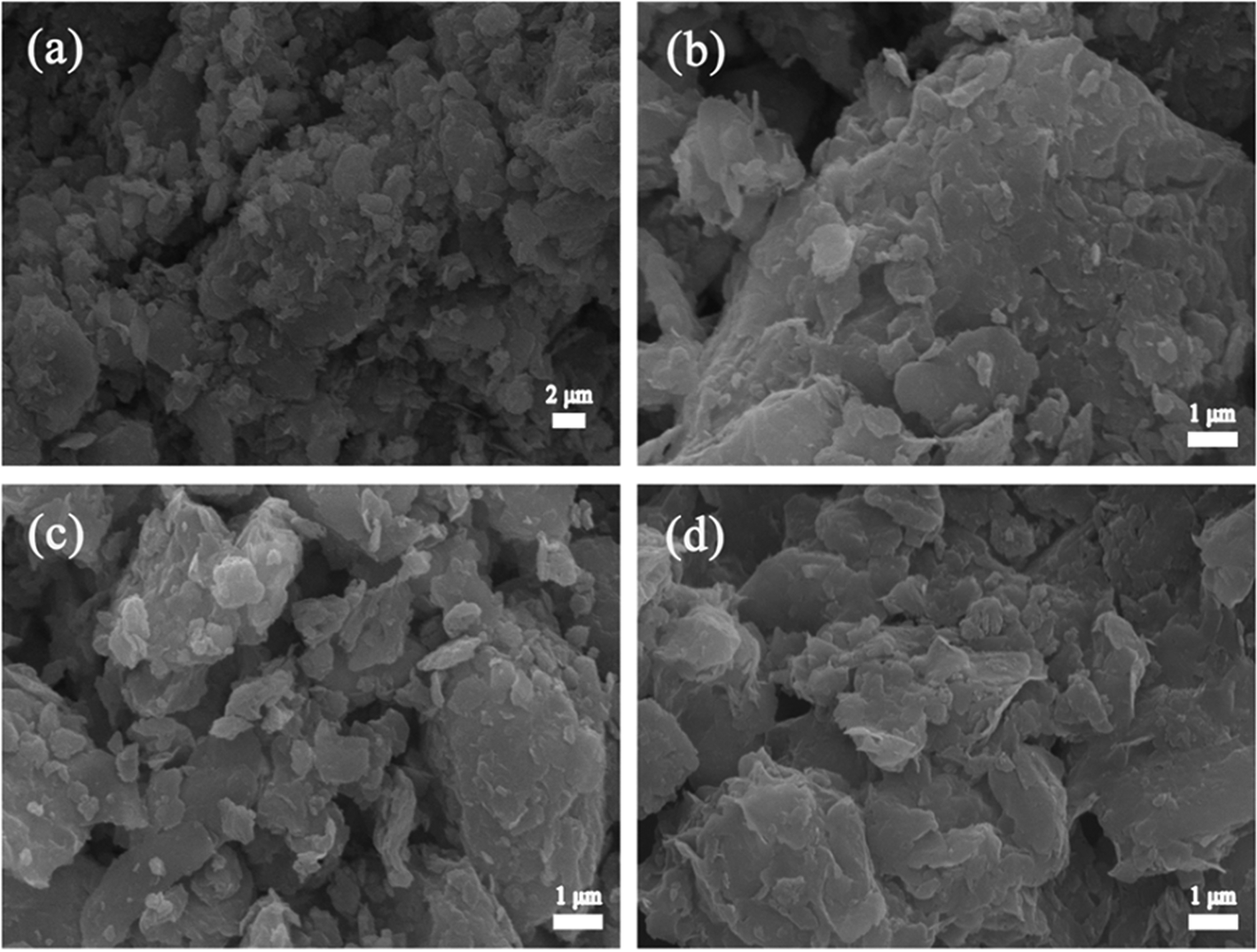
The morphologies of SBC, AUSBC, ASSBC and CBC were examined using SEM. The SBC sample consisted of agglomerated particles with a flake structure (Fig. 2). However, after ultrasonic or stirring treatment in the two-phase system, the surface morphology of the regenerated clay displayed marked changes (Fig. 2b,c). The ultrasonic waves increased the size of the samples. The SEM images of the CBC sample showed that the material had a curly, layered surface texture (Fig. 2d). In order to characterize the morphological changes, these samples were further studied by BET analysis.
SEM images of the samples: (a) SBC, (b) AUSBC, (c) ASSBC and (d) CBC.

Surface area measurements and pore analysis
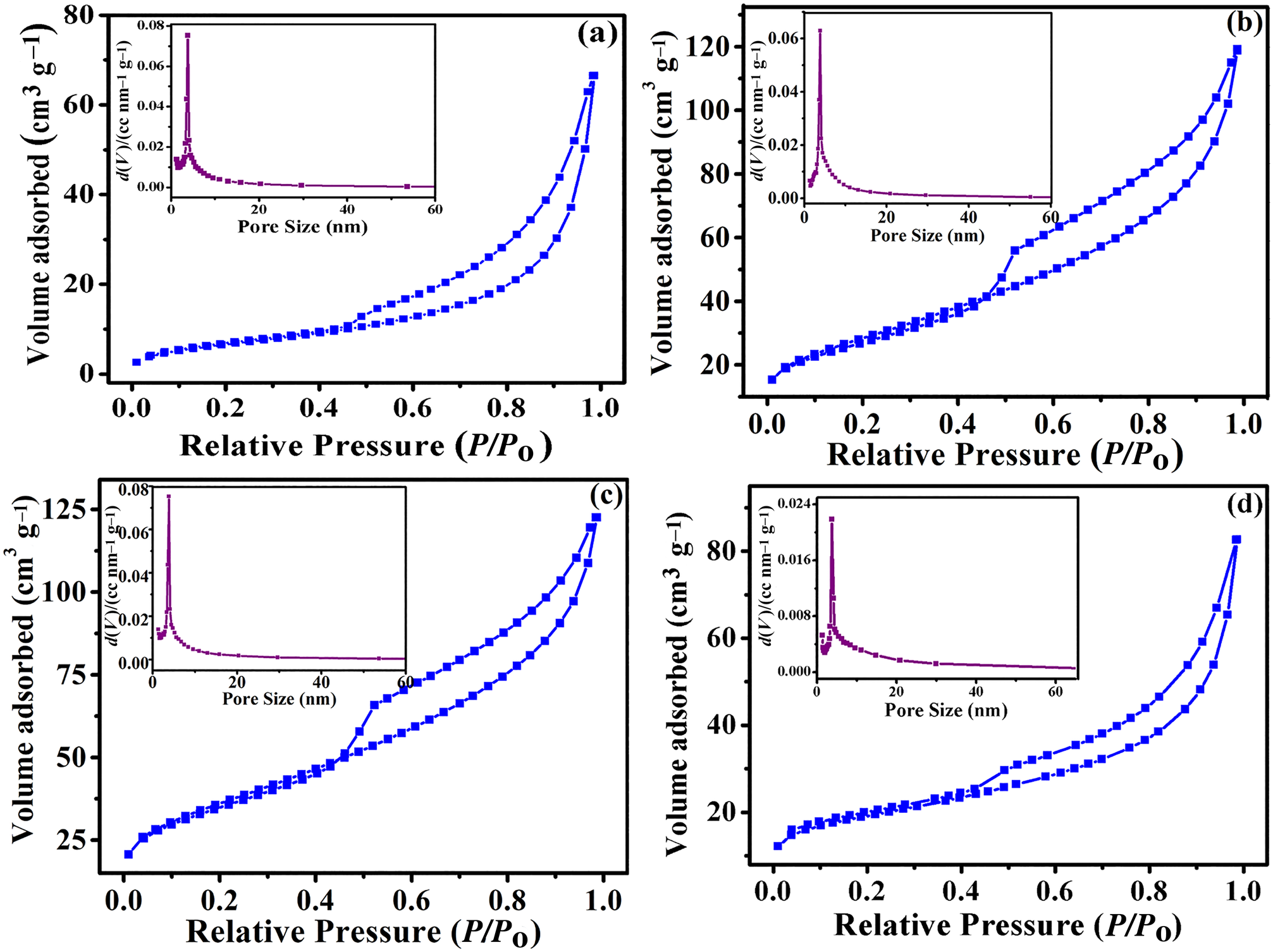
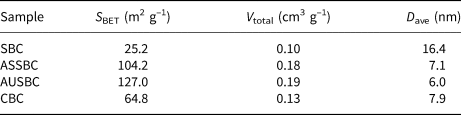
The S BET and pore structure of the SBC, ASSBC, AUSBC and CBC samples are displayed in Table 2 and Fig. 3. After treatment of the SBC sample by stirring/ultrasonic irradiation, the S BET values of the ASSBC and AUSBC samples increased and the average pore diameter (D ave) decreased. Regeneration may lead to the formation of pore spaces in the samples. Moreover, all of the samples yielded type IV adsorption isotherms with hysteresis, which was associated with capillary condensation in mesopores (Fig. 3).
N2 adsorption–desorption isotherms of (a) SBC, (b) ASSBC, (c) AUSBC and (d) CBC. Inserts are the corresponding Barrett–Joyner–Halenda (BJH) pore-size distributions.

Specific surface area (S BET), total pore volume (V total) and average pore volume (D ave) of the SBC, ASSBC, AUSBC and CBC samples.

FTIR analyses of the samples
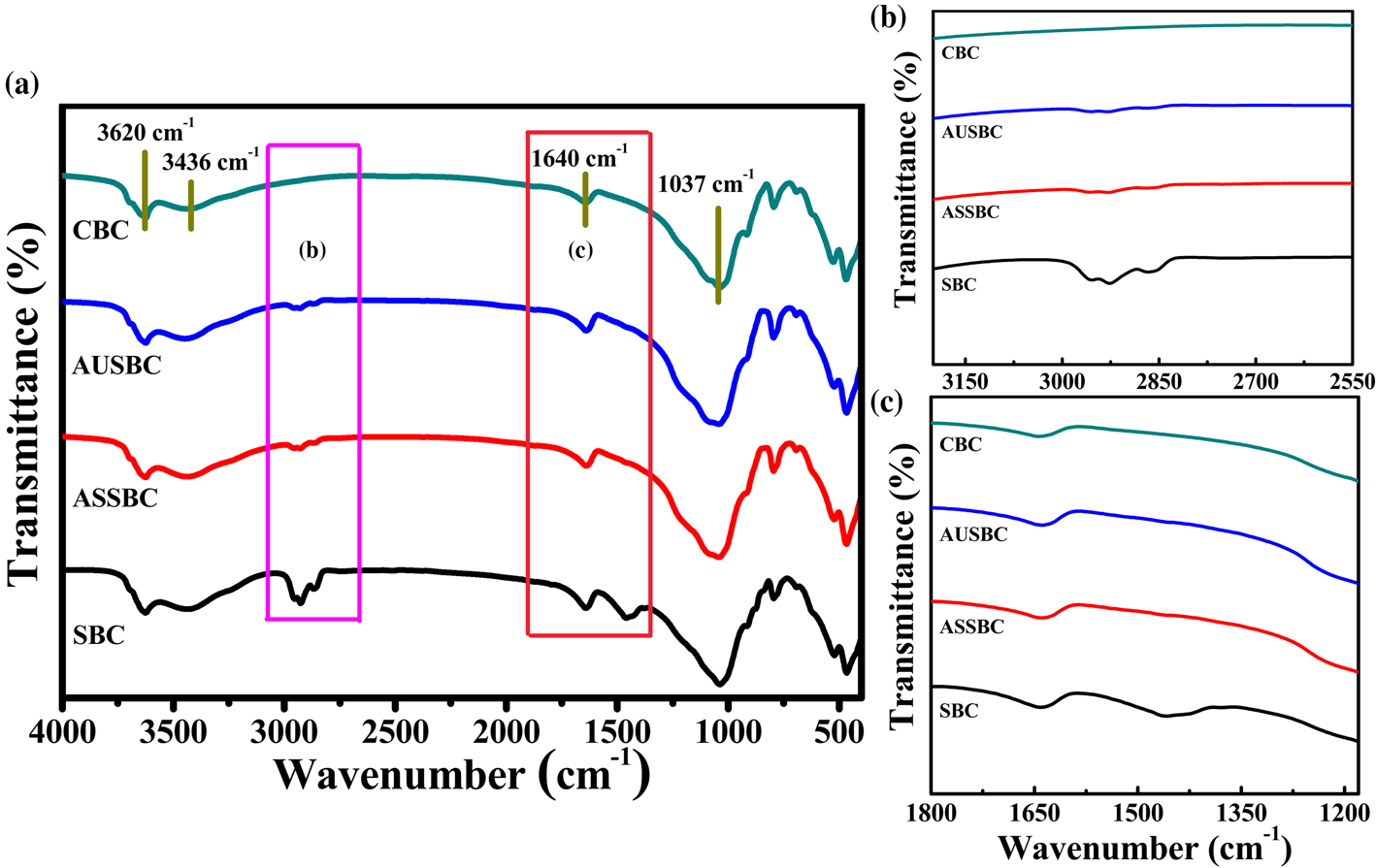
The FTIR spectra of the SBC, AUSBC, ASSBC and CBC samples were recorded in the 400–4000 cm–1 region (Fig. 4). The FTIR spectrum of CBC exhibited characteristic adsorption bands near 3436 cm–1 with a shoulder at 3620 cm–1, attributable to the adsorption by the interlayer water and the stretching vibrations of structural hydroxyl groups, respectively (Fig. 4a) (Mullassery et al., Reference Mullassery, Fernandez and Anirudhan2014; Zhou et al., Reference Zhou, Li, Gates, Zhu and Yu2019). In addition, the spectra displayed absorption bands at 1640 cm–1 (interlayer water hydroxyl bending vibration), at 1037 cm–1 (Si–O stretching vibrations), at 779 and 795 cm–1 (Si–O–Si symmetric stretching vibrations) and at 521 and 462 cm–1 (Si–O–Al bending vibrations). These results are in agreement with those from the previous literature (Mohamed et al., Reference Mohamed, Mohand, Marc and Louis2008). The CBC, AUSBC, ASSBC and SBC spectra were similar, but the latter exhibited sharp absorption bands of CH2 asymmetric and symmetric stretching vibrations at 2926 and 2850 cm–1, respectively. The intensity of the bands at 2926 and 2850 cm–1 became weaker, indicating the change in the chemical composition of SBC after acid modification (Fig. 4b). There was a –CH2 or –CH3 bending vibration near 1458 cm–1 in SBC, assigned to organic matter (Fig. 4c).
(a) FTIR spectra of the samples, and (b,c) enlarged versions of the corresponding boxed regions in (a).

TGA of the samples
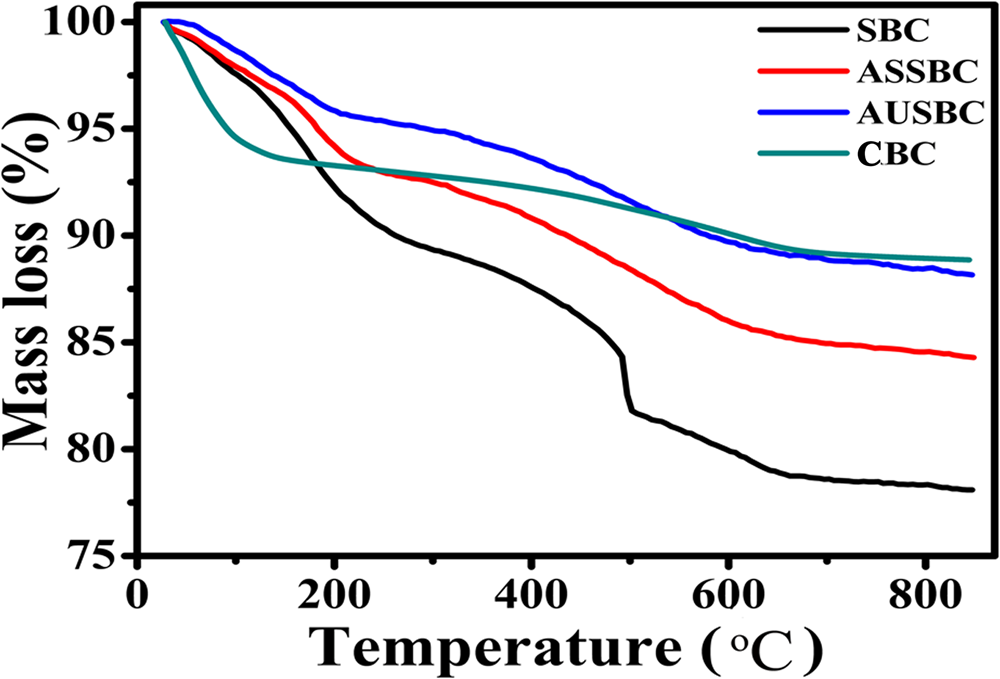
The mass losses of the SBC, AUSBC, ASSBC and CBC samples at various temperature intervals were studied by TGA. The samples were heated from 25 to 850°C at a constant heating rate of 10°C min–1 in an N2 atmosphere. The thermal decomposition profiles of the samples demonstrated a multistage process (Fig. 5).
TGA curves for the SBC, AUSBC, ASSBC and CBC samples.

For SBC (Fig. 5), the mass loss increased with elevating temperature up to ~500°C decreasing thereafter, which was attributed to the dehydration of the crystal lattice and decomposition of the structural OH groups from the organic impurities of SBC. The first dehydration stage, with a mass loss of ~5.4%, was observed in the 25–162°C range. The second stage, with a mass loss of 16.6%, was observed in the temperature range of 162–850°C and was ascribed to the removal of the structural hydroxyls and the decomposition of the organic content from the SBC sample. The TGA curve of the ASSBC sample revealed a mass loss of ~4.0% below 162°C due to dehydration. At temperatures above 162°C, the mass loss of 11.7% was associated with the release of structural water, the evolution of volatile species and the decomposition of residual oils from ASSBC. In the AUSBC sample, the 3.1% mass loss in the temperature range of 25–162°C was due to the removal of adsorbed water, followed by an 8.8% mass loss at 162–850°C due to the release of structural water and the oxidation of minor residual organic matter. Finally, the CBC sample displayed a total mass loss of 11.1% over the temperature range of 28–847°C due to the combined dehydration and dehydroxylation of the interlayer species and the host clay (Fig. 5).
SBC had a 6.3% greater mass loss than ASSBC, a 10.1% greater mass loss than AUSBC and a 10.9% greater mass loss than CBC. Hence, the amount of organic impurities adsorbed by SBC was greater than those of the regenerated ASSBC and AUSBC clays. The TGA results showed that most of the impurities of SBC were removed by stirring or ultrasonic irradiation in the two-phase system.
Adsorption of MB
Due to their large specific surface areas, clay materials can be used as adsorbents for the removal of organic waste from wastewater by adsorption and subsequent catalytic combustion at relatively low temperatures (Fei et al., Reference Fei, Cui, Yan, Qi, Yang, Wang, He and Li2008; Hao et al., Reference Hao, Yang, Rao, Wang, Niu and Su2014). In this study, MB was selected as the target pollutant for studying the adsorption performance of the regenerated clay (Jacobs & Schoonheydt, Reference Jacobs and Schoonheydt2001; Liu et al., Reference Liu, Wen, Nakata, Zhao, Liu, Ochiai, Murakami and Fujishima2012). The evolution of the absorption spectra of MB in the presence of AUSBC, ASSBC and CBC is shown in Fig. 6.
UV-Vis adsorption spectroscopic changes of MB aqueous solution in the presence of (a) AUSBC, (b) ASSBC and (c) CBC during first-cycle measurement at various time intervals, and the adsorption capacities for MB of (d) AUSBC, (e) ASSBC and (f) CBC over the three times cycle.

The characteristic absorption band of MB was at 664 nm. After it had been mixed with the samples (AUSBC, ASSBC and CBC), the absorbance of the 664 nm band decreased rapidly over 25 min and then remained constant with increasing time (Fig. 6a–c). This behaviour is attributed to the rapid diffusion of the dye molecules onto the external surface of the clay or the boundary diffusion layer of the solute molecules. The available adsorption sites became fewer, decreasing the adsorption capacity until equilibrium was attained.
Cyclic experiments were also carried out to investigate the stability of the regenerated clay. The samples that adsorbed MB were regenerated by catalytic combustion at 550°C for 5 h. Figure 6d–f shows the adsorption performance of MB over the three clays through adsorption–regeneration cycles (C 0 and C are the equilibrium concentrations of MB before and after adsorption, respectively). The regenerated CBC sample exhibited a significant decrease in adsorption capacity for MB from 97% in the original cycle to 45% in the second cycle and to 39% in the third cycle (Fig. 6f). The regenerated ASSBC sample exhibited a gradually decreasing trend with increasing cycle number, namely 98%, 99% and 77% for the first, second and third cycles, respectively (Fig. 6e). The adsorption capacity of the regenerated AUSBC was slightly modified from 99% in the original cycle to 98% in the second cycle and to 99% in the third cycle (Fig. 6d). It is evident that the adsorption capacity of these regenerated samples was diminished after calcination at 550°C. This is because the carbonization residue blocked the pores and was not removed completely during regeneration (Tsai et al., Reference Tsai, Chen, Hsieh, Sun and Lai2003), resulting in a reduction in the effective adsorption sites and adsorption capacity (Wang et al., Reference Wang, Wang, Song, Wei, Ding and Xiao2013). In comparison with CBC, the acid-activated clays displayed greater adsorption capacities during recycling, suggesting that new pores might have been generated during sulfuric acid treatment. In the presence of sulfuric acid, Al2O3, MgO, CaO and K2O in the parent clay dissolved out of the octahedral sheet and formed new pores in the activated clay (Dimirkou et al., Reference Dimirkou, Ioannou and Doula2002; Wang et al., Reference Wang, Wang, Song, Wei, Ding and Xiao2013). Furthermore, compared with ASSBC and CBC, the adsorption performance of AUSBC did not decrease significantly after three cycles. This is due to the use of ultrasonic vibration, which effectively degraded the dye molecules. The breaking of the bonds between dye molecules resulted from the shear force generated by the collapse of bubbles induced by ultrasonic treatment.
These results indicate clearly that AUSBC is a good adsorbent material with greater adsorptive ability and greater capacity for repeated use compared to CBC or ASSBC. Therefore, the ultrasonic treatment provided a simple route for improving the regeneration ability of SBC, suggesting a potential new approach to dealing with organic pollutants.
Conclusions
In the present study, a simple two-phase solvent extraction system was developed with the assistance of stirring and ultrasonic irradiation for the regeneration of SBC. The principle of ‘waste to treasure’ was used, which may assist in the design of regeneration synthesis approaches for obtaining cheaper and more efficient materials while minimizing subsequent environmental effects (Kamali et al., Reference Kamali, Costa, Otero-Irurueta and Capela2018). The morphology, specific surface area, pore structure and adsorption performance of the regenerated clay were examined. The stirring and ultrasonic treatment in the reaction system had significant effects on the as-treated samples. Compared with the commercial clay and stirred reclaimed clay, the reclaimed clay treated using ultrasonic irradiation displayed a greater adsorption rate for MB and better cycle performance. The reusability of the regenerated clay suggested that the ultrasonic-assisted method was effective for the regeneration of SBC, and the clay obtained could also be reused and applied as a low-cost mineral adsorbent for the removal of cationic dyes from aqueous effluents. This method opens up a new approach to the recycling of waste clays and provides a new method for obtaining a high-performance adsorbent for treating dye wastewater from industrial solid waste.
Supplementary material
To view supplementary material for this article, please visit https://doi.org/10.1180/clm.2020.1
Financial support
This work was supported by the Natural Science Foundation of China (51864043), the Doctoral Research Project of Henan Agricultural University (30500472) and the Natural Science Foundation of Fujian Province (2015J01068).