INTRODUCTION
Political participation is thought to be a crucial means through which immigrants can become integrated into the host country. This is because political participation gives immigrants channels through which their concerns and issues can be raised and addressed. Political participation itself serves an integrative function and can therefore increase the feeling among individuals — immigrants included — that they belong in a community (Pateman Reference Pateman1970). Political participation also has beneficial effects on the host country. Citizens who take advantage of the opportunities liberal-democratic systems offer for political participation are more satisfied with life than those who do not, and such satisfaction levels affect societal stability and cohesion (Owen, Videras, and Willemsen Reference Owen, Videras and Willemsen2008). However, although political participation significantly benefits immigrants and their host countries, immigrants are less likely to participate in various political acts and are more likely to face the risk of political marginalization than native-born citizens because of their lack of identification with political institutions and their lower levels of language proficiency, social capital, and socio-economic status (Jacob Reference Jacob2006; Jacobs and Tillie Reference Jacobs and Tillie2004). Increased research into the role of immigrants has established that immigrants may overcome inequalities in socio-economic status and psychological engagement, with their political participation and integration facilitated by various means including associational involvement.
With increased attention on the role of immigrants in Australian politics, one crucial finding has shown that migrants are at least as likely as Australian-born citizens to engage in political participation (e.g., Bean Reference Bean2012; Bilodeau, McAllister, and Kanji Reference Bilodeau, McAllister and Kanji2010; McAllister and Makkai Reference McAllister and Makkai1992; McAllister Reference McAllister2011). This finding is not consistent with findings from previous studies in North America and Europe (e.g., Heath et al. Reference Heath, Fisher, Rosenblatt, Sanders and Sobolewska2013; Myrberg and Rogstad Reference Myrberg, Rogstad, Morales and Giugni2011; Verba, Schlozman, and Brady Reference Verba, Schlozman and Brady1995; Wong et al. Reference Wong, Ramakrishnan, Lee and Junn2011). Clive Bean (Reference Bean2012, 129) argued the need for future research to investigate the reasons behind the patterns of participation by immigrants in Australia. Religious attendance has been regarded as one of the means by which political participation might be promoted (Rosenstone and Hansen Reference Rosenstone and Hansen1993; Verba, Schlozman, and Brady Reference Verba, Schlozman and Brady1995). But existing literature seems to paint a complex picture. Some scholars have argued that religious attendance has been shown to increase political participation (Harris Reference Harris1994; Lien Reference Lien2004; Wald and Calhoun-Brown Reference Wald and Calhoun-Brown2014). Others show that previous studies have overstated the role of religious attendance in mobilizing political participation, and find that the impact of religious attendance on political participation is limited and varies across groups (Ammann Reference Ammann2015; Wong, Lien, and Conway Reference Wong, Lien and Conway2005). In Australia, little is known about the role of religious attendance in mobilizing political participation among citizens, especially among overseas-born citizens. While immigrant political participation in Australia has been the focus of scholarly literature, studies of immigrant political participation are notably uneven. Some factors have received considerable scholarly attention, such as the duration of residence, access to socio-economic resources, premigration experiences, and political predispositions (Bean Reference Bean2012; Bilodeau Reference Bilodeau2008; Bilodeau, McAllister, and Kanji Reference Bilodeau, McAllister and Kanji2010; McAllister and Makkai Reference McAllister and Makkai1991; Reference McAllister and Makkai1992).
According to associational theories of political participation, religious involvement provides a powerful resource that enables minorities (including immigrants) to overcome deficits in tangible assets such as education and income, thereby promoting and encouraging their political participation (Verba, Schlozman, and Brady Reference Verba, Schlozman and Brady1995). While the literature argues that religion matters, religion may work differently in Australia and may not help connect immigrants to political life. Faced with competition between religious and secular organizations, religious institutions may focus more on congregational life than political life (Stolz Reference Stolz2010), which makes religion not closely connected to political action in society. The question in this article asks is: Is religious attendance also an instigating force for immigrant political participation in Australia?
Using data from the Australian Election Study (AES) 2013, this article addresses the longstanding controversy over religious influence on political participation. The AES uses an election-centered research design and includes a comprehensive set of participation measures. However, the AES measures only religious belonging and attendance. This means that it is not possible to test the various church-based predictors of political participation that have been employed in previous studies (see Djupe and Neiheisel Reference Djupe and Neiheisel2012). While acknowledging this limitation, this study is of particular interest, given that the ways in which immigrants take part in political systems remain understudied in the literature set in Australia (McAllister Reference McAllister2016) and the fact that there has also been no detailed investigation of the role of religion in this process. This study therefore applies rigorous multiple regression models to the AES data to account for the role of religious attendance on immigrant political participation in Australia.
This line of inquiry examining the role of religious attendance in political participation across racial or ethnic groups has profound implications. Models of political behavior stem principally from studies based on the majority population. The extent to which such models also apply to different racial or ethnic groups remains unclear. Specifically, a growing body of literature shows that standard models of voting choice for the majority population do not hold equally across racial or ethnic groups (Heath et al. Reference Heath, Fisher, Rosenblatt, Sanders and Sobolewska2013; Saggar Reference Saggar2000). However, other scholars have found that the models for the majority population do also apply to explaining the voting behavior of racial or ethnic groups (Jiang Reference Jiang2016). Similarly, research indicates that models of political participation are not always equally apt for racial or ethnic groups (Leighley and Vedlitz Reference Leighley and Vedlitz1999). Marschall (Reference Marschall2001), for instance, tested four theoretical models including socio-economic status to see the extent to which the models explained the participation of Whites, African-Americans, and Latinos in political activities, and found that the models explain differently participation across ethnic groups. In this article, I examine the extent to which associational theories of political participation apply to immigrants in Australia.
The Australian case offers an intriguing setting within which to investigate the influence of religious attendance on immigrant political participation. The separation of religion and state is long established, and has developed into a significant political principle in Australia, as in other modern democratic countries. However, religion has still been closely associated with politics and the political impact of religion is demonstrable in Australia (Warhurst Reference Warhurst2007). Religious organizations have lobbied governments and parliaments, and have exerted influence over public policy-making in Australia (Warhurst Reference Warhurst2014). A federal Parliamentary Christian Fellowship meets during sitting weeks to read passages from the Bible and exchange views and personal anecdotes on how their faith is tested within politics (Allison Reference Allison2014). When abortion and same-sex marriage policies are debated during election campaigns, the religious influence behind these moral issues is usually displayed (McAllister Reference McAllister2011). Australia is also a society based on large-scale immigration. The enormous influx of migrants over the years means that currently more than one in four of the nation's population was born overseas. Of these, 75% report a religious affiliation.Footnote 1
In addition, religious institutions may well be integrated into immigrant communities. The majority of immigrants who come to Australia are religious, according to Australian Bureau of Statistics, and immigrants also are clustered in several metropolitan centers. Those who choose to participate in a Christian religious group tend to choose a local community of worship (Kaldor et al. Reference Kaldor, Bellamy, Powell, Castle and Hughes1999), which would in principle connect religious institutions to immigrant communities and facilitate the integration of religious institutions into immigrant communities. Throughout Australia's colonial history local religious institutions have been an instigating force in driving immigrants to engage in civic activities for community benefit. Religious communities ask non-British Commonwealth migrants to respond accurately to census questions about religious identity in order to strengthen appeals for social services and representation in Australian society (Bouma Reference Bouma2006, 55).
Immigrants in Australia, hence, seem to connect well with religion. The particular social context of Australia therefore provides an excellent environment in which to test explanations of links between religious attendance and immigrant political participation. The following section presents the hypotheses about direct and indirect relations between religious attendance and immigrant political participation. The second section tests these hypotheses empirically. The final section draws conclusions and indicates directions for future research.
RELIGION AND POLITICAL PARTICIPATION
Political participation is described as action that has the purpose of influencing the shaping of government decisions, either directly by exerting influence on the formation and implementation of public policy, or indirectly by exerting influence on who is involved in making public policy (Verba, Schlozman, and Brady Reference Verba, Schlozman and Brady1995, 38). Political participation that indirectly influences policy-maker selection consists of electoral participation (namely, voting), potentially persuading others how to vote, supporting a party or candidate, and attending meetings and contributing money to a party or candidate. These actions are regarded as conventional political activities. A second level of political participation consists of engaging in acts of political protest that more directly affect the system, such as contacting politicians, petitioning the government, and participating in protest marches and demonstrations. In liberal democracies, such activities are considered legitimate forms of political participation and will therefore be included in the analysis in this article.
Traditional studies of political participation have argued that a citizen's propensity to participate in political activity is largely due to the resources that the individual possesses. Analyses of resources have focused mainly on the individual's socio-economic status, embodied in their educational level, occupation, and income (Verba and Nie Reference Verba and Nie1987). These socio-economic resources are differentially distributed among certain groups within a society so that a group that is socio-economically disadvantaged is likely to have lower levels of participation than a group possessing more socio-economic resources (Verba and Nie Reference Verba and Nie1987). In this context, ethnicity itself represents inequality, since socio-economic levels differ considerably among ethnic and racial groups (McAllister and Makkai Reference McAllister and Makkai1992). This theory is apparent in Australia. McAllister and Makkai (Reference McAllister and Makkai1992) found that variations in the levels of participation among different social groups are in part due to the different socio-economic resources that immigrants possess. Drawing on census data and interviews, Peucker, Rosse, and Akbarzadeh (Reference Peucker, Roose and Akbarzadeh2014) analyzed the relatively low level of political participation among the overseas born in Australia and found that their political participation was hampered by socio-economic disadvantages. Zingher and Thomas (Reference Zingher and Thomas2012) also see this as a consequence of the interaction between ethnicity and socio-economic background. Religion has often been found to be a strong predictor of political behavior, affecting political participation in different ways, regardless of individuals’ socio-economic backgrounds (Broughton and ten Napel Reference Broughton and ten Napel2000; Lijphart Reference Lijphart1979; Tresch and Nicolet Reference Tresch, Nicolet, Kriesi and Hug2010). Different theoretical approaches have been offered to explain the link between religion and political involvement.
The civic voluntarism model points to the fact that church involvement can increase the level of civic skills and political engagement. Verba, Schlozman, and Brady (Reference Verba, Schlozman and Brady1995) have argued that if people are to participate in political activity they need the resources of time, information, and civic skills. They found that churchgoers are more likely to take part in political activities because church provides an important incubator for those resources or capacities. In this sense, religious attendance serves an “educational function” (Peterson Reference Peterson1992), through which citizens gain a sense of efficacy, develop civic duty, and acquire organizational skills (Warren Reference Warren2001, 70–77). These politically-relevant psychological resources and skills can also be applied to civic life, and thus religious attendance facilitates civic behavior outside the institutional life of the church (Tate Reference Tate1993). Verba, Schlozman, and Brady (Reference Verba, Schlozman and Brady1995) also found that different Christian denominations (Catholic and Protestant) develop different levels of civic skills. This finding suggests that, in addition to the frequency of attendance at religious services, the level of political participation also depends on the denomination of the church to which individuals belong.
The social contextual approach maintains that attending religious institutions forms a social network or a context in which adherents are mobilized for political and social participation. Rather than developing members’ civic skills, religious institutions serve as important channels of political information and recruitment (Ammerman Reference Ammerman1997; Eggert and Giugni Reference Eggert, Giugni, Morales and Giugni2011). A direct call to mobilization from the clergy can have an effect on members’ levels of political engagement (Djupe and Gilbert Reference Djupe and Gilbert2009). Clergy and other leaders of congregations stress the importance of agenda and belief, thereby influencing opinions and mobilizing adherents. When the clergy express a position publicly, people exposed to such political messages at their local place of worship are more likely to participate in electoral and protest-demand activism (see also, Djupe and Gilbert Reference Djupe and Gilbert2009; Harris Reference Harris1994). Religious figures are thus recognized as political leaders or political opinion leaders, with scholars emphasizing the importance of the clergy (Cavendish Reference Cavendish, Crawford and Olson2001; Djupe and Gilbert Reference Djupe and Gilbert2002; Reference Djupe and Gilbert2009; Olson Reference Olson2000).
A second source of mobilization can come from informal social ties and organized small group activities. Verba, Schlozman, and Brady (Reference Verba, Schlozman and Brady1995) found that congregational activities beyond religious services encourage political and civic involvement by supplying personal friendship networks that provide social incentives to be active. McClerking and McDaniel (Reference McClerking and McDaniel2005) examine which of the internal activities of churches tend to foster political activism. The authors find that church activities that help members lower the cost of participation and that work to bolster their connections to one another and to society are the activities that reliably affect participation, such as talking with each other about political matters in church, having a political leader speak at church, and being contacted by a member of the clergy for non-electoral activities.
The social contextual approach stresses that the role of the church in the community can have an effect on the political involvement of adherents, since congregations, as part of communities, host networks that extend into the community, and draw on resources from the community (Djupe and Neiheisel Reference Djupe and Neiheisel2012). Churches may be a community center in their community, providing a gathering place in which people may acquire a set of skills, experiences, and informal social ties (Djupe and Neiheisel Reference Djupe and Neiheisel2012). Thus, church effects may be community effects. Church involvement means being networked into the majority community, which has the potential to encourage political action, because churches help people connect with community resources (i.e., mobilization attempts) (Djupe and Neiheisel Reference Djupe and Neiheisel2012). Djupe and Gilbert (Reference Djupe and Gilbert2009) contend that to the degree to which congregation members are willing to consider and accept political information and cues from the church depends to some extent on they perceive the church's status or their own personal status within the community.
Finally, the social psychological approach argues that churches bring together people with similar experiences to instill a collective sense of political participation (Eggert and Giugni Reference Eggert, Giugni, Morales and Giugni2011). Brown and Wolford (Reference Brown, Wolford and Holder1994) indicate that the culture of Black American churches can encourage political activism, for these churches foster a personal obligation to engage in political activity through church support and activities. Black American churches strive to convince members that it is their duty to engage in collective actions that will improve the overall spiritual and material well-being of members of their racial group. Brown and Wolford also show that these churches can mobilize political participation among Black Americans of low socio-economic status (also see Calhoun-Brown Reference Calhoun-Brown1996). In the social psychological approach, resources promoting political participation are collective resources based on collective identity and group consciousness (Eggert and Giugni Reference Eggert, Giugni, Morales and Giugni2011).
All the theoretical approaches outlined above stress the importance of involvement in religious institutions. Religious institutions either provide opportunities for churchgoers to develop civic skills or allow churchgoers to be exposed to mobilization efforts by which churchgoers will acquire the resources necessary to participate in the political arena (Jones-Correa and Leal Reference Jones-Correa and Leal2001; Schwadel Reference Schwadel2005; Verba, Schlozman, and Brady Reference Verba, Schlozman and Brady1995). According to associational theories of political participation, churches help to counteract inequities in socio-economic status and overcome unequal participation in a democratic society (Djupe and Neiheisel Reference Djupe and Neiheisel2012). In approaching my analysis of the AES data, I therefore hypothesize that immigrants who regularly attend religious services are more likely to engage in political participation (hypothesis 1).
Researchers have also identified one indirect effect underlying the link between religious attendance and participation: the acquisition of political resources through attendance (Sobolewska et al. Reference Sobolewska, Stephen, Heath and Sanders2015). Empirical studies provide ample evidence that religious attendance leads to the acquisition of politically relevant psychological resources (Calhoun-Brown Reference Calhoun-Brown1996; Jamal Reference Jamal2005; Layman Reference Layman2001; Sherkat et al. Reference Sherkat, Powell-Williams, Maddox and de Vries2011). A person can acquire politically relevant psychological resources through attendance, and those psychological resources in turn affect political participation. However, does the indirect relationship between religious attendance and political participation exist for immigrants? If an indirect relationship exists, there should be evidence for a second hypothesis: immigrants who regularly attend religious services have higher levels of political resources that may extend to subsequent political participation (hypothesis 2).
In this study, denominational differences are used as a proxy for the frequent finding that denominations have different political salience (McClerking and McDaniel Reference McClerking and McDaniel2005). Politicized churches espouse a clearer political orientation and enhance the propensity for voting, political campaigning, and other forms of political activism by members (Brown and Brown Reference Brown and Brown2003; Calhoun-Brown Reference Calhoun-Brown1996; Harris Reference Harris1994; McClerking and McDaniel Reference McClerking and McDaniel2005; Tate Reference Tate1993). Regular attendance at politicized churches is more effective than attendance at other churches in mobilizing the political participation of their adherents (Calhoun-Brown Reference Calhoun-Brown1996; Djupe and Gilbert Reference Djupe and Gilbert2009, 201). Given these considerations, it is hypothesized that religious denomination moderates the association between religious attendance and immigrant political participation (hypothesis 3).
DATA AND MEASUREMENT
This study uses the 2013 AES data (Bean et al. Reference Bean, McAllister, Pietsch and Gibson2014). The sample consists of 2815 Australian-born citizens and 974 overseas-born citizens. The main religions in the 2013 AES were various denominations of Christianity, and three other religions: Islam, Buddhism, and Hinduism.Footnote 2 The measures of direct links between religious attendance and immigrant political participation are electoral and non-electoral participation. The 2013 AES asks a variety of questions on electoral participation, ranging from the low-commitment act of discussing an election with others to the relatively infrequent act of contributing money to a political party or election candidate, which requires greater commitment. In this article, electoral activities include: (a) going to meetings or rallies; (b) persuading others how to vote; (c) supporting a party or candidate; (d) contributing money to a party or candidate. In the 2013 AES, non-electoral participation consisted of four different measures of non-electoral activities such as whether respondents (a) contacted politicians or officials in government in person or in writing; (b) contacted official via E-mail; (c) worked with others in the community to solve a problem; (d) attended a protest march, demonstration, or rally; (e) signed a written petition; (f) signed an e-petition. In terms of the multiple regressions, I construct an electoral engagement scale and non-electoral participation scale from the respective variables and use these as dependent variables to examine the effects religious attendance has on electoral engagement and non-electoral participation among immigrants. The electoral participation scaled variable (Cronbach's alpha: 0.70) has a minimum value of 4 and a maximum value of 16, while the non-electoral participation scaled variable (Cronbach's alpha: 0.71) has a minimum value of 6 and a maximum value of 12.Footnote 3
To test the indirect relationship between religious attendance and political participation, measures of the political resources of individuals are included. These measures are political interest and political efficacy, which are used as dependent and independent variables, respectively. Bean (Reference Bean2012) showed that political efficacy is related to political participation among immigrants in Australia. Calhoun-Brown (Reference Calhoun-Brown1996) also showed that regular attendance at religious activities boosts relevant psychological resources including political efficacy. Usually when political scientists refer to political efficacy they are talking about internal political efficacy that leads to political activity that can affect government decision-making. This article also uses internal efficacy, which is measured by the response to the statement “Some people say it makes a big difference who is in power. Others say it doesn't make any difference who is in power. Using the scale below, where would you place yourself?” In addition to efficacy, Australian literature shows that political interest is also a psychological component of motivation, and a strong predictor of immigrant political participation (Bean Reference Bean2012). Religious attendance can increase interest in politics due to mobilization by clergy, informal social ties, and small group activities (McClerking and McDaniel Reference McClerking and McDaniel2005; Peterson Reference Peterson1992). In order to explore the effect of religious attendance by religious denominations on immigrant political participation (hypothesis 3), interaction terms between different religious denominations and religious attendance are created.
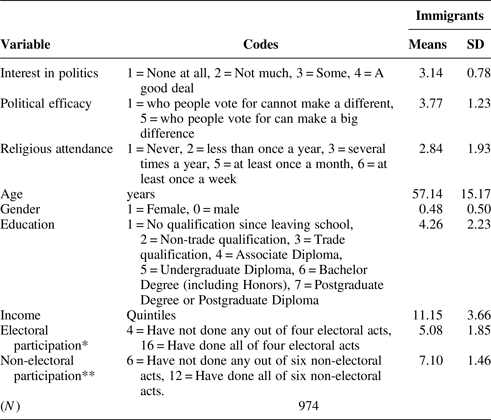
The primary independent variable is religious attendance. All multivariate models include demographic controls — age, gender, class, and education — which are typically related to immigrant political participation. Scholars have found different levels of political participation for men and women among ethnic and racial groups, which is in part due to the different levels at which immigrant women and men invest in community-building (Jones-Correa Reference Jones-Correa1998). Bean (Reference Bean1999) showed a gender gap in political participation in Australia. According to the civic voluntarism model (Verba, Schlozman, and Brady Reference Verba, Schlozman and Brady1995), participation is largely determined by socio-economic status, which is reflected in educational levels and social class (Verba, Schlozman, and Brady Reference Verba, Schlozman and Brady1995). Australian literatures also shows the impact of socio-economic disparity on political participation among immigrants (Peucker, Roose, and Akbarzadeh Reference Peucker, Roose and Akbarzadeh2014; Zingher and Thomas Reference Zingher and Thomas2012). The variables, scoring, means, and standard deviations are shown in the tables in the Appendix.
FINDINGS
The starting point for the analysis that follows is to identify patterns of association between religious attendance and immigrant political participation and to confirm that religious attendance is a part of immigrants’ associational experience. This must be done before I can plausibly contend that regular attendance at places of worship generates political resources to recompense immigrants for their relatively poor socio-economic resources. Table 1 displays the distribution of key measures of church involvement and participation across immigrants. What is clear from the first table is that Catholics attend religious services more than Protestants but less than those who belong to other religions. Protestants exhibit the lowest levels of attendance at religious services.Footnote 4 It also appears that Catholic affiliation and Protestant affiliation drive down levels of participation. As Table 1 shows, both Catholics and Protestants are less likely to participate in politics than all immigrants and then those immigrants who have other religious faiths. However, Table 1 does not tell us whether religious attendance promotes political participation, and whether identifying as Catholic promotes more political participation than identifying as Protestant, or whether identifying as believing in another religion encourages more political participation than identifying as a Catholic or Protestant. Only a fully specified multivariate model can unpack religious influence to assess whether religious attendance has an effect on political participation and whether denominations moderate such effect.
Religion and participation in public life (weighted percentages)

Notes: *Attending at least once a week. **Having done ANY out of four possible political acts has been coded as participation. ***Having done ANY out of six possible political acts has been coded as participation — see Appendix. Source: Australian Election Study, 2013.
MULTIVARIATE MODEL RESULTS
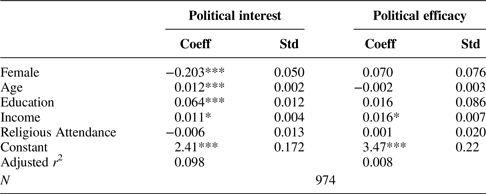
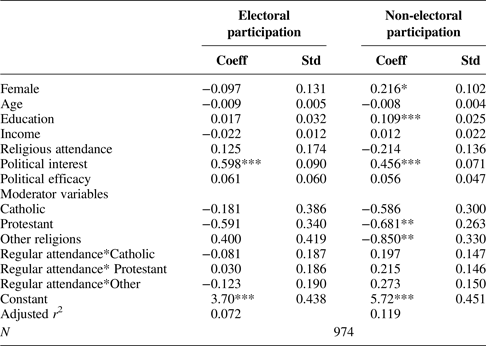
In light of the theoretical expectations outlined earlier, I employ two strategies for estimating the effects of religion on political participation. First, I estimate models for politically relevant psychological resources, such as political interest and efficacy, and see whether there is an indirect relationship between religious attendance and political participation among immigrants. Second, I estimate an ordinary least squares regression model (ordinary least squares regression) for each of the political participation scaled variables: electoral participation and non-electoral participation. I examine the effect of religious attendance on these variables and assess the comparative effects variables common to immigrants, such as individual status. At the same time, I also estimate the moderating roles of denominations in the association between religious attendance and participation. Because a number of studies have shown the role of politically relevant psychological resources (i.e., political interest), I have hypothesized that religious attendance increases politically relevant psychological resources (hypothesis 2). If this is true, it means that religious attendance can indirectly structure political participation by affecting politically relevant psychological resources. Two main psychological resources were tested: political interest and efficacy. Table 2 presents the results of the indirect relationship between religious attendance and political participation. These results indicate that socio-economic status variables are significant. Males, older people, the highly educated, and those who earn higher incomes have higher levels of interest in politics than others. However, religious attendance is not significantly associated with political interest. I also find a very similar result for political efficacy. Immigrants who earn higher incomes have higher levels of political efficacy. But, as Table 2 shows, religious attendance and political efficacy are not correlated. These results suggest that religious attendance does not increase political interest and efficacy among immigrants. There is also no indirect effect of religious attendance on political participation among immigrants. Table 3 presents results from two ordinary least squares regression models of participation for electoral and non-electoral participation. It is shown that religious attendance does not have effects on electoral participation among immigrants. Immigrant status variables also do not affect electoral participation. However, immigrant status matters in non-electoral participation due to gender and educational levels. Women and those who have higher educational levels are more likely to participate in non-electoral activities. Political interest is significantly associated with electoral and non-electoral participation. That is, immigrants who have higher levels of political interest are more likely to participate in electoral and non-electoral acts. Importantly given hypothesis 1, I did not find the effect of religious attendance on non-electoral participation. These results are not consistent with our expectation that religious attendance increases immigrant political participation.
Impact of regular religious attendance on psychological resources

Source: Australian Election Study, 2013. *p < 0.05; **p < 0.01; ***p < 0.001.
Impact of regular religious attendance on electoral and non-electoral participation (moderating impact)

Source: Australian Election Study, 2013. *p < 0.05; **p < 0.01; ***p < 0.001.
I now turn to examine one moderating effect suggested by the literature. For the moderating mechanism, the analysis could have included various religious group dummy variables and could have created interaction terms by interacting those dummy variables with regular attendance. However, the sample of some religions is too small for the analysis of immigrant political participation. I therefore created three dummy variables (Catholics, Protestants, and Other) and an interaction term for religious attendance. The moderating effect is expected to show that the effect of regular attendance on immigrant political participation depends on the denomination immigrants belong to. Looking at the moderating models presented in Table 3, however, I note that the effect of regular attendance does not seem to depend on denomination. Table 3 shows that the impact of denomination on participation varies across patterns of participation. The variable “Catholic” did not predict levels of electoral participation. Similarly, the categories Protestant and Other are not associated with electoral participation.
However, this is not true for non-electoral participation. Protestant and Other have significant and negative effects on non-electoral participation. Immigrants who are Protestant or who belong to other religions are less likely to participate in non-electoral acts. Since the interaction terms for Catholic, Protestant, and Other among the overseas-born are not statistically significant, the model suggests that among the overseas-born, electoral and the non-electoral participation does not vary with the frequency of attendance for Catholics, Protestants, and Others. Therefore, I conclude that in Australia the effect of religious attendance on political participation is independent of religious denominations. This finding does not support hypothesis 3.
CONCLUSIONS
Previous research has demonstrated that religious attendance increases political participation. However, this article paints a different picture, suggesting that previous research may have overstated the impact of religious attendance. Using data from Australia, this article has demonstrated that religious attendance was not associated with increased levels of political participation among the overseas-born, a finding different from results from studies in the United States and Europe. My evidence is also not consistent with the hypothesis that attendance increases the political resources that directly facilitate political participation. Religious attendance, hence, does not facilitate immigrant political participation by increasing those political resources. This article also finds that religious denominations do not play a moderating role in electoral and non-electoral participation among immigrants in Australia. Overall, I conclude that religious attendance is not an instigating force for immigrant political participation in Australia.
Religious attendance has been thought of as one of the main forms of associational life among immigrants, and has been positively associated with political participation across ethnic and racial groups in the United States and Europe. However, drawing on Australian data, this article has not found any evidence to support this contention. One tentative explanation is that religious attendance does not play a role in political mobilization in Australia. Political interest is one of the major drivers of citizens’ participation in Australia, whether citizens are overseas-born or the native-born (Bean Reference Bean2012). The stronger the level of citizens’ political interest, the higher the likelihood that they will participate in political activities. However, this article shows that religious attendance does not have any impact on political interest and efficacy. On the other hand, previous research has indicated that the preference for religious over political activity can have repercussions for adherents’ political activities (Djupe and Grant Reference Djupe and Grant2001). Previous studies find that clergy often consider and are significantly affected by the desires of their membership (Djupe and Gilbert Reference Djupe and Gilbert2002). In the Australian data, among immigrants no more than half of regular attenders participate in political activities, as shown in Table 1. This suggests that Australian immigrant regular attenders do not have a universally strong desire to participate in political activities. In other words, immigrants who normally eschew political activity are not significantly mobilized by the clergy or other members of religious organizations.
The unexpected findings in this article are also in part due to the competition between religious and secular institutions in the Australian context. Churches in Australia have traditionally been seen as inculcators and guardians of civic virtue, particularly through their offspring organizations such as various Christian associations. Historically, the church's major contribution has been the building of their members’ interaction with society. Through church participation, people are acculturated so that they have more confidence to join social gatherings and to articulate their social and political views. With the rise of social pluralism, however, a wide range of other organizations have emerged, offering citizens other choices. Churches are no longer the primary local centers they once were and no longer provide the only opportunities for people to meet (Bouma Reference Bouma2006). With the rise of other choices, people have gone elsewhere.
In contemporary Australian society, secular organizations compete with churches for participants because they perform similar functions. Secular organizations (such as secular clubs, psychological counseling services, or leisure activities) offer services and public benefits through which individuals may acquire or create the same or similar goods that churches offer (Stolz Reference Stolz2010). For instance, like churches, secular organizations also provide various occasions for people to meet. Even professional organizations that are particularly concerned with specific political and social issues may have more resources and knowledge than churches with which to mobilize individuals and address the issues. By consequence, individuals are more likely to join these secular organizations for collective action and goals. Stolz (Reference Stolz2010) also contends that the religious/secular competition is partly due to a change in goals. That is, people have replaced spiritual or religious goals with secular goals because they feel secular goals are more important. For instance, an individual may decide to work on Sunday (traditionally the day of religious attendance), thus prioritizing income rather than spiritual growth and satisfaction. In Australia, Dixon et al. (Reference Dixon, Bond, Engebretson, Rymarz, Cussen and Wright2007) point out that an increasing number of regular participants have stopped attending church services because individuals increasingly feel that other ways of using their time are more valuable. This is partly because people have replaced spiritual goals with secular goals in the pursuit of utility (Stolz Reference Stolz2010), and partly because secular alternatives to religious institutions offer services and public goods that better satisfy people's demands. Under the impact of this competition, people who have kept attending religious services are likely to be more focused on their spiritual growth instead of on non-religious affairs including political mobilization.
There may also be a deeper reason for the declining impact of religious attendance in Australia. The role of religion in political mobilization may be contingent on the political salience of religion (Djupe and Gilbert Reference Djupe and Gilbert2009; Sobolewska et al. Reference Sobolewska, Stephen, Heath and Sanders2015). In the Australian context, evidence shows that generally religion in Australia is not as politically salient as is religion in the United States, and that Christianity is relatively less politicized than other religions.Footnote 5 In Australia, membership of a Christian denomination is therefore less likely to be a factor that encourages adherents’ political activism. The impact of religious attendance can have varying effects on participation, depending on the level of commitment demanded by the church or other religious organization (Lam Reference Lam2002). Wuthnow (Reference Wuthnow, Skocpol and Fiorina1999) showed that the high demands made by evangelical churches in the United States limit their members to voluntary activities within their own religious community, leaving them with little or no time to engage in political participation. This may be a possible explanation of why denominations did not play any role in the association between religious attendance and political participation in the 2013 Australian election. Unfortunately, I cannot confirm this explanation in this study because the dataset does not specify the actual amount of time spent in religious institutions. It is therefore a finding that invites further investigation.
APPENDIX
Variables, scoring, means