Introduction
In North America, the European woodwasp, Sirex noctilio Fabricius (Hymenoptera: Siricidae) was first detected in 2004 in New York State, United States of America (Hoebeke et al. Reference Hoebeke, Haugen and Haack2005) and in 2005 in Ontario, Canada (de Groot et al. Reference de Groot, Nystrom and Scarr2006). Although there is a long history of accidental introductions of S. noctilio in the Southern Hemisphere at times resulting in extensive damage to pine (Pinus Linnaeus; Pinaceae) plantations (Slippers et al. Reference Slippers, de Groot and Wingfield2012), this was the first time that this invasive had become established where other species of the same woodwasp genus are native. In its native range, in Eurasia and North Africa, S. noctilio is of little economic or ecological importance (Spradbery and Kirk Reference Spradbery and Kirk1978).
Sirex noctilio is in obligate mutualistic ectosymbiosis with the white rot fungus Amylostereum areolatum (Chaillet ex Fries) Boidin (Basidiomycota: Amylostereaceae), and this fascinating association has been of interest to many researchers from past decades to the present (Slippers et al. Reference Slippers, de Groot and Wingfield2012). The invasive S. noctilio was previously thought to only be associated with A. areolatum until Wooding et al. (Reference Wooding, Wingfield, Hurley, Garnas, De Groot and Slippers2013) found that 3.5% of the S. noctilio collected in Ontario, Canada carried A. chailletii Boid (Persoon) Boidin, which is a symbiont of other species of Sirex Linnaeus and Urocerus Linnaeus (Hymenoptera: Siricidae) throughout the Northern Hemisphere (Tabata et al. Reference Tabata, Miyata and Maeto2012).
Male S. noctilio generally emerge before females, and aggregate around the crowns of pine trees, where the female wasps join them for mating (Madden Reference Madden1988; Ryan and Hurley Reference Ryan and Hurley2012). Sirex noctilio females are pro-ovigenic (Madden Reference Madden1974) and during oviposition they deposit arthrospores of A. areolatum and a phytotoxic venom. The injected fungus and venom together help overcome the remaining tree defenses (Coutts Reference Coutts1969a, Reference Coutts1969b). Ligno-cellulosic enzymes produced by the fungal symbiont facilitate the digestion of xylem, and the fungal symbionts act as the external gut of the woodwasp larvae (Thompson et al. Reference Thompson, Bodart, McEwen and Gruner2014). Although the symbiotic fungi are not the primary nutrients for Sirex larvae, the larval woodwasps are unable to develop without assistance from Amylostereum Boidin (Thompson et al. Reference Thompson, Grebenok, Behmer and Gruner2013). In contrast, both A. areolatum and A. chailletii can grow in coniferous trees when the woodwasps are not present, although they usually depend on Sirex for dispersal (Wermelinger and Thomsen Reference Wermelinger and Thomsen2012).
We know very little about the volatile organic compounds (VOCs) produced by Amylostereum species, despite that these chemicals seem to play an important role in multi-trophic interactions. For example, parasitoid wasps often use chemical cues derived from A. areolatum to locate S. noctilio eggs and larvae (Madden Reference Madden1968; Spradbery Reference Spradbery1974; Martinez et al. Reference Martinez, Fernandez-Arhex and Corley2006), and Fernández Ajó et al. (Reference Fernández Ajó, Martinez, Villacide and Corley2015) just recently found that female S. noctilio are attracted to A. areolatum volatiles in a Y-tube olfactometer. Since stressed and weakened trees are favoured by female S. noctilio (Titze Reference Titze1965; Ryan and Hurley Reference Ryan and Hurley2012), these wasps may use fungus volatiles to locate host trees previously infected by Amylostereum.
In this study we tested whether these two symbiotic fungi induce oriented movement by S. noctilio females towards their primary symbiont, A. areolatum or the alternative symbiont, A. chailletii, using a walk-in flight tunnel. We hypothesised that the invasive S. noctilio would be more attracted to its primary symbiont, A. areolatum. Volatile analysis of A. areolatum and A. chailletii was conducted to look for general differences between the two symbiotic fungi. Since female S. noctilio are more likely to search for host trees for oviposition after mating, we also hypothesised that mating would increase attraction towards cues from host-related olfactory signals, such as volatiles emitted by symbiotic fungi.
Materials and methods
Wasp rearing and mating
Sirex noctilio adults were reared from red pine (Pinus resinosa Aiton) and Scots pine (Pinus sylvestris Linnaeus) trees from infested areas of New York State and northern Pennsylvania, United States of America. Felled trees with signs of Sirex infestation (Bordeaux and Dean Reference Bordeaux and Dean2012) were cut into bolts ~1 m in length. Bolts were stored at ambient temperatures in screen-covered fibre barrels (77.5 cm tall×51.4 cm diameter), checked daily between 1 July and 30 September 2013 and all emerging woodwasps were collected from cages soon enough after emergence so that mating had not occurred. Mating does not occur on the first day after adult eclosion (Cooperband et al. Reference Cooperband, Boroczky, Hartness, Jones, Zylstra and Tumlinson2012). Wasps were kept individually in 29.6 mL clear plastic cups (Solo Inc., Newport News, Virginia, United States of America) at 4 °C for at least 24 hours before use. Generally, wasps older than two weeks were not used in the experiment. To compare responses of mated versus non-mated females, some female S. noctilio were mated in 61×61×61 cm tent-like netting cages (Bug Dorm 2; BioQuip Products, Rancho Dominguez, California, United States of America).
Fungus growth
Cultures of A. areolatum and A. chailletii were started from arthrospores extracted from mycangia at the bases of ovipositors of female S. noctilio and S. nigricornis, respectively (Table 1). Fungi were grown on potato dextrose agar (PDA) in the dark at ~23 °C for two weeks (A. areolatum) or three weeks (A. chailletii) before use. For flight studies, 10-cm-diameter petri dishes were used with ~78 cm2 of mycelial growth.
Strains of Amylostereum used in this study.

* Sirex/Amylostereum Culture Collection (SAC), Cornell University, Ithaca, New York, United States of America.
≅ Nuclear intergenic spacer regions (see Nielsen et al. Reference Nielsen, Williams and Hajek2009).
Wind tunnel
All flight studies were conducted under semi-field conditions in a 2×2×4 m (width×height×length) wind tunnel as described in Sarvary et al. (Reference Sarvary, Cooperband and Hajek2015). The two sources of olfactory signals being compared were placed side-by-side in the upwind end of the wind tunnel, ~1 m apart and 0.6 m below the wind tunnel ceiling.
Bioassay protocol
For all experiments, S. noctilio females were released at the centre of the downwind end of the wind tunnel. Wasps that did not initiate a flight were eliminated from the study. The possible volatile sources were petri dishes with A. areolatum and A. chailletii. Unmated and mated S. noctilio females were tested for responses in paired choice tests. Flying woodwasps were allowed three minutes to respond, after which time they were recorded as responsive to an odour source if they landed on a petri dish. In the absence of directional flight and landing they were recorded as non-responsive. The volatile sources were randomly assigned to one of the sides of the tunnel at the beginning of each flight. Each wasp was tested twice, as the positions of baits were interchanged to exclude location bias. Chi-squared tests, with the null hypotheses that one volatile source was not favoured over the other, were applied to the flight data (Crawley Reference Crawley2007) using the statistical software R (R Development Core Team 2012).
Volatile sampling and chemical analysis
Nine replicates of cultures of the two fungus species and a control of non-inoculated medium were sampled for 30 minutes at room temperature with solid phase microextraction (SPME) fibres coated with 100 µm of polydimethylsiloxane. Volatiles were thermally desorbed at 240 °C in the injector (used in splitless mode, valve opened at 1.5 minutes) of a GC-17A gas chromatograph (Shimadzu, Kyoto, Japan), which was connected to a GCMS-QP5000 mass spectrometer (Shimadzu). Helium was used as the carrier gas at an average linear velocity of 39 cm/second. Compounds were separated on an EC-WAX (30 m×0.25 µm×0.25 mm) capillary column (Alltech, Grace Corporation, Columbia, Maryland, United States of America) using the following temperature programme: started at the initial temperature of 40 °C (held for three minutes), increased to 260 °C by 10 °C/min, and held at the final temperature for five minutes. The transfer line was maintained at 260 °C. Compounds were ionized in the EI+ (positive electron ionisation) mode and fragments were detected in the scan range of 40–350 Da. Tentative identification of fungus volatiles was based on calculated retention indices (Van den Dool and Kratz Reference Van Den Dool and Kratz1963) and similarity of their mass spectra to those found in the National Institute of Standards and Technology, Wiley and Adams mass spectral libraries (Adams Reference Adams1995; Wiley 1995; National Institute of Standards and Technology 1998) provided with the software for data acquisition and analysis (LabSolutions, GCMSsolution Version 1.02 A, Shimadzu). For most of the sesquiterpene components the mass spectrum library match was usually between 80% and 90%. Therefore, they were tentatively identified to the chemical group based on the best matching library spectrum and the molecular ion. In cases where no apparent molecular ion was present in the mass spectrum the molecular weight was predicted based on the best matching library spectrum and characteristic peaks resulting from cleavage of an alkyl fragment from the molecular ion ([M-15] or [M-43]).
Results
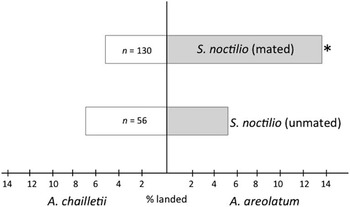
Mating status significantly affected the general responsiveness in S. noctilio females. A greater percentage of mated females landed on dishes containing A. areolatum than did unmated females (χ2=4.961, df=1, P=0.025). When mated S. noctilio females were offered both A. areolatum and A. chailletti, a greater percentage (13.9%) landed on A. areolatum than on A. chailletti (5.4%) (χ2=4.425, df=1, P=0.035) (Fig. 1). For unmated S. noctilio females, approximately the same percentages landed on each fungal species (χ 2=0.00, df=1, P=1.00).
Percentages of directional flight resulting in mated and unmated Sirex noctilio females landing on Amylostereum chailletii versus Amylostereum areolatum cultures. Dark bar indicates the primary symbiont of S. noctilio. The sample size (n) indicates the number of flights initiated by wasps for each pairwise comparison. Significant difference in response is indicated with an asterisk (χ2-test, P<0.05).

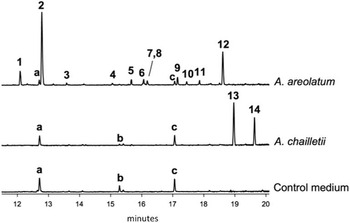
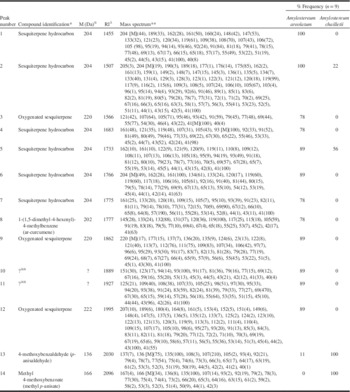
The differences in the volatile profiles of the two fungal species are pronounced: we found 12 sesquiterpenes that occurred in at least seven out of the nine replicates of A. areolatum but only two of these components were detected (only in trace amounts) in a few A. chailletii samples (see Table 2). In contrast, all replicates of A. chailletii emitted two aromatic volatiles, 4-methoxybenzaldehyde (or p-anisaldehyde) and methyl 4-methoxybenzoate (or methyl p-anisate) with the first being detected in only one of the A. areolatum samples (Fig. 2). Full identification of the sesquiterpenes was not possible based on their mass spectra and retention indices, except for ar-curcumene (8). No similar spectra were found for compounds 10 and 11 and the molecular weight could not be predicted. We examined all replicates collected from control medium (n=9) by looking at the chromatographic traces of the base peak and other characteristic fragments of the reported fungus-produced components and concluded that none of these components were detected in any of the control samples.
Representative chromatographic profiles (on an EC-WAX column) of the volatile blends emitted by the main Sirex noctilio symbiont Amylostereum areolatum, one of the Sirex nigricornis symbionts Amylostereum chailletii, and the control medium (PDA). Volatiles were collected with SPME (100 µm polydimethylsiloxane). Compound identification is based on the EI+ mass spectra and the calculated retention indices (Van den Dool and Kratz Reference Van Den Dool and Kratz1963): 1–9 and 12: sesquiterpene hydrocarbons and oxygenated sesquiterpenes; 10 and 11: unidentified, possibly sesquiterpenes (see Table 2); 13: 4-methoxybenzaldehyde (p-anisaldehyde); 14: methyl 4-methoxybenzoate (methyl p-anisate); and a: decanal, b: heptadecane, and c: geranyl acetone are components from the control medium.

Compounds detected in at least seven out of the nine volatile collection samples from either Amylostereum areolatum or Amylostereum chailletii.
* Identification of the sesquiterpenes is not complete due to lack of good match (>90%) to any available library spectra (for more explanation see Methods and materials).
≅ Molecular weight value in parentheses means that the mass spectrum lacked an apparent molecular ion (for more explanation see Methods and materials).
⊥ Retention index on EC-WAX calculated using the formula for temperature programmed analysis (Van den Dool and Kratz Reference Van Den Dool and Kratz1963).
** Fragment mass values with relative intensities (⩾1%) in parentheses; [M] indicates the molecular ion.
≅≅ No prediction available for identity based on the mass spectrum.
Discussion
As we hypothesised, mated S. noctilio females responded positively to their primary mutualistic fungus, A. areolatum, when they were offered the choice between A. chailletii and A. areolatum but unmated females did not. In nature, male S. noctilio emerge before females and fly to the tops of trees and once females emerge they also fly up where they locate lekking males, mate and only subsequently descend trees to begin laying eggs (Madden Reference Madden1988; Ryan and Hurley Reference Ryan and Hurley2012). Therefore, this heightened response by females after mating would be consistent with the behaviour of young females with the goal of mating before ovipositing. In fact, if unmated females were most attracted to the fungus on and in tree trunks, they would not find males at the tops of trees, and thus would not mate, resulting in only male offspring due to haplodiploidy. In addition, it is probably more beneficial for a mated female to locate a weakened tree that is already inoculated with the fungus needed for her offspring to develop.
A basic chemical comparison of A. areolatum and A. chailletii revealed that the chemical profiles of these two fungal species are different. There is a strong sesquiterpene presence in A. areolatum, while these volatiles are almost always absent from A. chailletii, in which two aromatic volatiles, p-anisaldehyde and methyl p-anisate, dominate. Volatile sesquiterpenes are commonly produced by members of the subkingdom Dicarya, lending a distinctive scent to many known fungal species (Hibbett et al. Reference Hibbett, Binder, Bischoff, Blackwell, Cannon and Eriksson2007; Kramer and Abraham Reference Kramer and Abraham2012). These sesquiterpenes are lipophilic with high vapour pressure and therefore good conveyors of specific messages (Kramer and Abraham Reference Kramer and Abraham2012). Although over 25 000 terpene structures are known (Dictionary of Natural Compounds 2008), only a few have been studied for their roles in ecological interactions (Kramer and Abraham Reference Kramer and Abraham2012).
Sirex females carry their symbiotic fungus in mycangia and that fungus must be established in wood for the offspring of a female to successfully develop (Madden Reference Madden1974). It was previously reported that S. noctilio avoids ovipositing near Leptographium wingfieldii Morelet (Ascomycetes, Ophiostomatales), vectored by bark beetles (Ryan et al. Reference Ryan, Moncalvo, de Groot and Smith2011, Reference Ryan, de Groot, Davis and Smith2012), or that other pathogens, such as blue strain fungi can outcompete A. areolatum (King Reference King1966). Amylostereum chailletii and A. areolatum also repel each other (Hajek et al. Reference Hajek, Nielsen, Kepler, Long and Castrillo2013; Castrillo et al. Reference Castrillo, Hajek, Kepler, Pajares, Thomsen and Csóka2015), so if A. chailletii is already present in an area of a tree, A. areolatum will not grow there or the area of wood that will be occupied by A. areolatum could be limited. The area of growth of A. areolatum influences the size of the resulting woodwasp adults (Madden Reference Madden1981) so attraction to A. areolatum versus A. chailletii could impact a female’s fitness as larger adult females carry more eggs (Kroll et al. Reference Kroll, Hajek, Morris and Long2013). A proportion of S. noctilio landed on A. chailletii during our study, which may not be surprising since Wooding et al. (Reference Wooding, Wingfield, Hurley, Garnas, De Groot and Slippers2013) has shown that S. noctilio is able to carry A. chailletii. Additional studies need to be conducted to test the fitness of S. noctilio when larvae develop in association with this infrequent associate.
While these two fungal species display major differences in their volatile composition, and A. areolatum can attract mated female S. noctilio, further experiments using fungal-inoculated host-plants should follow to test whether Amylostereum volatiles are also attractive under more natural conditions.
Acknowledgements
The authors thank Sirex-wrangler S. Long, E. Morris for growing fungus; I. Caetano for mating woodwasps; and A. Anderson, K. Peters, and S. Andrews for wind tunnel trials. A. Hartness assisted in the original construction of the wind tunnel, and R. Kepler and J. Liebherr assisted with reassembly and modification. They also thank the anonymous reviewers for their thoughtful comments. Funding for this study was provided through a cooperative agreement with United States Department of Agriculture-Animal and Plant Health Inspection Service. Mention of a commercial product does not constitute an endorsement or recommendation for its use by the United States Department of Agriculture.