INTRODUCTION
The central premise of this article is that only certain types of religious involvement in politics are harmful for democratic regimes, but other kinds are not. One of the essential characteristics of a democratic regime is the separation of Church and state. The elected governors of a democratic regime's institutions require sufficient autonomy in order to make policy that is within the bounds of the constitution and which cannot be contested or overruled by non-elected religious leaders or institutions (Stepan Reference Stepan, Linz and Stepan2001). However, this requirement is often confused by scholars and politicians to mean that a democracy should also be secular, or more correctly, that a democracy is ideally underpinned by a society where religion has little influence outside the private realm.
There are two principal reasons for this conflation. The first has to do with the historical roots of modern democracy in the West, which are intertwined with those of the liberal nation-state. The rise of the nation-state, in turn, required a definitive victory over religious claims to political legitimacy and loyalty. The second reason is that even if some scholars grant that there is still some room for religion to publicly influence politics in democracies, many argue that doing so in a way that is compatible with democracy is still the result of a uniquely Western, Christian conceptual-theological distinction between religion and state. In other traditions where this distinction is not present, as Huntington (Reference Huntington1996) has famously argued is the case with respect to Islamic countries, empowering religious authority can only serve to open the path to dangerous theological politics along the lines of the Ayatollahs in Iran and the Taliban in Afghanistan.
In this article, I respond to the first of these two claims by considering the origins of the intellectual conflation between the democratic necessity for a separation of Church and state and the strong state-building ideal of government-regulated religion and societies unencumbered of religious authority. I then turn to a conceptual framework proposed by Juan Linz (Reference Linz and Maier2004) and Cole Durham Jr. (1996) and make an analytic distinction between two different dimensions of religion(s)-state arrangements,Footnote 1 the degree to which governments regulate and restrict religion(s) and the degree to which governments are friendly or show favoritism toward religion(s). While the degree of government regulation of religion, or, vice versa, religious regulation of government represents the type of separation of Church and state that democratic scholars rightly consider to be harmful to democracy, I argue that government favoritism toward religion can have a neutral and at times even positive impact on national levels of democracy. Using cross-national databases on religion-state relationships created by Grim and Finke (Reference Grim and Finke2006) and Fox (Reference Fox2006), the data analysis supports these claims and indicates that once the core autonomy prerequisite has been fulfilled, there is a wide range of Church-state arrangements which allow for religion to have a public role in political life and simultaneously maintain a high quality of democratic rights and freedoms.
While I do not directly address the second principal reason for fearing any mix of religion and politics in democracies, namely, that only certain religious traditions support a democratic distinction between religious and political authority, recognizing these two, basic dimensions of the religious-political relationship broadens the band of opportunities which we normally think are available for healthy Church-state relations within a democracy. In particular, the data seem to suggest an “ideal” category of Church-state arrangements for democratic countries who host a culturally hegemonic, society-wide religion; the data indicate that many predominantly Catholic democracies are located in this category and some predominantly Islamic countries as well. Drawing on these results, I conclude that, under certain circumstances, a religion with strong public relevance, institutionalized in a friendly, democratic Church-state relationship, may be desirable and useful for the consolidation of newly democratizing countries. Heavy-handed ruling against religion in democracies, by contrast, not only runs the risk of provoking the counter-productive, anti-democratic forces which lie within religious fundamentalism but also obscures the full breadth of options open for healthy relationships between religion and state and, by doing so, weakens the potential religion possesses to help legitimize and strengthen new democratic regimes.
BACKGROUND
Since the time of at least the enlightenment, it has been argued that democratic states function best when religious authority is separated, completely, from political authority. In what follows, I briefly examine the basic fear animating this argument, and contest that it is a conceptual error to hold-up the total disentanglement of religion and state as the only ideal for democratic politics. This error conflates the goals of a state and a democratic regime with respect to religionFootnote 2 and muddles the point that while the historical process of state-building in the Western sense is one of a marginalization of religion to the private sphere, it is a process that is not necessarily required for a successful democratic regime.
What a democratic regime and a modern nation-state do share in common with respect to religion is that both are predicated on some removal of religious authority from the political sphere. As Weber (Reference Weber1978) recounts, this was made possible in part through the societal changes created by the Protestant reformation in which the rational individual was placed at the center of society and invested with the personal responsibility of interpreting human beings' role in the temporal order. By deconstructing the societal authority attributed to the Roman Catholic Church as the mediating mechanism between sacred and profane, the state was able to build up its own sovereignty, making it possible, eventually, for democratically-elected authorities to rule unfettered of religious authority. Shifting away from a model of absolute, monarchical power that was “divinely” sanctioned by the Catholic Church reduced the arbitrary rule of kings and the wars, crusades, inquisitions, and conquistes they fought on the basis of their religious passions (Appleby Reference Appleby2000). The codification of legal systems and the establishment of neutral bureaucracies further empowered the individual entrepreneur within the state and supported rational politics and capitalist enterprises conducted outside the authority of religion (Weber Reference Weber1978).
This retreat of religion from politics, however, did not happen spontaneously. In order to establish their own political authority, which was based on the rational and not the divine, state authorities strove to acquire a monopoly on the use of force, as Tilly (Reference Tilly1990) and Giddens (Reference Giddens1987) have argued, but also control over the interpretation and meaning of societal symbols and national history (Bourdieu Reference Bourdieu2004; Hansen and Stepputat Reference Hansen and Stepputat2001; Loveman Reference Loveman2005; Gorski Reference Gorski and Steinmetz1999). It was in this realm of symbols where the struggle was often fought, as religious powers had always staked out claims of control over the use of force, ideas and identity through the rituals of baptism, marriage, teachings on just and unjust wars, hereditary rights, alms-giving, and forgiveness.
If state elites marginalized religious authority and managed their power over symbols effectively, however, they won over the conscious and unconscious loyalty of their citizens, tied them together into a national identity, and directed their energies to defending and buttressing the state. As Anthony Marx's (Reference Marx2003) title aptly captures, Faith in Nation, the power of nationalism enabled the state to generate a pseudo-religious leap of faith on the part of its citizens. In essence, by replacing the legitimacy-conferring power of religion with its own state-controlled ideology, the state became the new “surpra-religion” of the land (Juergensmeyer Reference Juergensmeyer1993), permitting it to justify and direct its own doctrines of “destiny and wars.”Footnote 3 This logic also formed one of the most powerful versions of secularization theory: as the rational, bureaucratic state replaced the need for religiously legitimated politics, and as science replaced the need for religious explanations of the mysteries of nature, the need for religion, robbed of any public or private function, would wither away.
Although in Weber's account nation-state building and the rationalization of politics evolved simultaneously with the intellectual legitimization of democratic politics and the articulation of legal lists of individual rights, consolidating state power led to obvious tensions with democratic ideals. The requirements of political freedoms given by even the most minimalist definitions of democracy (Schumpeter Reference Schumpeter1947; Dahl Reference Dahl1971; Przeworski et al. Reference Przeworski, Jose Cheibub and Limongi2000) were often at odds with the state's goal of expanding its coercive and symbolic means of control. In fact, even while the creation of a strong state made it easier for democratic regimes to govern efficiently, democratic institutions were ultimately designed to put state power in check and protect individual rights from overwhelming political authority. This made it inherently difficult for the state to win absolute control over the national set of societal symbols and moral values within democracies.
As Casanova (Reference Casanova1994) argues, while the Weberian account is correct in accounting for some kind of separation of Church and state in the democratization of the West, the degree to which states were successful in marginalizing religion to the private sphere varied greatly from democracy to democracy. Recent studies, such as Fox's (Reference Fox2007, Reference Fox2008) important analyses of cross-national separation of Church and state, tend to support Casanova's claim and report that a full institutional separation of Church and state goes unheeded quite often, if not most of the time, in longstanding democracies let alone fragile new ones. Fox's (2008) work, in fact, shows that over the period from 1990 to 2002 government involvement in religion (GIR), measured on a variety of indicators, actually increased in a majority of countries.Footnote 4 While acknowledging that it is difficult to measure the motivations behind this increased involvement Fox's conclusion is a strong indicator that religion still has an important role to play in many democracies, including Western European ones.
Throughout early attempts at democratization in several Catholic countries of Europe, for example, as in Spain, Italy, Portugal, and Belgium, religious forces were relatively successful in mobilizing effective opposition against early democratic forces. Incapable of forcing a complete religious retreat from the political realm, democratic leaders often finished by compromising with these religious leaders over the content of their democratic republics in order to gain a majority approval over democratic institutions (Linz Reference Linz1991; Kalyvas 1996; Gould Reference Gould1999). In his recent book on the origins of religious liberty, Gill (Reference Gill2008) points out that similar process also occurred in parts of Catholic Latin America. Using a rational choice perspective on religious markets, Gill reveals how the political necessity of political leaders often necessitated that they deal with and bestow certain institutional favors on the Church in order to win much needed popular legitimacy for their governments.Footnote 5 While many of these new democracies eventually instituted separation of Church and state, the Catholic Church was often able to continue to negotiate a particularly favorable relationship with specific, national political regimes. To this day, religious authorities still wield enormous political power in these countries, through the remnants of Christian democratic political parties, state funding for buildings, education and clergy, and as a contentious public voice for laws and decisions on “life” issues like abortion, divorce, euthanasia and war.
Rather than fully retreating to the private sphere and withering away as secularization theorists might have predicted them to, under certain circumstances religious actors, therefore, have been able to successfully renegotiate their moral voice and public authority in democracies (Casanova Reference Casanova1994). In some Catholic countries, Church leaders have taken advantage of their roots in civil society and used them as a base from which to sustain active, public religion within modern democracies in a way that does not seem to risk a regression from the quality or sustainability of democratic governance (Casanova Reference Casanova2001). Instead of understanding the Church-state arrangement on a continuum with respect to democracy, where more separation of Church and state is positive and less separation of Church and state is negative, this suggests that it might be more analytically useful to understand Church-state arrangements as being typologically different in their associations with democracy.
The case of Italy is particularly illustrative in this respect and holds some clues for how to widen the conceptual framework which we use to understand the appropriate kinds of relationships available between religion and politics in democracies. In the fragile years following the Second World War, Catholic leaders, who had mobilized their faithful to weaken Italy's first attempts at liberal democracy just decades before, backed the creation of a democratic state (Lange and Tarrow Reference Lange and Tarrow1980; Pasquino Reference Pasquino, O'Donnell and Schmitter1986). Learning from the success of Mussolini before them, aspiring democratic elites wrote an impressively favorable place for the Catholic Church into the new democratic constitution, instituting a special role for the Church in national education, holidays, and laws on moral matters (Jemolo Reference Jemolo1960). In doing so, democratic elites gained the much needed legitimacy of Italian Catholics and delegated certain functions of the state to the Church, such as education and a few welfare activities. In return, the Church was able to ensure that it maintained some moral authority in Italian society, if not in politics.
Through political bargaining with Italian socialists and communists, Catholic leaders gradually helped establish the political authority of democratic institutions. Once they bought into the basic requirements of democracy, however, the democratic process itself, in turn, fundamentally changed Italian Catholics' aims in politics (Cartocci Reference Cartocci1994). Under democracy Italian Catholics had to make compromises with socialists, communists and other secular factions in order to win and maintain a voice in politics. Catholic political forces were eventually held accountable for good, bad, and corrupt economic and social policies, tempering both the institutional Catholic Church's ability and its desire to control politics while retrenching its role as a significant critic of it (Cartocci Reference Cartocci1994).Footnote 6 This creation of a democratic equilibrium for religion and politics in Italy, moreover, did not correspond to either a privatized Church or a fully secularized citizenry (Norris and Inglehart Reference Norris and Inglehart2004).Footnote 7
In the developing world, where religious authority is arguably at its strongest (Barrett, Kurian and Johnson Reference Barrett, Kurian and Johnson2001), Catholic and Protestant religious organizations also had an instrumental political role in many of the transitions to democracy throughout the 1970s and 1980s (Huntington Reference Huntington1991; Philpott Reference Philpott2007). While this suggests further potential for a religious role in legitimizing and strengthening democratic regimes through a religious presence in the public realm, scholars have also wondered whether this experience was a uniquely Christian phenomenon (Huntington Reference Huntington1996). Islamic religious networks also became centers of social protest and mobilization against de-legitimized authoritarian governments in the 1970s and 1980s, but the outcome of a few of these protests renewed fears among scholars that mixing religion and democracy is dangerous and unadvisable. The Iranian experience, where a religious authority which won power in elections used its mandate to institute an openly theocratic and authoritarian regime, particularly reaffirmed some scholars' beliefs that Islamic cultural traditions leave little room for democratic institutions to operate outside the authority of religious leaders. Because there is no separation of political authority from the sovereignty of Allah in Islam, offering religious Islamic leaders a more favorable and public role in society and politics would only serve to make democratic regimes and the rights of their citizens more vulnerable to being manipulated by unelected authorities. Although other scholars have pointed out that much anti-democratic politics in contemporary Islamic countries comes from secular forces blocking religious groups' attempts to organize politically (Stepan Reference Stepan, Linz and Stepan2001), the thought of legitimizing another Iran by legitimizing religious forces' rights to run candidates and contest elections seems potentially irresponsible, indeed.
One of the important lessons from the Italian case, however, is that the success of democracy was not associated with the full removal of the Catholic Church from the realm of politics, as many scholars in the Weberian tradition might have ideally expected. Rather, it renegotiated the kind of role the Church had in political life. The Catholic Church no longer sanctioned the authoritative power of state rulers, and it generally accepted the pluralistic nature of national belief and identity; the Italian state, in return, stopped regulating national religious belief, but still offered the Church special favors and some institutional role in public life. While there are risks to involving religion in the political sphere, not all kinds of religious involvement in politics or vice versa seem to be equally risky. In other words, some kinds of non-separation of Church and state appear to be quite compatible with democracy. I now turn to developing a more specific theoretical framework to capture this insight. In order to do so, I draw on the earlier conceptual work of Stepan (Reference Stepan, Linz and Stepan2001), Linz (Reference Linz and Maier2004), and Durham (Reference Durham, Vyer and Witte1996) to specify two basic dimensions of the Church-state arrangement and then operationalize the concept by using two indicators created by Grim and Finke (Reference Grim and Finke2006) and Fox (Reference Fox2006).
THEORY
In his article, “Religion, democracy and the twin tolerations,” later expanded in a book chapter of the same title, Stepan proposes two essential conditions for the role of religion in any regime that portends to be democratic. The first condition flows from the minimal democratic requirement for free, fair, and competitive elections for political office, as defined by Dahl (Reference Dahl1971), Linz and Stepan (Reference Linz and Stepan1996), Przeworski et al. (Reference Przeworski, Jose Cheibub and Limongi2000) and others. In order to avoid canceling the accountability-representative principle underlying this definition, these democratically elected officials require sufficient autonomy to make policy that is within the bounds of the constitution and which cannot be contested or overruled by non-elected religious leaders or institutions. The second condition flows from the basic political rights and civil liberties that democracies must guarantee their citizens to secure them their ability to exercise democratic rights to elect officials and hold them accountable. With respect to religion, the government cannot regulate or prohibit private religious belief and worship or prevent citizens from organizing politically and pursuing policy objectives which are in line with their religious values as long as they do not violate the constitution (Stepan Reference Stepan, Linz and Stepan2001).
Following Durham (Reference Durham, Vyer and Witte1996), Linz (Reference Linz and Maier2004), and Grim and Finke (Reference Grim and Finke2006), I refer to this dimension of the Church-state relationship as GRIFootnote 8 as it measures the extent to which the state regulates and restricts the “free exercise” of individual belief (Durham Reference Durham, Vyer and Witte1996). At very high levels of GRI, either religion totally dominates and regulates political life — which Linz terms politicized religion, as found in theocracies such as Iran — or politics overwhelms and totally regulates religious life, even in the private sphere — which Linz calls political religion, exemplified by some communist regimes, such as Laos and North Korea. Either extreme is the flipside and often indistinguishable form of total regulation on the dimension of “free exercise” and we would not expect either of these two types of GRI to be compatible with a fully democratic regime.
While democratic regimes are in need of some state capacity in order to function and thus some removal of religious authority from politics, Stepan's (2001) twin tolerations also suggest, however, that democracy does not require the total marginalization of religion to the private sphere; in theory, a perfectly democratic regime could co-exist with a Church-state arrangement where relevant religious elites still exercised significant symbolic and moral authority over a national citizenry. In many successful democracies, religion has been relegated to the private realm and enjoys little influence on public policy and politics. However, in friendlier religion-state relationships, such as Italy at the time of its transition to democracy, while still keeping to a democratic separation of Church and state, religions can have a more public face and be looked to more seriously for guidance on policy, morality, and identity matters.
One way to think about this other face of the Church-state arrangment is to add a second dimension to the Church-state relationship, which measures the degree of friendliness or “identification” (Durham Reference Durham, Vyer and Witte1996) that exists between government and religious institutions. Once again, following Durham (Reference Durham, Vyer and Witte1996), Linz (Reference Linz and Maier2004), and Grim and Finke (Reference Grim and Finke2006), I refer to this dimension of the Church-state relationship as government favoritism of religion (GFI)Footnote 9 as it measures the degree of friendliness of the state toward one or more religions in its country (Linz Reference Linz and Maier2004) independent of whether or not the state chooses to regulate religious organization and belief. Gill (Reference Gill2008) makes a similar distinction to that proposed here between GRI and GFI by introducing the language of negative restrictions on religious liberty as opposed to positive endorsements of religion. American scholars often refer to this positive endorsement of religion as a question of religious establishment and which is analytically distinct from the question of free religious excercise that GRI measures.Footnote 10 While the term “religious establishment” captures some aspect of GFI, it also tends to be situation specific to the American colonies, and the establishment of the Church of England in many British territories. The term, therefore, carries with it the connotations of state administration of an established religion that might include many elements of GFI, e.g., state salaries and tax exemptions for the clergy, but some elements of governmental regulation as well, e.g., the state appointment of Bishops and religious restrictions on voting or office-holding rights.Footnote 11 Gill (Reference Gill2008) argues that while negative restrictions on religious liberty are explicitly detrimental to the protection of civil liberties required of democracy, positive endorsements of religion (what we consider here to be GFI) similarly restrict the equality of religious treatment in society and full religious liberty. I argue, however, that while GFI may reduce the bandwidth of religious consumers' choice available, as long as a government does not actively restrict and regulate religious belief, this type of “positive” religious involvement in government is not necessarily harmful to national levels of democracy.
Ideal categories of GRI and GFI

Values of GRI and GFI are taken from Grim and Finke (2006).
Church-State Arrangements and Democracy: Grim and Finke (Reference Grim and Finke2006)

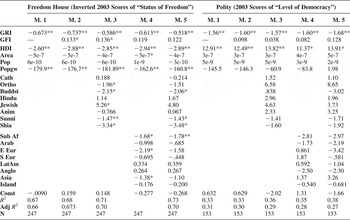
Coefficients of multi-variate regression analysis. Religion dummy variables coded 1 for majority religion in country with “Protestant” as the reference category. Region dummy variables coded 1 for region of country with “Western Europe” as reference category. GRI is “Government Regulation of Religion” and GFI is “Government Favoritism of Religion” from Grim and Finke (Reference Grim and Finke2006) coded for the year 2003. HDI is the United Nations Human Development Index coded for the year 2003.
*P = 0.05 level, **P = 0.01 level.
Church-State Arrangements and Democracy: Fox (Reference Fox2006)
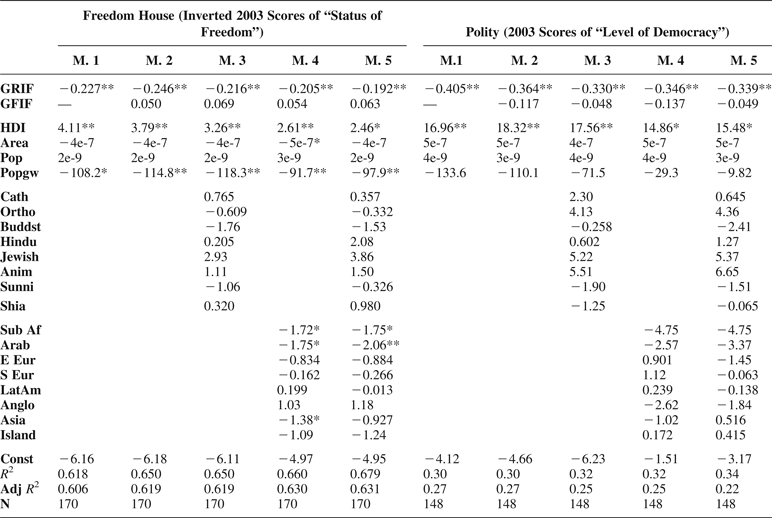
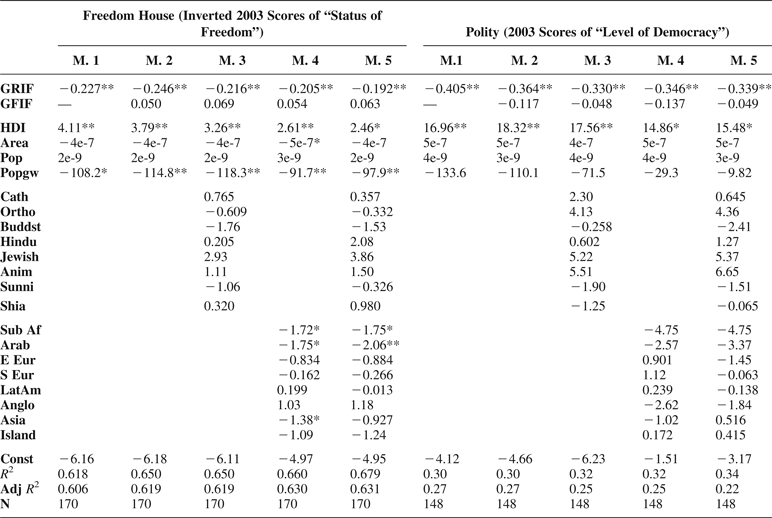
Coefficients of multi-variate regression analysis. Religious dummy variables coded 1 for majority religion in country with “Protestant” as the reference category. Region dummy variables coded 1 for region of country with “Western Europe” as reference category. GRIF and GFIF are composite measures of “Government Regulation of Religion” and “Government Favoritism of Religion” taken from Fox (Reference Fox2006) coded for the year 2002. HDI is the United Nations Human Development Index coded for the year 2003.
*P = 0.05 level, **P = 0.01 level.
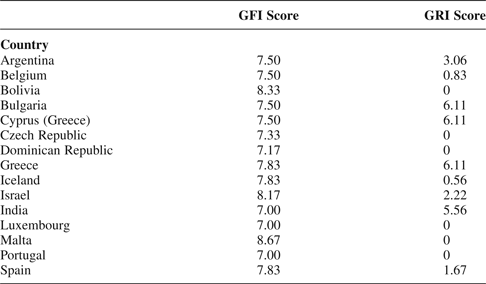
Democracies with Very Friendly Religion-State Arrangements
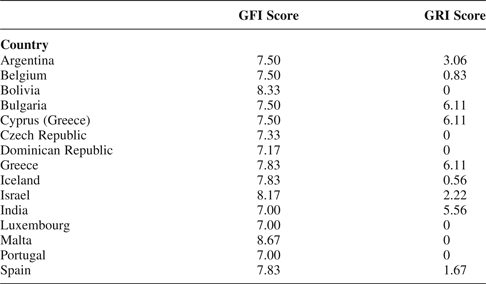
Countries coded as “Friendly” religion-state arrangement if their Government Favoritism of Religion score > 7. GFI and GRI are for the year 2003 as coded by Grim and Finke (Reference Grim and Finke2006). Countries coded as democracy if they were scored as “Free” for an average of five years prior to 2003 by Freedom House.
While any national Church-state arrangement could theoretically vary along either of these two dimensions as along a continuum (and as will be done later in the statistical analysis), a simple two-by-two table employing ideal categories helps illustrate the intuition behind the distinction between GRI and GFI (Table 1).
In countries that have high levels of religious pluralism, such as that which characterizes the United States, or where secularization is at very high levels for various reasons, such as in countries like Uruguay and Great Britain, low levels of both GRI and GFI pose no problem for democratic stability. However, in countries where there is a relatively high degree of religious homogeneity, I argue that it may be a useful strategy to anchor democratic values and rights to corresponding religious values within the set of symbols available in the predominant society-wide religion. This does not entail that one religious tradition will become the only identity that matters in these countries. However, by instituting some degree of government friendliness, and thereby touching on forms of symbolic meaning which a majority of its citizens recognize as a part of their identity set, democratic leaders stand to gain greater societal legitimacy for their regime.
To satisfy Stepan's (2001) conditions for the role of religion in democracies, regimes need to avoid establishing Churches with no toleration of other religious beliefs or swinging the balance so much in favor of separation of Church and state that religious beliefs are persecuted. With respect to political rights, relatively high levels of GFI do not exclude the protection of a pluralistic set of religious beliefs, but high levels of GRI do not offer this protection. Whether by repressing the public worship of certain sects, delegating the appointment of national clergy, or regulating religious and moral codes, GRI empowers the state to manage certain religious beliefs while prohibiting others. GFI, however, while actively identifying the state with, and thus encouraging some religious traditions over others, does not necessarily allow the state to manage the religious beliefs of those traditions. Even with a relatively high degree of GFI, the state can guarantee institutional “exit options” (Mazie Reference Mazie2004) and the free worship of religious belief for those who do not share in these beliefs. While a potentially risky strategy, as Mazie (Reference Mazie2004) writes is the case with the Jewish state of Israel, a democratic state may actively endorse one religious tradition of a majority of its citizens as essential to its national identity, while simultaneously protecting the rights of minority groups to rally around their own traditions.
Drawing on the propositions of Stepan's (2001) twin tolerations, we can now more clearly hypothesize about which kinds of religious interference with government or government interference with religion ought to be harmful for democracy and which are not, namely:
HYPOTHESIS 1
Countries with higher levels of GRI, which discriminate and regulate either against religions and religious belief or on their behalf, are less likely to be democratic than those with lower levels of GRI.
However, we can also hypothesize that:
HYPOTHESIS 2
To the extent that a government favors one religion without actively denying the liberties of any other, the chances for democracy will be unaffected. In other words, at reasonable levels of GRI, more or less GFI should have little effect on national levels of democracy.
If, on the other hand, we find evidence in the data that countries with higher levels of GFI are systematically associated with lower levels of national democracy, then this second hypothesis is most likely incorrect, and the total separation of Church and state in all of its forms ought to remain the ideal for democracy.
DATA ANALYSIS AND RESULTS
In order to analyze these two hypotheses, I use four basic databases. For levels of democracy and for some indication of their quality, I employ the widely used, if flawed, Freedom House database. Freedom House attempts a more comprehensive, if messier, definition of democracy and scores countries by employing checklists of essential democratic political rights and civil liberties in a way that can be combined onto a 1 to 14 point scale. One of Freedom House's criteria in establishing its measure of civil liberties is whether or not a country respects “freedom of religion.” This criteria, however, is only one of several indicators that add up to Freedom House's civil liberty variable. What is more, although their definition of violations of freedom of religion would seem to be much closer to our definition of GRI than GFI, Freedom House does not make any clear distinction between the two different types of government interference with religion presented here. Controlling for levels of GRI and GFI in the following analysis will therefore tell us whether GRI or GFI (or both) is more likely to correlate with violations of other civil liberties and political rights, and, thus, lower levels of democracy in general.
In order to test the hypotheses on a democracy database, which does not specifically look at Church-state arrangements, I also use the Polity IV dataset in these regressions which gives democracy scores on a scale of −10 to 10. Polity focuses its ledger of democracy less on the political and civil rights required of democracy and more on the minimal democratic requirements of institutional procedures, with particular importance given to the competitiveness of elections (Munck and Verkuilen Reference Munck and Verkuilen2002). Positive results on both the Freedom House and Polity databases will strengthen our confidence that the dimension of GRI captures those aspects of GIR which are harmful to democracy while GFI captures those which are not.
Finally, for the relationship between religion and state, I use Grim and Finke (Reference Grim and Finke2006) and Fox's (2006) databases. Grim and Finke (Reference Grim and Finke2006) construct three main indices on religion and government for 247 countries and territories, based on several measures that they coded from the 2003 International Religious Freedom Report, created annually by the United States Department of State. The authors disaggregate the information from the report into different types of government regulation or involvement with religion for each country. In this article, I am interested in their indices of GRI and GFI. As they define it, GRI refers, “to the actions of the state that deny religious freedoms, government regulation includes any laws, policies, or administrative actions that impinge on the practice, profession, or selection of religion.” The GRI index can be used to measure the first dimension of Linz (Reference Linz and Maier2004) and Durham's (1996) framework and test the validity of Stepan's (2001) two conditions for the role of religion in democracy. To the degree that a state regulates the private worship of individuals, Stepan's first toleration, or religion regulates state policies, Stepan's second toleration, a country will receive a higher GRI score. Importantly, as Linz (Reference Linz and Maier2004) theorizes in his continuum of Church-state arrangements, Grim and Finke's (2006) GRI makes no distinction between total politicized religion or political religion.
The coding of the index construction for GRI poses six basic questions to the Religious Freedom Reports. These questions scrutinize whether a government regulates or restricts public preaching, “Foreign” evangelization, and the generally free practice of religion. This index should not be considered to be an exhaustive list of the ways in which governments can potentially regulate religion, and future iterations of the index might pose further questions, for example, about the degree to which governments' appoint and manage religious clergy.
The GFI indicator, on the other hand, is not concerned with whether the state officially tries to regulate and control religion (or vice versa), but the extent to which a state allows and encourages the expression of certain religious traditions in public and political life. As Grim and Finke (Reference Grim and Finke2006) write, GFI refers, “to the actions of the state that provide one religion or a small group of religions special privileges, support, or favorable sanctions.”
The coding of the index construction for GFI poses five basic questions to the Religious Freedom Reports and scrutinize whether the state encourages and funds certain religious “brands” and symbols, religious education, clergy, religious infrastructure, and religious charities. Once again, this index is not exhaustive and other iterations could ideally include additional aspects of this favorable or friendly dimension of the Church-state arrangement, for example, including indicators of how much the state turns to the religion(s) of its society for guidance on social and moral policies through legislative measures and judicial courts.
It should be noted that GFI does not measure the full public power religions possess to orient societal values. By recording the level of state favoritism toward a religion, GFI does measure what I argue is the non-restrictive institutional presence of that religion in the political realm. However, GFI does not tell us whether or not that particular religion is an active protagonist with respect to such public institutionalization. Even in the context of high GFI, some religious actors might be either unwilling or unable to effectively use its favorable position as a political asset. An institutional framework with high GFI will continue to bias the bases of the public arena toward that religious tradition, for example, by socializing the nation's youth in that religious tradition's world-view and keeping that world-view as the moral and symbolic reference in public discourse and legislation. Over time, however, that traditions' leaders might have lost the “hearts and minds” of their faithful, reducing GFI to a latent, but important, institutional influence.
While they are certainly related (both measure some type of government involvement in religion), these two indices appear to tap into two distinct enough concepts to warrant analyzing them as two separate dimensions. Using exploratory factor analysis, Grim and Finke (Reference Grim and Finke2006) report that the GRI and GFI indices cluster into two statistically distinct regions with respect to the state's relationship to religion. The Eigen values reported in the factor analysis for GRI and GFI are 5.47 and 2.17, respectively. If our hypotheses are correct, GRI should be a stronger indicator of levels of national democracy, and GFI should have little bearing on them.
There is much overlap between Grim and Finke's (2006) measure and Fox's (2006) coding rules on worldwide separation of Church and state. Fox's (2006) data are not specifically designed to disentangle the difference in government regulation and favoritism toward religion as in Grim and Finke (Reference Grim and Finke2006), and he combines his indicators into one continuous measure of government involvement in religion (GIR), which stretches from official hostility toward religion to official support for one religion. That said, as a composite measure, which builds on five major sub-variables which themselves can be easily disaggregated, it is relatively easy to design variables from Fox's (2006) GIR dataset which are similar to Grim and Finke's (2006) distinction between regulation and friendliness or favoritism. Fox's (2006) data are also useful as they allow us to add other ideal attributes of these two dimensions which Grim and Finke (Reference Grim and Finke2006) do not include in their coding. For an alternative measurement of GRI, I therefore also run regressions using a composite measure, which adds Fox's (2006) indicators on government “regulation” and “discrimination” (which I term GRIF), and for an alternative measure of GFI, I use a composite measure of his two indicators of “official support” for religion and religious “legislation,” (which I term GFIF).
In order to test the hypotheses, I run several multi-variant regression models on both the Polity and Freedom House measures of levels of democracy, using both Grim and Finke (Reference Grim and Finke2006) and Fox's (2006) indicators of government regulation and favoritism towards religion. I add region and religion dummy variables to explore whether these relationships hold across different varieties of religious and cultural traditions. I also control for the effects of levels of combined human development and national economic well being, using the United Nations' measure of human development (the HDI indexFootnote 12) and measures of population growth, density, and country size.
The most statistically significant parameters that hold across all of the models using both Fox (Reference Fox2006) and Grim and Finke's (2006) data as well as Polity and Freedom House, are the GRI and Human Development Index (HDI) parameters (Tables 2 and 3). Other than confirming one of the most important statistical relationships within political science, namely that between democracy and economic well-being, these results also begins to tell a story about the effects of these two dimensions of the Church-state arrangement on democracy.
The GRI index is significantly and substantially associated with lower levels of democracy, supporting our first hypothesis that too much GRI diminishes the chances a country has of being democratic. Less government involvement with religion or religious involvement in government along this dimension appears to be desirable for the sustainability of democratic regimes and ought to remain an integral part of the definition of democracy.
This finding, of course, will not come as a great surprise, given our expectations of what constitutes a democracy and the measures we use to determine its presence. The result, nevertheless, is not an entirely banal one in that it affirms that violations of Freedom House's measure of respect for “religious freedom” most tightly bundle together with other violations of civil liberties and political rights when that measure is associated with higher levels of GRI. In other words, GRI, indeed, measures that sort of religious interference with religion that is bad for democracies. The results of the Polity regressions add confidence to this result: high levels of GRI are strongly associated with lower levels of democracy even when democracy is measured using institutional attributes that do not focus on civil liberties and political rights.
That said, the more interesting result of this analysis is that the degree of friendliness of government toward religion, as measured by GFI, seems to have no statistically significant effect on whether a regime is predicted to be democratic or not. In the few models where the GFI coefficient does take on some significance, it even has a slightly positive association with higher levels of democracy, although the real effects of this parameter appear to be negligible.
These results, therefore, also support our second hypothesis and indicate that as long as state authorities are able to contain GRI at an acceptable level, they can offer more or less favoritism to religion without necessarily risking harm to their national levels of democracy as measured by Freedom House and Polity. In other words, it is possible for a democratic state to have an institutionally friendly relationship with religion while simultaneously protecting essential democratic rights and rotating political power through elections. Carving out a favorable space for religion in the public and political realm, therefore, does not necessarily entail a trade-off with the democratic values that build and sustain democracy. These results remain consistent even when employing different measures of democracy and different indicators of government regulation and friendliness. While his study is not motivated by the same investigation of these two specific dimensions of Church-state arrangements, these results also mirror Fox's (2008) most recent analyses of the statistical association between indicators of democracy and his five sub-measures of GIR: in his results, democracies are no less likely than non-democracies to institute GIR on those measures of GIR that I have conceptualized as pertaining to the dimension of GFI.Footnote 13 However, democracies are less likely than non-democracies to institute higher levels of those measures of GIR which I have conceptualized as pertaining to the dimension of GRI.
The following chart of the 15 countries in the Grim and Finke (Reference Grim and Finke2006) study with GFI scores greater than 7 and which are simultaneously considered to be “free” by Freedom House helps illustrate the wide range of religion-state arrangements that are compatible with high levels of democracy.
In addition, the region and religion control variables tell us that, on average, the hypotheses are valid regardless of region or type of national religion. Although only significant in the models using the Freedom House data, the specific coefficients of the dummy variables also indicate, however, that regions and countries with predominantly Muslim populations are significantly and substantially associated with lower Freedom House scores of status of freedom. While the results do not implicate GFI as the culprit of this systematic relationship between Arabic regions or countries with predominant Muslim populations and the lack of democracy, they are a reminder that there are still very few democracies in the regions of the world with predominantly Islamic societies. The regression results do not help disentangle whether this negative association has something to do with Islamic culture, per se, as some have argued (Huntington Reference Huntington1996) or with the specificities of Arabic culture and history, as others have argued (Stepan and Robertson Reference Stepan and Robertson2003): the Islamic religion dummy variables (both Shia'a and Sunni) are more important in the regressions using the Grim and Finke (Reference Grim and Finke2006) data but the Arabic region variable is more important in the regressions using the Fox (Reference Fox2006) data.
To summarize, all the analyses strongly support the two hypotheses of this article: too much GRI diminishes the chances a country has of being democratic, but to the extent that government regulation is of an acceptable value, government friendliness toward religion has little effect on those chances. In other words, Stepan's (2001) twin tolerations of religion and democracy hold up to statistical analysis, and, in general, a variety of friendly-non-friendly Church-state relationships are compatible with high levels of national democracy scores (Table 4).
LESSONS, LIMITATIONS, AND NEEDS FOR FURTHER RESEARCH
Analyzing the differences between the democratic requirement for a separation of Church and state and the perceived historical, Western desire for a secular state, this article has made one central point: some separation of Church and state is a fundamental requirement for democracy, but the total removal of religion from politics, and vice versa, is neither required nor always ideal. Relatively high levels of GRI are particularly harmful to democracy, but not necessarily relatively high levels of government favoritism or friendliness toward religion. By expanding the conceptual framework normally used to study Church-state arrangements, this central insight also brings to the analytical spotlight those types of Church-state arrangements that some democratic countries have successfully pursued that give a central, public, institutionally friendly role to religion.
While it is not within the scope of this article to develop this idea, I want to conclude by suggesting that these friendly institutional Church-state relationships, even those with a society-wide religion that appears to be hostile to democracy, might be useful for nascent moments of transitions to democracy, and its subsequent consolidation. In the least, democracies that make it a point to be institutionally open and friendly to their religions do not systematically suffer on account of it. By incorporating them into the democratic process, in new or yet-to-be democracies, there is reason to believe that religious authorities could confer the much-needed legitimacy for strong, democratic state building. Although he does not use the term “public good,” Gill (Reference Gill2008) notes that common belief systems, including religious ones, can be useful for society and often in the interests of both the politicians seeking legitimacy and religious leaders seeking relevance and survival. Gill (Reference Gill2008) concludes his work by promoting the deregulation and dis-endorsement of government interference with religion as the means for encouraging the type of religious pluralism and organization which, he claims, are useful for the vitality of healthy civil society. However, in those parts of the world where religion has not uniformly lost its symbolic hegemony to the state and where democracy itself remains in question, it is not obvious that democratic elites should demand their societies to abandon all the vestiges of established religion overnight. That was a process which took centuries in the West and was often in contradiction to democratic values of tolerance anyway (Mazie Reference Mazie2004). In order for democratic regimes to garner the legitimacy of a majority of these societies, it would seem logical to root and ground essential democratic, civil and political rights in the most sacred values of the predominant culture, even if it is religious.
The results here cannot answer the important question of whether certain religious traditions, like Islam, bar the possibility of national transitions to democracy, which lower levels of GRI but maintain relatively high levels of GFI, as was the case in Italy. The data do reveal, however, that in those few countries with large Muslim constituencies where democracy seems to have had the most success, such as in Senegal, Pakistan, and Indonesia, the ratio of GRI to GFI is closer to that which characterizes many Catholic, democratic countries of Europe and Latin America where low levels of government regulation coexist with relatively high levels of GFI (Grim and Finke Reference Grim and Finke2006).
This analysis of Grim and Finke (Reference Grim and Finke2006) and Fox's (2006) databases has provided some large, general tendencies of religion-state relationships and democracies, but it also leaves a good deal of unanswered questions. In particular, what does a democracy with high levels of GFI really look like? How much power is religious authority able to wield under such circumstances and does that authority exercise itself in un-liberal ways which these standard democracy databases do not measure? What happens to instituted religious authority over time under democracy? In order to answer these and other questions on the complicated relationship between religion, state and democracy, the task, now, should be to explore the rich information available at lower levels of analysis by turning to more intimate case studies.