Introduction
The Brucella spp. are Gram-negative bacteria that cause disease in a variety of mammalian hosts (Roop et al., Reference Roop, Gaines, Anderson, Caswell and Martin2009). Although these bacterial strains are presently divided into 10 ‘nomenspecies’ for diagnostic and epidemiological reasons, comparative genomic studies indicate that they are highly related at the genetic level (O'Callaghan and Whatmore, Reference O'Callaghan and Whatmore2011). The brucellae are members of the α-proteobacteria (Moreno et al., Reference Moreno, Stackenbrandt, Dorsch, Wolters, Busch and Mayer1990), a phylogenetic group of bacteria that includes plant symbionts (Sinorhizobium, Rhizobium, and Bradyrhizobium spp.), plant pathogens (Agrobacterium spp.), and mammalian pathogens (Brucella and Bartonella spp.). It has become readily apparent that there are remarkable parallels between the interactions of these bacteria and their eukaryotic hosts (Batut et al., Reference Batut, Andersson and O'Callaghan2004), and studies of their comparative biology have made significant contributions to our understanding of the pathogenesis of Brucella infections (Sola-Landa et al., Reference Sola-Landa, Pizarro-Cerdá, Grilló, Moriyón, Blasco, Gorvel and López-Goñi1998; O'Callaghan et al.,Reference O'Callaghan, Cazevieille, Allardet-Servent, Boschiroli, Bourg, Foulongne, Frutos, Kulakov and Ramuz1999; LeVier et al., Reference LeVier, Phillips, Grippe, Roop and Walker2000; Sieira et al., Reference Sieira, Comerci, Sánchez and Ugalde2000).
Brucella melitensis, Brucella suis, and Brucella abortus strains cause abortion and infertility in goats, sheep, swine, and cattle, respectively, and are a great concern to the agricultural communities in areas of the world where these infections are not controlled by surveillance and eradication programs (Corbel, Reference Corbel1997). As they are easily transmitted to humans through direct contact with infected animals or their products, these strains also represent a serious public health threat in regions where they remain endemic in food animals. In fact, brucellosis is considered to be the world's leading zoonotic disease (Pappas et al., Reference Pappas, Panagopoulou, Christou and Tsianos2006). B. melitensis, B. suis, and B. abortus strains also possess biological characteristics that have historically made them attractive as agents of biological warfare (Franz et al., Reference Franz, Jahrling, Friedlander, McClain, Hoover, Bryne, Pavlin, Christopher and Eitzen1997), and currently make them a potential threat for use in bioterrorism (Valderas and Roop, Reference Valderas, Roop, Anderson, Friedman and Bendinelli2006). Specifically, they are easy to aerosolize, they have a very low infectious dose, and the disease they produce is difficult to treat in humans (Ariza et al., Reference Ariza, Bosilkovski, Cascio, Colmenero, Corbel, Falagas, Memish, Roushan, Rubinstein, Sipsas, Solera, Young and Pappas2007) and impractical to treat in animals (Nicoletti et al., Reference Nicoletti, Lenk, Popescu and Swenson1989).
Brucella ovis and Brucella canis strains are also important veterinary pathogens. B. ovis causes epididymitis and infertility in rams and occasionally abortion in ewes (Blasco, Reference Blasco, Lefevre, Blancou and Chermette2003), and B. canis produces abortion and infertility in dogs (Wanke, Reference Wanke2004). B. canis infections associated with contact with infected dogs have been reported in humans (Lucero et al., Reference Lucero, Corazza, Almuzara, Reynes, Escobar, Boeri and Ayala2010), although these infections occur much less frequently and appear to be less severe than those caused by B. melitensis, B. suis, or B. abortus. Human disease caused by B. ovis, on the other hand, has not been documented.
Brucella pinnipedialis and Brucella ceti strains are naturally found in marine mammals (Dawson et al., Reference Dawson, Stubblefield, Perrett, King, Whatmore, Bashiruddin, Stack and MacMillan2008). Reproductive tract pathology has been associated with B. ceti infections in cetaceans (e.g. dolphins and porpoises), but whether or not B. pinnipedialis causes disease in pinnipeds (e.g. seals and sea lions) is presently unknown (Nymo et al., Reference Nymo, Tryland and Godfroid2011). Human infections with B. ceti strains have been reported (Sohn et al., Reference Sohn, Probert, Glaser, Gupta, Bollen, Wong, Grace and McDonald2003), but the source of these infections is unclear. Other Brucella strains have been isolated from wild rodents [e.g. Brucella neotomae (Stoenner and Lackman, Reference Stoenner and Lackman1957) and Brucella microti (Scholz et al., Reference Scholz, Hubalek, Sedláček, Vergnaud, Tomaso, Al Dahouk, Melzer, Kämpfer, Nuebauer, Cloeckaert, Marquart, Zygmunt, Whatmore, Falsen, Bahn, Göllner, Pfeffer, Huber, Busse and Knöckler2008)], and human clinical specimens [Brucella inopinata (Scholz et al., Reference Scholz, Knöckler, Göllner, Bahn, Vergnaud, Tomaso, Al Dahouk, Kämpfer, Cloeckaert, Marquart, Zygmunt, Whatmore, Pfeffer, Huber, Busse and De2010)], but neither the capacity of the B. neotomae or B. microti strains to produce human disease, nor the natural host for B. inopinata strains, is known.
The mammalian host as a metal-restricted environment
With a few notable exceptions, all living things require magnesium, manganese, iron, copper, zinc, cobalt, and nickel as micronutrients to support their cellular metabolism and physiology (Summers, Reference Summers2009; Waldron and Robinson, Reference Waldron and Robinson2009). These metals play important structural roles in proteins and other cellular components. Owing to their redox activity at physiological pH, iron and copper serve critical functions in proteins that are components of electron transport chains or other proteins that undergo oxidation–reduction reactions. Unfortunately, iron and copper also have the capacity to react with the reactive oxygen species H2O2 and O2− in a series of reactions known as Fenton chemistry. These reactions produce the highly toxic OH• radical, which can cause extensive damage to cellular proteins, nucleic acids and lipids (Summers, Reference Summers2009). Improper incorporation of metals in proteins can also lead to their inactivation (Waldron and Robinson, Reference Waldron and Robinson2009). To avoid these latter two problems, organisms possess homeostasis systems that ensure that they only accumulate the levels of metals they need to meet their physiological requirements. These homeostasis systems consist of efflux systems; chaperones, transfer and storage proteins that hold these metals in unreactive or non-toxic forms; and transcriptional and translational regulators that tightly regulate expression of the genes encoding these metal import, export and storage systems.
In mammals, metal homeostasis systems not only protect the host from metal toxicity, but they also deprive invading microbes of the metals they need to establish a productive infection. Sequestration of iron, for instance, is a well-documented strategy employed by mammals to limit the replication of microbial pathogens (Nairz et al., Reference Nairz, Schroll, Sonnweber and Weiss2010). Iron that is not incorporated into host proteins is bound tightly by iron binding proteins such as transferrin and lactoferrin in the extracellular environment (Griffiths, Reference Griffiths, Bullen and Griffiths1999). This is predominantly an oxidizing environment, and, the vast majority of this iron is present as Fe3+ at physiological pH, and it has been estimated that the amount of ‘free’ Fe3+ in the blood and tissue fluids is <10−18 M. During infection, the protein hepcidin also inhibits the ability of the iron exporter ferroportin to release iron obtained from nutritional sources and recycled from senescent or damaged erythrocytes from the spleen, liver and intestine into the bloodstream, which further restricts the availability of iron in the extracellular environment in the host. This so-called ‘hypoferremic response’ is considered to be an important component of innate immunity (Weinberg, Reference Weinberg, Roth, Bolin, Brogden, Minion and Wannemuehler1995; Nemeth et al., Reference Nemeth, Tuttle, Powelson, Vaughn, Donovan, Ward, Ganz and Kaplan2004; Weiss, Reference Weiss2005).
Brucella strains are primarily intracellular pathogens in their mammalian hosts. Multiple independent studies by numerous research groups have clearly shown that the capacity of these strains to survive and replicate efficiently in host macrophages is critical to their ability to produce chronic infections in a variety of natural and experimental hosts (reviewed in Roop et al., Reference Roop, Gaines, Anderson, Caswell and Martin2009). In pregnant animals, extensive intracellular replication of the brucellae within placental trophoblasts is associated with abortion and reproductive tract pathology (Enright, Reference Enright, Nielsen and Duncan1990). Within the intracellular environment in the host, iron is present as a dynamic equilibrium between Fe2+ and Fe3+, and the ratio of these two types of iron present within an intracellular compartment is dictated by the redox status and pH of that intracellular compartment as well as the activity of cellular ferric reductases and ferroxidases (Anderson and Vulpe, Reference Anderson and Vulpe2009). Three mechanisms have been identified by which mammals can deprive microbial pathogens such as the brucellae that live within phagosomal compartments in host macrophages of iron. All three of these strategies are considered to be important components of the host immune response to infection. The first involves the natural resistance associated macrophage protein (Nramp1) (Cellier et al., Reference Cellier, Courville and Campion2007). This protein is incorporated into the phagosomal membranes of macrophages and pumps divalent cations such as Fe2+ and Mn2+ out of the phagosomal compartment. Macrophages activated by interferon γ (IFNγ) also have reduced levels of transferrin receptors on their surface, which reduces the overall flux of iron through these host cells (Byrd and Horwitz, Reference Byrd and Horwitz1989). Finally, although there is a generalized inhibition of iron release via ferroportin from host cells during the hypoferremic response, the ferroportin activity of infected macrophages actually increases, which results in an active efflux of iron from these cells (Nairz et al., Reference Nairz, Theurl, Ludwiczek, Theurl, Mair, Fritsche and Weiss2007).
Recent studies indicate that mammals also actively deprive invading microbes of zinc and manganese as a defense mechanism (Kehl-Fie and Skaar, Reference Kehl-Fie and Skaar2010). The identities of the proteins responsible for the sequestration of zinc in host tissues is unclear, but calreticulin, a protein produced by neutrophils, has been shown to be important for depriving Staphylococcus aureus of manganese during the formation of abscesses in a mouse model (Corbin et al., Reference Corbin, Seeley, Raab, Feldmann, Miller, Torres, Anderson, Dattilo, Dunman, Gerads, Caprioli, Nacken, Chazin and Skaar2008). In addition, as mentioned above, it is well documented that the capacity of Nramp1 to remove Mn2+ from the phagosomal compartment plays an important role in the capacity of macrophages to limit intracellular replication by microbial pathogens (Zaharik et al., Reference Zaharik, Cullen, Fung, Libby, Kujat Choy, Coburn, Kehres, Maguire, Fang and Finlay2004; Cellier et al., Reference Cellier, Courville and Campion2007).
Brucella strains require iron, manganese, zinc, and magnesium transporters for wild-type virulence in natural and experimental hosts
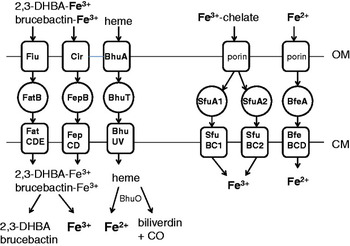
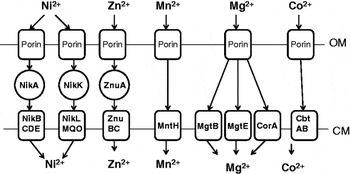
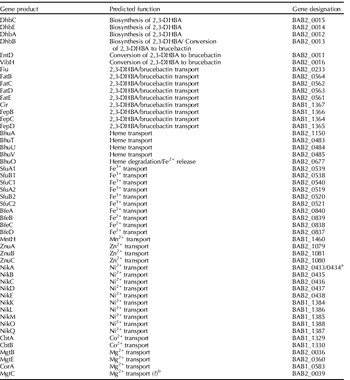
Figures 1 and 2 show the iron, manganese, zinc, nickel, cobalt, and magnesium transport systems predicted to be present in Brucella strains based on surveys of the publicly available genome sequences, and Table 1 lists the genes in the B. abortus 2308 genome sequence that encode the individual components of these systems. For a more general and comprehensive review of the genes involved in metal acquisition and homeostasis in Brucella strains, the reader is directed to a recently published book chapter (Roop et al., Reference Roop, Anderson, Ojeda, Martinson, Menscher, Martin, López-Goñi and O'Callaghan2011).
Iron transporters in Brucella. Abbreviations: OM, outer membrane; CM, cytoplasmic membrane.

Nickel, zinc, manganese, magnesium and cobalt transporters in Brucella. Abbreviations: OM, outer membrane; CM, cytoplasmic membrane. MgtC is not shown in this figure because its precise role in Mg2+ transport is not known (Günzel et al., Reference Günzel, Kucharski, Kehres, Romero and Maguire2006; Alix and Blanc-Potard, Reference Alix and Blanc-Potard2007).

Designations of the genes in the Brucella abortus 2308 genome sequence predicted to encode the individual components of the metal transporters depicted in Figs. 1 and 2.

a The region homologous to the nikA gene in other Brucella genome sequences is annotated as two adjacent pseudo-genes in the B. abortus 2308 genome sequence.
b The precise role of the MgtC in magnesium transport in bacteria is unknown.
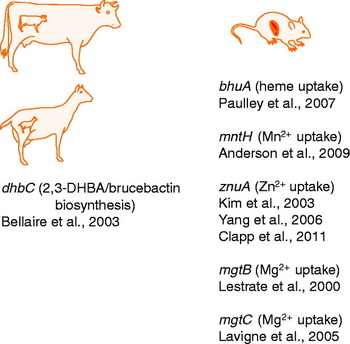
Iron, manganese, and magnesium are required for the optimal growth of Brucella strains in vitro (ZoBell and Meyer, Reference ZoBell and Meyer1932; McCullough et al., Reference McCullough, Mills, Herbst, Roessler and Brewer1947; Sanders et al., Reference Sanders, Higuchi and Brewer1953; Waring et al., Reference Waring, Elberg, Schneider and Green1953; Evenson and Gerhardt, Reference Evenson and Gerhardt1955; Gerhardt, Reference Gerhardt1958), and phenotypic evaluations of defined mutants has shown that in addition to these three metals, efficient transport of zinc is also required for the virulence of these strains in experimentally infected animals (Fig. 3). The following sections will further describe the Brucella metal acquisition genes that have been experimentally linked to virulence.
Brucella genes experimentally linked to virulence in pregnant ruminants and mice. Virulence in pregnant ruminants is measured by bacterial colonization of the dam and fetus and fetal pathology (e.g. abortion or the birth of a weak kid or calf). Virulence in mice is measured by chronic colonization of the spleen.

Iron transport
Owing to its chemical versatility, iron serves as a co-factor for a wide range of proteins (Crichton, Reference Crichton2009). In fact, to the author's knowledge, bacteria in the genera Lactobacillus and Borrelia are the only organisms that have been documented to be able to live without this metal (Archibald, Reference Archibald1983; Posey and Gherardini, Reference Posey and Gherardini2000). Presumably, a large and diverse group of Brucella proteins require iron for their activity. Some examples for which this requirement has been verified experimentally include catalase (Waring et al., Reference Waring, Elberg, Schneider and Green1953), aldolase (Gary et al., Reference Gary, Kupferberg and Graf1955), and CobG, an enzyme involved in cobalamin (vitamin B12) biosynthesis (Schroeder et al., Reference Schroeder, Lawrence, Biedendieck, Rose, Deery, Graham, McLean, Munro, Rigby and Warren2009).
Siderophores
Siderophores are low molecular weight chelators that microbes release into their external environment to capture iron (Raymond and Dertz, Reference Raymond, Dertz, Crosa, Mey and Payne2004). Brucella strains produce two catechol siderophores when exposed to iron deprivation – 2,3-dihydroxybenzoic acid (2,3-DHBA) and the 2,3-DHBA-based molecule brucebactin (López-Goñi et al., Reference López-Goñi, Moriyón and Neilands1992; González-Carreró et al., Reference González-Carreró, Sangari, Agüero and García-Lobo2002). Owing to its instability in the laboratory, the precise structure of brucebactin is currently unknown. The biochemical features of the enzymes predicted to be encoded by the genes responsible for the production of these siderophores, however, indicate that brucebactin is likely to be a monocatechol consisting of 2,3-DHBA linked to a polyamine or an amino acid (Bellaire et al., Reference Bellaire, Elzer, Hagius, Walker, Baldwin and Roop2003a). Experimental evidence suggests that siderophore production plays a critical role in the virulence of Brucella strains in the gravid ruminant reproductive tract, but is not required for the persistence of these strains in host macrophages. A B. abortus dhbC mutant, which produces neither 2,3-DHBA nor brucebactin, for instance, does not cause abortion in pregnant goats (Bellaire et al., Reference Bellaire, Baldwin, Elzer and Roop2000) or cattle (Bellaire et al., Reference Bellaire, Elzer, Hagius, Walker, Baldwin and Roop2003a) (Fig. 3). In contrast, this mutant and isogenic B. abortus mutants that produce 2,3-DHBA but cannot convert it to brucebactin display wild-type virulence in the mouse model of chronic infection (Bellaire et al., Reference Bellaire, Elzer, Baldwin and Roop1999; González-Carreró et al., Reference González-Carreró, Sangari, Agüero and García-Lobo2002; Parent et al., Reference Parent, Bellaire, Murphy, Roop, Elzer and Baldwin2002).
One possible explanation that has been put forth for the apparent differential requirement for siderophore production by B. abortus in the ruminant reproductive tract is linked to the capacity of this bacterium to utilize erythritol as its preferred carbon and energy source (Anderson and Smith, Reference Anderson and Smith1965; Meyer, Reference Meyer1967). Ruminant placental trophoblasts produce copious amounts of this four carbon sugar alcohol during the latter stages of pregnancy (Enright, Reference Enright, Nielsen and Duncan1990), and it has been proposed that the capacity of the brucellae to efficiently utilize this carbon source is linked to their virulence in pregnant ruminants (Smith et al., Reference Smith, Williams, Pearce, Keppie, Harris-Smith, Fitzgeorge and Witt1962). In vitro studies have shown that B. abortus 2308 displays a much greater need for iron when it is growing in the presence of erythritol than when it is growing with other readily utilizable carbon and energy sources (Bellaire et al., Reference Bellaire, Elzer, Baldwin and Roop2003b; Jain et al., Reference Jain, Rodriquez, Kimsawatde, Seleem, Boyle and Sriranganathan2011). Accordingly, it has been proposed that siderophore production plays an important role in supplying this strain with the iron it needs to fuel rapid and extensive bacterial replication in placental trophoblasts that leads to abortion (Bellaire et al., Reference Bellaire, Elzer, Baldwin and Roop2003b).
Not all B. abortus and B. melitensis strains produce catechol siderophores in response to iron deprivation in vitro (López-Goñi and Moriyón, Reference López-Goñi and Moriyón1995), and some of the siderophore biosynthesis genes in Brucella strains other than B. abortus 2308 are annotated as pseudo-genes in the genome sequences available in GenBank (Roop et al., Reference Roop, Anderson, Ojeda, Martinson, Menscher, Martin, López-Goñi and O'Callaghan2011). Thus, it will be important to better define the link between siderophore production and erythritol metabolism in Brucella strains and perform definitive experiments to determine whether or not this link is responsible for the extreme attenuation displayed by the B. abortus dhbC mutant in pregnant ruminants. Likewise, it will also be important to determine whether or not siderophore production is required for the virulence of other Brucella strains in a variety of pregnant and non-pregnant natural hosts.
Utilization of heme as an iron source
Degradation of senescent and damaged erythrocytes and the recycling of the iron released from these cells is one of the major functions of mammalian macrophages (Bratosin et al., Reference Bratosin, Mazurier, Tissier, Estaquier, Huart, Amiesen, Aminoff and Montreuil1998). Ruminant placental trophoblasts also ingest maternal erythrocytes and degrade these cells to provide a source of iron to the developing fetus (Anderson et al., Reference Anderson, Cheville and Meador1986). During both processes, a considerable amount of heme is released into these host phagocytes. Both B. abortus 2308 and B. melitensis 16M can use heme as an iron source in in vitro assays (Bellaire, Reference Bellaire2001; Danese, Reference Danese2001; Paulley et al., Reference Paulley, Anderson and Roop2007). Heme transport is mediated by the TonB-dependent outer membrane protein, BhuA, and a periplasmic binding protein-dependent ABC-type transporter comprised of the proteins BhuT, U and V (Fig. 1), and the genes encoding these proteins appear to be well-conserved among Brucella strains (Roop et al., Reference Roop, Anderson, Ojeda, Martinson, Menscher, Martin, López-Goñi and O'Callaghan2011). Brucella strains also possess a heme oxygenase (Puri and O'Brian, Reference Puri and O'Brian2008). Presumably, this enzyme, which we have given the designation BhuO (Roop et al., Reference Roop, Anderson, Ojeda, Martinson, Menscher, Martin, López-Goñi and O'Callaghan2011), allows the brucellae to use heme as an iron source by degrading the heme once it has been transported into the cytoplasm (Fig. 1). An isogenic bhuA mutant constructed from B. abortus 2308 displays significant attenuation in experimentally infected mice (Paulley et al., Reference Paulley, Anderson and Roop2007) (Fig. 3), suggesting that the capacity to transport heme represents a critical virulence determinant. Whether or not heme utilization plays an important role in the virulence of other Brucella strains, or in natural hosts, remains to be experimentally determined.
Due to its potential toxicity, the heme that is not incorporated into cellular proteins in mammalian cells is actively routed to the endoplasmic reticulum (ER) where it can be degraded by heme oxygenase (Taketani, Reference Taketani2005). Cell biology studies have shown that the membrane-bound vacuoles within which the brucellae replicate in host macrophages (known as the replicative Brucella-containing vacuoles or rBCVs) are derived through extensive interactions of phagosomes with the host cell ER (Celli et al., Reference Celli, de Chastellier, Franchini, Pizarro-Cerdá, Moreno and Gorvel2003). The rBCVs initially interact with the ER exit sites, and eventually fuse with the ER (Celli et al., Reference Celli, Salcedo and Gorvel2005). Extensive interactions of rBCVs with the host cell ER have also been observed microscopically in experimentally infected HeLa and Vero cells (Detilleux et al., Reference Detilleux, Deyoe and Cheville1990; Pizzaro-Cerdá et al., Reference Pizzaro-Cerdá, Méresse, Parton, van der Goot, Sola-Landa, López-Goñi, Moreno and Gorvel1998) and in placental trophoblasts from experimentally infected ruminants (Anderson et al., Reference Anderson, Cheville and Meador1986). Consequently, to gain a better understanding of the host–pathogen interactions in brucellosis, it will also be important to determine how the interactions of the rBCVs with the host cell ER influence the availability of heme as an iron source for Brucella strains during their intracellular residence in macrophages and placental trophoblasts.
Manganese transport
The ABC-type transporters exemplified by the SitABCD transporter of Salmonella and the proton-symporters of the MntH family are the most common types of manganese transporters that have been described in prokaryotes (Papp-Wallace and Maguire, Reference Papp-Wallace and Maguire2006). Many bacteria possess both of these types of manganese transporters, but an analysis of the currently available Brucella genome sequences and phenotypic analysis of a B. abortus mntH mutant suggest that Brucella strains utilize MntH (Fig. 2) as their sole high affinity Mn2+ transporter (Anderson et al., Reference Anderson, Paulley, Gaines, Valderas, Martin, Menscher, Brown, Burns and Roop2009). A B. abortus mntH mutant is extremely attenuated in the mouse model of chronic infection (Fig. 3). The basis for this attenuation is presently unknown. The B. abortus mntH mutant possesses reduced Mn superoxide dismutase activity compared to the parental strain, but an isogenic sodA mutant exhibits only modest attenuation in mice (Martin et al., Reference Martin, Baumgartner, Gee, Anderson and Roop2012), indicating that reduced SodA activity is not the basis for the severe attenuation exhibited by the mntH mutant. The B. abortus mntH mutant also exhibits aberrant expression of the genes encoding the Type IV secretion machinery (Anderson et al., Reference Anderson, Paulley, Gaines, Valderas, Martin, Menscher, Brown, Burns and Roop2009), and although the relationship between Mn2+ transport and virB expression has not been investigated, one plausible explanation for this relationship is that orthologs of the (p)ppGpp synthetase/hydrolase known as Rsh (Dozot et al., Reference Dozot, Boigegrain, Delrue, Hallez, Ouahrani-Bettache, Danese, Letesson, De Bolle and Köhler2006), which is required for virB expression as well as induction of the stringent response in Brucella, are manganese-dependent enzymes (Papp-Wallace and Maguire, Reference Papp-Wallace and Maguire2006).
Escherichia coli exhibits increased mntH expression in response to exposure to H2O2 (Anjem et al., Reference Anjem, Varghese and Imlay2009), and recent genetic and biochemical studies indicate that by elevating the intracellular ratio of Mn2+:Fe2+ this bacterium can substitute Mn2+ for Fe2+ in key metabolic enzymes such as ribulose-5-phosphate epimerase (Rpe), a major enzyme in the pentose-phosphate pathway (Sobota and Imlay, Reference Sobota and Imlay2011). Unlike Fe2+, Mn2+ does not participate in Fenton chemistry, hence this substitution protects Rpe from H2O2-mediated damage. Exposure of B. abortus 2308 to H2O2in vitro also results in increased mntH expression (E. Menscher, unpublished results), and an isogenic mntH mutant displays an increased sensitivity to exposure to H2O2 in in vitro assays compared to the parental 2308 strain (Anderson et al., Reference Anderson, Paulley, Gaines, Valderas, Martin, Menscher, Brown, Burns and Roop2009). Consequently, it will be important to determine whether Brucella strains have the same capacity to substitute Mn2+ for Fe2+ in metabolic enzymes as a mechanism for protecting these proteins from H2O2 mediated damage as has been demonstrated in E. coli.
Zinc transport
Zinc functions as a structural or enzymatic co-factor for a wide array of bacterial enzymes (Andreini et al., Reference Andreini, Banci, Bertini and Rosato2006). The Cu/Zn superoxide dismutase SodC represents an important virulence determinant for B. abortus 2308 (Tatum et al., Reference Tatum, Detilleux, Sacks and Halling1992; Gee et al., Reference Gee, Valderas, Kovach, Grippe, Robertson, Ng, Richardson, Winkler and Roop2005), and the Brucella carbonic anhydrases I and II and histidinol dehydrogenase are zinc-dependent enzymes that have been proposed to be good targets for the development of antimicrobials (Lopez et al., Reference Lopez, Köhler and Winum2012). Two separate groups have independently shown that the znuA gene is essential for the wild-type virulence of B. abortus and B. melitensis strains in experimentally infected mice (Kim et al., Reference Kim, Watanabe, Shirahata and Watarai2004, Yang et al., Reference Yang, Becker, Walters and Pascual2006; Clapp et al., Reference Clapp, Skyberg, Yang, Thornburg, Walters and Pascual2011) (Fig. 3). This gene encodes the periplasmic metal-binding component of an ABC-type high affinity zinc transporter, with ZnuB and ZnuC being the cytoplasmic permease and ATPase components of this transporter, respectively, (Fig. 2).
Magnesium transport
Magnesium is present in bacterial cells at high (i.e., mM) concentrations. It plays an important role in maintaining the structural integrity of ribosomes and cell membranes, and serves as a structural and enzymatic co-factor for a variety of cellular proteins (Moomaw and Maguire, Reference Moomaw and Maguire2008). Erythritol kinase, the enzyme that catalyzes the first step in the catabolism of erythritol in Brucella strains, for instance, requires Mg2+ for its activity (Sperry and Robertson, Reference Sperry and Robertson1975).
Homologs of two genes associated with magnesium transport in other bacteria have been genetically linked to virulence in Brucella strains. MgtB is a bacterial P-type ATPase (Fig. 2) and the activity of this protein as a magnesium transporter has been best described in Salmonella (Smith et al., Reference Smith, Tao and Maguire1993). A B. melitensis mgtB mutant was isolated during a screen of signature-tagged transposon mutants derived from B. melitensis 16M for attenuation in experimentally infected mice (Lestrate et al., Reference Lestrate, Delrue, Danese, Didembourg, Taminiau, Mertens, De Bolle, Tibor, Tang and Letesson2000). Interestingly, this mutant did not exhibit a growth defect when cultured in magnesium limited medium. This suggests that similar to other bacteria, and as depicted in Fig. 2, the brucellae possess multiple transport systems for magnesium. Although the precise role of MgtC in magnesium transport has not been established (Günzel et al., Reference Günzel, Kucharski, Kehres, Romero and Maguire2006; Alix and Blanc-Potard, Reference Alix and Blanc-Potard2007), a B. suis mgtC mutant does not grow well in a magnesium-restricted medium and displays significant attenuation in the murine macrophage-like J774 cell line (Lavigne et al., Reference Lavigne, O'Callaghan and Blanc-Potard2005). More importantly, this attenuation can be partially alleviated by supplementation of the cell culture medium with MgCl2.
Nickel transport
Urease is one of the few bacterial proteins that have been shown to require nickel as a co-factor (Li and Zamble, Reference Li and Zamble2009). This enzyme is essential for the virulence of B. abortus 2308 and B. suis 1330 in mice when these strains are introduced via the oral route, but not when they are administered via the peritoneal route (Bandara et al., Reference Bandara, Contreras, Contreras-Rodriguez, Martins, Dobrean, Poff-Reichow, Rajasekaran, Sriranganathan, Schurig and Boyle2007; Sangari et al., Reference Sangari, Seoane, Rodríguez, Agüero and García-Lobo2007). B. abortus and B. suis urease mutants also exhibit wild-type virulence in mammalian cell cultures. The proposed explanation for these findings is that urease assists the brucellae in resisting the very low pH they encounter during passage through the stomach and gastrointestinal tract after ingestion, but is not required for intracellular survival in eukaryotic cells. Two nickel transporters, NikABCDE and NikKMLQO (Fig. 2) have been identified in Brucella (Jubier-Maurin et al., Reference Jubier-Maurin, Rodrique, Ouahrani-Bettache, Layssac, Mandrand-Berthelos, Köhler and Liautard2001; Sangari et al., Reference Sangari, Cayón, Seoane and García-Lobo2010), but the role that these transporters play in virulence is unresolved. Although nikA expression is upregulated in B. suis 1330 during the intracellular replication of this strain in J774 cells, an isogenic nikA mutant derived from this strain displays wild-type virulence in the human monocytic cell line THP-1 (Jubier-Maurin et al., Reference Jubier-Maurin, Rodrique, Ouahrani-Bettache, Layssac, Mandrand-Berthelos, Köhler and Liautard2001). In order to gain a better understanding of the requirement for nickel transport by Brucella strains in the host, it will be important to assess the virulence properties of Brucella strains lacking either the NikABCDE or NikKMLQO transporter, or both, in cultured macrophages and in mice infected via both the intraperitoneal and oral routes. A comparison of the phenotypes displayed by these mutants with those exhibited by isogenic urease mutants in these experimental models will also be important for determining if Brucella strains require nickel for the proper function of enzymes other than urease.
Metalloregulators and metal storage/detoxification proteins p
As mentioned previously in this review, proteins that directly participate in metal homeostasis are essential for preventing toxicity due to the over-accumulation of these important micronutrients. Three transcriptional regulators that control the expression of Brucella metal acquisition genes have been characterized – Irr (Martínez et al., Reference Martínez, Ugalde and Almirón2005, Reference Martínez, Ugalde and Almirón2006), DhbR (Anderson et al., Reference Anderson, Paulley and Roop2008) and Mur (Menscher et al., Reference Menscher, Caswell, Anderson and Roop2012). Irr is an iron-responsive transcriptional regulator that controls iron acquisition and iron metabolism genes; DhbR is an AraC-type transcriptional regulator that activates the transcription of the siderophore biosynthesis genes in B. abortus 2308 in response to Fe3+-siderophore levels in the external environment; and Mur regulates the expression of the gene encoding the Mn2+ transporter MntH in response to cellular Mn2+ levels. Brucella strains also produce bacterioferritin (Bfr), a protein that stores and detoxifies intracellular iron (Denoel et al., Reference Denoel, Zygmunt, Weynants, Tibor, Lichtfouse, Briffeuil, Limet and Letesson1995; Almirón and Ugalde, Reference Almirón and Ugalde2010). To date, only Irr and Bfr have been examined for their roles in virulence. A B. abortus irr mutant is attenuated in the mouse model (Anderson et al., Reference Anderson, Paulley, Martinson, Gaines, Steele and Roop2011), but neither B. abortus nor B. melitensis bfr mutants exhibit attenuation in cultured human primary explant macrophages (Denoel et al., Reference Denoel, Crawford, Zygmunt, Tibor, Weynants, Godfroid, Hoover and Letesson1997), J774 or HeLa cells (Almirón and Ugalde, Reference Almirón and Ugalde2010), or experimentally infected mice (Denoel et al., Reference Denoel, Crawford, Zygmunt, Tibor, Weynants, Godfroid, Hoover and Letesson1997). The reader is pointed to a computational study described by Rodionov et al. (Reference Rodionov, Gelfand, Todd, Curson and Johnston2006) and a recent book chapter (Roop et al., Reference Roop, Anderson, Ojeda, Martinson, Menscher, Martin, López-Goñi and O'Callaghan2011) for a more comprehensive consideration of the Brucella genes involved in metal homeostasis.
Conclusion
It seems clear that Brucella strains are well equipped to deal with the metal deprivation they encounter in their mammalian hosts. However, the contributions of many of the metal transporters shown in Figs. 1 and 2 to virulence remain to be determined. Considering the conserved strategies the α-proteobacteria employ to establish and maintain chronic infections in their eukaryotic hosts (Batut et al., Reference Batut, Andersson and O'Callaghan2004), it will be particularly interesting to determine what role CbtAB-mediated Co2+ transport plays in the virulence of Brucella strains. Cobalt-containing enzymes play a critical role in the capacity of Sinorhizobium meliloti, a close phylogenetic relative of the brucellae, to maintain a symbiotic relationship with its eukaryotic plant host (Taga and Walker, Reference Taga and Walker2010).
A final point that bears consideration is that the vast majority of the studies that have evaluated the contributions of Brucella metal acquisition to virulence have been performed in the mouse model of chronic infection, which is used as a measure of the ability of these strains to survive and replicate in host macrophages. But as the studies with B. abortus siderophore biosynthesis mutants well demonstrate (Bellaire et al., Reference Bellaire, Elzer, Baldwin and Roop1999, Reference Bellaire, Baldwin, Elzer and Roop2000, Reference Bellaire, Elzer, Hagius, Walker, Baldwin and Roop2003a; González-Carreró et al., Reference González-Carreró, Sangari, Agüero and García-Lobo2002; Parent et al., Reference Parent, Bellaire, Murphy, Roop, Elzer and Baldwin2002), the results obtained with the mouse model may not always predict how a mutant will behave in the natural host, especially in pregnant ruminants. The sources of iron (e.g. Fe2+, Fe3+, and heme or heme-containing proteins) and other metals available and the metabolic requirements of the intracellular brucellae for these metals may differ depending upon whether or not these bacteria are residing in macrophages or placental trophoblasts, and pregnancy may have an impact on these differences. Consequently, it will be important in future studies to assess the importance of metal acquisition genes to virulence in a variety of pregnant and non-pregnant natural and experimental hosts.
Acknowledgments
Research on Brucella metal acquisition systems in the laboratory of R.M.R. was funded by grants from the National Institutes of Allergy and Infectious Diseases (AI-63516) and the United States Department of Agriculture's Competitive Research Grants Program (95-01995, 98-02620 and 02-02215). The author is extremely grateful to the individuals, present and past, who have worked on these projects.